


1 Chronicles 13:3
- וְנָסֵבָּהve·na·Se·bahand let us bring roundH5437Conj-w ¦ V-Hiphil-Imperf-1cpVerb Hiphil Imperfect 1st Plural common genderוְandנָסֵבָּהlet us bring round
- אֶת'et<obj.>H853DirObjMParticle Object Indicator
- אֲרוֹן'a·Ron[the] ark ofH727N-mscNoun Singular Masculine Construct
- אֱלֹהֵינוּ'e·lo·Hei·nuour GodH430N-mpc ¦ 1cpNoun Plural Masculine ConstructאֱלֹהֵיGodנוּour
- אֵלֵינוּ'e·Lei·nuto usH413Prep ¦ 1cpPrepositionאֵלֵיtoנוּus
- כִּיkiforH3588PrtParticle Conditional
- לֹאlo'notH3808NegParticle Negative
- דְרַשְׁנֻהוּde·rash·Nu·huwe sought itH1875V-Qal-Perf-1cp ¦ 3msVerb Qal Perfect 1st Plural common genderדְרַשְׁנֻwe soughtהוּit
- בִּימֵיbi·Meiin [the] days ofH3117Prep-b ¦ N-mpcNoun Plural Masculine Constructבִּinימֵי[the] days of
- שָׁאוּלsha·'UlSaulH7586N-proper-mNoun Proper Masculine
English is a literal word-by-word gloss of the Hebrew, not the KJV's wording. Why?
This is the original text the KJV's translators worked from — each Hebrew word with its own literal English meaning in this verse, prepared by scholars at Tyndale House, Cambridge. The KJV translates whole sentences, not word by word, so its wording differs: one Hebrew word can become several English words, and the KJV may choose “the LORD” where the gloss reads “Yahweh”. Both are faithful — they answer different questions. For the KJV's own rendering, switch to the KJV text.
Details
See on the biblical-era map
Study this verse
Public-domain commentary
Matthew Henry
From his Commentary on the Whole Bible. Henry comments on passages, not single verses — this entry covers 1 Chronicles 13:1–8. His three-level outline is real structure in the source text, so it is rendered as structure.
Here is, I. David's pious proposal to bring up the ark of God to Jerusalem, that the royal city might be the holy city, Ch1 13:1-3. This part of the story we had not in Samuel. We may observe in this proposal,
1.That as soon as David was well seated on his throne he had thoughts concerning the ark of God: Let us bring the ark to us, Ch1 13:3. Two things he aimed at herein: - (1.) To do honour to God, by showing respect to his ark, the token of his presence. As soon as he had power in his hand he would use it for the advancement and encouragement of religion. Note, It ought to be the first and great care of those that are enriched and preferred to honour God with their honours, and to serve him, and the interests of his kingdom among men, with their wealth and power. David said not, "What pompous thing shall I do now?" or, "What pleasant thing?" but, "What pious thing?" (2.) To have the comfort and benefit of that sacred oracle. "Let us bring it to us, not only that we may be a credit to it, but that it may be a blessing to us." Those that honour God profit themselves. Note, It is the wisdom of those who are setting out in the world to take God's ark with them, to make his oracles their counsellors and his laws their rule. Those are likely to proceed in the favour of God who thus begin in the fear of God.
2.That he consulted with the leaders of the people about it, Ch1 13:1. Though it was without doubt a very good work, and being king, he had the authority to command the doing of it, yet he chose rather to do it by consultation, (1.) That he might show respect to the great men of the kingdom and put honour upon them. Though they made him king, yet he would not rule with a high hand. He did not say, "We will and command, and it is our royal pleasure, that you do so and so; and we will be obeyed," but, "If it seem good to you, and you think that the motion comes from the Lord our God, let us send out orders for this purpose." No prince that is wise will covet to be absolute. The people's allegiance is best secured by taking their concurrence in their representatives. Happy then art thou, O Britain! (2.). That he might be advised by them in the manner of doing it, whether just now, whether publicly. David was a very intelligent man himself, and yet consulted with his captains; for in the multitude of counsellors there is safety. It is wisdom to make use of the wisdom of others. (3.) That, they joining in it, it might pass the better for a national act and so might procure a national blessing.
3.That he would have all the people summoned to attend on this occasion, both for the honour of the ark and for the people's satisfaction and edification, Ch1 13:2. Observe,
(1.)He calls the common people brethren, which bespeaks his humility and condescension (notwithstanding his advancement), and the tender concern he had for them. Thus our Lord Jesus is not ashamed to call his people brethren, Heb 2:11.
(2.)He speaks of the people as a remnant that had escaped: Our brethren that are left in all the land of Israel. They had been under scattering providences. Their wars with the Philistines, and with the house of Saul, had wasted the country and cut off many. We now hope to see an end of these troubles. Let those that are left be quickened by late judgments, and present mercies, to seek unto God.
(3.)He takes care that the priests and Levites especially should be summoned to attend the ark; for it was their province in a particular manner. Thus Christian magistrates should stir up ministers to do their duty when they see them remiss.
4.That all this is upon supposition that it is of the Lord their God. "Though it should seem good to you and me, yet if it be not of the Lord our God, we will not do it." What ever we undertake, this must be our enquiry, "Is it of the Lord? Is it agreeable to his mind? Can we approve ourselves to him in it? May we expect that he will own us?"
5.That thus it was requisite they should amend what has been amiss in the last reign, and, as it were, atone for their neglect: "For we enquired not at it in the days of Saul, and this was the reason why things went so ill with us: let that original error be amended, and then we may hope to see our affairs in a better posture." Observe, David makes no peevish reflections upon Saul. He does not say, "Saul never cared for the ark, at least in the latter end of this reign;" but, in general, We enquired not at it, making himself with others guilty of this neglect. It better becomes us to judge ourselves than others. Humble good men lament their own share in national guilt, and take shame to themselves, Dan 9:5, etc.
II.The people's ready agreement to this proposal (Ch1 13:4):
The thing was right in the eyes of all the people. Nobody could say to the contrary, but that it was a very good work and very seasonable; so that it was resolved, nemine contradicente - unanimously, that they would do so. Those that prudently proposed a good work, and lead in it, will perhaps find a more ready concurrence in it than they expected. Great men know not what a great deal of good they are capable of doing by their influence on others.
III.The solemnity of bringing up the ark, Ch1 13:5, etc., which we read before, Sa2 6:1, etc. Here therefore we shall only observe,
1.That it is worth while to travel far to attend the ark of God. They came out of all parts of the country, from the river of Egypt, the utmost part south, to the entering of Hemath, which lay furthest north, (Ch1 13:5), to grace this solemnity.
2.That we have reason greatly to rejoice in the revival of neglected ordinances and the return of the tokens of God's presence. When the light of religion shines out of obscurity, when it is openly and freely professed, is brought into reputation, and countenanced by princes and great ones, it is such a happy omen to a people as is worthy to be welcomed with all possible expressions of joy.
3.When, after long disuse, ordinances come to be revived, it is too common for even wise and good men to make some mistakes. Who would have thought that David would commit such an error as this, to carry the ark upon a cart? Ch1 13:7. because the Philistines so carried it, and a special providence drove the cart (Sa1 6:12), he thought they might do so too. But we must walk by rule, not by example when it varies from the rule, no, not even by those examples which Providence has owned.
Continue studying 1 Chronicles 13:3 across the web’s major study libraries — every link below opens this exact verse, chapter, or book on the destination site.
Read & Compare
 BibleGatewayThis verse in more than 200 translations and 70 languages.
 Bible.comThe YouVersion reader — hundreds of translations, reading plans, and highlights.
 ESV.orgCrossway's official English Standard Version reader.
 NET BibleThe NET translation with 60,000+ translators' notes on every rendering decision.
 STEP BibleTyndale House's free study tool — original text, vocabulary, and scholarly resources.
 BibliaLogos Bible Software's free web reader.
 USCCBThe New American Bible (Revised Edition) with the U.S. bishops' study notes.
Commentaries
 BibleHub CommentariesDozens of classic commentaries on this verse, gathered on one page.
 StudyLightMore than 100 commentary sets — the largest collection on the web.
 BibleRefPlain-English commentary on what this verse means, verse by verse.
 Enduring WordDavid Guzik's free commentary on this chapter, widely used by Bible teachers.
 Bible Study ToolsVerse commentary alongside Greek and Hebrew study aids.
Original Language & Research
- BibleHub InterlinearThe verse word by word — original language, transliteration, and English.
- BibleHub LexiconEvery word's original-language definition and Strong's entry.
 Blue Letter BibleDeep-study tools — Strong's numbers, concordance, and word studies.
 SefariaThe Hebrew text with Rashi and centuries of Jewish commentary.
Sermons, Hymns & Audio


TrulyRandomVerse is not affiliated with these sites and doesn’t control their content. They’re linked because they’re genuinely useful.
Summary
1 Chronicles 13:3 captures King David's decisive declaration to the assembly of Israel, articulating his fervent resolve to restore the Ark of God to its rightful and central place within the nation's spiritual and political life. This pivotal statement not only highlights David's immediate priority upon consolidating his reign but also serves as a poignant indictment of the spiritual neglect that characterized the preceding era of King Saul, during which the nation largely failed to seek divine counsel and presence through the Ark, thereby underscoring David's foundational commitment to re-establish a kingdom profoundly rooted in devotion and obedience to the Lord.
Context
ShowHideLiterary Context
This verse is strategically placed early in David's reign over a united Israel, immediately following his anointing as king in 1 Chronicles 11 and the establishment of Jerusalem as his capital (2 Samuel 5). The Chronicler, writing for a post-exilic audience, emphasizes David's spiritual priorities from the outset. Rather than focusing on military expansion or political consolidation as his first major act, David's primary initiative is the spiritual restoration of the nation by bringing the Ark of the Covenant to Jerusalem. This decision, made in consultation with all the leaders of Israel (1 Chronicles 13:1-2), immediately signals David's commitment to God's centrality, presenting a stark contrast to the spiritual apathy and self-reliance that marked Saul's era. The subsequent narrative in 1 Chronicles 13:5-14 details the initial, flawed attempt to move the Ark and its tragic consequences, which ultimately led to a more reverent and successful transfer later in 1 Chronicles 15, further highlighting the importance of proper worship.
Historical & Cultural Context
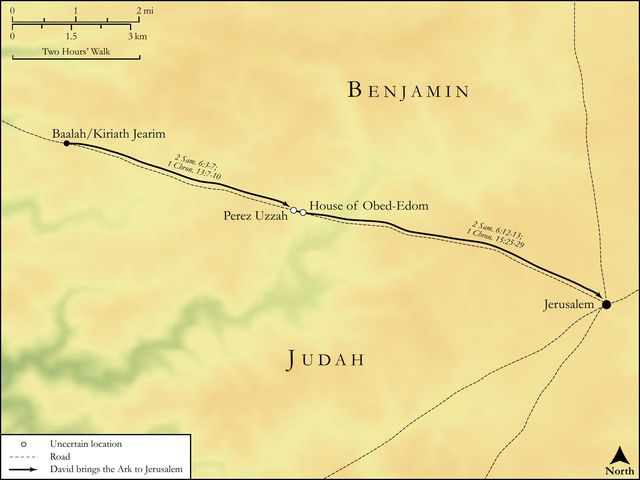
The Ark of the Covenant was the most sacred object in ancient Israel, embodying God's tangible presence, His covenant fidelity, and serving as the focal point for national worship and divine communication (Exodus 25:22). Its significance stemmed from its contents—the tablets of the Law, a pot of manna, and Aaron's rod—and its function as the "footstool" of God's throne, where He communed with His people. After its capture by the Philistines during the time of Eli (1 Samuel 4), it was eventually returned to Israelite territory but remained in relative obscurity at the house of Abinadab in Kiriath-Jearim for approximately seventy years (1 Samuel 7:1-2). During Saul's reign, the Ark was largely neglected, residing in this remote location, which symbolized a period of profound spiritual decline where seeking God's direct guidance through His established means was no longer a national priority. David's initiative represents a deliberate and conscious effort to reverse this spiritual downturn, re-establish the covenant relationship, and unify the nation under God's sovereign rule.
Key Themes
ShowHideThis verse powerfully introduces and reinforces several key themes that are central to the Chronicler's narrative and David's reign. Firstly, it emphatically highlights the prioritization of God's presence and worship as the foundational principle for national well-being and righteous leadership, presenting a direct counterpoint to Saul's self-reliant and ultimately tragic rule. Secondly, the verse explicitly addresses the spiritual neglect during Saul's reign, emphasizing the failure to "enquire at" the Ark, which symbolized a broader disinterest in seeking God's will and guidance. This sets the stage for David's reign as a period of spiritual revival and restoration, where the nation is called back to its covenant obligations. Thirdly, David's initiative to bring the Ark back was also a strategic and unifying move, aiming to unify the nation under a common spiritual purpose centered on the Lord, reinforcing the idea that true national cohesion stems from a shared commitment to God. Finally, the emphasis on seeking God's will through the Ark underscores the critical importance of divine counsel in all aspects of life, particularly in leadership, a theme that resonates throughout David's story, as seen in his frequent prayers and inquiries to the Lord before battles (2 Samuel 5:19).
Exposition and Analysis
ShowHideKey Word Analysis
ShowHideThis term (H727) refers to the Ark of the Covenant, the sacred chest containing the tablets of the Ten Commandments, a pot of manna, and Aaron's rod. It was the holiest object in Israel, representing God's throne on earth and His covenant presence among His people. Its prolonged neglect during Saul's reign signified a deep spiritual malaise and a departure from the nation's covenant identity. David's passionate initiative to bring it back symbolized a profound desire to restore God to the central place in the nation's life, governance, and worship, marking a pivotal shift towards spiritual renewal.
This plural noun (H430), used here with the definite article, refers specifically to the supreme God, Yahweh, the God of Israel. The phrase "the ark of our God" underscores the covenantal relationship between Yahweh and His people, and David's recognition that the Ark is not merely a national artifact but the tangible symbol of the sovereign Lord who guides and protects Israel. David's emphasis on "our God" highlights a communal ownership and responsibility towards the divine presence, contrasting with the individualistic and self-serving approach of Saul.
This verb (H1875) means "to seek," "to consult," "to inquire of," often carrying the connotation of seeking divine guidance or revelation, or even worship. In the context of the Ark, it specifically refers to the practice of seeking God's counsel, typically through the high priest who would minister before the Ark, sometimes utilizing the Urim and Thummim (Numbers 27:21). The phrase "we enquired not at it" signifies a cessation of this vital spiritual practice, indicating a period where the nation, under Saul, operated without consistent divine consultation, relying instead on human wisdom, political expediency, and military strength, leading to disastrous consequences.
Verse Breakdown
ShowHide"And let us bring again the ark of our God to us"
This opening clause reveals David's proactive, decisive, and communal approach to spiritual leadership. The use of the plural pronoun "us" indicates a shared responsibility and a desire for national participation and consensus in this sacred endeavor, contrasting with Saul's more autocratic rule. "Bring again" implies a restoration, a return to a former, more righteous state where the Ark, symbolizing God's active presence and guidance, was central to Israel's identity and function. It underscores David's vision for a kingdom truly governed by God, making the divine presence the cornerstone of national life.
"for we enquired not at it in the days of Saul"
This explanatory clause provides the crucial motivation and theological justification for David's initiative. It serves as a sharp, yet understated, indictment of Saul's reign, which was characterized by profound spiritual negligence and a failure to prioritize God's will. The omission to "enquire at" the Ark signifies a broader abandonment of seeking God's direction and relying on His wisdom. This spiritual vacuum and the resulting reliance on human strength ultimately led to Saul's tragic downfall and highlights the critical need for the spiritual reorientation that David sought to achieve by re-centering the nation on God's presence and counsel.
Literary Devices
ShowHideThe verse employs several significant literary devices to convey its powerful message. Most prominently, there is a clear Contrast between the spiritual posture of David's reign and that of Saul's. David's proactive desire to restore the Ark and seek God's counsel stands in stark opposition to Saul's neglect and self-reliance, which ultimately led to his demise. The Ark itself functions as powerful Symbolism, representing God's tangible presence, His covenant fidelity, and the ultimate source of divine authority and guidance for Israel. Its neglect under Saul symbolizes the nation's spiritual drift and disfavor, while its proposed return under David symbolizes a move towards spiritual revival, national unity, and alignment with God's will. Furthermore, David's statement, though declarative, carries the weight of a Rhetorical Exhortation, inviting the entire assembly to participate in this crucial act of national repentance and spiritual reorientation, emphasizing shared responsibility and a collective return to God.
Theological and Thematic Connections
ShowHide1 Chronicles 13:3 is a profound theological statement about the absolute necessity of prioritizing God's presence and actively seeking His will in the life of a leader and a nation. David's immediate focus on the Ark, rather than on military or political matters, demonstrates a deep theological understanding that true strength, legitimate authority, and lasting success derive solely from a vibrant, obedient relationship with God. The "enquiring" at the Ark was not a mere ritual but a profound means of intimate communion and receiving divine direction, reflecting a core biblical principle that God desires to guide His people in all their ways. The spiritual neglect during Saul's reign serves as a cautionary tale, illustrating the severe spiritual and practical consequences of operating independently of God's counsel and presence. David's initiative, therefore, is a theological declaration that God's active presence and guidance are indispensable for a righteous and flourishing kingdom, a truth that transcends the Old Testament context and applies universally to all who seek to live under God's sovereignty.
Reflection and Application
ShowHideDavid's initiative to bring back the Ark serves as a powerful and enduring model for believers today, illuminating the path to a life centered on God. Just as the Ark symbolized God's presence and the means of seeking His counsel for ancient Israel, so too are we called to prioritize God's presence and actively seek His will in our individual lives, our families, and our communities. In a world brimming with distractions, competing priorities, and the allure of self-sufficiency, it is perilously easy to neglect our spiritual disciplines—prayer, diligent Bible study, corporate worship, and faithful fellowship—which are our contemporary "means of enquiring" of God. The spiritual decline during Saul's reign, marked by a failure to consult God and a reliance on human wisdom, stands as a stark warning against spiritual complacency, apathy, and self-reliance. We are reminded that operating without intentional reliance on God's guidance invariably leads to missteps, moral compromise, and ultimately, spiritual barrenness. David's example challenges us to make God's presence the central pillar of our existence, ensuring that seeking His wisdom and direction is not an afterthought or a last resort, but the primary driver of our decisions, our relationships, and our overall life direction, fostering a vibrant and fruitful walk with Him.
Questions for Reflection
ShowHideFAQ
ShowHideWhy was the Ark neglected during Saul's reign?
ShowHideThe neglect of the Ark during Saul's reign was largely a symptom of his profound spiritual decline and persistent disobedience. Unlike David, who frequently sought God's counsel before significant actions (1 Samuel 23:2), Saul increasingly relied on his own judgment, even resorting to forbidden practices like consulting a medium (1 Samuel 28:7). The Ark, which symbolized God's direct presence and authority, was left in an obscure location at Kiriath-Jearim for decades, indicating that seeking God's direct guidance through His established means was not a priority for Saul or the nation during his rule. This reflected a broader spiritual apathy and a significant shift from a theocentric kingdom, where God was supreme, to one increasingly driven by human leadership and political expediency, ultimately leading to Saul's tragic end.
What was the significance of "enquiring at the Ark"?
ShowHide"Enquiring at the Ark" was a vital spiritual practice that signified seeking direct divine counsel and guidance for the nation of Israel. While the Ark itself was not consulted directly, it was the focal point of God's tangible presence, specifically the mercy seat above it, from which God promised to speak to His people (Exodus 25:22). Typically, the high priest would minister before the Ark, often utilizing the Urim and Thummim (sacred lots) to discern God's will on critical matters of national importance, such as going to war, making major judicial decisions, or seeking direction during times of crisis (Numbers 27:21). The cessation of this practice during Saul's time highlighted a profound spiritual disconnect, a failure to rely on God's sovereign direction, and a dangerous move towards self-reliance for the affairs of Israel.
Christ-Centered Fulfillment
ShowHideThe narrative of David's earnest desire to bring the Ark of God back to the center of Israel's life finds its ultimate and glorious fulfillment in the person and work of Jesus Christ. The Ark, as the preeminent symbol of God's tangible presence among His people, powerfully foreshadowed the incarnate Son of God, Jesus, who is Emmanuel—"God with us" (Matthew 1:23). Where the Ark was a physical object confined to a specific place, Jesus is the very embodiment of God's glory and the perfect dwelling of God among humanity (John 1:14). David's lament that Israel "enquired not at it" during Saul's days speaks to humanity's innate tendency to neglect God and His counsel. However, in Christ, we are given direct, unhindered, and perpetual access to God. Jesus is our ultimate High Priest, through whom we can now "draw near with confidence to the throne of grace, so that we may receive mercy and find grace to help in time of need" (Hebrews 4:16). Furthermore, the New Covenant establishes a new reality where God's presence is not confined to an Ark or a physical temple, but the Holy Spirit dwells within every believer (1 Corinthians 6:19), making each Christian a living temple of God. Thus, David's longing for God's presence is fully realized in Christ, who not only brings God to us but also empowers us to live in constant communion with Him through the Spirit, fulfilling the deepest spiritual desires of the human heart.