


1 Chronicles 13:4
- וַיֹּאמְרוּvai·yo·me·Ruand they saidH559Conj-w ¦ V-Qal-ConsecImperf-3mpVerb Qal Consecutive Imperfect 3rd Plural Masculineוַandיֹּאמְרוּthey said
- כָלkholallH3605N-mscNoun Singular Masculine Construct
- הַקָּהָלha·ka·Halthe assemblyH6951Art ¦ N-msNoun Singular Masculine Absoluteהַtheקָּהָלassembly
- לַעֲשׂוֹתla·'a·Sotto doH6213Prep-l ¦ V-Qal-InfVerb Qal Infinitive Constructלַtoעֲשׂוֹתdo
- כֵּןKenthusH3651AdvAdverb
- כִּיkiforH3588PrtParticle Conditional
- יָשַׁרya·Sharit was pleasingH3474V-Qal-Perf-3msVerb Qal Perfect 3rd Singular Masculine
- הַדָּבָרha·da·Varthe matterH1697Art ¦ N-msNoun Singular Masculine Absoluteהַtheדָּבָרmatter
- בְּעֵינֵיbe·'ei·Neiin [the] eyes ofH5869Prep-b ¦ N-fdcNoun Dual Feminine Constructבְּinעֵינֵי[the] eyes of
- כָלkholallH3605N-mscNoun Singular Masculine Construct
- הָעָםha·'Amthe peopleH5971Art ¦ N-msNoun Singular Masculine Absoluteהָtheעָםpeople
English is a literal word-by-word gloss of the Hebrew, not the KJV's wording. Why?
This is the original text the KJV's translators worked from — each Hebrew word with its own literal English meaning in this verse, prepared by scholars at Tyndale House, Cambridge. The KJV translates whole sentences, not word by word, so its wording differs: one Hebrew word can become several English words, and the KJV may choose “the LORD” where the gloss reads “Yahweh”. Both are faithful — they answer different questions. For the KJV's own rendering, switch to the KJV text.
Details
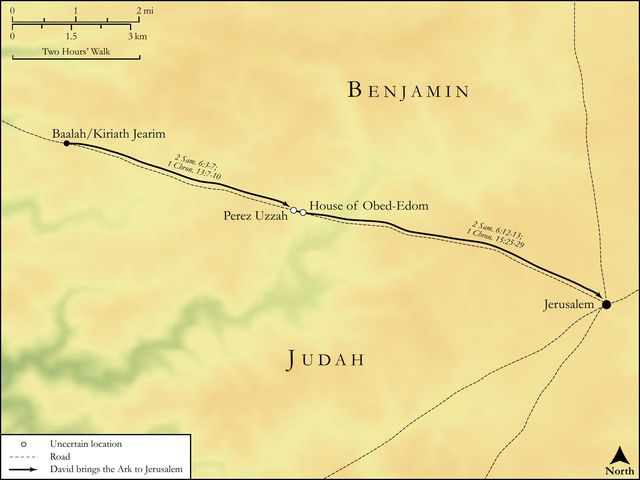
See on the biblical-era map
Study this verse
Public-domain commentary
Matthew Henry
From his Commentary on the Whole Bible. Henry comments on passages, not single verses — this entry covers 1 Chronicles 13:1–8. His three-level outline is real structure in the source text, so it is rendered as structure.
Here is, I. David's pious proposal to bring up the ark of God to Jerusalem, that the royal city might be the holy city, Ch1 13:1-3. This part of the story we had not in Samuel. We may observe in this proposal,
1.That as soon as David was well seated on his throne he had thoughts concerning the ark of God: Let us bring the ark to us, Ch1 13:3. Two things he aimed at herein: - (1.) To do honour to God, by showing respect to his ark, the token of his presence. As soon as he had power in his hand he would use it for the advancement and encouragement of religion. Note, It ought to be the first and great care of those that are enriched and preferred to honour God with their honours, and to serve him, and the interests of his kingdom among men, with their wealth and power. David said not, "What pompous thing shall I do now?" or, "What pleasant thing?" but, "What pious thing?" (2.) To have the comfort and benefit of that sacred oracle. "Let us bring it to us, not only that we may be a credit to it, but that it may be a blessing to us." Those that honour God profit themselves. Note, It is the wisdom of those who are setting out in the world to take God's ark with them, to make his oracles their counsellors and his laws their rule. Those are likely to proceed in the favour of God who thus begin in the fear of God.
2.That he consulted with the leaders of the people about it, Ch1 13:1. Though it was without doubt a very good work, and being king, he had the authority to command the doing of it, yet he chose rather to do it by consultation, (1.) That he might show respect to the great men of the kingdom and put honour upon them. Though they made him king, yet he would not rule with a high hand. He did not say, "We will and command, and it is our royal pleasure, that you do so and so; and we will be obeyed," but, "If it seem good to you, and you think that the motion comes from the Lord our God, let us send out orders for this purpose." No prince that is wise will covet to be absolute. The people's allegiance is best secured by taking their concurrence in their representatives. Happy then art thou, O Britain! (2.). That he might be advised by them in the manner of doing it, whether just now, whether publicly. David was a very intelligent man himself, and yet consulted with his captains; for in the multitude of counsellors there is safety. It is wisdom to make use of the wisdom of others. (3.) That, they joining in it, it might pass the better for a national act and so might procure a national blessing.
3.That he would have all the people summoned to attend on this occasion, both for the honour of the ark and for the people's satisfaction and edification, Ch1 13:2. Observe,
(1.)He calls the common people brethren, which bespeaks his humility and condescension (notwithstanding his advancement), and the tender concern he had for them. Thus our Lord Jesus is not ashamed to call his people brethren, Heb 2:11.
(2.)He speaks of the people as a remnant that had escaped: Our brethren that are left in all the land of Israel. They had been under scattering providences. Their wars with the Philistines, and with the house of Saul, had wasted the country and cut off many. We now hope to see an end of these troubles. Let those that are left be quickened by late judgments, and present mercies, to seek unto God.
(3.)He takes care that the priests and Levites especially should be summoned to attend the ark; for it was their province in a particular manner. Thus Christian magistrates should stir up ministers to do their duty when they see them remiss.
4.That all this is upon supposition that it is of the Lord their God. "Though it should seem good to you and me, yet if it be not of the Lord our God, we will not do it." What ever we undertake, this must be our enquiry, "Is it of the Lord? Is it agreeable to his mind? Can we approve ourselves to him in it? May we expect that he will own us?"
5.That thus it was requisite they should amend what has been amiss in the last reign, and, as it were, atone for their neglect: "For we enquired not at it in the days of Saul, and this was the reason why things went so ill with us: let that original error be amended, and then we may hope to see our affairs in a better posture." Observe, David makes no peevish reflections upon Saul. He does not say, "Saul never cared for the ark, at least in the latter end of this reign;" but, in general, We enquired not at it, making himself with others guilty of this neglect. It better becomes us to judge ourselves than others. Humble good men lament their own share in national guilt, and take shame to themselves, Dan 9:5, etc.
II.The people's ready agreement to this proposal (Ch1 13:4):
The thing was right in the eyes of all the people. Nobody could say to the contrary, but that it was a very good work and very seasonable; so that it was resolved, nemine contradicente - unanimously, that they would do so. Those that prudently proposed a good work, and lead in it, will perhaps find a more ready concurrence in it than they expected. Great men know not what a great deal of good they are capable of doing by their influence on others.
III.The solemnity of bringing up the ark, Ch1 13:5, etc., which we read before, Sa2 6:1, etc. Here therefore we shall only observe,
1.That it is worth while to travel far to attend the ark of God. They came out of all parts of the country, from the river of Egypt, the utmost part south, to the entering of Hemath, which lay furthest north, (Ch1 13:5), to grace this solemnity.
2.That we have reason greatly to rejoice in the revival of neglected ordinances and the return of the tokens of God's presence. When the light of religion shines out of obscurity, when it is openly and freely professed, is brought into reputation, and countenanced by princes and great ones, it is such a happy omen to a people as is worthy to be welcomed with all possible expressions of joy.
3.When, after long disuse, ordinances come to be revived, it is too common for even wise and good men to make some mistakes. Who would have thought that David would commit such an error as this, to carry the ark upon a cart? Ch1 13:7. because the Philistines so carried it, and a special providence drove the cart (Sa1 6:12), he thought they might do so too. But we must walk by rule, not by example when it varies from the rule, no, not even by those examples which Providence has owned.
Continue studying 1 Chronicles 13:4 across the web’s major study libraries — every link below opens this exact verse, chapter, or book on the destination site.
Read & Compare
 BibleGatewayThis verse in more than 200 translations and 70 languages.
 Bible.comThe YouVersion reader — hundreds of translations, reading plans, and highlights.
 ESV.orgCrossway's official English Standard Version reader.
 NET BibleThe NET translation with 60,000+ translators' notes on every rendering decision.
 STEP BibleTyndale House's free study tool — original text, vocabulary, and scholarly resources.
 BibliaLogos Bible Software's free web reader.
 USCCBThe New American Bible (Revised Edition) with the U.S. bishops' study notes.
Commentaries
 BibleHub CommentariesDozens of classic commentaries on this verse, gathered on one page.
 StudyLightMore than 100 commentary sets — the largest collection on the web.
 BibleRefPlain-English commentary on what this verse means, verse by verse.
 Enduring WordDavid Guzik's free commentary on this chapter, widely used by Bible teachers.
 Bible Study ToolsVerse commentary alongside Greek and Hebrew study aids.
Original Language & Research
- BibleHub InterlinearThe verse word by word — original language, transliteration, and English.
- BibleHub LexiconEvery word's original-language definition and Strong's entry.
 Blue Letter BibleDeep-study tools — Strong's numbers, concordance, and word studies.
 SefariaThe Hebrew text with Rashi and centuries of Jewish commentary.
Sermons, Hymns & Audio


TrulyRandomVerse is not affiliated with these sites and doesn’t control their content. They’re linked because they’re genuinely useful.
Summary
1 Chronicles 13:4 records the enthusiastic and unanimous affirmation of the entire Israelite assembly for King David's proposal to retrieve the Ark of the Covenant from Kirjath-jearim and bring it to Jerusalem. This verse underscores a profound moment of national unity and a widespread conviction that this sacred undertaking was inherently proper and pleasing in the collective judgment of all the people, thereby setting the stage for the subsequent events in the unfolding narrative.
Context
ShowHideLiterary Context
This verse is strategically placed at a crucial juncture in David's early reign, immediately following his consultation with the military commanders and his direct appeal to the entire assembly of Israel to bring back the Ark of God, which had been neglected since the days of Saul (1 Chronicles 13:1-3). The unanimous agreement expressed in verse 4 serves as the immediate and collective response to David's initiative, demonstrating widespread buy-in and shared zeal before the actual journey commences. This initial outpouring of popular enthusiasm, however, stands in stark contrast to the tragic events that soon follow in 1 Chronicles 13:9-10, where Uzzah is struck down for touching the Ark. This juxtaposition subtly reveals a critical flaw in their methodology, despite their seemingly righteous intentions, highlighting a central tension in the chapter.
Historical & Cultural Context
Historically, the Ark of the Covenant was the preeminent symbol of God's tangible presence among His people, serving as His earthly throne and the sacred repository of the Law. Its prolonged neglect during Saul's reign signified a period of spiritual decline and national disunity. David's fervent desire to relocate the Ark to Jerusalem was not merely a pragmatic political maneuver to establish his capital as the nation's spiritual epicenter but also a deeply felt, genuine attempt to restore proper worship and reinstate God's rightful place at the heart of Israelite life. Culturally, achieving unanimous consensus among the people and their leaders was highly valued in ancient Israel, often perceived as a divine affirmation of a wise and righteous decision. However, this cultural value was always understood to be subordinate to divine command, especially concerning the handling of sacred objects and rituals, as meticulously detailed in the Mosaic Law regarding the Ark's transport (e.g., Numbers 4).
Key Themes
ShowHideThe verse powerfully introduces and illustrates the theme of unity and collective zeal for God's presence, as "all the congregation" readily and enthusiastically agrees to David's proposal. It also subtly but significantly introduces the theme of human perception versus divine standard, encapsulated in the phrase "the thing was right in the eyes of all the people." This highlights a crucial theological tension: what appears good, logical, or even spiritually beneficial from a human perspective may not, in fact, align with God's specific instructions or His perfect, holy will. This tension is foundational to the broader narrative of 1 Chronicles 13, foreshadowing the tragic consequences that can arise from well-intentioned but disobedient actions. Furthermore, the Ark itself is a central theme, symbolizing God's active presence and the indispensable importance of reverent, prescribed worship.
Exposition and Analysis
ShowHideKey Word Analysis
ShowHideThis term (H6951) refers to an assembled community or gathering of people, often implying a divinely convoked assembly. In this context, "all the congregation" emphasizes the broad, representative, and unified nature of the agreement, encompassing all segments of Israelite society, from the leadership to the common people. The use of "all" underscores the complete unanimity, signifying a powerful collective will and shared purpose.
This adjective (H3474) derives from a root meaning "to be straight or even." Figuratively, it denotes something that is morally or practically correct, upright, or pleasing. Here, it reflects the human judgment that David's proposal was appropriate, beneficial, and in alignment with their understanding of what God desired. However, the biblical narrative frequently contrasts what is "right in one's own eyes" (Judges 17:6) with what is truly right in God's sight, which necessitates adherence to His revealed will and commands.
As part of the idiom "in the eyes of" (H5869), this word signifies perception, opinion, or judgment. The phrase "right in the eyes of all the people" explicitly states that the unanimous approval stemmed from a human assessment of the situation. It indicates that the decision was based on what seemed good or proper from the observers' perspective, rather than necessarily from a prior, rigorous consultation of divine law or specific revelation regarding the Ark's transport.
Verse Breakdown
ShowHide"And all the congregation said that they would do so"
This clause highlights the immediate, enthusiastic, and universal consent of the entire assembly of Israel. It signifies a remarkable moment of national unity and shared purpose among the Israelites, indicating their readiness and eagerness to participate in David's initiative to bring the Ark back. The collective voice underscores the widespread desire for spiritual restoration and the centralization of worship.
"for the thing was right in the eyes of all the people"
This explanatory clause provides the rationale for their unanimous agreement. It reveals that the decision was based on a human perception of what was fitting, proper, and good. While the goal of bringing the Ark back to Jerusalem was indeed righteous and God-honoring, this phrase subtly yet significantly hints that the method chosen was determined by human consensus and perceived correctness, rather than strict adherence to God's specific, divinely revealed commands for handling the sacred Ark. This distinction between good intentions and precise obedience would prove to be profoundly consequential.
Literary Devices
ShowHideThe verse employs several significant literary devices that enrich its meaning and foreshadow future events. Foreshadowing is prominently featured, as the seemingly positive and unanimous agreement, based on human perception ("right in the eyes of all the people"), subtly hints at the impending tragedy involving Uzzah. This popular approval, while seemingly good and well-intentioned, will prove insufficient to navigate the sacred and precise protocols of God. There is also a powerful element of Irony, as the very "rightness" perceived by the people leads to a method of transport (on a new cart, rather than carried by Levites) that is ultimately "wrong" in God's eyes and results in divine judgment. Finally, the verse sets up a profound Contrast between human wisdom and divine wisdom, and between good intentions versus the indispensable requirement of precise obedience to God's revealed will.
Theological and Thematic Connections
ShowHide1 Chronicles 13:4 serves as a potent reminder that while unity, enthusiasm, and good intentions for God's work are commendable and often desirable, they must always be tempered and guided by diligent adherence to God's revealed will and specific instructions. The popular consensus that "the thing was right" highlights a common human tendency to rely on what seems logical, good, or widely accepted, rather than rigorously consulting divine precepts. This narrative underscores the profound theological principle that God's ways are infinitely higher than human ways, and His holiness demands reverence and obedience according to His terms, not ours. Good intentions alone, without the discipline of obedience, can lead to tragic consequences, as powerfully demonstrated by Uzzah's death later in the chapter.
Reflection and Application
ShowHideThis verse offers a profound and enduring lesson for believers today: our zeal and unity in serving God, while vital and commendable, must always be coupled with a humble and diligent pursuit of God's specific will as revealed in His Word. It is insufficient for an endeavor merely to "seem right in our eyes" or to gain widespread popular approval. True spiritual success, divine blessing, and genuine faithfulness come from aligning our intentions, our chosen methods, and our actions with God's established commands and timeless principles. We are called to seek not merely what is expedient, popular, or even seemingly efficient from a human perspective, but what is truly pleasing and perfectly aligned with God's eyes, which often requires a deeper study of Scripture, a greater reliance on the Holy Spirit's guidance, and a willingness to submit to divine authority over human consensus. This passage challenges us to move beyond mere good intentions to a life of faithful and precise obedience, ensuring that our worship and service are not only passionate but also precisely aligned with God's holy truth.
Questions for Reflection
ShowHideFAQ
ShowHideWhat was David's proposal that everyone agreed to?
ShowHideDavid's proposal, detailed in 1 Chronicles 13:1-3, was to bring the Ark of God back to Jerusalem. The Ark had been neglected and remained at Kirjath-jearim since the Philistines had returned it years earlier (1 Samuel 7:1-2). David recognized the Ark's immense spiritual significance as the symbol of God's tangible presence and sought to restore it to a central place in Israelite worship and national life, thereby consolidating his kingdom both politically and spiritually.
Why was the Ark of the Covenant so important to the Israelites?
ShowHideThe Ark of the Covenant was the most sacred object in Israel, representing the very presence and throne of God among His people. It contained the tablets of the Law, Aaron's rod that budded, and a pot of manna, symbolizing God's covenant, His divine authority, and His faithful provision. The mercy seat on top of the Ark was where God's presence was manifested and where atonement for sins was made on the Day of Atonement. Its presence signified God's dwelling among them, guiding, protecting, and blessing them, making its return to Jerusalem a profoundly significant spiritual and national event for David and the people.
If everyone agreed that bringing the Ark was "right," what went wrong later?
ShowHideWhile the goal of bringing the Ark back to Jerusalem was undoubtedly righteous and God-honoring, the method chosen was not in accordance with God's specific, divinely revealed instructions. The Mosaic Law stipulated that the Ark was to be carried on poles by the Levites, specifically the Kohathites, who were consecrated for this sacred duty (Numbers 4:15). However, David and the people chose to transport it on a new cart, similar to how the Philistines had returned it (1 Samuel 6:7-8). This deviation from divine protocol, despite good intentions and overwhelming popular approval, led to Uzzah's death when he touched the Ark to steady it (1 Chronicles 13:9-10). This tragic event powerfully illustrates that God cares not only about the "what" (the intention or goal) but also the "how" (the method and obedience) of our worship and service.
Christ-Centered Fulfillment
ShowHideThe narrative of David's initial attempt to bring the Ark, with its foundation in human-centered "rightness" leading to tragic consequences, powerfully foreshadows the ultimate fulfillment of God's presence and the perfect, divinely ordained way to approach Him in Jesus Christ. The Ark of the Covenant, with its mercy seat, symbolized God's dwelling among His people and the sacred place where atonement was made. Yet, it was a physical object, handled with strict, often deadly, protocols, and its presence was limited. In Christ, we find the true and ultimate dwelling of God among humanity, for He is the incarnate "God with us" (Matthew 1:23). Unlike the Ark, which required careful handling according to human effort and prescribed rituals, Christ perfectly fulfilled all of God's righteous demands and became the Lamb of God who takes away the sin of the world (John 1:29). Through His perfect, once-for-all sacrifice on the cross, He established a new and living way to the Father, a way not based on human consensus, well-intentioned but flawed methods, or adherence to the Law, but on His perfect obedience and atoning work (Hebrews 10:19-20). The "rightness" that was merely "in the eyes of all the people" finds its true and complete expression in the perfect righteousness of Christ, which is graciously imputed to all who believe, granting them direct access to God's presence not through ritualistic adherence or human effort, but through grace by faith (Ephesians 2:8-9).