


1 Chronicles 13:5
- וַיַּקְהֵלvai·yak·Heland he called togetherH6950Conj-w ¦ V-Hiphil-ConsecImperf-3msVerb Hiphil Consecutive Imperfect 3rd Singular Masculineוַandיַּקְהֵלhe called together
- דָּוִידda·VidDavidH1732N-proper-mNoun Proper Masculine
- אֶת'et<obj.>H853DirObjMParticle Object Indicator
- כָּלkolallH3605N-mscNoun Singular Masculine Construct
- יִשְׂרָאֵלYis·ra·'ElIsraelH3478N-properNoun Proper Location
- מִןminfromH4480PrepPreposition
- שִׁיחוֹרshi·ChorShihorH7883N-properNoun Proper Location
- מִצְרַיִםmitz·Ra·yimof EgyptH4714N-properNoun Proper Location
- וְעַדve·'adand toH5704Conj-w ¦ PrepPrepositionוְandעַדto
- לְבוֹאle·Vo'LeboH935V-Qal-InfVerb Qal Infinitive Construct
- חֲמָתcha·MatHamathH2574N-properNoun Proper Location
- לְהָבִיאle·ha·Vi'to bringH935Prep-l ¦ V-Hiphil-InfVerb Hiphil Infinitive Constructלְtoהָבִיאbring
- אֶת'et<obj.>H853DirObjMParticle Object Indicator
- אֲרוֹן'a·Ron[the] ark ofH727N-mscNoun Singular Masculine Construct
- הָאֱלֹהִיםha·'E·lo·Him<the> GodH430Art ¦ N-mpNoun Plural Masculine Absoluteהָ<the>אֱלֹהִיםGod
- מִקִּרְיַתmi·kir·Yatfrom KiriathH7157Prep-m ¦ N-properNoun Proper LocationמִfromקִּרְיַתKiriath
- יְעָרִיםye·'a·RimJearimH7157N-properNoun Proper Location
English is a literal word-by-word gloss of the Hebrew, not the KJV's wording. Why?
This is the original text the KJV's translators worked from — each Hebrew word with its own literal English meaning in this verse, prepared by scholars at Tyndale House, Cambridge. The KJV translates whole sentences, not word by word, so its wording differs: one Hebrew word can become several English words, and the KJV may choose “the LORD” where the gloss reads “Yahweh”. Both are faithful — they answer different questions. For the KJV's own rendering, switch to the KJV text.
Details
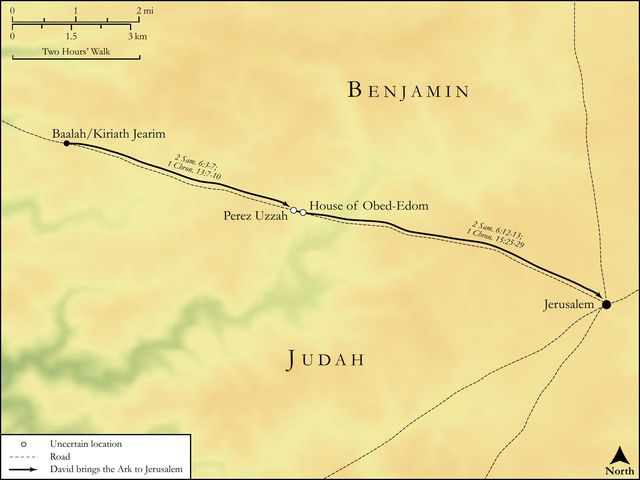
See on the biblical-era map
Study this verse
Public-domain commentary
Matthew Henry
From his Commentary on the Whole Bible. Henry comments on passages, not single verses — this entry covers 1 Chronicles 13:1–8. His three-level outline is real structure in the source text, so it is rendered as structure.
Here is, I. David's pious proposal to bring up the ark of God to Jerusalem, that the royal city might be the holy city, Ch1 13:1-3. This part of the story we had not in Samuel. We may observe in this proposal,
1.That as soon as David was well seated on his throne he had thoughts concerning the ark of God: Let us bring the ark to us, Ch1 13:3. Two things he aimed at herein: - (1.) To do honour to God, by showing respect to his ark, the token of his presence. As soon as he had power in his hand he would use it for the advancement and encouragement of religion. Note, It ought to be the first and great care of those that are enriched and preferred to honour God with their honours, and to serve him, and the interests of his kingdom among men, with their wealth and power. David said not, "What pompous thing shall I do now?" or, "What pleasant thing?" but, "What pious thing?" (2.) To have the comfort and benefit of that sacred oracle. "Let us bring it to us, not only that we may be a credit to it, but that it may be a blessing to us." Those that honour God profit themselves. Note, It is the wisdom of those who are setting out in the world to take God's ark with them, to make his oracles their counsellors and his laws their rule. Those are likely to proceed in the favour of God who thus begin in the fear of God.
2.That he consulted with the leaders of the people about it, Ch1 13:1. Though it was without doubt a very good work, and being king, he had the authority to command the doing of it, yet he chose rather to do it by consultation, (1.) That he might show respect to the great men of the kingdom and put honour upon them. Though they made him king, yet he would not rule with a high hand. He did not say, "We will and command, and it is our royal pleasure, that you do so and so; and we will be obeyed," but, "If it seem good to you, and you think that the motion comes from the Lord our God, let us send out orders for this purpose." No prince that is wise will covet to be absolute. The people's allegiance is best secured by taking their concurrence in their representatives. Happy then art thou, O Britain! (2.). That he might be advised by them in the manner of doing it, whether just now, whether publicly. David was a very intelligent man himself, and yet consulted with his captains; for in the multitude of counsellors there is safety. It is wisdom to make use of the wisdom of others. (3.) That, they joining in it, it might pass the better for a national act and so might procure a national blessing.
3.That he would have all the people summoned to attend on this occasion, both for the honour of the ark and for the people's satisfaction and edification, Ch1 13:2. Observe,
(1.)He calls the common people brethren, which bespeaks his humility and condescension (notwithstanding his advancement), and the tender concern he had for them. Thus our Lord Jesus is not ashamed to call his people brethren, Heb 2:11.
(2.)He speaks of the people as a remnant that had escaped: Our brethren that are left in all the land of Israel. They had been under scattering providences. Their wars with the Philistines, and with the house of Saul, had wasted the country and cut off many. We now hope to see an end of these troubles. Let those that are left be quickened by late judgments, and present mercies, to seek unto God.
(3.)He takes care that the priests and Levites especially should be summoned to attend the ark; for it was their province in a particular manner. Thus Christian magistrates should stir up ministers to do their duty when they see them remiss.
4.That all this is upon supposition that it is of the Lord their God. "Though it should seem good to you and me, yet if it be not of the Lord our God, we will not do it." What ever we undertake, this must be our enquiry, "Is it of the Lord? Is it agreeable to his mind? Can we approve ourselves to him in it? May we expect that he will own us?"
5.That thus it was requisite they should amend what has been amiss in the last reign, and, as it were, atone for their neglect: "For we enquired not at it in the days of Saul, and this was the reason why things went so ill with us: let that original error be amended, and then we may hope to see our affairs in a better posture." Observe, David makes no peevish reflections upon Saul. He does not say, "Saul never cared for the ark, at least in the latter end of this reign;" but, in general, We enquired not at it, making himself with others guilty of this neglect. It better becomes us to judge ourselves than others. Humble good men lament their own share in national guilt, and take shame to themselves, Dan 9:5, etc.
II.The people's ready agreement to this proposal (Ch1 13:4):
The thing was right in the eyes of all the people. Nobody could say to the contrary, but that it was a very good work and very seasonable; so that it was resolved, nemine contradicente - unanimously, that they would do so. Those that prudently proposed a good work, and lead in it, will perhaps find a more ready concurrence in it than they expected. Great men know not what a great deal of good they are capable of doing by their influence on others.
III.The solemnity of bringing up the ark, Ch1 13:5, etc., which we read before, Sa2 6:1, etc. Here therefore we shall only observe,
1.That it is worth while to travel far to attend the ark of God. They came out of all parts of the country, from the river of Egypt, the utmost part south, to the entering of Hemath, which lay furthest north, (Ch1 13:5), to grace this solemnity.
2.That we have reason greatly to rejoice in the revival of neglected ordinances and the return of the tokens of God's presence. When the light of religion shines out of obscurity, when it is openly and freely professed, is brought into reputation, and countenanced by princes and great ones, it is such a happy omen to a people as is worthy to be welcomed with all possible expressions of joy.
3.When, after long disuse, ordinances come to be revived, it is too common for even wise and good men to make some mistakes. Who would have thought that David would commit such an error as this, to carry the ark upon a cart? Ch1 13:7. because the Philistines so carried it, and a special providence drove the cart (Sa1 6:12), he thought they might do so too. But we must walk by rule, not by example when it varies from the rule, no, not even by those examples which Providence has owned.
Continue studying 1 Chronicles 13:5 across the web’s major study libraries — every link below opens this exact verse, chapter, or book on the destination site.
Read & Compare
 BibleGatewayThis verse in more than 200 translations and 70 languages.
 Bible.comThe YouVersion reader — hundreds of translations, reading plans, and highlights.
 ESV.orgCrossway's official English Standard Version reader.
 NET BibleThe NET translation with 60,000+ translators' notes on every rendering decision.
 STEP BibleTyndale House's free study tool — original text, vocabulary, and scholarly resources.
 BibliaLogos Bible Software's free web reader.
 USCCBThe New American Bible (Revised Edition) with the U.S. bishops' study notes.
Commentaries
 BibleHub CommentariesDozens of classic commentaries on this verse, gathered on one page.
 StudyLightMore than 100 commentary sets — the largest collection on the web.
 BibleRefPlain-English commentary on what this verse means, verse by verse.
 Enduring WordDavid Guzik's free commentary on this chapter, widely used by Bible teachers.
 Bible Study ToolsVerse commentary alongside Greek and Hebrew study aids.
Original Language & Research
- BibleHub InterlinearThe verse word by word — original language, transliteration, and English.
- BibleHub LexiconEvery word's original-language definition and Strong's entry.
 Blue Letter BibleDeep-study tools — Strong's numbers, concordance, and word studies.
 SefariaThe Hebrew text with Rashi and centuries of Jewish commentary.
Sermons, Hymns & Audio


TrulyRandomVerse is not affiliated with these sites and doesn’t control their content. They’re linked because they’re genuinely useful.
Summary
1 Chronicles 13:5 vividly portrays King David's pivotal initiative to unify "all Israel" for the sacred purpose of relocating the Ark of God. This verse marks a significant turning point in Israel's spiritual life, as David, having recently established his reign, prioritizes bringing the tangible symbol of God's presence and covenant from its long-standing, somewhat neglected residence in Kirjathjearim to a more central and honored place within the newly unified kingdom. The gathering, spanning the entire geographical breadth of Israel, underscores David's commitment to centering the nation's identity and worship on God.
Context
ShowHideLiterary Context
This verse is strategically placed early in David's reign over all Israel, immediately following his anointing as king and the capture of Jerusalem, which he established as his capital (1 Chronicles 11). Having secured his political and military base, David's next major undertaking is not further conquest but a profound spiritual act: the relocation of the Ark of the Covenant to Jerusalem. This sequence highlights David's theological priorities, demonstrating his immediate commitment to centering the nation's life and worship on God's presence. The subsequent narrative in 1 Chronicles 13 details the initial, ill-fated attempt to move the Ark, culminating in Uzzah's death. This tragic event serves to underscore the Ark's immense holiness and the critical necessity of adhering to God's precise instructions for its handling, setting the stage for the later, successful, and properly executed transfer in 1 Chronicles 15.
Historical & Cultural Context
For many decades, since its return from Philistine captivity, the Ark had resided in relative obscurity at Kirjathjearim, specifically in the house of Abinadab (1 Samuel 7:1-2). This period reflects a significant decline in centralized worship and a general neglect of the Ark's proper place within Israel's national and religious life, particularly during Saul's reign. David's decision to move the Ark was therefore a monumental act of religious restoration and national reunification, signaling a renewed commitment to the covenant with Yahweh. The phrase "from Shihor of Egypt even unto the entering of Hemath" was a well-known biblical idiom used to denote the full geographical extent of the promised land of Israel, from its traditional southwestern border near the Nile Delta to its northernmost reach in modern-day Syria. This emphasizes the comprehensive, national scope of David's undertaking, involving all tribes and regions in a unified act of worship and spiritual renewal.
Key Themes
ShowHideThis verse powerfully contributes to several overarching themes prominent in Chronicles and the broader biblical narrative. Firstly, it underscores the Centrality of God's Presence in the life of Israel; David's primary concern is to bring the symbol of God's dwelling place to the heart of his kingdom, signifying that true national strength and blessing derive from God's favor. Secondly, it highlights National Unity and Restoration, as "all Israel" is gathered for a common, sacred purpose, signifying a unified kingdom under David's leadership seeking to restore proper worship and covenant fidelity. Thirdly, it speaks to Davidic Kingship, portraying David as a pious and divinely appointed leader who prioritizes God's glory and the spiritual well-being of his nation, setting him apart from his predecessor Saul and establishing a model for righteous rule. Finally, the narrative initiated by this verse, concerning the Ark's movement, profoundly emphasizes the Holiness and Significance of the Ark, not merely as an artifact but as the tangible representation of God's covenant and law, demanding reverence and strict adherence to divine instruction, a lesson painfully learned in the subsequent verses of 1 Chronicles 13.
Exposition and Analysis
ShowHideKey Word Analysis
ShowHideThis primitive root signifies "to convoke" or "to assemble (selves) (together)." It implies a deliberate, organized convocation of the entire nation, often for a significant religious or national purpose. In this context, it underscores David's active and unifying leadership, bringing together the diverse tribes of Israel for a shared, sacred endeavor, emphasizing the collective and unified nature of the effort to honor God.
This term, also transliterated as Shihor or Sihor, probably means "dark" or "turbid," referring to a stream or wadi of Egypt. It likely designates the "brook of Egypt," a wadi that served as the traditional southwestern boundary of the land of Canaan/Israel. Its mention here, coupled with Hemath, forms a merism, defining the full geographical scope of the land of Israel.
Derived from a root meaning "walled," Chamath was a significant city-state located in modern-day Syria, far to the north of Israel. "The entering of Hemath" refers to the gateway or approach to its territory, marking the northernmost extent of the ideal Israelite territory. Its inclusion, alongside Shihor, underscores the comprehensive nature of the national gathering, encompassing all parts of the promised land under David's unified rule.
Verse Breakdown
ShowHide"So David gathered all Israel together"
This opening clause establishes David's active and decisive leadership as king. The phrase "all Israel" emphasizes the comprehensive nature of the assembly, signifying that this was a unified national effort, reflecting the newly consolidated kingdom under David's rule and his desire for a shared spiritual purpose that transcended tribal divisions.
"from Shihor of Egypt even unto the entering of Hemath"
This geographical phrase provides the full scope of the national gathering. It is a common biblical idiom that uses two extreme points to denote the entire breadth of the land of Israel, from its southernmost boundary near Egypt to its northernmost limits. This detail underscores the immense scale of the assembly and the widespread national support for David's spiritual objective, demonstrating his authority and the people's willingness to participate.
"to bring the ark of God"
This is the explicit and central purpose of the grand assembly. The "ark of God" was the most sacred object in Israel, symbolizing God's manifest presence, His covenant with Israel, and His divine authority. David's immediate focus on relocating it signifies his deep reverence for God and his intention to place God at the very center of his kingdom and national life, making a profound theological statement about the source of Israel's strength and identity.
"from Kirjathjearim"
This specifies the Ark's long-term, somewhat isolated dwelling place. For many decades, the Ark had remained in this town, indicating a period of neglect regarding its proper ceremonial place and a decline in centralized worship. Moving it from Kirjathjearim was thus a symbolic act of spiritual renewal and restoration, bringing God's presence back into the heart of the nation's worship and governance, signifying a new era under David's leadership.
Literary Devices
ShowHideThe verse employs several literary techniques to convey its profound significance. The most prominent is Merism, seen in the phrase "from Shihor of Egypt even unto the entering of Hemath," which uses two geographical extremes to represent the entire land of Israel. This device effectively communicates the comprehensive and unified nature of the national gathering, emphasizing the breadth of David's influence and the widespread participation of the people. Additionally, the Ark of God functions as a powerful Symbol, representing God's manifest presence, His covenant with Israel, and His divine authority. David's action of gathering the nation to bring the Ark also serves as Foreshadowing, hinting at the eventual establishment of Jerusalem as the central place of worship and the future construction of the Temple, where God's presence would ultimately reside in a more permanent structure. Furthermore, the narrative structure of Chronicles itself, by placing this spiritual initiative so early in David's reign, emphasizes David's Pious Characterization, portraying him as a king who prioritizes God above all else and seeks to restore proper worship in the land.
Theological and Thematic Connections
ShowHideDavid's earnest desire to bring the Ark of God to a central place in Israel's national life reflects a profound theological truth: the indispensable importance of God's manifest presence among His people. Throughout biblical history, God has consistently sought to dwell with humanity, from His walk in the Garden of Eden to His presence in the Tabernacle and Temple. The Ark, with its unique holiness and representation of the divine, served as a tangible reminder of God's covenant faithfulness and His active involvement in Israel's affairs. David's initiative was not merely a logistical move but a theological statement, acknowledging that the true strength, identity, and blessing of the kingdom lay in God's favor and abiding presence. This act of national unity centered on God's presence foreshadows the ultimate gathering of God's people around His Son, Jesus Christ, who is the ultimate dwelling place of God.
Reflection and Application
ShowHide1 Chronicles 13:5 serves as a powerful and enduring reminder for believers today about the centrality of God's presence in our individual lives, our families, and our communities. Just as David prioritized bringing the Ark—the sacred symbol of God's dwelling—to the heart of his kingdom, we are called to prioritize God's Spirit and His Word in our daily existence. This involves intentionally creating space for worship, prayer, and obedience, ensuring that God is not relegated to the periphery but is truly at the center of our decisions, aspirations, and relationships. The national unity seen in David's grand gathering challenges us to seek spiritual unity within the body of Christ, working together across diverse backgrounds and perspectives to advance God's kingdom and make His transformative presence known in a fractured world. It also highlights the profound importance of leadership, whether in the church, home, or workplace, that genuinely seeks to honor God and foster spiritual devotion among those it influences, recognizing that true flourishing comes from God's blessing.
Questions for Reflection
ShowHideFAQ
ShowHideWhy was the Ark at Kirjathjearim for so long before David moved it?
ShowHideAfter its capture by the Philistines and subsequent return to Israel, the Ark was placed in the house of Abinadab in Kirjathjearim, where it remained for approximately 70 years, spanning the period of the judges and much of Saul's reign. This prolonged stay reflects a significant period of spiritual decline, national disunity, and a lack of initiative from Israel's leadership to properly restore the Ark to a central place of worship and reverence. It wasn't until David, a king after God's own heart, took the throne and unified the kingdom that this significant spiritual oversight was addressed, as detailed in 1 Samuel 7:1-2. David's action was a deliberate move to restore God's rightful place at the heart of the nation.
What is the significance of the geographical boundaries mentioned ("from Shihor of Egypt even unto the entering of Hemath")?
ShowHideThis phrase is a common biblical idiom used to describe the full, ideal territorial extent of the land of Israel, from its traditional southwestern border near the Nile Delta ("Shihor of Egypt") to its northernmost reach near the city of Hamath in modern-day Syria ("the entering of Hemath"). Its inclusion in this verse emphasizes that David's endeavor to bring the Ark was a truly national effort, involving the participation and unity of all the tribes across the entire breadth of the promised land. It underscores the widespread support and the comprehensive nature of this spiritual undertaking, signifying that the entire unified nation was engaged in this sacred act of worship and restoration under David's leadership.
Christ-Centered Fulfillment
ShowHideWhile 1 Chronicles 13:5 describes David's earnest desire to bring God's symbolic presence (the Ark) into the heart of Israel, this act finds its ultimate and perfect fulfillment in Jesus Christ. The Ark, with its mercy seat and the tablets of the covenant, was a powerful shadow of the true dwelling place of God among humanity. In Christ, God Himself tabernacled among us, full of grace and truth (John 1:14). Jesus is the ultimate Temple, the very embodiment of God's presence, as He declared, "Destroy this temple, and in three days I will raise it up," speaking of His own body (John 2:19-21). David's gathering of "all Israel" to unite around the Ark foreshadows the grand gathering of all nations—both Jew and Gentile—who are drawn to Christ and united in Him, becoming a spiritual house where God dwells by His Spirit (Ephesians 2:19-22). Through Christ's atoning sacrifice on the cross, the veil separating humanity from God's holy presence was torn from top to bottom (Matthew 27:51), granting believers direct, confident access to the Father through His blood (Hebrews 10:19-22). Thus, David's longing for God's presence in the midst of His people is fully realized in the person and work of Jesus, who not only brings God's presence to us but also brings us into God's very presence, making us part of His eternal dwelling.