


1 Samuel 7:1
- וַיָּבֹאוּvai·ya·Vo·'uand they cameH935Conj-w ¦ V-Qal-ConsecImperf-3mpVerb Qal Consecutive Imperfect 3rd Plural Masculineוַandיָּבֹאוּthey came
- אַנְשֵׁי'an·Shei[the] people ofH582N-mpcNoun Plural Masculine Construct
- קִרְיַתkir·YatKiriathH7157N-properNoun Proper Location
- יְעָרִיםye·'a·RimJearimH7157N-properNoun Proper Location
- וַיַּעֲלוּvai·ya·'a·Luand they took upH5927Conj-w ¦ V-Hiphil-ConsecImperf-3mpVerb Hiphil Consecutive Imperfect 3rd Plural Masculineוַandיַּעֲלוּthey took up
- אֶת'et<obj.>H853DirObjMParticle Object Indicator
- אֲרוֹן'a·Ron[the] ark ofH727N-mscNoun Singular Masculine Construct
- יְהוָהYah·wehYahwehH3068N-properNoun Proper Title
- וַיָּבִאוּvai·ya·Vi·'uand they broughtH935Conj-w ¦ V-Hiphil-ConsecImperf-3mpVerb Hiphil Consecutive Imperfect 3rd Plural Masculineוַandיָּבִאוּthey brought
- אֹתוֹ'o·To<obj.> itH853DirObjM ¦ 3msParticle Object Indicatorאֹת<obj.>וֹit
- אֶל'eltoH413PrepPreposition
- בֵּיתbeit[the] house ofH1004N-mscNoun Singular Masculine Construct
- אֲבִינָדָב'a·vi·na·DavAbinadabH41N-proper-mNoun Proper Masculine
- בַּגִּבְעָהba·giv·'Ahon the hillH1389Prep-b ¦ N-fsNoun Singular Feminine Absoluteבַּon theגִּבְעָהhill
- וְאֶתve·'Etand <obj.>H853Conj-w ¦ DirObjMParticle Object Indicatorוְandאֶת<obj.>
- אֶלְעָזָר'el·'a·ZarEleazarH499N-proper-mNoun Proper Masculine
- בְּנוֹbe·Nohis sonH1121N-msc ¦ 3msNoun Singular Masculine Constructבְּנsonוֹhis
- קִדְּשׁוּki·de·Shuthey consecratedH6942V-Piel-Perf-3cpVerb Piel Perfect 3rd Plural common gender
- לִשְׁמֹרlish·Morto keepH8104Prep-l ¦ V-Qal-InfVerb Qal Infinitive Constructלִtoשְׁמֹרkeep
- אֶת'et<obj.>H853DirObjMParticle Object Indicator
- אֲרוֹן'a·Ron[the] ark ofH727N-mscNoun Singular Masculine Construct
- יְהוָהYah·wehYahwehH3068N-properNoun Proper Title
English is a literal word-by-word gloss of the Hebrew, not the KJV's wording. Why?
This is the original text the KJV's translators worked from — each Hebrew word with its own literal English meaning in this verse, prepared by scholars at Tyndale House, Cambridge. The KJV translates whole sentences, not word by word, so its wording differs: one Hebrew word can become several English words, and the KJV may choose “the LORD” where the gloss reads “Yahweh”. Both are faithful — they answer different questions. For the KJV's own rendering, switch to the KJV text.
Details
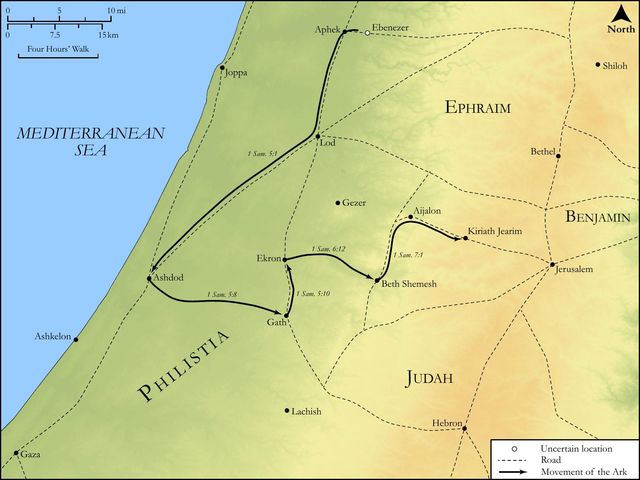
See on the biblical-era map
Study this verse
Public-domain commentary
Matthew Henry
From his Commentary on the Whole Bible. Henry comments on passages, not single verses — this entry covers 1 Samuel 7:1–2. His four-level outline is real structure in the source text, so it is rendered as structure.
Here we must attend the ark to Kirjath-jearim, and then leave it there, to hear not a word more of it except once (Sa1 14:18), till David fetched it thence, about forty years after, Ch1 13:6.
I.We are very willing to attend it thither, for the men of Beth-shemesh have by their own folly made that a burden which might have been a blessing; and gladly would we see it among those to whom it will be a savour of life unto life, for in every place where it has been of late it has been a savour of death unto death. Now,
1.The men of Kirjath-jearim cheerfully bring it among them, Sa1 7:1. They came, at the first word, and fetched up the ark of the Lord. Their neighbours the Beth-shemites, were not more glad to get rid of it than they were to receive it, knowing very well that what slaughter the ark had made at Beth-shemesh was not an act of arbitrary power, but of necessary justice, and those that suffered by it must blame themselves, not the ark; we may depend upon the word which God hath said (Jer 25:6), Provoke me not, and I will do you no hurt. Note, The judgments of God on those who profane his ordinances should not make us afraid of the ordinances, but of profaning them and making an ill use of them.
2.They carefully provided for its decent entertainment among them, as a welcome guest, with true affection, and, as an honourable guest, with respect and reverence.
(1.)They provided a proper place to receive it. They had no public building to adorn with it, but they lodged it in the house of Abinadab, which stood upon the highest ground, and, probably, was the best house in their city; or perhaps the master of it was the most eminent man they had for piety, and best affected to the ark. The men of Beth-shemesh left it exposed upon a stone in the open field, and, though it was a city of priests, none of them received it into his house; but the men of Kirjath-jearim, though common Israelites, gave it house-room, and no doubt the best-furnished room in the house to which it was brought. Note,
[1.]God will find out a resting-place for his ark; if some thrust it from them, yet the hearts of others shall be inclined to receive it.
[2.]It is no new thing for God's ark to be thrust into a private house. Christ and his apostles preached from house to house when they could not have public places at command.
[3.]Sometimes priests are shamed and out-done in religion by common Israelites.
(2.)They provided a proper person to attend it: They sanctified Eleazar his son to keep it; not the father, either because he was aged and infirm, or because he had the affairs of his house and family to attend, from which they would not take him off. But the son, who, it is probable, was a very pious devout young man, and zealously affected towards the best things. His business was to keep the ark, not only from being seized by malicious Philistines, but from being touched or looked into by too curious Israelites. He was to keep the room clean and decent in which the ark was, that, though it was in an obscure place, it might no look like a neglected thing, which no man looked after. It does not appear that this Eleazar was of the tribe of Levi, much less of the house of Aaron, nor was it needful that he should, for here was no altar either for sacrifice or incense, only we may suppose that some devout Israelites would come and pray before the ark, and those that did so he was there ready to attend and assist. For this purpose they sanctified him, that is, by his own consent, they obliged him to make this his business, and to give a constant attendance to it; they set him apart for it in the name of all their citizens. This was irregular, but was excusable because of the present distress. When the ark has but recently come out of captivity we cannot expect it to be on a sudden in its usual solemnity, but must take things as they are, and make the best of them.
II.Yet we are very loth to leave it here, wishing it well at Shiloh again, but that is made desolate (Jer 7:14), or at least wishing it at Nob, or Gibeon, or wherever the tabernacle and the altars are; but, it seems, it must lie by the way for want of some public-spirited men to bring it to its proper place.
1.The time of its continuance here was long, very long, above forty years it lay in these fields of the wood, a remote, obscure, private place, unfrequented and almost unregarded (Sa1 7:2): The time that the ark abode in Kirjath-jearim was long, even till David fetched it thence. It was very strange that all the time that Samuel governed the ark was never brought to its place in the holy of holies, an evidence of the decay of holy zeal among them. God suffered it to be so, to punish them for their neglect of the ark when it was in its place and to show that the great stress which the institution laid upon the ark was but typical of Christ, and those good things to come which cannot be moved, Heb 9:23; Heb 12:27. It was a just reproach to the priests that one not of their order was sanctified to keep the ark.
2.Twenty years of this time had passed before the house of Israel was sensible of the want of the ark. The Septuagint read it somewhat more clearly than we do; and it was twenty years, and (that is, when) the whole house of Israel looked up again after the Lord. So long the ark remained in obscurity, and the Israelites were not sensible of the inconvenience, nor ever made any enquiry after it, what has become of it; though, while it was absent from the tabernacle, the token of God's special presence was wanting, nor could they keep the day of atonement as it should be kept. They were content with the altars without the ark; so easily can formal professors rest satisfied in a round of external performances, without any tokens of God's presence or acceptance. But at length they bethought themselves, and began to lament after the lord, stirred up to it, it is probable, by the preaching of Samuel, with which an extraordinary working of the Spirit of God set in. A general disposition to repentance and reformation now appears throughout all Israel, and they begin to look unto him whom they had slighted, and to mourn, Zac 12:10. Dr. Lightfoot thinks this was a matter and time as remarkable as almost any we read of in scripture; and that the great conversion, Acts 2 and 3, is the only parallel to it. Note,
(1.)Those that know how to value God's ordinances cannot but reckon it a very lamentable thing to want them.
(2.)True repentance and conversion begin in lamenting after the Lord; we must be sensible that by sin we have provoked him to withdraw and are undone if we continue in a state of distance from him, and be restless till we have recovered his favour and obtained his gracious returns. It was better with the Israelites when they wanted the ark, and were lamenting after it, than when they had the ark, and were prying into it, or priding themselves in it. Better see people longing in the scarcity of the means of grace than loathing in the abundance of them.
Historical interpretation
Ten Centuries of Reception
2 surviving comments on this verse. Each one is dated, so this reads as a timeline rather than a list.
Select a marker to jump to its quote. Markers stagger vertically where authors wrote within a few decades of each other.
They sanctified his son Eleazar, etc. They chose holy and learned men, and by the name of the sons of God, they appointed teachers who would guard the state of the Church. For Eleazar, who is called the helper of God, figuratively expresses the assembly of those who can say with the apostle: "For we are God's fellow workers" (I Cor. III). And elsewhere: "I planted, Apollos watered, but God gave the growth" (Ibid.)
In Gabaa: That is, on the hill, for Gabaa signifieth a hill.
Continue studying 1 Samuel 7:1 across the web’s major study libraries — every link below opens this exact verse, chapter, or book on the destination site.
Read & Compare
 BibleGatewayThis verse in more than 200 translations and 70 languages.
 Bible.comThe YouVersion reader — hundreds of translations, reading plans, and highlights.
 ESV.orgCrossway's official English Standard Version reader.
 NET BibleThe NET translation with 60,000+ translators' notes on every rendering decision.
 STEP BibleTyndale House's free study tool — original text, vocabulary, and scholarly resources.
 BibliaLogos Bible Software's free web reader.
 USCCBThe New American Bible (Revised Edition) with the U.S. bishops' study notes.
Commentaries
 BibleHub CommentariesDozens of classic commentaries on this verse, gathered on one page.
 StudyLightMore than 100 commentary sets — the largest collection on the web.
 BibleRefPlain-English commentary on what this verse means, verse by verse.
 Enduring WordDavid Guzik's free commentary on this chapter, widely used by Bible teachers.
 Bible Study ToolsVerse commentary alongside Greek and Hebrew study aids.
Original Language & Research
- BibleHub InterlinearThe verse word by word — original language, transliteration, and English.
- BibleHub LexiconEvery word's original-language definition and Strong's entry.
 Blue Letter BibleDeep-study tools — Strong's numbers, concordance, and word studies.
 SefariaThe Hebrew text with Rashi and centuries of Jewish commentary.
Sermons, Hymns & Audio


TrulyRandomVerse is not affiliated with these sites and doesn’t control their content. They’re linked because they’re genuinely useful.
Summary
Following a period of divine judgment upon the Philistines and the Israelites of Beth-shemesh for their irreverent handling of the Ark of the LORD, 1 Samuel 7:1 details the Ark's relocation to Kirjath-jearim. Here, the men of the city retrieve the sacred Ark and bring it to the residence of Abinadab, situated on a hill. In a significant act of provisional care, Abinadab's son, Eleazar, is consecrated and set apart for the solemn duty of guarding and tending to this most holy symbol of God's covenant presence among His people. This arrangement marks a new, albeit temporary, phase in the Ark's journey, highlighting both the spiritual disarray of Israel during the period of the Judges and God's unwavering commitment to preserving the emblem of His presence.
Context
ShowHideLiterary Context
This verse serves as a pivotal transition point in the narrative of the Ark of the LORD, following a series of dramatic and often tragic events. Previously, the Ark was captured by the Philistines in a devastating battle, a consequence of Israel's unfaithfulness and the corrupt priesthood under Eli's sons (1 Samuel 4). Its presence among the Philistines, however, brought severe plagues and judgment upon their cities (1 Samuel 5), compelling them to return it to Israelite territory on a new cart (1 Samuel 6). Upon its arrival in Beth-shemesh, many Israelites died because they irreverently gazed into the Ark (1 Samuel 6:19), demonstrating that God's holiness was dangerous to both Philistines and Israelites when treated with disrespect. Overwhelmed by fear and the weight of responsibility, the people of Beth-shemesh sent messengers to Kirjath-jearim, pleading for them to take the Ark. Thus, 1 Samuel 7:1 describes the response to this plea, initiating a new, prolonged phase of the Ark's journey, where it would remain for approximately twenty years until King David eventually brought it to Jerusalem (2 Samuel 6:12).
Historical & Cultural Context
The events of 1 Samuel 7:1 are situated within the tumultuous era of the Judges, a period characterized by widespread spiritual apostasy, moral decay, and a notable absence of centralized leadership, famously summarized by the observation that "everyone did what was right in his own eyes" (Judges 21:25). The Philistines were a formidable regional power, frequently oppressing Israel. The Ark of the Covenant was Israel's most sacred object, symbolizing God's throne and His covenant presence among His people. According to Mosaic Law, it was designed to reside within the Tabernacle, under the exclusive care of the Levitical priesthood, with strict regulations governing its handling (Exodus 25:10-22). However, at this juncture, the Tabernacle system was in disarray, and the priesthood itself was compromised. Kirjath-jearim was a Gibeonite city (Joshua 9:17) located on the border between Judah and Benjamin. Its selection may have been pragmatic, perhaps seen as a neutral or accessible site given the prevailing circumstances and the fear surrounding the Ark. The act of "sanctifying" Eleazar, while not a formal Levitical ordination, underscores the urgent and practical need for someone to assume responsibility for the Ark in the absence of established ecclesiastical order.
Key Themes
ShowHideThe narrative surrounding the Ark in 1 Samuel 7:1 powerfully illuminates several enduring theological themes. Foremost is the absolute necessity of reverence for God's presence. Both the Philistines and the Israelites of Beth-shemesh experienced severe divine judgment for treating the Ark—and by extension, God Himself—with irreverence, emphatically demonstrating that God's holiness demands profound respect from all, irrespective of their covenant status. This incident also profoundly illustrates God's enduring faithfulness despite Israel's failures. Even in a period of profound spiritual decline and organizational disarray, God providentially ensures that the Ark, the tangible symbol of His covenant presence, is preserved and cared for, albeit through unconventional means. The "sanctification" of Eleazar points to the theme of consecration for sacred duties, emphasizing that even when formal structures break down, the principle of setting apart individuals for holy service remains vital. This provisional care also subtly highlights the pressing need for proper leadership and a central sanctuary for Israel, foreshadowing the crucial roles of Samuel, Saul, and ultimately King David in restoring Israel's spiritual order and bringing the Ark to its rightful, permanent dwelling place in Jerusalem (2 Samuel 6).
Exposition and Analysis
ShowHideKey Word Analysis
ShowHideDerived from a root meaning "to build," bayith primarily refers to a physical dwelling or house, but it extends to encompass family, household, or even a temple. In this context, the Ark is brought into the "house of Abinadab," signifying a private residence rather than the designated Tabernacle. This highlights the provisional and unconventional nature of the Ark's dwelling during this period of spiritual disorganization in Israel. The use of a private home underscores the breakdown of the established Levitical and Tabernacle system, yet also God's providential care in securing a temporary place for His sacred presence.
This feminine noun denotes a "hillock" or "little hill." The phrase "in the hill" suggests Abinadab's house was situated on an elevated piece of ground within or near Kirjath-jearim. While seemingly a simple geographical detail, a location "in the hill" could imply a degree of prominence, security, or perhaps a traditional site for worship or significant events. Its mention emphasizes the specific location of the Ark's long-term, albeit temporary, resting place, contrasting with its previous, more public and tumultuous movements.
The Hebrew verb qâdash means "to make holy," "to set apart," "to consecrate," or "to dedicate." Here, it signifies that Eleazar was formally designated and separated for a sacred task: the care of the Ark of the LORD. While Eleazar was not a Levite and thus not formally qualified for priestly duties according to Mosaic Law, his "sanctification" indicates a practical, necessary consecration. It was an act of dedication, acknowledging the Ark's profound holiness and the serious responsibility of its guardianship in a period when the established priestly system was in disarray. This highlights the urgency and importance of providing proper care for God's holy presence, even if it required unconventional means.
Verse Breakdown
ShowHide"And the men of Kirjathjearim came, and fetched up the ark of the LORD"
This clause details the response of the people of Kirjath-jearim to the desperate plea from Beth-shemesh. Their willingness to come and retrieve the Ark, despite the recent devastating judgments associated with it, suggests a degree of reverence, a sense of civic duty, or perhaps a pragmatic acceptance of a difficult responsibility. The phrase "fetched up" implies a careful, perhaps even reverent, approach to handling the sacred object, contrasting sharply with the carelessness seen at Beth-shemesh. This action marks the beginning of a new phase for the Ark.
"and brought it into the house of Abinadab in the hill"
The Ark is transported to a private residence, specifically the house of Abinadab. This marks a significant departure from its intended dwelling in the Tabernacle. The phrase "in the hill" might suggest that Abinadab's house was situated on an elevated place, perhaps for security or prominence, or simply denotes its location within the town. This private residence would become the Ark's home for approximately two decades, serving as a stark testament to the spiritual disarray in Israel and the lack of a proper central sanctuary.
"and sanctified Eleazar his son to keep the ark of the LORD"
This final clause describes the specific arrangement for the Ark's long-term care. Abinadab's son, Eleazar, is "sanctified" or consecrated for the specific duty of guarding the Ark. This was a crucial step, acknowledging the Ark's holiness and the imperative need for a designated caretaker. While Eleazar was not a Levitical priest, this act of setting him apart underscores the profound importance of treating God's presence with utmost respect and diligence, even when formal religious structures were compromised. His role was to ensure the Ark's safety and prevent further incidents of irreverence.
Literary Devices
ShowHide1 Samuel 7:1 employs several significant literary devices. Narrative Transition is prominent, as this verse marks a crucial shift in the Ark's tumultuous journey, moving from its dramatic encounters with the Philistines and the subsequent judgment at Beth-shemesh to a period of stable, albeit provisional, residence. This transition effectively sets the stage for the subsequent narrative, particularly the rise of Samuel's leadership and the eventual establishment of the monarchy. The profound Symbolism of the Ark itself remains central; it is not merely a physical container but powerfully represents God's active, holy, and covenantal presence among His people. The events surrounding its movements continually emphasize the profound implications of God's presence for both blessing and judgment. Furthermore, the long, temporary stay of the Ark in a private home can be seen as Foreshadowing the eventual need for a permanent, dedicated dwelling place—the Temple in Jerusalem—and the indispensable role of a righteous king, David, in bringing it there. The contrast between the irreverence of Beth-shemesh and the (at least initially) respectful actions of Kirjath-jearim and the consecration of Eleazar also serves as a subtle Contrast, highlighting the varying degrees of understanding and respect for God's holiness among the Israelites.
Theological and Thematic Connections
ShowHideThe Ark's journey to Kirjath-jearim and its prolonged stay in Abinadab's house profoundly underscore God's enduring faithfulness to His covenant people, even when they are unfaithful and disorganized. Despite the spiritual decline and the breakdown of proper priestly order, God providentially ensures that the symbol of His presence is preserved and cared for. This provisional arrangement highlights the timeless principle that God's holiness demands reverence and careful handling, regardless of the circumstances. It also serves as a poignant reminder that God's presence, while an ultimate source of blessing and life, is also a consuming fire for those who treat it lightly or presumptuously. The "sanctification" of Eleazar, though unconventional in light of Mosaic Law, points to the universal call to set apart individuals for sacred service, recognizing that God can use even imperfect or extraordinary means to accomplish His divine purposes when His people respond with a measure of obedience and respect.
Reflection and Application
ShowHideThe narrative of the Ark's journey to Kirjath-jearim offers profound and enduring lessons for believers today. Just as the physical Ark symbolized God's tangible presence among ancient Israel, so too does the Holy Spirit indwell every believer, making our very bodies temples of God (1 Corinthians 6:19). This divine indwelling calls us to a life of profound reverence, holiness, and intentional consecration. We are to "sanctify" ourselves, setting apart our lives—our thoughts, words, actions, and desires—for God's exclusive glory, recognizing that His holy presence within us demands a consecrated walk. Like Eleazar, we are entrusted with guarding something infinitely precious: not a physical Ark, but the spiritual truths of the Gospel, the purity of our faith, the integrity of our witness in a fallen world, and the sacred indwelling of the Spirit. This requires diligent stewardship, a deep and abiding respect for God's holiness, and a steadfast commitment to living in a manner worthy of His indwelling presence, avoiding both careless irreverence and presumptuous familiarity. Our lives, like Abinadab's house, become the provisional dwelling place for God's presence in the world, awaiting the full consummation of His kingdom.
Questions for Reflection
ShowHideFAQ
ShowHideWhy was the Ark taken to Kirjath-jearim specifically, and not back to the Tabernacle or a priestly city?
ShowHideThe Ark was taken to Kirjath-jearim primarily out of necessity and in response to the desperate plea from Beth-shemesh, whose people had suffered severe divine judgment for their irreverence. At this time, the central Tabernacle, traditionally located at Shiloh, had likely been abandoned or destroyed following the Philistine defeat in 1 Samuel 4. Furthermore, the Levitical priesthood was in disarray due to the corruption of Eli's sons and the subsequent judgment. Kirjath-jearim was a Gibeonite city (Joshua 9:17) located on the border of Judah and Benjamin, which may have made it a practical and accessible location for the Ark's temporary relocation, perhaps seen as a neutral or safe site given the prevailing fear. While Kirjath-jearim was later identified as a Levitical city, the text does not indicate that Abinadab or Eleazar were Levites. This suggests a pragmatic, provisional solution adopted during a period of spiritual and governmental breakdown, highlighting the urgency of providing a safe, albeit unconventional, dwelling for the sacred Ark when formal religious structures were failing.
Was Eleazar a legitimate priest, and was his "sanctification" a proper ordination?
ShowHideThe biblical text does not explicitly state Eleazar's lineage, but it is generally understood that he was not a Levitical priest in the formal sense required by Mosaic Law for handling and caring for the Ark (Numbers 4:15). His "sanctification" was not a formal priestly ordination according to the Mosaic covenant, but rather an act of practical consecration, setting him apart for the specific, solemn duty of guarding the Ark. This arrangement was provisional, born out of the desperate circumstances and the breakdown of proper priestly order during the tumultuous period of the Judges. It demonstrates that in times of spiritual disarray and the absence of established structures, God can providentially use individuals and unconventional means to ensure the preservation of His holy things, even if the formal requirements of the Law cannot be fully met. It highlights the principle of dedication and reverence for sacred service, even when formal structures are compromised.
Christ-Centered Fulfillment
ShowHideThe Ark of the Covenant, a tangible symbol of God's holy presence among His people and the locus of atonement, finds its ultimate and perfect fulfillment in the person of Jesus Christ. The Ark, with its mercy seat, was the designated place where God met with His people and where atonement was made for sins through the shedding of blood (Exodus 25:22). Christ is the true "mercy seat" (propitiation) through His own shed blood, where God's perfect justice and boundless mercy perfectly converge (Romans 3:25). The temporary and provisional care of the Ark by Eleazar in a private home in Kirjath-jearim profoundly points to the deeper truth that God's ultimate dwelling place is not in a man-made structure or through human-appointed caretakers, but in the incarnate Son. Jesus is Immanuel, "God with us" (Matthew 1:23), the true Tabernacle where God's glory dwells in human flesh, full of grace and truth (John 1:14). He is the ultimate High Priest (Hebrews 4:14) who perfectly sanctifies His people and brings them into intimate, permanent fellowship with God, a reality far surpassing the temporary guardianship of Eleazar. Through Christ's finished work on the cross, God's presence now indwells believers through the Holy Spirit (1 Corinthians 6:19), making us living temples, a profound fulfillment that the physical Ark could only foreshadow.