


Joshua 9:17
Bible text: King James Version (1769 Blayney text) · Public domain
Bible text: King James Version with Strong's numbers · Public domain
Bible text: Berean Standard Bible · Public domain
Bible text: American Standard Version (1901) · Public domain
Bible text: World English Bible, Messianic edition · Public domain
Bible text: Geneva Bible (1599) · Public domain
Bible text: Young's Literal Translation · Public domain
- וַיִּסְעוּvai·yis·'Uand they set outH5265Conj-w ¦ V-Qal-ConsecImperf-3mpVerb Qal Consecutive Imperfect 3rd Plural Masculineוַandיִּסְעוּthey set out
- בְנֵיve·nei[the] people ofH1121N-mpcNoun Plural Masculine Construct
- יִשְׂרָאֵלYis·ra·'ElIsraelH3478N-properNoun Proper Location
- וַיָּבֹאוּvai·ya·Vo·'uand they cameH935Conj-w ¦ V-Qal-ConsecImperf-3mpVerb Qal Consecutive Imperfect 3rd Plural Masculineוַandיָּבֹאוּthey came
- אֶל'eltoH413PrepPreposition
- עָרֵיהֶם'a·rei·Hemtheir citiesH5892N-mpc ¦ 3mpNoun Plural Masculine Constructעָרֵיcitiesהֶםtheir
- בַּיּוֹםbai·Yomon the dayH3117Prep-b ¦ N-msNoun Singular Masculine Absoluteבַּon theיּוֹםday
- הַשְּׁלִישִׁיha·she·li·Shi<the> thirdH7992Art ¦ Adj-msAdjective Numerical Position Singular Masculine Absoluteהַ<the>שְּׁלִישִׁיthird
- וְעָרֵיהֶםve·'a·rei·Hemand their citiesH5892Conj-w ¦ N-mpc ¦ 3mpNoun Plural Masculine Constructוְandעָרֵיcitiesהֶםtheir
- גִּבְעוֹןgiv·'on[were] GibeonH1391N-properNoun Proper Location
- וְהַכְּפִירָהve·ha·ke·fi·Rahand <the> KephirahH3716Conj-w ¦ Art ¦ N-properNoun Proper Locationוְandהַ<the>כְּפִירָהKephirah
- וּבְאֵרוֹתu·ve·'e·Rotand BeerothH881Conj-w ¦ N-properNoun Proper LocationוּandבְאֵרוֹתBeeroth
- וְקִרְיַתve·kir·Yatand KiriathH7157Conj-w ¦ N-properNoun Proper LocationוְandקִרְיַתKiriath
- יְעָרִיםye·'a·RimJearimH7157N-properNoun Proper Location
English is a literal word-by-word gloss of the Hebrew, not the KJV's wording. Why?
This is the original text the KJV's translators worked from — each Hebrew word with its own literal English meaning in this verse, prepared by scholars at Tyndale House, Cambridge. The KJV translates whole sentences, not word by word, so its wording differs: one Hebrew word can become several English words, and the KJV may choose “the LORD” where the gloss reads “Yahweh”. Both are faithful — they answer different questions. For the KJV's own rendering, switch to the KJV text.
Details
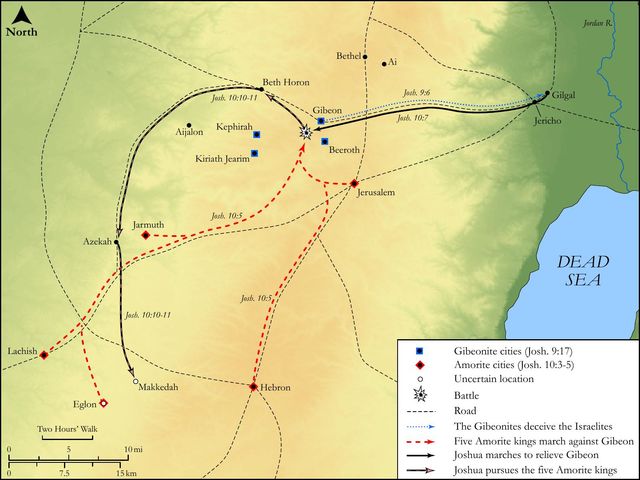
See on the biblical-era map
Study this verse
Public-domain commentary
Matthew Henry
From his Commentary on the Whole Bible. Henry comments on passages, not single verses — this entry covers Joshua 9:15–21. His three-level outline is real structure in the source text, so it is rendered as structure.
Here is, I. The treaty soon concluded with the Gibeonites, Jos 9:15. The thing was not done with much formality, but in short, 1. They agreed to let them live, and more the Gibeonites did not ask. In a common war this would have been but a small matter to be granted; but in the wars of Canaan, which were to make a general destruction, it was a great favour to a Canaanite to have his life given him for a prey, Jer 45:5. 2. This agreement was made not by Joshua only, but by the princes of the congregation in conjunction with him. Though Joshua had an extraordinary call to the government, and extraordinary qualifications for it, yet he would not act in an affair of this nature without the counsel and concurrence of the princes, who were neither kept in the dark nor kept under foot, but were treated by him as sharers in the government. 3. It was ratified by an oath; they swore unto them, not by any of the gods of Canaan, but by the God of Israel only, Jos 9:19. Those that mean honestly do not startle at assurances, but satisfy those with whom they treat, and glorify God by calling him to witness to the sincerity of their intentions. 4. Nothing appears to have been culpable in all this but that it was done rashly; they took of their victuals, by which they satisfied themselves that it was indeed old and dry, but did not consider that his was no proof of their bringing it fresh from home; so that, making use of their senses only, but not their reason, they received the men (as the margin reads it) because of their victuals, perceiving perhaps, upon the view and taste of their bread, not only that now it was old, but that it had been fine and very good at first, whence they inferred that they were persons of some quality, and therefore the friendship of their country was not to be despised. But they asked not counsel at the mouth of the Lord. They had the Urim and Thummim with them, which they might have advised with in this difficult case, and which would have told them no lie, would have led them into no error; but they relied so much on their own politics that they thought it needless to bring the matter to the oracle. Joshua himself was not altogether without blame herein. Note, We make more haste than good speed in any business when we stay not to take God along with us, and by the word and prayer to consult him. Many a time we see cause to reflect upon it with regret that such and such an affair miscarried, because we asked not counsel at the mouth of the Lord; would we acknowledge him in all our ways, we should find them more safe, easy, and successful.
II.The fraud soon discovered, by which this league was procured.
A lying tongue is but for a moment, and truth will be the daughter of time. Within three days they found, to their great surprise, that the cities which these ambassadors had treated for were very near them, but one night's foot-march from the camp at Gilgal, Jos 10:9. Either their own scouts or the parties that sallied out to acquaint themselves with the country, or perhaps some deserters that came over to them from the enemy, informed them of the truth in this matter. Those that suffer themselves to be deceived by the wiles of Satan will soon be undeceived to their confusion, and will find that near, even at the door, which they imagined was very far off.
III.The disgust of the congregation at this.
They did indeed submit to the restraints which this league laid upon them, and smote not the cities of the Gibeonites, neither slew the persons nor seized the prey; but it vexed them to have their hands thus tied, and they murmured against the princes (Jos 9:18) it is to be feared, more from a jealousy for their own profit than from a zeal for the fulfilling of God's command, though some of them perhaps had a regard to that. Many are forward to arraign and censure the actions of princes while they are ignorant of the springs of those actions and are incompetent judges of the reasons of state that govern them. While therefore we are satisfied in general that those who are over us aim at nothing but the public good, and sincerely seek the welfare of their people, we ought to make the best of what they do and not exercise ourselves in things above us.
IV.The prudent endeavour of the princes to pacify the discontented congregation, and to accommodate the matter; herein all the princes concurred and were unanimous, which doubtless disposed the people to acquiesce.
1.They resolved to spare the lives of the Gibeonites, for so they had expressly sworn to do (Jos 9:15), to let them live.
(1.)The oath was lawful, else it had not bound them any more than Herod's oath bound him to cut off John Baptist's head; it is true God had appointed them to destroy all the Canaanites, but the law must be construed, in favorem vitae - with some tender allowance, to mean those only that stood it out and would not surrender their country to them, and not to bind them so far to put off the sense of honour and humanity as to slay those who had never lifted up a hand against them nor ever would, but before they were reduced to any extremity, or ever attempted any act of hostility, with one consent humbled themselves; the kings of Israel were certainly more merciful kings than to do so (Kg1 20:31), and the God of Israel a more merciful God than to order it so. Satis est prostrasse leoni - It is enough to have laid the lion prostrate. And besides, the reason of the law is the law; the mischief designed to be prevented by that law was the infecting of the Israelites with their idolatry, Deu 7:4. But if the Gibeonites renounce their idolatry, and become friends and servants to the house of God, the danger is effectually prevented, the reason of the law ceases, and consequently the obligation of it, especially to a thing of this nature. The conversion of sinners shall prevent their ruin.
(2.)The oath being lawful, both the princes and the people for whom they transacted were bound by it, bound in conscience, bound in honour to the God of Israel, by whom they had sworn, and whose name would have been blasphemed by the Canaanites if they had violated this oath. They speak as those that feared an oath (Ecc 9:2), when they argued thus: We will let them live, lest wrath be upon us, because of the oath which we swore, Jos 9:20. He that ratifies a promise with an oath imprecates the divine vengeance if he wilfully break his promise, and has reason to expect that divine justice will take him at his word. God is not mocked, and therefore oaths are not to be jested with. The princes would keep their word, [1.] Though they lost by it. A citizen of Zion swears to his own hurt and changes not, Psa 15:4. Joshua and the princes, when they found it was to their prejudice that they had thus bound themselves, did not apply to Eleazar for a dispensation, much less did they pretend that no faith is to be kept with heretics, with Canaanites; no, they were strangers to the modern artifices of the Romish church to elude the most sacred bonds, and even to sanctify perjuries [2.] Though the people were uneasy at it, and their discontent might have ended in a mutiny, yet the princes would not violate their engagement to the Gibeonites; we must never be over-awed, either by majesty or multitude, to do a sinful thing, and go against our consciences. [3.] Though they were drawn into this league by a wile, and might have had a very plausible pretence to declare it null and void, yet they adhered to it. They might have pleaded that though those were the men with whom they exchanged the ratifications, yet these were not the cities intended in the league; they had promised to spare certain cities, without names, that were very far off, and upon the express consideration of their being so; but these were very near, and therefore not the cities that they covenanted with. And many learned men have thought that they were so grossly imposed upon by the Gibeonites that it would have been lawful for them to have recalled their promise, but to preserve their reputation, and to keep up in Israel a veneration of an oath, they would stand to it; but it is plain that they thought themselves indispensably obliged by it, and were apprehensive that the wrath of God would fall upon them if they broke it. And, however their adherence to it might be displeasing to the congregation, it is plain that it was acceptable to God; for when, in pursuance of this league, they undertook the protection of the Gibeonites, God gave them the most glorious victory that ever they had in all their wars (ch. 10), and long afterwards severely avenged the wrong Saul did to the Gibeonites in violation of this league, Sa2 21:1. Let this convince us all how religiously we ought to perform our promises, and make good our bargains; and what conscience we ought to make of our words when they are once given. If a covenant obtained by so many lies and deceits might not be broken, shall we think to evade the obligation of those that have been made with all possible honesty and fairness? If the fraud of others will not justify or excuse our falsehood, certainly the honesty of others in dealing with us will aggravate and condemn our dishonesty in dealing with them.
2.Though they spared their lives, yet they seized their liberties, and sentenced them to be hewers of wood and drawers of water to the congregation, Jos 9:21. By this proposal the discontented congregation was pacified; for,
(1.)Those who were angry that the Gibeonites lived might be content when they saw them condemned to that which, in the general apprehension, is worse than death, perpetual servitude.
(2.)Those who were angry that they were not spoiled might be content when their serving the congregation would be more to the public advantage than their best effects could be; and, in short, the Israelites would be not losers either in honour or profit by this peace with the Gibeonites; convince them of this, and they will be satisfied.
Continue studying Joshua 9:17 across the web’s major study libraries — every link below opens this exact verse, chapter, or book on the destination site.
Read & Compare
 BibleGatewayThis verse in more than 200 translations and 70 languages.
 Bible.comThe YouVersion reader — hundreds of translations, reading plans, and highlights.
 ESV.orgCrossway's official English Standard Version reader.
 NET BibleThe NET translation with 60,000+ translators' notes on every rendering decision.
 STEP BibleTyndale House's free study tool — original text, vocabulary, and scholarly resources.
 BibliaLogos Bible Software's free web reader.
 USCCBThe New American Bible (Revised Edition) with the U.S. bishops' study notes.
Commentaries
 BibleHub CommentariesDozens of classic commentaries on this verse, gathered on one page.
 StudyLightMore than 100 commentary sets — the largest collection on the web.
 BibleRefPlain-English commentary on what this verse means, verse by verse.
 Enduring WordDavid Guzik's free commentary on this chapter, widely used by Bible teachers.
 Bible Study ToolsVerse commentary alongside Greek and Hebrew study aids.
Original Language & Research
- BibleHub InterlinearThe verse word by word — original language, transliteration, and English.
- BibleHub LexiconEvery word's original-language definition and Strong's entry.
 Blue Letter BibleDeep-study tools — Strong's numbers, concordance, and word studies.
 SefariaThe Hebrew text with Rashi and centuries of Jewish commentary.
Sermons, Hymns & Audio


TrulyRandomVerse is not affiliated with these sites and doesn’t control their content. They’re linked because they’re genuinely useful.
Summary
Joshua 9:17 meticulously chronicles the Israelites' journey to, and subsequent discovery of, the Gibeonite cities—Gibeon, Chephirah, Beeroth, and Kirjathjearim—on the third day following the solemnization of a deceptive covenant. This verse marks the critical moment when Israel's leaders realized the profound extent of the Gibeonites' elaborate ruse, as these cities were not, as claimed, from a distant land, but were in fact strategically located within the very heart of the promised land of Canaan, directly contravening God's explicit command to dispossess all its inhabitants.
Context
ShowHideLiterary Context
This verse serves as the immediate and dramatic climax to the narrative of the Gibeonite deception, which unfolds in Joshua 9:3-15. Having heard of Israel's formidable victories at Jericho and Ai, the Gibeonites, a Hivite people, ingeniously disguised themselves as weary travelers from a far-off country to secure a peace treaty with Israel. The critical failure of Israel's leaders, including Joshua, was their neglect to consult the Lord before entering into this binding covenant. Joshua 9:17 then vividly portrays the swift and shocking revelation of the truth, underscoring the immediate and unavoidable consequences of their hasty, unguided decision. This sudden discovery precipitates the profound ethical and theological dilemma faced by Israel's leadership in Joshua 9:18-21, compelling them to grapple with the sanctity of an oath made under false pretenses.
Historical & Cultural Context
The divine mandate for Israel's conquest of Canaan was unequivocal: to utterly destroy its idolatrous inhabitants, a command repeatedly emphasized in passages such as Deuteronomy 7:1-5 and Deuteronomy 20:16-18. This "ban" (Hebrew: herem) was not a display of arbitrary cruelty but a righteous judgment against the pervasive moral depravity and spiritual corruption of the Canaanite nations, designed to safeguard Israel's theological purity and covenant faithfulness. The Gibeonites, identified as Hivites, were explicitly among the peoples designated for destruction. The "third day" journey mentioned in the verse is significant; a three-day journey on foot typically covered a relatively short distance, perhaps 30-50 miles, which dramatically highlighted the Gibeonites' proximity to Israel's camp at Gilgal. Gibeon itself was no minor settlement, but a formidable city, described in Joshua 10:2 as "a great city, as one of the royal cities," where "all the men thereof were mighty," making their deception all the more audacious and the Israelites' oversight more profound.
Key Themes
ShowHideThis verse profoundly contributes to several overarching themes within the book of Joshua and the broader Old Testament narrative. Firstly, it powerfully illustrates the perilous consequences of hasty decisions and the critical failure to seek divine counsel. Israel's leaders, relying solely on their own human judgment and outward appearances, were skillfully ensnared by a clever stratagem, demonstrating the inherent danger of operating without God's explicit guidance, a timeless principle echoed in Proverbs 3:5-6. Secondly, the passage underscores the binding nature and inviolable sanctity of oaths and covenants within ancient Israelite culture. Despite the egregious deception, the Israelites felt compelled to honor their oath, fearing severe divine repercussions for breaking a promise made in the Lord's name, as articulated by the leaders in Joshua 9:19. Lastly, and perhaps most subtly, it reveals God's overarching sovereignty even amidst human fallibility. While Israel stumbled significantly, God's ultimate plan for the land and His chosen people continued to unfold, eventually integrating the Gibeonites into a subservient role, a development that would have its own complex and far-reaching implications for Israel's future history, as seen in later interactions in 2 Samuel 21.
Exposition and Analysis
ShowHideKey Word Analysis
ShowHideThis term, often translated as "son," carries a broad semantic range, encompassing descendants, members of a group, or even those belonging to a particular quality or condition. In this context, "children of Israel" (H1121 H3478) refers to the collective body of the Israelite nation, emphasizing their corporate identity and responsibility under the covenant. It highlights that the entire community, through its representatives, was involved in the journey and discovery, and thus bore the consequences of the decision.
Derived from a root meaning "hill" or "elevated place," this name accurately describes the city's geographical prominence. Gibeon was indeed situated on a significant hill, strategically located in the territory later allotted to the tribe of Benjamin. Its name not only reflects its physical characteristic but also its importance as a major Hivite city, which would later become a significant Israelite city and a prominent high place for worship, as evidenced by Solomon's sacrifice there in 1 Kings 3:4.
This word signifies a literal day (from sunrise to sunset or one sunset to the next) but can also denote a defined period of time. In the phrase "on the third day," yôwm is crucial for establishing the immediate proximity of the Gibeonite cities to Israel's camp. This short duration of travel (three days) dramatically exposes the Gibeonites' lie about coming from a "very distant country" (Joshua 9:6), making the Israelites' failure to discern the truth all the more glaring.
Verse Breakdown
ShowHide"And the children of Israel journeyed, and came unto their cities on the third day."
This clause details the immediate and direct action taken by the Israelite army and leadership following the covenant with the Gibeonites. The verb "journeyed" (Hebrew: nâçaʻ) implies a deliberate and purposeful movement from their encampment at Gilgal, indicating their intent to verify the Gibeonites' story or to escort them home. The crucial detail "on the third day" is not merely a temporal marker but a narrative device that immediately exposes the deception. A three-day journey in ancient times signified a relatively short distance, making it impossible for the Gibeonites to have traveled from a "very distant country." This swift discovery underscores the immediate and unavoidable consequences of Israel's unadvised decision.
"Now their cities [were] Gibeon, and Chephirah, and Beeroth, and Kirjathjearim."
This concluding part of the verse explicitly names the four cities that comprised the Gibeonite confederacy. The precise naming of these cities serves to concretize the deception and highlight the direct violation of God's command to dispossess the Canaanite inhabitants. The geographical proximity of these specific cities to Israel's current position at Gilgal, coupled with their undeniable location within the very heart of the land of Canaan, irrefutably confirms the Gibeonites' elaborate lie and the Israelites' profound oversight.
Literary Devices
ShowHideJoshua 9:17 masterfully employs several literary devices to amplify its narrative impact and theological significance. Irony is profoundly evident, as the Israelites, fresh from decisive victories achieved through divine guidance, are outwitted not by military might but by a cunning deception, leading them directly into a covenant with inhabitants they were commanded to utterly destroy. The mention of the "third day" journey, revealing the close proximity of the cities, injects a potent layer of dramatic irony, underscoring how easily the Israelites were fooled and how close the truth was to their grasp. The explicit naming of the specific cities, particularly Kirjathjearim, functions as a subtle yet significant foreshadowing for discerning readers, as this city would later play a pivotal role in Israelite history as a temporary resting place for the Ark of the Covenant (1 Samuel 7:1), demonstrating God's continued working through His people even amidst their failures and the unforeseen consequences of their actions. Furthermore, the narrative employs contrast between Israel's previous obedience and unwavering reliance on God (e.g., the conquest of Jericho) and their current lapse in judgment, highlighting the inherent vulnerability of even divinely guided leaders to human weakness and the deceptive schemes of their adversaries.
Theological and Thematic Connections
ShowHideJoshua 9:17 stands as a stark and enduring reminder of the profound spiritual danger inherent in making significant decisions without diligent divine consultation. The Israelites' failure to inquire of the Lord before entering into a binding covenant, despite having clear and repeated commands regarding the inhabitants of Canaan, plunged them into a morally and theologically complex situation that would have long-lasting repercussions. This incident powerfully underscores the biblical principle that even actions undertaken with seemingly good intentions, if not rooted in God's revealed wisdom and guided by His Spirit, can lead to unforeseen and deeply challenging consequences. It also highlights the sacredness of oaths and covenants in God's eyes, demonstrating that commitments made, even under duress or deception, carry significant weight and cannot be easily dismissed without incurring divine displeasure. Ultimately, the verse illustrates the perennial tension between human fallibility and divine sovereignty, showing how God's overarching purposes can still advance even through the mistakes and shortcomings of His people, albeit often with difficult and complex implications for their journey of faith.
Reflection and Application
ShowHideJoshua 9:17 offers profound and enduring lessons for contemporary believers, emphasizing the critical importance of spiritual discernment, patient waiting upon the Lord, and unwavering reliance on God's guidance in all areas of life. In a world saturated with persuasive voices, appealing opportunities, and clever deceptions, it is remarkably easy to be swayed by outward appearances or compelling arguments, much as the Israelites were by the Gibeonites' elaborate charade. This passage serves as a powerful call to pause before making any significant commitments—whether in the realm of relationships, career choices, financial decisions, or ministry endeavors—and to diligently seek the Lord's will through fervent prayer, careful and consistent study of His Word, and wise counsel from godly mentors. Hasty decisions, often driven by fear, ambition, impatience, or a lack of spiritual discipline, frequently lead to entanglements and consequences that can persist for a long time, impacting not only ourselves but also those within our sphere of influence. Furthermore, the Israelites' commitment to uphold their oath, despite the deception, serves as a poignant reminder of the profound value of integrity and the sacredness of our spoken word. Even when circumstances change, or we realize we have been misled, our commitment to truthfulness and honoring our promises, insofar as it aligns with God's higher commands, powerfully reflects His character and bears witness to His faithfulness in a world often devoid of such integrity.
Questions for Reflection
ShowHideFAQ
ShowHideWhy was it so important for the Israelites to consult the Lord before making treaties?
ShowHideIt was critically important for the Israelites to consult the Lord before making treaties because their entire existence, their covenant relationship with God, and their success in the Promised Land were predicated upon their absolute obedience to God's specific commands. God had explicitly forbidden them from making treaties or covenants with the inhabitants of Canaan (e.g., Exodus 23:32, Deuteronomy 7:2). This prohibition was not arbitrary; it was a protective measure designed to prevent Israel from adopting the idolatrous, immoral, and detestable practices of the Canaanites, which would inevitably lead to their spiritual corruption, the breaking of their covenant with Yahweh, and ultimately, divine judgment. By consulting the Lord, Israel would receive divine wisdom, be protected from deception, and ensure that their actions aligned perfectly with God's overarching redemptive plan for His people and the land. Their profound failure to do so, as highlighted in Joshua 9:14, led directly to the complex and enduring dilemma described in Joshua 9:17, demonstrating the severe consequences of operating outside divine counsel.
Christ-Centered Fulfillment
ShowHideJoshua 9:17, with its narrative of cunning deception, a binding oath, and the complex consequences of human error, finds profound Christ-centered fulfillment in the person and redemptive work of Jesus Christ. The Gibeonites' desperate and deceptive attempt to secure peace and escape judgment through a false covenant powerfully illustrates humanity's inherent fallenness and its futile attempts to save itself or secure peace on its own terms. Yet, unlike the flawed and problematic covenant made by Joshua and the leaders of Israel, God's new covenant in Christ is not predicated on human deception or legalistic adherence, but on divine truth, perfect obedience, and an unbreakable, eternal oath. Jesus Christ is the ultimate fulfillment of all God's promises, the one who perfectly upholds the divine covenant, not through trickery or human strength, but through His perfect life, His sacrificial death on the cross, and His glorious resurrection. He is the true Lamb of God, who takes away the sin of the world!, establishing a covenant of grace that genuinely reconciles fallen humanity to a holy God. Furthermore, just as the Gibeonites, through a flawed covenant, were incorporated into Israel in a subservient role, so too, through Christ, Gentiles who were once "aliens from the commonwealth of Israel and strangers from the covenants of promise, having no hope and without God in the world" (Ephesians 2:12) are now, by the blood of Christ, brought near and made "fellow citizens with the saints and members of the household of God" (Ephesians 2:19). The Gibeonite episode underscores humanity's desperate need for divine wisdom, a wisdom perfectly embodied in Christ, who is "the power of God and the wisdom of God" (1 Corinthians 1:24), guiding us away from the deceptions and pitfalls of the world and into the liberating truth of His saving grace.