


Joshua 9:16
Bible text: King James Version (1769 Blayney text) · Public domain
Bible text: King James Version with Strong's numbers · Public domain
Bible text: Berean Standard Bible · Public domain
Bible text: American Standard Version (1901) · Public domain
Bible text: World English Bible, Messianic edition · Public domain
Bible text: Geneva Bible (1599) · Public domain
Bible text: Young's Literal Translation · Public domain
- וַיְהִיvay·Hiand it wasH1961Conj-w ¦ V-Qal-ConsecImperf-3msVerb Qal Consecutive Imperfect 3rd Singular Masculineוַandיְהִיit was
- מִקְצֵהmik·Tzehfrom [the] end ofH7097Prep-m ¦ N-mscNoun Singular Masculine Constructמִfromקְצֵה[the] end of
- שְׁלֹשֶׁתshe·Lo·shetthreeH7969Adj-cscAdjective Numerical Singular common gender Construct
- יָמִיםya·MimdaysH3117N-mpNoun Plural Masculine Absolute
- אַחֲרֵי'a·cha·ReiafterH310Adj-mpcAdjective Numerical Plural Masculine Construct
- אֲשֶׁר'a·SherthatH834RelParticle Relative
- כָּרְתוּka·re·Tuthey had madeH3772V-Qal-Perf-3cpVerb Qal Perfect 3rd Plural common gender
- לָהֶםla·Hemto <the> themPrep-l ¦ 3mpSuffix Personal 3rd Plural Masculineלָto <the>הֶםthem
- בְּרִיתbe·Rita covenantH1285N-fsNoun Singular Feminine Absolute
- וַיִּשְׁמְעוּvai·yish·me·'Uand they heardH8085Conj-w ¦ V-Qal-ConsecImperf-3mpVerb Qal Consecutive Imperfect 3rd Plural Masculineוַandיִּשְׁמְעוּthey heard
- כִּיkithatH3588PrtParticle Conditional
- קְרֹבִיםke·ro·Vim[were] nearH7138Adj-mpAdjective Plural Masculine Absolute
- הֵםhemtheyH1992Pro-3mpPronoun Personal 3rd Plural Masculine
- אֵלָיו'e·Lavto himH413Prep ¦ 3msPreposition Definiteאֵלָיtoוhim
- וּבְקִרְבּוֹu·ve·kir·Boand in his midstH7130Conj-w ¦ Prep-b ¦ N-msc ¦ 3msNoun Singular Masculine Constructוּandבְinקִרְבּmidstוֹhis
- הֵםhemtheyH1992Pro-3mpPronoun Personal 3rd Plural Masculine
- יֹשְׁבִיםyo·she·Vim[were] dwellingH3427V-Qal-Prtcpl-mpVerb Qal Participle Plural Masculine Absolute
English is a literal word-by-word gloss of the Hebrew, not the KJV's wording. Why?
This is the original text the KJV's translators worked from — each Hebrew word with its own literal English meaning in this verse, prepared by scholars at Tyndale House, Cambridge. The KJV translates whole sentences, not word by word, so its wording differs: one Hebrew word can become several English words, and the KJV may choose “the LORD” where the gloss reads “Yahweh”. Both are faithful — they answer different questions. For the KJV's own rendering, switch to the KJV text.
Details
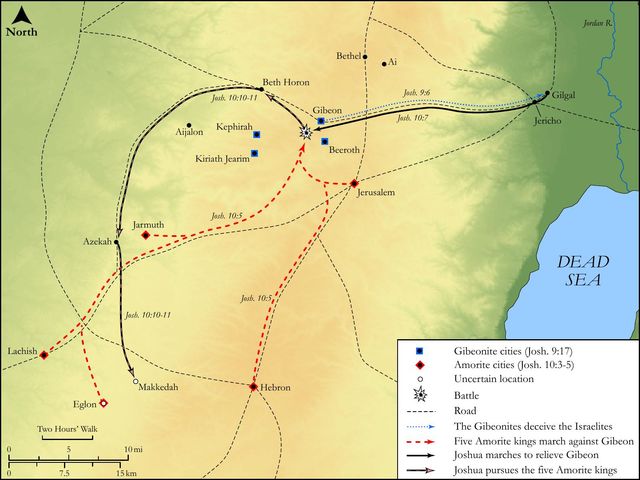
See on the biblical-era map
Study this verse
Public-domain commentary
Matthew Henry
From his Commentary on the Whole Bible. Henry comments on passages, not single verses — this entry covers Joshua 9:15–21. His three-level outline is real structure in the source text, so it is rendered as structure.
Here is, I. The treaty soon concluded with the Gibeonites, Jos 9:15. The thing was not done with much formality, but in short, 1. They agreed to let them live, and more the Gibeonites did not ask. In a common war this would have been but a small matter to be granted; but in the wars of Canaan, which were to make a general destruction, it was a great favour to a Canaanite to have his life given him for a prey, Jer 45:5. 2. This agreement was made not by Joshua only, but by the princes of the congregation in conjunction with him. Though Joshua had an extraordinary call to the government, and extraordinary qualifications for it, yet he would not act in an affair of this nature without the counsel and concurrence of the princes, who were neither kept in the dark nor kept under foot, but were treated by him as sharers in the government. 3. It was ratified by an oath; they swore unto them, not by any of the gods of Canaan, but by the God of Israel only, Jos 9:19. Those that mean honestly do not startle at assurances, but satisfy those with whom they treat, and glorify God by calling him to witness to the sincerity of their intentions. 4. Nothing appears to have been culpable in all this but that it was done rashly; they took of their victuals, by which they satisfied themselves that it was indeed old and dry, but did not consider that his was no proof of their bringing it fresh from home; so that, making use of their senses only, but not their reason, they received the men (as the margin reads it) because of their victuals, perceiving perhaps, upon the view and taste of their bread, not only that now it was old, but that it had been fine and very good at first, whence they inferred that they were persons of some quality, and therefore the friendship of their country was not to be despised. But they asked not counsel at the mouth of the Lord. They had the Urim and Thummim with them, which they might have advised with in this difficult case, and which would have told them no lie, would have led them into no error; but they relied so much on their own politics that they thought it needless to bring the matter to the oracle. Joshua himself was not altogether without blame herein. Note, We make more haste than good speed in any business when we stay not to take God along with us, and by the word and prayer to consult him. Many a time we see cause to reflect upon it with regret that such and such an affair miscarried, because we asked not counsel at the mouth of the Lord; would we acknowledge him in all our ways, we should find them more safe, easy, and successful.
II.The fraud soon discovered, by which this league was procured.
A lying tongue is but for a moment, and truth will be the daughter of time. Within three days they found, to their great surprise, that the cities which these ambassadors had treated for were very near them, but one night's foot-march from the camp at Gilgal, Jos 10:9. Either their own scouts or the parties that sallied out to acquaint themselves with the country, or perhaps some deserters that came over to them from the enemy, informed them of the truth in this matter. Those that suffer themselves to be deceived by the wiles of Satan will soon be undeceived to their confusion, and will find that near, even at the door, which they imagined was very far off.
III.The disgust of the congregation at this.
They did indeed submit to the restraints which this league laid upon them, and smote not the cities of the Gibeonites, neither slew the persons nor seized the prey; but it vexed them to have their hands thus tied, and they murmured against the princes (Jos 9:18) it is to be feared, more from a jealousy for their own profit than from a zeal for the fulfilling of God's command, though some of them perhaps had a regard to that. Many are forward to arraign and censure the actions of princes while they are ignorant of the springs of those actions and are incompetent judges of the reasons of state that govern them. While therefore we are satisfied in general that those who are over us aim at nothing but the public good, and sincerely seek the welfare of their people, we ought to make the best of what they do and not exercise ourselves in things above us.
IV.The prudent endeavour of the princes to pacify the discontented congregation, and to accommodate the matter; herein all the princes concurred and were unanimous, which doubtless disposed the people to acquiesce.
1.They resolved to spare the lives of the Gibeonites, for so they had expressly sworn to do (Jos 9:15), to let them live.
(1.)The oath was lawful, else it had not bound them any more than Herod's oath bound him to cut off John Baptist's head; it is true God had appointed them to destroy all the Canaanites, but the law must be construed, in favorem vitae - with some tender allowance, to mean those only that stood it out and would not surrender their country to them, and not to bind them so far to put off the sense of honour and humanity as to slay those who had never lifted up a hand against them nor ever would, but before they were reduced to any extremity, or ever attempted any act of hostility, with one consent humbled themselves; the kings of Israel were certainly more merciful kings than to do so (Kg1 20:31), and the God of Israel a more merciful God than to order it so. Satis est prostrasse leoni - It is enough to have laid the lion prostrate. And besides, the reason of the law is the law; the mischief designed to be prevented by that law was the infecting of the Israelites with their idolatry, Deu 7:4. But if the Gibeonites renounce their idolatry, and become friends and servants to the house of God, the danger is effectually prevented, the reason of the law ceases, and consequently the obligation of it, especially to a thing of this nature. The conversion of sinners shall prevent their ruin.
(2.)The oath being lawful, both the princes and the people for whom they transacted were bound by it, bound in conscience, bound in honour to the God of Israel, by whom they had sworn, and whose name would have been blasphemed by the Canaanites if they had violated this oath. They speak as those that feared an oath (Ecc 9:2), when they argued thus: We will let them live, lest wrath be upon us, because of the oath which we swore, Jos 9:20. He that ratifies a promise with an oath imprecates the divine vengeance if he wilfully break his promise, and has reason to expect that divine justice will take him at his word. God is not mocked, and therefore oaths are not to be jested with. The princes would keep their word, [1.] Though they lost by it. A citizen of Zion swears to his own hurt and changes not, Psa 15:4. Joshua and the princes, when they found it was to their prejudice that they had thus bound themselves, did not apply to Eleazar for a dispensation, much less did they pretend that no faith is to be kept with heretics, with Canaanites; no, they were strangers to the modern artifices of the Romish church to elude the most sacred bonds, and even to sanctify perjuries [2.] Though the people were uneasy at it, and their discontent might have ended in a mutiny, yet the princes would not violate their engagement to the Gibeonites; we must never be over-awed, either by majesty or multitude, to do a sinful thing, and go against our consciences. [3.] Though they were drawn into this league by a wile, and might have had a very plausible pretence to declare it null and void, yet they adhered to it. They might have pleaded that though those were the men with whom they exchanged the ratifications, yet these were not the cities intended in the league; they had promised to spare certain cities, without names, that were very far off, and upon the express consideration of their being so; but these were very near, and therefore not the cities that they covenanted with. And many learned men have thought that they were so grossly imposed upon by the Gibeonites that it would have been lawful for them to have recalled their promise, but to preserve their reputation, and to keep up in Israel a veneration of an oath, they would stand to it; but it is plain that they thought themselves indispensably obliged by it, and were apprehensive that the wrath of God would fall upon them if they broke it. And, however their adherence to it might be displeasing to the congregation, it is plain that it was acceptable to God; for when, in pursuance of this league, they undertook the protection of the Gibeonites, God gave them the most glorious victory that ever they had in all their wars (ch. 10), and long afterwards severely avenged the wrong Saul did to the Gibeonites in violation of this league, Sa2 21:1. Let this convince us all how religiously we ought to perform our promises, and make good our bargains; and what conscience we ought to make of our words when they are once given. If a covenant obtained by so many lies and deceits might not be broken, shall we think to evade the obligation of those that have been made with all possible honesty and fairness? If the fraud of others will not justify or excuse our falsehood, certainly the honesty of others in dealing with us will aggravate and condemn our dishonesty in dealing with them.
2.Though they spared their lives, yet they seized their liberties, and sentenced them to be hewers of wood and drawers of water to the congregation, Jos 9:21. By this proposal the discontented congregation was pacified; for,
(1.)Those who were angry that the Gibeonites lived might be content when they saw them condemned to that which, in the general apprehension, is worse than death, perpetual servitude.
(2.)Those who were angry that they were not spoiled might be content when their serving the congregation would be more to the public advantage than their best effects could be; and, in short, the Israelites would be not losers either in honour or profit by this peace with the Gibeonites; convince them of this, and they will be satisfied.
Continue studying Joshua 9:16 across the web’s major study libraries — every link below opens this exact verse, chapter, or book on the destination site.
Read & Compare
 BibleGatewayThis verse in more than 200 translations and 70 languages.
 Bible.comThe YouVersion reader — hundreds of translations, reading plans, and highlights.
 ESV.orgCrossway's official English Standard Version reader.
 NET BibleThe NET translation with 60,000+ translators' notes on every rendering decision.
 STEP BibleTyndale House's free study tool — original text, vocabulary, and scholarly resources.
 BibliaLogos Bible Software's free web reader.
 USCCBThe New American Bible (Revised Edition) with the U.S. bishops' study notes.
Commentaries
 BibleHub CommentariesDozens of classic commentaries on this verse, gathered on one page.
 StudyLightMore than 100 commentary sets — the largest collection on the web.
 BibleRefPlain-English commentary on what this verse means, verse by verse.
 Enduring WordDavid Guzik's free commentary on this chapter, widely used by Bible teachers.
 Bible Study ToolsVerse commentary alongside Greek and Hebrew study aids.
Original Language & Research
- BibleHub InterlinearThe verse word by word — original language, transliteration, and English.
- BibleHub LexiconEvery word's original-language definition and Strong's entry.
 Blue Letter BibleDeep-study tools — Strong's numbers, concordance, and word studies.
 SefariaThe Hebrew text with Rashi and centuries of Jewish commentary.
Sermons, Hymns & Audio


TrulyRandomVerse is not affiliated with these sites and doesn’t control their content. They’re linked because they’re genuinely useful.
Summary
Joshua 9:16 dramatically exposes the Gibeonites' elaborate deception, revealing their true identity and immediate proximity to Israel just three days after a solemn covenant was forged. This verse marks the swift unraveling of their cunning ruse, highlighting the immediate aftermath of Israel's critical failure to seek divine counsel. The supposed distant travelers are unmasked as immediate neighbors dwelling within the very land Israel was commanded to possess, setting the stage for significant theological and practical dilemmas concerning the sanctity of oaths and the profound consequences of human oversight.
Context
ShowHideLiterary Context
This verse serves as the critical turning point following the establishment of a covenant between Israel and the Gibeonites, meticulously detailed in Joshua 9:15. The narrative preceding this verse, specifically Joshua 9:3-13, elaborates on the Gibeonites' cunning strategy: they presented themselves as weary, distant travelers to secure a treaty and avoid the fate of Jericho and Ai. A pivotal detail, explicitly stated in Joshua 9:14, is Israel's critical lapse in judgment: "they asked not counsel at the mouth of the Lord." This spiritual oversight directly precipitates the predicament revealed in Joshua 9:16. The swift discovery of the Gibeonites' true identity in this verse immediately raises the stakes, compelling Joshua and the Israelite leaders to confront the inviolability of their oath, despite the deception, as detailed in the subsequent verses (Joshua 9:17-21).
Historical & Cultural Context
The broader historical backdrop for Joshua 9:16 is Israel's divinely mandated conquest of Canaan. This campaign was not merely territorial but a judgment against the idolatry and moral depravity of the existing inhabitants, whom God commanded Israel to dispossess and utterly destroy (Deuteronomy 7:1-6). In Scripture, treaties and covenants (Hebrew: berith) were profoundly sacred agreements, often ratified with solemn oaths, elaborate rituals, and appeals to God as witness. Breaking such an oath, even if made under false pretenses, was considered a grave offense that could incur divine wrath and severe social consequences. The Gibeonites, identified as Hivites in Joshua 9:7, were explicitly among the nations Israel was commanded to eliminate. Their desperate and deceptive strategy was born out of a profound fear of Israel's God and their military prowess, vividly demonstrated by the recent, devastating conquests of Jericho (Joshua 6) and Ai (Joshua 8).
Key Themes
ShowHideJoshua 9:16 powerfully illustrates several core themes woven throughout the book of Joshua and the broader biblical narrative. Firstly, it underscores the unveiling of deception: no matter how cunningly crafted a lie, truth ultimately comes to light, often with startling swiftness. The Gibeonites' elaborate ruse, meticulously detailed in Joshua 9:3-13, could not withstand the simple reality of their geographical proximity. Secondly, the verse highlights the binding nature of oaths and covenants, even those entered into under duress or deception. Despite being tricked, Israel felt morally and religiously compelled to uphold their solemn word, demonstrating the profound sanctity of promises made before God. This theme resonates deeply with God's own unwavering covenant faithfulness throughout Scripture. Finally, Joshua 9:16 serves as a stark warning about the consequences of hasty decisions and the critical failure to seek divine counsel. Israel's oversight in Joshua 9:14 led to a binding agreement with an enemy, creating a complex moral and strategic dilemma that would have lasting implications for their future actions and the Gibeonites' fate (Joshua 9:22-27).
Exposition and Analysis
ShowHideKey Word Analysis
ShowHideThis term denotes a solemn, binding agreement or covenant. As derived from a root meaning "to cut," it often refers to ancient practices of covenant-making, which sometimes involved cutting animals and passing between the pieces, symbolizing the dire consequences of breaking the agreement. A bᵉrîyth in ancient Israel was considered inviolable, often sealed in the presence of God, making its violation a serious religious and social transgression. The Gibeonites' deception shrewdly exploited the profound sanctity of this concept.
Derived from a root meaning "to draw near," qârôwb refers to someone or something that is physically or temporally close, a close resident, kinsman, or immediate inhabitant. The revelation that the Gibeonites were "neighbours" directly contradicted their elaborate claim of being from a "very far country" (Joshua 9:6), starkly exposing the magnitude of their lie and the immediate threat they posed as indigenous Canaanites.
This primitive root primarily means "to sit down," but by implication, it extends to "to dwell, to remain, to inhabit." In this context, it emphasizes the Gibeonites' established physical presence within the very territory Israel was in the process of conquering. The discovery that they "dwelt among them" (using the preposition qereb, "in the midst of") was particularly alarming because it meant Israel had made a covenant with people who were part of the very nations God commanded them to dispossess and destroy, not distant foreigners.
Verse Breakdown
ShowHide"And it came to pass at the end of three days after they had made a league with them"
This clause precisely establishes the immediate timeframe for the revelation. The "three days" highlights the astonishing swiftness with which the truth was exposed, underscoring the ephemeral nature of even the most elaborate deceptions. The "league" refers to the bᵉrîyth or solemn covenant established in Joshua 9:15, a sacred agreement that Israel felt bound to uphold, despite the circumstances of its formation.
"that they heard that they [were] their neighbours"
This indicates the manner of discovery – Israel "heard" the truth, implying it came through intelligence gathering, scouting expeditions, or perhaps direct observation by the Israelites as they continued their conquest. This was not a confession from the Gibeonites. The profound shock of this revelation stems from its direct contradiction of the Gibeonites' carefully crafted narrative of being from a "very far country" (Joshua 9:6). They were not distant, but intimately and dangerously close.
"and [that] they dwelt among them."
This final clause clarifies the precise nature and gravity of the Gibeonites' proximity. They were not merely "neighbours" in a general sense, but were already inhabiting territory that Israel was commanded to conquer and cleanse of its pagan inhabitants. This crucial detail underscores the magnitude of Israel's oversight and the profound moral and strategic dilemma it created, as they had sworn an oath to preserve the lives of people whom God had explicitly commanded them to destroy.
Literary Devices
ShowHideThe narrative of Joshua 9:16 is rich with literary devices that amplify its dramatic impact and theological significance. Irony is profoundly evident, as the Gibeonites, through their elaborate ruse, sought to appear geographically distant, yet are revealed to be immediate "neighbours" dwelling "among them." The very act of deception, intended to create separation and safety, ultimately highlights their dangerous proximity and the severity of Israel's error. The swiftness of the discovery ("at the end of three days") creates significant narrative tension, immediately raising the stakes and compelling the reader to anticipate Israel's difficult response to this profound ethical and theological challenge. This rapid revelation also functions as a form of foreshadowing, subtly hinting at the long-term, complex consequences of this ill-advised covenant, which would indeed impact Israel's future, including a later conflict related to the Gibeonites in 2 Samuel 21:1-6. The entire episode serves as a powerful parable of discernment, illustrating the inherent dangers of relying solely on outward appearances and the critical, non-negotiable necessity of divine consultation in all significant decisions.
Theological and Thematic Connections
ShowHideJoshua 9:16 serves as a powerful theological pivot, starkly highlighting the tension between human fallibility and divine covenant faithfulness. Israel's critical failure to consult God (Joshua 9:14) led to a binding oath with an enemy, forcing a profound moral choice between upholding a human promise (made under deception) and fulfilling a clear divine command (to utterly destroy the Canaanites). This dilemma underscores the sanctity of oaths in God's eyes, even when made in error, reflecting His own unwavering and immutable faithfulness to His covenants. It also emphasizes the critical importance of discernment and seeking God's will in all matters, as human wisdom alone, untethered from divine guidance, can lead to unforeseen and deeply complex consequences.
Reflection and Application
ShowHideThe swift and undeniable revelation in Joshua 9:16 offers profound and timeless lessons for contemporary believers. It serves as a stark reminder that truth, like an unstoppable force, eventually exposes darkness and deception. In a world saturated with misinformation, cleverly disguised falsehoods, and deceptive appearances, the church and individual believers are called to cultivate rigorous spiritual discernment, refusing to merely accept things at face value. The Israelites' critical error lay in their failure to consult God before making a life-altering decision, relying instead on their own flawed judgment and outward appearances. This should prompt us to prioritize fervent prayer, diligent study of God's infallible Word, and seeking wise counsel rooted deeply in biblical principles before committing to any significant undertakings. Furthermore, while the Gibeonites' deception was undeniably reprehensible, Israel's subsequent commitment to their oath, despite the trickery, speaks volumes about the enduring value of integrity and the sanctity of one's word. Even when wronged or placed in a difficult position, maintaining one's integrity and fulfilling obligations, where morally permissible, can be a powerful testimony to a higher standard of conduct, reflecting the very character of a God who is eternally faithful to His promises.
Questions for Reflection
ShowHideFAQ
ShowHideWhy did the Israelites not consult the Lord before making the covenant, especially given their clear mandate to destroy the Canaanites?
ShowHideThe text in Joshua 9:14 explicitly states, "And the men of Israel took of their victuals, and asked not counsel at the mouth of the Lord." This was a critical failure of leadership and spiritual discipline, a departure from their established pattern of seeking divine guidance for military campaigns (e.g., Joshua 6:2-5 for Jericho, Joshua 8:1-2 for Ai). Several factors likely contributed to this oversight: the Gibeonites' elaborate and highly convincing disguise (old clothes, moldy bread, worn-out sandals, as described in Joshua 9:5), their clever rhetoric about coming from a "very far country" and hearing of God's mighty deeds (Joshua 9:9-10), and perhaps a desire for a quick resolution or a sense of overconfidence in their own judgment. They were likely so impressed by the apparent "distance" of the Gibeonites that they overlooked the essential step of seeking divine guidance, which ultimately led directly to the profound dilemma presented in Joshua 9:16.
Christ-Centered Fulfillment
ShowHideThe narrative of Joshua 9:16, with its potent themes of deception, broken trust, and the sanctity of oaths, finds its ultimate and profound Christ-centered fulfillment in the person and work of Jesus. While Israel, in their human fallibility, failed to discern the Gibeonites' true nature, leading to a compromised and problematic covenant, Jesus stands as the perfect discerner of hearts and minds. He "needed no one to bear witness about man, for he himself knew what was in man" (John 2:25), flawlessly perceiving truth amidst all deception. Furthermore, the dilemma of Israel being bound by an oath made under false pretenses powerfully highlights the absolute and unwavering faithfulness of God in His New Covenant with humanity. Unlike the flawed and often broken human covenants, such as the one made with Gibeon, God's covenant in Christ is founded on perfect truth, divine integrity, and unbreakable promises. Jesus, as the "Amen, the faithful and true witness" (Revelation 3:14), perfectly fulfills every promise of God, becoming the mediator of a "better covenant, which has been enacted on better promises" (Hebrews 8:6). Through His sacrificial death, Jesus takes away the sin that blinds, deceives, and separates, offering not a temporary reprieve like the Gibeonites received, but eternal life and true reconciliation, making peace not through trickery or human compromise, but through divine truth and boundless grace (Ephesians 2:13-16).