


John 2:25
- καὶkaiandG2532CONJConjunction
- ὅτιhotibecauseG3754CONJConjunction
- οὐounoG3756PRT-NNegative Particle Negative
- χρείανchreianneedG5532N-ASFNoun Accusative Singular Feminine
- εἶχενeichenHe hadG2192V-IAI-3SVerb Imperfect Active Indicative 3rd Singular
- ἵναinathatG2443CONJConjunction
- τιςtisanyoneG5100X-NSMIndefinite pronoun Nominative Singular Masculine
- μαρτυρήσῃmarturēsēmay testifyG3140V-AAS-3SVerb Aorist Active Subjunctive 3rd Singular
- περὶpericoncerningG4012PREPPreposition
- τοῦtoutheG3588T-GSMDefinite article Genitive Singular Masculine
- ἀνθρώπου·anthrōpoumanG444N-GSMNoun Genitive Singular Masculine
- αὐτὸςautosHe HimselfG846P-NSMPersonal pronoun Nominative Singular Masculine
- γὰρgarforG1063CONJConjunction
- ἐγίνωσκενeginōskenwas knowingG1097V-IAI-3SVerb Imperfect Active Indicative 3rd Singular
- τίtiwhatG5101I-NSNInterrogative pronoun Nominative Singular Neuter
- ἦνēnwasG1510V-IAI-3SVerb Imperfect Active Indicative 3rd Singular
- ἐνeninG1722PREPPreposition
- τῷtōtheG3588T-DSMDefinite article Dative Singular Masculine
- ἀνθρώπῳanthrōpōmanG444N-DSMNoun Dative Singular Masculine
English is a literal word-by-word gloss of the Greek, not the KJV's wording. Why?
This is the original text the KJV's translators worked from — each Greek word with its own literal English meaning in this verse, prepared by scholars at Tyndale House, Cambridge. The KJV translates whole sentences, not word by word, so its wording differs: one Greek word can become several English words, and the KJV may choose “charity” where the gloss reads “love”. Both are faithful — they answer different questions. For the KJV's own rendering, switch to the KJV text.
Details
See on the biblical-era map
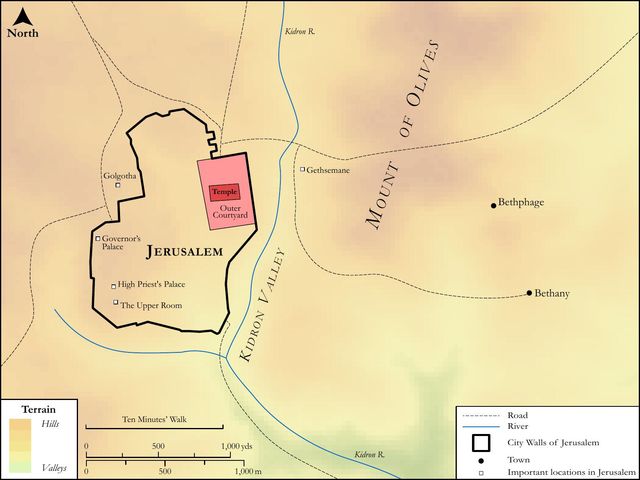

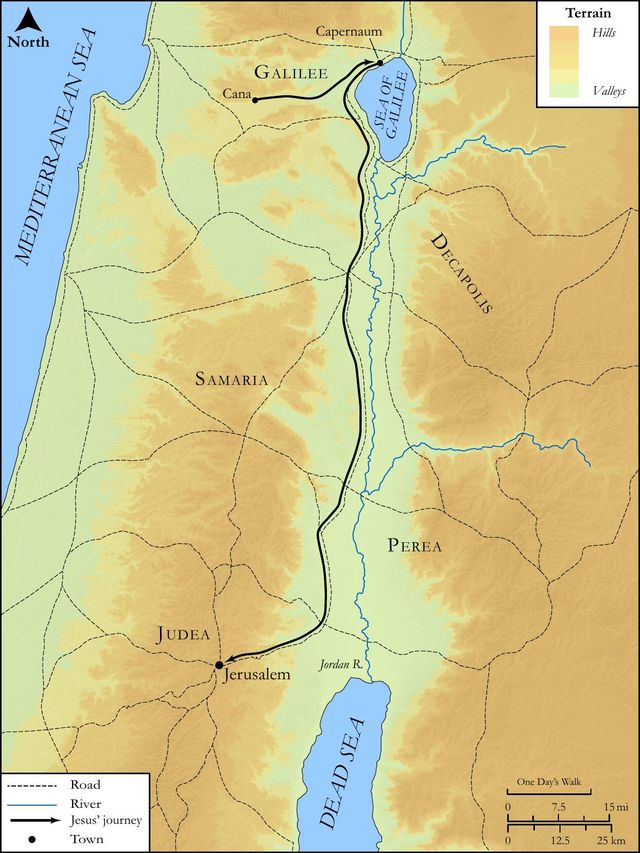
Study this verse
Public-domain commentary
Matthew Henry
From his Commentary on the Whole Bible. Henry comments on passages, not single verses — this entry covers John 2:23–25. His three-level outline is real structure in the source text, so it is rendered as structure.
We have here an account of the success, the poor success, of Christ's preaching and miracles at Jerusalem, while he kept the passover there. Observe,
I.That our Lord Jesus, when he was at Jerusalem at the passover, did preach and work miracles.
People's believing on him implied that he preached; and it is expressly said, They saw the miracles he did. He was now in Jerusalem, the holy city, whence the word of the Lord was to go froth. His residence was mostly in Galilee, and therefore when he was in Jerusalem he was very busy. The time was holy time, the feast-day, time appointed for the service of God; at the passover the Levites taught the good knowledge of the Lord (Ch2 30:22), and Christ took that opportunity of preaching, when the concourse of people was great, and thus he would own and honour the divine institution of the passover.
II.That hereby many were brought to believe in his name, to acknowledge him a teacher come from God, as Nicodemus did (Joh 3:2), a great prophet; and, probably, some of those who looked for redemption in Jerusalem believed him to be the Messiah promised, so ready were they to welcome the first appearance of that bright and morning star.
III.That yet Jesus did not commit himself unto them (Joh 2:24):
ouk episteuen heauton autois - He did not trust himself with them. It is the same word that is used for believing in him. So that to believe in Christ is to commit ourselves to him and to his guidance. Christ did not see cause to repose any confidence in these new converts at Jerusalem, where he had many enemies that sought to destroy him, either,
1.Because they were false, at least some of them, and would betray him if they had an opportunity, or were strongly tempted to do so. He had more disciples that he could trust among the Galileans than among the dwellers at Jerusalem. In dangerous times and places, it is wisdom to take heed in whom you confide; memnēso apistein - learn to distrust. Or,
2.Because they were weak, and I would hope that this was the worst of it; not that they were treacherous and designed him a mischief, but,
(1.)They were timorous, and wanted zeal and courage, and might perhaps be frightened to do a wrong thing. In times of difficulty and danger, cowards are not fit to be trusted. Or,
(2.)They were tumultuous, and wanted discretion and management. These in Jerusalem perhaps had their expectations of the temporal reign of the Messiah more raised than others, and, in that expectation, would be ready to give some bold strokes at the government if Christ would have committed himself to them and put himself at the head of them; but he would not, for his kingdom is not of this world. We should be shy of turbulent unquiet people, as our Master here was, though they profess to believe in Christ, as these did.
IV.That the reason why he did not commit himself to them was because he knew them (Joh 2:25), knew the wickedness of some and the weakness of others. The evangelist takes this occasion to assert Christ's omniscience.
1.He knew all men, not only their names and faces, as it is possible for us to know many, but their nature, dispositions, affections, designs, as we do not know any man, scarcely ourselves. He knows all men, for his powerful hand made them all, his piercing eye sees them all, sees into them. He knows his subtle enemies, and all their secret projects; his false friends, and their true characters; what they really are, whatever they pretend to be. He knows them that are truly his, knows their integrity, and knows their infirmity too. He knows their frame.
2.He needed not that any should testify of man. His knowledge was not by information from others, but by his own infallible intuition. It is the infelicity of earthly princes that they must see with other men's eyes, and hear with other men's ears, and take things as they are represented to them; but Christ goes purely upon his own knowledge. Angels are his messengers, but not his spies, for his own eyes run to and fro through the earth, Ch2 16:9. This may comfort us in reference to Satan's accusations, that Christ will not take men's characters from him.
3.He knew what was in man; in particular persons, in the nature and race of man. We know what is done by men; Christ knows what is in them, tries the heart and the reins. This is the prerogative of that essential eternal Word, Heb 4:12, Heb 4:13. We invade his prerogative if we presume to judge men's hearts. How fit is Christ to be the Saviour of men, very fit to be the physician, who has such a perfect knowledge of the patient's state and case, temper and distemper; knows what is in him! How fit also to be the Judge of all! For the judgment of him who knows all men, all in men, must needs be according to truth.
Now this is all the success of Christ's preaching and miracles at Jerusalem, in this journey. The Lord comes to his temple, and none come to him but a parcel of weak simple people, that he can neither have credit from nor put confidence in; yet he shall at length see of the travail of his soul.
Historical interpretation
Five Centuries of Reception
9 surviving comments on this verse. Each one is dated, so this reads as a timeline rather than a list.
Select a marker to jump to its quote. Markers stagger vertically where authors wrote within a few decades of each other.
For inasmuch as the Word of God was man from the root of Jesse, and son of Abraham, in this respect did the Spirit of God rest upon Him, and anoint Him to preach the Gospel to the lowly. But inasmuch as He was God, He did not judge according to glory, nor reprove after the manner of speech. For "He needed not that any should testify to Him of man, for He Himself knew what was in man." For He called all men that mourn; and granting forgiveness to those who had been led into captivity by their sins, He loosed them from their chains.
Was He one of us, I say, who by one act of intervention at once healed a hundred or more afflicted with various infirmities and diseases; at whose word only the raging and maddened seas were still, the whirlwinds and tempests were lulled; who walked over the deepest pools with unwet foot; who trod the ridges of the deep, the very waves being astonished, and nature coming under bondage; who with five loaves satisfied five thousand of His followers: and who, lest it might appear to the unbelieving and hard of heart to be an illusion, filled twelve capacious baskets with the fragments that remained? Was He one of us, who ordered the breath that had departed to return to the body, persons buried to come forth from the tomb, and after three days to be loosed from the swathings of the undertaker? Was He one of us, who saw clearly in the hearts of the silent what each was pondering, what each had in his secret thoughts?
Of the men of that time some clung to their error, others laid hold on the truth, while of these last, some having retained it for a little while again fell off from it. Alluding to these, Christ compared them to seeds not deeply sown, but having their roots upon the surface of the earth; and He said that they should quickly perish. And these the Evangelist has here pointed out to us, saying, "When He was in Jerusalem, at the Passover, in the feast, many believed on Him, when they saw the miracles which He did." "But Jesus did not commit Himself unto them."
For they were the more perfect among His disciples, who came to Him not only because of His miracles, but through His teaching also. The grosser sort the miracles attracted, but the better reasoners His prophecies and doctrines; and so they who were taken by His teaching were more steadfast than those attracted by His miracles. And Christ also called them "blessed," saying, "Blessed are they that have not seen, and yet have believed." But that these here mentioned were not real disciples, the following passage shows, for it saith, "Jesus did not commit Himself unto them." Wherefore? "Because He knew all things," "And needed not that any should testify of man, for He knew what was in man."
The meaning is of this kind. "He who dwells in men's hearts, and enters into their thoughts, took no heed of outward words; and knowing well that their warmth was but for a season, He placed not confidence in them as in perfect disciples, nor committed all His doctrines to them as though they had already become firm believers." Now, to know what is in the heart of men belongs to God alone, "who hath fashioned hearts one by one"; for, saith Solomon, "Thou, even Thou only, knowest the hearts"; He therefore needed not witnesses to learn the thoughts of His own creatures, and so He felt no confidence in them because of their mere, temporary belief.
(Hom. xxiv. 1) Those had been wiser disciples, however, who were brought to Christ not by His miracles, but by His doctrine. For it is the duller sort who are attracted by miracles; the more rational are convinced by prophecy, or doctrine. And therefore it follows, But Jesus did not commit Himself unto them.
(Hom. xxv. 1) Or it means that He did not place confidence in them, as perfect disciples, and did not, as if they were brethren of confirmed faith, commit to them all His doctrines, for He did not attend to their outward words, but entered into their hearts, and well knew how short-lived was their zeal1. Because He knew all men, and needed not that any should testify of man, for He knew what was in man. To know what is in man's heart, is in the power of God alone, who fashioned the heart. He does not want witnesses, to inform Him of that mind, which was of His own fashioning.
If they believed, why did he not entrust himself to them? Clearly the words “many believed in him” are not said about a firm and true faith, such as the faith of those who, after believing once that his words were true, considered him as a doctor of truth, without doubting the things said by him. That kind of faith is typical of the true believers. But here, John refers to people who were astonished by the events that happened and praised him as a great and admirable man. In fact, not all of them approved his words by showing their respect for him to others. Such respect, too, is typical of true believers. So, he added, “But Jesus on his part would not entrust himself to them.” In these words there is a particular doctrine of the true faith. Indeed, the virtue of the knowledge of Christ is revealed through which he was not cheated by the outward appearance of those coming to him. Rather by recognizing precisely each of them for who they were, he knew already who were the true disciples and who were in doubt and coming to him under false pretenses.
"Because He knew all men, and needed not that any should bear witness of man: for Himself knew what was in man." The artificer knew what was in His own work better than the work knew what was in itself. The Creator of man knew what was in man, which the created man himself knew not. Do we not prove this of Peter, that he knew not what was in himself, when he said, "With Thee, even to death"? Hear that the Lord knew what was in man: "Thou with me even to death? Verily, verily, I say unto thee, Before the cock crow, thou shalt deny me thrice." The man, then, knew not what was in himself; but the Creator of the man knew what was in the man.
(Tr. xi. in Joan. c. 2. 3) What meaneth this, Many believed in His Name—but Jesus did not commit Himself unto them? Was it that they did not believe in Him, but only pretended that they did? In that case the Evangelist would not have said, Many believed in His Name. Wonderful this, and strange, that men should trust Christ, and Christ trusts not Himself to men; especially considering that He was the Son of God, and suffered voluntarily, or else need not have suffered at all. Yet such are all catechumens. If we say to a catechumen, Believest thou in Christ? he answers, I do believe, and crosses himself. If we ask him, Dost thou eat the flesh of the Son of man? he knows not what we sayk, for Jesus has not committed Himself to him.
(Tr. xi. c. 2) The Maker knew better what was in His own work, than the work knew what was in itself. Peter knew not what was in himself when he said, I will go with Thee unto death; (Luke 22:33. ver. 61) but our Lord's answer showed that He knew what was in man; Before the cock crow, thou shalt thrice deny Me.
truly God doth the Psalmist ascribe it, saying, He fashioneth their hearts alike, He considereth all |166 their works. But if while God Alone understandeth what is in us, Christ understandeth them: how shall He not be God by Nature, Who knoweth the secrets, and knoweth the deep and secret things, as it is written? For what man knoweth the things of a man, save the spirit of man which is in him? Though no man knoweth, God will not be ignorant, for neither is He reckoned in the number of all, of whom "No man" may rightly be predicated, but as being external to all, and all things under His Feet, He will know. And Paul too will testify, saying, For the word of God is quick and powerful and sharper than any two edged sword, piercing even to the dividing asunder of soul and spirit, and of the joints and marrow, and is a discerner of the thoughts and intents of the heart: neither is there any creature that is not manifest in His sight, but all things are naked and opened unto the Eyes of Him. For as having planted the ear, He hears all things, and as having formed the eye, He observeth. And indeed He is introduced saying in Job, Who is this that hideth counsel from Me, holding words in his heart, and thinketh to conceal them from Me? In order then that we might acknowledge that the Son is by Nature God, needs does the Evangelist say that He needed not that any should testify of man, for He knew what was in man.
(in loc.) The Evangelist has related above what our Lord did on his way to Jerusalem; now He relates how others were affected towards Him at Jerusalem; Now when He was in Jerusalem at the Passover, in the feast day, many believed in His Name, when they saw the miracles which He did.
An admonition to us not to be confident of ourselves, but ever anxious and mistrustful; knowing that what escapes our own knowledge, cannot escape the eternal Judge.
Continue studying John 2:25 across the web’s major study libraries — every link below opens this exact verse, chapter, or book on the destination site.
Read & Compare
 BibleGatewayThis verse in more than 200 translations and 70 languages.
 Bible.comThe YouVersion reader — hundreds of translations, reading plans, and highlights.
 ESV.orgCrossway's official English Standard Version reader.
 NET BibleThe NET translation with 60,000+ translators' notes on every rendering decision.
 STEP BibleTyndale House's free study tool — original text, vocabulary, and scholarly resources.
 BibliaLogos Bible Software's free web reader.
 USCCBThe New American Bible (Revised Edition) with the U.S. bishops' study notes.
Commentaries
 BibleHub CommentariesDozens of classic commentaries on this verse, gathered on one page.
 StudyLightMore than 100 commentary sets — the largest collection on the web.
 BibleRefPlain-English commentary on what this verse means, verse by verse.
 Enduring WordDavid Guzik's free commentary on this chapter, widely used by Bible teachers.
 Bible Study ToolsVerse commentary alongside Greek and Hebrew study aids.
Original Language & Research
- BibleHub InterlinearThe verse word by word — original language, transliteration, and English.
- BibleHub LexiconEvery word's original-language definition and Strong's entry.
 Blue Letter BibleDeep-study tools — Strong's numbers, concordance, and word studies.
 CNTR CollationThe earliest Greek manuscripts of this verse, collated letter by letter.
Sermons, Hymns & Audio


TrulyRandomVerse is not affiliated with these sites and doesn’t control their content. They’re linked because they’re genuinely useful.
Summary
concludes a passage highlighting Jesus' profound and inherent understanding of human nature, explaining why He did not fully entrust Himself to the crowds who believed in Him based solely on His miracles. This verse asserts Jesus' divine omniscience, revealing that He possessed an innate, intuitive knowledge of the inner thoughts, intentions, and true character of every individual, rendering external testimony or human assessment unnecessary for Him.
Context
ShowHideLiterary Context
This verse serves as the powerful conclusion to a brief but pivotal section in John's Gospel (John 2:23-25) that immediately follows the miracle at Cana and the cleansing of the temple. John 2:23 notes that "many believed in his name, when they saw the miracles which he did" during the Passover feast in Jerusalem. However, John 2:24 introduces a crucial caveat: "But Jesus did not commit himself unto them." John 2:25 then provides the divine rationale for this caution, emphasizing Jesus' unique ability to discern the true nature of human belief, distinguishing between superficial assent based on signs and genuine, heart-level commitment. This sets the stage for later encounters, such as with Nicodemus in John 3, where the nature of true faith is further explored.
Historical & Cultural Context
The setting is the Passover feast in Jerusalem, a time when the city would be teeming with pilgrims from all over the Jewish world. Miracles, or "signs" (σημεῖα, sēmeia), were often seen as authenticating a prophet's message or divine commission within Jewish culture. Many people, witnessing Jesus' powerful deeds, would naturally be impressed and declare belief. However, such belief could be pragmatic, seeking personal benefit or political deliverance, rather than spiritual transformation. The historical context of a people longing for a Messiah, often envisioned as a political deliverer, meant that "belief" could carry varied and sometimes superficial connotations. Jesus, as a divine figure, operates outside the limitations of human perception and cultural expectations, possessing an inherent understanding that transcends outward displays or popular opinion.
Key Themes
ShowHideThis verse powerfully contributes to several overarching themes in John's Gospel. Firstly, it underscores Jesus' Divine Omniscience, a recurring motif demonstrating His inherent deity. Unlike human judges who rely on external testimony, Jesus possesses an intrinsic knowledge of the human heart, revealing His divine nature and authority. Secondly, it highlights the Nature of True Faith. The contrast between the "many who believed" (John 2:23) and Jesus' refusal to "commit himself unto them" (John 2:24) reveals that not all belief is genuine or salvific. Jesus' ability to know "what was in man" (John 2:25) implies that true faith involves more than intellectual assent to miracles; it requires a transformed heart and genuine commitment. This theme resurfaces throughout John's narrative, distinguishing between superficial adherence and profound, life-altering belief, as seen in passages like John 6:66-69. Lastly, it speaks to the Fallenness and Complexity of Human Nature, affirming that Jesus understands humanity's deepest flaws, hidden motives, and inherent sinfulness, even beneath a veneer of religiosity or outward belief.
Exposition and Analysis
ShowHideKey Word Analysis
ShowHideThis primary particle serves to assign a reason or provide an explanation. In John 2:25, "for" directly explains why Jesus "needed not that any should testify of man." It indicates that His inherent knowledge of humanity was the foundational reason for His discerning caution, linking the two clauses in a cause-and-effect relationship.
This verb signifies a deep, experiential, and intuitive knowledge, not merely intellectual apprehension or factual information. When applied to Jesus, it implies a profound, intrinsic understanding of the essence of humanity, encompassing not just general human nature but also the specific, hidden inner state, thoughts, intentions, and motives of individuals. This is a knowledge that transcends observation or testimony, pointing to His divine insight.
As a primary preposition, "in" denotes fixed position, state, or even instrumentality. Here, "what was in man" (τὸ ἐν τῷ ἀνθρώπῳ, to en tō anthrōpō) refers to the internal state, the very core of a person's being—their thoughts, desires, intentions, character, and hidden motives. It's not just about what a person does but what they are at their deepest level, unseen by human eyes.
Verse Breakdown
ShowHide"And needed not that any should testify of man:"
This clause emphasizes Jesus' self-sufficiency and divine independence from human input or assessment. Unlike human judges or leaders who require witnesses, reports, or observations to understand others, Jesus had no such need. His knowledge was not derived or dependent on external sources; it was intrinsic. The phrase "testify of man" refers to any form of human witness, evidence, or declaration about a person's character, motives, or state.
"for he knew what was in man."
This second clause provides the divine rationale for the first. Jesus' lack of need for human testimony stemmed from His perfect, inherent knowledge of humanity. "What was in man" refers to the deepest recesses of the human heart and mind—the thoughts, intentions, desires, weaknesses, and hidden motives. This is a profound statement about Jesus' omniscience, portraying Him as one who sees beyond outward appearances and actions, directly into the core of human nature.
Literary Devices
ShowHideThe verse employs Assertion to declare Jesus' divine attribute directly. It uses Contrast by juxtaposing human dependence on external testimony with Jesus' inherent, self-sufficient knowledge. This highlights His unique divine nature against the backdrop of human limitations. Furthermore, the statement functions as a form of Revelation, unveiling a key aspect of Jesus' identity as the omniscient Son of God. The phrase "what was in man" can also be seen as a form of Synecdoche, where "man" represents all of humanity, and "what was in" refers to the comprehensive internal reality of human beings.
Theological and Thematic Connections
ShowHideJohn 2:25 is a profound theological statement affirming Jesus' divine omniscience and His unique insight into the human heart. This attribute sets Him apart from all humanity and aligns Him perfectly with the God of Israel, who alone "knows the hearts of all the children of men" (1 Kings 8:39). It underscores that Jesus' understanding of individuals transcends mere observation or intellectual deduction; it is an inherent, intuitive, and complete knowledge of their innermost being, including their true motives, hidden thoughts, and the depth of their sinfulness or potential for genuine faith. This divine discernment is crucial for His role as Savior, as He alone can truly address the root issues of the human condition.
Reflection and Application
ShowHideJohn 2:25 offers both immense comfort and a profound challenge to believers today. The comfort lies in knowing that Jesus, our Lord and Savior, truly understands us at the deepest level. He sees beyond our outward expressions, our carefully constructed facades, and even our own limited self-knowledge. He knows our hidden struggles, our unexpressed fears, our deepest longings, and the true motivations behind our actions. This means we can approach Him with complete honesty, knowing there is nothing to hide or pretend. The challenge, however, is to examine the authenticity of our own faith. Are we drawn to Christ primarily by His blessings, His power, or what we can gain from Him, much like those in Jerusalem who believed because of His signs? Or is our faith rooted in a genuine, heart-level commitment to Him as Lord and Savior, recognizing His true identity and submitting to His will? This verse calls us to cultivate a sincere, transparent relationship with Jesus, allowing His divine knowledge to expose and transform every part of our being.
Questions for Reflection
ShowHideFAQ
ShowHideWhat does "needed not that any should testify of man" mean in this context?
ShowHideThis phrase means that Jesus did not require human testimony, external information, or any form of human assessment to understand people. Unlike human beings who rely on observation, reports, or someone else's witness to form an opinion about another person, Jesus possessed an inherent, divine knowledge. He didn't need anyone to "tell" Him about a person's character, motives, or true intentions because He already knew them intimately, from the inside out. It highlights His self-sufficient and omniscient nature as God.
Does Jesus' knowledge of "what was in man" imply He mistrusted people?
ShowHideNot necessarily mistrust in a negative, human sense, but rather a perfect, divine discernment. Jesus' knowledge of "what was in man" (which includes human fallenness, sin, and superficiality, as well as potential for genuine faith) led Him to exercise divine caution. He knew that many who "believed in his name" (as described in John 2:23) were doing so based on external signs and wonders, not on a deep, transformative understanding of His true identity and mission. Therefore, He did not "commit himself unto them" (John 2:24) in the same way He would with His truly committed disciples. This was not a lack of love, but a perfect understanding of the human heart's capacity for superficiality and a protection of His divine mission.
Christ-Centered Fulfillment
ShowHideJohn 2:25 powerfully foreshadows and undergirds the entirety of Christ's redemptive work. His inherent knowledge of "what was in man"—the depths of human sinfulness, the deceitfulness of the heart (Jeremiah 17:9), and humanity's utter inability to save itself—is precisely why He came. As the divine Son, Jesus fully understood the fallen condition of humanity and the radical solution required: His own perfect life, atoning death, and victorious resurrection. This omniscience means that when Jesus calls us to follow Him, He does so with full awareness of our weaknesses, our past failures, and our future struggles, yet He still extends grace and offers transformation. He is not surprised by our shortcomings, nor does He need us to pretend to be something we are not. This divine insight is crucial for His role as our great High Priest, who "can sympathize with our weaknesses, having been tempted in every way, just as we are—yet without sin" (Hebrews 4:15). Ultimately, His knowledge of what is in man enables Him to be the perfect Savior, who died for us "while we were still sinners" (Romans 5:8), and who will one day judge all humanity with perfect righteousness, for He truly knows every heart and every secret (Romans 2:16).