


2 Chronicles 30:22
- וַיְדַבֵּרvay·da·Berand he spokeH1696Conj-w ¦ V-Piel-ConsecImperf-3msVerb Piel Consecutive Imperfect 3rd Singular Masculineוַandיְדַבֵּרhe spoke
- יְחִזְקִיָּהוּye·chiz·ki·Ya·huHezekiahH2396N-proper-mNoun Proper Masculine
- עַל'altoH5921PrepPreposition
- לֵבlev[the] heart ofH3820N-mscNoun Singular Masculine Construct
- כָּלkolallH3605N-mscNoun Singular Masculine Construct
- הַלְוִיִּםhal·vi·Yimthe LevitesH3881Art ¦ N-mpNoun Gentilic Plural Masculine AbsoluteהַtheלְוִיִּםLevites
- הַמַּשְׂכִּילִיםha·mas·ki·Limwho were understandingH7919Art ¦ V-Hiphil-Prtcpl-mpVerb Hiphil Participle Plural Masculine Absoluteהַwhoמַּשְׂכִּילִיםwere understanding
- שֵׂכֶלse·khelunderstandingH7922N-msNoun Singular Masculine Absolute
- טוֹבTovgoodH2896Adj-msAdjective Singular Masculine Absolute
- לַיהוָהla·Yah·wehto YahwehH3068Prep-l ¦ N-properNoun Proper TitleלַtoיהוָהYahweh
- וַיֹּאכְלוּvai·yo·khe·Luand they ateH398Conj-w ¦ V-Qal-ConsecImperf-3mpVerb Qal Consecutive Imperfect 3rd Plural Masculineוַandיֹּאכְלוּthey ate
- אֶת'et<obj.>H853DirObjMParticle Object Indicator
- הַמּוֹעֵדha·mo·'Edthe appointed feastH4150Art ¦ N-msNoun Singular Masculine Absoluteהַtheמּוֹעֵדappointed feast
- שִׁבְעַתshiv·'At[the] sevenH7651N-cscNoun Singular common gender Construct
- הַיָּמִיםhai·ya·Mimthe daysH3117Art ¦ N-mpNoun Plural Masculine Absoluteהַtheיָּמִיםdays
- מְזַבְּחִיםme·za·be·ChimsacrificingH2076V-Piel-Prtcpl-mpVerb Piel Participle Plural Masculine Absolute
- זִבְחֵיziv·Cheisacrifices ofH2077N-mpcNoun Plural Masculine Construct
- שְׁלָמִיםshe·la·Mimpeace offeringsH8002N-mpNoun Plural Masculine Absolute
- וּמִתְוַדִּיםu·Mit·va·Dimand giving thanksH3034Conj-w ¦ V-Hithpael-Prtcpl-mpVerb Hithpael Participle Plural Masculine Absoluteוּandמִתְוַדִּיםgiving thanks
- לַיהוָהla·Yah·wehto YahwehH3068Prep-l ¦ N-properNoun Proper TitleלַtoיהוָהYahweh
- אֱלֹהֵי'e·lo·Hei[the] God ofH430N-mpcNoun Plural Masculine Construct
- אֲבוֹתֵיהֶם'a·vo·tei·Hemtheir ancestorsH1N-fpc ¦ 3mpNoun Plural Feminine Constructאֲבוֹתֵיancestorsהֶםtheir
English is a literal word-by-word gloss of the Hebrew, not the KJV's wording. Why?
This is the original text the KJV's translators worked from — each Hebrew word with its own literal English meaning in this verse, prepared by scholars at Tyndale House, Cambridge. The KJV translates whole sentences, not word by word, so its wording differs: one Hebrew word can become several English words, and the KJV may choose “the LORD” where the gloss reads “Yahweh”. Both are faithful — they answer different questions. For the KJV's own rendering, switch to the KJV text.
Details
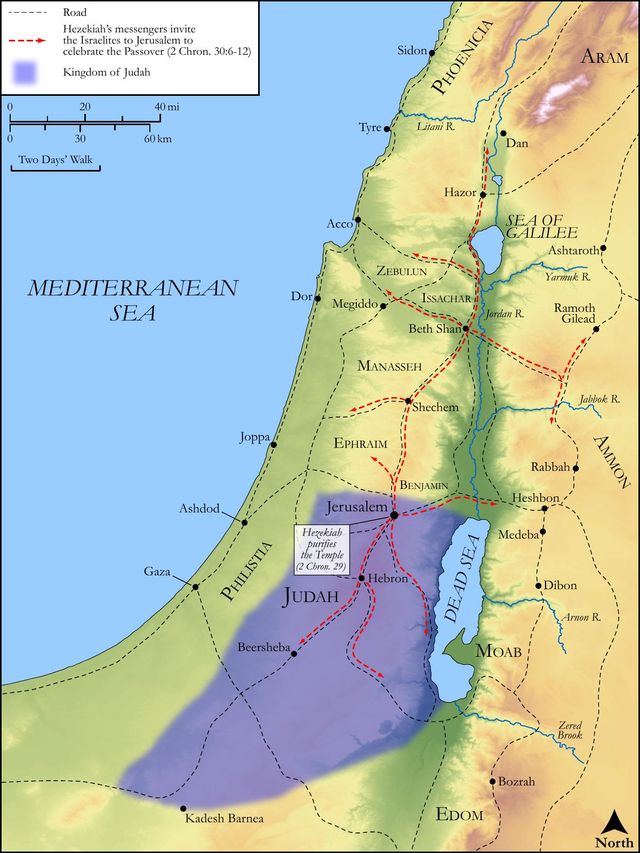
See on the biblical-era map
Study this verse
Public-domain commentary
Matthew Henry
From his Commentary on the Whole Bible. Henry comments on passages, not single verses — this entry covers 2 Chronicles 30:21–27.
After the passover followed the feast of unleavened bread, which continued seven days. How that was observed we are here told, and every thing in this account looks pleasant and lively. 1. Abundance of sacrifices were offered to God in peace-offerings, by which they both acknowledged and implored the favour of God, and on part of which the offerers feasted with their friends during these seven days (Ch2 30:22), in token of their communion with God and the comfort they took in his favour and their reconciliation to him. To keep up this part of the service, that God's altar might be abundantly regaled with the fat and blood and his priests and people with the flesh of the peace-offerings, Hezekiah gave out of his own stock 1000 bullocks and 7000 sheep, and the princes, excited by his pious example, gave the same number of bullocks and a greater number of sheep, and all for peace-offerings, Ch2 30:24. By this God was honoured, the joy of the festival was kept up, and the strangers were encouraged to come again to Jerusalem. It was generously done of the king and the princes thus plentifully to entertain the whole congregation; but what is a great estate good for but that it puts men into a capacity of doing so much the more good? Christ feasted those that followed him. I believe neither Hezekiah nor his princes were the poorer at the year's end for this their pious liberality. 2. Many good prayers were put up to God with the peace-offerings, Ch2 30:22. They made confession to the Lord God of their fathers, in which the intent and meaning of the peace-offerings were directed and explained. When the priests sprinkled the blood and burnt the fat they made confession, so did the people when they feasted on their part. They made a religious confession of their relation to God and dependence upon him, a penitent confession of their sins and infirmities, a thankful confession of God's mercies to them, and a supplicatory confession of their wants and desires; and, in all these, they had an eye to God as the God of their fathers, a God in covenant with them. 3. There was a great deal of good preaching. The Levites (whose office it was, Deu 33:10) taught the people the good knowledge of the Lord, read and opened the scriptures, and instructed the congregation concerning God and their duty to him; and great need there was of this, after so long a famine of the word as there had been in the last reign. Hezekiah did not himself preach, but he spoke comfortably to the Levites that did, attended their preaching, commended their diligence, and assured them of his protection and countenance. Hereby he encouraged them to study hard and take pains, and put a reputation upon them, that the people might respect and regard them the more. Princes and magistrates, by owning and encouraging faithful and laborious preachers, greatly serve the interest of God's kingdom among men. 4. They sang psalms every day (Ch2 30:21): The Levites and priests praised the Lord day by day, both with songs and musical instruments, thus expressing their own and exciting one another's joy in God and thankfulness to him. Praising God should be much of our work in our religious assemblies. 5. Having kept the seven days of the feast in this religious manner, they had so much comfort in the service that they kept other seven days, Ch2 30:23. They did not institute any new modes of worship, but repeated and continued the old. The case was extraordinary: they had been long without the ordinance; guilt had been contracted by the neglect of it; they had now got a very great congregation together, and were in a devout serious frame; they knew not when they might have such another opportunity, and therefore could not now find in their hearts to separate till they had doubled the time. Many of them were a great way from home, and had business in the country to look after, for, this being the second month, they were in the midst of their harvest; yet they were in no haste to return: the zeal of God's house made them forget their secular affairs. How unlike those who snuffed at God's service, and said, What a weariness is it! Or those who asked, When will the sabbath be gone? The servants of God should abound in his work. 6. All this they did with gladness (Ch2 30:23); they all rejoiced, and particularly the strangers, Ch2 30:25. So there was great joy in Jerusalem, Ch2 30:26. Never was the like since the dedication of the temple in Solomon's time. Note, Holy duties should be performed with holy gladness; we should be forward to them, and take pleasure in them, relish the sweetness of communion with God, and look upon it as matter of unspeakable joy and comfort that we are thus favoured and have such earnests of everlasting joy. 7. The congregation was at length dismissed with a solemn blessing, Ch2 30:27. (1.) The priests pronounced it; for it was part of their office to bless the people (Num 6:22, Num 6:23), in which they were both the people's mouth to God by way of prayer and God's mouth to the people by way of promise; for their blessing included both. In it they testified both their desire of the people's welfare and their dependence upon God and that word of his grace to which they commended them. What a comfort is it to a congregation to be sent home thus crowned! (2.) God said Amen to it. The voice of the priests, when they blessed the people, was heard in heaven and came up to the habitation of God's holiness. When they pronounced the blessing God commanded it, and perhaps gave some sensible token of the ratification of it. The prayer that comes up to heaven in a cloud of incense will come down again to this earth in showers of blessings.
Continue studying 2 Chronicles 30:22 across the web’s major study libraries — every link below opens this exact verse, chapter, or book on the destination site.
Read & Compare
 BibleGatewayThis verse in more than 200 translations and 70 languages.
 Bible.comThe YouVersion reader — hundreds of translations, reading plans, and highlights.
 ESV.orgCrossway's official English Standard Version reader.
 NET BibleThe NET translation with 60,000+ translators' notes on every rendering decision.
 STEP BibleTyndale House's free study tool — original text, vocabulary, and scholarly resources.
 BibliaLogos Bible Software's free web reader.
 USCCBThe New American Bible (Revised Edition) with the U.S. bishops' study notes.
Commentaries
 BibleHub CommentariesDozens of classic commentaries on this verse, gathered on one page.
 StudyLightMore than 100 commentary sets — the largest collection on the web.
 BibleRefPlain-English commentary on what this verse means, verse by verse.
 Enduring WordDavid Guzik's free commentary on this chapter, widely used by Bible teachers.
 Bible Study ToolsVerse commentary alongside Greek and Hebrew study aids.
Original Language & Research
- BibleHub InterlinearThe verse word by word — original language, transliteration, and English.
- BibleHub LexiconEvery word's original-language definition and Strong's entry.
 Blue Letter BibleDeep-study tools — Strong's numbers, concordance, and word studies.
 SefariaThe Hebrew text with Rashi and centuries of Jewish commentary.
Sermons, Hymns & Audio


TrulyRandomVerse is not affiliated with these sites and doesn’t control their content. They’re linked because they’re genuinely useful.
Summary
This verse captures a profound moment in Judah's spiritual revival under King Hezekiah, emphasizing the indispensable role of the Levites in disseminating God's truth. It highlights Hezekiah's heartfelt commendation of these spiritual instructors and describes the people's joyous, extended celebration of the Passover feast, marked by communal eating, the offering of peace offerings, and sincere confession to the God of their ancestors. The passage powerfully underscores the interconnectedness of faithful instruction, heartfelt worship, and genuine repentance in fostering national spiritual renewal and restored communion with the divine.
Context
ShowHideLiterary Context
This pivotal verse is situated within the broader narrative of King Hezekiah's sweeping religious reforms and the unprecedented Passover celebration in Jerusalem, detailed in 2 Chronicles 29 and 2 Chronicles 30. Chapter 29 describes the cleansing and consecration of the Temple, which had been defiled under his idolatrous father, Ahaz. Chapter 30 then chronicles Hezekiah's audacious call to all Israel, including the long-estranged northern kingdom, to observe the Passover. 2 Chronicles 30:21 recounts the initial seven days of the Feast of Unleavened Bread, which followed the Passover. Verse 22 then introduces the extraordinary decision to extend this feast for an additional seven days, a spontaneous act born of the assembly's overwhelming joy and renewed commitment to the LORD. This verse specifically highlights the Levites' crucial role during this extended period, setting the stage for the subsequent destruction of idolatrous altars and the reorganization of Temple service described in 2 Chronicles 31.
Historical & Cultural Context
King Hezekiah ascended the throne of Judah after the reign of his father, Ahaz, who had plunged the nation into deep idolatry, even sacrificing his own son and shutting the doors of the Temple. Hezekiah immediately embarked on a radical spiritual reformation, seeking to restore the pure worship of Yahweh. The Passover celebration described here was extraordinary for several reasons: it was observed in the second month, as permitted by Mosaic Law (Numbers 9:10-11) for those unable to keep it in the first month; it included participants from the northern kingdom of Israel, a rare and significant act of unity since the kingdom's division; and it was marked by a profound, spontaneous extension of the feast. The Levites, traditionally responsible for the intricate details of Temple service, carrying the Ark, and teaching the Law (as mandated in Deuteronomy 33:10), played an indispensable role in facilitating the massive number of sacrifices and instructing the people in proper worship and the significance of the Law. The "peace offerings" were voluntary sacrifices of thanksgiving, communion, or vows, signifying restored fellowship with God, as detailed in Leviticus 7:11-21.
Key Themes
ShowHideThe passage powerfully articulates several key themes central to the book of Chronicles and the broader biblical narrative. Firstly, it underscores the theme of National Revival and Restoration, demonstrating God's willingness to restore a repentant people, even after generations of spiritual decline, when leaders and people turn back to Him. Secondly, it highlights the Indispensable Role of Spiritual Leadership and Teaching, particularly through the Levites, whose diligent instruction in "the good knowledge of the LORD" was foundational to the people's spiritual awakening and their ability to worship rightly. Thirdly, the extended feast and the abundance of offerings emphasize Joyful, Communal Worship and Fellowship, portraying worship not as a burdensome duty but as a spontaneous, overflowing expression of gratitude and deep communion with God and one another. Finally, the act of "making confession" underscores the vital theme of Repentance and Reconciliation, recognizing that genuine spiritual renewal is always preceded by humility and acknowledgment of sin before God, a principle echoed throughout Scripture, such as in Psalm 32:5.
Exposition and Analysis
ShowHideKey Word Analysis
ShowHideThis word literally means "heart." When combined with "spake" (H1696, dâbar), the phrase "spake comfortably" (Hebrew, dibber al-lev) idiomatically means to "speak to the heart," "speak kindly," or "speak encouragingly." It conveys a profound sense of empathy, reassurance, and affirmation. Hezekiah's words were not merely a formal address but a heartfelt commendation, acknowledging the Levites' tireless dedication and the spiritual and physical demands of their service during the arduous, extended festival. This affirmation boosted their morale and validated their crucial role in the revival.
This term denotes intelligence, discretion, understanding, and wisdom. When coupled with "good" (H2896, ṭôwb), "the good knowledge of the LORD" refers to a beneficial, wholesome, and life-giving understanding of God's character, His laws, and His will. It signifies more than mere intellectual assent; it implies a practical, experiential wisdom that leads to righteous living, true worship, and a deeper, transformative relationship with God. This "good knowledge" was the spiritual bedrock upon which the entire national revival was built.
This refers to a voluntary sacrifice made to express thanksgiving, fulfill a vow, or as a freewill offering. It is derived from a root meaning "to be complete" or "to be at peace." These offerings symbolized fellowship and communion with God and fellow worshippers, often culminating in a communal meal where portions of the sacrifice were eaten by the offerer and priests. Their abundance during this feast signifies the people's overflowing gratitude and their fervent desire for restored harmony and shalom (wholeness, peace) with God, marking a profound shift from their previous state of alienation.
Verse Breakdown
ShowHide"And Hezekiah spake comfortably unto all the Levites that taught the good knowledge of the LORD"
This opening clause immediately highlights King Hezekiah's personal and profound affirmation of the Levites. His act of "speaking comfortably" (literally, "to the heart") conveys deep appreciation for their tireless efforts in educating the people about God's ways and facilitating the complex sacrificial system. The emphasis on the Levites' role as teachers of "the good knowledge of the LORD" underscores the foundational importance of sound theological instruction in fostering genuine faith, righteous living, and authentic worship within the community.
"and they did eat throughout the feast seven days"
This phrase describes the continuation and extraordinary extension of the Passover celebration. While the initial Feast of Unleavened Bread lasted seven days (as prescribed in Exodus 12:15), this verse speaks of an additional seven days, making a total of fourteen. This unprecedented duration signifies the overwhelming zeal, joy, and spiritual hunger of the people, who were so moved by God's goodness and their renewed relationship with Him that they desired to prolong their communal worship and fellowship. The act of "eating" symbolizes communal celebration, sustenance, and shared life in God's presence.
"offering peace offerings"
This clause specifies a key aspect of their worship during the extended feast. The proliferation of peace offerings indicates a spirit of profound thanksgiving, overflowing joy, and a fervent desire for communion with God. These voluntary sacrifices, which often involved shared meals, were a tangible and communal expression of the people's restored relationship with Yahweh, celebrating the peace and reconciliation they had found and reinforcing their fellowship with one another.
"and making confession to the LORD God of their fathers."
This final clause reveals the profound humility and repentance that characterized the revival. The act of "confession" signifies a public or private acknowledgment of sin, a turning away from past transgressions, and a turning back to God. It was a crucial element of their spiritual cleansing and reconciliation, demonstrating that their joy and offerings were rooted not in mere emotionalism but in a genuine, contrite heart before the God who had faithfully covenanted with their ancestors, thereby underscoring the sincerity of their spiritual renewal.
Literary Devices
ShowHideThe verse employs several potent literary devices to convey its powerful message of spiritual renewal. Emphasis is placed on the Levites' teaching role and the extraordinary nature of the extended feast, underscoring their significance in the revival and the depth of the people's commitment. The phrase "spake comfortably" utilizes Idiom (literally "spoke to the heart") to convey the profound depth of Hezekiah's encouragement and empathy, moving beyond a mere formal address to a deeply personal affirmation. The sequence of "eating," "offering peace offerings," and "making confession" demonstrates a clear Progression from communal celebration to sacrificial worship and, finally, to contrite repentance, illustrating the multifaceted and holistic nature of true spiritual renewal. The entire scene functions as Symbolism, with the extended feast and the acts of worship symbolizing the restored relationship between God and His people, a relationship now marked by overflowing joy, profound peace, and humble obedience.
Theological and Thematic Connections
ShowHideThis verse powerfully illustrates God's desire for His people to know Him intimately and to worship Him wholeheartedly. It reveals a reciprocal relationship between diligent spiritual instruction and genuine spiritual transformation: the Levites' faithful teaching of "the good knowledge of the LORD" directly facilitated the people's ability to engage in meaningful worship, characterized by joyful communion (eating and peace offerings) and sincere repentance (confession). This dynamic demonstrates that true revival is not merely emotional fervor but is rooted in a deep understanding of God's character and a humble, obedient response to His truth. The emphasis on "the LORD God of their fathers" also connects this current revival to the enduring covenant faithfulness of Yahweh across generations, reinforcing the continuity of God's redemptive plan and His unwavering commitment to His people, even when they stray.
Reflection and Application
ShowHideThe account of Hezekiah and the Levites in 2 Chronicles 30:22 offers profound and enduring lessons for believers today, highlighting the essential components of a vibrant spiritual life and a healthy faith community. Just as Hezekiah affirmed the Levites, we are called to recognize, value, and actively support those who faithfully teach and shepherd God's people, understanding that their diligent efforts in imparting "the good knowledge of the LORD" are foundational for spiritual growth and maturity within the church. This verse reminds us that true worship is not merely ritualistic or perfunctory but is characterized by overflowing joy, authentic communal fellowship, and a humble spirit of confession. It prompts us to critically examine our own pursuit of God's knowledge, asking whether our understanding of Him is truly "good"—transformative, life-giving, and leading to deeper devotion. Furthermore, the emphasis on peace offerings and confession encourages us to cultivate a lifestyle of spontaneous thanksgiving and regular, sincere repentance, ensuring that our communion with God remains unhindered and our hearts are continually aligned with His perfect will.
Questions for Reflection
ShowHideFAQ
ShowHideWhy did Hezekiah "speak comfortably" to the Levites?
ShowHideHezekiah "spoke comfortably" (literally, "spoke to the heart" or "spoke kindly") to the Levites to offer them profound encouragement and affirmation. Their role during the extended Passover feast was incredibly demanding, involving the facilitation of countless sacrifices, the meticulous oversight of Temple rituals, and the continuous instruction of a large, spiritually hungry populace. Hezekiah's words were a heartfelt commendation, recognizing their tireless dedication and vital contribution to the national spiritual revival. This royal endorsement not only boosted their morale but also reinforced their authority and importance in the eyes of the people, underscoring the value of faithful spiritual leadership and the king's personal investment in their well-being, as seen in 2 Chronicles 29:11.
What is "the good knowledge of the LORD" that the Levites taught?
ShowHide"The good knowledge of the LORD" refers to a beneficial, life-transforming understanding of God's character, His covenant, His laws, and His will. It's not merely intellectual information but a practical, spiritual wisdom that leads to righteous living, true worship, and a deeper, more intimate relationship with God. This knowledge was essential for the people to understand the significance of the Passover, the purpose of the offerings, and the necessity of confession, thereby enabling genuine spiritual growth and national renewal. This concept aligns with the wisdom literature, which champions the pursuit of divine understanding as the foundation of life, as highlighted in Proverbs 9:10.
What was the significance of "peace offerings" and "confession" during this extended feast?
ShowHideThe abundance of "peace offerings" (also known as fellowship offerings or sacrifices of well-being) during the extended feast signified the people's overflowing gratitude, joy, and fervent desire for communion with God. These voluntary sacrifices were often accompanied by communal meals, symbolizing restored fellowship and harmony between God and His people, and among the people themselves. "Confession" was a crucial act of humility and repentance, where individuals and the nation publicly acknowledged their sins before God. This public and private acknowledgment was essential for cleansing, forgiveness, and restoring a right relationship with the Holy God, demonstrating that true spiritual renewal is always rooted in a contrite heart and a turning away from sin, as seen in Psalm 32:5.
Christ-Centered Fulfillment
ShowHideThe events of 2 Chronicles 30:22 find their ultimate and perfect fulfillment in Jesus Christ. Hezekiah, as a righteous king who led his people in a profound spiritual revival, foreshadows Christ, the perfect King who inaugurates the ultimate and eternal spiritual restoration for all humanity. The Levites, who diligently taught "the good knowledge of the LORD," point to Jesus as the supreme Teacher and the very embodiment of God's wisdom and truth. In Christ, we receive the fullness of "the good knowledge of the LORD," for He is the Word made flesh (John 1:14) and the one in whom "are hidden all the treasures of wisdom and knowledge" (Colossians 2:2-3). The peace offerings, which symbolized communion and reconciliation with God, are perfectly fulfilled in Christ's singular, perfect sacrifice on the cross, through which He became our peace, breaking down the wall of hostility and reconciling us to God once for all (Ephesians 2:14-16). Finally, the act of confession before "the LORD God of their fathers" finds its ultimate efficacy and power through Christ's atoning blood. It is through confessing our sins to God, confident in Christ's finished work, that we receive forgiveness and cleansing, as promised in 1 John 1:9). The extended feast, a time of overflowing joy and communal fellowship, foreshadows the eternal feast of intimate communion with God that believers will experience in Christ's presence, culminating in the glorious marriage supper of the Lamb (Revelation 19:9).