


Isaiah 40:2
- דַּבְּרוּda·be·RuspeakH1696V-Piel-Imp-2mpVerb Piel Imperative 2nd Plural Masculine
- עַל'altoH5921PrepPreposition
- לֵבlev[the] heart ofH3820N-mscNoun Singular Masculine Construct
- יְרוּשָׁלִַםye·ru·sha·LimJerusalemH3389N-properNoun Proper Location
- וְקִרְאוּve·kir·'Uand proclaimH7121Conj-w ¦ V-Qal-Imp-2mpVerb Qal Imperative 2nd Plural Masculineוְandקִרְאוּproclaim
- אֵלֶיהָ'e·Lei·hato itH413Prep ¦ 3fsPrepositionאֵלֶיtoהָit
- כִּיkithatH3588PrtParticle Conditional
- מָלְאָהmal·'Ahit has been completedH4390V-Qal-Perf-3fsVerb Qal Perfect 3rd Singular Feminine
- צְבָאָהּtze·va·'Ahits serviceH6635N-msc ¦ 3fsNoun Singular Masculine Constructצְבָאָserviceהּits
- כִּיkiforH3588PrtParticle Conditional
- נִרְצָהnir·Tzahit has been acceptedH7521V-Niphal-Perf-3msVerb Niphal Perfect 3rd Singular Masculine
- עֲוֹנָהּ'a·vo·Nahits iniquityH5771N-msc ¦ 3fsNoun Singular Masculine Constructעֲוֹנָiniquityהּits
- כִּיkithatH3588PrtParticle Conditional
- לָקְחָהla·ke·Chahit has receivedH3947V-Qal-Perf-3fsVerb Qal Perfect 3rd Singular Feminine
- מִיַּדmi·Yadfrom [the] hand ofH3027Prep-m ¦ N-cscNoun Singular common gender Constructמִfromיַּד[the] hand of
- יְהוָהYah·wehYahwehH3068N-properNoun Proper Title
- כִּפְלַיִםkif·La·yimdoubleH3718N-mdNoun Dual Masculine Absolute
- בְּכָלbe·kholfor allH3605Prep-b ¦ N-mscNoun Singular Masculine Constructבְּforכָלall
- חַטֹּאתֶיהָcha·to·Tei·haits sinsH2403N-fpc ¦ 3fsNoun Plural Feminine Constructחַטֹּאתֶיsinsהָits
English is a literal word-by-word gloss of the Hebrew, not the KJV's wording. Why?
This is the original text the KJV's translators worked from — each Hebrew word with its own literal English meaning in this verse, prepared by scholars at Tyndale House, Cambridge. The KJV translates whole sentences, not word by word, so its wording differs: one Hebrew word can become several English words, and the KJV may choose “the LORD” where the gloss reads “Yahweh”. Both are faithful — they answer different questions. For the KJV's own rendering, switch to the KJV text.
Details
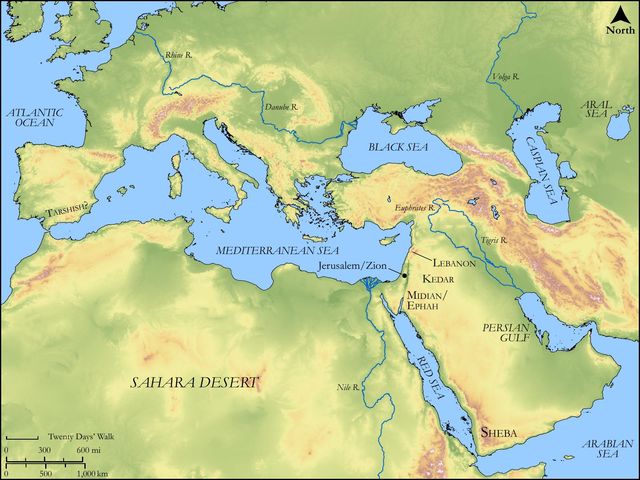
See on the biblical-era map
Study this verse
Public-domain commentary
Matthew Henry
From his Commentary on the Whole Bible. Henry comments on passages, not single verses — this entry covers Isaiah 40:1–2. His two-level outline is real structure in the source text, so it is rendered as structure.
We have here the commission and instructions given, not to this prophet only, but, with him, to all the Lord's prophets, nay, and to all Christ's ministers, to proclaim comfort to God's people. 1. This did not only warrant, but enjoin, this prophet himself to encourage the good people who lived in his own time, who could not but have very melancholy apprehensions of things when they saw Judah and Jerusalem by their daring impieties ripening apace for ruin, and God in his providence hastening ruin upon them. Let them be sure that, notwithstanding all this, God had mercy in store for them. 2. It was especially a direction to the prophets that should live in the time of captivity, when Jerusalem was in ruins; they must encourage the captives to hope for enlargement in due time. 3. Gospel ministers, being employed by the blessed Spirit as comforters, and as helpers of the joy of Christians, are here put in mind of their business. Here we have,
I.Comfortable words directed to God's people in general, Isa 40:1.
The prophets have instructions from their God (for he is the Lord God of the holy prophets, Rev 22:6) to comfort the people of God; and the charge is doubled, Comfort you, comfort you - not because the prophets are unwilling to do it (no, it is the most pleasant part of their work), but because sometimes the souls of God's people refuse to be comforted, and their comforters must repeat things again and again, ere they can fasten any thing upon them. Observe here,
1.There are a people in the world that are God's people.
2.It is the will of God that his people should be a comforted people, even in the worst of times.
3.It is the work and business of ministers to do what they can for the comfort of God's people.
4.Words of conviction, such as we had in the former part of this book, must be followed with words of comfort, such as we have here; for he that has torn will heal us.
II.Comfortable words directed to Jerusalem in particular:
"Speak to the heart of Jerusalem (Isa 40:2); speak that which will revive her heart, and be a cordial to her and to all that belong to her and wish her well. Do not whisper it, but cry unto her: cry aloud, to show saints their comforts as well as to show sinners their transgressions; make her hear it:" 1. "That the days of her trouble are numbered and finished: Her warfare is accomplished, the set time of her servitude; the campaign is now at an end, and she shall retire into quarters of refreshment." Human life is a warfare (Job 7:1); the Christian life much more. But the struggle will not last always; the warfare will be accomplished, and then the good soldiers shall not only enter into rest, but be sure of their pay. 2. "That the cause of her trouble is removed, and, when that is taken away, the effect will cease. Tell her that her iniquity is pardoned, God is reconciled to her, and she shall no longer be treated as one guilty before him." Nothing can be spoken more comfortably than this, Son, be of good cheer; thy sins be forgiven thee. Troubles are then removed in love when sin is pardoned. 3. "That the end of her trouble is answered: She has received of the Lord double for the cure of all her sins, sufficient, and more than sufficient, to separate between her and her idols," the worship of which was the great sin for which God had a controversy with them, and from which he designed to reclaim them by their captivity in Babylon: and it had that effect upon them; it begat in them a rooted antipathy to idolatry, and was physic doubly strong for the purging out of that iniquity. Or it may be taken as the language of the divine compassion: His soul was grieved for the misery of Israel (Jdg 10:16), and, like a tender father, since he spoke against them he earnestly remembered them (Jer 31:20), and was ready to say that he had given them too much correction. They, being very penitent, acknowledged that God has punished them less than their iniquities deserved; but he, being very pitiful, owned, in a manner, that he had punished them more than they deserved. True penitents have indeed, in Christ and his sufferings, received of the Lord's hand double for all their sins; for the satisfaction Christ made by his death was of such an infinite value that it was more than double to the demerits of sin; for God spared not his own Son.
Historical interpretation
Historical reception
4 surviving comments on this verse. Each one is dated, so this reads as a timeline rather than a list.
Select a marker to jump to its quote. Markers stagger vertically where authors wrote within a few decades of each other.
How is it that some receive at the Lord’s hand double for their sins and the measure of their wickedness is doubly filled up, as in the correction of Israel, while the sins of others are removed by a sevenfold compensation? What is the measure of the Amorites that is not yet full? And how is the sinner either acquitted or chastised again, acquitted perhaps, because reserved for the other world, chastised because healed thereby in this?
There is also another type of consolation for those who have paid heavy penalties, as it is written in the book of Isaiah: 'Comfort, comfort my people,' says the Lord. 'Speak tenderly to Jerusalem, and cry to her that her warfare is ended, that her iniquity is pardoned, that she has received from the Lord's hand double for all her sins.' Even if faith was lacking, punishment was satisfied. The penalties are mitigated for those who are acquitted by commendation of their merits.
(Chapter 40, Verses 1 onwards) Console, console my people, says your God: Speak to the heart of Jerusalem, and call out to her; for her wickedness is complete, her iniquity is forgiven. She has received from the hand of the Lord double for all her sins. LXX: Console, console my people, says God. O priests, speak to the heart of Jerusalem; console her, for her humility is fulfilled. His sin has been forgiven, for he has received from the hand of the Lord double for all his sins. According to other interpreters, others are commanded to console the people of God and Jerusalem together. According to the Hebrew text, the people themselves are commanded to console, speak to the heart of Jerusalem, and advocate for her. Speaking to the heart of Jerusalem is the language of the Scriptures. For one who speaks to the mournful and soothes is called a consoler who speaks to the heart. Let us be taught by Sichem, the son of Hemor, who spoke corruptly to his heart about the defiled Dinah, and comforted her (Genesis XXXIV). And wherever you find something similar, it has this meaning. The reason for consolation is the forgiveness of sins, and the cause of forgiveness is that he received double from the hand of the Lord for all his sins. For whoever knows the will of his Lord and sins, will be beaten with many stripes (Luke XII). And everyone who has the indwelling of the Holy Spirit, whom the Savior promised to the Apostles, saying: I will ask my Father, and he will give you another Comforter, that he may be with you forever, the Spirit of truth (John XIV, 16); and again: But when the Comforter comes, whom I will send to you from the Father, the Spirit of truth who comes forth from the Father, he will bear witness about me (John XV, 26); and: It is profitable for you that I go away: for if I do not go away, the Comforter will not come to you (John XVI, 7); the Comforter is the one now commanded to console the people of God. Wherefore also the Apostle Paul was speaking to believers: Blessed be the God and Father of our Lord Jesus Christ, the Father of mercies, and the God of all comfort, who comforts us in all our tribulation, that we may be able to comfort those who are in any trouble, by the comfort wherewith we ourselves are comforted of God: for as the sufferings of Christ abound in us, so our consolation also aboundeth by Christ (2 Corinthians 1:1-6); and again: And our hope of you is steadfast, knowing that as ye are partakers of the sufferings, so shall ye be also of the consolation (2 Corinthians 1:7). But who is this people, who through the Apostles and Ecclesiastical men is consoled, not Israel, and Jacob and Juda, as the Scripture mentions in other places, but the people of God, as the Prophet Zacharias testifies saying: Rejoice and be glad, daughter of Zion, for I will come and dwell in your midst, says the Lord. And many nations will flee to the Lord in that day, and they will be His people, and they will dwell in your midst, and they will know that the Lord Almighty has sent me to you (Zach. II, 10, 11). By this testimony, it is clearly demonstrated that many nations are to be turned into the people of God. And this is what the Lord, sent by the Lord, whose name is Almighty, says. And it should be noted that our sins are not forgiven unless we receive them from the hand of the Lord. And it is not the same thing to have sins forgiven as to have them pardoned. For those to whom they are pardoned, there is no need for forgiveness, as it is written in the Gospel: Believe, my child, your sins are forgiven you (Matthew 9:2). But those who are released are released because they have been cleansed and freed through punishments. According to history, Jerusalem received its sins twice from the hands of the Babylonians and secondly from the Romans. And what is added by the Seventy, the Priests, must be noted.
The God of the universe has left the king aside to invite the priests to give courage back to Jerusalem, as if the chastisement with which it had been threatened had already occurred. This is made clear in the passage to follow: “Comfort [Jerusalem], for its humiliation is accomplished.” The words of the threat have received a perfect accomplishment. “[Its] sin is put away: for it has received of the Lord’s hand double the amount of its sins.” It is worthwhile to admire the kindness of the Master at this point: because he is good and his compassion is unfathomable, and although he inflicted a punishment less than equal to the sin, he says, by reason of great benevolence, that this lesser punishment is double the amount of the sin. Now that the chastisement was less than the sin, the same prophet has cried in testimony: “Your chastening was to us with small affliction.” Nevertheless, because he tempers his justice with infinite mercy, the lesson that the victims of the chastisement call small, the judge has called double [the amount of the sin]. Then he teaches the comforters the means of comfort.
Continue studying Isaiah 40:2 across the web’s major study libraries — every link below opens this exact verse, chapter, or book on the destination site.
Read & Compare
 BibleGatewayThis verse in more than 200 translations and 70 languages.
 Bible.comThe YouVersion reader — hundreds of translations, reading plans, and highlights.
 ESV.orgCrossway's official English Standard Version reader.
 NET BibleThe NET translation with 60,000+ translators' notes on every rendering decision.
 STEP BibleTyndale House's free study tool — original text, vocabulary, and scholarly resources.
 BibliaLogos Bible Software's free web reader.
 USCCBThe New American Bible (Revised Edition) with the U.S. bishops' study notes.
Commentaries
 BibleHub CommentariesDozens of classic commentaries on this verse, gathered on one page.
 StudyLightMore than 100 commentary sets — the largest collection on the web.
 BibleRefPlain-English commentary on what this verse means, verse by verse.
 Enduring WordDavid Guzik's free commentary on this chapter, widely used by Bible teachers.
 Bible Study ToolsVerse commentary alongside Greek and Hebrew study aids.
Original Language & Research
- BibleHub InterlinearThe verse word by word — original language, transliteration, and English.
- BibleHub LexiconEvery word's original-language definition and Strong's entry.
 Blue Letter BibleDeep-study tools — Strong's numbers, concordance, and word studies.
 SefariaThe Hebrew text with Rashi and centuries of Jewish commentary.
Sermons, Hymns & Audio


TrulyRandomVerse is not affiliated with these sites and doesn’t control their content. They’re linked because they’re genuinely useful.
Summary
Isaiah 40:2 marks a pivotal shift in the prophetic book, delivering a divine command for profound comfort and restoration to Jerusalem. It declares that the city's period of arduous discipline and suffering, metaphorically likened to a military campaign or hard service, has reached its divinely appointed conclusion. Furthermore, it proclaims a complete and gracious pardon for her iniquity, asserting that she has received a full and sufficient recompense from the LORD's hand, signaling an imminent season of abundant grace, healing, and restoration after a necessary period of judgment.
Context
ShowHideLiterary Context
Isaiah 40 initiates a dramatic and profound transition within the book of Isaiah. The preceding chapters (1-39) are largely characterized by pronouncements of judgment, warnings against idolatry, and prophecies of impending exile for Judah's unfaithfulness. Chapter 39, in particular, concludes with King Hezekiah displaying his treasures to Babylonian envoys, a scene that directly foreshadows the future Babylonian captivity. Against this backdrop of divine wrath and impending doom, Isaiah 40:1-2 bursts forth as a sudden, tender, and authoritative declaration of comfort and hope. This verse serves as the opening statement of what scholars often refer to as "Second Isaiah" or the "Book of Comfort" (chapters 40-66), setting the tone for themes of redemption, the glorious return from exile, the revelation of God's incomparable power, and the coming Servant of the Lord. It signifies a shift from the pronouncements of a holy God's righteous indignation to the tender compassion of a faithful God who remembers His covenant.
Historical & Cultural Context
The primary audience for the message of Isaiah 40 is the Jewish people, either facing the imminent threat of the Babylonian exile (c. 586 BCE) or already enduring its harsh realities. This period was one of profound national trauma: the destruction of Jerusalem and its sacred Temple, the cessation of national sovereignty, and the forced displacement of a significant portion of the population to a foreign land. Culturally, the concept of "warfare" (Hebrew: tsâbâʼ, often meaning "hard service" or "campaign") would have resonated deeply with their experience of military subjugation, forced labor, and the arduous nature of their captivity. The people were burdened by guilt, despair, and a sense of abandonment, questioning God's faithfulness. The declaration of "iniquity being pardoned" and receiving "double" would have been understood in the context of ancient Near Eastern legal and social customs, where a period of punishment had a defined end, and restoration often involved a generous recompense, much like a prisoner completing their sentence or a servant fulfilling their term of service. This message directly addressed their deepest fears and longings for reconciliation and return.
Key Themes
ShowHideThis foundational verse introduces several critical themes that will be extensively developed throughout the "Book of Comfort." The most prominent is Divine Consolation, emphasizing God's tender compassion and His active desire to comfort His afflicted people after a necessary period of discipline. It powerfully underscores God's Sovereign Control over History, demonstrating that even the period of punishment was not arbitrary but divinely ordained with a specific purpose and a definite end. The declaration of Complete Pardon and Forgiveness is central, highlighting God's willingness to reconcile with His people, not based on their merit, but on His gracious initiative. This paves the way for the theme of Restoration and Abundant Blessing, where the "double" signifies not merely an end to suffering, but a superabundant return of divine favor and prosperity, echoing promises found in passages like Job 42:10 and Zechariah 9:12. These themes collectively affirm God's unwavering faithfulness to His covenant promises, even in the face of His people's unfaithfulness, and His ultimate desire for their redemption and flourishing.
Exposition and Analysis
ShowHideKey Word Analysis
ShowHideThis word, literally meaning "heart" (H3820), is used here adverbially in the phrase "speak to the heart." According to the ground truth data, lêb encompasses "the feelings, the will and even the intellect; likewise for the centre of anything." Therefore, to "speak comfortably" means to speak intimately, empathetically, and profoundly to the very core of Jerusalem's being, addressing her deepest pain, fear, and despair with words of solace, encouragement, and hope. It signifies a comfort that penetrates beyond superficiality to the soul.
This term refers to "a mass of persons (or figuratively, things), especially reg. organized for war (an army); by implication, a campaign, literally or figuratively (specifically, hardship, worship)." In this context, "her warfare" signifies Jerusalem's appointed period of hard service, tribulation, or military duty—the decreed time of punishment and suffering under God's judgment, particularly the Babylonian exile. It implies a fixed, finite period of hardship or a completed tour of duty.
Derived from H7521, meaning "to be pleased with; specifically, to satisfy a debt; (be) accept(-able), accomplish, set affection, approve, consent with, delight (self), enjoy, (be, have, take) please(-ure), reconcile self." When applied to iniquity, it means the sin has been accepted, propitiated, or atoned for, signifying that the debt of sin has been fully addressed and God's favor is now extended, making way for reconciliation. It indicates that the penalty has been satisfied and God's anger appeased.
This simply means "a duplicate; double." In this context, it is crucial to interpret it not as double punishment (which would contradict the overarching message of comfort and pardon) but as a complete, full, or even superabundant measure. It can signify that Jerusalem has fully experienced the deserved punishment, or more commonly, that God will give back to His people "double" in blessings and restoration compared to the suffering they endured, emphasizing His generosity and ultimate desire for restoration beyond mere justice.
Verse Breakdown
ShowHide"Speak ye comfortably to Jerusalem,"
This is a divine command, likely addressed to heavenly messengers or prophets, to deliver a message of deep, heartfelt consolation to the suffering city. "Comfortably" (Hebrew: al-lêb, "to the heart") signifies an intimate, empathetic, and profound soothing of her pain and despair, designed to penetrate to her very core and offer genuine solace.
"and cry unto her,"
This amplifies the urgency, authority, and public nature of the message. It's not a whisper but a loud, clear proclamation, ensuring the message of hope and restoration is heard widely and unequivocally by the afflicted populace.
"that her warfare is accomplished,"
This declares the definitive end of Jerusalem's appointed period of hard service or military campaign, which is a metaphor for her time of divine discipline and suffering, specifically the Babylonian exile. The term "accomplished" (Hebrew: mâlêʼ, H4390, "to fill or be full of, be at an end") signifies that the full measure of her disciplinary period has been completed, the sentence served.
"that her iniquity is pardoned:"
This is a direct, authoritative declaration of divine forgiveness. The Hebrew word râtsâh (H7521) implies that the sin has been accepted, propitiated, or atoned for, signifying that the debt of sin has been fully addressed and God's favor is now extended, paving the way for reconciliation and renewed relationship.
"for she hath received of the LORD'S hand double for all her sins."
This concluding clause provides the divine rationale and basis for the pardon and the cessation of suffering. "Double" (Hebrew: kephel, H3718) here does not signify double punishment, but rather a full, complete, and perhaps even overflowing measure of recompense. It can be interpreted as Jerusalem having fully endured the necessary discipline, or more optimistically and consistent with the ensuing chapters, that God, in His abundant grace, will now bestow blessings and restoration in superabundance, far exceeding the past suffering, demonstrating His lavish generosity and faithfulness.
Literary Devices
ShowHideIsaiah 40:2 employs several powerful literary devices to convey its transformative message of comfort and hope. Personification is prominently used, as Jerusalem is addressed as a suffering individual ("her warfare," "her iniquity," "she hath received"), allowing the prophet to speak to the city with tender intimacy and directness, making the divine message deeply personal. The phrase "her warfare is accomplished" utilizes a compelling Metaphor, comparing the period of divine judgment and exile to a military campaign or a period of arduous, mandatory service. This emphasizes both the fixed duration of the suffering and the completion of a difficult assignment. The concluding phrase, "she hath received... double for all her sins," employs Hyperbole or Intensification. While "double" literally means twice, in this context, it functions to convey the completeness and sufficiency of the judgment received, or more powerfully, the superabundant nature of the restoration and blessings God is about to bestow, far outweighing the previous suffering. This rhetorical flourish underscores the immense magnitude of God's grace and generosity, moving beyond mere justice to lavish favor.
Theological and Thematic Connections
ShowHideIsaiah 40:2 is a cornerstone of biblical theology, powerfully articulating God's multifaceted character as both perfectly just and boundlessly merciful. It reveals that divine judgment, though severe and necessary, is not eternal but has a divinely appointed end, always serving a redemptive purpose. The declaration that "her iniquity is pardoned" underscores the profound truth of God's capacity and desire for forgiveness and reconciliation, even after His people's deep rebellion. The concept of receiving "double" speaks to God's abundant grace, promising not just an end to suffering but a lavish outpouring of restoration and blessing that far surpasses the measure of past affliction. This verse sets the stage for the New Testament understanding of God's ultimate solution to sin and suffering through the atoning work of Christ, demonstrating His unwavering commitment to His covenant people and His ultimate plan for their redemption.
Reflection and Application
ShowHideIsaiah 40:2 offers profound comfort and enduring hope for all who have experienced periods of discipline, suffering, or hardship. It assures us that God's judgment, though real, is not endless, and His ultimate desire is to bring comfort and restoration. For believers, this verse serves as a powerful reminder that even in the midst of our deepest trials, there is an appointed end, and God's faithfulness will lead us to a season of comfort and abundant blessing. It encourages us to trust in God's sovereign timing and His redemptive purposes, knowing that He is in control of our suffering and that His grace is always greater than our sin. This passage calls us to receive God's comfort personally and, in turn, to extend that same deep, heart-to-heart consolation to others who are suffering, becoming agents of His comfort and hope in a broken world. We are invited to internalize the truth that our "warfare" against sin and its consequences is accomplished in Christ, and our "iniquity is pardoned," leading to a life of overflowing grace.
Questions for Reflection
ShowHideFAQ
ShowHideWhat does "speak ye comfortably to Jerusalem" truly mean?
ShowHideThe Hebrew phrase behind "speak comfortably" is dalberu al leb (דַּבְּרוּ עַל־לֵב), which literally translates to "speak to the heart." This signifies a message of profound, intimate, and empathetic consolation. It's not a superficial or detached comfort, but one that penetrates to the deepest emotional and spiritual core of the listener. It implies understanding their pain, acknowledging their suffering, and offering genuine solace and hope directly to their inner being. It's a divine mandate for compassionate communication from God's messengers to His afflicted people, ensuring the message truly ministers to their soul.
What is the "warfare" that is accomplished?
ShowHideThe "warfare" (Hebrew: tsâbâʼ, H6635) refers metaphorically to Jerusalem's period of hard service, tribulation, or appointed time of punishment and suffering. In the immediate historical context, this primarily points to the Babylonian exile—a time of national humiliation, displacement, and severe discipline from God due to their persistent idolatry and disobedience. The declaration that this "warfare is accomplished" means that the full measure of this disciplinary period has been completed; the sentence has been served, and the time for divine favor and restoration has arrived. It signifies the end of God's active judgment against them, marking a definitive turning point.
Does "she hath received... double for all her sins" mean double punishment?
ShowHideNo, in the context of comfort and pardon, "double" (Hebrew: kephel, H3718) does not mean double punishment. Such an interpretation would contradict the overarching message of grace and restoration that defines Isaiah 40 and subsequent chapters. Instead, it is understood in two primary, positive ways:
Christ-Centered Fulfillment
ShowHideIsaiah 40:2 finds its ultimate and most profound fulfillment in the person and redemptive work of Jesus Christ. The "warfare" of humanity, our arduous service under the dominion of sin and death, is definitively "accomplished" through Christ's perfect life, atoning sacrifice on the cross, and victorious resurrection. He bore the full measure of God's righteous judgment against sin, thereby bringing an end to the spiritual "exile" and alienation from God that plagued humanity. Our "iniquity is pardoned" not by our own suffering or meritorious works, but entirely by the finished work of Christ, whose blood fully propitiated God's wrath and secured our forgiveness (as declared in Romans 3:25 and Colossians 1:14). Furthermore, the promise that Jerusalem "hath received... double for all her sins" finds its spiritual reality in the superabundant grace and blessings poured out upon believers in Christ. We do not receive double punishment; rather, we receive "double" in terms of spiritual riches, eternal life, the indwelling Holy Spirit, and an inheritance that far surpasses the temporal consequences of sin. Through Christ, we receive "grace upon grace" (John 1:16), a peace that surpasses all understanding (Philippians 4:7), and a reconciliation that brings us into intimate fellowship with God, fulfilling the deepest meaning of speaking "comfortably to Jerusalem" by speaking peace to the hearts of all who believe in Him (Ephesians 2:14).