


Jeremiah 33:8
Bible text: King James Version (1769 Blayney text) · Public domain
Bible text: King James Version with Strong's numbers · Public domain
Bible text: Berean Standard Bible · Public domain
Bible text: American Standard Version (1901) · Public domain
Bible text: World English Bible, Messianic edition · Public domain
Bible text: Geneva Bible (1599) · Public domain
Bible text: Young's Literal Translation · Public domain
- וְטִהַרְתִּיםve·Ti·har·Timand I will cleanse themH2891Conj-w ¦ V-Piel-ConsecPerf-1cs ¦ 3mpVerb Piel Consecutive Perfect 1st Singular common genderוְandטִהַרְתִּיI will cleanseםthem
- מִכָּלmi·kolfrom allH3605Prep-m ¦ N-mscNoun Singular Masculine Constructמִfromכָּלall
- עֲוֹנָם'a·vo·Namtheir iniquityH5771N-msc ¦ 3mpNoun Singular Masculine Constructעֲוֹנָiniquityםtheir
- אֲשֶׁר'a·SherwhichH834RelParticle Relative
- חָטְאוּcha·te·'uthey have sinnedH2398V-Qal-Perf-3cpVerb Qal Perfect 3rd Plural common gender
- לִיLito <the> mePrep-l ¦ 1csSuffix Personal 1st Singular common genderלִto <the>יme
- וְסָלַחְתִּיve·sa·lach·Tiand I will forgiveH5545Conj-w ¦ V-Qal-ConsecPerf-1csVerb Qal Consecutive Perfect 1st Singular common genderוְandסָלַחְתִּיI will forgive
- לְכָלle·khol<to> allH3605Prep-l ¦ N-mscNoun Singular Masculine Constructלְ<to>כָלall
- עֲוֹנוֹתֵיהֶםa·vo·no·tei·Hemtheir iniquitiesH5771N-fpc ¦ 3mpNoun Plural Feminine Constructעֲוֹנוֹתֵיiniquitiesהֶםtheir
- אֲשֶׁר'a·SherwhichH834RelParticle Relative
- חָטְאוּcha·te·'uthey have sinnedH2398V-Qal-Perf-3cpVerb Qal Perfect 3rd Plural common gender
- לִיLito <the> mePrep-l ¦ 1csSuffix Personal 1st Singular common genderלִto <the>יme
- וַאֲשֶׁרva·'a·Sherand whichH834Conj-w ¦ RelParticle Relativeוַandאֲשֶׁרwhich
- פָּשְׁעוּPa·she·'uthey have rebelledH6586V-Qal-Perf-3cpVerb Qal Perfect 3rd Plural common gender
- בִיViagainst <the> mePrep-b ¦ 1csSuffix Personal 1st Singular common genderבִagainst <the>יme
English is a literal word-by-word gloss of the Hebrew, not the KJV's wording. Why?
This is the original text the KJV's translators worked from — each Hebrew word with its own literal English meaning in this verse, prepared by scholars at Tyndale House, Cambridge. The KJV translates whole sentences, not word by word, so its wording differs: one Hebrew word can become several English words, and the KJV may choose “the LORD” where the gloss reads “Yahweh”. Both are faithful — they answer different questions. For the KJV's own rendering, switch to the KJV text.
Details
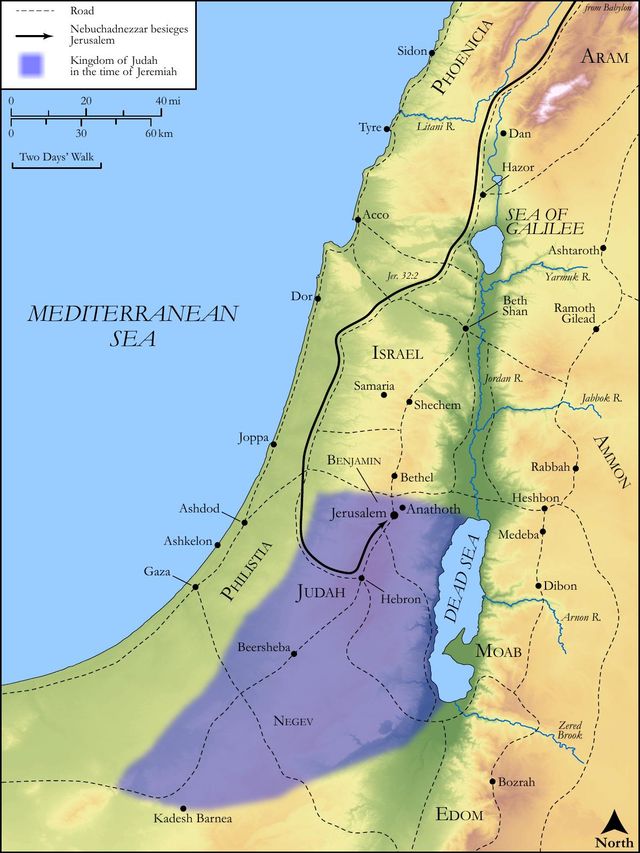
See on the biblical-era map
Study this verse
Public-domain commentary
Matthew Henry
From his Commentary on the Whole Bible. Henry comments on passages, not single verses — this entry covers Jeremiah 33:1–9. His four-level outline is real structure in the source text, so it is rendered as structure.
Observe here, I. The date of this comfortable prophecy which God entrusted Jeremiah with. It is not exact in the time, only that it was after that in the foregoing chapter, when things were still growing worse and worse; it was the second time. God speaketh once, yea, twice, for the encouragement of his people. We are not only so disobedient that we have need of precept upon precept to bring us to our duty, but so distrustful that we have need of promise upon promise to bring us to our comfort. This word, as the former, came to Jeremiah when he was in prison. Note, No confinement can deprive God's people of his presence; no locks nor bars can shut out his gracious visits; nay, oftentimes as their afflictions abound their consolations much more abound, and they have the most reviving communications of his favour when the world frowns upon them. Paul's sweetest epistles were those that bore date out of a prison.
II.The prophecy itself.
A great deal of comfort is wrapped up in it for the relief of the captives, to keep them from sinking into despair. Observe,
1.Who it is that secures this comfort to them (Jer 33:2): It is the Lord, the maker thereof, the Lord that framed it, He is the maker and former of heaven and earth, and therefore has all power in his hands; so it refers to Jeremiah's prayer, Jer 32:17. He is the maker and former of Jerusalem, of Zion, built them at first, and therefore can rebuild them - built them for his own praise, and therefore will. He formed it, to establish it, and therefore it shall be established till those things be introduced which cannot be shaken, but shall remain for ever. He is the maker and former of this promise; he has laid the scheme for Jerusalem's restoration, and he that has formed it will establish it, he that has made the promise will make it good; for Jehovah is his name, a God giving being to his promises by the performance of them, and when he does this he is known by that name (Exo 6:3), a perfecting God. When the heavens and the earth were finished, then, and not till then, the creator is called Jehovah, Gen 2:4.
2.How this comfort must be obtained and fetched in - by prayer (Jer 33:3): Call upon me, and I will answer them. The prophet, having received some intimations of this kind, must be humbly earnest with God for further discoveries of his kind intentions. He had prayed (Jer 32:16), but he must pray again. Note, Those that expect to receive comforts from God must continue instant in prayer. We must call upon him, and then he will answer us. Christ himself must ask, and it shall be given him, Psa 2:8. I will show thee great and mighty things (give thee a clear and full prospect of them), hidden things, which, though in part discovered already, yet thou knowest not, thou canst not understand or give credit to. Or this may refer not only to the prediction of these things which Jeremiah, if he desire it, shall be favoured with, but to the performance of the things themselves which the people of God, encouraged by this prediction, must pray for. Note, Promises are given, not to supersede, but to quicken and encourage prayer. See Eze 36:37.
3.How deplorable the condition of Jerusalem was which made it necessary that such comforts as these should be provided for it, and notwithstanding which its restoration should be brought about in due time (Jer 33:4, Jer 33:5): The houses of this city, not excepting those of the kings of Judah, are thrown down by the mounts, or engines of battery, and by the sword, or axes, or hammers. It is the same word that is used Eze 26:9, With his axes he shall break down thy towers. The strongest stateliest houses, and those that were best furnished, were levelled with the ground. The fifth verse comes in in a parenthesis, giving a further instance of the present calamitous state of Jerusalem. Those that came to fight with the Chaldeans, to beat them off from the siege, did more hurt than good, provoked the enemy to be more fierce and furious in their assaults, so that the houses in Jerusalem were filled with the dead bodies of men, who died of the wounds they received in sallying out upon the besiegers. God says that they were such as he had slain in his anger, for the enemies' sword was his sword and their anger his anger. But, it seems, the men that were slain were generally such as had distinguished themselves by their wickedness, for they were the very men for whose wickedness God did now hide himself from this city, so that he was just in all he brought upon them.
4.What the blessings are which God has in store for Judah and Jerusalem, such as will redress all their grievances.
(1.)Is their state diseased? Is it wounded? God will provide effectually for the healing of it, though the disease was thought mortal and incurable, Eze 7:22. "The whole head is sick, and the whole heart faint (Isa 1:5); but (Jer 33:6) I will bring it health and cure; I will prevent the death, remove the sickness, and set all to rights again," Jer 30:17. Note, Be the case ever so desperate, if God undertake the cure, he will effect it. The sin of Jerusalem was the sickness of it (Isa 1:6); its reformation therefore will be its recovery. And the following words tell us how that is wrought: "I will reveal unto them the abundance of peace and truth; I will give it to them in due time, and give them an encouraging prospect of it in the mean time." Peace stands here for all good; peace and truth are peace according to the promise and in pursuance of that: or peace and truth are peace and the true religion, peace and the true worship of God, in opposition to the many falsehoods and deceits by which they had been led away from God. We may apply it more generally, and observe,
[1.]That peace and truth are the great subject-matter of divine revelation. These promises here lead us to the gospel of Christ, and in that God has revealed to us peace and truth, the method of true peace - truth to direct us, peace to make us easy. Grace and truth, and abundance of both, come by Jesus Christ. Peace and truth are the life of the soul, and Christ came that we might have that life, and might have it more abundantly. Christ rules by the power of truth (Joh 18:37) and by it he gives abundance of peace, Psa 72:7; Psa 85:10.
[2.]That the divine revelation of peace and truth brings health and cure to all those that by faith receive it: it heals the soul of the diseases it has contracted, as it is a means of sanctification, Joh 17:17. He sent his word and healed them, Psa 107:20. And it puts the soul into good order, and keeps it in a good frame and fit for the employments and enjoyments of the spiritual and divine life.
(2.)Are they scattered and enslaved, and is their nation laid in ruins? "I will cause their captivity to return (Jer 33:7), both that of Israel and that of Judah" (for though those who returned under Zerubbabel were chiefly of Judah, and Benjamin, and Levi, yet afterwards many of all the other tribes returned), "and I will rebuild them, as I built them at first." When they by repentance do their first works God will by their restoration do his first works.
(3.)Is sin the procuring cause of all their troubles? That shall be pardoned and subdued, and so the root of the judgments shall be killed, Jer 33:8.
[1.]By sin they have become filthy, and odious to God's holiness, but God will cleanse them, and purify them from their iniquity. As those that were ceremonially unclean, and were therefore shut out from the tabernacle, when they were sprinkled with the water of purification had liberty of access to it again, so had they to their own land, and the privileges of it, when God had cleansed them from their iniquities. In allusion to that sprinkling, David prays, Purge me with hyssop.
[2.]By sin they have become guilty, and obnoxious to his justice; but he will pardon all their iniquities, will remove the punishment to which for sin they were bound over. All who by sanctifying grace are cleansed from the filth of sin, by pardoning mercy are freed from the guilt of it.
(4.)Have both their sins and their sufferings turned to the dishonour of God? Their reformation and restoration shall redound as much to his praise, Jer 33:9. Jerusalem thus rebuilt, Judah thus repeopled, shall be to me a name of joy, as pleasing to God as ever they have been provoking, and a praise and an honour before all the nations. They, being thus restored, shall glorify God by their obedience to him, and he shall glorify himself by his favours to them. This renewed nation shall be as much a reputation to religion as formerly it has been a reproach to it. The nations shall hear of all the good that God has wrought in them by his grace and of all the good he has wrought for them by his providence. The wonders of their return out of Babylon shall make as great a noise in the world as ever the wonders of their deliverance out of Egypt did. and they shall fear and tremble for all this goodness.
[1.]The people of God themselves shall fear and tremble; they shall be much surprised at it, shall be afraid of offending so good a God and of forfeiting his favour. Hos 3:5, They shall fear the Lord and his goodness.
[2.]The neighbouring nations shall fear because of the prosperity of Jerusalem, shall look upon the growing greatness of the Jewish nation as really formidable, and shall be afraid of making them their enemies. When the church is fair as the moon, and clear as the sun, she is terrible as an army with banners.
Continue studying Jeremiah 33:8 across the web’s major study libraries — every link below opens this exact verse, chapter, or book on the destination site.
Read & Compare
 BibleGatewayThis verse in more than 200 translations and 70 languages.
 Bible.comThe YouVersion reader — hundreds of translations, reading plans, and highlights.
 ESV.orgCrossway's official English Standard Version reader.
 NET BibleThe NET translation with 60,000+ translators' notes on every rendering decision.
 STEP BibleTyndale House's free study tool — original text, vocabulary, and scholarly resources.
 BibliaLogos Bible Software's free web reader.
 USCCBThe New American Bible (Revised Edition) with the U.S. bishops' study notes.
Commentaries
 BibleHub CommentariesDozens of classic commentaries on this verse, gathered on one page.
 StudyLightMore than 100 commentary sets — the largest collection on the web.
 BibleRefPlain-English commentary on what this verse means, verse by verse.
 Enduring WordDavid Guzik's free commentary on this chapter, widely used by Bible teachers.
 Bible Study ToolsVerse commentary alongside Greek and Hebrew study aids.
Original Language & Research
- BibleHub InterlinearThe verse word by word — original language, transliteration, and English.
- BibleHub LexiconEvery word's original-language definition and Strong's entry.
 Blue Letter BibleDeep-study tools — Strong's numbers, concordance, and word studies.
 SefariaThe Hebrew text with Rashi and centuries of Jewish commentary.
Sermons, Hymns & Audio


TrulyRandomVerse is not affiliated with these sites and doesn’t control their content. They’re linked because they’re genuinely useful.
Summary
Jeremiah 33:8 serves as a pivotal declaration within the "Book of Consolation," articulating God's profound commitment to the spiritual restoration of His covenant people, Judah and Israel. Amidst prophecies of impending judgment and exile, this verse shines as a beacon of divine grace, promising a comprehensive cleansing from all their iniquity and a complete pardon for their sins and transgressions. It powerfully underscores God's sovereign initiative to remove the spiritual barriers erected by human rebellion, thereby paving the way for a renewed, intimate, and purified covenant relationship with Him.
Context
ShowHideLiterary Context
Jeremiah 33:8 is embedded within the "Book of Consolation" (Jeremiah 30-33), a distinct section of Jeremiah's prophecy that shifts from pronouncements of judgment to extensive promises of future restoration. This collection was delivered during the dire circumstances of Jerusalem's siege by Babylon (c. 588-586 BCE), while Jeremiah himself was imprisoned. The preceding chapters (Jeremiah 1-29) detail Judah's persistent idolatry and covenant unfaithfulness, leading to the prophesied exile. However, chapters 30-33 pivot, offering hope for a future return from captivity, the rebuilding of Jerusalem, and the re-establishment of the Davidic monarchy. Specifically, Jeremiah 33:6-7 speaks of physical healing for the land and its inhabitants, alongside the return of prosperity. Verse 8 then addresses the spiritual foundation necessary for this holistic restoration, emphasizing that divine forgiveness and purification are indispensable for the re-establishment of the covenant community and the fulfillment of God's overarching promises. It highlights that physical restoration is contingent upon spiritual renewal.
Historical & Cultural Context
The historical setting for Jeremiah 33 is the final, desperate years of the Kingdom of Judah, on the brink of its destruction by Nebuchadnezzar's Babylonian forces. Jerusalem was under siege, and a significant portion of the population, including King Jehoiachin, had already been exiled in 597 BCE. The people were experiencing the devastating consequences of centuries of covenant unfaithfulness, which included widespread idolatry, egregious oppression, and a reliance on political alliances rather than on God's protection. Culturally, ancient Israel placed great emphasis on ritual purity, with elaborate sacrificial systems and purification rites designed to cleanse individuals and the community from various forms of impurity, including those incurred by sin. However, the sins of Judah had reached a level that ritual cleansing alone could not address. Jeremiah 33:8 transcends these ritualistic practices, speaking of a profound, spiritual cleansing enacted directly by God, a divine intervention far surpassing any human-initiated purification. This promise of comprehensive pardon was revolutionary, offering hope in a context where sin had led directly to national calamity and divine abandonment.
Key Themes
ShowHideJeremiah 33:8 profoundly contributes to several overarching themes within the book of Jeremiah and the broader prophetic tradition. Firstly, it powerfully underscores the theme of Divine Initiative in Salvation. The repeated phrases "I will cleanse them" and "I will pardon" unequivocally demonstrate that restoration is not achieved through human merit or effort but is a gracious, sovereign act originating solely from God's will. Secondly, the verse reinforces the theme of Comprehensive Forgiveness. The emphatic repetition of "all their iniquity" and "all their iniquities" highlights the totality of God's pardon, extending even to the deepest forms of rebellion and transgression, as detailed in passages lamenting Israel's apostasy, such as Jeremiah 2:13. This comprehensive forgiveness is crucial for understanding the immense depth of God's mercy despite the severity and persistence of Judah's sin. Thirdly, and perhaps most significantly, this verse foreshadows the New Covenant, a central theological concept in Jeremiah, particularly articulated in Jeremiah 31:31-34. The promised internal transformation, where God's law is written on hearts and sins are remembered no more, is a direct outgrowth of the radical cleansing and pardon promised in Jeremiah 33:8. Finally, the verse emphasizes the Restoration of Relationship, as the removal of sin's barrier allows for renewed fellowship and intimacy between God and His people, which is essential for the future flourishing and covenant faithfulness of Israel.
Exposition and Analysis
ShowHideKey Word Analysis
ShowHideThis primitive root primarily signifies "to be bright," but by implication, it means "to be pure." Its semantic range encompasses physical purity (e.g., clean water), Levitical purity (e.g., after ritual defilement), and moral purity (e.g., a clean heart). In Jeremiah 33:8, its application is profoundly spiritual, denoting a thorough and active removal of the defilement of sin. It implies not merely a covering of sin but a divine act of purification that makes the people morally innocent and holy in God's sight, akin to a thorough purging that restores integrity.
This term derives from a root meaning "to bend" or "to twist," thus conveying "perversity," "crookedness," or "distortion." It refers not just to a specific sinful act but to the inherent moral evil, the guilt associated with the sin, and even the punishment that results from it. The repetition of "all their iniquity" emphasizes the pervasive, deep-seated, and morally twisted nature of their corruption, which God promises to address completely and fundamentally. It speaks to the inherent bent towards sin within humanity.
This primitive root means "to forgive" or "to spare." It is almost exclusively used in the Old Testament to describe God's unique and sovereign act of forgiving sin. Unlike human forgiveness, which can be conditional or limited, divine pardon signifies a gracious, unmerited act of releasing from the guilt, penalty, and consequences of sin. It is an act of divine grace that effectively removes the charge against the offender, restoring them to a state of favor.
Verse Breakdown
ShowHide"And I will cleanse them from all their iniquity"
This opening clause immediately establishes God's active, sovereign, and unilateral role in initiating the process of spiritual restoration. "Cleanse" signifies a thorough and complete removal of defilement, addressing the deep-seated moral corruption, or "iniquity," that has pervaded the people. This is a divine act of purification, making what was impure spiritually clean and restoring them to a state of holiness before Him.
"whereby they have sinned against me"
This phrase clarifies the precise nature and ultimate target of their "iniquity." Their actions were not mere mistakes or unfortunate occurrences but deliberate acts of "sin" (Hebrew: châṭâʼ, meaning to miss the mark or go astray). Crucially, these sins were directed specifically "against me"—against God Himself. This highlights the personal offense, the breach of covenant, and the direct affront to God's holy character inherent in their unfaithfulness.
"and I will pardon all their iniquities"
This second declaration of divine action parallels and reinforces the first, underscoring the completeness and comprehensiveness of God's restorative work. "Pardon" signifies a gracious act of forgiveness, releasing the people from the guilt, condemnation, and consequences associated with their "iniquities." The repetition of "all their iniquities" emphasizes the exhaustive nature of this forgiveness, ensuring that no sin or aspect of their moral crookedness remains unaddressed.
"whereby they have sinned, and whereby they have transgressed against me"
This concluding phrase further elaborates on the extent and severity of their offenses, leaving no doubt about the depth of their rebellion. "Sinned" reiterates their failure to meet God's righteous standard, while "transgressed" (Hebrew: pâshaʻ) implies a more deliberate and defiant act of rebellion, a breaking away from just authority, or an open revolt against God's covenant. The powerful repetition of "against me" at the end of both main clauses profoundly emphasizes that every offense, from missing the mark to outright rebellion, was ultimately a direct affront to God's holiness and covenant relationship, yet even these profound acts of rebellion are met with His boundless promise of pardon.
Literary Devices
ShowHideJeremiah 33:8 is replete with literary devices that amplify its powerful message of divine mercy and comprehensive restoration. The most prominent device is Repetition, particularly of the phrases "all their iniquity" and "whereby they have sinned," which serves to underscore the pervasive and comprehensive nature of both the people's sin and God's subsequent, equally comprehensive pardon. This repetition emphasizes that no aspect of their rebellion is overlooked by God's cleansing grace. Parallelism is also strikingly evident in the two main clauses: "And I will cleanse them from all their iniquity, whereby they have sinned against me; and I will pardon all their iniquities, whereby they have sinned, and whereby they have transgressed against me." This synonymous parallelism reinforces the singular, complete act of divine forgiveness, presenting it from two complementary angles—purification and absolution—thereby intensifying the message of total restoration. Furthermore, the verse powerfully employs Divine Initiative, as the subject of all key verbs ("I will cleanse," "I will pardon") is God Himself. This highlights that this profound restoration is not a human achievement or earned merit but a sovereign, unmerited act of grace. The use of strong, active verbs for God's actions contrasts sharply with the passive consequences of human sin, creating a powerful statement of hope, divine power, and unyielding covenant faithfulness.
Theological and Thematic Connections
ShowHideJeremiah 33:8 articulates a profound theological truth: God's character is not only defined by His perfect justice, which necessitates judgment for sin, but also by an even greater, boundless capacity for mercy, forgiveness, and reconciliation. This verse is far more than a historical promise of spiritual cleansing for ancient Israel; it is a timeless revelation of God's unchanging desire to reconcile with humanity, actively removing the formidable barrier of sin. It fundamentally underscores that true restoration, whether for an individual soul or an entire nation, must begin with a sovereign act of divine purification and pardon, which addresses the very root cause of alienation from a holy God. This act of forgiveness is presented as utterly comprehensive, extending to cover all forms of human rebellion, from unintentional failings and moral perversity to deliberate transgressions and outright revolt. It sets the immutable stage for a renewed, vibrant covenant relationship, where the people, made clean and whole by divine grace, can once again walk in intimate fellowship with their holy God, thereby fulfilling the ultimate purpose of their existence and the covenant promises.
Reflection and Application
ShowHideJeremiah 33:8 offers an incredibly powerful message of hope, assurance, and transformative grace for believers navigating the complexities of modern life. In a world often burdened by the weight of guilt, shame, and the lingering consequences of past mistakes, this verse serves as a profound reminder that God's capacity for forgiveness is not merely sufficient but boundless and utterly complete. It challenges us to engage in an honest self-assessment, confronting our own "iniquities" and "transgressions" with humility and truth. True spiritual health and freedom begin with an authentic acknowledgment of our sinfulness and a turning in faith to the One who alone possesses the power and willingness to cleanse and pardon. This divine act is not a passive absolution but an active, profound, and transformative work of God that purifies us from within, enabling us to walk in renewed, vibrant relationship with Him. The emphasis on God's divine initiative in this cleansing should inspire profound gratitude, deep humility, and unwavering trust, drawing us ever closer to the inexhaustible source of all grace. Furthermore, understanding the depth of God's pardon for us compels us to extend similar grace, forgiveness, and understanding to others, thereby reflecting the very character of the God who has so freely and completely pardoned us.
Questions for Reflection
ShowHideFAQ
ShowHideWhat is the significance of the repetition of "all their iniquity" in Jeremiah 33:8?
ShowHideThe repetition of "all their iniquity" and "all their iniquities" in Jeremiah 33:8 is a powerful rhetorical device emphasizing the comprehensive and complete nature of God's forgiveness and cleansing. It serves to assure the people that every facet of their sin—whether it be their inherent moral perversity, their specific sinful acts, or their deliberate acts of rebellion—will be fully addressed, removed, and covered by God's boundless grace. This emphatic repetition leaves no room for doubt about the totality of the divine absolution, highlighting God's immense mercy in the face of widespread and deeply entrenched sin. It communicates that God's pardon is not partial or conditional, but absolute and all-encompassing.
How does this verse relate to the concept of a "new covenant" in Jeremiah?
ShowHideJeremiah 33:8 is intrinsically and profoundly linked to the concept of the "new covenant" detailed earlier in Jeremiah, particularly in Jeremiah 31:31-34. The cleansing from iniquity and the pardon of sins promised in Jeremiah 33:8 are foundational and indispensable elements of this new covenant. Under the terms of the old covenant, sin led directly to brokenness, judgment, and exile. However, under the new covenant, God promises a radical, internal transformation, where His law is written not on stone tablets but on the hearts of His people, and, crucially, He declares, "for I will forgive their wickedness and will remember their sins no more" (Jeremiah 31:34). Thus, Jeremiah 33:8 describes the divine act of purification and pardon that makes the new covenant's intimate relationship, spiritual renewal, and lasting fellowship possible.
Christ-Centered Fulfillment
ShowHideJeremiah 33:8 finds its ultimate, most profound, and glorious fulfillment in the person and redemptive work of Jesus Christ. The Old Testament promises of divine cleansing and comprehensive pardon, while initially given to Israel, consistently pointed forward to a greater, more efficacious spiritual reality that would be accomplished through the Messiah. Jesus, the Lamb of God who takes away the sin of the world, is the definitive means by which God "cleanses us from all our iniquity" and "pardons all our iniquities." His sacrificial death on the cross serves as the perfect, once-for-all atonement, making true and complete purification possible, for "without the shedding of blood there is no forgiveness of sins" (Hebrews 9:22). Through faith in Him, believers receive not merely a ceremonial cleansing but a radical, internal spiritual transformation, being declared righteous before God by grace through faith (Romans/3-23-24). The New Covenant, so powerfully prophesied by Jeremiah, is inaugurated in Christ's shed blood, establishing an eternal relationship where sins are truly remembered no more by God (Hebrews 8:12). Thus, what Jeremiah foresaw as a future hope for Israel is fully realized in Jesus, who offers complete forgiveness, radical purification, and reconciliation to all who believe, ushering them into an eternal, reconciled relationship with God as a "new creation" (2 Corinthians 5:17-19).