


Revelation 18:6
Pay her back double for what she has done!
Use the cup in which she has brewed
to brew her a double-sized drink!
- ἀπόδοτεapodotedo give backG591V-2AAM-2PVerb 2nd Aorist Active Imperative 2nd Plural
- αὐτῇautēato herG846P-DSFPersonal pronoun Dative Singular Feminine
- ὡςhōsasG5613PRTParticle or Disjunctive
- καὶkaialsoG2532CONJConjunction
- αὐτὴautēsheG846P-NSFPersonal pronoun Nominative Singular Feminine
- ἀπέδωκενapedōkenhas renderedG591V-2AAI-3SVerb 2nd Aorist Active Indicative 3rd Singular
- ὑμῖνhuminto youG4771P-2DPPersonal pronoun Dative 2nd Plural
- καὶkaiandG2532CONJConjunction
- διπλώσατεdiplōsatedo pay back doubleG1363V-AAM-2PVerb Aorist Active Imperative 2nd Plural
- αὐτῇautēato herG846P-DSFPersonal pronoun Dative Singular Feminine
- διπλᾶdiplatwofoldG1362A-APNAdjective Accusative Plural Neuter
- κατὰkataaccording toG2596PREPPreposition
- τὰtatheG3588T-APNDefinite article Accusative Plural Neuter
- ἔργαergaworksG2041N-APNNoun Accusative Plural Neuter
- αὐτῆςautēsof herG846P-GSFPersonal pronoun Genitive Singular Feminine
- ἐνenInG1722PREPPreposition
- τῷtōtheG3588T-DSNDefinite article Dative Singular Neuter
- ποτηρίῳpotēriōcupG4221N-DSNNoun Dative Singular Neuter
- ᾧhōwhichG3739R-DSNRelative pronoun Dative Singular Neuter
- ἐκέρασενekerasenshe has mixedG2767V-AAI-3SVerb Aorist Active Indicative 3rd Singular
- κεράσατεkerasatedo mixG2767V-AAM-2PVerb Aorist Active Imperative 2nd Plural
- αὐτῇautēato herG846P-DSFPersonal pronoun Dative Singular Feminine
- διπλοῦνdiploundoubleG1362A-ASNAdjective Accusative Singular Neuter
English is a literal word-by-word gloss of the Greek, not the KJV's wording. Why?
This is the original text the KJV's translators worked from — each Greek word with its own literal English meaning in this verse, prepared by scholars at Tyndale House, Cambridge. The KJV translates whole sentences, not word by word, so its wording differs: one Greek word can become several English words, and the KJV may choose “charity” where the gloss reads “love”. Both are faithful — they answer different questions. For the KJV's own rendering, switch to the KJV text.
Details
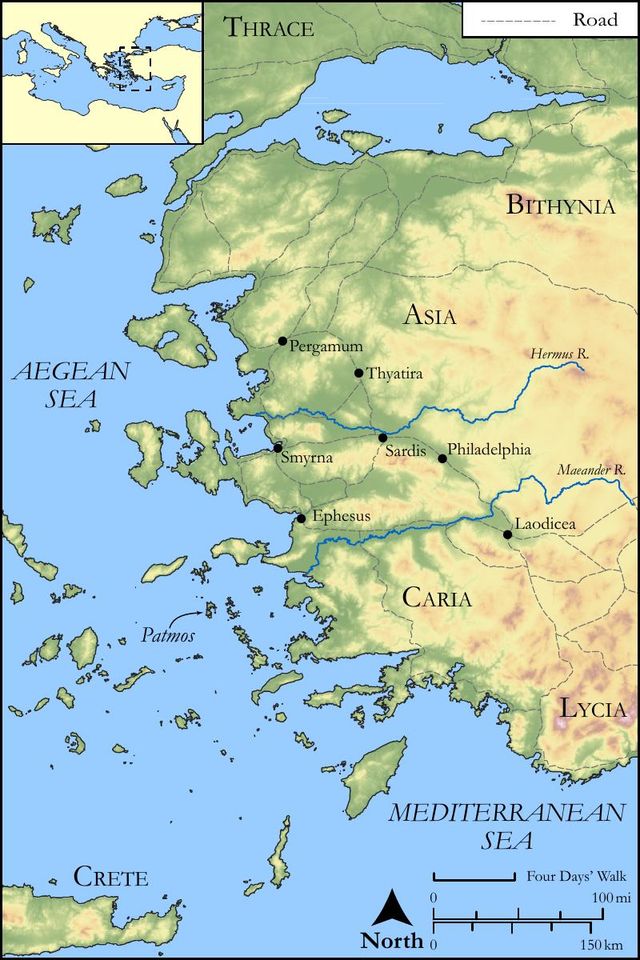
See on the biblical-era map

Study this verse
Public-domain commentary
Matthew Henry
From his Commentary on the Whole Bible. Henry comments on passages, not single verses — this entry covers Revelation 18:1–8.
The downfall and destruction of Babylon form an event so fully determined in the counsels of God, and of such consequence to his interests and glory, that the visions and predictions concerning it are repeated. 1. Here is another angel sent from heaven, attended with great power and lustre, Rev 18:1. He had not only light in himself, to discern the truth of his own prediction, but to inform and enlighten the world about that great event; and not only light to discern it, but power to accomplish it. 2. This angel publishes the fall of Babylon, as a thing already come to pass; and this he does with a mighty strong voice, that all might hear the cry, and might see how well this angel was pleased to be the messenger of such tidings. Here seems to be an allusion to the prediction of the fall of pagan Babylon (Isa 21:9), where the word is repeated as it is here: has fallen, has fallen. Some have thought a double fall is hereby intended, first her apostasy, and then her ruin; and they think the words immediately following favour their opinion; She has become the habitation of devils, and the hold of every foul spirit, and the cage of every unclean and hateful bird, Rev 18:2. But this is also borrowed from Isa 21:9, and seems to describe not so much her sin of entertaining idols (which are truly called devils) as her punishment, it being a common notion that unclean spirits, as well as ominous and hateful birds, used to haunt a city or house that lay in its ruins. 3. The reason of this ruin is declared (Rev 18:3); for, though God is not obliged to give any account of his matters, yet he is pleased to do so, especially in those dispensations of providence that are most awful and tremendous. The wickedness of Babylon had been very great; for she had not only forsaken the true God herself, and set up idols, but had with great art and industry drawn all sorts of men into the spiritual adultery, and by her wealth and luxury had retained them in her interest. 4. Fair warning is given to all that expect mercy from God, that they should not only come out of her, but be assisting in her destruction, Rev 18:4, Rev 18:5. Here observe, (1.) God may have a people even in Babylon, some who belong to the election of grace. (2.) God's people shall be called out of Babylon, and called effectually. (3.) Those that are resolved to partake with wicked men in their sins must receive of their plagues. (4.) When the sins of a people reach up to heaven, the wrath of God will reach down to the earth. (5.) Though private revenge is forbidden, yet God will have his people act under him, when called to it, in pulling down his and their inveterate and implacable enemies, Rev 18:6. (6.) God will proportion the punishment of sinners to the measure of their wickedness, pride, and security, Rev 18:7. (7.) When destruction comes on a people suddenly, the surprise is a great aggravation of their misery, Rev 18:8.
Historical interpretation
Six Centuries of Reception
7 surviving comments on this verse. Each one is dated, so this reads as a timeline rather than a list.
Select a marker to jump to its quote. Markers stagger vertically where authors wrote within a few decades of each other.
Now, brothers, you see the saints armed. Observe the slaughter, observe their glorious battles.… What have these done who had in their hands swords sharpened on both sides? "To do vengeance on the nations." See whether vengeance has not been done on the nations. Daily is it done; we do it ourselves by speaking. Observe how the nations of Babylon are slain. She is repaid twofold.… How is she repaid double? The saints wage war, they draw their "swords twice sharpened." From there come defeats, slaughters, severances. How is she repaid double? When she had the power to persecute the Christians, she slew the flesh indeed, but she crushed not God. Now she is repaid double, for the pagans are extinguished and the idols are broken.… And lest you should think that people are really smitten with the sword, blood really shed, wounds made in the flesh, he goes on and explains "chastisements on the peoples." What is "chastisements"? Reproof. Let the two-edged sword go forth from you. Do not delay. Say to your friend, if you have yet a friend [among the pagans] left to whom to say it, "What kind of man are you, who have abandoned him by whom you were made, and worship what he made? Better is the workman than that which he makes." When he begins to blush, when he begins to feel compunction, you have made a wound with your sword, it has reached his heart, he is about to die that he may live.
All of these future events are appropriate for the second advent, when upon the inquiry of the final judgment the society of the impious will be excluded and will suffer its just reward, so that those who sinned in time might be punished in perpetuity. This is what is meant when it says, “Repay her double” and “a double draught is mixed for her,” that whoever took pleasure in transient delights might suffer eternal torments. By way of the psalm the Lord foretells that he frees his own from such payments: “From usury and injustice he will redeem their souls.” In addition, they are said to burn in a perpetual fire and to be afflicted by a famine, namely, then when those who now hunger and thirst after righteousness shall receive an incorruptible abundance. Moreover, they suffer death, since God has abandoned them. For just as when the soul leaves, the body dies, so when God abandons the soul, it is thought to die. This mourning is that of which Christ speaks in the Gospel, “Woe to you that laugh now, for you shall mourn and weep.” To show that God desires to keep his followers unharmed by these plagues, it says, “Lest you share in her plagues.” This is as though it said, since you were turned away from their will and were not like them in their sins, you will not receive an equal punishment. Nor can we by our own strength avoid these plagues, since this can be granted to us only by the goodness of God. But keeping to the proper order, the Holy Spirit declares that those who were not made captive in their heart by an assent to impiety would in no way suffer the torments of the impious, saying, “The souls of the righteous are in the hand of God, and no torment will ever touch them.”
In Isaiah it is said to her, “Come down and sit in the dust, O virgin daughter of Babylon; sit on the ground, for there is no throne for the daughter of the Chaldeans, because you shall no longer be called tender and delicate.” And shortly thereafter: “Sit, be silent, go into the darkness, for you shall no more be called the mistress of kingdoms.” And again: “You said, ‘I shall be mistress forever,’ so that you did not lay these things to heart, nor did you remember your name. Now therefore, hear this, you delicate one who dwells in confidence, who says in your heart, ‘I am, and there is no one besides me; I shall not sit as a widow or know the loss of children.’ These two things shall come to you suddenly, in one day, sterility and widowhood.” Who would not understand these things together to be one prophecy and that they were said of one, universal event?
These words may refer to those who, although innocent in [Babylon], yet suffered the most terrible things at the hands of those who ruled her and through their endurance of these agonies were the reason for the punishment of their tormentors. Or these words may refer to a change of persons and circumstances, from those who were tormented to certain holy powers that have acquired the power of punishment and through love of God exercise those torments that had been done by her against their fellow servants. He speaks of the cup as “double,” either because sinners and transgressors are punished both here and in the age to come, or because both the soul and the body are punished for their common deeds, or because of the depth of divine benevolence that is reckoned as double which is lacking of pure justice on account of sin, and punishment is often endured in the conscience. “In her heart she says, ‘A queen I sit, I am no widow, and mourning I will never see.’ ” If there is no fear of God in them, it is the habit of those in prosperity to say, “I shall never be moved.” This is what [the city] has spoken to herself.… By a “single day” he means either the suddenness and shortness of the time in which mourning will come to her either from the sword or from famine, and she will be wasted from pestilence and will be consumed by fire. Or it refers to the course of the day itself in which [the city] will experience these things that are prophesied. For after the enemies gain control of the city, only one day will suffice to bring every evil and every form of death upon those who have been defeated. For God is strong both to save those who please him and to punish those who are unrepentant sinners.
And repay her double according to her works. So that she who enjoyed temporal pleasures may be tormented with eternal pains.
Repay her as she has repaid you. For visible and invisible plagues come forth from the Church into the world.
Therefore he says that God, having been very patient, has now risen for retribution. He therefore tells her to render sins double, although through the all-wise Moses God commanded us that "one should not exact vengeance twice for the same thing." (see Deut. 32.41; Nahum 1:9) How then does he himself repay twice? Double [διπλᾶ] does not mean double in the numerical sense, but that, being loving toward mankind and good, and far less inclined to punish to the extent deserved, God considers that he has repaid twice even when he gives back a portion; and not only twice, but sevenfold. And knowing this the prophet said, "Return to our neighbors sevenfold into their bosom their reproach which they reproached you with, O Lord." (Ps. 78:12) From the petition for sevenfold vengeance he is asking God concerning the deserved punishment of the enemies, instead of which, he says, having been glorified and having squandered the providence of this present life, he has not fulfilled the divine will. Render to her.
Continue studying Revelation 18:6 across the web’s major study libraries — every link below opens this exact verse, chapter, or book on the destination site.
Read & Compare
 BibleGatewayThis verse in more than 200 translations and 70 languages.
 Bible.comThe YouVersion reader — hundreds of translations, reading plans, and highlights.
 ESV.orgCrossway's official English Standard Version reader.
 NET BibleThe NET translation with 60,000+ translators' notes on every rendering decision.
 STEP BibleTyndale House's free study tool — original text, vocabulary, and scholarly resources.
 BibliaLogos Bible Software's free web reader.
 USCCBThe New American Bible (Revised Edition) with the U.S. bishops' study notes.
Commentaries
 BibleHub CommentariesDozens of classic commentaries on this verse, gathered on one page.
 StudyLightMore than 100 commentary sets — the largest collection on the web.
 BibleRefPlain-English commentary on what this verse means, verse by verse.
 Enduring WordDavid Guzik's free commentary on this chapter, widely used by Bible teachers.
 Bible Study ToolsVerse commentary alongside Greek and Hebrew study aids.
Original Language & Research
- BibleHub InterlinearThe verse word by word — original language, transliteration, and English.
- BibleHub LexiconEvery word's original-language definition and Strong's entry.
 Blue Letter BibleDeep-study tools — Strong's numbers, concordance, and word studies.
 CNTR CollationThe earliest Greek manuscripts of this verse, collated letter by letter.
Sermons, Hymns & Audio


TrulyRandomVerse is not affiliated with these sites and doesn’t control their content. They’re linked because they’re genuinely useful.
Summary
Revelation 18:6 pronounces a command for the divine retribution against "Babylon the Great," a symbolic entity representing the culmination of worldly rebellion against God and His people. It calls for a just and complete recompense, emphasizing a double measure of judgment proportionate to Babylon's accumulated works of sin, oppression, and idolatry, ensuring that the cup of suffering she inflicted upon others is now filled to her own brim, and beyond, with divine wrath.
Context
ShowHideLiterary Context
Revelation 18:6 is situated within the climactic pronouncements of judgment against "Babylon the Great," which spans chapters 17 and 18. Chapter 17 introduces Babylon as a harlot riding a scarlet beast, revealing her spiritual depravity and political alliances. Chapter 18 then details her economic and social collapse, portraying her as a global commercial hub whose destruction elicits lamentation from kings, merchants, and mariners who profited from her. Immediately preceding verse 6, a mighty angel announces Babylon's utter desolation, proclaiming her fall and transformation into a dwelling place for demons and unclean spirits Revelation 18:2. This sets the stage for the divine command for retribution, which is then followed by a call for God's people to "come out of her" to avoid sharing in her sins and plagues Revelation 18:4. Verse 6, therefore, serves as the direct command for the execution of the judgment that has been declared and justified by Babylon's extensive wickedness.
Historical & Cultural Context
The imagery of "Babylon" in Revelation draws heavily from Old Testament prophetic traditions, particularly those concerning the historical city of Babylon, which famously conquered Judah and exiled its people. This historical Babylon became a symbol of oppressive world empires, idolatry, and arrogance against God (e.g., Isaiah 13, Jeremiah 50-51). In John's day, "Babylon the Great" likely served as a coded reference to Rome, the dominant imperial power that persecuted Christians and demanded emperor worship. The Roman Empire was known for its vast wealth, intricate trade networks, and pervasive idolatry, all of which resonate with the description of Babylon in Revelation 18. The concept of "double" recompense or punishment also has roots in Old Testament legal and prophetic literature, where it could signify either a full, complete measure of payment or punishment, or an intensified, overwhelming judgment, often reflecting the severity of the offense.
Key Themes
ShowHideThis verse powerfully contributes to several overarching themes within Revelation and the broader biblical narrative. Foremost is the theme of Divine Justice and Retribution, asserting God's unwavering commitment to righteous judgment against all forms of evil and oppression. Babylon's fall is not arbitrary but a direct, deserved consequence of her actions, demonstrating that God sees, remembers, and will ultimately repay every injustice. The emphasis on "double" judgment highlights the Proportionality and Completeness of God's Wrath, signifying a full and overwhelming measure of divine recompense that perfectly fits the magnitude of Babylon's sin and her persecution of God's saints Revelation 18:20. Furthermore, the imagery of "the cup" reinforces the biblical theme of God's Wrath as a Consummated Reality, where the wicked are forced to drink the bitter consequences of their own deeds, a motif seen in passages like Jeremiah 25:15-16 and Isaiah 51:17.
Exposition and Analysis
ShowHideKey Word Analysis
ShowHideThe word diplous (G1362) means "two-fold," while diplóō (G1363) means "to render two-fold" or "double." Their repeated use in Revelation 18:6 ("double unto her double") is highly emphatic, underscoring the absolute certainty and comprehensive nature of Babylon's judgment. It signifies not merely a tit-for-tat, but a full, decisive, and final reckoning that leaves no room for escape or mitigation. This "double" measure represents a complete and overwhelming divine wrath, proportionate to Babylon's immense evil, luxury, and oppression. It is a judgment that fully satisfies the demands of justice.
The term érgon (G2041) refers to toil, effort, or an act. In this context, "according to her works" (κατὰ τὰ ἔργα αὐτῆς, kata ta erga autēs) stresses that the judgment is entirely merited and based on Babylon's accumulated deeds of sin, oppression, and rebellion against God. This phrase connects the punishment directly to her actions, emphasizing divine justice and accountability. It highlights that God's judgment is not arbitrary but a righteous response to the totality of her wicked endeavors, including her persecution of the saints and prophets Revelation 18:24.
The word potḗrion (G4221) denotes a drinking-vessel, its contents, or figuratively, a lot or fate. In biblical imagery, a cup frequently symbolizes destiny, suffering, or divine wrath. Here, "the cup which she hath filled" refers to the measure of wickedness, persecution, and idolatry that Babylon has meted out to others and accumulated for herself. The command to "fill to her double" from this very cup signifies that she will be forced to drink the full, intensified consequences of her own actions. It is a powerful metaphor for poetic justice, where the instrument of her sin becomes the instrument of her judgment.
Verse Breakdown
ShowHide"Reward her even as she rewarded you"
This clause establishes the foundational principle of divine retribution: lex talionis, or "an eye for an eye." God's judgment is not arbitrary but perfectly tailored to the actions of the wicked. Babylon's punishment will directly mirror the suffering, oppression, and injustice she inflicted upon God's people and the world. It signifies a just and equitable recompense.
"and double unto her double according to her works"
This expands upon the initial principle, intensifying the judgment. The repetition of "double" (from diplóō and diplous) underscores the completeness and overwhelming nature of the recompense. It is a full measure, perhaps even amplified, of divine wrath that is precisely proportionate to the totality of her accumulated "works"—her deeds of sin, rebellion, and persecution. This ensures that the punishment is not merely equivalent but decisively conclusive.
"in the cup which she hath filled fill to her double"
This final phrase employs powerful metaphorical language. The "cup" symbolizes the destiny or fate, specifically the measure of wickedness and suffering that Babylon has "filled" or prepared for others. The command to "fill to her double" from this very cup means that Babylon will be forced to drink the full, intensified consequences of her own actions. It is a vivid image of poetic justice, where the instrument of her sin becomes the instrument of her judgment, ensuring a complete and inescapable reckoning.
Literary Devices
ShowHideRevelation 18:6 masterfully employs several literary devices to convey the certainty and severity of divine judgment. The most prominent is Repetition, particularly with the word "double" (Greek, diplous and diplóō). Its threefold appearance ("double unto her double... fill to her double") creates a powerful rhetorical emphasis, underscoring the absolute certainty, completeness, and overwhelming nature of the judgment. This is not a partial or negotiable punishment but a full, intensified reckoning. Parallelism is also evident in the structure, where the command to "reward her even as she rewarded you" is echoed and amplified by the subsequent clauses concerning the "double" measure and the "cup." This reinforces the principle of just retribution. Furthermore, the verse utilizes potent Metaphor through the imagery of "the cup." The cup is a well-established biblical symbol for destiny, suffering, or divine wrath, and here it vividly portrays Babylon being forced to consume the very consequences of her own wickedness. This powerful imagery contributes to the dramatic and final pronouncements against the oppressive world system.
Theological and Thematic Connections
ShowHideRevelation 18:6 stands as a profound declaration of God's unwavering commitment to justice, a theme woven throughout the entire biblical narrative. It assures believers that no act of sin, oppression, or rebellion against God and His people will go unpunished. This verse highlights the principle of divine accountability, where judgment is not arbitrary but perfectly commensurate with the deeds committed. It underscores that God is sovereign over history, and though evil may seem to triumph for a season, His ultimate and complete justice will prevail, bringing full recompense to those who oppose Him and vindication to His suffering saints.
Reflection and Application
ShowHideRevelation 18:6 offers profound comfort and a sobering warning for believers today. In a world often characterized by injustice, where the wicked seem to prosper and the righteous suffer, this verse serves as a powerful reminder that God is ultimately just. It assures us that every tear shed, every act of persecution endured, and every sin committed against God's kingdom is seen and recorded by Him. This divine promise of ultimate justice provides hope and strengthens our faith, encouraging us to persevere even when circumstances seem bleak. It also calls us to self-examination: if God's justice is so precise and comprehensive, how much more should we strive for righteousness in our own lives, living in light of His coming judgment and rewards? Furthermore, this passage reinforces the call to spiritual discernment and separation from worldly systems that oppose God's values. Just as ancient Israel was called to separate from Babylon, believers are urged to avoid entanglement with the corrupting influences of the world, lest they partake in its sins and its judgment. It's a call to live distinctly, guided by eternal principles rather than fleeting worldly allurements.
Questions for Reflection
ShowHideFAQ
ShowHideWhat does "double unto her double" mean in the context of Babylon's judgment?
ShowHideThe phrase "double unto her double" (and "fill to her double") signifies a complete, overwhelming, and decisively comprehensive measure of judgment. While some interpretations suggest a literal doubling of suffering, the primary theological meaning is that Babylon will receive the full, intensified recompense that perfectly fits the magnitude of her sins and her persecution of God's people. It's not merely a tit-for-tat, but a final, unmitigated outpouring of divine wrath that leaves no room for escape or mitigation, ensuring that justice is fully satisfied according to her accumulated "works" Revelation 18:5.
Does this verse encourage believers to seek revenge against their oppressors?
ShowHideNo, Revelation 18:6 is a divine pronouncement of God's own justice, not a command for human vengeance. While it assures believers that God will ultimately repay those who harm His people, the New Testament consistently teaches believers to love their enemies Matthew 5:44, bless those who persecute them Romans 12:14, and leave vengeance to God Romans 12:19. This verse provides comfort and assurance that God will right all wrongs in His perfect timing, removing the burden of revenge from His followers and allowing them to focus on their mission of love and reconciliation.
Christ-Centered Fulfillment
ShowHideRevelation 18:6, with its resounding declaration of divine justice against the ultimate expression of worldly evil, finds its profoundest Christ-centered fulfillment in the person and work of Jesus. While this verse speaks of judgment, it implicitly points to Christ as the one through whom all judgment is executed, for the Father "has given him authority to execute judgment, because he is the Son of Man" John 5:27. The ultimate "reward" for sin, which is death Romans 6:23, was taken upon Himself by Christ on the cross, as He became sin for us, bearing the full cup of God's wrath that we deserved 2 Corinthians 5:21. Thus, for those who are in Christ, the "double" measure of judgment is not for them, but for the world system that rejected Him. Conversely, through His atoning sacrifice, Christ offers a "double" portion of grace and blessing to His redeemed, fulfilling prophecies of restoration and comfort for His people who had suffered "double for all her sins" Isaiah 61:7. Ultimately, the judgment pronounced in Revelation 18:6 is a testament to the righteous reign of the Lamb, who will ultimately conquer all evil and establish His eternal kingdom of justice and peace Revelation 19:11-16.