


Revelation 14:10
Bible text: King James Version (1769 Blayney text) · Public domain
Bible text: King James Version with Strong's numbers · Public domain
Bible text: Berean Standard Bible · Public domain
Bible text: American Standard Version (1901) · Public domain
Bible text: World English Bible, Messianic edition · Public domain
Bible text: Geneva Bible (1599) · Public domain
Bible text: Young's Literal Translation · Public domain
- καὶkaialsoG2532CONJConjunction
- αὐτὸςautoshe himselfG846P-NSMPersonal pronoun Nominative Singular Masculine
- πίεταιpietaiwill drinkG4095V-FDI-3SVerb Future Middle Deponent Indicative 3rd Singular
- ἐκekofG1537PREPPreposition
- τοῦtoutheG3588T-GSMDefinite article Genitive Singular Masculine
- οἴνουoinouwineG3631N-GSMNoun Genitive Singular Masculine
- τοῦtouof theG3588T-GSMDefinite article Genitive Singular Masculine
- θυμοῦthumouangerG2372N-GSMNoun Genitive Singular Masculine
- τοῦtou<the>G3588T-GSMDefinite article Genitive Singular Masculine
- θεοῦtheouof GodG2316N-GSM-TNoun Genitive Singular Masculine Title
- τοῦtouwhichG3588T-GSMDefinite article Genitive Singular Masculine
- κεκερασμένουkekerasmenoumixedG2767V-RPP-GSMVerb Perfect Passive Participle Genitive Singular Masculine
- ἀκράτουakratouundilutedG194A-GSMAdjective Genitive Singular Masculine
- ἐνeninG1722PREPPreposition
- τῷtōtheG3588T-DSNDefinite article Dative Singular Neuter
- ποτηρίῳpotēriōcupG4221N-DSNNoun Dative Singular Neuter
- τῆςtēsof theG3588T-GSFDefinite article Genitive Singular Feminine
- ὀργῆςorgēswrathG3709N-GSFNoun Genitive Singular Feminine
- αὐτοῦautouof HimG846P-GSMPersonal pronoun Genitive Singular Masculine
- καὶkaiandG2532CONJConjunction
- βασανισθήσεταιbasanisthēsetaihe will be tormentedG928V-FPI-3SVerb Future Passive Indicative 3rd Singular
- ἐνeninG1722PREPPreposition
- πυρὶpurifireG4442N-DSNNoun Dative Singular Neuter
- καὶkaiandG2532CONJConjunction
- θείῳtheiōbrimstoneG2303N-DSNNoun Dative Singular Neuter
- ἐνώπιονenōpionbeforeG1799PREPPreposition
- τῶνtōnof theG3588T-GPMDefinite article Genitive Plural Masculine
- ἀγγέλωνangelōnangelsG32N-GPMNoun Genitive Plural Masculine
- ἁγίωνhagiōnholyG40A-GPMAdjective Genitive Plural Masculine
- καὶkaiandG2532CONJConjunction
- ἐνώπιονenōpionbeforeG1799PREPPreposition
- τοῦtoutheG3588T-GSNDefinite article Genitive Singular Neuter
- ἀρνίουarniouLambG721N-GSNNoun Genitive Singular Neuter
English is a literal word-by-word gloss of the Greek, not the KJV's wording. Why?
This is the original text the KJV's translators worked from — each Greek word with its own literal English meaning in this verse, prepared by scholars at Tyndale House, Cambridge. The KJV translates whole sentences, not word by word, so its wording differs: one Greek word can become several English words, and the KJV may choose “charity” where the gloss reads “love”. Both are faithful — they answer different questions. For the KJV's own rendering, switch to the KJV text.
Details
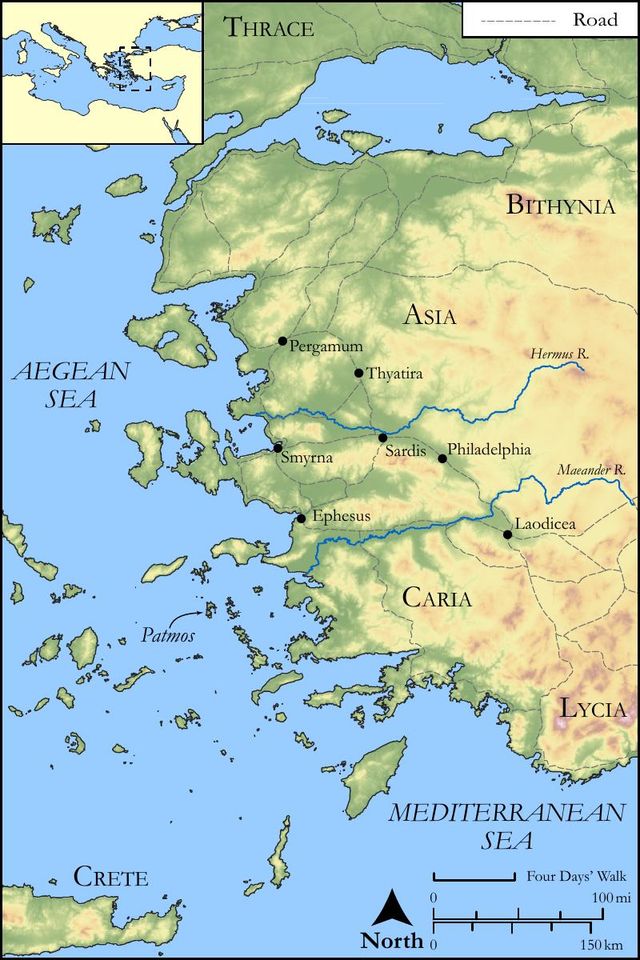
See on the biblical-era maps

Study this verse
Public-domain commentary
Matthew Henry
From his Commentary on the Whole Bible. Henry comments on passages, not single verses — this entry covers Revelation 14:6–12. His two-level outline is real structure in the source text, so it is rendered as structure.
In this part of the chapter we have three angels or messengers sent from heaven to give notice of the fall of Babylon, and of those things that were antecedent and consequent to that great event.
I.The first angel was sent on an errand antecedent to it, and that was to preach the everlasting gospel, Rev 14:6, Rev 14:7. Observe,
1.The gospel is an everlasting gospel; it is so in its nature, and it will be so in its consequences. Though all flesh be grass, the word of the Lord endureth for ever.
2.It is a work fit for an angel to preach this everlasting gospel; such is the dignity, and such is the difficulty of that work! And yet we have this treasure in earthen vessels.
3.The everlasting gospel is of great concern to all the world; and, as it is the concern of all, it is very much to be desired that it should be made known to all, even to every nation, and kindred, and tongue, and people.
4.The gospel is the great means whereby men are brought to fear God, and to give glory to him. Natural religion is not sufficient to keep up the fear of God, nor to secure to him glory from men; it is the gospel that revives the fear of God, and retrieves his glory in the world.
5.When idolatry creeps into the churches of God, it is by the preaching of the gospel, attended by the power of the Holy Spirit, that men are turned from idols to serve the living God, as the Creator of the heaven, and the earth, and the sea, and the fountains of waters, Rev 14:7. To worship any God besides him who created the world is idolatry.
II.The second angel follows the other, and proclaims the actual fall of Babylon.
The preaching of the everlasting gospel had shaken the foundations of antichristianism in the world, and hastened its downfall. By Babylon is generally understood Rome, which was before called Sodom and Egypt, for wickedness and cruelty, and is now first called Babylon, for pride and idolatry. Observe,
1.What God has fore-ordained and foretold shall be done as certainly as if it were done already.
2.The greatness of the papal Babylon will not be able to prevent her fall, but will make it more dreadful and remarkable.
3.The wickedness of Babylon, in corrupting, debauching, and intoxicating the nations round about her, will make her fall just and will declare the righteousness of God in her utter ruin, Rev 14:8. Her crimes are recited as the just cause of her destruction.
III.A third angel follows the other two, and gives warning to all of that divine vengeance which would overtake all those that obstinately adhered to the antichristian interest after God had thus proclaimed its downfall, Rev 14:9, Rev 14:10. If after this (this threatening denounced against Babylon, and in part already executed) any should persist in their idolatry, professing subjection to the beast and promoting his cause, they must expect to drink deep of the wind of the wrath of God; they shall be for ever miserable in soul and body; Jesus Christ will inflict this punishment upon them, and the holy angels will behold it and approve of it. Idolatry, both pagan and papal, is a damning sin in its own nature, and will prove fatal to those who persist in it, after fair warning given by the word of Providence; those who refuse to come out of Babylon, when thus called, and resolve to partake of her sins, must receive of her plagues; and the guilt and ruin of such incorrigible idolaters will serve to set forth the excellency of the patience and obedience of the saints. These graces shall be rewarded with salvation and glory. When the treachery and rebellion of others shall be punished with everlasting destruction, then it will be said, to the honour of the faithful (Rev 14:12): Here is the patience of the saints; you have before seen their patience exercised, now you see it rewarded.
Historical interpretation
Four Centuries of Reception
5 surviving comments on this verse. Each one is dated, so this reads as a timeline rather than a list.
Select a marker to jump to its quote. Markers stagger vertically where authors wrote within a few decades of each other.
Certain heretics withdraw from us because of their evil belief, while with a different depravity of morals, others turn aside from our traditions, and in addition there are yet others ordained to perish from both faith and morals. Here in summary fashion he includes all those among the living who have the inscription of the beast on their forehead or on their hand. Here the cup of wrath must not only be understood as the one of which the Lord spoke, “He must endure God’s wrath” showing original sin, but also the cup that he mentions to the arrogant Jews, when he says, “You will die in your sin,” indicating the merit obtained through their accursed actions.… It says that they will be tormented in the sight of the Lamb for whose condemnation they suffer, whom they haughtily condemned and over whose members they inappropriately pretended to be masters. They will also be tormented in the sight of his angels who know by God’s revelation that they are paying a just penalty.
It says that should anyone bow down to the beastlike antichrist and pursue an ungodly life like his, and should anyone proclaim him to be God in word and deed—for the mark given on the forehead and upon the hand would show this—that person will share with [the antichrist] in the drinking of the revenge-filled cup, which is unmixed and devoid of any divine mercy because of the justice of the judgment. And this cup is of wine poured from different punishments because of the diversity and variety of evils that were freely chosen. He aptly calls this torment the “wine of wrath,” since it follows upon the wine of godlessness, which inebriates those who drink of it, for “in that way by which one sins shall one also be punished.”
And he also shall drink of the wine of the wrath of God, etc. By saying, "And he also shall drink," he shows that there is another who drinks, so that he does not separate the one who, although visibly not mingling with the nations, yet under the name of Christ worships the same beast. Justly, however, those who offer the cup of the wrath of fornication are struck down by the cup of the Lord, not so that, according to Jeremiah, they may vomit out the malice of their hearts and be cleansed, but so that they perish condemned, falling into eternal death.
And he shall be tormented with fire and brimstone, etc. The saints reigning with the Lord can always see the punishment of the wicked, so that they may give greater thanks to their Redeemer, and sing the mercies of the Lord forever. For the torments of the wicked seen do not sadden those agreeing with the just Judge, just as the rest of Lazarus, seen buried in the flames, could not refresh the rich man.
And he says that he will drink of the wine of the wrath of God, which is mixed undiluted in the cup of His anger. The glorious David also remembers this cup and the wine, saying that "a cup is in the hand of the Lord, full of wine mixed undiluted, and he inclined from it to this: but the cluster of its vintage was not emptied; all the sinners of the earth shall drink." (Ps. 74:9) He says that the wrath of God is wine, not making the metaphor from joy but from darkening and from the change by which those controlled by the wrath of God are restrained.
He says of the mixed thing that it is undiluted. That is, mixed in an undiluted way; for the wrath of God has been mixed with generosity and goodness, it has been mixed undiluted; for there is no equality between anger and goodness, but generosity far outweighs. For if there were equality of both the wrath of the righteous and the goodness, not every living thing would have endured. Knowing this, the prophet said, "If iniquity be observed, Lord, Lord, who will stand before you?" (Ps. 130:3) But since goodness is diverse in the cup of God beyond righteous anger, he again spoke mysteriously, saying: "Merciful is the Lord and just, and our God has mercy." (Ps. 116:5) Having arranged his justice in the middle, so that, by the surrounding compassion being constrained and not forgiven, it may work its proper effects; and this is proper to justice, to give to each according to merit. Having once remembered the wine and therefore called forth the anger, he persisted in that course and named the cup the portion given by the hand of God to sinners. But someone may perhaps say, how do you call the mercy of God many in that judgment at the time when the vision delivered to us, having descended a little, declared that the punishments of those being punished are eternal?
Continue studying Revelation 14:10 across the web’s major study libraries — every link below opens this exact verse, chapter, or book on the destination site.
Read & Compare
 BibleGatewayThis verse in more than 200 translations and 70 languages.
 Bible.comThe YouVersion reader — hundreds of translations, reading plans, and highlights.
 ESV.orgCrossway's official English Standard Version reader.
 NET BibleThe NET translation with 60,000+ translators' notes on every rendering decision.
 STEP BibleTyndale House's free study tool — original text, vocabulary, and scholarly resources.
 BibliaLogos Bible Software's free web reader.
 USCCBThe New American Bible (Revised Edition) with the U.S. bishops' study notes.
Commentaries
 BibleHub CommentariesDozens of classic commentaries on this verse, gathered on one page.
 StudyLightMore than 100 commentary sets — the largest collection on the web.
 BibleRefPlain-English commentary on what this verse means, verse by verse.
 Enduring WordDavid Guzik's free commentary on this chapter, widely used by Bible teachers.
 Bible Study ToolsVerse commentary alongside Greek and Hebrew study aids.
Original Language & Research
- BibleHub InterlinearThe verse word by word — original language, transliteration, and English.
- BibleHub LexiconEvery word's original-language definition and Strong's entry.
 Blue Letter BibleDeep-study tools — Strong's numbers, concordance, and word studies.
 CNTR CollationThe earliest Greek manuscripts of this verse, collated letter by letter.
Sermons, Hymns & Audio


TrulyRandomVerse is not affiliated with these sites and doesn’t control their content. They’re linked because they’re genuinely useful.
Summary
Revelation 14:10 issues a stark and terrifying warning regarding the ultimate destiny of those who align themselves with the beast and receive its mark. It vividly describes a judgment where God's undiluted wrath is poured out as a bitter draught, leading to eternal torment by fire and brimstone. This severe and public punishment unfolds in the solemn presence of both holy angels and the Lamb, underscoring the righteousness and finality of divine justice against unrepentant rebellion.
Context
ShowHideLiterary Context
This verse is situated within a pivotal sequence in Revelation, specifically following the messages of the three angels in Revelation 14:6-12. The first angel proclaims the eternal gospel, urging all humanity to worship the Creator. The second declares the definitive fall of Babylon, the symbol of worldly corruption and opposition to God. Immediately preceding our verse, the third angel delivers a solemn and severe warning against worshiping the beast and receiving its mark (Revelation 14:9). Therefore, Revelation 14:10 serves as the explicit and horrifying description of the consequences for those who disregard this final, urgent call to repentance and choose allegiance to the beast's system, directly linking their actions to their inescapable doom.
Historical & Cultural Context
The imagery employed in Revelation 14:10 draws heavily from Old Testament prophetic traditions of judgment. The concept of a "cup of wrath" or "wine of indignation" was a well-established metaphor in Jewish prophetic literature (e.g., Isaiah 51:17 and Jeremiah 25:15), signifying the full measure of divine judgment poured out upon nations or individuals. The "fire and brimstone" imagery immediately evokes the destruction of Sodom and Gomorrah (Genesis 19:24), symbolizing complete and irreversible devastation. For early Christians facing persecution under Roman imperial cult worship, this verse would have provided both a terrifying warning against apostasy and a comforting assurance that their oppressors would ultimately face divine retribution.
Key Themes
ShowHideRevelation 14:10 powerfully contributes to several overarching themes in the book of Revelation. Foremost is the theme of Divine Justice and Retribution, emphasizing God's righteous response to unrepentant rebellion and idolatry. It highlights the Sovereignty of God over all earthly powers, demonstrating that even the formidable beast and its followers are subject to His ultimate judgment. The concept of Unmixed Judgment signifies the purity and intensity of God's wrath, indicating that there will be no mitigation or mercy for those who have definitively rejected His authority. Furthermore, the theme of Witnessed Judgment is crucial, as the torment occurs "in the presence of the holy angels, and in the presence of the Lamb," showcasing God's vindication and righteousness before all of creation. This verse also underscores the Eternal Consequences of Human Choice, presenting a stark contrast between choosing God and choosing the beast, with eternal life or eternal torment as the respective outcomes, a theme echoed throughout Revelation 20.
Exposition and Analysis
ShowHideKey Word Analysis
ShowHideFrom θύω (thúō), meaning "passion (as if breathing hard)." This word denotes a sudden, violent outburst of anger or indignation, often contrasted with orgē (G3709), which signifies a more settled, abiding anger. Here, it conveys the intense, fervent indignation of God, a righteous fury against sin that is about to be unleashed.
From Α (as a negative particle) and a presumed derivative of κεράννυμι (keránnymi), meaning "undiluted." In ancient times, wine was frequently mixed with water to reduce its potency. The term "without mixture" emphasizes that God's wrath will be pure, undiluted, and unmitigated in its intensity. There will be no softening or lessening of the judgment; it will be experienced in its full, devastating power.
From βάσανος (básanos), meaning "to torture." This verb describes severe pain, agony, or distress, often associated with physical torture or intense mental anguish. Its use here indicates an active, conscious, and excruciating suffering that is inflicted upon the condemned.
Verse Breakdown
ShowHide"The same shall drink of the wine of the wrath of God"
This clause identifies the recipients of the judgment – those who worship the beast and receive its mark – and describes their fate metaphorically. To "drink of the wine of the wrath of God" signifies being subjected to the full, intoxicating, and devastating effects of divine judgment. It is a forced consumption of the consequences of their rebellion, a bitter draught prepared by God's righteous anger.
"which is poured out without mixture into the cup of his indignation"
This further intensifies the description of God's wrath. The "wine" is not diluted; it is "without mixture," meaning it is pure, undiluted, and unmitigated in its potency. The "cup of his indignation" (using orgē, G3709) refers to God's settled, righteous abhorrence of sin, which is now being poured out in its full measure. This emphasizes the absolute severity and unyielding nature of the impending judgment.
"and he shall be tormented with fire and brimstone"
This clause describes the specific nature of the torment. "Fire and brimstone" is a powerful biblical idiom for eternal, agonizing punishment, drawing on the Old Testament destruction of Sodom and Gomorrah (Genesis 19:24). It signifies a conscious, painful, and perpetual suffering, indicating a state of complete devastation and separation from God's favor.
"in the presence of the holy angels, and in the presence of the Lamb"
This final phrase adds a profound dimension to the judgment. The torment is not hidden but is openly witnessed by the "holy angels" and, most significantly, "the Lamb." This public display underscores the righteousness and justice of God's judgment. It serves as a vindication of God's character and a testament to the Lamb's ultimate triumph, demonstrating that even those who rejected His sacrifice will bear witness to His righteous authority.
Literary Devices
ShowHideRevelation 14:10 is rich with powerful Symbolism and Metaphor. The "wine of the wrath of God" and "cup of his indignation" are potent metaphors for divine judgment, drawing on ancient practices where a cup could symbolize one's destiny or lot. The act of drinking implies forced consumption of the consequences of one's actions. The phrase "without mixture" serves as a form of Hyperbole and Emphasis, dramatically underscoring the undiluted, pure, and unmitigated nature of God's wrath, leaving no room for mercy or alleviation. The imagery of "fire and brimstone" is deeply rooted Allusion to Old Testament narratives, particularly the destruction of Sodom and Gomorrah, serving as a powerful symbol of complete and eternal devastation. Finally, the repetition of "in the presence of" creates Parallelism and Emphasis, highlighting the public and undeniable nature of this judgment, witnessed by both heavenly beings and the very Lamb who offered salvation.
Theological and Thematic Connections
ShowHideThis verse profoundly articulates the doctrine of divine retribution, emphasizing that God's justice is not merely punitive but perfectly righteous and inevitable for those who persistently reject His sovereignty and embrace evil. It reveals a God who is not indifferent to human rebellion but whose holy character demands a response to sin. The "wine of wrath" signifies the full measure of divine judgment, a concept found throughout Scripture, underscoring that God's patience has limits and that unrepentant sin ultimately leads to a terrifying, self-chosen destiny. The presence of the holy angels and the Lamb during this torment highlights the transparency and vindication of God's justice before all creation, demonstrating that His judgments are just and true.
Reflection and Application
ShowHideRevelation 14:10 serves as a solemn and urgent warning, a stark reminder of the eternal consequences of our choices. It compels us to consider the gravity of allegiance: to whom or what do we ultimately pledge our loyalty? In a world that often downplays sin or dismisses divine judgment, this verse reaffirms God's absolute holiness and His commitment to justice. For believers, it should deepen our gratitude for the salvation offered through Christ, who bore the wrath we deserved. For those who have not yet committed their lives to Christ, it is a profound call to repentance and faith, urging them to flee from the coming wrath by embracing the grace freely offered. It reminds us that God's patience, while vast, is not infinite, and that the ultimate outcome of rejecting His love is a terrifying, self-chosen separation from Him and His goodness. This passage should motivate us to live lives of faithful obedience, sharing the gospel with urgency, and standing firm against the allure of worldly systems that oppose God.
Questions for Reflection
ShowHideFAQ
ShowHideWhat does "wine of the wrath of God" mean in this context?
ShowHideThe "wine of the wrath of God" is a powerful biblical metaphor, frequently used in prophetic literature (e.g., Isaiah 51:17, Jeremiah 25:15), to symbolize the full, intoxicating, and devastating measure of divine judgment. It represents the consequences of unrepentant sin and rebellion against God, which the wicked are forced to "drink" or experience in its entirety. The term "wine" here signifies the potent, unadulterated nature of this judgment, leading to spiritual intoxication and ultimate ruin.
Why is the wrath "poured out without mixture"?
ShowHideIn ancient times, wine was often diluted with water to make it less potent. The phrase "without mixture" (Greek: ákratos) emphasizes that God's wrath will be undiluted, pure, and unmitigated. This means there will be no mercy, no softening, and no lessening of the judgment for those who have definitively chosen to worship the beast and receive its mark. It signifies the full, unadulterated intensity and severity of God's righteous indignation, poured out in its most potent form. This highlights the absolute finality and unyielding nature of this divine retribution.
What is the significance of the torment occurring "in the presence of the holy angels, and in the presence of the Lamb"?
ShowHideThe fact that the torment occurs "in the presence of the holy angels, and in the presence of the Lamb" is highly significant. It underscores that God's judgment is not hidden but is a public, open, and undeniably righteous act. The holy angels, who serve God and carry out His will, bear witness to the justice of His decrees. Most profoundly, the presence of "the Lamb" (Jesus Christ) serves as a stark contrast and a powerful vindication. It demonstrates that those who rejected His atoning sacrifice and chose rebellion will face the very One they spurned, witnessing His righteous authority as Judge. This public display serves to glorify God's justice and righteousness before all of creation.
Christ-Centered Fulfillment
ShowHideWhile Revelation 14:10 vividly portrays the terrifying reality of God's wrath, its ultimate Christ-centered fulfillment lies in the profound contrast it presents to the gospel. This verse highlights the just recompense for those who reject the Lamb, but it simultaneously magnifies the immeasurable grace and substitutionary atonement offered by Christ. The "wine of the wrath of God" is the cup that Jesus willingly drank on the cross, as foreshadowed in His prayer in Gethsemane, where He asked if this "cup" could pass from Him (Matthew 26:39). He, the sinless Lamb, bore the full, unmixed indignation of God's wrath against sin, so that those who believe in Him would never have to experience it. His suffering with "fire and brimstone" (figuratively, the full torment of divine abandonment and judgment) on the cross means that believers are forever delivered from the "wrath to come" (1 Thessalonians 1:10). Thus, this passage, while terrifying for the unrepentant, serves to highlight the glorious and complete salvation accomplished by the Lamb, who, though present at the judgment as a witness to justice, first stood in the place of sinners to absorb the very wrath described here, offering eternal life to all who turn to Him (John 3:16).