


Joshua 9:5
Bible text: King James Version (1769 Blayney text) · Public domain
Bible text: Berean Standard Bible · Public domain
Bible text: American Standard Version (1901) · Public domain
Bible text: World English Bible, Messianic edition · Public domain
Bible text: Geneva Bible (1599) · Public domain
Bible text: Young's Literal Translation · Public domain
- וּנְעָלוֹתu·ne·'a·Lotand sandalsH5275Conj-w ¦ N-fpNoun Plural Feminine Absoluteוּandנְעָלוֹתsandals
- בָּלוֹתba·Lotworn outH1087Adj-fpAdjective Plural Feminine Absolute
- וּמְטֻלָּאוֹתu·me·tu·la·'Otand patchedH2921Conj-w ¦ V-Pual-PassPrtcpl-fpVerb Pual Participle Passive Plural Feminine Absoluteוּandמְטֻלָּאוֹתpatched
- בְּרַגְלֵיהֶםbe·rag·lei·Hem[were] on their feetH7272Prep-b ¦ N-fdc ¦ 3mpNoun Dual Feminine Constructבְּ[were] onרַגְלֵיfeetהֶםtheir
- וּשְׂלָמוֹתu·se·la·Motand garmentsH8008Conj-w ¦ N-fpNoun Plural Feminine Absoluteוּandשְׂלָמוֹתgarments
- בָּלוֹתba·Lotworn outH1087Adj-fpAdjective Plural Feminine Absolute
- עֲלֵיהֶם'a·lei·Hem[were] on themH5921Prep ¦ 3mpPreposition Definiteעֲלֵי[were] onהֶםthem
- וְכֹלve·Kholand allH3605Conj-w ¦ N-mscNoun Singular Masculine Constructוְandכֹלall
- לֶחֶםLe·chem[the] bread ofH3899N-mscNoun Singular Masculine Construct
- צֵידָםtzei·Damtheir provision[s]H6718N-msc ¦ 3mpNoun Singular Masculine Constructצֵידָprovision[s]םtheir
- יָבֵשׁya·Veshit was dried upH3001V-Qal-Perf-3msVerb Qal Perfect 3rd Singular Masculine
- הָיָהha·Yahit wasH1961V-Qal-Perf-3msVerb Qal Perfect 3rd Singular Masculine
- נִקֻּדִיםni·ku·DimcrumbsH5350N-mpNoun Plural Masculine Absolute
English is a literal word-by-word gloss of the Hebrew, not the KJV's wording. Why?
This is the original text the KJV's translators worked from — each Hebrew word with its own literal English meaning in this verse, prepared by scholars at Tyndale House, Cambridge. The KJV translates whole sentences, not word by word, so its wording differs: one Hebrew word can become several English words, and the KJV may choose “the LORD” where the gloss reads “Yahweh”. Both are faithful — they answer different questions. For the KJV's own rendering, switch to the KJV text.
Details
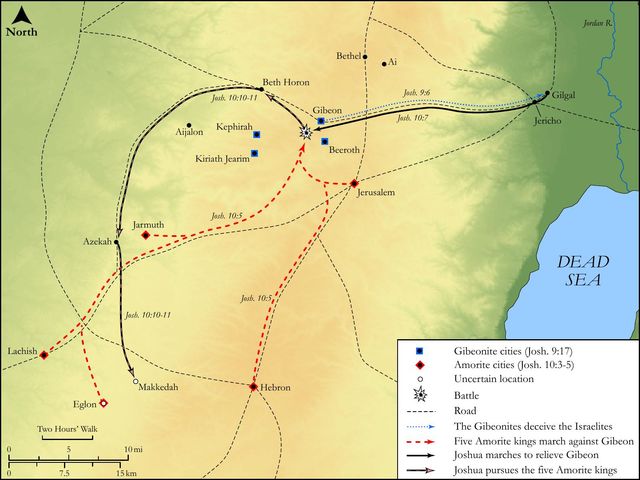
See on the biblical-era map
Study this verse
Public-domain commentary
Matthew Henry
From his Commentary on the Whole Bible. Henry comments on passages, not single verses — this entry covers Joshua 9:3–14. His four-level outline is real structure in the source text, so it is rendered as structure.
Here, I. The Gibeonites desire to make peace with Israel, being alarmed by the tidings they heard of the destruction of Jericho, Jos 9:3. Other people heard those tidings, and were irritated thereby to make war upon Israel; but the Gibeonites heard them and were induced to make peace with them. Thus the discovery of the glory and grace of God in the gospel is to some a savour of life unto life, but to others a savour of death unto death, Co2 2:16. The same sun softens wax and hardens clay. I do not remember that we read any where of a king of Gibeon. Had their government been at this time in a single person, perhaps his heart would have been too high to yield to Israel, and he would have joined with the rest of the kings against Israel. But these four united cities (mentioned Jos 9:17) seem to have been governed by elders, or senators (Jos 9:11), who consulted the common safety more than their own personal dignity. The inhabitants of Gibeon did well for themselves. We have,
II.The method they took to compass it.
They knew that all the inhabitants of the land of Canaan were to be cut off; perhaps they had some spies in the congregation at Ebal, when the law was read, who observed and brought them notice of the command given to Israel (Deu 7:1-3), that they should show no mercy to the Canaanites, give them no quarter in battle, which made them afraid of fighting them, and that they should make no covenant with them, which made them despair of gaining any advantage by treating with them; and therefore there was no way of saving their lives from the sword of Israel unless they could, by disguising themselves, make Joshua believe that they came from some very country, which the Israelites were not commanded to make war upon nor forbidden to make peace with, but were particularly appointed to offer peace to, Deu 20:10, Deu 20:15. Unless they could be admitted under this notion, they saw there was but one way with them: they must submit to the fate of Jericho and Ai. Though the neighbouring princes knew that all the men thereof were mighty (Jos 10:2), and they knew it themselves, yet they durst not contend with Israel, who had an Almighty God on their side. This therefore is the only game they have to play, and observe,
1.They play it very artfully and successfully. Never was any such thing more craftily managed.
(1.)They come under the character of ambassadors from a foreign state, which they thought would please the princes of Israel, and make them proud of the honour of being courted by distant countries: we find Hezekiah fond of those that came to him from a far country (Isa 39:3); they were not used to be thus courted.
(2.)They pretended to have undergone the fatigues of a very long journey, and produced what passed for an ocular demonstration of it. It should seem it was then usual for those that undertook long journeys to take with them, as we do now for long voyages, all manner of provision in kind, the country not being furnished as ours is now with houses of entertainment, for the convenience of which, when we have occasion to make use of them, we have reason to be very thankful. Now they here pretended that their provision, when they brought it from home, was fresh and new, but now it appeared to be old and dry, whereas it might well be presumed they had not loitered, but made the best of their way; so that hence it must be inferred that they came, as they said they did, from a very far country: their sacks or portmanteaus were old; the wine was all drunk, and the bottles in which it had been were broken; their shoes and clothes were worse than those of the Israelites in forty years, and their bread was mouldy, Jos 9:4, Jos 9:5, and again, Jos 9:12, Jos 9:13. Thus God's Israel have often been deceived and imposed upon with a show of antiquity. But (as bishop Hall expresses it) errors are never the older for being patched, and so seeming old; but those that will be caught with this Gibeonitish stratagem prove they have not consulted with God. And thus there are those who make themselves poor with the badges of want and distress and yet have great riches (Pro 13:7), or at least have no need of relief, by which fraud charity is misplaced and diverted from those that are real objects of it.
(3.)When they were suspected, and more strictly examined as to whence they came, they industriously declined telling the name of their country, till the agreement was settled. [1.] The men of Israel suspected a fraud (Jos 9:7): "Peradventure you dwell among us, and then we may not, we must not, make any league with you." This might have discouraged the Gibeonites from urging the matter any further, concluding that if the peace were made the Israelites would not think themselves obliged to keep it, having thus solemnly protested against it in case they dwelt among them; but, knowing that there was no hope at all if they stood it out, they bravely ventured a submission. "Who knows but the people of Israel may save us alive, though thus inveigled into a promise; and if we tell them at last we shall but die." [2.] Joshua put the questions to them, Who are you? and whence come you? He finds himself concerned to stand upon his guard against secret fraud as well as against open force. We in our spiritual warfare must stand against the wiles of the devil, remembering he is a subtle serpent as well as a roaring lion. In all leagues of relation and friendship we must first try and then trust, lest we repent at leisure agreements made in haste. [3.] They would not tell whence they came; but still repeat the same thing: We have come from a very far country, Jos 9:9. They will have it thought that it is a country Joshua knows nothing of nor ever heard of, and therefore would be never the wiser if they should tell him the name of it.
(4.)They profess a respect for the God of Israel, the more to ingratiate themselves with Joshua, and we charitably believe they were sincere in this profession: "We have come because of the name of the Lord thy God (v. 9), because of what we have heard of that name, which has convinced us that it is above every name, and because we have a desire towards that name and the remembrance of it, and would gladly come under its protection."
(5.)They fetch their inducements from what had been done some time before in Moses's reign, the tidings whereof might easily be supposed ere this to have reached distant regions, the plagues of Egypt and the destruction of Sihon and Og (v. 9, 10), but prudently say nothing of the destruction of Jericho and Ai (though this was the true inducement, v. 3), because they will have it supposed that they came from home long before those conquests were made. We need not be long to seek for reasons why we should submit to the God of Israel; we may be furnished either with new or old, which we will.
(6.)They make a general submission - We are our servants; and humbly sue for a general agreement - Make a league with us, v. 11. They insist not upon terms, but will be glad of peace upon any terms; nor will the case admit of delays, lest the fraud be discovered; they would fain have the bargain struck up immediately; if Joshua will but make a league with them, they have all they come for, and they hope their ragged clothes and clouted shoes will be no exception against them. God and Israel reject none for their poverty. But,
2.There is a mixture of good and evil in their conduct.
(1.)Their falsehood cannot be justified, nor ought it to be drawn into a precedent. We must not do evil that good may come. Had they owned their country but renounced the idolatries of it, resigning the possession of it to Israel and themselves to the God of Israel, we have reason to think Joshua would have been directed by the oracle of God to spare their lives, and they needed not to have made these pretensions. It is observable that when they had once said, We have come from a far country (Jos 9:6), they found themselves necessitated to say it again (Jos 9:9), and to say what was utterly false concerning their bread, their bottles, and their clothes (Jos 9:12, Jos 9:13), for one lie is an inlet to another, and that to a third, and so on. The way of that sin is down-hill. But,
(2.)Their faith and prudence are to be greatly commended. Our Lord commended even the unjust steward, because he had done wisely and well for himself, Luk 16:8. In submitting to Israel, they submitted to the God of Israel, which implied a renunciation of the god they had served, a resignation to the laws of true religion. They had heard enough to convince them of the infinite power of the God of Israel, and thence might infer his other perfections of wisdom and goodness; and how can we do better for ourselves than surrender at discretion to infinite wisdom, and cast ourselves upon the mercy of a God of infinite goodness. The submission of these Gibeonites was the more laudable because it was,
[1.]Singular. Their neighbours took another course, and expected they should join with them.
[2.]Speedy. They did not stay till Israel had besieged their cities; then it would have been too late to capitulate; but when they were at some distance they desired conditions of peace. Thy way to avoid a judgment is to meet it by repentance. Let us imitate these Gibeonites, and make our peace with God in the rags of humiliation, godly sorrow, and mortification, so our iniquity shall not be our ruin. Let us be servants to Jesus, our blessed Joshua, and make a league with him and the Israel of God, and we shall live.
Historical interpretation
Historical reception
1 surviving comment on this verse from the historical church.
“In my father’s house are many mansions,” says the Word of God. Yet even the resurrection of the dead will not exhibit an equal glory of those rising again, for “there is one flesh of birds, another of cattle, and even another of fish. There are both heavenly bodies and earthly bodies; but the glory of heavenly things is one thing, that of the earthly, another. One glory of the sun, another glory of the moon, another glory of the stars. Star differs from star in glory; thus also, the resurrection of the dead.”4Therefore, many differences of those who come to salvation are depicted. Whence even now I think those Gibeonites, whose history has been recited, are a certain small portion of those who must be saved but in such a manner that they are not saved apart from the branding of some mark. For you see how they are condemned to become “hewers of wood” or “bearers of water” for the service of the people and for the ministry of the altar of God, because they indeed approached the sons of Israel with deceit and cunning, “clothed in old garments and shoes” and “carrying food of aged bread.” Therefore, these persons come to Jesus [Joshua] with all their aged things and greatly beg of him that they may be saved.
Something such as this seems to me to be displayed in their figure. There are in the church certain ones who believe in God, have faith in God, and acquiesce in all the divine precepts. Furthermore, they are conscientious toward the servants of God and desire to serve them, for they also are fully ready and prepared for the furnishing of the church or for the ministry. But, in fact, they are completely disgusting in their actions and particular habit of life, wrapped up with vices and not wholly “putting away the old self with its actions.” Indeed they are enveloped in ancient vices and offensive faults, just as those persons were covered over with old garments and shoes. Apart from the fact that they believe in God and seem to be conscientious toward the servants of God or the worship of the church, they make no attempt to correct or alter their habits. For those, therefore, our Lord Jesus certainly permits salvation, but their salvation itself, in a certain measure, does not escape a note of infamy.
Continue studying Joshua 9:5 across the web’s major study libraries — every link below opens this exact verse, chapter, or book on the destination site.
Read & Compare
 BibleGatewayThis verse in more than 200 translations and 70 languages.
 Bible.comThe YouVersion reader — hundreds of translations, reading plans, and highlights.
 ESV.orgCrossway's official English Standard Version reader.
 NET BibleThe NET translation with 60,000+ translators' notes on every rendering decision.
 STEP BibleTyndale House's free study tool — original text, vocabulary, and scholarly resources.
 BibliaLogos Bible Software's free web reader.
 USCCBThe New American Bible (Revised Edition) with the U.S. bishops' study notes.
Commentaries
 BibleHub CommentariesDozens of classic commentaries on this verse, gathered on one page.
 StudyLightMore than 100 commentary sets — the largest collection on the web.
 BibleRefPlain-English commentary on what this verse means, verse by verse.
 Enduring WordDavid Guzik's free commentary on this chapter, widely used by Bible teachers.
 Bible Study ToolsVerse commentary alongside Greek and Hebrew study aids.
Original Language & Research
- BibleHub InterlinearThe verse word by word — original language, transliteration, and English.
- BibleHub LexiconEvery word's original-language definition and Strong's entry.
 Blue Letter BibleDeep-study tools — Strong's numbers, concordance, and word studies.
 SefariaThe Hebrew text with Rashi and centuries of Jewish commentary.
Sermons, Hymns & Audio


TrulyRandomVerse is not affiliated with these sites and doesn’t control their content. They’re linked because they’re genuinely useful.
Summary
Joshua 9:5 provides a meticulous description of the Gibeonites' elaborate and deceptive disguise, crafted to mislead the Israelites into believing they had traveled from a distant land. This verse details their worn-out, patched footwear, their tattered clothing, and their stale, moldy provisions, all carefully orchestrated elements designed to convey extreme age and arduous travel. This visual ruse was central to their cunning strategy to secure a peace treaty with Israel, thereby avoiding the fate of other Canaanite nations destined for destruction.
Context
ShowHideLiterary Context
Joshua 9:5 is strategically placed within the narrative of Israel's conquest of Canaan, immediately following the decisive and miraculous victories at Jericho and Ai. The widespread fame of Israel's God and their military prowess had instilled terror among the Canaanite inhabitants, prompting various responses. While many prepared for direct confrontation, the Gibeonites, a powerful Hivite city, opted for a path of cunning deception. This verse precisely outlines the visual evidence of their elaborate ruse, setting the stage for the Israelites' critical examination of these very provisions in Joshua 9:14, a pivotal moment that directly precedes their ill-advised covenant. The detailed description here underscores the Gibeonites' meticulous planning and, by contrast, highlights the Israelites' subsequent failure in discernment.
Historical & Cultural Context
During this period, Israel was operating under explicit divine commands to utterly destroy the inhabitants of Canaan and to make no covenant with them, as clearly articulated in Deuteronomy 7:1-2. This strict injunction was crucial to prevent the Israelites from being corrupted by the pervasive pagan idolatry and abhorrent practices of the land. The Gibeonites, identified as a significant Hivite city (Joshua 9:7), were acutely aware of Israel's mission and their own precarious position. Treaty-making was a common and formal practice, often involving elaborate protocols, oaths, and even shared meals, as when Isaac made a feast for Abimelech and they swore one to another. The Gibeonites shrewdly exploited this custom by presenting themselves as ambassadors from a far-off land, a status that would typically warrant a peace treaty rather than immediate destruction. Their meticulously crafted disguise, therefore, was far more than mere cosmetic alteration; it was a sophisticated performance designed to appeal to the Israelites' sense of protocol and their understanding of international relations, effectively bypassing the divine command regarding local inhabitants.
Key Themes
ShowHideThis verse powerfully contributes to several overarching themes within the book of Joshua and the broader Old Testament narrative. Firstly, it vividly illustrates the theme of deception and guile, showcasing the Gibeonites' meticulous effort to secure their survival through cunning rather than direct confrontation. Their elaborate disguise underscores the desperate lengths to which people will go to preserve themselves, even if it means resorting to falsehood. Secondly, the verse starkly highlights the contrast between appearance and reality. The "old shoes and clouted," "old garments," and "dry and mouldy bread" were all carefully chosen props in a theatrical performance, designed to convey a false narrative of a long journey and distant origin. This serves as a potent cautionary tale, setting up the Israelites' subsequent failure to see beyond the superficial. Finally, Joshua 9:5 profoundly foreshadows the consequences of hasty judgment and a lack of spiritual discernment. The detailed description of the Gibeonites' provisions prepares the reader for the Israelites' critical error in failing to inquire of the Lord before making a covenant, as explicitly stated in Joshua 9:14, ultimately leading to a binding, albeit unintended, agreement that would have lasting and complex repercussions for generations to come.
Exposition and Analysis
ShowHideKey Word Analysis
ShowHideFrom the root meaning "to wear out" or "to decay," this term describes something that is worn out, dilapidated, or aged. In the context of Joshua 9:5, it emphasizes the extreme age and deterioration of the Gibeonites' shoes and garments, meticulously chosen to support their fabricated story of an exceedingly long journey. This word highlights the intentional effort to appear ancient and travel-worn.
Derived from a primitive root meaning "to cover with pieces," this term specifically refers to something that has been patched or mended. When applied to the shoes, it signifies that they were not merely old, but had undergone repeated repairs, indicative of extensive and prolonged wear. This detail was a crucial element of the Gibeonites' deception, as it powerfully suggested the immense mileage covered, making their claim of distant origin more credible and visually compelling.
This word, related to a root meaning "to be spotted" or "to be pricked," describes something that is crumbly, spotted, or marked with decay. When referring to bread, it vividly conveys a state of being spoiled, dried out, and discolored from age and exposure. The "mouldy" condition of their bread was a key piece of "evidence" for the Gibeonites, as fresh provisions would have immediately betrayed their proximity. Its decayed state was a calculated element to reinforce their narrative of a long, provisions-exhausting journey, making their story seem undeniably true.
Verse Breakdown
ShowHide"And old shoes and clouted upon their feet"
This clause immediately establishes the visual foundation of the Gibeonites' deception. Their footwear was deliberately chosen or prepared to appear ancient and heavily worn. The specific mention of "clouted" (patched) highlights the meticulous effort to make the shoes look as if they had endured countless miles, powerfully reinforcing the narrative of a journey from a distant land. This detail was intended to evoke sympathy and validate their claim of arduous travel, serving as compelling visual evidence for the Israelites.
"and old garments upon them"
Complementing the footwear, their clothing was also carefully selected to convey extreme age and wear. "Old garments" would suggest prolonged exposure to the elements, the passage of much time on the road, and the absence of opportunities for fresh attire. This element of their disguise aimed to create a consistent visual narrative of a group that had been traveling for an extended period, further supporting their fabricated story of coming from a far-off country and enhancing the overall credibility of their appearance.
"and all the bread of their provision was dry [and] mouldy"
The condition of their food was arguably the most convincing piece of their "evidence." Bread, being highly perishable, would quickly spoil on a long journey. By presenting bread that was "dry" (stale, hard, dehydrated) and "mouldy" (decayed, spotted with fungi), the Gibeonites offered tangible, undeniable proof that their provisions had been carried for an exceedingly long time. This detail was designed to be the clinching argument for their claim of distant origin and the urgency of their request for a treaty, appealing directly to the Israelites' practical understanding of travel and food preservation.
Literary Devices
ShowHideJoshua 9:5 is rich in Descriptive Language, painting a vivid and precise picture of the Gibeonites' elaborate disguise. The specific, carefully chosen details—"old shoes and clouted," "old garments," "dry and mouldy bread"—are designed to evoke a powerful sense of extreme age and arduous travel, making the deception remarkably plausible. This detailed imagery also functions as a form of Foreshadowing, subtly preparing the reader for the Israelites' impending and significant error in judgment. The very precision with which the Gibeonites' "props" are described highlights the profound Irony of the situation: the Israelites, who had recently witnessed miraculous divine interventions and received clear divine commands, would ultimately be swayed by such earthly, tangible, and fabricated evidence. The entire scene is presented as an elaborate Performance, where the Gibeonites act as skilled deceivers, and their worn items are meticulously selected Props, all designed to manipulate perception and secure their survival through cunning.
Theological and Thematic Connections
ShowHideJoshua 9:5 stands as a powerful testament to the pervasive nature of deception and the critical, enduring need for spiritual discernment. The Gibeonites' elaborate ruse underscores humanity's persistent propensity to rely on cunning, outward appearances, and human ingenuity rather than on divine truth and guidance. This narrative serves as a timeless warning against superficial judgments, reminding believers that not everything is as it seems, and that true wisdom necessitates looking beyond the visible to diligently seek God's counsel. The Israelites' profound failure to inquire of the Lord before making a covenant, despite the clear and convincing (albeit false) evidence of the Gibeonites' "long journey," highlights a significant spiritual lapse. This incident underscores the timeless biblical principle that even when circumstances appear clear, urgent, or logically compelling, the ultimate source of truth, direction, and wisdom must always be God's revealed Word and the guidance of His Spirit, not human logic or persuasive presentations.
Reflection and Application
ShowHideThe meticulous description in Joshua 9:5 offers profound and enduring lessons for believers today, primarily emphasizing the critical importance of spiritual discernment in a world increasingly characterized by superficiality, misinformation, and deliberate deception. We are constantly bombarded with claims, narratives, and appearances that may not reflect underlying reality. This passage challenges us to cultivate a deep spiritual sensitivity that allows us to look beyond the immediate and the obvious, to critically question narratives, and to diligently seek the underlying truth. Just as the Israelites were swayed by the Gibeonites' seemingly convincing disguise, we too can be misled by persuasive arguments, appealing images, or seemingly urgent circumstances if we do not anchor ourselves firmly in God's wisdom. The ultimate and most vital lesson from this account is the absolute necessity of seeking God's counsel in all significant decisions, even when the path ahead appears self-evident or logically sound. Our reliance should never be solely on our own understanding, our human intellect, or the convincing nature of external evidence, but rather on the unfailing, infallible guidance of the Holy Spirit and the unchanging truth of God's Word.
Questions for Reflection
ShowHideFAQ
ShowHideWhy did the Gibeonites resort to such elaborate deception?
ShowHideThe Gibeonites resorted to such an elaborate deception because they were acutely aware of Israel's overwhelming military victories against cities like Jericho and Ai, and, more importantly, God's explicit command to Israel to utterly destroy all the inhabitants of Canaan (as seen in Deuteronomy 7:1-2). Unlike other Canaanite peoples who prepared for direct military confrontation, the Gibeonites, being a powerful city-state themselves, chose a strategy of cunning and guile to preserve their lives and their city. By meticulously pretending to be from a very distant land, they hoped to bypass the divine injunctions against covenant-making with local Canaanites and thereby secure a peace treaty that would guarantee their survival. Their detailed disguise was an act of desperate and calculated cunning to exploit the Israelites' sense of protocol and prevent their own annihilation.
What was the Israelites' key mistake in dealing with the Gibeonites?
ShowHideThe Israelites' key and most significant mistake was their failure to inquire of the Lord before making a covenant with the Gibeonites. Joshua 9:14 explicitly states, "And the men of Israel took of their provisions, and asked not counsel at the mouth of the Lord." Despite the Gibeonites' elaborate disguise and seemingly convincing physical evidence, the Israelites relied solely on their own human judgment and the outward appearance of things. They neglected to seek divine wisdom and guidance, which would have undoubtedly revealed the Gibeonites' true identity and prevented them from entering into a forbidden treaty. This critical oversight led to a binding oath that God honored, even though it was made under false pretenses, highlighting the serious and lasting consequences of neglecting to seek God's counsel in pivotal moments.
How does this story relate to God's command to destroy the Canaanites?
ShowHideThis story directly relates to God's command to destroy the Canaanites by vividly illustrating the consequences of human failure to fully obey that divine injunction. God had explicitly commanded Israel to make no covenant with the inhabitants of the land and to utterly destroy them, primarily to prevent the spread of idolatry and moral wickedness among His chosen people (e.g., Exodus 23:32-33). The Gibeonites' deception effectively circumvented this command. While the Israelites were bound by their oath, God, in His sovereignty, still worked within the new circumstances. The Gibeonites were ultimately subjugated, becoming "hewers of wood and drawers of water" for the congregation and for the altar of the Lord (Joshua 9:27). This outcome, while not total destruction, was a direct result of Israel's lack of discernment and their failure to consult God, demonstrating that even when human error leads to a deviation from the initial command, God's overarching purposes for Israel and His sanctuary can still be advanced.
Christ-Centered Fulfillment
ShowHideThe narrative of the Gibeonites' elaborate deception and Israel's subsequent error in Joshua 9:5 finds profound Christ-centered fulfillment and contrasts in several significant ways. While the Gibeonites sought to secure their lives through cunning and a carefully constructed false appearance, Christ offers true, eternal life and genuine peace through perfect truth and ultimate self-sacrifice. The Gibeonites' meticulous disguise highlights the world's pervasive deception and the superficiality of human schemes, standing in stark contrast to Jesus, who unequivocally declares Himself to be the Way, the Truth, and the Life. He came not with "old shoes and clouted" to feign a long journey or a distant origin, but as the eternal Son of God, truly journeying from the glory of heaven to the humility of earth to reconcile fallen humanity to a holy God. The Israelites' failure to discern the Gibeonites' true nature underscores humanity's inherent spiritual blindness and our inability to discern divine truth without the illuminating power of God's Spirit. Christ, however, came precisely to open the eyes of the blind (John 9:39), enabling us to see beyond superficial appearances to the profound spiritual realities of God's kingdom. Furthermore, the covenant made with the Gibeonites, though tragically initiated by deception, was nevertheless upheld by God's faithfulness to an oath. This points forward to the new covenant, not based on human trickery or flawed judgment, but established in Christ's own precious blood, a covenant of grace and truth (Luke 22:20). Unlike a covenant secured by human guile, the covenant in Christ is freely given, based on divine love and perfect sacrifice, and offers eternal life to all who believe, fulfilling humanity's deepest need for true peace and security, not through deception, but through the Lamb of God who takes away the sin of the world.