


2 Chronicles 1:3
Bible text: King James Version (1769 Blayney text) · Public domain
Bible text: King James Version with Strong's numbers · Public domain
Bible text: Berean Standard Bible · Public domain
Bible text: American Standard Version (1901) · Public domain
Bible text: World English Bible, Messianic edition · Public domain
Bible text: Geneva Bible (1599) · Public domain
Bible text: Young's Literal Translation · Public domain
- וַיֵּלְכוּvai·ye·le·Khuand they wentH1980Conj-w ¦ V-Qal-ConsecImperf-3mpVerb Qal Consecutive Imperfect 3rd Plural Masculineוַandיֵּלְכוּthey went
- שְׁלֹמֹהshe·lo·MohSolomonH8010N-proper-mNoun Proper Masculine
- וְכָלve·kholand allH3605Conj-w ¦ N-mscNoun Singular Masculine Constructוְandכָלall
- הַקָּהָלha·ka·Halthe assemblyH6951Art ¦ N-msNoun Singular Masculine Absoluteהַtheקָּהָלassembly
- עִמּוֹi·Mowith himH5973Prep ¦ 3msPrepositionעִמּwithוֹhim
- לַבָּמָהla·ba·Mahto the high placeH1116Prep-l ¦ N-fsNoun Singular Feminine Absoluteלַto theבָּמָהhigh place
- אֲשֶׁר'a·SherwhichH834RelParticle Relative
- בְּגִבְעוֹןbe·giv·'on[was] at GibeonH1391Prep-b ¦ N-properNoun Proper Locationבְּ[was] atגִבְעוֹןGibeon
- כִּיkiforH3588PrtParticle Conditional
- שָׁםshamthereH8033AdvAdverb
- הָיָהha·Yahit wasH1961V-Qal-Perf-3msVerb Qal Perfect 3rd Singular Masculine
- אֹהֶל'O·hel[the] tent ofH168N-mscNoun Singular Masculine Construct
- מוֹעֵדmo·'Edmeeting ofH4150N-mscNoun Singular Masculine Construct
- הָאֱלֹהִיםha·'E·lo·Him<the> GodH430Art ¦ N-mpNoun Plural Masculine Absoluteהָ<the>אֱלֹהִיםGod
- אֲשֶׁר'a·SherwhichH834RelParticle Relative
- עָשָׂה'a·Sahhe had madeH6213V-Qal-Perf-3msVerb Qal Perfect 3rd Singular Masculine
- מֹשֶׁהmo·ShehMosesH4872N-proper-mNoun Proper Masculine
- עֶבֶד'e·ved[the] servant ofH5650N-mscNoun Singular Masculine Construct
- יְהוָהYah·wehYahwehH3068N-properNoun Proper Title
- בַּמִּדְבָּרba·mid·Barin the wildernessH4057Prep-b ¦ N-msNoun Singular Masculine Absoluteבַּin theמִּדְבָּרwilderness
English is a literal word-by-word gloss of the Hebrew, not the KJV's wording. Why?
This is the original text the KJV's translators worked from — each Hebrew word with its own literal English meaning in this verse, prepared by scholars at Tyndale House, Cambridge. The KJV translates whole sentences, not word by word, so its wording differs: one Hebrew word can become several English words, and the KJV may choose “the LORD” where the gloss reads “Yahweh”. Both are faithful — they answer different questions. For the KJV's own rendering, switch to the KJV text.
Details
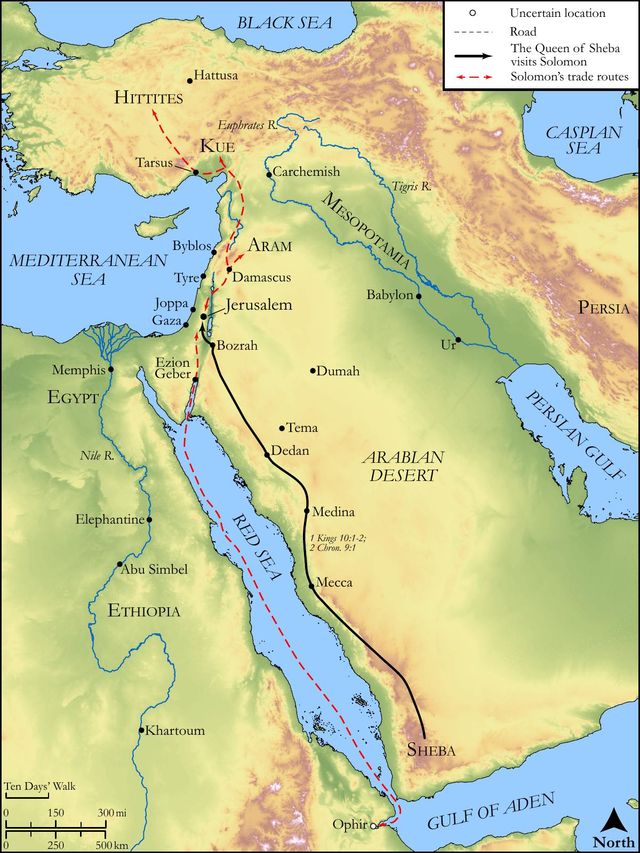
See on the biblical-era map
Study this verse
Public-domain commentary
Matthew Henry
From his Commentary on the Whole Bible. Henry comments on passages, not single verses — this entry covers 2 Chronicles 1:1–12. His three-level outline is real structure in the source text, so it is rendered as structure.
Here is, I. Solomon's great prosperity, Ch2 1:1. Though he had a contested title, yet, God being with him, he was strengthened in his kingdom; his heart and hands were strengthened, and his interest in the people. God's presence will be our strength.
II.His great piety and devotion.
His father was a prophet, a psalmist, and kept mostly to the ark; but Solomon, having read much in his Bible concerning the tabernacle which Moses built and the altars there, paid more respect to them than, it should seem, David had done. Both did well, and let neither be censured. If the zeal of one be carried out most to one instance of religion, and of another to some other instance, let them not judge nor despise each other.
1.All his great men must thus far be good men that they must join with him in worshipping God. He spoke to the captains and judges, the governors and chief of the fathers, to go with him to Gibeon, Ch2 1:2, Ch2 1:3. Authority and interest are well bestowed on those that will thus use them for the glory of God, and the promoting of religion. It is our duty to engage all with whom we have influence in the solemnities of religion, and it is very desirable to have many join with us in those solemnities - the more the better; it is the more like heaven. Solomon began his reign with this public pious visit to God's altar, and it was a very good omen. Magistrates are then likely to do well for themselves and their people when they thus take God along with them at their setting out.
2.He offered abundance of sacrifices to God there (Ch2 1:6): 1000 burnt-offerings, and perhaps a greater number of peace-offerings, on which he and his company feasted before the Lord. Where God sows plentifully he expects to reap accordingly. His father David had left him flocks and herds in abundance (Ch1 27:29, Ch1 27:31), and thus he gave God his dues out of them. The ark was at Jerusalem (Ch2 1:4), but the altar was at Gibeon (Ch2 1:5), and thither he brought his sacrifices; for it is the altar that sanctifieth every gift.
3.He prayed a good prayer to God: this, with the answer to it, we had before, Kg1 3:5, etc.
(1.)God bade him ask what he would; not only that he might put him in the right way of obtaining the favours that were intended him (Ask, and you shall receive, that your joy may be full), but that he might try him, how he stood affected, and might discover what was in his heart. Men's characters appear in their choices and desires. What wouldst thou have? tries a man as much as, What wouldst thou do? Thus God tried whether Solomon was one of the children of this world, that say, Who will show us any good, or of the children of light, that say, Lord, lift up the light of thy countenance upon us. As we choose we shall have, and that is likely to be our portion to which we give the preference, whether the wealth and pleasure of this world or spiritual riches or delights.
(2.)Like a genuine son of David, he chose spiritual blessings rather than temporal. His petition here is, Give me wisdom and knowledge. He owns those to be desirable gifts, and God to be the giver of them, Pro 2:6. God gave the faculty of understanding, and to him we must apply for the furniture of it. Two things are here pleaded which we had not in Kings: - [1.] Thou hast made me reign in my father's stead, Ch2 1:8. "Lord, thou hast put me into this place, and therefore I can in faith ask of thee grace to enable me to do the duty of it." What service we have reason to believe God calls us to we have reason to hope he will qualify us for. But that is not all. "Lord, thou hast put me into this place in the stead of David, the great and good man that filled it up so well; therefore give me wisdom, that Israel may not suffer damage by the change. Must I reign in my father's stead? Lord, give me my father's spirit." Note, The eminency of those that went before us, and the obligation that lies upon us to keep up and carry on the good work they were engaged in, should provoke us to a gracious emulation, and quicken our prayers to God for wisdom and grace, that we may do the work of God in our day as faithfully and well as they did in theirs. [2.] Let thy promise to David my father be established, Ch2 1:9. He means the promise of concerning his successor. "In performance of that promise, Lord, give me wisdom." We do not find that wisdom was any of the things promised, but it was necessary in order to the accomplishment of what was promised, Sa2 7:13-15. The promise was, He shall build a house for my name, I will establish his throne, he shall be my son, and my mercy shall not depart from him. "Now, Lord, unless thou give me wisdom, thy house will not be built, nor my throne established; I shall behave in a manner unbecoming my relation to thee as a Father, shall forfeit thy mercy, and fool it away; therefore, Lord, give me wisdom." Note, First, God's promises are our best pleas in prayer. Remember thy word unto thy servant. Secondly, Children may take the comfort of the promises of that covenant which their parents, in their baptism, laid claim to, and took hold of, for them. Thirdly, The best way to obtain the benefit of the promises and privileges of the covenant is to be earnest in prayer with God for wisdom and grace to do the duties of it.
4.He received a gracious answer to this prayer, Ch2 1:11, Ch2 1:12.
(1.)God gave him the wisdom that he asked for because he asked for it. Wisdom is a gift that God gives as freely and liberally as any gift to those that value it, and wrestle for it; and will resolve to make use of it; and he upbraids not the poor petitioners with their folly, Jam 1:5. God's grace shall never be wanting to those who sincerely desire to know and do their duty.
(2.)God gave him the wealth and honour which he did not ask for because he asked not for them. Those that pursue present things most earnestly are most likely to miss of them; while those that refer themselves to the providence of God, if they have not the most of those things, have the most comfort in them. Those that make this world their end come short of the other and are disappointed in this too; but those that make the other world their end shall not only obtain that, and full satisfaction in it, but shall enjoy as much as is convenient of this world in their way.
Continue studying 2 Chronicles 1:3 across the web’s major study libraries — every link below opens this exact verse, chapter, or book on the destination site.
Read & Compare
 BibleGatewayThis verse in more than 200 translations and 70 languages.
 Bible.comThe YouVersion reader — hundreds of translations, reading plans, and highlights.
 ESV.orgCrossway's official English Standard Version reader.
 NET BibleThe NET translation with 60,000+ translators' notes on every rendering decision.
 STEP BibleTyndale House's free study tool — original text, vocabulary, and scholarly resources.
 BibliaLogos Bible Software's free web reader.
 USCCBThe New American Bible (Revised Edition) with the U.S. bishops' study notes.
Commentaries
 BibleHub CommentariesDozens of classic commentaries on this verse, gathered on one page.
 StudyLightMore than 100 commentary sets — the largest collection on the web.
 BibleRefPlain-English commentary on what this verse means, verse by verse.
 Enduring WordDavid Guzik's free commentary on this chapter, widely used by Bible teachers.
 Bible Study ToolsVerse commentary alongside Greek and Hebrew study aids.
Original Language & Research
- BibleHub InterlinearThe verse word by word — original language, transliteration, and English.
- BibleHub LexiconEvery word's original-language definition and Strong's entry.
 Blue Letter BibleDeep-study tools — Strong's numbers, concordance, and word studies.
 SefariaThe Hebrew text with Rashi and centuries of Jewish commentary.
Sermons, Hymns & Audio


TrulyRandomVerse is not affiliated with these sites and doesn’t control their content. They’re linked because they’re genuinely useful.
Summary
Solomon's initial act as king, leading the entire Israelite assembly to Gibeon, is recounted in 2 Chronicles 1:3. This pilgrimage was a profoundly significant national worship event, establishing the new king's reign under divine favor. Its legitimacy was underscored by the presence of the Tabernacle of the congregation at Gibeon, the sacred sanctuary meticulously crafted by Moses in the wilderness, thereby connecting Solomon's nascent rule to the enduring covenant heritage of Israel. This pivotal journey sets the stage for God's subsequent appearance to Solomon, where the young monarch would famously receive the extraordinary gift of wisdom.
Context
ShowHideLiterary Context
This verse serves as a crucial bridge in the narrative, immediately following the affirmation of Solomon's divinely strengthened kingship and his unparalleled magnification by the Lord, as stated in 2 Chronicles 1:1. It transitions from a general declaration of Solomon's prosperity and God's favor to a specific, intentional act of national worship that directly precedes one of the most significant divine encounters in his reign. The subsequent verses, 2 Chronicles 1:7-12, detail God's appearance to Solomon at Gibeon and the granting of his request for wisdom, making this journey to the high place a deliberate and necessary prelude to that profound divine intervention. It also subtly highlights the unique, temporary arrangement of Israelite worship, where the Ark of the Covenant had been brought to Jerusalem by David (2 Samuel 6:17), yet the ancient Tabernacle, with its central altar for burnt offerings, remained at Gibeon, indicating a dual, legitimate center of worship before the unified worship system of the Temple was established.
Historical & Cultural Context
Solomon's ascension to the throne marked a new era for Israel, following a period of intense political consolidation after David's death, as chronicled in 1 Kings 2. Among the nations, it was customary for a new monarch to inaugurate his reign with significant religious ceremonies to secure divine legitimacy and blessing. Gibeon, situated several miles northwest of Jerusalem, was indeed a prominent "high place" (bamah). While such sites later became associated with illicit worship and idolatry, Gibeon held a unique and legitimate status at this time because it was the repository of the ancient Tabernacle, the portable sanctuary constructed by Moses in the wilderness according to divine instruction (Exodus 35). This made Gibeon a divinely sanctioned site for large-scale national sacrifices and communion with God, representing a vital continuity of Israel's foundational covenant relationship with the Lord. The act of going to Gibeon, therefore, was not a deviation but an adherence to the most significant available means of national worship at the time.
Key Themes
ShowHideSolomon's pilgrimage to Gibeon at the dawn of his reign powerfully underscores several foundational themes. First, it emphasizes the legitimacy of worship and the critical importance of adhering to God's established means of approaching Him. By seeking God at the Tabernacle, the very sanctuary crafted by Moses, the servant of the LORD, Solomon publicly affirmed his unwavering commitment to the Lord and meticulously connected his reign to the foundational history and covenant relationship of Israel. Second, this act highlights the profound theme of continuity and spiritual heritage, demonstrating Solomon's deep respect for the divine institutions and traditions inherited from previous generations, particularly those established during the Exodus. Third, the journey represents a profound seeking of God's presence and blessing at the very outset of his kingship, an act of humility and absolute dependence on divine favor for the success of his rule. Finally, the inclusion of "all the congregation with him" stresses the corporate responsibility of the entire nation, symbolizing a collective dedication to the Lord and a shared reliance on His favor for their future stability and prosperity under Solomon's leadership, echoing the importance of communal worship seen throughout Israel's history.
Exposition and Analysis
ShowHideKey Word Analysis
ShowHideFrom an unused root meaning "to be high," this term refers to an elevated cultic site. While bâmâh often acquires negative connotations in later biblical texts, denoting illicit pagan worship or unauthorized Israelite altars, in this specific context, the "high place" at Gibeon was legitimate. Its sanctity and permissibility stemmed entirely from housing the divinely ordained Tabernacle and its associated altar, making it a sanctioned center for sacrifice and communion with God prior to the construction of the Temple in Jerusalem.
Derived from a root meaning "to be clearly conspicuous from a distance," this word denotes a tent or dwelling place. The Tabernacle was the portable sanctuary where God's presence dwelt among His people during their wilderness wanderings and early settlement in Canaan. Its presence at Gibeon signified that this was not merely a local shrine but the primary national worship center, consecrated by God's own glory (Exodus 40:34-35). It symbolized God's accessibility and His enduring covenant relationship with Israel.
This term, from a root meaning "to assemble," refers to the assembled community or assembly of Israel. The inclusion of "all the congregation with him" emphasizes the corporate and communal nature of this worship act. It was not merely a private devotion by Solomon but a public, national pilgrimage, signifying a collective commitment and dependence on God at the dawn of a new era for the entire nation.
Verse Breakdown
ShowHide"So Solomon, and all the congregation with him, went to the high place that [was] at Gibeon;"
This initial clause highlights the proactive leadership of Solomon as the newly established king, initiating a significant act of national worship. The explicit mention of "all the congregation" underscores the comprehensive, communal nature of this pilgrimage, signifying a unified seeking of God's favor and blessing at the very commencement of Solomon's reign. The specific destination, Gibeon, is identified as the site of this crucial and divinely sanctioned encounter.
"for there was the tabernacle of the congregation of God,"
This provides the essential theological and historical justification for the legitimacy of Gibeon as a worship site, despite its designation as a "high place." The presence of the Tabernacle, the divinely appointed dwelling place of God's glory and the central locus for Israel's sacrificial system and communal worship, transformed Gibeon into a sacred and permissible location for national worship and sacrifice, distinguishing it from illicit high places.
"which Moses the servant of the LORD had made in the wilderness."
This final clause powerfully emphasizes the Tabernacle's ancient origins and its direct, authoritative connection to Moses, God's chosen servant, and the foundational period of Israel's history. It underscores the profound continuity of God's covenant with His people and His enduring presence among them, meticulously linking Solomon's contemporary act of worship to the sacred heritage and divine institutions established during the Exodus and wilderness wanderings.
Literary Devices
ShowHideThe verse employs several significant literary devices that enrich its meaning. Symbolism is profoundly present, with Gibeon serving as a symbol of legitimate worship and continuity with Israel's sacred heritage, specifically through the presence of the Tabernacle, which itself is a powerful symbol of God's dwelling among His people and His covenant faithfulness. The journey of "all the congregation" to Gibeon is an act of corporate symbolism, representing the entire nation's unified dedication and collective reliance on God at the dawn of a new era. The verse also utilizes foreshadowing, as this deliberate act of seeking God's presence and favor at Gibeon directly precedes and meticulously sets the stage for God's appearance to Solomon and the granting of wisdom, indicating that Solomon's initial act of devotion was a prerequisite for profound divine blessing and guidance.
Theological and Thematic Connections
ShowHideThis verse powerfully articulates the profound theological principle that true leadership, national stability, and enduring prosperity are fundamentally rooted in a foundational commitment to God and His established ways of worship. Solomon's inaugural act of leading the entire nation to Gibeon, the very site of the Tabernacle, demonstrates a deep understanding that divine blessing is not earned through human might, political acumen, or even inherent wisdom, but through humble submission, corporate obedience, and a genuine seeking of God's presence. This collective pilgrimage signifies a national acknowledgment of God's absolute sovereignty and a collective dependence on His guidance for the future. It underscores the vital importance of valuing spiritual heritage and maintaining continuity with God's past dealings with His people, recognizing that the Tabernacle, meticulously made by Moses, represented centuries of divine presence, covenant faithfulness, and the means of atonement.
Reflection and Application
ShowHideSolomon's deliberate journey to Gibeon at the very outset of his reign offers a timeless and profound paradigm for individuals, leaders, and communities in every generation. It teaches us the critical importance of commencing new endeavors, especially those involving leadership, significant life transitions, or major projects, with a deliberate and public act of seeking God's presence, blessing, and wisdom. This is not merely a perfunctory religious duty, but a foundational declaration of dependence, acknowledging that true success, lasting wisdom, and divine favor flow uniquely from Him. The corporate nature of this pilgrimage also powerfully reminds us of the profound significance of communal worship and shared spiritual commitment. In an age that often prioritizes individual achievement and self-sufficiency, Solomon's example calls us to remember our collective reliance on God and the immense strength found in corporate dedication and unified pursuit of His will. It challenges us to reflect deeply on how we honor our spiritual heritage and ensure that our actions, particularly in positions of influence or leadership, are rooted in humility and a genuine, unwavering pursuit of God's divine will.
Questions for Reflection
ShowHideFAQ
ShowHideWhy did Solomon go to Gibeon if the Ark of the Covenant was in Jerusalem?
ShowHideWhile King David had indeed brought the Ark of the Covenant to a specially prepared tent in Jerusalem (2 Samuel 6:17), the Tabernacle itself, which housed the large bronze altar for burnt offerings and was the primary site for comprehensive, large-scale national sacrifices, remained at Gibeon. This arrangement meant that for full national worship involving extensive sacrificial rites, Gibeon was the appropriate and legitimate location. Solomon's act was therefore an adherence to the established, albeit temporary, divinely sanctioned protocols for national worship before the construction of the Temple in Jerusalem, which would eventually consolidate both the Ark and the sacrificial system in one singular, permanent dwelling place for God's name (1 Kings 8:1-11).
What is a "high place" and why was Gibeon legitimate when other high places were condemned?
ShowHideA "high place" (Hebrew: bamah) literally refers to an elevated cultic site. Throughout much of Israel's history, these sites became associated with idolatry or unauthorized worship of Yahweh, leading to their condemnation by prophets and kings who sought to centralize worship at Jerusalem. However, Gibeon was a unique exception at this specific time because it housed the divinely ordained Tabernacle of the congregation and its large bronze altar, which Moses had constructed in the wilderness under God's explicit instructions (Exodus 35). Its legitimacy derived solely from the presence of this sacred, God-commissioned sanctuary, making it a permissible and central location for national worship before the Temple in Jerusalem became the singular, permanent dwelling place for God's name and the exclusive site for national sacrifices.
Christ-Centered Fulfillment
ShowHideSolomon's pilgrimage to Gibeon, a temporary dwelling place of God's presence and a site for sacrificial atonement, profoundly foreshadows the ultimate and perfect dwelling of God among humanity in the person of Jesus Christ. The Tabernacle, a physical structure where God met His people and where sacrifices were offered, points directly to Christ, who is the true "Tabernacle" or "tent" of God, as John 1:14 declares, "The Word became flesh and made his dwelling among us." Solomon's act of seeking divine wisdom and blessing at the outset of his reign finds its ultimate and consummate fulfillment in Christ, who is not merely wise, but is the very embodiment of divine wisdom, as 1 Corinthians 1:30 states, "Christ Jesus, who has become for us wisdom from God." The corporate journey of "all the congregation" to Gibeon anticipates the gathering of God's new covenant people, the Church, who are called to assemble in Christ's name, recognizing Him as their head, their High Priest, and the singular source of all blessing, guidance, and access to the Father (Ephesians 2:19-22). The sacrifices offered at Gibeon, though legitimate and divinely prescribed for their time, were temporary and inherently incomplete, serving as a shadow pointing forward to the definitive, once-for-all, and perfect sacrifice of the Lamb of God, who takes away the sin of the world, a sacrifice that fully cleanses, atones, and makes eternal communion with God eternally possible for all who believe (Hebrews 10:10-14). Thus, Solomon's act of seeking God in a temporary, physical dwelling ultimately directs our gaze to the permanent, perfect, and all-sufficient presence of God in Christ, our Lord, King, and eternal High Priest.