


2 Chronicles 1:1
Bible text: King James Version (1769 Blayney text) · Public domain
Bible text: King James Version with Strong's numbers · Public domain
Bible text: Berean Standard Bible · Public domain
Bible text: American Standard Version (1901) · Public domain
Bible text: World English Bible, Messianic edition · Public domain
Bible text: Geneva Bible (1599) · Public domain
Bible text: Young's Literal Translation · Public domain
- וַיִּתְחַזֵּקvai·yit·cha·Zekand he strengthened himselfH2388Conj-w ¦ V-Hithpael-ConsecImperf-3msVerb Hithpael Consecutive Imperfect 3rd Singular Masculineוַandיִּתְחַזֵּקhe strengthened himself
- שְׁלֹמֹהshe·lo·MohSolomonH8010N-proper-mNoun Proper Masculine
- בֶןven[the] son ofH1121N-mscNoun Singular Masculine Construct
- דָּוִידda·VidDavidH1732N-proper-mNoun Proper Masculine
- עַל'aloverH5921PrepPreposition
- מַלְכוּתוֹmal·khu·Tohis kingdomH4438N-fsc ¦ 3msNoun Singular Feminine Constructמַלְכוּתkingdomוֹhis
- וַיהוָהva·Yah·wehand YahwehH3068Conj-w ¦ N-properNoun Proper TitleוַandיהוָהYahweh
- אֱלֹהָיו'e·lo·Havhis GodH430N-mpc ¦ 3msNoun Plural Masculine ConstructאֱלֹהָיGodוhis
- עִמּוֹi·Mo[was] with himH5973Prep ¦ 3msPrepositionעִמּ[was] withוֹhim
- וַיְגַדְּלֵהוּvay·ga·de·Le·huand he made great himH1431Conj-w ¦ V-Piel-ConsecImperf-3ms ¦ 3msVerb Piel Consecutive Imperfect 3rd Singular Masculineוַandיְגַדְּלֵhe made greatהוּhim
- לְמָעְלָהle·Ma·'e·lah<to> upwards <towards>H4605Prep-l ¦ Adj-cs ¦ SfxAdjective Numerical Singular common gender Absoluteלְ<to>מָעְלָupwardsה<towards>
English is a literal word-by-word gloss of the Hebrew, not the KJV's wording. Why?
This is the original text the KJV's translators worked from — each Hebrew word with its own literal English meaning in this verse, prepared by scholars at Tyndale House, Cambridge. The KJV translates whole sentences, not word by word, so its wording differs: one Hebrew word can become several English words, and the KJV may choose “the LORD” where the gloss reads “Yahweh”. Both are faithful — they answer different questions. For the KJV's own rendering, switch to the KJV text.
Details
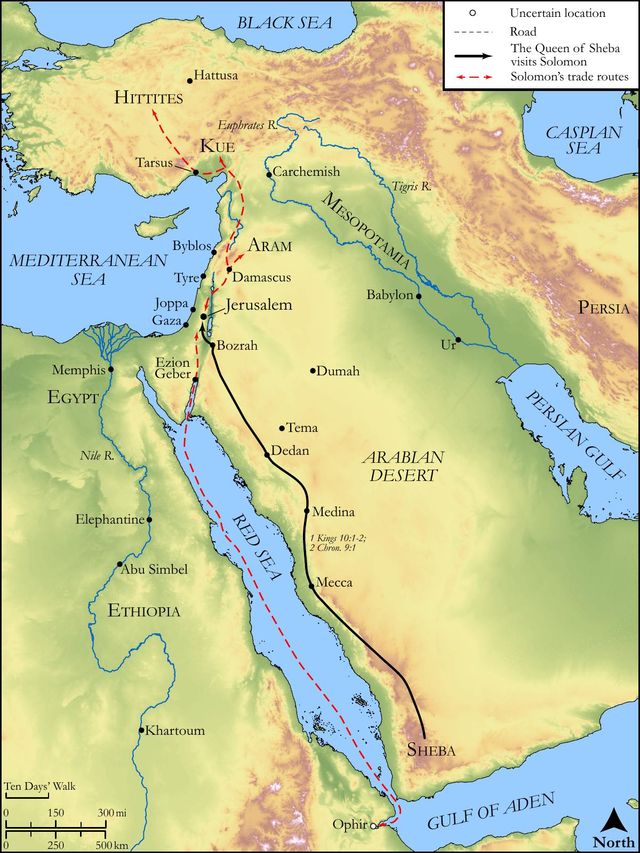
See on the biblical-era map
Study this verse
Public-domain commentary
Matthew Henry
From his Commentary on the Whole Bible. Henry comments on passages, not single verses — this entry covers 2 Chronicles 1:1–12. His three-level outline is real structure in the source text, so it is rendered as structure.
Here is, I. Solomon's great prosperity, Ch2 1:1. Though he had a contested title, yet, God being with him, he was strengthened in his kingdom; his heart and hands were strengthened, and his interest in the people. God's presence will be our strength.
II.His great piety and devotion.
His father was a prophet, a psalmist, and kept mostly to the ark; but Solomon, having read much in his Bible concerning the tabernacle which Moses built and the altars there, paid more respect to them than, it should seem, David had done. Both did well, and let neither be censured. If the zeal of one be carried out most to one instance of religion, and of another to some other instance, let them not judge nor despise each other.
1.All his great men must thus far be good men that they must join with him in worshipping God. He spoke to the captains and judges, the governors and chief of the fathers, to go with him to Gibeon, Ch2 1:2, Ch2 1:3. Authority and interest are well bestowed on those that will thus use them for the glory of God, and the promoting of religion. It is our duty to engage all with whom we have influence in the solemnities of religion, and it is very desirable to have many join with us in those solemnities - the more the better; it is the more like heaven. Solomon began his reign with this public pious visit to God's altar, and it was a very good omen. Magistrates are then likely to do well for themselves and their people when they thus take God along with them at their setting out.
2.He offered abundance of sacrifices to God there (Ch2 1:6): 1000 burnt-offerings, and perhaps a greater number of peace-offerings, on which he and his company feasted before the Lord. Where God sows plentifully he expects to reap accordingly. His father David had left him flocks and herds in abundance (Ch1 27:29, Ch1 27:31), and thus he gave God his dues out of them. The ark was at Jerusalem (Ch2 1:4), but the altar was at Gibeon (Ch2 1:5), and thither he brought his sacrifices; for it is the altar that sanctifieth every gift.
3.He prayed a good prayer to God: this, with the answer to it, we had before, Kg1 3:5, etc.
(1.)God bade him ask what he would; not only that he might put him in the right way of obtaining the favours that were intended him (Ask, and you shall receive, that your joy may be full), but that he might try him, how he stood affected, and might discover what was in his heart. Men's characters appear in their choices and desires. What wouldst thou have? tries a man as much as, What wouldst thou do? Thus God tried whether Solomon was one of the children of this world, that say, Who will show us any good, or of the children of light, that say, Lord, lift up the light of thy countenance upon us. As we choose we shall have, and that is likely to be our portion to which we give the preference, whether the wealth and pleasure of this world or spiritual riches or delights.
(2.)Like a genuine son of David, he chose spiritual blessings rather than temporal. His petition here is, Give me wisdom and knowledge. He owns those to be desirable gifts, and God to be the giver of them, Pro 2:6. God gave the faculty of understanding, and to him we must apply for the furniture of it. Two things are here pleaded which we had not in Kings: - [1.] Thou hast made me reign in my father's stead, Ch2 1:8. "Lord, thou hast put me into this place, and therefore I can in faith ask of thee grace to enable me to do the duty of it." What service we have reason to believe God calls us to we have reason to hope he will qualify us for. But that is not all. "Lord, thou hast put me into this place in the stead of David, the great and good man that filled it up so well; therefore give me wisdom, that Israel may not suffer damage by the change. Must I reign in my father's stead? Lord, give me my father's spirit." Note, The eminency of those that went before us, and the obligation that lies upon us to keep up and carry on the good work they were engaged in, should provoke us to a gracious emulation, and quicken our prayers to God for wisdom and grace, that we may do the work of God in our day as faithfully and well as they did in theirs. [2.] Let thy promise to David my father be established, Ch2 1:9. He means the promise of concerning his successor. "In performance of that promise, Lord, give me wisdom." We do not find that wisdom was any of the things promised, but it was necessary in order to the accomplishment of what was promised, Sa2 7:13-15. The promise was, He shall build a house for my name, I will establish his throne, he shall be my son, and my mercy shall not depart from him. "Now, Lord, unless thou give me wisdom, thy house will not be built, nor my throne established; I shall behave in a manner unbecoming my relation to thee as a Father, shall forfeit thy mercy, and fool it away; therefore, Lord, give me wisdom." Note, First, God's promises are our best pleas in prayer. Remember thy word unto thy servant. Secondly, Children may take the comfort of the promises of that covenant which their parents, in their baptism, laid claim to, and took hold of, for them. Thirdly, The best way to obtain the benefit of the promises and privileges of the covenant is to be earnest in prayer with God for wisdom and grace to do the duties of it.
4.He received a gracious answer to this prayer, Ch2 1:11, Ch2 1:12.
(1.)God gave him the wisdom that he asked for because he asked for it. Wisdom is a gift that God gives as freely and liberally as any gift to those that value it, and wrestle for it; and will resolve to make use of it; and he upbraids not the poor petitioners with their folly, Jam 1:5. God's grace shall never be wanting to those who sincerely desire to know and do their duty.
(2.)God gave him the wealth and honour which he did not ask for because he asked not for them. Those that pursue present things most earnestly are most likely to miss of them; while those that refer themselves to the providence of God, if they have not the most of those things, have the most comfort in them. Those that make this world their end come short of the other and are disappointed in this too; but those that make the other world their end shall not only obtain that, and full satisfaction in it, but shall enjoy as much as is convenient of this world in their way.
Continue studying 2 Chronicles 1:1 across the web’s major study libraries — every link below opens this exact verse, chapter, or book on the destination site.
Read & Compare
 BibleGatewayThis verse in more than 200 translations and 70 languages.
 Bible.comThe YouVersion reader — hundreds of translations, reading plans, and highlights.
 ESV.orgCrossway's official English Standard Version reader.
 NET BibleThe NET translation with 60,000+ translators' notes on every rendering decision.
 STEP BibleTyndale House's free study tool — original text, vocabulary, and scholarly resources.
 BibliaLogos Bible Software's free web reader.
 USCCBThe New American Bible (Revised Edition) with the U.S. bishops' study notes.
Commentaries
 BibleHub CommentariesDozens of classic commentaries on this verse, gathered on one page.
 StudyLightMore than 100 commentary sets — the largest collection on the web.
 BibleRefPlain-English commentary on what this verse means, verse by verse.
 Enduring WordDavid Guzik's free commentary on this chapter, widely used by Bible teachers.
 Bible Study ToolsVerse commentary alongside Greek and Hebrew study aids.
Original Language & Research
- BibleHub InterlinearThe verse word by word — original language, transliteration, and English.
- BibleHub LexiconEvery word's original-language definition and Strong's entry.
 Blue Letter BibleDeep-study tools — Strong's numbers, concordance, and word studies.
 SefariaThe Hebrew text with Rashi and centuries of Jewish commentary.
Sermons, Hymns & Audio


TrulyRandomVerse is not affiliated with these sites and doesn’t control their content. They’re linked because they’re genuinely useful.
Summary
Second Chronicles 1:1 serves as a foundational declaration, immediately establishing King Solomon's reign as divinely ordained and empowered. Far from a mere political succession, this verse asserts that Solomon's authority was solidified by God, who actively accompanied him and elevated his status to an extraordinary degree. It sets a theological tone for the entire book of 2 Chronicles, emphasizing God's direct involvement in the prosperity and legitimacy of Israel's monarchy, particularly concerning the Davidic line and the building of the Temple.
Context
ShowHideLiterary Context
This verse opens the book of 2 Chronicles, which presents a theological history of Israel from Adam to the Babylonian exile, with a strong emphasis on the Davidic dynasty and the Jerusalem Temple. Unlike 1 Kings, which details the political machinations and challenges of Solomon's succession (e.g., the rebellion of Adonijah in 1 Kings 1), 2 Chronicles 1:1 immediately bypasses these human complexities. It focuses instead on the divine perspective, asserting Solomon's reign as already "strengthened" and divinely sanctioned. This deliberate choice highlights the Chronicler's primary concern: demonstrating God's faithfulness to His covenant promises and His active presence in the lives of His chosen kings, particularly as they relate to the worship of God and the building of His house. The immediate focus on God's active role sets the stage for the Chronicler's narrative, which consistently interprets historical events through a theological lens, emphasizing divine favor and judgment.
Historical & Cultural Context
Solomon's ascension occurred in the context of a well-established monarchy under his father, King David. David had unified the tribes, secured the borders, and made extensive preparations for the construction of the Temple. However, the transition of power from a charismatic and long-reigning king like David to his son was a critical moment for the young Israelite kingdom. Among the kingdoms of that day, a new king's legitimacy often depended on divine approval, military strength, and popular support. For Israel, God's covenant with David, promising an enduring dynasty (as seen in 2 Samuel 7:12-16), was paramount. Therefore, the declaration that "the LORD his God was with him" and "magnified him exceedingly" served as a powerful theological endorsement, solidifying Solomon's rule in the eyes of the people and affirming his divine mandate to lead and to build the Temple. This divine backing was crucial for stability and continuity in the kingdom, especially given the internal challenges that often accompanied royal successions.
Key Themes
ShowHideSeveral major theological themes emerge from this verse, setting the trajectory for Solomon's reign and the Chronicler's overall message. First, Divine Sovereignty in Kingship is paramount; Solomon's authority is not merely inherited but divinely established and secured. The phrase "was strengthened in his kingdom" implies God's direct action in fortifying his rule, underscoring that all legitimate power flows from Him. Second, God's Presence as a Mark of Favor is explicitly stated with "the LORD his God was with him." This echoes a recurring motif in biblical leadership, where God's presence signifies approval, guidance, and success, as promised to leaders like Joshua in Joshua 1:5 and demonstrated with Joseph in Genesis 39:2. Third, Divine Empowerment and Magnification is evident in "magnified him exceedingly," indicating that Solomon's greatness, wisdom, and wealth were not solely due to his own abilities but were extraordinary gifts from God, foreshadowing the unparalleled prosperity described later in the narrative. This theme underscores God's ability to elevate and honor those He chooses, as articulated in 1 Samuel 2:7.
Exposition and Analysis
ShowHideKey Word Analysis
ShowHideThe verb חָזַק (châzaq) means "to fasten upon; hence, to seize, be strong (figuratively, courageous, causatively strengthen, cure, help, repair, fortify)." In this context, it is used in the Niphal stem, indicating a passive sense: "was strengthened" or "was made strong." This signifies that Solomon's kingdom was not merely strong by human effort or political maneuvering, but its stability and authority were divinely imparted and secured. God was the active agent in establishing Solomon's reign on a firm foundation, ensuring its legitimacy and resilience.
The verb גָּדַל (gâdal) means "to be (causatively make) large (in various senses, as in body, mind, estate or honor, also in pride); advance, boast, bring up, exceed, excellent, be(-come, do, give, make, wax), great(-er, come to... estate, [phrase] things), grow(up), increase, lift up, magnify(-ifical), be much set by, nourish (up), pass, promote, proudly (spoken), tower." Here, in the Hiphil stem, it means "to make great" or "to cause to grow." This word choice indicates that God actively elevated Solomon's status, power, and renown. It speaks to an increase in his influence, prestige, and overall standing, not just domestically but internationally.
This adverbial, מַעַל (maʻal), literally means "the upper part, used only adverbially with prefix upward, above, overhead, from the top, etc.; above, exceeding(-ly), forward, on ([idiom] very) high, over, up(-on, -ward), very." It serves as an intensifier, emphasizing the extraordinary and unparalleled nature of the divine magnification. This highlights that the greatness bestowed upon Solomon by God surpassed all ordinary expectations and set him apart as a uniquely favored king, elevating him to a position of supreme honor and influence.
Verse Breakdown
ShowHide"And Solomon the son of David was strengthened in his kingdom"
This clause immediately establishes Solomon's divine legitimacy and the stability of his rule. It emphasizes that his authority was not merely inherited or seized through human power struggles, but divinely secured and fortified. The Chronicler presents Solomon's kingdom as already firm and established from its inception, underscoring God's active hand in his succession and the foundation of his reign. This divine strengthening implies both internal stability and external security.
"and the LORD his God [was] with him"
This is a profound theological statement signifying God's active, personal, and favorable presence with Solomon. It implies divine approval, guidance, protection, and partnership. God's "being with" a leader in the Old Testament is a consistent marker of success and blessing, indicating that the individual is operating under divine favor and according to God's will. This presence is the ultimate source of Solomon's wisdom, prosperity, and the legitimacy of his rule, demonstrating God's faithfulness to the Davidic covenant.
"and magnified him exceedingly"
This final clause declares that God Himself elevated Solomon to an extraordinary level of greatness. This magnification encompasses not only his personal stature but also his kingdom's power, wealth, and international renown. The intensifier "exceedingly" underscores the unparalleled nature of this divine promotion, setting the stage for the narrative of Solomon's unparalleled wisdom, wealth, and building projects, all attributed to God's direct and abundant blessing. It signifies an elevation beyond human expectation or achievement.
Literary Devices
ShowHideThe verse employs several impactful literary devices. Assertion is prominent, as the Chronicler makes direct, declarative statements about God's actions concerning Solomon, leaving no room for doubt about the divine origin of his strength and greatness. The use of "exceedingly" functions as Hyperbole or Intensification, emphasizing the unparalleled nature of God's blessing and Solomon's subsequent renown. This is not merely a statement of fact but a theological declaration designed to impress upon the reader the extraordinary divine favor. The verse also serves as Foreshadowing, hinting at the immense wisdom, wealth, and international influence that Solomon would acquire, all presented as a direct result of God's active presence and magnification. Finally, the concise nature of the verse, packing so much theological weight into a single sentence, demonstrates Conciseness with profound Theological Statement, immediately setting the divine perspective for the entire book.
Theological and Thematic Connections
ShowHide2 Chronicles 1:1 encapsulates core theological truths about God's sovereignty, His faithfulness to His covenant promises, and His active involvement in the affairs of His people and their leaders. It powerfully asserts that true authority and enduring success in leadership are ultimately derived from divine appointment and sustained by divine presence. This initial declaration sets the stage for the Chronicler's consistent emphasis on the principle that obedience to God brings blessing and prosperity, while deviation leads to decline. Solomon's reign, therefore, begins not as a human achievement but as a testament to God's power to establish, accompany, and elevate His chosen instruments for His purposes, particularly in the context of the Davidic covenant and the building of the Temple. It underscores the divine initiative in human history and the ultimate source of all true power and blessing.
Reflection and Application
ShowHideThe opening verse of 2 Chronicles offers profound encouragement and guidance for believers today. Just as God established, accompanied, and magnified Solomon, so too does He remain sovereign over all circumstances, actively involved in the lives of His children. This verse reminds us that our true strength and ultimate success in any endeavor, whether personal, professional, or spiritual, come not from our own abilities or connections, but from the empowering presence of the Lord. It calls us to cultivate a deep reliance on God, trusting that when we seek to walk in His ways, He will be "with" us, providing the wisdom, resources, and favor necessary to fulfill the callings He places on our lives. Our focus should be less on human striving and more on cultivating a relationship where God's presence is our greatest asset, allowing Him to work through us to accomplish His purposes, often "exceedingly" beyond what we could ask or imagine, for His glory and the good of His kingdom.
Questions for Reflection
ShowHideFAQ
ShowHideWhy does 2 Chronicles begin with this verse, seemingly skipping the succession struggles found in 1 Kings?
ShowHideThe Chronicler's primary purpose differs significantly from that of the books of Kings. While 1 Kings focuses on the political and historical narrative of the monarchy, including the challenges and human failures, 2 Chronicles presents a theological history. Its aim is to emphasize God's faithfulness to the Davidic covenant, the centrality of the Temple, and the importance of proper worship. By immediately stating that Solomon "was strengthened in his kingdom" and that "the LORD his God was with him," the Chronicler bypasses the earthly struggles (like Adonijah's rebellion in 1 Kings 1) to present Solomon's reign as divinely legitimate and blessed from its inception. This sets a tone of divine sovereignty and ideal kingship, consistent with the Chronicler's broader theological agenda, which seeks to encourage post-exilic Israel by highlighting God's enduring commitment to His people and His chosen line.
What does "magnified him exceedingly" imply for Solomon's reign?
ShowHideThis phrase implies an extraordinary and unparalleled elevation of Solomon's status, power, and renown, all attributed directly to God's action. It foreshadows the remarkable characteristics of his reign described throughout 1 and 2 Kings and 2 Chronicles: his unparalleled wisdom (e.g., 1 Kings 3:12), his immense wealth and prosperity (e.g., 1 Kings 10:23), and his widespread international influence and fame (e.g., 1 Kings 4:34). The "exceedingly" emphasizes that this was not merely human achievement but a supernatural blessing, making Solomon one of the most prominent and celebrated kings in Israel's history, whose greatness served to glorify the God who exalted him. It signifies a divine endorsement that set his reign apart from all others.
Christ-Centered Fulfillment
ShowHide2 Chronicles 1:1, while describing the earthly reign of Solomon, finds its ultimate and perfect fulfillment in Jesus Christ. Solomon, the "son of David" who built the Temple and ushered in an era of peace and wisdom, serves as a significant type of the Messiah. Just as Solomon "was strengthened in his kingdom" by God, so too is Jesus the true King, whose kingdom is not of this world but is eternally established and unshakeable, utterly strengthened by the Father's power (as declared in Matthew 28:18). The declaration that "the LORD his God was with him" points directly to Jesus, who is Emmanuel, "God with us" (Matthew 1:23), and in whom the fullness of God dwells bodily (Colossians 2:9). Furthermore, the phrase "and magnified him exceedingly" finds its supreme realization in Christ's exaltation. While Solomon's magnification was earthly and temporal, Jesus was magnified "far above all rule and authority and power and dominion, and above every name that is named" (Ephesians 1:20-21). He is the true and greater Son of David, the ultimate Temple builder (referencing His body and the Church, as in John 2:19-21), whose reign is everlasting, spiritual, and universal, bringing not just an era of peace but eternal salvation and reconciliation through His sacrifice and resurrection, a glory far exceeding any earthly king's.