


Exodus 3:12
Bible text: King James Version (1769 Blayney text) · Public domain
Bible text: King James Version with Strong's numbers · Public domain
Bible text: Berean Standard Bible · Public domain
Bible text: American Standard Version (1901) · Public domain
Bible text: World English Bible, Messianic edition · Public domain
Bible text: Geneva Bible (1599) · Public domain
Bible text: Young's Literal Translation · Public domain
- וַיֹּאמֶרvai·Yo·merand he saidH559Conj-w ¦ V-Qal-ConsecImperf-3msVerb Qal Consecutive Imperfect 3rd Singular Masculineוַandיֹּאמֶרhe said
- כִּיkithatH3588PrtParticle Conditional
- אֶהְיֶה'eh·YehI will beH1961V-Qal-Imperf-1csVerb Qal Imperfect 1st Singular common gender
- עִמָּךְ'i·Makhwith youH5973Prep ¦ 2msPreposition Definiteעִמָּwithךְyou
- וְזֶהve·zehand thisH2088Conj-w ¦ PrtParticle Demonstrativeוְandזֶהthis
- לְּךָle·Khafor <the> youPrep-l ¦ 2msSuffix Personal 2nd Singular Masculineלְּfor <the>ךָyou
- הָאוֹתha·'ot[will be] the signH226Art ¦ N-fsNoun Singular Feminine Absoluteהָ[will be] theאוֹתsign
- כִּיkithatH3588PrtParticle Conditional
- אָנֹכִי'a·no·KhiIH595Pro-1csPronoun Personal 1st Singular common gender
- שְׁלַחְתִּיךָshe·lach·Ti·khaI sent youH7971V-Qal-Perf-1cs ¦ 2msVerb Qal Perfect 1st Singular common genderשְׁלַחְתִּיI sentךָyou
- בְּהוֹצִיאֲךָbe·ho·tzi·'a·Khawhen bringing out youH3318Prep-b ¦ V-Hiphil-Inf ¦ 2msVerb Hiphil Infinitive Constructבְּwhenהוֹצִיאֲbringing outךָyou
- אֶת'et<obj.>H853DirObjMParticle Object Indicator
- הָעָםha·'Amthe peopleH5971Art ¦ N-msNoun Singular Masculine Absoluteהָtheעָםpeople
- מִמִּצְרַיִםmi·mitz·Ra·yimfrom EgyptH4714Prep-m ¦ N-properNoun Proper LocationמִfromמִּצְרַיִםEgypt
- תַּעַבְדוּןta·'av·Dunyou will serve !H5647V-Qal-Imperf-2mp ¦ SfxVerb Qal Imperfect 2nd Plural Masculineתַּעַבְדוּyou will serveן!
- אֶת'et<obj.>H853DirObjMParticle Object Indicator
- הָאֱלֹהִיםha·'E·lo·Him<the> GodH430Art ¦ N-mpNoun Plural Masculine Absoluteהָ<the>אֱלֹהִיםGod
- עַל'alonH5921PrepPreposition
- הָהָרha·Harthe mountainH2022Art ¦ N-msNoun Singular Masculine Absoluteהָtheהָרmountain
- הַזֶּהha·Zeh<the> thisH2088Art ¦ PrtParticle Demonstrativeהַ<the>זֶּהthis
English is a literal word-by-word gloss of the Hebrew, not the KJV's wording. Why?
This is the original text the KJV's translators worked from — each Hebrew word with its own literal English meaning in this verse, prepared by scholars at Tyndale House, Cambridge. The KJV translates whole sentences, not word by word, so its wording differs: one Hebrew word can become several English words, and the KJV may choose “the LORD” where the gloss reads “Yahweh”. Both are faithful — they answer different questions. For the KJV's own rendering, switch to the KJV text.
Details
See on the biblical-era maps

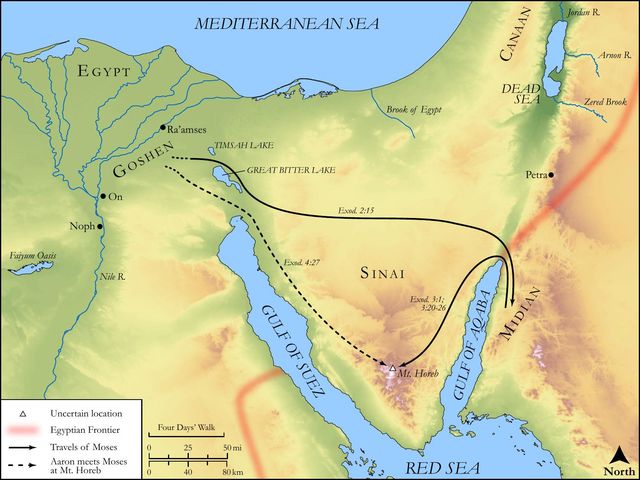
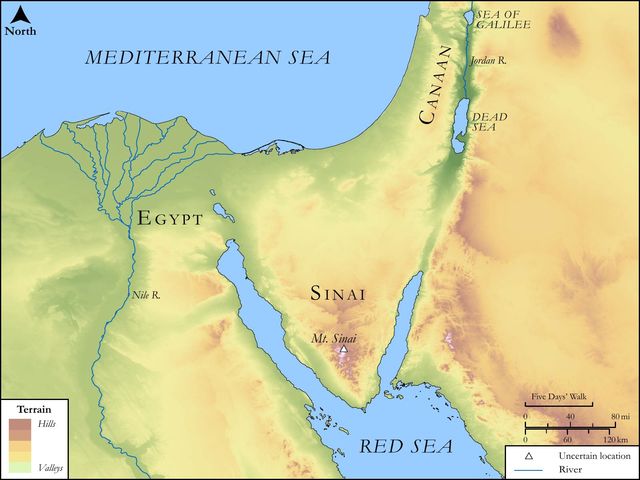
Study this verse
Public-domain commentary
Matthew Henry
From his Commentary on the Whole Bible. Henry comments on passages, not single verses — this entry covers Exodus 3:11–15. His three-level outline is real structure in the source text, so it is rendered as structure.
God, having spoken to Moses, allows him also a liberty of speech, which he here improves; and,
I.He objects his own insufficiency for the service he was called to (Exo 3:11):
Who am I? He thinks himself unworthy of the honour, and not par negotio - equal to the task. He thinks he wants courage, and therefore cannot go to Pharaoh, to make a demand which might cost the demandant his head: he thinks he wants skill, and therefore cannot bring forth the children of Israel out of Egypt; they are unarmed, undisciplined, quite dispirited, utterly unable to help themselves; it is morally impossible to bring them out.
1.Moses was incomparably the fittest of any man living for this work, eminent for learning, wisdom, experience, valour, faith, holiness; and yet he says, Who am I? Note, The more fit any person is for service commonly the less opinion he has of himself: see Jdg 9:8, etc.
2.The difficulties of the work were indeed very great, enough to startle the courage and stagger the faith of Moses himself. Note, Even wise and faithful instruments may be much discouraged at the difficulties that lie in the way of the church's salvation.
3.Moses had formerly been very courageous when he slew the Egyptian, but now his heart failed him; for good men are not always alike bold and zealous.
4.Yet Moses is the man that does it at last; for God gives grace to the lowly. Modest beginnings are very good presages.
II.God answers this objection, Exo 3:12.
1.He promises him his presence: Certainly I will be with thee, and that is enough. Note, Those that are weak in themselves may yet do wonders, being strong in the Lord and in the power of his might; and those that are most diffident of themselves may be most confident in God. God's presence puts an honour upon the worthless, wisdom and strength into the weak and foolish, makes the greatest difficulties dwindle to nothing, and is enough to answer all objections.
2.He assures him of success, and that the Israelites should serve God upon this mountain. Note,
(1.)Those deliverances are most valuable which open to us a door of liberty to serve God.
(2.)If God gives us opportunity and a heart to serve him, it is a happy and encouraging earnest of further favours designed us.
III.He begs instructions for the executing of his commission, and has them, thoroughly to furnish him.
He desires to know by what name God would at this time make himself known, Exo 3:13.
1.He supposes the children of Israel would ask him, What is his name? This they would ask either,
(1.)To perplex Moses: he foresaw difficulty, not only in dealing with Pharaoh, to make him willing to part with them, but in dealing with them, to make them willing to remove. They would be scrupulous and apt to cavil, would bid him produce his commission, and probably this would be the trial: "Does he know the name of God? Has he the watch-word?" Once he was asked, Who made thee a judge? Then he had not his answer ready, and he would not be nonplussed so again, but would be able to tell in whose name he came. Or,
(2.)For their own information. It is to be feared that they had grown very ignorant in Egypt, by reason of their hard bondage, want of teachers, and loss of the sabbath, so that they needed to be told the first principles of the oracles of God. Or this question, What is his name? amounted to an enquiry into the nature of the dispensation they were now to expect: "How will God in it be known to us, and what may we depend upon from him?"
2.He desires instructions what answer to give them: "What shall I say to them? What name shall I vouch to them for the proof of my authority? I must have something great and extraordinary to say to them; what must it be? If I must go, let me have full instructions, that I may not run in vain." Note,
(1.)It highly concerns those who speak to people in the name of God to be well prepared beforehand.
(2.)Those who would know what to say must go to God, to the word of his grace and to the throne of his grace, for instructions, Eze 2:7; Eze 3:4, Eze 3:10, Eze 3:17.
(3.)Whenever we have any thing to do with God, it is desirable to know, and our duty to consider, what is his name.
IV.God readily gives him full instructions in this matter. Two names God would now be known by: -
1.A name that denotes what he is in himself (Exo 3:14): I am that I am. This explains his name Jehovah, and signifies,
(1.)That he is self-existent; he has his being of himself, and has no dependence upon any other: the greatest and best man in the world must say, By the grace of God I am what I am; but God says absolutely - and it is more than any creature, man or angel, can say - I am that I am. Being self-existent, he cannot but be self-sufficient, and therefore all-sufficient, and the inexhaustible fountain of being and bliss.
(2.)That he is eternal and unchangeable, and always the same, yesterday, today, and for ever; he will be what he will be and what he is; see Rev 1:8.
(3.)That we cannot by searching find him out. This is such a name as checks all bold and curious enquiries concerning God, and in effect says, Ask not after my name, seeing it is secret, Jdg 13:18; Pro 30:4. Do we ask what is God? Let it suffice us to know that he is what he is, what he ever was, and ever will be. How little a portion is heard of him! Job 26:14.
(4.)That he is faithful and true to all his promises, unchangeable in his word as well as in his nature, and not a man that he should lie. Let Israel know this, I AM hath sent me unto you.
2.A name that denotes what he is to his people. Lest that name I AM should amuse and puzzle them, he is further directed to make use of another name of God more familiar and intelligible: The Lord God of your fathers hath sent me unto you (Exo 3:15): Thus God had made himself know to him (Exo 3:6), and thus he must make him known to them,
(1.)That he might revive among them the religion of their fathers, which, it is to be feared, was much decayed and almost lost. This was necessary to prepare them for deliverance, Psa 80:19.
(2.)That he might raise their expectations of the speedy performance of the promises made unto their fathers. Abraham, Isaac, and Jacob, are particularly named, because with Abraham the covenant was first made, and with Isaac and Jacob often expressly renewed; and these three were distinguished from their brethren, and chosen to be the trustees of the covenant, when their brethren were rejected. God will have this to be his name for ever, and it has been, is, and will be, his name, by which his worshippers know him, and distinguish him from all false gods; see Kg1 18:36. Note, God's covenant-relation to his people is what he will be ever mindful of, what he glories in, and what he will have us never forget, but give him the glory of: if he will have this to be his memorial unto all generations, we have all the reason in the world to make it so with us, for it is a precious memorial.
Historical interpretation
Historical reception
1 surviving comment on this verse from the historical church.
Then said the high priest, Are these things so? And he said, Men, brethren, and fathers, hearken; The God of glory appeared unto our father Abraham, when he was in Mesopotamia, before he dwelt in Charran, And said unto him, Get thee out of thy country, and from thy kindred, and come into the land which I shall show thee. Then came he out of the land of the Chaldaeans, and dwelt in Charran: and from thence, when his father was dead, he removed him into this land, wherein ye now dwell. And he gave him none inheritance in it, no, not so much as to set his foot on: yet he promised that he would give it to him for a possession, and to his seed after him, when as yet he had no child. And God spake on this wise, That his seed should sojourn in a strange land; and that they should bring them into bondage, and entreat them evil four hundred years. And the nation to whom they shall be in bondage will I judge, said God: and after that shall they come forth, and serve me in this place. [Exodus 3:12] And he gave him the covenant of circumcision: and so Abraham begat Isaac, and circumcised him the eighth day; and Isaac begat Jacob; and Jacob begat the twelve patriarchs. And the patriarchs, moved with envy, sold Joseph into Egypt: but God was with him, And delivered him out of all his afflictions, and gave him favour and wisdom in the sight of Pharaoh king of Egypt; and he made him governor over Egypt and all his house. Now there came a dearth over all the land of Egypt and Chanaan, and great affliction: and our fathers found no sustenance. But when Jacob heard that there was corn in Egypt, he sent out our fathers first. And at the second time Joseph was made known to his brethren; and Joseph's kindred was made known unto Pharaoh. Then sent Joseph, and called his father Jacob to him, and all his kindred, threescore and fifteen souls. So Jacob went down into Egypt, and died, he, and our fathers, And were carried over into Sychem, and laid in the sepulchre that Abraham bought for a sum of money of the sons of Emmor the father of Sychem. But when the time of the promise drew nigh, which God had sworn to Abraham, the people grew and multiplied in Egypt, Till another king arose, which knew not Joseph. The same dealt subtilly with our kindred, and evil entreated our fathers, so that they cast out their young children, to the end they might not live. In which time Moses was born, and was exceeding fair, and nourished up in his father's house three months: And when he was cast out, Pharaoh's daughter took him up, and nourished him for her own son. And Moses was learned in all the wisdom of the Egyptians, and was mighty in words and in deeds. And when he was full forty years old, it came into his heart to visit his brethren the children of Israel. And seeing one of them suffer wrong, he defended him, and avenged him that was oppressed, and smote the Egyptian: For he supposed his brethren would have understood how that God by his hand would deliver them: but they understood not. And the next day he showed himself unto them as they strove, and would have set them at one again, saying, Sirs, ye are brethren; why do ye wrong one to another? But he that did his neighbour wrong thrust him away, saying, Who made thee a ruler and a judge over us? Wilt thou kill me, as thou diddest the Egyptian yesterday? Then fled Moses at this saying, and was a stranger in the land of Madian, where he begat two sons. And when forty years were expired, there appeared to him in the wilderness of mount Sina an angel of the Lord in a flame of fire in a bush. When Moses saw it, he wondered at the sight: and as he drew near to behold it, the voice of the Lord came unto him, Saying, I am the God of thy fathers, the God of Abrham, and the God of Isaac, and the God of Jacob. Then Moses trembled, and durst not behold. Then said the Lord to him, Put off thy shoes from thy feet: for the place where thou standest is holy ground. I have seen, I have seen the affliction of my people which is in Egypt, and I have heard their groaning, and am come down to deliver them. And now come, I will send thee into Egypt. This Moses whom they refused, saying, Who made thee a ruler and a judge? the same did God send to be a ruler and a deliverer by the hand of the angel which appeared to him in the bush. He brought them out, after that he had showed wonders and signs in the land of Egypt, and in the Red sea, and in the wilderness forty years. This is that Moses, which said unto the children of Israel, A prophet shall the Lord your God raise up unto you of your brethren, like unto me; him shall ye hear. This is he, that was in the church in the wilderness with the angel which spake to him in the mount Sina, and with our fathers: who received the lively oracles to give unto us: To whom our fathers would not obey, but thrust him from them, and in their hearts turned back again into Egypt, Saying unto Aaron, Make us gods to go before us: for as for this Moses, which brought us out of the land of Egypt, we wot not what is become of him. And they made a calf in those days, and offered sacrifice unto the idol, and rejoiced in the works of their own hands. Then God turned, and gave them up to worship the host of heaven; as it is written in the book of the prophets, O ye house of Israel, have ye offered to me slain beasts and sacrifices by the space of forty years in the wilderness? Yea, ye took up the tabernacle of Moloch, and the star of your god Remphan, figures which ye made to worship them: and I will carry you away beyond Babylon. Our fathers had the tabernacle of witness in the wilderness, as he had appointed, speaking unto Moses, that he should make it according to the fashion that he had seen.
Continue studying Exodus 3:12 across the web’s major study libraries — every link below opens this exact verse, chapter, or book on the destination site.
Read & Compare
 BibleGatewayThis verse in more than 200 translations and 70 languages.
 Bible.comThe YouVersion reader — hundreds of translations, reading plans, and highlights.
 ESV.orgCrossway's official English Standard Version reader.
 NET BibleThe NET translation with 60,000+ translators' notes on every rendering decision.
 STEP BibleTyndale House's free study tool — original text, vocabulary, and scholarly resources.
 BibliaLogos Bible Software's free web reader.
 USCCBThe New American Bible (Revised Edition) with the U.S. bishops' study notes.
Commentaries
 BibleHub CommentariesDozens of classic commentaries on this verse, gathered on one page.
 StudyLightMore than 100 commentary sets — the largest collection on the web.
 BibleRefPlain-English commentary on what this verse means, verse by verse.
 Enduring WordDavid Guzik's free commentary on this chapter, widely used by Bible teachers.
 Bible Study ToolsVerse commentary alongside Greek and Hebrew study aids.
Original Language & Research
- BibleHub InterlinearThe verse word by word — original language, transliteration, and English.
- BibleHub LexiconEvery word's original-language definition and Strong's entry.
 Blue Letter BibleDeep-study tools — Strong's numbers, concordance, and word studies.
 SefariaThe Hebrew text with Rashi and centuries of Jewish commentary.
Sermons, Hymns & Audio


TrulyRandomVerse is not affiliated with these sites and doesn’t control their content. They’re linked because they’re genuinely useful.
Summary
Exodus 3:12 records God's profound and multi-faceted response to Moses' apprehension at the burning bush, providing both an immediate assurance of divine presence and a future, undeniable sign validating his commission. God declares, "Certainly I will be with thee," directly addressing Moses' fear of inadequacy. He then establishes that the successful deliverance of the Israelites from Egyptian bondage, culminating in their corporate worship upon Mount Horeb, will serve as the ultimate, retrospective confirmation that He is indeed the one who has sent Moses. This pivotal verse underscores that God's liberation of His people is always purposed not merely for freedom, but for devoted service and worship, with His unwavering presence as the foundation for their success.
Context
ShowHideLiterary Context
This verse is God's direct and powerful answer to Moses' profound hesitation during his initial encounter with the Almighty at the burning bush on Mount Horeb. God has just revealed His intention to rescue the Israelites from Egyptian bondage and has appointed Moses as His chosen instrument to lead them. Overwhelmed by the enormity of the task and feeling utterly inadequate, Moses questions his own suitability, asking, "Who am I, that I should go unto Pharaoh, and that I should bring forth the children of Israel out of Egypt?" Exodus 3:12 directly addresses this deep-seated doubt, offering both an immediate promise of divine companionship and a future, tangible confirmation of the mission's divine origin. It shifts the focus from Moses' human limitations to God's boundless power and faithfulness, setting the stage for the dramatic events of the Exodus narrative that follow in Exodus 4.
Historical & Cultural Context
The Israelites were deeply entrenched in Egyptian slavery, a condition that had persisted for generations and was marked by severe oppression and forced labor, as described in Exodus 1. Their cries for deliverance had reached God, who now intervenes. Moses, having fled Egypt after killing an Egyptian, had spent forty years as a shepherd in Midian, far removed from the centers of power. His self-perception as a fugitive and an unlikely leader for such a monumental task was rooted in his personal history and the overwhelming might of the Egyptian empire. Mount Horeb (also known as Mount Sinai) was "the mountain of God," the place of divine revelation and covenant. The idea of serving God "upon this mountain" would have resonated with the cultural understanding of sacred space as a locus for encountering the divine and establishing covenants, a concept profoundly developed in Israel's history with the giving of the Law.
Key Themes
ShowHideExodus 3:12 contributes significantly to several major theological and narrative themes within the book of Exodus and the broader Pentateuch. Foremost is the theme of Divine Presence and Empowerment, where God assures Moses that His "being with" him is the true source of success, directly countering human inadequacy, a promise echoed to other leaders like Joshua and later to the disciples in Matthew 28. Another crucial theme is God's Initiative and Sovereignty, as it is God who initiates the call and guarantees its fulfillment, demonstrating His active involvement in human history and His unwavering commitment to His covenant people. Furthermore, the verse highlights the Purpose of Liberation, revealing that freedom from bondage is not an end in itself, but a means to enter into a deeper relationship with God, characterized by worship and devoted service. This sets the stage for the covenant at Sinai, where Israel would become God's treasured possession, a kingdom of priests and a holy nation, as articulated in Exodus 19:5-6.
Exposition and Analysis
ShowHideIn Exodus 3:12, God provides a two-fold response to Moses' profound sense of inadequacy: an immediate promise of His unwavering presence and a future, retrospective sign. This structure is designed to bolster Moses' faith and provide ultimate validation for his daunting mission.
Key Word Analysis
ShowHideThis word (H226) refers to a signal, mark, sign, or pledge. Crucially, in this context, it is not an immediate miraculous display but a future event that will serve as undeniable proof of God's commission. It functions as a prophetic sign, a guarantee that the extraordinary and seemingly impossible task of delivering an entire nation will indeed come to pass, and its fulfillment will be the ultimate validation of God's sending.
This primitive root (H7971) signifies to send away, for, or out, in a great variety of applications. Here, it emphasizes God's sovereign initiative and authority in commissioning Moses. Moses is not acting on his own accord or human ambition, but as a divinely appointed messenger, carrying the authority and purpose of the one who sent him. This concept of being "sent" is foundational to understanding prophetic and apostolic ministry throughout Scripture.
This primitive root (H5647) means to work in any sense, by implication, to serve, till, or (causatively) enslave. In the context of the Israelites, it starkly contrasts their former forced labor under Pharaoh with their future willing service to God. This "service" encompasses worship, obedience to God's commands, and living in covenant relationship. It highlights that the ultimate purpose of their liberation is not merely freedom from slavery, but freedom for devoted worship and obedience to God.
Verse Breakdown
ShowHide"And he said, Certainly I will be with thee;"
This opening phrase is a foundational promise, not merely of assistance but of God's abiding, empowering, and active presence. It directly counters Moses' "Who am I?" by shifting the focus from Moses' inadequacy to God's all-sufficiency. This divine assurance of presence is a recurring theme throughout Scripture, serving as the bedrock for those called to challenging tasks. It signifies that the success of the mission rests not on the human agent's ability, but on God's power and faithfulness.
"and this [shall be] a token unto thee, that I have sent thee:"
This clause introduces the "token" or sign, which is a future event, not an immediate miracle. This sign is tied to the successful completion of the very task Moses is being sent to perform. It serves as a prophetic reassurance to Moses that the extraordinary and seemingly impossible task of delivering an entire nation will indeed come to pass, and its fulfillment will be the ultimate validation of God's sending. It requires Moses to trust God's word before seeing the full manifestation of the sign.
"When thou hast brought forth the people out of Egypt, ye shall serve God upon this mountain."
This specifies the nature of the "token." The successful deliverance of the Israelites from Egyptian bondage and their subsequent corporate worship of God at Mount Horeb (also known as Mount Sinai), the very place of Moses' call, will confirm God's word. This highlights the ultimate purpose of the Exodus: not merely freedom from slavery, but freedom for worship and devoted service to God. The journey culminates in a renewed relationship and covenant at the sacred mountain, demonstrating that God's liberation is always for a higher purpose of relationship and obedience.
Literary Devices
ShowHideThe passage employs several significant literary devices. Assurance is central, as God directly addresses Moses' fear with an emphatic promise of His presence, bolstering his confidence. The "token" functions as a Prophecy, a future event foretold by God that will serve as undeniable proof of His divine commission. This prophetic element requires faith in the interim, as the sign is retrospective. Symbolism is also present in "this mountain," which represents not only the physical location of the divine encounter and future covenant but also the sacred space where God's people will enter into a deeper relationship with Him through worship and obedience. The contrast between Moses' present inadequacy and the future glorious fulfillment of the mission creates a powerful sense of Divine Irony, where God chooses the seemingly least capable to accomplish His greatest works, highlighting His sovereignty.
Theological and Thematic Connections
ShowHideExodus 3:12 profoundly illustrates that God's call is always accompanied by His presence and purpose. It teaches that divine confirmation may not always be immediate; sometimes, the clarity and validation of God's will are revealed through the faithful completion of the task itself, demonstrating His hand at work in retrospect. This pattern cultivates a deep reliance on God's character and promises rather than on immediate, tangible proof. Furthermore, the verse establishes a foundational principle for all of God's redemptive acts: liberation is always for the purpose of relationship and service. The Exodus was not an end in itself, but a means to bring Israel into covenant with God at Sinai, where they would learn to serve and worship Him in truth.
Reflection and Application
ShowHideExodus 3:12 offers profound encouragement for believers facing daunting tasks or feeling inadequate for the callings God places on their lives today. Like Moses, we often question our own suitability, focusing on our weaknesses rather than God's strength. However, God's promise, "Certainly I will be with thee," is our ultimate assurance; His presence is our sufficiency, not our own strength or ability. This verse reminds us that divine confirmation may not always come immediately; sometimes, the clarity and validation of God's will are revealed through the faithful completion of the task itself, demonstrating His hand at work in retrospect. This requires a faith that trusts God's word even before seeing its full manifestation, cultivating perseverance and reliance on His faithfulness. Finally, it underscores that our freedom in Christ is not merely for our own comfort or liberation from sin, but fundamentally for the purpose of serving and worshipping Him, mirroring the Israelites' deliverance for service on the mountain. Our spiritual liberation is ultimately for a life of devoted obedience and joyful worship.
Questions for Reflection
ShowHideFAQ
ShowHideWhy did God give Moses a future sign instead of an immediate one?
ShowHideGod gave Moses a future sign ("When thou hast brought forth the people out of Egypt, ye shall serve God upon this mountain") for several profound reasons. Firstly, it was designed to build Moses' faith and demonstrate that the success of the mission would be entirely dependent on divine power, not Moses' own abilities. An immediate, one-time sign might have provided temporary comfort, but a future, retrospective sign required ongoing trust and perseverance throughout the arduous journey. Secondly, it served as a powerful, undeniable validation after the seemingly impossible task was accomplished, proving God's faithfulness throughout the entire process. This retrospective sign provided ultimate confirmation of God's sending and the divine origin of the Exodus, not just for Moses, but for the entire nation of Israel, solidifying their understanding of God's redemptive work.
Christ-Centered Fulfillment
ShowHideExodus 3:12 finds its ultimate and most profound fulfillment in Jesus Christ. The promise, "Certainly I will be with thee," foreshadows the person of Emmanuel, "God with us," whose very name signifies the divine presence among humanity, as prophesied in Isaiah 7:14 and fulfilled in Matthew 1:23. Just as God commissioned Moses to lead His people out of physical bondage, Christ is the greater deliverer who leads humanity out of spiritual slavery to sin and death, as declared by John the Baptist. The "token" of serving God upon the mountain points to the New Covenant worship inaugurated by Christ, where believers are brought into direct fellowship with God not on a physical mountain like Sinai, but through the Spirit and in truth, as Jesus taught the Samaritan woman in John 4:21-24. Christ's atoning sacrifice and glorious resurrection are the ultimate and undeniable "token" that God has sent Him, enabling His redeemed people to truly serve and worship God in Spirit and truth, fulfilling the deeper purpose of liberation envisioned in Exodus 3:12 and establishing a new covenant relationship sealed by His blood, as described in Hebrews 9:11-14.