


Exodus 4:15
Bible text: King James Version (1769 Blayney text) · Public domain
Bible text: Berean Standard Bible · Public domain
Bible text: American Standard Version (1901) · Public domain
Bible text: World English Bible, Messianic edition · Public domain
Bible text: Geneva Bible (1599) · Public domain
Bible text: Young's Literal Translation · Public domain
- וְדִבַּרְתָּve·di·bar·Taand you will speakH1696Conj-w ¦ V-Piel-ConsecPerf-2msVerb Piel Consecutive Perfect 2nd Singular Masculineוְandדִבַּרְתָּyou will speak
- אֵלָיו'e·Lavto himH413Prep ¦ 3msPreposition Definiteאֵלָיtoוhim
- וְשַׂמְתָּve·sam·Taand you will putH7760Conj-w ¦ V-Qal-ConsecPerf-2msVerb Qal Consecutive Perfect 2nd Singular Masculineוְandשַׂמְתָּyou will put
- אֶת'et<obj.>H853DirObjMParticle Object Indicator
- הַדְּבָרִיםha·de·va·Rimthe wordsH1697Art ¦ N-mpNoun Plural Masculine Absoluteהַtheדְּבָרִיםwords
- בְּפִיוbe·Fivin his mouthH6310Prep-b ¦ N-msc ¦ 3msNoun Singular Masculine Constructבְּinפִיmouthוhis
- וְאָנֹכִיve·'a·no·Khiand IH595Conj-w ¦ Pro-1csPronoun Personal 1st Singular common genderוְandאָנֹכִיI
- אֶהְיֶה'eh·YehI will beH1961V-Qal-Imperf-1csVerb Qal Imperfect 1st Singular common gender
- עִם'imwithH5973PrepPreposition
- פִּיךָpi·khayour mouthH6310N-msc ¦ 2msNoun Singular Masculine Constructפִּיmouthךָyour
- וְעִםve·'imand withH5973Conj-w ¦ PrepPrepositionוְandעִםwith
- פִּיהוּPi·huhis mouthH6310N-msc ¦ 3msNoun Singular Masculine Constructפִּיmouthהוּhis
- וְהוֹרֵיתִיve·ho·rei·Tiand I will teachH3384Conj-w ¦ V-Hiphil-ConsecPerf-1csVerb Hiphil Consecutive Perfect 1st Singular common genderוְandהוֹרֵיתִיI will teach
- אֶתְכֶם'et·Khem<obj.> youH853DirObjM ¦ 2mpParticle Object Indicatorאֶתְ<obj.>כֶםyou
- אֵת'et<obj.>H853DirObjMParticle Object Indicator
- אֲשֶׁר'a·Sher[that] whichH834RelParticle Relative
- תַּעֲשׂוּןta·'a·Sunyou will do !H6213V-Qal-Imperf-2mp ¦ SfxVerb Qal Imperfect 2nd Plural Masculineתַּעֲשׂוּyou will doן!
English is a literal word-by-word gloss of the Hebrew, not the KJV's wording. Why?
This is the original text the KJV's translators worked from — each Hebrew word with its own literal English meaning in this verse, prepared by scholars at Tyndale House, Cambridge. The KJV translates whole sentences, not word by word, so its wording differs: one Hebrew word can become several English words, and the KJV may choose “the LORD” where the gloss reads “Yahweh”. Both are faithful — they answer different questions. For the KJV's own rendering, switch to the KJV text.
Details
See on the biblical-era maps

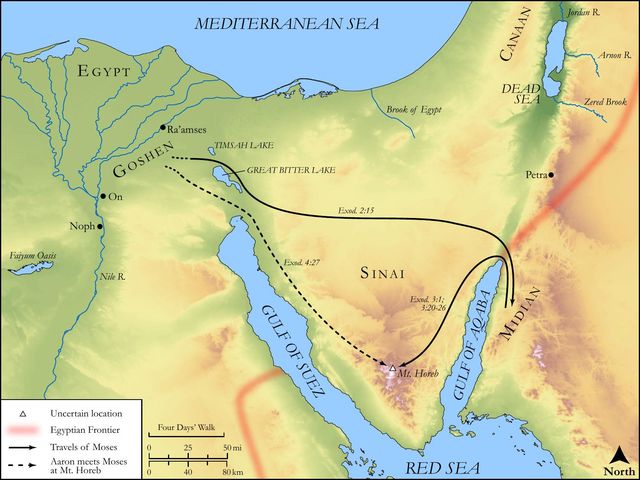
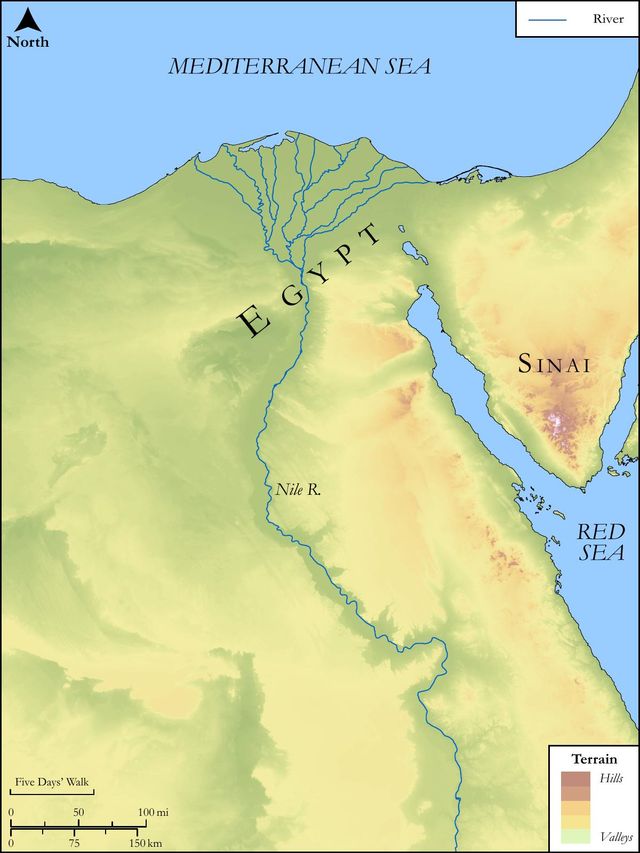
Study this verse
Public-domain commentary
Matthew Henry
From his Commentary on the Whole Bible. Henry comments on passages, not single verses — this entry covers Exodus 4:10–17. His four-level outline is real structure in the source text, so it is rendered as structure.
Moses still continues backward to the service for which God had designed him, even to a fault; for now we can no longer impute it to his humility and modesty, but must own that here was too much of cowardice, slothfulness, and unbelief in it. Observe here,
I.How Moses endeavours to excuse himself from the work.
1.He pleads that he was no good spokesman: O my Lord! I am not eloquent, Exo 4:10. He was a great philosopher, statesman, and divine, and yet no orator; a man of a clear head, great thought, and solid judgment, but had not a voluble tongue, or ready utterance, and therefore he thought himself unfit to speak before great men about great affairs, and in danger of being run down by the Egyptians. Observe,
(1.)We must not judge of men by the readiness and fluency of their discourse. Moses was mighty in word (Act 7:22), and yet not eloquent: what he said was strong and nervous, and to the purpose, and distilled as the dew (Deu 32:2), though he did not deliver himself with that readiness, ease, and elegance, that some do, who have not the tenth part of his sense. St. Paul's speech was contemptible, Co2 10:10. A great deal of wisdom and true worth is concealed by a slow tongue.
(2.)God is pleased sometimes to make choice of those as his messengers who have fewest of the advantages of art or nature, that his grace in them may appear the more glorious. Christ's disciples were no orators, till the Spirit made them such.
2.When this plea was overruled, and all his excuses were answered, he begged that God would send somebody else on this errand and leave him to keep sheep in Midian (Exo 4:13): "Send by any hand but mine; thou canst certainly find one much more fit." Note, An unwilling mind will take up with a sorry excuse rather than none, and is willing to devolve those services upon others that have any thing of difficulty or danger in them.
II.How God condescends to answer all his excuses.
Though the anger of the Lord was kindled against him (Exo 4:14), yet he continued to reason with him, till he had overcome him. Note, Even self-diffidence, when it grows into an extreme - when it either hinders us from duty or clogs us in duty, or when it discourages our dependence upon the grace of God - is very displeasing to him. God justly resents our backwardness to serve him, and has reason to take it ill; for he is such a benefactor as is before-hand with us, and such a rewarder as will not be behind-hand with us. Note further, God is justly displeased with those whom yet he does not reject: he vouchsafes to reason the case even with his froward children, and overcomes them, as he did Moses here, with grace and kindness.
1.To balance the weakness of Moses, he here reminds him of his own power, Exo 4:11.
(1.)His power in that concerning which Moses made the objection: Who has made man's mouth? Have not I the Lord? Moses knew that God made man, but he must be reminded now that God made man's mouth. An eye to God as Creator would help us over a great many of the difficulties which lie in the way of our duty, Psa 124:8. God, as the author of nature, has given us the power and faculty of speaking; and from him, as the fountain of gifts and graces, comes the faculty of speaking well, the mouth and wisdom (Luk 21:15), the tongue of the learned (Isa 50:4); he pours grace into the lips, Psa 45:2.
(2.)His power in general over the other faculties. Who but God makes the dumb and the deaf, the seeing and the blind?
[1.]The perfections of our faculties are his work, he makes the seeing; he formed the eye (Psa 94:9); he opens the understanding, the eye of the mind, Luk 24:45.
[2.]Their imperfections are from him too; he make the dumb, and deaf, and blind. Is there any evil of this kind, and the Lord has not done it? No doubt he has, and always in wisdom and righteousness, and for his own glory, Joh 9:3. Pharaoh and the Egyptians were made deaf and blind spiritually, as Isa 6:9, Isa 6:10. But God knew how to manage them, and get himself honour upon them.
2.To encourage him in this great undertaking, he repeats the promise of his presence, not only in general, I will be with thee (Isa 3:12), but in particular, "I will be with thy mouth, so that the imperfection in thy speech shall be no prejudice to thy message." It does not appear that God did immediately remove the infirmity, whatever it was; but he did that which was equivalent, he taught him what to say, and then let the matter recommend itself: if others spoke more gracefully, none spoke more powerfully. Note, Those whom God employs to speak for him ought to depend upon him for instructions, and it shall be given them what they shall speak, Mat 10:19.
3.He joins Aaron in commission with him. He promises that Aaron shall meet him opportunely, and that he will be glad to see him, they having not seen one another (it is likely) for many years, Exo 4:14. He directs him to make use of Aaron as his spokesman, Exo 4:16. God might have laid Moses wholly aside, for his backwardness to be employed; but he considered his frame, and ordered him an assistant. Observe,
(1.)Two are better than one, Ecc 4:9. God will have his two witnesses (Rev 11:3), that out of their mouths every word may be established.
(2.)Aaron was the brother of Moses, divine wisdom so ordering it, that their natural affection one to another might strengthen their union in the joint execution of their commission. Christ sent his disciples two and two, and some of the couples were brothers.
(3.)Aaron was the elder brother, and yet he was willing to be employed under Moses in this affair, because God would have it so.
(4.)Aaron could speak well, and yet was far inferior to Moses in wisdom. God dispenses his gifts variously to the children of men, that we may see our need one of another, and each may contribute something to the good of the body, Co1 12:21. The tongue of Aaron, with the head and heart of Moses, would make one completely fit for this embassy.
(5.)God promises, I will be with thy mouth, and with his mouth. Even Aaron, that could speak well, yet could not speak to purpose unless God was with his mouth; without the constant aids of divine grace the best gifts will fail.
4.He bids him take the rod with him in his hand (Exo 4:17), to intimate that he must bring about his undertaking rather by acting than by speaking; the signs he should work with this rod might abundantly supply the want of eloquence; one miracle would do him better service than all the rhetoric in the world. Take this rod, the rod he carried as a shepherd, that he might not be ashamed of that mean condition out of which God called him. This rod must be his staff of authority, and must be to him instead both of sword and sceptre.
Continue studying Exodus 4:15 across the web’s major study libraries — every link below opens this exact verse, chapter, or book on the destination site.
Read & Compare
 BibleGatewayThis verse in more than 200 translations and 70 languages.
 Bible.comThe YouVersion reader — hundreds of translations, reading plans, and highlights.
 ESV.orgCrossway's official English Standard Version reader.
 NET BibleThe NET translation with 60,000+ translators' notes on every rendering decision.
 STEP BibleTyndale House's free study tool — original text, vocabulary, and scholarly resources.
 BibliaLogos Bible Software's free web reader.
 USCCBThe New American Bible (Revised Edition) with the U.S. bishops' study notes.
Commentaries
 BibleHub CommentariesDozens of classic commentaries on this verse, gathered on one page.
 StudyLightMore than 100 commentary sets — the largest collection on the web.
 BibleRefPlain-English commentary on what this verse means, verse by verse.
 Enduring WordDavid Guzik's free commentary on this chapter, widely used by Bible teachers.
 Bible Study ToolsVerse commentary alongside Greek and Hebrew study aids.
Original Language & Research
- BibleHub InterlinearThe verse word by word — original language, transliteration, and English.
- BibleHub LexiconEvery word's original-language definition and Strong's entry.
 Blue Letter BibleDeep-study tools — Strong's numbers, concordance, and word studies.
 SefariaThe Hebrew text with Rashi and centuries of Jewish commentary.
Sermons, Hymns & Audio


TrulyRandomVerse is not affiliated with these sites and doesn’t control their content. They’re linked because they’re genuinely useful.
Summary
Exodus 4:15 stands as a pivotal moment in the narrative of Moses' call, revealing God's patient and comprehensive provision for His chosen leader. Following Moses' repeated expressions of doubt and perceived inadequacies, particularly his struggle with eloquence, this verse solidifies Aaron's role as Moses' divinely appointed spokesman and reiterates God's unwavering commitment to empower both brothers for the monumental task of leading Israel out of Egyptian bondage. It underscores God's faithfulness in equipping those He calls, addressing human weakness with divine enablement.
Context
ShowHideLiterary Context
This verse is embedded within the detailed account of Moses' call at the burning bush in Exodus 3, Exodus 4. After God reveals His name and mission to Moses, Moses raises a series of objections: his unworthiness (Exodus 3:11), the Israelites' disbelief (Exodus 3:13), his lack of miraculous signs (Exodus 4:1), and finally, his perceived inadequacy in speech (Exodus 4:10). Despite God's direct assurance, "who hath made man's mouth? or who maketh the dumb, or deaf, or the seeing, or the blind? have not I the Lord? Now therefore go, and I will be with thy mouth, and teach thee what thou shalt say" (Exodus 4:11-12), Moses persists, begging God to send someone else (Exodus 4:13). It is in response to this persistent hesitation, and with God's anger kindled, that God mercifully provides Aaron as Moses' spokesman in Exodus 4:14, with our verse solidifying the divine arrangement and promise of empowerment for both.
Historical & Cultural Context
Among the Egyptians and the Hebrews, the role of a spokesman or interpreter was crucial, especially when dealing with foreign dignitaries or large assemblies. Kings and deities often had official messengers or prophets who conveyed their will. Moses' concern about his speech impediment (often interpreted as a stammer or slow speech) would have been a significant barrier to his credibility and effectiveness as God's representative before Pharaoh and the Israelites. Pharaoh's court, known for its elaborate protocols and sophisticated rhetoric, would have demanded a clear and authoritative voice. Furthermore, the concept of a "prophet" in the Old Testament often involved being a "mouth" for God, speaking His exact words. God's provision of Aaron as Moses' "mouth" (or "prophet," as stated in Exodus 7:1) directly addresses this cultural expectation and Moses' personal limitation, demonstrating God's practical and powerful intervention in human affairs.
Key Themes
ShowHideThis verse powerfully contributes to several overarching themes in Exodus and the broader Pentateuch. It highlights the theme of Divine Sovereignty and Initiative, as God chooses, commissions, and equips His servant despite human weakness, demonstrating that His plan will not be thwarted by human inadequacy. It underscores Divine Empowerment and Provision, showing God's specific and practical solutions to the challenges faced by those He calls; He doesn't just call, He enables. The establishment of Aaron as Moses' spokesman introduces the theme of Partnership in Ministry, illustrating that God often uses multiple individuals, each with unique gifts, to accomplish His purposes, foreshadowing the collaborative nature of leadership seen throughout Israel's history. Finally, it reinforces the theme of God's Faithfulness to His Covenant Promises, as He ensures the means for His promise to Abraham, Isaac, and Jacob to be fulfilled through the liberation of Israel, as detailed in Exodus 2:24-25.
Exposition and Analysis
ShowHideKey Word Analysis
ShowHideThis primitive root means "to arrange," but is used figuratively for "to speak." It implies an ordered, intentional communication. When God commands Moses to "speak" to Aaron, it's not just casual talk but the transmission of divinely arranged words. The related noun dâbâr (H1697) means "a word," "a matter," or "a thing," emphasizing the substantive content being conveyed.
This word refers to the literal mouth, but also figuratively to speech, utterance, and authority. Its repeated use in the verse ("thy mouth," "his mouth") underscores that God's presence and power will be directly manifest in the very act of articulation, transforming a physical organ into a conduit of divine power. It signifies the source and instrument of communication.
This root properly means "to flow as water," or "to lay or throw" (like an arrow). Figuratively, it means "to point out" (as if by aiming the finger) or "to instruct." This highlights that God's guidance is precise and directional, like an arrow hitting its mark, ensuring that Moses and Aaron will know not only what to say but also the exact course of action to take.
Verse Breakdown
ShowHide"And thou shalt speak unto him"
This clause establishes Moses' primary role as the direct recipient of God's revelation and the immediate conduit of that revelation to Aaron. Moses, despite his perceived speech impediment, is still the one through whom God's message will flow first.
"and put words in his mouth"
This is a powerful idiom signifying divine inspiration and provision. It means God will provide Aaron with the exact message to deliver, channeled through Moses. It assures that Aaron's speech will not originate from his own wisdom or eloquence, but will be divinely ordained, carrying the full authority of God's message.
"and I will be with thy mouth, and with his mouth"
This is the core promise of divine empowerment. The repetition of "mouth" emphasizes God's direct, personal, and active presence in the very act of communication for both brothers. It signifies that God Himself will enable Moses to effectively transmit His words to Aaron, and will enable Aaron to articulate those words clearly and powerfully to Pharaoh and the Israelites, directly addressing Moses' initial fears about his speech.
"and will teach you what ye shall do"
This final clause extends God's comprehensive provision beyond mere verbal communication to encompass all necessary actions. It promises that divine instruction will cover not only what to say, but also how to act, what steps to take, and how to navigate the unfolding events. This ensures that their mission will be guided by God's wisdom in its entirety, guaranteeing obedience and effectiveness.
Literary Devices
ShowHideThe verse employs several significant literary devices. Repetition is prominent with the word "mouth" (Hebrew: peh), appearing three times. This repetition serves to emphasize the central concern of communication and God's direct involvement in enabling both Moses' and Aaron's speech. The phrase "put words in his mouth" is a powerful idiom, conveying the concept of divine inspiration and dictation, ensuring that the message is God's own, not human invention. Furthermore, the entire verse is an example of Divine Discourse, as God Himself is speaking directly to Moses, providing assurance and instruction. This direct address underscores God's authority, faithfulness, and active participation in the unfolding narrative.
Theological and Thematic Connections
ShowHideExodus 4:15 profoundly illustrates God's commitment to equipping those He calls, transforming human weakness into a platform for divine power. It reveals that God's plans are not contingent upon human ability but on His own sovereign provision. He doesn't just call the qualified; He qualifies the called, often by providing partners and specific enablement for the task at hand. This principle of divine enablement for ministry is a recurring theme throughout Scripture.
Reflection and Application
ShowHideExodus 4:15 offers profound encouragement for believers today, reminding us that God calls and equips the willing, even when we feel inadequate or incapable. Moses' persistent objections highlight a common human tendency to focus on our limitations rather than God's limitless power. Yet, God patiently, though firmly, provides a solution that not only addresses Moses' specific weakness but also demonstrates His comprehensive care. We are not alone in our tasks, as God often provides partners and resources to complement our weaknesses, ensuring His purposes are fulfilled. Just as He promised to teach Moses and Aaron, God continues to guide His people through His Spirit and Word, empowering our words and actions to accomplish His will. This verse gives us the confidence to step out in faith despite our perceived limitations, trusting that God will be "with our mouth" and "teach us what we shall do" in every sphere of life and ministry.
Questions for Reflection
ShowHideFAQ
ShowHideHow does this verse address Moses' reluctance?
ShowHideMoses repeatedly expressed doubts about his speaking ability, stating he was "slow of speech, and of a slow tongue" in Exodus 4:10. In response to his final plea for God to send someone else in Exodus 4:13, God, despite His anger, mercifully provides Aaron as Moses' spokesman. This verse then solidifies that arrangement, directly promising to empower both Moses' mouth (for communicating to Aaron) and Aaron's mouth (for speaking to Pharaoh and the Israelites). This demonstrates God's patient provision for human weakness and His unwavering commitment to His chosen plan, ensuring that His will is accomplished despite human limitations.
What does it mean for God to "put words in his mouth"?
ShowHideThis is a powerful Hebrew idiom signifying divine inspiration and authority. It means God will directly provide Aaron with the exact message to deliver, channeled through Moses. It ensures that the words spoken are not human inventions or mere rhetoric, but divinely ordained declarations, carrying the weight and authority of God's own voice. This concept is foundational to the prophetic office, where the prophet is merely the mouthpiece for God's truth, as seen in other prophetic calls like Jeremiah 1:9.
Christ-Centered Fulfillment
ShowHideExodus 4:15, with its emphasis on divine empowerment for speech and action, finds its ultimate and perfect fulfillment in Jesus Christ. Jesus is the quintessential "Word made flesh" (John 1:14), the ultimate spokesman through whom God speaks His final and most complete revelation to humanity (Hebrews 1:1-2). Just as God promised to be "with thy mouth, and with his mouth" for Moses and Aaron, Jesus, after His ascension, promises His disciples the empowering presence of the Holy Spirit, who will give them the very words to speak when they are called to testify (Matthew 10:19-20 and Acts 1:8). Through Christ, believers are not only empowered by the Spirit to speak God's truth with authority and clarity but are also guided by Him in all their actions, fulfilling the promise of divine teaching and guidance for all who follow Him (John 14:26 and Romans 8:14). Jesus is the perfect embodiment of God's presence, wisdom, and power, enabling His people to participate in His ongoing mission.