


Exodus 4:1
Bible text: King James Version (1769 Blayney text) · Public domain
Bible text: Berean Standard Bible · Public domain
Bible text: American Standard Version (1901) · Public domain
Bible text: World English Bible, Messianic edition · Public domain
Bible text: Geneva Bible (1599) · Public domain
Bible text: Young's Literal Translation · Public domain
- וַיַּעַןvai·Ya·'anand he answeredH6030Conj-w ¦ V-Qal-ConsecImperf-3msVerb Qal Consecutive Imperfect 3rd Singular Masculineוַandיַּעַןhe answered
- מֹשֶׁהmo·ShehMosesH4872N-proper-mNoun Proper Masculine
- וַיֹּאמֶרvai·Yo·merand he saidH559Conj-w ¦ V-Qal-ConsecImperf-3msVerb Qal Consecutive Imperfect 3rd Singular Masculineוַandיֹּאמֶרhe said
- וְהֵןve·Henand here!H2005Conj-w ¦ PrtParticle Interjectionוְandהֵןhere!
- לֹאlo'notH3808NegParticle Negative
- יַאֲמִינוּya·'a·Mi·nuthey will believeH539V-Hiphil-Imperf-3mpVerb Hiphil Imperfect 3rd Plural Masculine
- לִיLi<to> <the> mePrep-l ¦ 1csSuffix Personal 1st Singular common genderלִ<to> <the>יme
- וְלֹאve·Lo'and notH3808Conj-w ¦ NegParticle Negativeוְandלֹאnot
- יִשְׁמְעוּyish·me·'Uthey will listenH8085V-Qal-Imperf-3mpVerb Qal Imperfect 3rd Plural Masculine
- בְּקֹלִיbe·ko·Lito my voiceH6963Prep-b ¦ N-msc ¦ 1csNoun Singular Masculine Constructבְּtoקֹלִvoiceיmy
- כִּיkiforH3588PrtParticle Conditional
- יֹאמְרוּyo·me·Ruthey will sayH559V-Qal-Imperf-3mpVerb Qal Imperfect 3rd Plural Masculine
- לֹאlo'notH3808NegParticle Negative
- נִרְאָהnir·'Ahhe appearedH7200V-Niphal-Perf-3msVerb Niphal Perfect 3rd Singular Masculine
- אֵלֶיךָ'e·Lei·khato youH413Prep ¦ 2msPreposition Definiteאֵלֶיtoךָyou
- יְהוָהYah·wehYahwehH3068N-properNoun Proper Title
English is a literal word-by-word gloss of the Hebrew, not the KJV's wording. Why?
This is the original text the KJV's translators worked from — each Hebrew word with its own literal English meaning in this verse, prepared by scholars at Tyndale House, Cambridge. The KJV translates whole sentences, not word by word, so its wording differs: one Hebrew word can become several English words, and the KJV may choose “the LORD” where the gloss reads “Yahweh”. Both are faithful — they answer different questions. For the KJV's own rendering, switch to the KJV text.
Details
See on the biblical-era maps

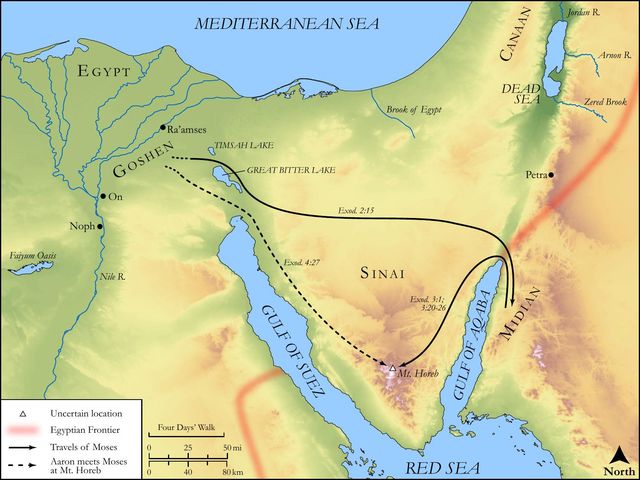
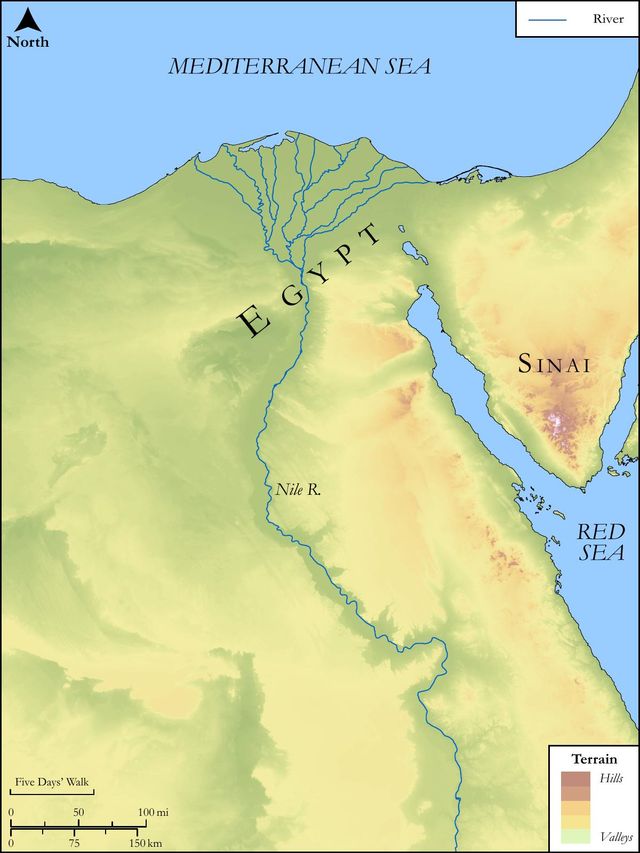
Study this verse
Public-domain commentary
Matthew Henry
From his Commentary on the Whole Bible. Henry comments on passages, not single verses — this entry covers Exodus 4:1–9. His three-level outline is real structure in the source text, so it is rendered as structure.
It was a very great honour that Moses was called to when God commissioned him to bring Israel out of Egypt; yet he is with difficulty persuaded to accept the commission, and does it at last with great reluctance, which we should rather impute to a humble diffidence of himself and his own sufficiency than to any unbelieving distrust of God and his word and power. Note, Those whom God designs for preferment he clothes with humility; the most fit for service are the least forward.
I.Moses objects that in all probability the people would not hearken to his voice (Exo 4:1), that is, they would not take his bare word, unless he showed them some sign, which he had not been yet instructed to do. This objection cannot be justified, because it contradicts what God had said (Exo 3:18), They shall hearken to thy voice. If God says, They will, does it become Moses to say, They will not? Surely he means, "Perhaps they will not at first, or some of them will not." If there should be some gainsayers among them who would question his commission, how should he deal with them? And what course should he take to convince them? He remembered how they had once rejected him, and feared it would be so again. Note,
1.Present discouragements often arise from former disappointments.
2.Wise and good men have sometimes a worse opinion of people than they deserve. Moses sad (Exo 4:1), They will not believe me; and yet he was happily mistaken, for it is said (Exo 4:31), The people believed; but then the signs which God appointed in answer to this objection were first wrought in their sight.
II.God empowers him to work miracles, directs him to three particularly, two of which were now immediately wrought for his own satisfaction.
Note, True miracles are the most convincing external proofs of a divine mission attested by them. Therefore our Saviour often appealed to his works (as Joh 5:36), and Nicodemus owns himself convinced by them, Joh 3:2. And here Moses, having a special commission given him as a judge and lawgiver to Israel, has this seal affixed to his commission, and comes supported by these credentials.
1.The rod in his hand is made the subject of a miracle, a double miracle: it is but thrown out of his hand and it becomes a serpent; he resumes it and it becomes a rod again, Exo 4:2-4. Now,
(1.)Here was a divine power manifested in the change itself, that a dry stick should be turned into a living serpent, a lively one, so formidable a one that Moses himself, on whom, it should seem, it turned in some threatening manner, fled from before it, though we may suppose, in that desert, serpents were no strange things to him; but what was produced miraculously was always the best and strongest of the kind, as the water turned to wine: and, then, that this living serpent should be turned into a dry stick again, this was the Lord's doing.
(2.)Here was an honour put upon Moses, that this change was wrought upon his throwing it down and taking it up, without any spell, or charm, or incantation: his being empowered thus to act under God, out of the common course of nature and providence, was a demonstration of his authority, under God, to settle a new dispensation of the kingdom of grace. We cannot imagine that the God of truth would delegate such a power as this to an impostor.
(3.)There was a significancy in the miracle itself. Pharaoh had turned the rod of Israel into a serpent, representing them as dangerous (Exo 1:10), causing their belly to cleave to the dust, and seeking their ruin; but now they should be turned into a rod again: or, thus Pharaoh had turned the rod of government into the serpent of oppression, from which Moses had himself fled into Midian; but by the agency of Moses the scene was altered again.
(4.)There was a direct tendency in it to convince the children of Israel that Moses was indeed sent of God to do what he did, Exo 4:5. Miracles were for signs to those that believed not, Co1 14:22.
2.His hand itself is next made the subject of a miracle. He puts it once into his bosom, and takes it out leprous; he puts it again into the same place, and takes it out well, Exo 4:6, Exo 4:7. This signified,
(1.)That Moses, by the power of God, should bring sore diseases upon Egypt, and that, at his prayer, they should be removed.
(2.)That whereas the Israelites in Egypt had become leprous, polluted by sin, and almost consumed by oppression (a leper is as one dead, Num 12:12), by being taken into the bosom of Moses they should be cleansed and cured, and have all their grievances redressed.
(3.)That Moses was not to work miracles by his own power, nor for his own praise, but by the power of God and for his glory; the leprous hand of Moses does for ever exclude boasting. Now it was supposed that, if the former sign did not convince, this latter would. Note, God is willing more abundantly to show the truth of his word, and is not sparing in his proofs; the multitude and variety of the miracles corroborate the evidence.
3.He is directed, when he shall come to Egypt, to turn some of the water of the river into blood, Exo 4:9. This was done, at first, as a sign, but, not gaining due credit with Pharaoh, the whole river was afterwards turned into blood, and then it became a plague. He is ordered to work this miracle in case they would not be convinced by the other two. Note, Unbelief shall be left inexcusable, and convicted of a wilful obstinacy. As to the people of Israel, God had said (Exo 3:18), They shall hearken; yet he appoints these miracles to be wrought for their conviction, for he that has ordained the end has ordained the means.
Continue studying Exodus 4:1 across the web’s major study libraries — every link below opens this exact verse, chapter, or book on the destination site.
Read & Compare
 BibleGatewayThis verse in more than 200 translations and 70 languages.
 Bible.comThe YouVersion reader — hundreds of translations, reading plans, and highlights.
 ESV.orgCrossway's official English Standard Version reader.
 NET BibleThe NET translation with 60,000+ translators' notes on every rendering decision.
 STEP BibleTyndale House's free study tool — original text, vocabulary, and scholarly resources.
 BibliaLogos Bible Software's free web reader.
 USCCBThe New American Bible (Revised Edition) with the U.S. bishops' study notes.
Commentaries
 BibleHub CommentariesDozens of classic commentaries on this verse, gathered on one page.
 StudyLightMore than 100 commentary sets — the largest collection on the web.
 BibleRefPlain-English commentary on what this verse means, verse by verse.
 Enduring WordDavid Guzik's free commentary on this chapter, widely used by Bible teachers.
 Bible Study ToolsVerse commentary alongside Greek and Hebrew study aids.
Original Language & Research
- BibleHub InterlinearThe verse word by word — original language, transliteration, and English.
- BibleHub LexiconEvery word's original-language definition and Strong's entry.
 Blue Letter BibleDeep-study tools — Strong's numbers, concordance, and word studies.
 SefariaThe Hebrew text with Rashi and centuries of Jewish commentary.
Sermons, Hymns & Audio


TrulyRandomVerse is not affiliated with these sites and doesn’t control their content. They’re linked because they’re genuinely useful.
Summary
Exodus 4:1 captures Moses' immediate and deeply human hesitation following God's profound commission at the burning bush. Despite his direct encounter with the Almighty, Moses voices a fundamental concern that the Israelites will not accept his divine mandate, fearing they will dismiss his claims by asserting, "The LORD hath not appeared unto thee." This pivotal moment highlights the tension between divine command and human apprehension, setting the stage for God's patient provision of validating signs to bolster Moses' credibility and the people's faith.
Context
ShowHideLiterary Context
This verse serves as a critical pivot point in the narrative of Moses' call. It immediately follows God's detailed instructions in Exodus 3 regarding Moses' mission to deliver Israel from Egyptian bondage and lead them to the Promised Land. Moses has already raised several objections concerning his personal inadequacy ("Who am I?" in Exodus 3:11) and the divine name he should use ("What is His name?" in Exodus 3:13). In Exodus 4:1, Moses shifts his focus from his own perceived limitations to the anticipated skepticism of the Israelite elders and the wider community. His fear that they will reject his claims of a divine encounter ("The LORD hath not appeared unto thee") directly prompts God to provide a series of miraculous signs to validate Moses' authority, beginning immediately in Exodus 4:2-9.
Historical & Cultural Context
The Israelites had endured centuries of brutal slavery in Egypt, a period marked by severe oppression, forced labor, and the systematic killing of their male infants (Exodus 1:8-22). This prolonged suffering likely fostered deep cynicism and a sense of abandonment, making them wary of any new promises or claims of divine intervention. They had witnessed numerous false hopes and had become accustomed to their plight. For Moses to suddenly appear, claiming a direct revelation from a God who seemed distant for generations, would naturally invite skepticism. Furthermore, among the kings and peoples of that day, a messenger's authority was intrinsically linked to the power and credibility of the one who sent them. Moses understood that his message, however divinely inspired, would be dismissed without tangible proof that the God of their ancestors had indeed "appeared" to him and was now actively intervening on their behalf.
Key Themes
ShowHideExodus 4:1 contributes significantly to several overarching themes in Exodus and the broader Pentateuch. It underscores the theme of Divine Commission and Human Hesitation, illustrating that even those divinely chosen for monumental tasks often grapple with profound doubt and a sense of inadequacy. It also highlights the Nature of Faith and Trust, revealing that true belief (beyond mere intellectual assent) often requires tangible evidence, especially when confronting deep-seated skepticism. Furthermore, the verse introduces the theme of God's Patience and Provision, as God, rather than rebuking Moses, patiently addresses his fears by offering concrete proofs and solutions. This moment sets the stage for the recurring theme of Divine Validation, where God repeatedly confirms His word and His chosen instruments through miraculous signs and wonders, preparing both Moses and the Israelites for the mighty acts of deliverance that would follow (Exodus 7-12).
Exposition and Analysis
ShowHideMoses' response in Exodus 4:1 reveals a profound human struggle with faith and obedience, even after a direct encounter with the Almighty. His concern is not merely intellectual disbelief but a deeper failure of trust and willingness to obey, rooted in the anticipated skepticism of others.
Key Word Analysis
ShowHideThis primitive root signifies more than simple intellectual assent; it means "to build up or support," "to foster as a parent or nurse," and figuratively "to render (or be) firm or faithful, to trust or believe, to be permanent or quiet." When Moses fears the Israelites will not "believe" him, he anticipates they will not place firm trust or confidence in his divine appointment, nor will they consider his message reliable or true. This word is the root of "Amen," emphasizing certainty and faithfulness.
This primitive root means "to hear intelligently," often with the implication of attention, obedience, or consent. Moses' concern that they will not "hearken unto my voice" indicates a fear that the Israelites will not only fail to listen attentively to his message but, more importantly, will refuse to obey the divine commands conveyed through him. Lack of belief, in Moses' mind, directly leads to disobedience and rejection of God's authority.
This primitive root means "to see, literally or figuratively," and in various applications, "to appear," "to behold," or "to discern." Moses' specific fear that "The LORD hath not appeared unto thee" directly challenges the very foundation of his authority. He understands that his credibility hinges entirely on the Israelites' acceptance of his claim to have had a direct, visible, and undeniable encounter with Yahweh. This word emphasizes the visual, tangible manifestation of God's presence.
Verse Breakdown
ShowHide"And Moses answered and said,"
This introductory phrase highlights Moses' active engagement in a dialogue with God, not merely a passive reception of divine commands. It signals his human agency and the unfolding of his internal struggle as he processes the monumental task laid before him.
"But, behold, they will not believe me, nor hearken unto my voice:"
Moses articulates his primary apprehension. The "But, behold" (or "Indeed") introduces a strong counter-argument to God's commission. He anticipates a two-fold rejection from the Israelites: a lack of fundamental trust ("believe") in his divine appointment and a refusal to obey ("hearken") the message he brings. This reveals his deep concern for the practical reception of his mission among a skeptical people.
"for they will say, The LORD hath not appeared unto thee."
This clause provides the specific reason for the Israelites' anticipated disbelief and disobedience. Moses understands that the credibility of his entire mission rests upon the authenticity of his claim to a direct, personal encounter with Yahweh. He fears that the Israelites, having not witnessed the burning bush themselves, will dismiss his testimony as a fabrication, thereby undermining his authority and the divine message.
Literary Devices
ShowHideThe verse primarily employs Dialogue, presenting Moses' direct response to God's commission, which allows for a realistic portrayal of human doubt in the face of divine calling. There is also a strong element of Anticipation, as Moses projects the future reaction of the Israelites, revealing his anxieties about their skepticism. This anticipation serves as a Foreshadowing of the challenges Moses will indeed face in leading a stubborn and often unbelieving people. Furthermore, there is a subtle Irony present: Moses, who has just experienced a profound divine manifestation at the burning bush, immediately doubts that others will believe his account of that very appearance, highlighting the persistent human tendency to rely on visible evidence and the opinions of others rather than solely on divine assurance.
Theological and Thematic Connections
ShowHideMoses' initial reluctance and the specific doubt he expresses in Exodus 4:1 are profoundly theological. They underscore the reality that God's call often encounters human weakness, fear, and a sense of inadequacy, even in those chosen for monumental tasks. This moment highlights the critical nature of faith, which is not merely intellectual assent but a profound trust and reliance on God's word and His chosen instruments, leading to obedience. Rather than rebuking Moses for his doubt, God patiently addresses his fears by immediately offering concrete proofs and solutions, demonstrating His willingness to equip and empower His servants. This divine patience and provision reveal God's understanding of humanity's need for tangible evidence, especially when a message requires significant societal change or a radical shift in belief. God provides signs to confirm His word and His messenger's authority, establishing the credibility necessary for effective spiritual leadership.
Reflection and Application
ShowHideMoses' initial reluctance and the specific doubt he expresses in Exodus 4:1 are remarkably relatable for believers today. When called to a significant task, especially one that seems beyond our capabilities or involves convincing others of a spiritual truth, we often anticipate skepticism, resistance, or outright rejection. This verse reminds us that God understands our fears and insecurities. Just as He patiently equipped Moses with undeniable signs to overcome the Israelites' potential disbelief, God empowers believers today to fulfill His purposes. Our focus should be on trusting God's commission and relying on His power to make His truth known, rather than being paralyzed by the fear of others' reactions or our own perceived inadequacies. God's call comes with His provision and validation; our role is to step forward in faith, knowing He will confirm His word. What seems impossible to us is entirely within God's power to accomplish through us.
Questions for Reflection
ShowHideFAQ
ShowHideWhy does Moses anticipate the Israelites' disbelief even after his encounter with God?
ShowHideMoses anticipates disbelief because he understands the deep skepticism that centuries of slavery, oppression, and unfulfilled promises might have instilled in the Israelites. They had long suffered and might have lost hope in God's active involvement in their lives. Moses, having just experienced a supernatural encounter at the burning bush (Exodus 3), recognizes the profound difficulty of conveying such a unique spiritual experience convincingly to others without tangible proof. His concern is practical: how can he establish divine authority and credibility in the eyes of a people who have every reason to be cynical and weary of false hope? He knows his message, though from God, will be judged by its perceived authenticity and power to deliver.
Christ-Centered Fulfillment
ShowHideMoses' doubt and God's subsequent provision of validating signs in Exodus 4:1 powerfully foreshadow the greater deliverer, Jesus Christ. Moses, despite being God's chosen prophet, was a man of human weakness and doubt, requiring divine authentication for his message to be believed and obeyed. He needed signs (like the staff turning into a serpent, Exodus 4:2-3) to prove that "the LORD hath appeared unto thee." Christ, however, is the ultimate Prophet and Deliverer, whose authority is inherent and perfectly divine. While Moses needed external signs to validate his commission, Christ's life, teachings, miracles (John 2:11), and ultimately His resurrection (Romans 1:4) were the ultimate, undeniable signs of His identity as God incarnate and the promised Messiah. The Israelites' anticipated need to "believe" and "hearken" to Moses points to humanity's ultimate need to believe in and obey the voice of Christ (John 10:27), who perfectly embodies the Lord's appearance and brings true liberation from sin and death (John 8:36). He is the one to whom all the prophets bore witness (Acts 10:43), and in Him, the ultimate "appearance" of God to humanity is fully realized (John 1:14).