


Exodus 4:6
Bible text: King James Version (1769 Blayney text) · Public domain
Bible text: King James Version with Strong's numbers · Public domain
Bible text: Berean Standard Bible · Public domain
Bible text: American Standard Version (1901) · Public domain
Bible text: World English Bible, Messianic edition · Public domain
Bible text: Geneva Bible (1599) · Public domain
Bible text: Young's Literal Translation · Public domain
- וַיֹּאמֶרvai·yo·Merand he saidH559Conj-w ¦ V-Qal-ConsecImperf-3msVerb Qal Consecutive Imperfect 3rd Singular Masculineוַandיֹּאמֶרhe said
- יְהוָהYah·wehYahwehH3068N-properNoun Proper Title
- לוֹloto <the> himPrep-l ¦ 3msSuffix Personal 3rd Singular Masculineלto <the>וֹhim
- עוֹדodagainH5750Adj-msAdjective Numerical Singular Masculine Absolute
- הָבֵאha·ve'putH935V-Hiphil-Imp-2msVerb Hiphil Imperative 2nd Singular Masculine
- נָאna'pleaseH4994PrtParticle Interjection
- יָדְךָya·de·Khayour handH3027N-csc ¦ 2msNoun Singular common gender Constructיָדְhandךָyour
- בְּחֵיקֶךָbe·chei·Ke·chain your bosomH2436Prep-b ¦ N-msc ¦ 2msNoun Singular Masculine Constructבְּinחֵיקֶbosomךָyour
- וַיָּבֵאvai·ya·Ve'and he putH935Conj-w ¦ V-Hiphil-ConsecImperf-3msVerb Hiphil Consecutive Imperfect 3rd Singular Masculineוַandיָּבֵאhe put
- יָדוֹya·Dohis handH3027N-csc ¦ 3msNoun Singular common gender Constructיָדhandוֹhis
- בְּחֵיקוֹbe·chei·Koin his bosomH2436Prep-b ¦ N-msc ¦ 3msNoun Singular Masculine Constructבְּinחֵיקbosomוֹhis
- וַיּוֹצִאָהּvai·Yo·tzi·'Ahand he brought out itH3318Conj-w ¦ V-Hiphil-ConsecImperf-3ms ¦ 3fsVerb Hiphil Consecutive Imperfect 3rd Singular Masculineוַandיּוֹצִאָhe brought outהּit
- וְהִנֵּהve·hi·Nehand there!H2009Conj-w ¦ PrtParticle Interjectionוְandהִנֵּהthere!
- יָדוֹya·Dohis handH3027N-csc ¦ 3msNoun Singular common gender Constructיָדhandוֹhis
- מְצֹרַעַתme·tzo·Ra·'at[was] leprousH6879V-Pual-PassPrtcpl-fsVerb Pual Participle Passive Singular Feminine Construct
- כַּשָּׁלֶגka·Sha·leglike <the> snowH7950Prep-k ¦ N-msNoun Singular Masculine Absoluteכַּlike <the>שָּׁלֶגsnow
English is a literal word-by-word gloss of the Hebrew, not the KJV's wording. Why?
This is the original text the KJV's translators worked from — each Hebrew word with its own literal English meaning in this verse, prepared by scholars at Tyndale House, Cambridge. The KJV translates whole sentences, not word by word, so its wording differs: one Hebrew word can become several English words, and the KJV may choose “the LORD” where the gloss reads “Yahweh”. Both are faithful — they answer different questions. For the KJV's own rendering, switch to the KJV text.
Details
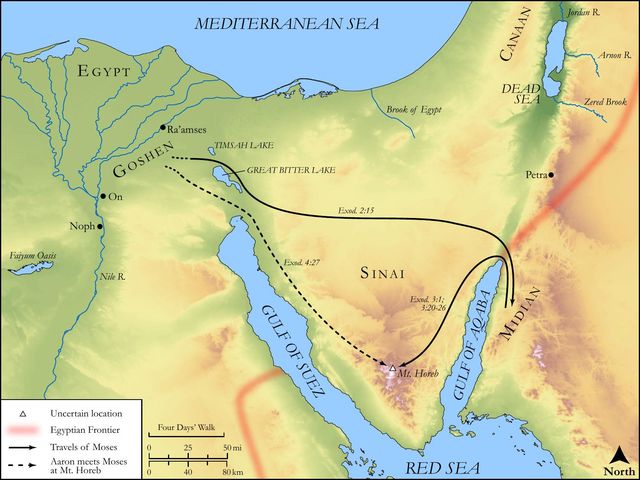
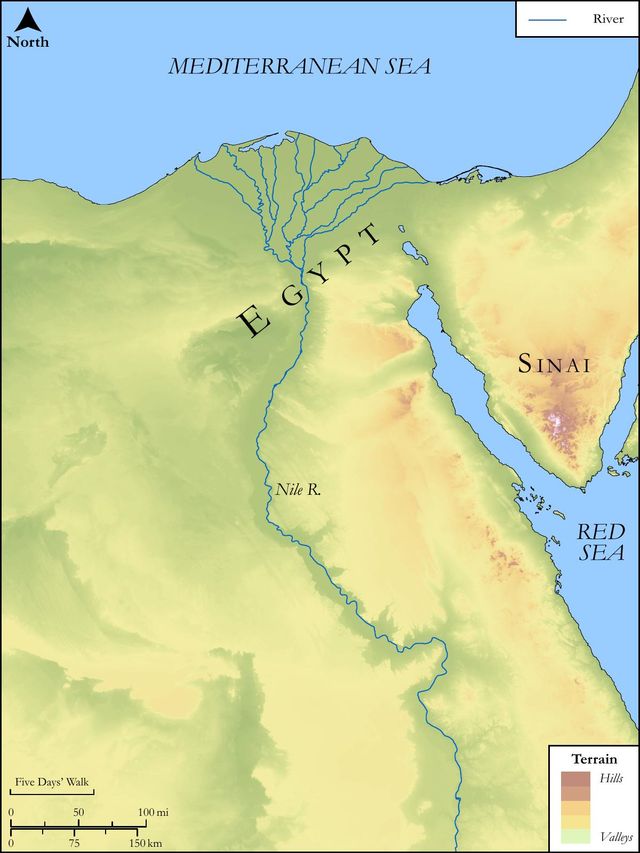
See on the biblical-era maps

Study this verse
Public-domain commentary
Matthew Henry
From his Commentary on the Whole Bible. Henry comments on passages, not single verses — this entry covers Exodus 4:1–9. His three-level outline is real structure in the source text, so it is rendered as structure.
It was a very great honour that Moses was called to when God commissioned him to bring Israel out of Egypt; yet he is with difficulty persuaded to accept the commission, and does it at last with great reluctance, which we should rather impute to a humble diffidence of himself and his own sufficiency than to any unbelieving distrust of God and his word and power. Note, Those whom God designs for preferment he clothes with humility; the most fit for service are the least forward.
I.Moses objects that in all probability the people would not hearken to his voice (Exo 4:1), that is, they would not take his bare word, unless he showed them some sign, which he had not been yet instructed to do. This objection cannot be justified, because it contradicts what God had said (Exo 3:18), They shall hearken to thy voice. If God says, They will, does it become Moses to say, They will not? Surely he means, "Perhaps they will not at first, or some of them will not." If there should be some gainsayers among them who would question his commission, how should he deal with them? And what course should he take to convince them? He remembered how they had once rejected him, and feared it would be so again. Note,
1.Present discouragements often arise from former disappointments.
2.Wise and good men have sometimes a worse opinion of people than they deserve. Moses sad (Exo 4:1), They will not believe me; and yet he was happily mistaken, for it is said (Exo 4:31), The people believed; but then the signs which God appointed in answer to this objection were first wrought in their sight.
II.God empowers him to work miracles, directs him to three particularly, two of which were now immediately wrought for his own satisfaction.
Note, True miracles are the most convincing external proofs of a divine mission attested by them. Therefore our Saviour often appealed to his works (as Joh 5:36), and Nicodemus owns himself convinced by them, Joh 3:2. And here Moses, having a special commission given him as a judge and lawgiver to Israel, has this seal affixed to his commission, and comes supported by these credentials.
1.The rod in his hand is made the subject of a miracle, a double miracle: it is but thrown out of his hand and it becomes a serpent; he resumes it and it becomes a rod again, Exo 4:2-4. Now,
(1.)Here was a divine power manifested in the change itself, that a dry stick should be turned into a living serpent, a lively one, so formidable a one that Moses himself, on whom, it should seem, it turned in some threatening manner, fled from before it, though we may suppose, in that desert, serpents were no strange things to him; but what was produced miraculously was always the best and strongest of the kind, as the water turned to wine: and, then, that this living serpent should be turned into a dry stick again, this was the Lord's doing.
(2.)Here was an honour put upon Moses, that this change was wrought upon his throwing it down and taking it up, without any spell, or charm, or incantation: his being empowered thus to act under God, out of the common course of nature and providence, was a demonstration of his authority, under God, to settle a new dispensation of the kingdom of grace. We cannot imagine that the God of truth would delegate such a power as this to an impostor.
(3.)There was a significancy in the miracle itself. Pharaoh had turned the rod of Israel into a serpent, representing them as dangerous (Exo 1:10), causing their belly to cleave to the dust, and seeking their ruin; but now they should be turned into a rod again: or, thus Pharaoh had turned the rod of government into the serpent of oppression, from which Moses had himself fled into Midian; but by the agency of Moses the scene was altered again.
(4.)There was a direct tendency in it to convince the children of Israel that Moses was indeed sent of God to do what he did, Exo 4:5. Miracles were for signs to those that believed not, Co1 14:22.
2.His hand itself is next made the subject of a miracle. He puts it once into his bosom, and takes it out leprous; he puts it again into the same place, and takes it out well, Exo 4:6, Exo 4:7. This signified,
(1.)That Moses, by the power of God, should bring sore diseases upon Egypt, and that, at his prayer, they should be removed.
(2.)That whereas the Israelites in Egypt had become leprous, polluted by sin, and almost consumed by oppression (a leper is as one dead, Num 12:12), by being taken into the bosom of Moses they should be cleansed and cured, and have all their grievances redressed.
(3.)That Moses was not to work miracles by his own power, nor for his own praise, but by the power of God and for his glory; the leprous hand of Moses does for ever exclude boasting. Now it was supposed that, if the former sign did not convince, this latter would. Note, God is willing more abundantly to show the truth of his word, and is not sparing in his proofs; the multitude and variety of the miracles corroborate the evidence.
3.He is directed, when he shall come to Egypt, to turn some of the water of the river into blood, Exo 4:9. This was done, at first, as a sign, but, not gaining due credit with Pharaoh, the whole river was afterwards turned into blood, and then it became a plague. He is ordered to work this miracle in case they would not be convinced by the other two. Note, Unbelief shall be left inexcusable, and convicted of a wilful obstinacy. As to the people of Israel, God had said (Exo 3:18), They shall hearken; yet he appoints these miracles to be wrought for their conviction, for he that has ordained the end has ordained the means.
Historical interpretation
Three Centuries of Reception
3 surviving comments on this verse. Each one is dated, so this reads as a timeline rather than a list.
Select a marker to jump to its quote. Markers stagger vertically where authors wrote within a few decades of each other.
It is difficult to see what this sign can symbolize for us. But since we must not stop seeking and must deliver to the reader what occurs to us as an interpretation, we will say that in many passages the hand is a symbol of deeds. Now the bosom of Moses has two meanings. The first, in accordance with the sense of the letter, makes the deed of the doer like snow, as it says in the Hebrew, and leprous. The second, however, in accordance with the spiritual law, shows that the conduct is pure and that it is restored to the will of the nature of the Word.
Again, another sign which Moses gave points to our Lord Jesus Christ. He put his hand into his bosom and drew it out again, and his hand had become as snow. A second time he put it in and drew it out, and it was again like the appearance of human flesh. This signified first the original glory of the Godhead of the Lord Jesus and then the assumption of our flesh, in which truth all nations and peoples must believe. So he put in his hand, for Christ is the right hand of God; and whosoever does not believe in his Godhead and incarnation is punished as a sinner; like that king who, while not believing open and plain signs, yet afterwards, when punished, prayed that he might find mercy.
Just as Moses was allowed to perform miracles with a rod, so he was ordered to thrust his hand into his bosom, and when it was brought out again it was found to be leprous; then he was ordered to insert it again, and it was at once healed. This indicates that the Jewish people was to become impure by abandoning the Lord Christ but that it would recover its former health by returning to him.
Continue studying Exodus 4:6 across the web’s major study libraries — every link below opens this exact verse, chapter, or book on the destination site.
Read & Compare
 BibleGatewayThis verse in more than 200 translations and 70 languages.
 Bible.comThe YouVersion reader — hundreds of translations, reading plans, and highlights.
 ESV.orgCrossway's official English Standard Version reader.
 NET BibleThe NET translation with 60,000+ translators' notes on every rendering decision.
 STEP BibleTyndale House's free study tool — original text, vocabulary, and scholarly resources.
 BibliaLogos Bible Software's free web reader.
 USCCBThe New American Bible (Revised Edition) with the U.S. bishops' study notes.
Commentaries
 BibleHub CommentariesDozens of classic commentaries on this verse, gathered on one page.
 StudyLightMore than 100 commentary sets — the largest collection on the web.
 BibleRefPlain-English commentary on what this verse means, verse by verse.
 Enduring WordDavid Guzik's free commentary on this chapter, widely used by Bible teachers.
 Bible Study ToolsVerse commentary alongside Greek and Hebrew study aids.
Original Language & Research
- BibleHub InterlinearThe verse word by word — original language, transliteration, and English.
- BibleHub LexiconEvery word's original-language definition and Strong's entry.
 Blue Letter BibleDeep-study tools — Strong's numbers, concordance, and word studies.
 SefariaThe Hebrew text with Rashi and centuries of Jewish commentary.
Sermons, Hymns & Audio


TrulyRandomVerse is not affiliated with these sites and doesn’t control their content. They’re linked because they’re genuinely useful.
Summary
Exodus 4:6 records the second of three potent miraculous signs God grants Moses, designed to overcome his profound doubt and authenticate his divine commission to lead Israel out of Egyptian bondage. In this dramatic display, Moses' hand is instantaneously afflicted with tsara'ath, a severe skin condition described as "leprous as snow," serving as a powerful, undeniable demonstration of God's absolute sovereignty over life, health, and disease, intended to convince both Moses and the Israelites of the LORD's active presence and authoritative backing for their liberation.
Context
ShowHideLiterary Context
This verse is situated immediately after God's initial call to Moses at the burning bush and Moses' subsequent expressions of deep inadequacy and skepticism. In Exodus 3, God reveals His name and purpose, commissioning Moses to confront Pharaoh. However, in Exodus 4:1, Moses voices his primary concern: "But, behold, they will not believe me, nor hearken unto my voice." This verse, therefore, directly addresses that doubt. The sign of the leprous hand follows the first sign of the staff turning into a serpent (Exodus 4:2-4). The progression from an external object (staff) to Moses' own body signifies an escalating, more personal demonstration of divine power, designed to leave no room for doubt about the authenticity of the message and the messenger. The subsequent verse, Exodus 4:7, completes this sign by showing the miraculous restoration of the hand, reinforcing God's power to both afflict and heal.
Historical & Cultural Context
The condition described as "leprous as snow" (Hebrew: tsara'ath) was a severe skin affliction in ancient Israel, encompassing a range of dermatological diseases, not exclusively modern Hansen's disease. In the Old Testament, tsara'ath was not merely a physical ailment but carried profound social and ritual implications. Those afflicted were considered ritually unclean and were often ostracized from the community (Leviticus 13:45-46). Its sudden appearance was frequently associated with divine judgment or a direct act of God (e.g., Miriam's leprosy in Numbers 12:10). The phrase "as snow" emphasizes the stark, brilliant whiteness of the afflicted skin, making the condition immediately recognizable and its severity undeniable. This visual impact would have been particularly shocking and convincing to an ancient audience familiar with the dread and implications of such a disease.
Key Themes
ShowHideExodus 4:6 significantly contributes to several overarching themes within the book of Exodus and the broader Pentateuch. Firstly, it underscores the theme of Divine Authentication; God provides tangible proof to validate His chosen servant, Moses, and His message of liberation. Secondly, it powerfully illustrates God's Sovereignty and Omnipotence over creation, health, and disease, demonstrating His direct control over the physical world. Thirdly, it highlights God's Patience and Accommodation of Human Weakness, as He graciously provides multiple signs to bolster Moses' faltering faith and equip him for the monumental task ahead. Finally, the choice of tsara'ath touches upon the theme of Holiness and Purity, foreshadowing the extensive laws concerning ritual purity found later in the Torah, and emphasizing God's ultimate authority over all forms of defilement.
Exposition and Analysis
ShowHideKey Word Analysis
ShowHideThis is the covenant name of God, H3068, "the self-Existent or Eternal; Jehovah, Jewish national name of God." Its use here emphasizes that the one speaking to Moses is not merely a deity, but the personal, relational, and sovereign God who is eternally present and faithful to His covenant promises. The miraculous sign is a direct act of this specific, powerful God.
A primitive word, referring to "the open one (indicating power, means, direction, etc.)." The hand is a symbol of action, power, and capability. For Moses' own hand to be afflicted and then restored signifies God's direct control over his very instrument of action and leadership, demonstrating that Moses' power to lead comes not from himself, but from the LORD.
A primitive root meaning "to scourge, i.e. (intransitive and figurative) to be stricken with leprosy." This word denotes the specific, severe skin affliction. Its use here emphasizes the debilitating, defiling, and often divinely-sent nature of the condition, making the miraculous infliction and subsequent healing (in Exodus 4:7) a profound testament to God's authority over human health and ritual purity.
Verse Breakdown
ShowHide"And the LORD said furthermore unto him"
This clause highlights the divine initiative. God continues to speak to Moses, adding a second sign ("furthermore") to address Moses' persistent doubt, demonstrating His patience and commitment to equipping His chosen servant.
"Put now thine hand into thy bosom"
This is a direct, simple command, requiring an act of obedience from Moses. The bosom (Hebrew: chêyq, H2436) refers to the fold of the garment over the chest, a common place for carrying items or resting the hand. The act is intimate and personal, involving Moses' own body.
"And he put his hand into his bosom"
Moses' immediate obedience to the divine instruction is crucial. This demonstrates his willingness, despite his doubts, to follow God's specific directions, which is a prerequisite for witnessing God's power.
"and when he took it out, behold, his hand [was] leprous as snow"
The instantaneous and dramatic result. "Behold!" signals a sudden, astonishing revelation. The hand is not merely diseased but "leprous as snow," a vivid simile emphasizing the stark, shocking whiteness and severity of the affliction. This immediate transformation is a clear, undeniable miracle, leaving no room for natural explanation.
Literary Devices
ShowHideThe primary literary device at play in Exodus 4:6 is Symbolism. Moses' hand, the instrument of his future leadership and action, becomes "leprous as snow," a condition associated with uncleanness, separation, and divine judgment under the law of Moses. This symbolizes the profound spiritual "uncleanness" and inability of humanity apart from God's intervention, and by extension, the spiritual state of Israel in bondage. The subsequent restoration of the hand (Exodus 4:7) then symbolizes God's power to cleanse, restore, and empower. The phrase "leprous as snow" employs a striking Simile, comparing the appearance of the diseased hand to snow, which vividly conveys the extreme whiteness and unmistakable nature of the affliction, heightening the dramatic impact of the miracle. The entire sequence also serves as a form of Divine Signage, where a physical act or transformation communicates a profound spiritual truth and authenticates a divine messenger.
Theological and Thematic Connections
ShowHideExodus 4:6 profoundly illustrates God's active involvement in human history and His unwavering commitment to His redemptive plan, even in the face of human doubt. The miracle serves as a powerful testament to God's absolute sovereignty over all aspects of creation, including the delicate balance of human health and the very laws of nature. It underscores that God is not a distant, abstract deity but one who directly intervenes to accomplish His purposes, providing undeniable evidence of His presence and power to those He calls and to those He seeks to deliver. This direct intervention also highlights the nature of biblical miracles as revelatory acts, designed not merely to astound, but to confirm divine truth and authenticate God's chosen instruments.
Reflection and Application
ShowHideExodus 4:6 offers profound insights for contemporary believers. It reminds us that God is intimately involved in our lives and capable of dramatic, undeniable interventions to confirm His call and empower us for His purposes. When we, like Moses, are overwhelmed by feelings of inadequacy or face daunting tasks that seem beyond our capabilities, this passage encourages us to look beyond our limitations and trust in God's infinite power. The signs God gave Moses were not for Moses' personal benefit alone, but to authenticate his message to a skeptical audience. Similarly, God often works in our lives in ways that not only build our faith but also serve as a testimony to others, validating His truth in a world that often doubts His existence or power. We are called to obey, even when we don't fully understand, trusting that God will provide the necessary confirmation and strength to fulfill His divine will. This passage also implicitly challenges us to consider what "signs" God might be providing in our own lives or in the world around us to draw us closer to Him and affirm His ongoing work.
Questions for Reflection
ShowHideFAQ
ShowHideWhy did God choose leprosy as a sign?
ShowHideGod chose tsara'ath (often translated "leprosy") as a sign because it was a highly visible, debilitating, and feared condition in ancient Israel, symbolizing severe uncleanness and often associated with divine judgment or direct divine action. Its sudden appearance and immediate reversal (as seen in Exodus 4:7) powerfully demonstrated God's absolute power over health, disease, and ritual purity. This made it an undeniable and impactful sign for Moses and, crucially, for the Israelites who would witness it, leaving no doubt that the God of their fathers had indeed appeared to Moses and was actively working on their behalf.
Does this passage suggest God causes sickness?
ShowHideIn this specific instance, God directly inflicted the tsara'ath upon Moses' hand as a miraculous sign to demonstrate His power and authenticate Moses' mission. This was a unique, targeted act for a specific revelatory purpose, not a general statement about the cause of all illness. While God is ultimately sovereign over all things, including sickness, this event primarily highlights His ability to both bring and remove affliction at will, thereby asserting His supreme authority and control over creation for His redemptive purposes. It serves as a powerful display of His power rather than a theological statement on the origin of all human suffering.
What does "as snow" mean in this context?
ShowHideThe phrase "as snow" is a vivid simile emphasizing the stark, brilliant white appearance of Moses' hand. This indicates the severe, unmistakable, and profound nature of the tsara'ath. Among the Hebrews, pure white was often associated with extreme forms of leprosy. By using this comparison, the text vividly conveys the visual horror and undeniable severity of the affliction, making it clear that the condition was miraculously profound and left no room for doubt about the divine origin of the event.
Christ-Centered Fulfillment
ShowHideWhile Exodus 4:6 demonstrates God's power through a temporary affliction and its immediate reversal, it powerfully foreshadows Christ's ultimate authority over sickness and sin, and His capacity to bring complete spiritual and physical cleansing. Just as God could instantly inflict and remove tsara'ath from Moses' hand, Jesus, the Son of God, demonstrated His divine power by healing countless individuals afflicted with leprosy during His earthly ministry, as seen in the accounts of Him touching and cleansing a leper in Matthew 8:2-3 and cleansing ten lepers in Luke 17:12-19. These acts were not merely physical cures but profound signs of the arrival of God's kingdom and the Messiah's authority over all forms of impurity and disease. More profoundly, Christ's atoning work on the cross addresses the deeper, spiritual "leprosy" of sin that separates humanity from God, offering complete cleansing, forgiveness, and restoration to all who believe in Him. Through His sacrifice, Jesus makes the spiritually unclean clean, fulfilling the symbolic power of God's ability to bring judgment or impurity, and equally, to restore and make whole, as prophesied by Isaiah in Isaiah 53:5 and realized in the New Covenant through the shedding of His blood for the remission of sins (Hebrews 9:22).