


2 Kings 5:27
Bible text: King James Version (1769 Blayney text) · Public domain
Bible text: Berean Standard Bible · Public domain
Bible text: American Standard Version (1901) · Public domain
Bible text: World English Bible, Messianic edition · Public domain
Bible text: Geneva Bible (1599) · Public domain
Bible text: Young's Literal Translation · Public domain
- וְצָרַעַתve·tza·Ra·'atand [the] skin disease ofH6883Conj-w ¦ N-fscNoun Singular Feminine Constructוְandצָרַעַת[the] skin disease of
- נַעֲמָןna·'a·ManNaamanH5283N-proper-mNoun Proper Masculine
- תִּדְבַּקtid·bakit will clingH1692V-Qal-Imperf-3fsVerb Qal Imperfect 3rd Singular Feminine
- בְּךָbe·Khato youPrep-b ¦ 2msSuffix Personal 2nd Singular Masculineבְּtoךָyou
- וּבְזַרְעֲךָU·ve·zar·'a·khaand to your offspringH2233Conj-w ¦ Prep-b ¦ N-msc ¦ 2msNoun Singular Masculine Constructוּandבְtoזַרְעֲoffspringךָyour
- לְעוֹלָםle·'o·Lamfor everH5769Prep-l ¦ N-msNoun Singular Masculine Absoluteלְforעוֹלָםever
- וַיֵּצֵאvai·ye·Tze'and he went outH3318Conj-w ¦ V-Qal-ConsecImperf-3msVerb Qal Consecutive Imperfect 3rd Singular Masculineוַandיֵּצֵאhe went out
- מִלְּפָנָיוmi·le·fa·Navfrom to before himH6440Prep-m ¦ Prep-l ¦ N-mpc ¦ 3msNoun Plural Masculine Constructמִfromלְּtoפָנָיbeforeוhim
- מְצֹרָעme·tzo·Ra'having a skin diseaseH6879V-Pual-PassPrtcpl-msVerb Pual Participle Passive Singular Masculine Absolute
- כַּשָּׁלֶגka·Sha·leglike <the> snowH7950Prep-k ¦ N-msNoun Singular Masculine Absoluteכַּlike <the>שָּׁלֶגsnow
English is a literal word-by-word gloss of the Hebrew, not the KJV's wording. Why?
This is the original text the KJV's translators worked from — each Hebrew word with its own literal English meaning in this verse, prepared by scholars at Tyndale House, Cambridge. The KJV translates whole sentences, not word by word, so its wording differs: one Hebrew word can become several English words, and the KJV may choose “the LORD” where the gloss reads “Yahweh”. Both are faithful — they answer different questions. For the KJV's own rendering, switch to the KJV text.
Details
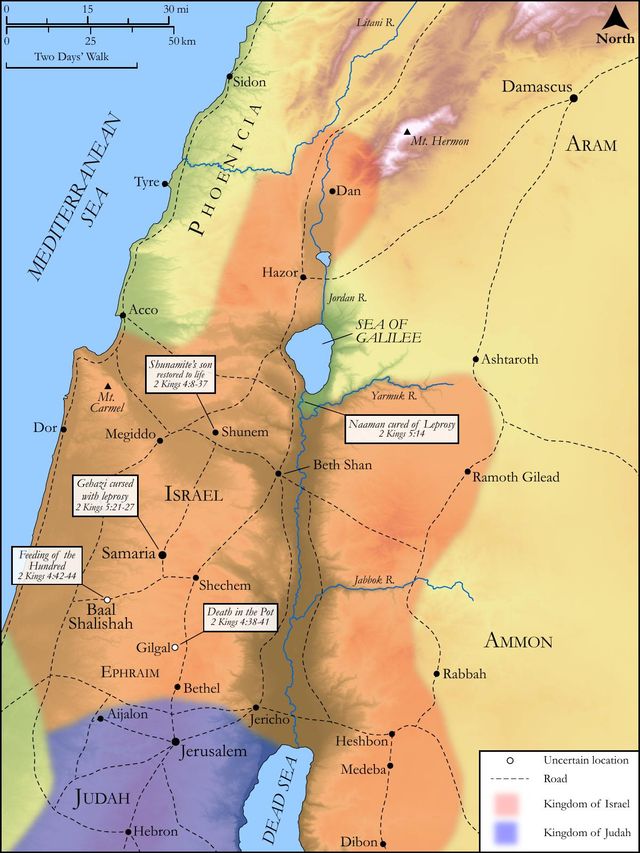
See on the biblical-era map
Study this verse
Public-domain commentary
Matthew Henry
From his Commentary on the Whole Bible. Henry comments on passages, not single verses — this entry covers 2 Kings 5:20–27. His three-level outline is real structure in the source text, so it is rendered as structure.
Naaman, a Syrian, a courtier, a soldier, had many servants, and we read how wise and good they were, Kg2 5:13. Elisha, a holy prophet, a man of God, has but one servant, and he proves a base, lying, naughty fellow. Those that heard of Elisha at a distance honoured him, and got good by what they heard; but he that stood continually before him, to hear his wisdom, had no good impressions made upon him either by his doctrine or miracles. One would have expected that Elisha's servant should be a saint (even Ahab's servant, Obadiah, was), but even Christ himself had a Judas among his followers. The means of grace cannot give grace. The best men, the best ministers have often had those about them that have been their grief and shame. The nearer the church the further from God. Many come from the east and west to sit down with Abraham when the children of the kingdom shall be cast out. Here is,
I.Gehazi's sin. It was a complicated sin.
1.The love of money, that root of all evil, was at the bottom of it. His master contemned Naaman's treasures, but he coveted them, Kg2 5:20. His heart (says bishop Hall) was packed up in Naaman's chests, and he must run after him to fetch it. Multitudes, by coveting worldly wealth, have erred from the faith and pierced themselves with many sorrows.
2.He blamed his master for refusing Naaman's present, condemned him as foolish in not taking gold when he might have it, envied and grudged his kindness and generosity to this stranger, though it was for the good of his soul. In short, he thought himself wiser than his master.
3.When Naaman, like a person of accomplished manners, alighted from his chariot to meet him (Kg2 5:21), he told him a deliberate lie, that his master sent him to him, and so he received that courtesy to himself that Naaman intended to his master.
4.He abused his master, and basely misrepresented him to Naaman as one that had soon repented of his generosity, that was fickle, and did not know his own mind, that would say and unsay, swear and unswear, that would not do an honourable thing but he must presently undo it again. his story of the two sons of the prophets was as silly as it was false; if he would have begged a token for two young scholars, surely less than a talent of silver might serve them.
5.There was danger of his alienating Naaman from that holy religion which he had espoused, and lessening his good opinion of it. he would be ready to say, as Paul's enemies suggested concerning him (Co2 12:16, Co2 12:17), that, though Elisha himself did not burden him, yet being crafty he caught him with guile, sending those that made a gain of him. We hope that he understood afterwards that Elisha's hand was not in it, and that Gehazi was forced to restore what he had unjustly got, else it might have driven him to his idols again.
6.His seeking to conceal what he had unjustly got added much to his sin.
(1.)He hid it, as Achan did his gain, by sacrilege, in the tower, a secret place, a strong place, till he should have an opportunity of laying it out, Kg2 5:24. Now he thought himself sure of it, and applauded his own management of a fraud by which he had imposed, not only upon the prudence of Naaman, but upon Elisha's spirit of discerning, as Ananias and Sapphira upon the apostles.
(2.)He denied it: He went in, and stood before his master, ready to receive his orders. None looked more observant of his master, though really none more injurious to him; he thought, as Ephraim, I have become rich, but they shall find no iniquity in me, Hos 12:8. His master asked him where he had been, "Nowhere, sir" (said he), "out of the house." Note, One lie commonly begets another: the way of that sin is down-hill; therefore dare to be true.
II.The punishment of this sin. Elisha immediately called him to an account for it; and observe,
1.How he was convicted. he thought to impose upon the prophet, but was soon given to understand that the Spirit of prophecy could not be deceived, and that it was in vain to lie to the Holy Ghost. Elisha could tell him,
(1.)What he had done, though he had denied it. "Thou sayest thou wentest nowhere, but went not my heart with thee?" Kg2 5:26. Had Gehazi yet to learn that prophets had spiritual eyes? or could he think to hide any thing from a seer, from him with whom the secret of the Lord was? Note, It is folly to presume upon sin in hopes of secresy. When thou goest aside into any by-path does not thy own conscience go with thee? Does not the eye of God go with thee? He that covers his sin shall not prosper, particularly a lying tongue is but for a moment, Pro 12:19. Truth will transpire, and often comes to light strangely, to the confusion of those that make lies their refuge.
(2.)What he designed, though he kept that in his own breast. He could tell him the very thoughts and intents of his heart, that he was projecting, now that he had got these two talents, to purchase ground and cattle, to leave Elisha's service, and to set up for himself. Note, All the foolish hopes and contrivances of carnal worldlings are open before God. And he tells him also the evil of it: "Is it a time to receive money? Is this an opportunity of enriching thyself? Couldst thou find no better way of getting money than by belying thy master and laying a stumbling-block before a young convert?" Note, Those that are for getting wealth at any time, and by any ways and means whatsoever, right or wrong, lay themselves open to a great deal of temptation. Those that will be rich (per fas, per nefas; rem, rem, quocunque modo rem - by fair means, by foul means; careless of principle, intent only on money) drown themselves in destruction and perdition, Ti1 6:9. War, and fire, and plague, and shipwreck, are not, as many make them, things to get money by. It is not a time to increase our wealth when we cannot do it but in such ways as are dishonourable to God and religion or injurious to our brethren or the public.
2.How he was punished for it: The leprosy of Naaman shall cleave to thee, Kg2 5:27. If he will have his money, he shall take his disease with it, Transit cum onere - It passes with this incumbrance. He was contriving to entail lands upon his posterity; but, instead of them, he entails a loathsome disease on the heirs of his body, from generation to generation. The sentence was immediately executed on himself; no sooner said than done: He went out from his presence a leper as white as snow. Thus he is stigmatized and made infamous, and carries the mark of his shame wherever he goes: thus he loads himself and family with a curse, which shall not only for the present proclaim his villany, but for ever perpetuate the remembrance of it. Note, The getting of treasures by a lying tongue is a vanity tossed to and fro of those that seek death, Pro 21:6. Those who get wealth by fraud and injustice cannot expect either the comfort or the continuance of it. What was Gehazi profited, though he gained his two talents, when thereby he lost his health, his honour, his peace, his service, and, if repentance prevented not, his soul for ever? See Job 20:12, etc.
Historical interpretation
Historical reception
1 surviving comment on this verse from the historical church.
After Gehazi had come back from his meeting with Naaman, he entered Elisha’s house, and [the prophet] asked him, according to custom, why he had moved away from him. “Where do you come from?” he said to Gehazi. He said this on purpose, so that the justice of the judgment passed on his sin might be evident. If Gehazi repented and swore, he would have been forgiven; but if he denied that he had secretly received money, the leprosy of Naaman would cover him conspicuously.
Continue studying 2 Kings 5:27 across the web’s major study libraries — every link below opens this exact verse, chapter, or book on the destination site.
Read & Compare
 BibleGatewayThis verse in more than 200 translations and 70 languages.
 Bible.comThe YouVersion reader — hundreds of translations, reading plans, and highlights.
 ESV.orgCrossway's official English Standard Version reader.
 NET BibleThe NET translation with 60,000+ translators' notes on every rendering decision.
 STEP BibleTyndale House's free study tool — original text, vocabulary, and scholarly resources.
 BibliaLogos Bible Software's free web reader.
 USCCBThe New American Bible (Revised Edition) with the U.S. bishops' study notes.
Commentaries
 BibleHub CommentariesDozens of classic commentaries on this verse, gathered on one page.
 StudyLightMore than 100 commentary sets — the largest collection on the web.
 BibleRefPlain-English commentary on what this verse means, verse by verse.
 Enduring WordDavid Guzik's free commentary on this chapter, widely used by Bible teachers.
 Bible Study ToolsVerse commentary alongside Greek and Hebrew study aids.
Original Language & Research
- BibleHub InterlinearThe verse word by word — original language, transliteration, and English.
- BibleHub LexiconEvery word's original-language definition and Strong's entry.
 Blue Letter BibleDeep-study tools — Strong's numbers, concordance, and word studies.
 SefariaThe Hebrew text with Rashi and centuries of Jewish commentary.
Sermons, Hymns & Audio


TrulyRandomVerse is not affiliated with these sites and doesn’t control their content. They’re linked because they’re genuinely useful.
Summary
The verse 2 Kings 5:27 delivers a swift and severe divine judgment upon Gehazi, the servant of the prophet Elisha, who, driven by covetousness and deceit, pursued and accepted gifts from Naaman, the Syrian commander, after Elisha had explicitly refused them. As a direct and immediate consequence of his profound greed and dishonesty, Gehazi is afflicted with the very leprosy from which Naaman had just been miraculously healed, a condition that is pronounced to cleave to him and his descendants forever, manifesting instantly as he departs Elisha's presence, appearing "as white as snow."
Context
ShowHideLiterary Context
This verse serves as the dramatic and tragic culmination of the narrative concerning Naaman's healing and Gehazi's subsequent fall. It immediately follows Elisha's divinely revealed confrontation with Gehazi, where the prophet exposes his servant's secret sin, asking, "Was it a time to receive money and garments, olive groves and vineyards, sheep and oxen, male and female servants?" (2 Kings 5:26). The preceding narrative meticulously details Naaman's miraculous cleansing from leprosy in the Jordan River, a healing that Elisha insists is a pure, unmerited gift from God, steadfastly refusing any payment or reward (2 Kings 5:1-19). Gehazi's actions directly undermine Elisha's integrity and the purity of God's grace, making his swift and visible punishment a stark contrast to Naaman's restoration and a powerful statement on the severe consequences of misusing spiritual privilege for personal gain. The chapter's opening with Naaman's affliction and its close with Gehazi's creates a powerful narrative arc of reversal and divine justice.
Historical & Cultural Context
Leprosy (Hebrew: tzara'at) in Israel was far more than a physical ailment; it carried profound social, ritual, and theological implications. Individuals afflicted with leprosy were considered ceremonially unclean and were often ostracized from society, compelled to live apart from the community (Leviticus 13:45-46). The visible symptoms, particularly the "white as snow" appearance, were unmistakable and frequently associated with direct divine judgment, as evidenced in the cases of Miriam (Numbers 12:10) and King Uzziah (2 Chronicles 26:19-21). Culturally, it was common practice for prophets and healers to receive gifts for their services, which makes Elisha's resolute refusal of Naaman's generous reward a radical and intentional demonstration of God's unmerited grace and the non-commercial nature of His power. Gehazi's deceitful pursuit of these gifts was, therefore, not merely an act of personal greed but a public affront to the character of God and the integrity of His prophetic representative.
Key Themes
ShowHideThe story of Naaman and Gehazi, culminating in this verse, powerfully illustrates several core themes found throughout the book of 2 Kings. Firstly, it underscores the sovereignty and omniscience of God, demonstrating that no hidden sin escapes His notice, even when concealed from human eyes, reinforcing the truth that God knows the secrets of the heart (compare with Psalm 139:7-12). Secondly, it highlights the severe consequences of greed and deception, particularly when intertwined with spiritual authority or service. Gehazi's covetousness directly undermines the selfless and gracious nature of God's gifts and ministry. Thirdly, the narrative emphasizes the purity and freeness of God's grace; Naaman's healing was unearned, and Gehazi's attempt to commercialize it defiled this sacred principle. Finally, the hereditary nature of the curse ("unto thy seed for ever") serves as a stark warning about the long-reaching impact of profound spiritual transgression, reflecting a principle of corporate responsibility or familial consequence seen elsewhere in the Old Testament (e.g., Exodus 20:5).
Exposition and Analysis
ShowHideKey Word Analysis
ShowHideThis primitive root signifies to impinge, cling, or adhere. In the context of 2 Kings 5:27, it powerfully conveys the permanent and inescapable nature of Gehazi's judgment. The leprosy is not a temporary affliction but becomes an inseparable, intrinsic part of Gehazi and his lineage, much like Naaman's leprosy had "cleaved" to him before his miraculous healing. This term emphasizes being inextricably bound to the curse, highlighting the divine decree's absolute and lasting effect.
Derived from a root meaning "to sow," this term refers to offspring, descendants, or posterity. Its inclusion in the divine pronouncement signifies that the judgment extends beyond Gehazi himself, impacting his future generations. This hereditary curse underscores the extreme gravity of Gehazi's sin—his abuse of spiritual privilege and the sacred trust placed in him as Elisha's servant—and its enduring consequences that transcend a single lifetime.
This noun, derived from the verb "to scourge" or "to be stricken with leprosy," refers specifically to the skin disease of leprosy. In this verse, it is the very affliction from which Naaman was healed, now transferred to Gehazi. The use of this specific term underscores the divine irony and poetic justice: Gehazi, who sought to gain from the healing of Naaman's leprosy, is now cursed with the same disease, making his punishment a direct reversal of the miracle he witnessed.
Verse Breakdown
ShowHide"The leprosy therefore of Naaman shall cleave unto thee"
This clause establishes the direct, immediate, and specific nature of the judgment. The conjunction "therefore" explicitly links the punishment directly to Gehazi's preceding actions of greed and deception. The phrase "the leprosy of Naaman" is crucial, signifying not just any leprosy, but the very disease from which Naaman was miraculously healed, creating a powerful and ironic reversal. It means that Gehazi, who sought to gain from Naaman's healing, would instead inherit his affliction, a profound act of divine retribution.
"and unto thy seed for ever"
This phrase extends the judgment beyond Gehazi's personal lifetime, pronouncing a perpetual, hereditary curse upon his descendants. This highlights the extreme severity of his sin, particularly his covetousness and the commercialization of God's free grace, which had implications not just for him but for his entire lineage. It serves as a stark warning about the long-term, intergenerational consequences of profound spiritual transgression and the abuse of sacred trust.
"And he went out from his presence a leper [as white] as snow"
This final clause describes the immediate and visible fulfillment of Elisha's prophetic word. The transformation is instantaneous and undeniable, confirming the divine origin and certainty of the judgment. The vivid description "as white as snow" graphically portrays the advanced and unmistakable stage of the leprosy, making Gehazi's condition publicly apparent and serving as a stark, visible sign of his disgrace and divine punishment. It marks his dramatic and tragic exit from the narrative, no longer Elisha's trusted servant but a ritually unclean outcast.
Literary Devices
ShowHideThe narrative of 2 Kings 5:27 employs several powerful literary devices to heighten its impact. Irony is profoundly central, as Gehazi, in his pursuit of material gain from Naaman's healing, is instead afflicted with Naaman's very disease. This demonstrates a potent poetic justice, where the "gift" Gehazi coveted transforms into a devastating curse. The phrase "as white as snow" functions as a striking example of paradoxical imagery; while white often symbolizes purity or cleansing in other biblical contexts, here it signifies the advanced, unmistakable, and defiling nature of leprosy, ironically marking Gehazi as utterly unclean. The immediate manifestation of the leprosy upon Gehazi's departure from Elisha's presence serves as a powerful instance of divine retribution, emphasizing God's swift and certain justice. Furthermore, the story masterfully uses contrast, juxtaposing Naaman's humility and spiritual cleansing with Gehazi's greed and subsequent physical and spiritual defilement.
Theological and Thematic Connections
ShowHideThe judgment on Gehazi in 2 Kings 5:27 powerfully underscores God's absolute holiness and His unwavering commitment to justice, particularly concerning the integrity of His prophetic ministry and the purity of His grace. Gehazi's sin was not merely personal greed but a profound desecration of a divine encounter, an audacious attempt to commercialize a miraculous act of God's free mercy. This incident serves as a stark reminder that God is not mocked and that those who operate within spiritual authority are held to a higher standard, with severe consequences for hypocrisy and covetousness. It highlights the principle that true spiritual blessings are not for sale and that attempts to exploit them for personal gain will incur severe divine displeasure, demonstrating God's zealous protection of His own reputation and the sacredness of His work.
Reflection and Application
ShowHideThe tragic story of Gehazi serves as a timeless and sobering warning for all believers, especially those entrusted with positions of spiritual leadership or service within God's kingdom. It compels us to rigorously examine our hearts for any subtle inclinations towards greed, dishonesty, or the misuse of spiritual gifts and opportunities for personal enrichment. Gehazi's dramatic downfall reminds us that God sees not only our outward actions but also the hidden motives and intentions of our hearts, for nothing is concealed from Him (Hebrews 4:13). True ministry is characterized by selfless service, unwavering integrity, and a profound reverence for God's unmerited grace, recognizing that His blessings are not commodities to be bought or sold. We are called to cultivate a spirit of contentment with what God provides, to walk in transparency before Him and others, and to honor the sacredness of His work, trusting that our true reward comes from Him alone. This narrative challenges us to cultivate humility and accountability, recognizing that our actions, even those done in secret, have far-reaching consequences that can impact not only ourselves but also those connected to us and the integrity of the gospel message itself.
Questions for Reflection
ShowHideFAQ
ShowHideWas Gehazi's punishment fair, especially the hereditary aspect "unto thy seed for ever"?
ShowHideThe severity of Gehazi's punishment, including its hereditary nature, reflects the profound gravity of his sin in the eyes of God within the Old Testament covenant context. Gehazi was not merely a common person but the trusted servant of a great prophet, privy to divine power, revelation, and the sacred work of God. His actions represented a profound betrayal of trust, a blatant commercialization of God's free grace, and a public discredit to the prophetic ministry. In the Old Testament, particularly in cases of severe covenant violation or profound spiritual transgression (e.g., Achan's sin in Joshua 7), consequences sometimes extended to the offender's family or lineage. This served to emphasize the corporate nature of identity and responsibility within ancient Israel, where the actions of an individual could impact the entire family unit or community. This served as a powerful deterrent and underscored the seriousness of sin that impacted the community and God's holy reputation. While the New Covenant emphasizes individual responsibility and the cleansing power of Christ's blood for individual sin, this Old Testament account highlights God's unwavering commitment to justice and the profound consequences of misusing spiritual authority and gifts for selfish gain. It underscores that God takes the purity and integrity of His work very seriously.
Christ-Centered Fulfillment
ShowHideThe narrative of Gehazi's judgment, set against the backdrop of Naaman's miraculous healing, finds profound Christ-centered fulfillment. Naaman's cleansing from leprosy, a disease symbolizing the pervasive nature of sin and ritual uncleanness, powerfully foreshadows the ultimate spiritual cleansing and healing offered through Jesus Christ. Just as Naaman was made "clean" and his flesh restored "like the flesh of a little child" (2 Kings 5:14), so too are believers made pure and spiritually renewed by the sacrificial work of the Lamb of God, who takes away the sin of the world. Gehazi's covetousness and the resulting leprosy stand in stark contrast to the selfless, unmerited grace embodied by Christ. While Gehazi sought to gain earthly riches through deception, Jesus, though rich, became poor for our sake, so that we through His poverty might become rich. The "leprosy" of sin that "cleaves" to fallen humanity is removed not by human effort, payment, or deceit, but by the precious blood of Christ, a lamb without blemish or spot, which cleanses us and makes us whiter than snow. Gehazi's immediate, visible judgment serves as a powerful reminder of the consequences of rejecting God's free grace and seeking self-gain, contrasting sharply with the New Testament's emphasis on genuine faith and selfless service, where true and lasting reward comes from God alone (Matthew 6:1-4). Ultimately, Christ's perfect sacrifice ensures that the "leprosy" of sin does not cleave to those who believe, but rather their sins are completely removed, as far as the east is from the west, offering eternal life and purity instead of perpetual curse.