


Exodus 1:10
Bible text: King James Version (1769 Blayney text) · Public domain
Bible text: King James Version with Strong's numbers · Public domain
Bible text: Berean Standard Bible · Public domain
Bible text: American Standard Version (1901) · Public domain
Bible text: World English Bible, Messianic edition · Public domain
Bible text: Geneva Bible (1599) · Public domain
Bible text: Young's Literal Translation · Public domain
- הָבָהHa·vahgive !H3051V-Qal-Imp-2ms ¦ SfxVerb Qal Imperative 2nd Singular Masculineהָבָgiveה!
- נִתְחַכְּמָהnit·cha·ke·Mahlet us deal wiselyH2449V-Hithpael-Imperf-1cpVerb Hithpael Imperfect 1st Plural common gender
- לוֹloto <the> itPrep-l ¦ 3msSuffix Personal 3rd Singular Masculineלto <the>וֹit
- פֶּןpenlestH6435PrtParticle Conditional
- יִרְבֶּהyir·Behit should increaseH7235V-Qal-Imperf-3msVerb Qal Imperfect 3rd Singular Masculine
- וְהָיָהve·ha·Yahand it will beH1961Conj-w ¦ V-Qal-ConsecPerf-3msVerb Qal Consecutive Perfect 3rd Singular Masculineוְandהָיָהit will be
- כִּיkithatH3588PrtParticle Conditional
- תִקְרֶאנָהtik·Re·nahthey will happenH7122V-Qal-Imperf-3fpVerb Qal Imperfect 3rd Plural Feminine
- מִלְחָמָהmil·cha·MahwarH4421N-fsNoun Singular Feminine Absolute
- וְנוֹסַףve·no·Safand it will be addedH3254Conj-w ¦ V-Niphal-ConsecPerf-3msVerb Niphal Consecutive Perfect 3rd Singular Masculineוְandנוֹסַףit will be added
- גַּםgamalsoH1571AdvAdverb
- הוּאhu'itH1931Pro-3msPronoun Personal 3rd Singular Masculine
- עַל'altoH5921PrepPreposition
- שֹׂנְאֵינוּso·ne·'Ei·nu[those who] hate usH8130V-Qal-Prtcpl-mp ¦ 1cpVerb Qal Participle Plural Masculine Constructשֹׂנְאֵי[those who] hateנוּus
- וְנִלְחַםve·nil·chamand it will fightH3898Conj-w ¦ V-Niphal-ConsecPerf-3msVerb Niphal Consecutive Perfect 3rd Singular Masculineוְandנִלְחַםit will fight
- בָּנוּBa·nuagainst <the> usPrep-b ¦ 1cpSuffix Personal 1st Plural common genderבָּagainst <the>נוּus
- וְעָלָהve·'a·Lahand it will go upH5927Conj-w ¦ V-Qal-ConsecPerf-3msVerb Qal Consecutive Perfect 3rd Singular Masculineוְandעָלָהit will go up
- מִןminfromH4480PrepPreposition
- הָאָרֶץha·'A·retzthe landH776Art ¦ N-fsNoun Singular Feminine Absoluteהָtheאָרֶץland
English is a literal word-by-word gloss of the Hebrew, not the KJV's wording. Why?
This is the original text the KJV's translators worked from — each Hebrew word with its own literal English meaning in this verse, prepared by scholars at Tyndale House, Cambridge. The KJV translates whole sentences, not word by word, so its wording differs: one Hebrew word can become several English words, and the KJV may choose “the LORD” where the gloss reads “Yahweh”. Both are faithful — they answer different questions. For the KJV's own rendering, switch to the KJV text.
Details
See on the biblical-era maps

Study this verse
Public-domain commentary
Matthew Henry
From his Commentary on the Whole Bible. Henry comments on passages, not single verses — this entry covers Exodus 1:8–14. His three-level outline is real structure in the source text, so it is rendered as structure.
The land of Egypt here, at length, becomes to Israel a house of bondage, though hitherto it had been a happy shelter and settlement for them. Note, The place of our satisfaction may soon become the place of our affliction, and that may prove the greatest cross to us of which we said, This same shall comfort us. Those may prove our sworn enemies whose parents were our faithful friends; nay, the same persons that loved us may possibly turn to hate us: therefore cease from man, and say not concerning any place on this side heaven, This is my rest for ever. Observe here,
I.The obligations they lay under to Israel upon Joseph's account were forgotten:
There arose a new king, after several successions in Joseph's time, who knew not Joseph, Exo 1:8. All that knew him loved him, and were kind to his relations for his sake; but when he was dead he was soon forgotten, and the remembrance of the good offices he had done was either not retained or not regarded, nor had it any influence upon their councils. Note, the best and the most useful and acceptable services done to men are seldom remembered, so as to be recompensed to those that did them, in the notice taken either of their memory, or of their posterity, after their death, Ecc 9:5, Ecc 9:15. Therefore our great care should be to serve God, and please him, who is not unrighteous, whatever men are, to forget our work and labour of love, Heb 6:10. If we work for men only, our works, at furthest, will die with us; if for God, they will follow us, Rev 14:13. This king of Egypt knew not Joseph; and after him arose one that had the impudence to say, I know not the Lord, Rev 5:2. Note, Those that are unmindful of their other benefactors, it is to be feared, will forget the supreme benefactor, Jo1 4:20.
II.Reasons of state were suggested for their dealing hardly with Israel, Exo 1:9, Exo 1:10.
1.They are represented as more and mightier than the Egyptians; certainly they were not so, but the king of Egypt, when he resolved to oppress them, would have them thought so, and looked on as a formidable body.
2.Hence it is inferred that if care were not taken to keep them under they would become dangerous to the government, and in time of war would side with their enemies and revolt from their allegiance to the crown of Egypt. Note, It has been the policy of persecutors to represent God's Israel as a dangerous people, hurtful to kings and provinces, not fit to be trusted, nay, not fit to be tolerated, that they may have some pretence for the barbarous treatment they design them, Ezr 4:12, etc.; Est 3:8. Observe, The thing they feared was lest they should get them up out of the land, probably having heard them speak of the promise made to their fathers that they should settle in Canaan. Note, The policies of the church's enemies aim to defeat the promises of the church's God, but in vain; God's counsels shall stand.
3.It is therefore proposed that a course be taken to prevent their increase: Come on, let us deal wisely with them, lest they multiply. Note,
(1.)The growth of Israel is the grief of Egypt, and that against which the powers and policies of hell are levelled.
(2.)When men deal wickedly, it is common for them to imagine that they deal wisely; but the folly of sin will, at last, be manifested before all men.
III.The method they took to suppress them, and check their growth, Exo 1:11, Exo 1:13, Exo 1:14.
The Israelites behaved themselves so peaceably and inoffensively that they could not find any occasion of making war upon them, and weakening them by that means: and therefore,
1.They took care to keep them poor, by charging them with heavy taxes, which, some think, is included in the burdens with which they afflicted them.
2.By this means they took an effectual course to make them slaves. The Israelites, it should seem, were much more industrious laborious people than the Egyptians, and therefore Pharaoh took care to find them work, both in building (they built him treasure-cities), and in husbandry, even all manner of service in the field: and this was exacted from them with the utmost rigour and severity. Here are many expressions used, to affect us with the condition of God's people. They had taskmasters set over them, who were directed, not only to burden them, but, as much as might be, to afflict them with their burdens, and contrive how to make them grievous. They not only made them serve, which was sufficient for Pharaoh's profit, but they made them serve with rigour, so that their lives became bitter to them, intending hereby,
(1.)To break their spirits, and rob them of every thing in them that was ingenuous and generous.
(2.)To ruin their health and shorten their days, and so diminish their numbers.
(3.)To discourage them from marrying, since their children would be born to slavery.
(4.)To oblige them to desert the Hebrews, and incorporate themselves with the Egyptians. Thus he hoped to cut off the name of Israel, that it might be no more in remembrance. And it is to be feared that the oppression they were under had this bad effect upon them, that it brought over many of them to join with the Egyptians in their idolatrous worship; for we read (Jos 24:14) that they served other gods in Egypt; and, though it is not mentioned here in this history, yet we find (Eze 20:8) that God had threatened to destroy them for it, even while they were in the land of Egypt: however, they were kept a distinct body, unmingled with the Egyptians, and by their other customs separated from them, which was the Lord's doing, and marvellous.
IV.The wonderful increase of the Israelites, notwithstanding the oppressions they groaned under (Exo 1:12):
The more they afflicted them the more they multiplied, sorely to the grief and vexation of the Egyptians. Note,
1.Times of affliction have often been the church's growing times, Sub pondere crescit - Being pressed, it grows. Christianity spread most when it was persecuted: the blood of the martyrs was the seed of the church.
2.Those that take counsel against the Lord and his Israel do but imagine a vain thing (Psa 2:1), and create so much the greater vexation to themselves: hell and earth cannot diminish those whom Heaven will increase.
Continue studying Exodus 1:10 across the web’s major study libraries — every link below opens this exact verse, chapter, or book on the destination site.
Read & Compare
 BibleGatewayThis verse in more than 200 translations and 70 languages.
 Bible.comThe YouVersion reader — hundreds of translations, reading plans, and highlights.
 ESV.orgCrossway's official English Standard Version reader.
 NET BibleThe NET translation with 60,000+ translators' notes on every rendering decision.
 STEP BibleTyndale House's free study tool — original text, vocabulary, and scholarly resources.
 BibliaLogos Bible Software's free web reader.
 USCCBThe New American Bible (Revised Edition) with the U.S. bishops' study notes.
Commentaries
 BibleHub CommentariesDozens of classic commentaries on this verse, gathered on one page.
 StudyLightMore than 100 commentary sets — the largest collection on the web.
 BibleRefPlain-English commentary on what this verse means, verse by verse.
 Enduring WordDavid Guzik's free commentary on this chapter, widely used by Bible teachers.
 Bible Study ToolsVerse commentary alongside Greek and Hebrew study aids.
Original Language & Research
- BibleHub InterlinearThe verse word by word — original language, transliteration, and English.
- BibleHub LexiconEvery word's original-language definition and Strong's entry.
 Blue Letter BibleDeep-study tools — Strong's numbers, concordance, and word studies.
 SefariaThe Hebrew text with Rashi and centuries of Jewish commentary.
Sermons, Hymns & Audio


TrulyRandomVerse is not affiliated with these sites and doesn’t control their content. They’re linked because they’re genuinely useful.
Summary
Exodus 1:10 records the new Egyptian pharaoh's cunning proposal to deal with the rapidly multiplying Israelite population. Driven by fear that their exponential growth posed a national security threat, he devises a "wise" but malicious plan to suppress them, fearing they might align with Egypt's enemies during wartime, fight against them, and ultimately depart from the land. This pivotal verse marks the beginning of the intense period of state-sanctioned oppression against God's people, setting the stage for their miraculous deliverance by divine intervention.
Context
ShowHideLiterary Context
This verse is situated immediately after the introduction of a "new king over Egypt, who knew not Joseph" (Exodus 1:8). The preceding verses detail the rapid and extensive multiplication of Jacob's descendants, fulfilling the covenant promises made to the patriarchs (e.g., Genesis 15:5, Genesis 46:3). Pharaoh's declaration in verse 10 is the direct governmental response to this demographic shift, initiating the oppressive policies that will define the narrative until the Exodus itself. It sets up the fundamental conflict between human schemes and divine sovereignty, which will be a dominant theme throughout the book of Exodus.
Historical & Cultural Context
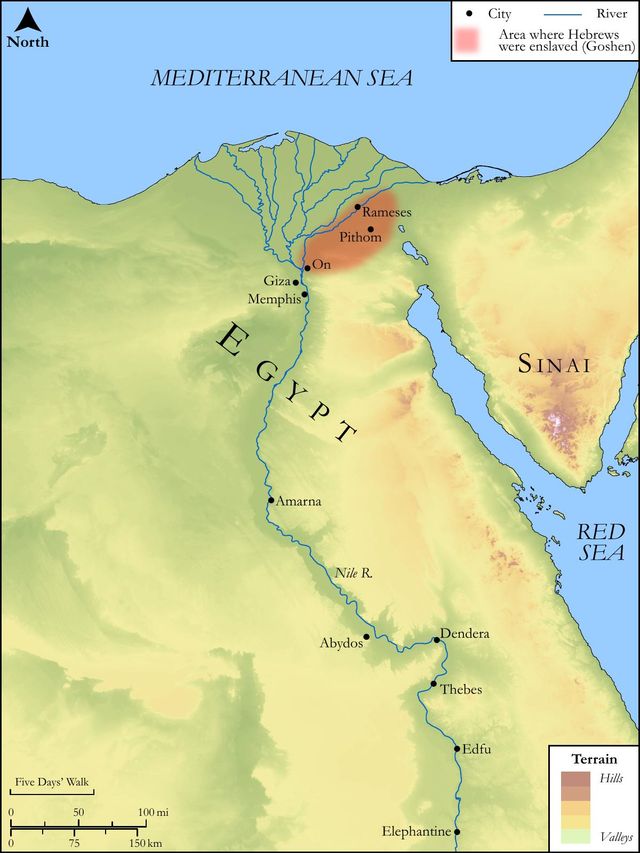
While the precise identity of this "new king" is debated among scholars, the narrative reflects a historical period when foreign dynasties or newly established native rulers might have been wary of large, distinct ethnic groups within their borders. Egypt was often vulnerable to invasions from the north and east, making the presence of a numerous, unassimilated population in the fertile Goshen region (strategically located near the eastern frontier) a legitimate geopolitical concern from Pharaoh's perspective. The Egyptians, known for their xenophobia and strong sense of national identity, would have viewed the Israelites' distinct culture and rapid growth as a potential fifth column, especially in times of war. This fear, coupled with a desire to maintain control over a valuable labor force, fueled Pharaoh's decision to act.
Key Themes
ShowHideExodus 1:10 introduces several critical themes that resonate throughout the biblical narrative. Firstly, it highlights the theme of divine faithfulness amidst human adversity, as God's promise of multiplication continues despite Pharaoh's opposition. Secondly, it powerfully illustrates how human fear and insecurity can lead to injustice and oppression, demonstrating the corrupting influence of power unchecked by moral or divine principles, a theme seen in various forms throughout scripture, such as in 1 Samuel 8. Thirdly, the verse sets up the conflict between human schemes and divine sovereignty, showing that even the most cunning human plans cannot thwart God's ultimate purposes for His people, foreshadowing God's mighty hand in their deliverance, as later celebrated in Psalm 105:23-25.
Exposition and Analysis
ShowHideKey Word Analysis
ShowHideMeaning "to be wise (in mind, word or act); [idiom] exceeding, teach wisdom, be (make self, shew self) wise, deal (never so) wisely, make wiser." In this context, Pharaoh's "wisdom" is not true, godly wisdom but rather a shrewd, cunning, and manipulative intelligence. It is a pragmatic, self-serving wisdom aimed at maintaining power and control, even if it means resorting to injustice and oppression. This contrasts sharply with the wisdom that comes from God, which is pure, peaceable, gentle, and full of mercy (James 3:17).
Meaning "to add or augment (often adverbial, to continue to do a thing); add, [idiom] again, [idiom] any more, [idiom] cease, [idiom] come more, [phrase] conceive again, continue, exceed, [idiom] further, [idiom] gather together, get more, give more-over, [idiom] henceforth, increase (more and more), join, [idiom] longer (bring, do, make, much, put), [idiom] (the, much, yet) more (and more), proceed (further), prolong, put, be (strong-) er, [idiom] yet, yield." Pharaoh's specific fear is that the Israelites would "add themselves" or "join" forces with Egypt's enemies, thereby augmenting the strength of hostile forces against him. This highlights his perception of them as an unloyal, distinct entity within his realm.
Meaning "to ascend, intransitively (be high) or actively (mount); used in a great variety of senses, primary and secondary, literal and figurative; arise (up), (cause to) ascend up, at once, break (the day) (up), bring (up), (cause to) burn, carry up, cast up, [phrase] shew, climb (up), (cause to, make to) come (up), cut off, dawn, depart, exalt, excel, fall, fetch up, get up, (make to) go (away, up); grow (over) increase, lay, leap, levy, lift (self) up, light, (make) up, [idiom] mention, mount up, offer, make to pay, [phrase] perfect, prefer, put (on), raise, recover, restore, (make to) rise (up), scale, set (up), shoot forth (up), (begin to) spring (up), stir up, take away (up), work." This phrase encapsulates Pharaoh's ultimate fear: that the Israelites would not only fight against Egypt but also successfully "ascend" or "depart" from the land, thus escaping his control and depriving Egypt of their labor. This concern ironically foreshadows the very outcome God intends for His people.
Verse Breakdown
ShowHide"Come on, let us deal wisely with them"
This opening phrase, a call to action, reveals Pharaoh's initiative and the calculated nature of his plan. The term "wisely" (as discussed above) is laden with the connotation of cunning and self-serving shrewdness, indicating a strategic, yet morally bankrupt, approach to a perceived threat.
"lest they multiply"
This clause explicitly states the immediate cause of Pharaoh's anxiety—the continued, unchecked growth of the Israelite population. Their demographic success, a sign of God's blessing and faithfulness to His covenant, is seen by Pharaoh as a direct threat to his power and national security.
"and it come to pass, that, when there falleth out any war, they join also unto our enemies, and fight against us"
Here, Pharaoh articulates his primary fear: that in the event of an external conflict, the numerous Israelites, whom he views as a foreign and potentially disloyal element, would form an alliance with Egypt's adversaries and turn against their Egyptian overlords. This highlights his deep-seated distrust and xenophobia.
"and [so] get them up out of the land"
This final clause reveals Pharaoh's ultimate concern. Beyond merely fighting against Egypt, he fears that the Israelites would leverage such a conflict to achieve their freedom and depart from Egypt. This foreshadows the actual Exodus, demonstrating the profound irony of Pharaoh's "wisdom" inadvertently setting the stage for God's redemptive plan.
Literary Devices
ShowHideExodus 1:10 employs several potent literary devices. Irony is prominent, as Pharaoh's "wisdom" (Hebrew: châkam) is ultimately revealed as folly. His cunning plan to suppress the Israelites and prevent their departure inadvertently sets in motion the very events that lead to their miraculous liberation and the downfall of Egypt, demonstrating that human schemes cannot thwart divine purpose. This verse also functions as powerful Foreshadowing, explicitly stating Pharaoh's fear that the Israelites would "get them up out of the land," which is precisely what God intends and eventually accomplishes through the Exodus. The narrative also establishes a clear Contrast between Pharaoh's worldly, self-serving wisdom, driven by fear and leading to oppression, and the true, divine wisdom that guides God's sovereign plan for justice and liberation.
Theological and Thematic Connections
ShowHideExodus 1:10 profoundly illustrates how unchecked human fear, particularly when coupled with a desire for absolute power, can become a destructive force leading to pervasive injustice and oppression. Pharaoh's "wise" plan, rooted in xenophobia and insecurity, is a stark example of worldly wisdom that prioritizes self-preservation and control over righteousness and compassion. Yet, this verse simultaneously serves as a testament to God's unwavering sovereignty and faithfulness to His covenant promises. Despite Pharaoh's cunning and the immense power of the Egyptian empire, God's plan for His people's multiplication and ultimate liberation remains unstoppable. This narrative underscores the futility of human opposition against the divine will, demonstrating that no earthly ruler or scheme can ultimately thwart God's purposes.
Reflection and Application
ShowHideExodus 1:10 offers a timeless and sobering reflection on the dangers of fear-driven leadership and the insidious nature of oppression. Pharaoh's "wisdom" serves as a cautionary tale, reminding us that not all shrewdness is righteous, and that policies born of fear often lead to profound injustice against the defenseless. This passage challenges us to examine our own hearts and societies for similar patterns: where do we, individually or collectively, allow fear of the "other," economic insecurity, or the desire for control to dictate our responses to demographic shifts or perceived threats? True wisdom, unlike Pharaoh's, is characterized by compassion, justice, and an unwavering trust in God's sovereign plan, even when circumstances seem overwhelming. The narrative provides profound hope, demonstrating that even the most meticulously crafted human schemes cannot ultimately thwart God's purposes for His people, offering assurance and resilience in times of adversity.
Questions for Reflection
ShowHideFAQ
ShowHideDoes Pharaoh's "wisdom" imply he was truly wise?
ShowHideNo, not in a morally or divinely approved sense. While the Hebrew word ḥakam (H2449) can denote genuine wisdom, in the context of Exodus 1:10, it carries a strong connotation of shrewdness, craftiness, or cunning, often with malicious intent. Pharaoh's "wisdom" was entirely self-serving, designed to maintain his power and control over the Israelites, leading directly to cruel oppression. This worldly wisdom stands in stark contrast to the true, godly wisdom that promotes justice, righteousness, and compassion, as exemplified in Proverbs 9:10. It was a calculated strategy for political and economic advantage, not a pursuit of truth or the well-being of all people.
Christ-Centered Fulfillment
ShowHideExodus 1:10, with Pharaoh's cunning attempt to suppress God's people through oppressive measures, powerfully foreshadows the spiritual opposition faced by Christ and His Church throughout history. Just as Pharaoh feared the multiplication and departure of Israel, the forces of sin, death, and the devil continually seek to thwart God's redemptive plan and the expansion of His kingdom. Herod's attempt to kill the infant Jesus (Matthew 2:13-18) echoes Pharaoh's decree. Yet, Christ, the ultimate Deliverer, embodies true divine wisdom, which is infinitely superior to any worldly cunning. He did not merely lead a physical exodus but secured a spiritual liberation, freeing His people from the bondage of sin and the fear of death (Hebrews 2:14-15). His triumph on the cross utterly disarmed the spiritual powers that oppose God's people (Colossians 2:15). The ultimate "getting them up out of the land" is not merely a physical departure but the spiritual resurrection and ascension with Christ, granting true freedom to those whom the Son sets free (John 8:36).