


Exodus 1:14
Bible text: King James Version (1769 Blayney text) · Public domain
Bible text: King James Version with Strong's numbers · Public domain
Bible text: Berean Standard Bible · Public domain
Bible text: American Standard Version (1901) · Public domain
Bible text: World English Bible, Messianic edition · Public domain
Bible text: Geneva Bible (1599) · Public domain
Bible text: Young's Literal Translation · Public domain
- וַיְמָרְרוּvay·ma·re·Ruand they made bitterH4843Conj-w ¦ V-Piel-ConsecImperf-3mpVerb Piel Consecutive Imperfect 3rd Plural Masculineוַandיְמָרְרוּthey made bitter
- אֶת'et<obj.>H853DirObjMParticle Object Indicator
- חַיֵּיהֶםchai·yei·Hemtheir livesH2416N-mpc ¦ 3mpNoun Plural Masculine Constructחַיֵּיlivesהֶםtheir
- בַּעֲבֹדָהba·'a·vo·Dahwith laborH5656Prep-b ¦ N-fsNoun Singular Feminine Absoluteבַּwithעֲבֹדָהlabor
- קָשָׁהka·ShahhardH7186Adj-fsAdjective Singular Feminine Absolute
- בְּחֹמֶרbe·Cho·merin mortarH2563Prep-b ¦ N-msNoun Singular Masculine Absoluteבְּinחֹמֶרmortar
- וּבִלְבֵנִיםu·vil·ve·Nimand in bricksH3843Conj-w ¦ Prep-b ¦ N-mpNoun Plural Masculine Absoluteוּandבִinלְבֵנִיםbricks
- וּבְכָלu·ve·Kholand in allH3605Conj-w ¦ Prep-b ¦ N-mscNoun Singular Masculine Constructוּandבְinכָלall
- עֲבֹדָה'a·vo·DahlaborH5656N-fsNoun Singular Feminine Absolute
- בַּשָּׂדֶהba·sa·Dehin the fieldH7704Prep-b ¦ N-msNoun Singular Masculine Absoluteבַּin theשָּׂדֶהfield
- אֵת'et<obj.>H853DirObjMParticle Object Indicator
- כָּלkolallH3605N-mscNoun Singular Masculine Construct
- עֲבֹדָתָם'a·Vo·da·Tamtheir laborH5656N-fsc ¦ 3mpNoun Singular Feminine Constructעֲבֹדָתָlaborםtheir
- אֲשֶׁר'a·SherwhichH834RelParticle Relative
- עָבְדוּ'a·ve·Duthey laboredH5647V-Qal-Perf-3cpVerb Qal Perfect 3rd Plural common gender
- בָהֶםva·Hemby <the> themPrep-b ¦ 3mpSuffix Personal 3rd Plural Masculineבָby <the>הֶםthem
- בְּפָרֶךְbe·Fa·rekhwith harshnessH6531Prep-b ¦ N-msNoun Singular Masculine Absoluteבְּwithפָרֶךְharshness
English is a literal word-by-word gloss of the Hebrew, not the KJV's wording. Why?
This is the original text the KJV's translators worked from — each Hebrew word with its own literal English meaning in this verse, prepared by scholars at Tyndale House, Cambridge. The KJV translates whole sentences, not word by word, so its wording differs: one Hebrew word can become several English words, and the KJV may choose “the LORD” where the gloss reads “Yahweh”. Both are faithful — they answer different questions. For the KJV's own rendering, switch to the KJV text.
Details
See on the biblical-era maps

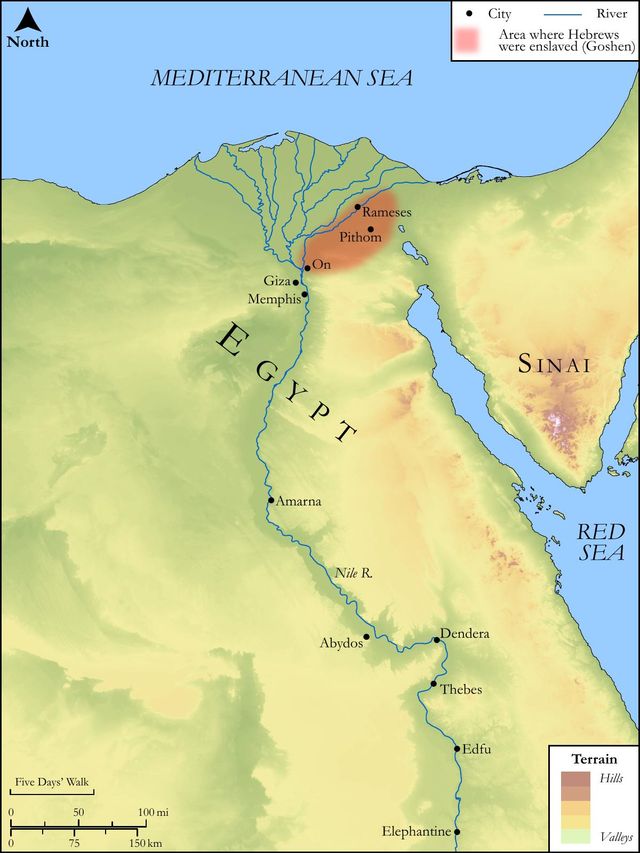
Study this verse
Public-domain commentary
Matthew Henry
From his Commentary on the Whole Bible. Henry comments on passages, not single verses — this entry covers Exodus 1:8–14. His three-level outline is real structure in the source text, so it is rendered as structure.
The land of Egypt here, at length, becomes to Israel a house of bondage, though hitherto it had been a happy shelter and settlement for them. Note, The place of our satisfaction may soon become the place of our affliction, and that may prove the greatest cross to us of which we said, This same shall comfort us. Those may prove our sworn enemies whose parents were our faithful friends; nay, the same persons that loved us may possibly turn to hate us: therefore cease from man, and say not concerning any place on this side heaven, This is my rest for ever. Observe here,
I.The obligations they lay under to Israel upon Joseph's account were forgotten:
There arose a new king, after several successions in Joseph's time, who knew not Joseph, Exo 1:8. All that knew him loved him, and were kind to his relations for his sake; but when he was dead he was soon forgotten, and the remembrance of the good offices he had done was either not retained or not regarded, nor had it any influence upon their councils. Note, the best and the most useful and acceptable services done to men are seldom remembered, so as to be recompensed to those that did them, in the notice taken either of their memory, or of their posterity, after their death, Ecc 9:5, Ecc 9:15. Therefore our great care should be to serve God, and please him, who is not unrighteous, whatever men are, to forget our work and labour of love, Heb 6:10. If we work for men only, our works, at furthest, will die with us; if for God, they will follow us, Rev 14:13. This king of Egypt knew not Joseph; and after him arose one that had the impudence to say, I know not the Lord, Rev 5:2. Note, Those that are unmindful of their other benefactors, it is to be feared, will forget the supreme benefactor, Jo1 4:20.
II.Reasons of state were suggested for their dealing hardly with Israel, Exo 1:9, Exo 1:10.
1.They are represented as more and mightier than the Egyptians; certainly they were not so, but the king of Egypt, when he resolved to oppress them, would have them thought so, and looked on as a formidable body.
2.Hence it is inferred that if care were not taken to keep them under they would become dangerous to the government, and in time of war would side with their enemies and revolt from their allegiance to the crown of Egypt. Note, It has been the policy of persecutors to represent God's Israel as a dangerous people, hurtful to kings and provinces, not fit to be trusted, nay, not fit to be tolerated, that they may have some pretence for the barbarous treatment they design them, Ezr 4:12, etc.; Est 3:8. Observe, The thing they feared was lest they should get them up out of the land, probably having heard them speak of the promise made to their fathers that they should settle in Canaan. Note, The policies of the church's enemies aim to defeat the promises of the church's God, but in vain; God's counsels shall stand.
3.It is therefore proposed that a course be taken to prevent their increase: Come on, let us deal wisely with them, lest they multiply. Note,
(1.)The growth of Israel is the grief of Egypt, and that against which the powers and policies of hell are levelled.
(2.)When men deal wickedly, it is common for them to imagine that they deal wisely; but the folly of sin will, at last, be manifested before all men.
III.The method they took to suppress them, and check their growth, Exo 1:11, Exo 1:13, Exo 1:14.
The Israelites behaved themselves so peaceably and inoffensively that they could not find any occasion of making war upon them, and weakening them by that means: and therefore,
1.They took care to keep them poor, by charging them with heavy taxes, which, some think, is included in the burdens with which they afflicted them.
2.By this means they took an effectual course to make them slaves. The Israelites, it should seem, were much more industrious laborious people than the Egyptians, and therefore Pharaoh took care to find them work, both in building (they built him treasure-cities), and in husbandry, even all manner of service in the field: and this was exacted from them with the utmost rigour and severity. Here are many expressions used, to affect us with the condition of God's people. They had taskmasters set over them, who were directed, not only to burden them, but, as much as might be, to afflict them with their burdens, and contrive how to make them grievous. They not only made them serve, which was sufficient for Pharaoh's profit, but they made them serve with rigour, so that their lives became bitter to them, intending hereby,
(1.)To break their spirits, and rob them of every thing in them that was ingenuous and generous.
(2.)To ruin their health and shorten their days, and so diminish their numbers.
(3.)To discourage them from marrying, since their children would be born to slavery.
(4.)To oblige them to desert the Hebrews, and incorporate themselves with the Egyptians. Thus he hoped to cut off the name of Israel, that it might be no more in remembrance. And it is to be feared that the oppression they were under had this bad effect upon them, that it brought over many of them to join with the Egyptians in their idolatrous worship; for we read (Jos 24:14) that they served other gods in Egypt; and, though it is not mentioned here in this history, yet we find (Eze 20:8) that God had threatened to destroy them for it, even while they were in the land of Egypt: however, they were kept a distinct body, unmingled with the Egyptians, and by their other customs separated from them, which was the Lord's doing, and marvellous.
IV.The wonderful increase of the Israelites, notwithstanding the oppressions they groaned under (Exo 1:12):
The more they afflicted them the more they multiplied, sorely to the grief and vexation of the Egyptians. Note,
1.Times of affliction have often been the church's growing times, Sub pondere crescit - Being pressed, it grows. Christianity spread most when it was persecuted: the blood of the martyrs was the seed of the church.
2.Those that take counsel against the Lord and his Israel do but imagine a vain thing (Psa 2:1), and create so much the greater vexation to themselves: hell and earth cannot diminish those whom Heaven will increase.
Historical interpretation
Two Centuries of Reception
4 surviving comments on this verse. Each one is dated, so this reads as a timeline rather than a list.
Select a marker to jump to its quote. Markers stagger vertically where authors wrote within a few decades of each other.
When the children of Israel were in Egypt, they were afflicted with mortar and brick for the works of Pharaoh the king until they cried out in their groaning to the Lord. And he heard their cry and sent his word to them by Moses and led them out of Egypt. When we were also in Egypt, I mean in the errors of this world and in the darkness of ignorance, we then did the works of the devil in lusts and desires of the flesh. But the Lord had pity on our affliction and sent the Word, his only begotten Son, to deliver us from ignorance of our error and to lead us to the light of divine law.
Perhaps it is in this sense that God is said to have hardened the heart of Pharaoh, because the substance of his heart was obviously such as to elicit from the Sun of justice not his illumination but his power to harden and to scorch. That no doubt was the reason why this same Pharaoh afflicted the life of the Hebrews with hard work and wore them out with clay and bricks. And certainly the works that he devised came from a heart as miry and muddy! And as the visible sun contracts and hardens the substance of clay, so with the same rays by which he enlightened the people of Israel and by means of those rays’ same properties the Sun of justice hardened the heart of Pharaoh that harbored muddy devices.
I have already lived through many paschs, which was the fruit of a long life. But now I desire a purer pasch: to depart from this Egypt, the heavy and dark Egypt of this life, and to be freed from the clay and bricks that held us in bondage and to pass over to the land of promise.
We have been led out of Egypt where we were serving the devil as a pharaoh, where we were doing works of clay amid earthly desires, and we were laboring much in them. For Christ cried out to us, as if we were making bricks, “Come to me, all you who labor and are burdened.” Led out of here, we were led over through baptism as through the Red Sea—red for this reason, because consecrated by the blood of Christ—when all our enemies who were assailing us were dead, that is, when our sins have been wiped out.
Continue studying Exodus 1:14 across the web’s major study libraries — every link below opens this exact verse, chapter, or book on the destination site.
Read & Compare
 BibleGatewayThis verse in more than 200 translations and 70 languages.
 Bible.comThe YouVersion reader — hundreds of translations, reading plans, and highlights.
 ESV.orgCrossway's official English Standard Version reader.
 NET BibleThe NET translation with 60,000+ translators' notes on every rendering decision.
 STEP BibleTyndale House's free study tool — original text, vocabulary, and scholarly resources.
 BibliaLogos Bible Software's free web reader.
 USCCBThe New American Bible (Revised Edition) with the U.S. bishops' study notes.
Commentaries
 BibleHub CommentariesDozens of classic commentaries on this verse, gathered on one page.
 StudyLightMore than 100 commentary sets — the largest collection on the web.
 BibleRefPlain-English commentary on what this verse means, verse by verse.
 Enduring WordDavid Guzik's free commentary on this chapter, widely used by Bible teachers.
 Bible Study ToolsVerse commentary alongside Greek and Hebrew study aids.
Original Language & Research
- BibleHub InterlinearThe verse word by word — original language, transliteration, and English.
- BibleHub LexiconEvery word's original-language definition and Strong's entry.
 Blue Letter BibleDeep-study tools — Strong's numbers, concordance, and word studies.
 SefariaThe Hebrew text with Rashi and centuries of Jewish commentary.
Sermons, Hymns & Audio


TrulyRandomVerse is not affiliated with these sites and doesn’t control their content. They’re linked because they’re genuinely useful.
Summary
Exodus 1:14 vividly portrays the excruciating and systematic oppression endured by the Israelites in Egypt, detailing how their lives were made profoundly miserable through an unyielding regimen of forced labor. Pharaoh's regime subjected them to back-breaking work in mortar, brick, and various agricultural tasks, all enforced with relentless cruelty and without compassion, highlighting a deliberate strategy to break their spirit and diminish their population.
Context
ShowHideLiterary Context
This verse is strategically placed within the opening chapter of Exodus, immediately following the alarming increase in the Israelite population and the rise of a new Pharaoh "who knew not Joseph" (Exodus 1:8). Pharaoh, fearing the growing number and potential power of the Israelites, devises a strategy to suppress them. Initially, this involves forced labor in the building of store cities like Pithom and Raamses. Verse 14 intensifies this depiction, moving beyond the mere fact of their servitude to describe the nature and severity of their oppression, setting the stage for God's intervention in the subsequent chapters as He responds to their cries. This verse marks the nadir of their suffering before the dawn of deliverance.
Historical & Cultural Context
Ancient Egypt was renowned for its monumental construction projects, including pyramids, temples, and cities, which required immense labor. The use of mortar and brick was fundamental to Egyptian architecture, and agricultural work was the backbone of their economy. Pharaohs routinely employed both native Egyptians and foreign captives in these endeavors. However, the unique aspect described in Exodus 1:14 is not merely the labor itself, but its deliberate "rigour" and the intent to make the Israelites' lives "bitter." This points to a calculated policy of state-sponsored ethnic oppression, designed to control a perceived threat. The Nile River's fertile floodplains dictated the agricultural "field service," while the abundant clay provided the raw material for bricks, making the tasks described historically accurate for the region and period.
Key Themes
ShowHideExodus 1:14 powerfully contributes to several overarching themes in Exodus. Firstly, it underscores the theme of Oppression and Suffering, portraying the depth of human cruelty and the dehumanizing effects of slavery. This suffering is the catalyst for God's redemptive plan. Secondly, it highlights God's Sovereignty and Providence, even amidst intense human wickedness; though Pharaoh intends evil, God will use this very suffering to demonstrate His power and faithfulness. Thirdly, it introduces the theme of Divine Deliverance, as the bitter bondage described here creates the urgent need for a rescuer, foreshadowing God's mighty acts of salvation. Finally, it subtly introduces the theme of Covenant Faithfulness, as God's eventual intervention is rooted in His remembrance of His covenant with Abraham, Isaac, and Jacob, even when His people are at their lowest point, as seen later in Exodus 2:24.
Exposition and Analysis
ShowHideKey Word Analysis
ShowHideMeaning "life (or living thing), whether literally or figuratively." In this context, it signifies the totality of their existence – not just physical being, but their well-being, their spirit, their very essence. The Egyptians sought to embitter their entire life experience, making it devoid of joy, hope, or dignity.
A primitive root meaning "to trickle," but used as a denominative from H4751 (mar) to mean "to be (causatively, make) bitter (literally or figuratively)." Here, it denotes a profound, pervasive misery that went beyond physical discomfort to encompass psychological, emotional, and spiritual anguish. It implies a deliberate action to inflict suffering that penetrates to the core of their being.
Meaning "work of any kind; act, bondage, service." This word is used multiple times in the verse, emphasizing the comprehensive nature of their servitude. It refers to the forced labor itself, but also the state of being enslaved, highlighting the systematic and inescapable nature of their oppression.
Meaning "fracture, i.e., severity; cruelty." This term is crucial, indicating that the service was not merely hard but enforced with an unyielding, brutal, and inhumane hand. It speaks to the absolute lack of compassion and the intent to break the Israelites physically and spiritually through harshness and brutality.
Verse Breakdown
ShowHide"And they made their lives bitter with hard bondage"
This opening clause immediately establishes the profound suffering inflicted upon the Israelites. The phrase "made their lives bitter" (from mârar and chay) signifies a deliberate and comprehensive effort by the Egyptians to strip the Israelites of all joy, hope, and dignity, making their very existence a source of deep anguish. The "hard bondage" (qâsheh ʻăbôdâh) refers to the severe, difficult, and oppressive nature of the forced labor itself, which was designed to be physically exhausting and mentally crushing.
"in morter, and in brick, and in all manner of service in the field"
This clause specifies the types of labor imposed upon them, illustrating the comprehensive scope of their servitude. "Morter" (chômer) and "brick" (lᵉbênâh) refer to the arduous and physically demanding work of preparing building materials and constructing structures, likely the store cities mentioned earlier. "All manner of service in the field" (ʻăbôdâh bᵉsâdeh) indicates that their forced labor extended beyond construction to agriculture, encompassing every aspect of the Egyptian economy and leaving no part of their lives untouched by servitude.
"all their service, wherein they made them serve, [was] with rigour"
This concluding statement provides the overarching characterization of their oppression. The repetition of "service" (ʻăbôdâh) emphasizes the totality of their forced labor. The crucial word "rigour" (perek) signifies extreme severity, cruelty, and brutality. It means their work was not simply difficult, but enforced with an unyielding, merciless hand, designed to break them and reduce them to mere instruments of Pharaoh's will, devoid of any human dignity or compassion.
Literary Devices
ShowHideExodus 1:14 employs several powerful literary devices to convey the depth of Israel's suffering. The most prominent is Hyperbole, as the phrase "made their lives bitter" is not merely descriptive of physical hardship but exaggerates the emotional and spiritual toll, implying an all-encompassing misery that permeated every aspect of their existence. The repetition of "service" (Hebrew: ʻăbôdâh) throughout the verse acts as Anaphora and Emphasis, underscoring the relentless and inescapable nature of their forced labor. This repetition highlights that every facet of their daily life was consumed by this oppressive work. Furthermore, the stark contrast between the Israelites' rapid multiplication (v. 7) and their subsequent bitter bondage (v. 14) creates a powerful Juxtaposition, emphasizing the sudden and dramatic shift in their circumstances from prosperity to profound suffering, thereby setting the stage for divine intervention.
Theological and Thematic Connections
ShowHideExodus 1:14 is a pivotal verse, not just for its graphic depiction of suffering, but for its profound theological implications. It establishes the depth of human depravity when power is abused and highlights the systematic nature of oppression, revealing how a state can intentionally dehumanize a people. Yet, this intense suffering is precisely the crucible through which God's redemptive plan begins to unfold. It underscores that God is not distant from the cries of the oppressed; rather, their groaning is what moves Him to act decisively, demonstrating His profound compassion and unwavering commitment to justice. The bitter bondage sets the stage for the greatest act of national deliverance in the Old Testament, showcasing God's power to liberate His people from seemingly insurmountable odds, thereby fulfilling His covenant promises.
Reflection and Application
ShowHideExodus 1:14 serves as a timeless and sobering mirror reflecting the enduring presence of oppression and injustice in the world. It compels us, as believers, to cultivate a profound empathy for those whose lives are "bitter" due to various forms of modern bondage—whether economic exploitation, human trafficking, pervasive discrimination, or political tyranny. This verse challenges us to move beyond mere awareness to active compassion, recognizing that God himself is moved by the cries of the afflicted. It reminds us that even in the darkest, most seemingly hopeless situations, God sees, hears, and is faithful to deliver His people. Therefore, we are called not only to trust in His ultimate justice but also to actively champion dignity, freedom, and compassion for all people, standing against the abuse of power wherever it manifests, and to be instruments of His liberating love in a world still marked by "rigour."
Questions for Reflection
ShowHideFAQ
ShowHideWhat does "made their lives bitter" signify beyond physical hardship?
ShowHideThe phrase "made their lives bitter" (Hebrew: mârar from H4843, applied to chay H2416, "lives") signifies a profound and pervasive misery that extended far beyond mere physical discomfort. It speaks to a deliberate, comprehensive effort by the Egyptians to inflict psychological, emotional, and spiritual anguish upon the Israelites. This bitterness permeated every aspect of their existence, stripping life of joy, hope, and dignity, and was designed to crush their spirit and break their will, reducing them to a state of utter despair and dehumanization.
How does this verse foreshadow God's intervention?
ShowHideThe extreme suffering and "rigour" described in Exodus 1:14 are crucial for foreshadowing God's subsequent intervention. The intensity of their groaning and affliction is precisely what moves God to hear their cries (Exodus 2:23) and remember His covenant (Exodus 2:24). This verse establishes the urgent need for divine deliverance, highlighting that God's powerful acts of salvation are often initiated in response to the deepest human suffering and oppression. It sets the stage for the miraculous Exodus, underscoring His compassion for the afflicted and His unwavering commitment to justice for His people.
Christ-Centered Fulfillment
ShowHideThe bitter bondage of Israel in Exodus 1:14 serves as a profound Old Testament type for humanity's universal enslavement to sin and death. Just as the Israelites were under the "rigour" of Pharaoh's cruel dominion, humanity finds itself under the tyrannical power of sin, which makes our lives profoundly "bitter" with its consequences of guilt, shame, brokenness, and spiritual death. The deliverer, Moses, who emerged from the very oppression, foreshadows Christ, the ultimate Liberator. Jesus Christ entered into the bitter suffering of humanity, not merely observing but fully experiencing the depths of human pain and enduring the ultimate "rigour" on the cross (Isaiah 53:3-5). Through His sacrificial death and resurrection, He broke the power of sin and death (Colossians 2:13-15), setting captives free. He is the one who truly hears the groaning of His people (Romans 8:22-23) and leads them out of spiritual bondage into the glorious freedom of God's children (John 8:36), fulfilling the promise of deliverance foreshadowed in the Exodus.