


Exodus 1:15
Bible text: King James Version (1769 Blayney text) · Public domain
Bible text: Berean Standard Bible · Public domain
Bible text: American Standard Version (1901) · Public domain
Bible text: World English Bible, Messianic edition · Public domain
Bible text: Geneva Bible (1599) · Public domain
Bible text: Young's Literal Translation · Public domain
- וַיֹּאמֶרvai·Yo·merand he saidH559Conj-w ¦ V-Qal-ConsecImperf-3msVerb Qal Consecutive Imperfect 3rd Singular Masculineוַandיֹּאמֶרhe said
- מֶלֶךְMe·lekh[the] king ofH4428N-mscNoun Singular Masculine Construct
- מִצְרַיִםmitz·Ra·yimEgyptH4714N-properNoun Proper Location
- לַמְיַלְּדֹתlam·ya·le·Dotto the midwivesH3205Prep-l ¦ V-Piel-Prtcpl-fpVerb Piel Participle Plural Feminine Absoluteלַto theמְיַלְּדֹתmidwives
- הָעִבְרִיֹּתha·'iv·ri·Yot<the> HebrewH5680Art ¦ N-fpNoun Gentilic Plural Feminine Absoluteהָ<the>עִבְרִיֹּתHebrew
- אֲשֶׁר'a·SherwhoH834RelParticle Relative
- שֵׁםshem[the] name ofH8034N-mscNoun Singular Masculine Construct
- הָאַחַתha·'a·Chatthe oneH259Art ¦ Adj-fsAdjective Numerical Singular Feminine Absoluteהָtheאַחַתone
- שִׁפְרָהshif·Rah[was] ShiphrahH8236N-proper-fNoun Proper Feminine
- וְשֵׁםve·Shemand [the] name ofH8034Conj-w ¦ N-mscNoun Singular Masculine Constructוְandשֵׁם[the] name of
- הַשֵּׁנִיתha·she·Nitthe secondH8145Art ¦ Adj-fsAdjective Numerical Position Singular Feminine Absoluteהַtheשֵּׁנִיתsecond
- פּוּעָהpu·'Ah[was] PuahH6326N-proper-fNoun Proper Feminine
English is a literal word-by-word gloss of the Hebrew, not the KJV's wording. Why?
This is the original text the KJV's translators worked from — each Hebrew word with its own literal English meaning in this verse, prepared by scholars at Tyndale House, Cambridge. The KJV translates whole sentences, not word by word, so its wording differs: one Hebrew word can become several English words, and the KJV may choose “the LORD” where the gloss reads “Yahweh”. Both are faithful — they answer different questions. For the KJV's own rendering, switch to the KJV text.
Details
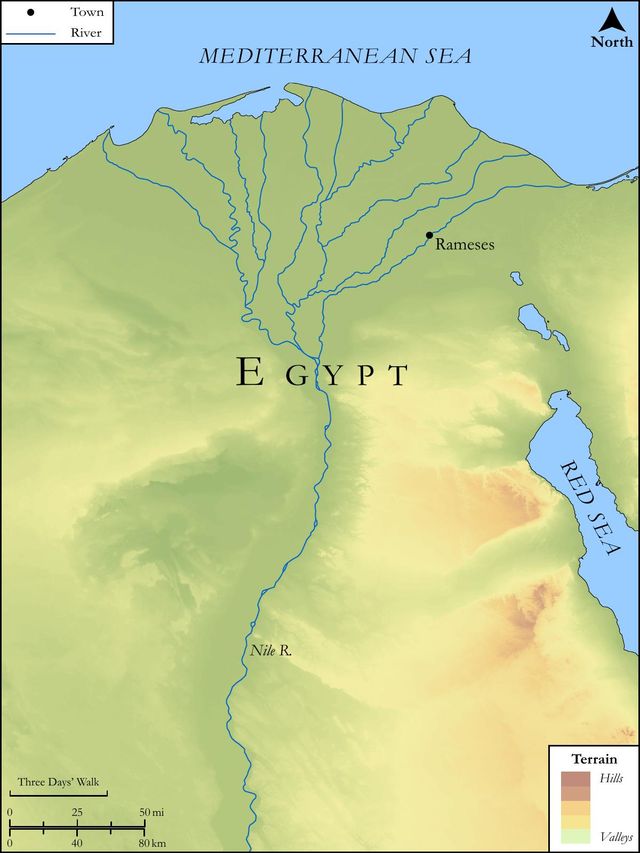
See on the biblical-era maps

Study this verse
Public-domain commentary
Matthew Henry
From his Commentary on the Whole Bible. Henry comments on passages, not single verses — this entry covers Exodus 1:15–22. His two-level outline is real structure in the source text, so it is rendered as structure.
The Egyptians' indignation at Israel's increase, notwithstanding the many hardships they put upon them, drove them at length to the most barbarous and inhuman methods of suppressing them, by the murder of their children. It was strange that they did not rather pick quarrels with the grown men, against whom they might perhaps find some occasion: to be thus bloody towards the infants, whom all must own to be innocents, was a sin which they had to cloak for. Note, 1. There is more cruelty in the corrupt heart of man than one would imagine, Rom 3:15, Rom 3:16. The enmity that is in the seed of the serpent against the seed of the woman divests men of humanity itself, and makes them forget all pity. One would not think it possible that ever men should be so barbarous and blood-thirsty as the persecutors of God's people have been, Rev 17:6. 2. Even confessed innocence is no defence against the old enmity. What blood so guiltless as that of a child new-born? Yet that is prodigally shed like water, and sucked with delight like milk or honey. Pharaoh and Herod sufficiently proved themselves agents for that great red dragon, who stood to devour the man-child as soon as it was born, Rev 12:3, Rev 12:4. Pilate delivered Christ to be crucified, after he had confessed that he found no fault in him. It is well for us that, though man can kill the body, this is all he can do. Two bloody edicts are here signed for the destruction of all the male children that were born to the Hebrews.
I.The midwives were commanded to murder them. Observe,
1.The orders given them, Exo 1:15, Exo 1:16. It added much to the barbarity of the intended executions that the midwives were appointed to be the executioners; for it was to make them, not only bloody, but perfidious, and to oblige them to betray a trust, and to destroy those whom they undertook to save and help. Could he think that their sex would admit such cruelty, and their employment such base treachery? Note, Those who are themselves barbarous think to find, or make, others as barbarous. Pharaoh's project was secretly to engage the midwives to stifle the men-children as soon as they were born, and then to lay it upon the difficulty of the birth, or some mischance common in that case, Job 3:11. The two midwives he tampered with in order hereunto are here named; and perhaps, at this time, which was above eighty years before their going out of Egypt, those two might suffice for all the Hebrew women, at least so many of them as lay near the court, as it is plain by Exo 2:5, Exo 2:6, many of them did, and of them he was most jealous. They are called Hebrew midwives, probably not because they were themselves Hebrews (for surely Pharaoh could never expect they should be so barbarous to those of their own nation), but because they were generally made use of by the Hebrews; and, being Egyptians, he hoped to prevail with them.
2.Their pious disobedience to this impious command, Exo 1:17. They feared God, regarded his law, and dreaded his wrath more than Pharaoh's and therefore saved the men-children alive. Note, If men's commands be any way contrary to the commands of God, we must obey God and not man, Act 4:19; Act 5:29. No power on earth can warrant us, much less oblige us, to sin against God, our chief Lord. Again, Where the fear of God rules in the heart, it will preserve it from the snare which the inordinate fear of man brings.
3.Their justifying themselves in this disobedience, when they were charged with it as a crime, Exo 1:18. They gave a reason for it, which, it seems, God's gracious promise furnished them with - that they came too late to do it, for generally the children were born before they came, Exo 1:19. I see no reason we have to doubt the truth of this; it is plain that the Hebrews were now under an extraordinary blessing of increase, which may well be supposed to have this effect, that the women had very quick and easy labour, and, the mothers and children being both lively, they seldom needed the help of midwives: this these midwives took notice of, and, concluding it to the finger of God, were thereby emboldened to disobey the king, in favour of those whom Heaven thus favoured, and with this justified themselves before Pharaoh, when he called them to an account for it. Some of the ancient Jews expound it thus, Ere the midwife comes to them they pray to their Father in heaven, and he answereth them, and they do bring forth. Note, God is a readier help to his people in distress than any other helpers are, and often anticipates them with the blessings of his goodness; such deliverances lay them under peculiarly strong obligations.
4.The recompence God gave them for their tenderness towards his people: He dealt well with them, Exo 1:20. Note, God will be behind-hand with none for any kindness done to his people, taking it as done to himself. In particular, he made them houses (Exo 1:21), built them up into families, blessed their children, and prospered them in all they did. Note, The services done for God's Israel are often repaid in kind. The midwives kept up the Israelites' houses, and, in recompence for it, God made them houses. Observe, The recompence has relation to the principle upon which they went: Because they feared God, he made them houses. Note, Religion and piety are good friends to outward prosperity: the fear of God in a house will help to build it up and establish it. Dr. Lightfoot's notion of it is, That, for their piety, they were married to Israelites, and Hebrew families were built up by them.
II.When this project did not take effect, Pharaoh gave public orders to all his people to drown all the male children of the Hebrews, Exo 1:22.
We may suppose it was made highly penal for any to know of the birth of a son to an Israelite, and not to give information to those who were appointed to throw him into the river. Note, The enemies of the church have been restless in their endeavours to wear out the saints of the Most High, Dan 7:25. But he that sits in heaven shall laugh at them. See Psa 2:4.
Continue studying Exodus 1:15 across the web’s major study libraries — every link below opens this exact verse, chapter, or book on the destination site.
Read & Compare
 BibleGatewayThis verse in more than 200 translations and 70 languages.
 Bible.comThe YouVersion reader — hundreds of translations, reading plans, and highlights.
 ESV.orgCrossway's official English Standard Version reader.
 NET BibleThe NET translation with 60,000+ translators' notes on every rendering decision.
 STEP BibleTyndale House's free study tool — original text, vocabulary, and scholarly resources.
 BibliaLogos Bible Software's free web reader.
 USCCBThe New American Bible (Revised Edition) with the U.S. bishops' study notes.
Commentaries
 BibleHub CommentariesDozens of classic commentaries on this verse, gathered on one page.
 StudyLightMore than 100 commentary sets — the largest collection on the web.
 BibleRefPlain-English commentary on what this verse means, verse by verse.
 Enduring WordDavid Guzik's free commentary on this chapter, widely used by Bible teachers.
 Bible Study ToolsVerse commentary alongside Greek and Hebrew study aids.
Original Language & Research
- BibleHub InterlinearThe verse word by word — original language, transliteration, and English.
- BibleHub LexiconEvery word's original-language definition and Strong's entry.
 Blue Letter BibleDeep-study tools — Strong's numbers, concordance, and word studies.
 SefariaThe Hebrew text with Rashi and centuries of Jewish commentary.
Sermons, Hymns & Audio


TrulyRandomVerse is not affiliated with these sites and doesn’t control their content. They’re linked because they’re genuinely useful.
Summary
Exodus 1:15 introduces a pivotal moment in the escalating oppression of the Israelites in ancient Egypt, marking a direct and sinister shift in Pharaoh's strategy from forced labor to targeted infanticide. This verse details the Egyptian king's personal command to two specific Hebrew midwives, Shiphrah and Puah, setting the stage for their courageous defiance and God's miraculous intervention to preserve His covenant people.
Context
ShowHideLiterary Context
This verse immediately follows the description of a new Pharaoh who "knew not Joseph" and became increasingly fearful of the burgeoning Israelite population, which was "more and mightier" than the Egyptians (Exodus 1:8-9). Pharaoh's initial response was to enslave the Hebrews and afflict them with harsh labor, building store cities like Pithom and Raamses (Exodus 1:11-14). However, this strategy proved ineffective as the Israelites continued to multiply. Exodus 1:15 thus represents a dark escalation in Pharaoh's genocidal intent, moving from economic oppression to a direct assault on the very existence of the Israelite people, specifically targeting their male offspring. The naming of the midwives sets them up as key figures in the unfolding narrative of divine deliverance.
Historical & Cultural Context
Among the Hebrews, midwives played a crucial role in childbirth, often holding positions of respect and trust within their communities. They possessed intimate knowledge of families and households. Pharaoh's direct address to the midwives, bypassing his male officials, underscores the calculated and desperate nature of his plan. It reveals his understanding that controlling the population required access to the most private and vulnerable moments of life. Infanticide, particularly of male children, was a common strategy in ancient warfare and population control, aimed at preventing the growth of a rival group or eliminating a perceived threat. This historical backdrop highlights the gravity of Pharaoh's decree and the immense courage required for the midwives to defy such a powerful ruler.
Key Themes
ShowHideExodus 1:15 contributes significantly to several overarching themes in the book of Exodus and the broader biblical narrative. Firstly, it powerfully illustrates the theme of Divine Sovereignty amidst Human Oppression. Despite Pharaoh's absolute power and his evil designs, God's plan for His people's growth and deliverance cannot be thwarted. Secondly, it introduces the theme of Faithful Resistance to Unjust Authority. The naming of Shiphrah and Puah foreshadows their subsequent act of defiance, highlighting how individuals, even those in seemingly humble positions, can become instruments of God's will by choosing obedience to Him over obedience to wicked human decrees. This sets the stage for the larger narrative of God's deliverance of Israel from bondage, a story that begins not with a mighty army, but with the quiet courage of two women, as further elaborated in Exodus 1:17-21.
Exposition and Analysis
ShowHideKey Word Analysis
ShowHideThis word (H4428) refers to a monarch or ruler. In this context, it emphasizes the absolute authority and power of Pharaoh, whose word was law in ancient Egypt. His direct engagement with the midwives underscores the gravity and official nature of his genocidal decree, emanating from the highest seat of power.
The verb (H559) signifies "to say" or "to command." Its use here highlights Pharaoh's direct communication and the issuing of a specific, deliberate order. This was not an indirect policy but a personal instruction, making the midwives' subsequent defiance a direct act of rebellion against the highest authority.
Derived from a primitive root (H3205) meaning "to bear young" or "to beget," and causatively, "to act as midwife." This term precisely identifies the women's profession and their intimate role in the birthing process. Pharaoh's targeting of midwives demonstrates his strategic understanding of where to strike to control the Israelite population, recognizing their unique access and influence.
Verse Breakdown
ShowHide"And the king of Egypt spake to the Hebrew midwives"
This opening clause immediately establishes the central conflict and the key players. Pharaoh, the absolute ruler of Egypt, initiates a direct conversation with the Hebrew midwives. This direct address is significant, indicating the personal and calculated nature of his genocidal plan, as he seeks to leverage their intimate role in the community.
"of which the name of the one [was] Shiphrah"
This part of the verse specifically names the first of the two midwives. The act of naming individuals in ancient texts often signifies their importance and foreshadows their significant role in the unfolding narrative. Shiphrah is not an anonymous figure but a named participant, setting her apart for her coming actions.
"and the name of the other Puah"
Similarly, the second midwife is also named. The explicit naming of both Shiphrah and Puah elevates them from mere background characters to courageous individuals who will soon play a pivotal role in subverting Pharaoh's wicked decree. Their individual identities are highlighted, emphasizing their personal responsibility and eventual faithfulness.
Literary Devices
ShowHideExodus 1:15 employs several significant literary devices. Foreshadowing is prominent, as the naming of Shiphrah and Puah and Pharaoh's direct command immediately hint at the crucial role these women will play in the narrative, setting the stage for their courageous defiance in the following verses. This personal address and naming elevate them from anonymous figures to agents of God's plan. There is also a subtle Irony at play: Pharaoh, in his attempt to control and diminish the Israelites, unwittingly sets in motion the very events that will lead to their miraculous deliverance and his own downfall. His desperate measure to prevent Israel's growth ultimately highlights God's power to multiply His people even under duress. Furthermore, the use of Onomastics (the study of names) is significant. While not explicitly explained in the text, the names themselves carry potential meaning. Shiphrah (H8236) might relate to "beauty" or "to be fruitful," ironically contrasting Pharaoh's intent to prevent fruitfulness. Puah (H6326) could be linked to "to groan" or "to cry out," perhaps reflecting the sounds of childbirth or the cries of the oppressed, further deepening the narrative's emotional resonance.
Theological and Thematic Connections
ShowHideExodus 1:15 serves as a profound theological statement on God's unwavering sovereignty and His active involvement in human history, even in the face of the most oppressive regimes. Pharaoh's decree, intended to eradicate the Israelite male population and thus destroy God's covenant people, instead becomes the very catalyst for God's dramatic intervention and the raising up of deliverers. This verse underscores that no human power, however absolute, can ultimately thwart God's redemptive purposes. It also highlights the divine value placed on human life, particularly the vulnerable, and the moral imperative to resist unjust commands that violate God's law. The naming of the midwives emphasizes God's ability to use seemingly ordinary individuals to accomplish extraordinary acts of faithfulness and courage, setting a precedent for obedience to God over human authority.
Reflection and Application
ShowHideExodus 1:15 offers a powerful and enduring lesson for believers today. It reminds us that even in the darkest periods of oppression and fear, God is actively at work, often through unexpected means and seemingly ordinary individuals. The specific naming of Shiphrah and Puah, two women in a vulnerable position, foreshadows their incredible courage and faithfulness in defying a tyrannical ruler. This passage challenges us to consider where our ultimate allegiance lies: with human authority or with divine will. When human laws or commands directly conflict with God's moral standards, this narrative calls us to a courageous, God-fearing resistance. It encourages us to recognize that our faithfulness, however small it may seem, can be a vital part of God's grand redemptive plan. Furthermore, it instills confidence that God will always protect and preserve His people, even when faced with overwhelming odds, ensuring the continuation of His covenant promises and the ultimate triumph of His kingdom.
Questions for Reflection
ShowHideFAQ
ShowHideWhy did Pharaoh speak directly to the Hebrew midwives?
ShowHidePharaoh bypassed his usual male officials and spoke directly to the Hebrew midwives because they held a unique and intimate position, giving them direct access to and influence over the birthing process. This direct address highlights his desperate and calculated attempt to control the Israelite population growth at its most vulnerable point, recognizing their crucial role in his genocidal plan. He understood that to effectively implement his decree of infanticide, he needed the cooperation of those who literally held life in their hands.
What is the significance of the midwives' names, Shiphrah and Puah?
ShowHideThe specific naming of Shiphrah and Puah elevates them from anonymous figures to individuals of importance in the biblical narrative. In ancient texts, naming often signifies character, destiny, or a pivotal role. While the text doesn't explicitly explain their names, Shiphrah (H8236) may relate to "beauty" or "fruitfulness," ironically contrasting Pharaoh's intent to prevent fruitfulness. Puah (H6326) could be linked to "to groan" or "to cry out," perhaps reflecting the sounds of childbirth or the cries of the oppressed. Their individual naming foreshadows their courageous and pivotal role in defying Pharaoh's decree, as detailed in Exodus 1:17-21, demonstrating God's use of specific individuals in His redemptive plan.
Christ-Centered Fulfillment
ShowHideExodus 1:15, with Pharaoh's attempt to eradicate Israelite male children, serves as a profound foreshadowing of the ultimate genocidal attempt against God's people and, specifically, against the Messiah. Just as God preserved the lineage through the faithfulness of the midwives and later Moses, so too did He meticulously preserve the line leading to Christ, culminating in Herod's chillingly similar decree to kill all male children in Bethlehem and its vicinity, in an attempt to eliminate the infant Jesus (Matthew 2:16). This verse underscores God's unwavering commitment to His covenant people and His redemptive plan, ensuring the advent of the true Deliverer. The ultimate triumph over the forces of oppression and death is found in Jesus Christ, the Lamb of God who takes away the sin of the world, who through His own birth, life, death, and resurrection, secured eternal life and deliverance for all who believe, fulfilling the promise of a seed that would crush the serpent's head (Genesis 3:15).