


Numbers 20:15
Bible text: King James Version (1769 Blayney text) · Public domain
Bible text: Berean Standard Bible · Public domain
Bible text: American Standard Version (1901) · Public domain
Bible text: World English Bible, Messianic edition · Public domain
Bible text: Geneva Bible (1599) · Public domain
Bible text: Young's Literal Translation · Public domain
- וַיֵּרְדוּvai·ye·re·Duand they went downH3381Conj-w ¦ V-Qal-ConsecImperf-3mpVerb Qal Consecutive Imperfect 3rd Plural Masculineוַandיֵּרְדוּthey went down
- אֲבֹתֵינוּ'a·vo·Tei·nuour ancestorsH1N-fpc ¦ 1cpNoun Plural Feminine Constructאֲבֹתֵיancestorsנוּour
- מִצְרַיְמָהmitz·Ray·mahEgypt towardsH4714N-proper ¦ SfxNoun Proper LocationמִצְרַיְמָEgyptהtowards
- וַנֵּשֶׁבva·Ne·shevand we dweltH3427Conj-w ¦ V-Qal-ConsecImperf-1cpVerb Qal Consecutive Imperfect 1st Plural common genderוַandנֵּשֶׁבwe dwelt
- בְּמִצְרַיִםbe·mitz·Ra·yimin EgyptH4714Prep-b ¦ N-properNoun Proper LocationבְּinמִצְרַיִםEgypt
- יָמִיםya·MimdaysH3117N-mpNoun Plural Masculine Absolute
- רַבִּיםra·BimmanyH7227Adj-mpAdjective Plural Masculine Absolute
- וַיָּרֵעוּvai·ya·Re·'uand they did harmH7489Conj-w ¦ V-Hiphil-ConsecImperf-3mpVerb Hiphil Consecutive Imperfect 3rd Plural Masculineוַandיָּרֵעוּthey did harm
- לָנוּLa·nuto <the> usPrep-l ¦ 1cpSuffix Personal 1st Plural common genderלָto <the>נוּus
- מִצְרַיִםmitz·Ra·yimEgyptH4713N-properNoun Proper Location
- וְלַאֲבֹתֵינוּve·la·'a·vo·Tei·nuand to our ancestorsH1Conj-w ¦ Prep-l ¦ N-fpc ¦ 1cpNoun Plural Feminine Constructוְandלַtoאֲבֹתֵיancestorsנוּour
English is a literal word-by-word gloss of the Hebrew, not the KJV's wording. Why?
This is the original text the KJV's translators worked from — each Hebrew word with its own literal English meaning in this verse, prepared by scholars at Tyndale House, Cambridge. The KJV translates whole sentences, not word by word, so its wording differs: one Hebrew word can become several English words, and the KJV may choose “the LORD” where the gloss reads “Yahweh”. Both are faithful — they answer different questions. For the KJV's own rendering, switch to the KJV text.
Details
See on the biblical-era maps
Study this verse
Public-domain commentary
Matthew Henry
From his Commentary on the Whole Bible. Henry comments on passages, not single verses — this entry covers Numbers 20:14–21. His two-level outline is real structure in the source text, so it is rendered as structure.
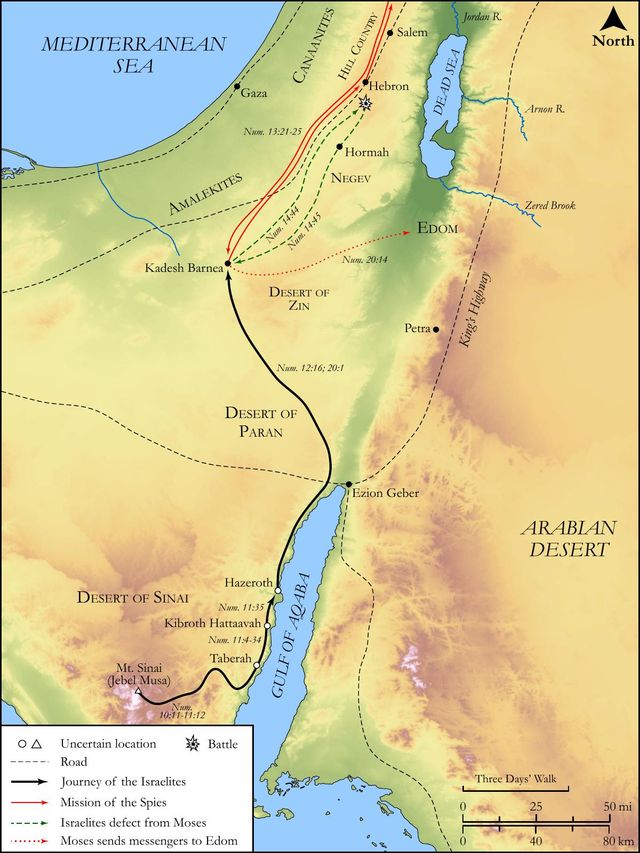
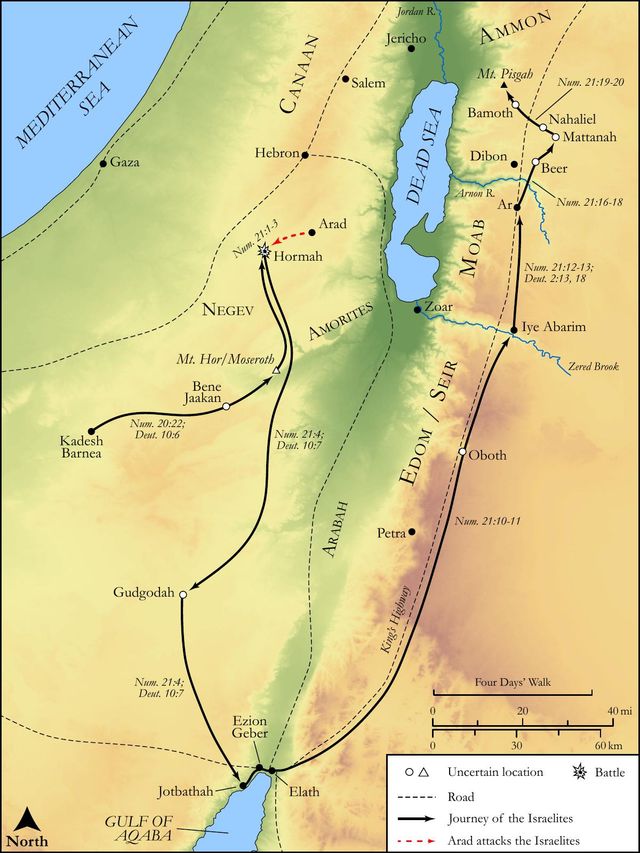
We have here the application made by Israel to the Edomites. The nearest way to Canaan from the place where Israel now lay encamped was through the country of Edom. Now,
I.Moses sends ambassadors to treat with the king of Edom for leave to pass through his country, and gives them instructions what to say, Num 20:14-17.
1.They are to claim kindred with the Edomites: Thus saith thy brother Israel. Both nations descended from Abraham and Isaac, their common ancestors; Esau and Jacob, the two fathers of their respective nations, were twin-brothers; and therefore, for relation-sake, they might reasonably expect this kindness from them; nor needed the Edomites to fear that their brother Israel had any ill design upon them, or would take any advantages against them.
2.They are to give a short account of the history and present state of Israel, which, they take it for granted, the Edomites were no strangers to. And in this there was a double plea: - (1.) Israel had been abused by the Egyptians, and therefore ought to be pitied and succoured by their relations: "The Egyptians vexed us and our fathers, but we may hope our brethren the Edomites will not be so vexatious." (2.) Israel had been wonderfully saved by the Lord, and therefore ought to be countenanced and favoured (Num 20:16): "We cried unto the Lord, and he sent an angel, the angel of his presence, the angel of the covenant, the eternal Word, who had brought us forth out of Egypt, and led us hither." It was therefore the interest of the Edomites to ingratiate themselves with a people that had so great an interest in heaven and were so much its favourites, and it was at their peril if they offered them any injury. It is our wisdom and duty to be kind to those whom God is pleased to own, and to take his people for our people. Come in, thou blessed of the Lord.
3.They are humbly to beg a passport through their country. Though God himself, in the pillar of cloud and fire, was Israel's guide, in following which they might have justified their passing through any man's ground against all the world, yet God would have this respect paid to the Edomites, to show that no man's property ought to be invaded under colour of religion. Dominion is founded in providence, not in grace. Thus when Christ was to pass through a village of the Samaritans, to whom his coming was likely to be offensive, he sent messengers before his face to ask leave, Luk 9:52. Those that would receive kindness must not disdain to request it.
4.They are to give security for the good behaviour of the Israelites in this march, that they would keep in the king's high road, that they would commit no trespass upon any man's property, either in ground or water, that they would not so much as make use of a well without paying for it, and that they would make all convenient speed, as fast as they could well go on their feet, Num 20:17, Num 20:19. Nothing could be offered more fair and neighbourly.
II.The ambassadors returned with a denial, Num 20:18.
Edom, that is, the king of Edom, as protector of his country, said, Thou shalt not pass by me; and, when the ambassadors urged it further, he repeated the denial (Num 20:20) and threatened, if they offered to enter his country, it should be at their peril; he raised his trained bands to oppose them. Thus Edom refused to give Israel passage. This was owing,
1.To their jealousy of the Israelites; they feared they should receive promises. And truly, had this numerous army been under any other discipline and command than that of the righteous God himself, who would no more suffer them to do wrong than to take wrong, there might have been cause for this jealousy; but what could they fear from a nation that had statutes and judgments so righteous?
2.It was owing to the old enmity which Esau bore to Israel. If they had no reason to fear damage by them, yet they were not willing to show so much kindness to them. Esau hated Jacob because of the blessing, and now the hatred revived, when the blessing was ready to be inherited. God would hereby discover the ill-nature of the Edomites to their shame, and try the good-nature of the Israelites to their honour: they turned away from him, and did not take this occasion to quarrel with him. Note, We must not think it strange if the most reasonable requests be denied by unreasonable men, and if those be affronted by men whom God favours. I as a deaf man heard not. After this indignity which the Edomites offered to Israel God gave them a particular caution not to abhor an Edomite (Deu 23:7), though the Edomites had shown such an abhorrence of them, to teach us in such cases not to meditate revenge.
Continue studying Numbers 20:15 across the web’s major study libraries — every link below opens this exact verse, chapter, or book on the destination site.
Read & Compare
 BibleGatewayThis verse in more than 200 translations and 70 languages.
 Bible.comThe YouVersion reader — hundreds of translations, reading plans, and highlights.
 ESV.orgCrossway's official English Standard Version reader.
 NET BibleThe NET translation with 60,000+ translators' notes on every rendering decision.
 STEP BibleTyndale House's free study tool — original text, vocabulary, and scholarly resources.
 BibliaLogos Bible Software's free web reader.
 USCCBThe New American Bible (Revised Edition) with the U.S. bishops' study notes.
Commentaries
 BibleHub CommentariesDozens of classic commentaries on this verse, gathered on one page.
 StudyLightMore than 100 commentary sets — the largest collection on the web.
 BibleRefPlain-English commentary on what this verse means, verse by verse.
 Enduring WordDavid Guzik's free commentary on this chapter, widely used by Bible teachers.
 Bible Study ToolsVerse commentary alongside Greek and Hebrew study aids.
Original Language & Research
- BibleHub InterlinearThe verse word by word — original language, transliteration, and English.
- BibleHub LexiconEvery word's original-language definition and Strong's entry.
 Blue Letter BibleDeep-study tools — Strong's numbers, concordance, and word studies.
 SefariaThe Hebrew text with Rashi and centuries of Jewish commentary.
Sermons, Hymns & Audio


TrulyRandomVerse is not affiliated with these sites and doesn’t control their content. They’re linked because they’re genuinely useful.
Summary
Numbers 20:15 encapsulates a pivotal moment in Israel's wilderness journey, forming part of Moses' diplomatic appeal to the King of Edom. It succinctly recounts the nation's foundational history: the descent of their ancestors into Egypt, their protracted stay, and the severe oppression inflicted upon them by the Egyptians. This historical summary serves as both a reminder of their shared past with Edom (through Isaac) and a poignant plea for empathy, underscoring Israel's current status as a people seeking peaceful passage to their promised inheritance, shaped by generations of hardship and divine deliverance.
Context
ShowHideLiterary Context
The verse is found in Numbers 20, a chapter detailing significant events at the end of Israel's 40-year wilderness wanderings. Immediately preceding this, Miriam dies and is buried at Kadesh (Numbers 20:1). Following this, the people complain about lack of water, leading to Moses' sin at Meribah where he strikes the rock instead of speaking to it, resulting in God's judgment that he and Aaron will not enter the Promised Land (Numbers 20:2-13). Numbers 20:14-21 describes Moses' diplomatic request to Edom for passage through their territory, a request that is ultimately denied. This specific verse (20:15) is part of Moses' historical preamble, establishing the legitimacy and plight of the Israelite nation to the Edomite king. It sets the stage for the request by reminding Edom of Israel's long and difficult journey, appealing to a shared ancestral history.
Historical & Cultural Context
Historically, the Israelites are at the threshold of the Promised Land, having completed nearly forty years of wilderness wandering. Their journey requires traversing territories of various established nations. Edom, located southeast of the Dead Sea, was a nation descended from Esau, Jacob's brother (Genesis 36:1). This familial connection, though distant, formed the basis for Moses' diplomatic approach rather than a military confrontation. Culturally, recounting national history, particularly periods of suffering and divine intervention, was a common practice in Israel to establish identity, justify actions, or appeal for aid, as Jephthah later recounted Israel's way from Egypt to Kadesh when he sent to the king of Ammon. The "going down into Egypt" refers to Jacob's family entering Egypt during a famine (Genesis 46), and their "long time" there refers to the centuries of their stay, culminating in severe enslavement under the Pharaohs (Exodus 1:8-14). Moses' appeal leverages this shared historical memory and the hardship endured to elicit empathy and secure peaceful passage.
Key Themes
ShowHideThis verse contributes to several overarching themes in Numbers and the Pentateuch. First, it underscores the theme of Remembrance and Identity, highlighting how Israel's national identity was profoundly shaped by their collective experience of suffering and deliverance from Egypt. This memory was not merely historical but foundational to their covenant relationship with Yahweh, who had heard their cry and acted on their behalf (Exodus 2:23-25). Second, it speaks to the theme of Divine Providence and Guidance, even if not explicitly stated in this verse, the entire journey from Egypt to the borders of Canaan is a testament to God's leading. The recounting of past hardship serves to magnify the miraculous nature of their current existence as a free people. Third, it introduces the theme of Fraternal Relations and Diplomacy, as Moses attempts to navigate relations with a "brother" nation through peaceful means, appealing to shared heritage and the common human experience of hardship, rather than immediate conquest. This highlights the complexities of inter-national relations even among those with shared ancestry.
Exposition and Analysis
ShowHideKey Word Analysis
ShowHideThis primitive Hebrew word (H1) means "father" in a literal or figurative sense, often referring to ancestors or patriarchs. By invoking "our fathers," Moses connects the present generation directly to the covenant promises made to Abraham, Isaac, and Jacob, and to the collective national experience. It highlights continuity and shared heritage, not just with the Edomites (through Isaac), but within Israel itself, reinforcing their identity as the descendants of those who went down to Egypt.
This primitive root (H3427) properly means "to sit down," and by implication, "to dwell, to remain." In this context, it conveys the idea of a prolonged and settled residence. The phrase "a long time" (using H7227 rab for "long" and H3117 yôwm for "time") further amplifies this, indicating not a temporary sojourn but centuries of habitation. This extended period allowed the Israelites to grow into a numerous people, but also solidified their vulnerability to the eventual oppression, making their subsequent deliverance all the more significant.
This primitive root (H7489) properly means "to spoil (by breaking to pieces)," and figuratively, "to make (or be) good for nothing, i.e., bad (physically, socially or morally); to afflict, do harm, hurt, or oppress." This is a strong verb indicating malicious and severe mistreatment. It goes beyond mere inconvenience to describe a deliberate and sustained campaign of hardship and suffering imposed by the Egyptians. This term captures the essence of the brutal forced labor and persecution described in the opening chapters of Exodus, underscoring the depth of Israel's past suffering and the divine intervention required for their liberation.
Verse Breakdown
ShowHide"How our fathers went down into Egypt,"
This opening clause immediately establishes the historical trajectory of the Israelite nation, recalling the initial voluntary descent of Jacob's family into Egypt during a famine. It sets the stage for their long sojourn, emphasizing the ancestral origin of their presence in that land and implicitly reminding Edom of their shared patriarchal lineage through Isaac, Jacob's father.
"and we have dwelt in Egypt a long time;"
This clause highlights the extended duration of Israel's stay in Egypt, spanning several centuries. The phrase "a long time" underscores the profound impact this period had on their national formation, transforming them from a family into a numerous people, yet also rendering them vulnerable to the subsequent oppression. It emphasizes the deep roots they established before their eventual exodus.
"and the Egyptians vexed us, and our fathers:"
This final clause describes the severe and prolonged oppression inflicted by the Egyptians. The term "vexed" conveys the harshness of their enslavement, encompassing forced labor, cruelty, and attempts at genocide. The repetition of "us, and our fathers" powerfully connects the current generation to the suffering of their ancestors, reinforcing a collective memory of hardship that defines their national experience and justifies their present plea for peaceful passage.
Literary Devices
ShowHideThis verse employs several potent literary devices to achieve its persuasive effect. The primary device is Historical Recounting, where Moses succinctly summarizes centuries of national history in a few clauses. This serves not merely as information but as a foundational narrative establishing Israel's identity and justifying their current situation. The use of Repetition in "our fathers... and our fathers" (though the KJV renders it slightly differently, the Hebrew structure emphasizes this connection) links the past suffering directly to the present generation, fostering a sense of continuous national experience and shared trauma. This also contributes to an appeal to Pathos (empathy), as Moses seeks to evoke sympathy from the Edomite king by highlighting the profound and prolonged suffering of his people. The conciseness of the summary, packing such a vast history into a single verse, demonstrates Brevity and Impact, ensuring the core message of their plight is conveyed efficiently and memorably. The entire statement functions as a diplomatic Plea, strategically framing Israel's journey not as a threat, but as the continuation of a long, arduous, and divinely guided pilgrimage from oppression to promise.
Theological and Thematic Connections
ShowHideNumbers 20:15, while a diplomatic statement, carries profound theological weight. It implicitly points to God's covenant faithfulness despite Israel's suffering. The history recounted—descent, dwelling, and vexation—is the very narrative that necessitated God's miraculous intervention in the Exodus. This verse reminds us that God does not abandon His people in their affliction; rather, suffering often becomes the crucible in which His deliverance is most powerfully revealed. It highlights the formation of a national identity forged in hardship, where the memory of oppression serves as a constant reminder of God's redemptive power and the distinctiveness of His chosen people. The plea for empathy also subtly reflects the divine command for Israel to remember their own past as strangers and oppressed, fostering compassion for others.
Reflection and Application
ShowHideNumbers 20:15 invites us to reflect on the shaping power of our own personal and collective histories, particularly those seasons marked by hardship and adversity. Just as Israel's identity was forged in the crucible of Egyptian oppression and the subsequent divine deliverance, our own experiences of trial and struggle often become the very means through which God reveals His faithfulness and refines our character. Remembering "where we came from"—our past challenges, our moments of dependence, and God's interventions—can cultivate profound humility, gratitude, and a deeper reliance on His ongoing guidance. This historical perspective not only strengthens our faith but also informs our interactions with others. When we recall our own vulnerabilities and the grace we have received, it can foster a wellspring of empathy, enabling us to extend compassion and understanding to those who are suffering or seeking help, just as Moses sought empathy from Edom. Our past, therefore, is not merely a record of events, but a living testimony to God's work in our lives, shaping our present identity and informing our future journey.
Questions for Reflection
ShowHideFAQ
ShowHideWhy did Moses recount Israel's history to Edom?
ShowHideMoses recounted Israel's history to the King of Edom primarily as a diplomatic strategy to justify their request for peaceful passage through Edomite territory. By reminding Edom of their shared ancestral connection (both descended from Isaac, Edom from Esau, Israel from Jacob) and highlighting Israel's long history of suffering and divine deliverance from Egypt, Moses aimed to evoke empathy and establish a basis for cooperation. It was an appeal to a common heritage and the understanding that Israel was not an invading force but a people on a divinely appointed journey to their promised land, having already endured immense hardship under the Egyptians (Exodus 1:8-14). This historical narrative served to frame Israel's current plea within a context of legitimate need and a desire for peaceful relations.
What was the significance of Israel's "long time" in Egypt?
ShowHideThe "long time" Israel spent in Egypt, estimated to be around 430 years (Exodus 12:40), was profoundly significant for several reasons. First, it allowed Jacob's small family to multiply into a numerous nation, fulfilling God's promise to Abraham (Genesis 15:5). Second, it was a period of severe testing and oppression, which served to humble the people and deepen their cry for a deliverer, preparing them to receive God's covenant at Sinai. Third, the miraculous deliverance from such a powerful empire forged their national identity as a people redeemed by Yahweh, setting them apart from other nations. This prolonged sojourn and subsequent Exodus became the foundational event for their understanding of God's character and their own unique calling (Deuteronomy 6:20-25).
Christ-Centered Fulfillment
ShowHideNumbers 20:15, while detailing Israel's historical suffering and God's past deliverance, finds its ultimate Christ-centered fulfillment in the person and work of Jesus Christ. The "vexation" and "long time" of bondage in Egypt foreshadow the universal human condition of spiritual slavery to sin and death (Romans 6:20). Just as God heard the cry of His people in Egypt and sent Moses as a deliverer, so too did He hear the groans of a fallen humanity and send His Son, Jesus, as the ultimate and final Deliverer. Jesus embodies a new and greater Exodus, not from physical bondage in a land, but from the spiritual dominion of darkness (Colossians 1:13-14). He is the true Lamb whose sacrifice provides the blood that covers sin, leading His people out of spiritual Egypt into the promised land of eternal life with God (John 1:29 and Hebrews 9:11-14). Furthermore, Jesus identifies with the suffering of His people, having himself endured rejection and affliction (Isaiah 53:3), thereby becoming the compassionate High Priest who understands our weaknesses (Hebrews 4:15). Thus, the historical narrative of Israel's suffering and deliverance in Numbers 20:15 ultimately points to the profound spiritual liberation offered to all who trust in Christ, the one who perfectly fulfills God's redemptive plan.