


Genesis 46:6
- וַיִּקְחוּvai·yik·Chuand they tookH3947Conj-w ¦ V-Qal-ConsecImperf-3mpVerb Qal Consecutive Imperfect 3rd Plural Masculineוַandיִּקְחוּthey took
- אֶת'et<obj.>H853DirObjMParticle Object Indicator
- מִקְנֵיהֶםmik·nei·Hemtheir livestockH4735N-msc ¦ 3mpNoun Singular Masculine Constructמִקְנֵיlivestockהֶםtheir
- וְאֶתve·'Etand <obj.>H853Conj-w ¦ DirObjMParticle Object Indicatorוְandאֶת<obj.>
- רְכוּשָׁםre·khu·Shamtheir possession[s]H7399N-msc ¦ 3mpNoun Singular Masculine Constructרְכוּשָׁpossession[s]םtheir
- אֲשֶׁר'a·SherwhichH834RelParticle Relative
- רָכְשׁוּra·khe·Shuthey had accumulatedH7408V-Qal-Perf-3cpVerb Qal Perfect 3rd Plural common gender
- בְּאֶרֶץbe·'E·retzin [the] land ofH776Prep-b ¦ N-fscNoun Singular Feminine Constructבְּinאֶרֶץ[the] land of
- כְּנַעַןke·Na·'anCanaanH3667N-properNoun Proper Location
- וַיָּבֹאוּvai·ya·Vo·'uand they cameH935Conj-w ¦ V-Qal-ConsecImperf-3mpVerb Qal Consecutive Imperfect 3rd Plural Masculineוַandיָּבֹאוּthey came
- מִצְרָיְמָהmitz·Ra·ye·mahEgypt towardsH4714N-proper ¦ SfxNoun Proper LocationמִצְרָיְמָEgyptהtowards
- יַעֲקֹבya·'a·KoJacobH3290N-proper-mNoun Proper Masculine
- וְכָלve·kholand allH3605Conj-w ¦ N-mscNoun Singular Masculine Constructוְandכָלall
- זַרְעוֹzar·'Ohis offspringH2233N-msc ¦ 3msNoun Singular Masculine Constructזַרְעoffspringוֹhis
- אִתּוֹ'i·Towith himH854Prep ¦ 3msPreposition Definiteאִתּwithוֹhim
English is a literal word-by-word gloss of the Hebrew, not the KJV's wording. Why?
This is the original text the KJV's translators worked from — each Hebrew word with its own literal English meaning in this verse, prepared by scholars at Tyndale House, Cambridge. The KJV translates whole sentences, not word by word, so its wording differs: one Hebrew word can become several English words, and the KJV may choose “the LORD” where the gloss reads “Yahweh”. Both are faithful — they answer different questions. For the KJV's own rendering, switch to the KJV text.
Details
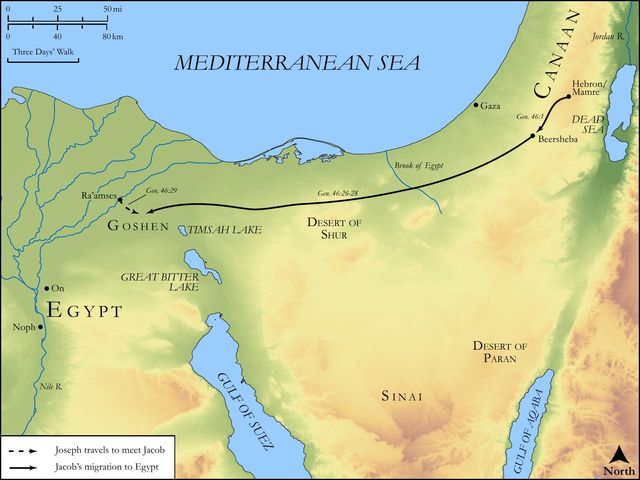
See on the biblical-era maps


Study this verse
Public-domain commentary
Matthew Henry
From his Commentary on the Whole Bible. Henry comments on passages, not single verses — this entry covers Genesis 46:5–27.
Old Jacob is here flitting. Little did he think of ever leaving Canaan; he expected, no doubt, to die in his nest, and to leave his seed in actual possession of the promised land: but Providence orders it otherwise. Note, Those that think themselves well settled may yet be unsettled in a little time. Even old people, who think of no other removal than that to the grave (which Jacob had much upon his heart, Gen 37:35; Gen 42:38), sometimes live to see great changes in their family. It is good to be ready, not only for the grave, but for whatever may happen betwixt us and the grave. Observe, 1. How Jacob was conveyed; not in a chariot, though chariots were then used, but in a wagon, Gen 46:5. Jacob had the character of a plain man, who did not affect any thing stately or magnificent; his son rode in a chariot (Gen 41:43), but a wagon would serve him. 2. The removal of what he had with him. (1.) His effects (Gen 46:6), cattle and goods; these he took with him that he might not wholly be beholden to Pharaoh for a livelihood, and that it might not afterwards be said of them, "that they came beggars to Egypt." (2.) His family, all his seed, Gen 46:7. It is probable that they had continued to live together in common with their father; and therefore when he went they all went, which perhaps they were the more willing to do, because, though they had heard that the land of Canaan was promised them, yet, to this day, they had none of it in possession. We have here a particular account of the names of Jacob's family, his sons' sons, most of whom are afterwards mentioned as heads of houses in the several tribes. See Num 26:5, etc. Bishop Patrick observes that Issachar called his eldest son Tola, which signifies a worm, probably because when he was born he was a very little weak child, a worm, and no man, not likely to live; and yet there sprang from him a very numerous offspring, Ch1 7:2. Note, Living and dying do not go by probability. The whole number that went down into Egypt was sixty-six (Gen 46:26), to which add Joseph and his two sons, who were there before, and Jacob himself, the head of the family, and you have the number of seventy, Gen 46:27. The Septuagint makes them seventy-five, and Stephen follows them (Act 7:14), the reason of which we leave to the conjecture of the critics; but let us observe, [1.] Masters of families ought to take care of all under their charge, and to provide for those of their own house food convenient both for body and soul. When Jacob himself removed to a land of plenty, he would not leave any of his children behind him to starve in a barren land. [2.] Though the accomplishment of promises is always sure, yet it is often slow. It was now 215 years since God had promised Abraham to make of him a great nation (Gen 12:2); and yet that branch of his seed on which the promise was entailed had increased only to seventy, of which this particular account is kept, that the power of God in multiplying these seventy to so vast a multitude, even in Egypt, may appear the more illustrious. When God pleases, a little one shall become a thousand, Isa 60:22.
Continue studying Genesis 46:6 across the web’s major study libraries — every link below opens this exact verse, chapter, or book on the destination site.
Read & Compare
 BibleGatewayThis verse in more than 200 translations and 70 languages.
 Bible.comThe YouVersion reader — hundreds of translations, reading plans, and highlights.
 ESV.orgCrossway's official English Standard Version reader.
 NET BibleThe NET translation with 60,000+ translators' notes on every rendering decision.
 STEP BibleTyndale House's free study tool — original text, vocabulary, and scholarly resources.
 BibliaLogos Bible Software's free web reader.
 USCCBThe New American Bible (Revised Edition) with the U.S. bishops' study notes.
Commentaries
 BibleHub CommentariesDozens of classic commentaries on this verse, gathered on one page.
 StudyLightMore than 100 commentary sets — the largest collection on the web.
 BibleRefPlain-English commentary on what this verse means, verse by verse.
 Enduring WordDavid Guzik's free commentary on this chapter, widely used by Bible teachers.
 Bible Study ToolsVerse commentary alongside Greek and Hebrew study aids.
Original Language & Research
- BibleHub InterlinearThe verse word by word — original language, transliteration, and English.
- BibleHub LexiconEvery word's original-language definition and Strong's entry.
 Blue Letter BibleDeep-study tools — Strong's numbers, concordance, and word studies.
 SefariaThe Hebrew text with Rashi and centuries of Jewish commentary.
Sermons, Hymns & Audio


TrulyRandomVerse is not affiliated with these sites and doesn’t control their content. They’re linked because they’re genuinely useful.
Summary
Genesis 46:6 marks a pivotal moment in biblical history, chronicling the departure of Jacob's entire household from the land of Canaan and their entry into Egypt. This verse details the comprehensive nature of their migration, emphasizing the inclusion of their valuable livestock and accumulated possessions, alongside Jacob and all his descendants. It signifies the physical commencement of a divinely orchestrated journey, essential for the preservation and future proliferation of God's chosen people in the face of a severe regional famine.
Context
ShowHideLiterary Context
Genesis 46:6 immediately follows God's reaffirmation of His covenant promises to Jacob at Beersheba (Genesis 46:1-4), assuring him of His presence during the journey to Egypt and the promise of a great nation to emerge from him there. This divine assurance dispelled Jacob's initial apprehension about leaving the Promised Land. The preceding chapters detail Joseph's rise to power in Egypt and his emotional reunion with his brothers, culminating in his invitation for his family to settle in Goshen (Genesis 45:16-20). Thus, verse 6 serves as the narrative hinge, transitioning from the family's decision and divine sanction to the physical act of migration, setting the stage for the next phase of Israel's formation.
Historical & Cultural Context
The ancient Near East was frequently susceptible to severe and widespread famines, as evidenced by the seven years of famine foretold by Joseph (Genesis 41:29-30). For nomadic or semi-nomadic peoples like Jacob's family, livestock represented their primary wealth and means of survival. Moving such a large household, complete with herds and accumulated goods, was a monumental undertaking, requiring significant planning and resources, which Joseph had provided through wagons and provisions (Genesis 45:21). Egypt, with its fertile Nile Delta region (Goshen), was renowned as a granary, making it a logical refuge during times of famine, especially under the stable administration of a vizier like Joseph.
Key Themes
ShowHideThis verse powerfully contributes to several overarching themes in Genesis and the broader biblical narrative. It underscores God's sovereign providence in orchestrating events, even adversity like famine, to fulfill His redemptive purposes, specifically the preservation of His covenant people. The migration highlights the theme of divine guidance and faithfulness, as God leads Jacob's family to a place of safety and growth, fulfilling His promises to the patriarchs concerning their numerous descendants. Furthermore, it marks a critical step in the formation of a nation from a family, foreshadowing the later exodus and the establishment of Israel as God's chosen people, a narrative arc that begins with their entry into Egypt.
Exposition and Analysis
ShowHideGenesis 46:6 succinctly describes the comprehensive nature of Jacob's family's relocation: "And they took their cattle, and their goods, which they had gotten in the land of Canaan, and came into Egypt, Jacob, and all his seed with him." The verse emphasizes the totality of their commitment to this new phase, highlighting not just the patriarch but the entirety of his lineage, signifying the foundational nature of this migration for the formation of the nation of Israel.
Key Word Analysis
ShowHideA primitive root meaning "to take (in the widest variety of applications)." In this context, it signifies the active collection and removal of their possessions, indicating a deliberate and comprehensive relocation rather than a temporary visit. It implies a full commitment to the journey, uprooting their established life.
From קָנָה, meaning "something bought, i.e. property, but only livestock; abstractly, acquisition." This term specifically refers to their herds and flocks, which were their primary form of wealth and sustenance in an agrarian-pastoral society. The inclusion of "cattle" underscores the economic and practical necessities driving their move, as well as the significant material assets they were transporting.
Or רְכֻשׁ, from passive participle of רָכַשׁ, meaning "property (as gathered)." This term encompasses all other accumulated possessions beyond livestock, such as household items, tools, and other valuables. Together with "cattle," it forms a comprehensive description of all their worldly belongings, emphasizing the complete transfer of their earthly estate from Canaan to Egypt.
From זָרַע, meaning "seed; figuratively, fruit, plant, sowing-time, posterity." In this verse, "seed" refers to Jacob's entire posterity and descendants, encompassing not just his immediate children but the future generations that would spring from him. This term carries profound theological weight, underscoring the foundational nature of this migration for the formation of the nation of Israel and the continuation of the covenant line.
Verse Breakdown
ShowHide"And they took their cattle, and their goods, which they had gotten in the land of Canaan"
This clause describes the material aspect of the migration. "They" refers to Jacob's family, acting collectively under his patriarchal leadership. The phrase "cattle, and their goods" indicates the entirety of their movable wealth, signifying a complete uprooting from their established life in Canaan. The inclusion of "which they had gotten" emphasizes that these were not just inherited possessions but wealth accumulated through their own labor and God's blessing in the land promised to their forefathers.
"and came into Egypt"
This concise phrase states the destination and the primary action of the verse. It marks the physical entry into a foreign land, a significant geographical and cultural shift that would profoundly impact the family's future. This journey was not merely a relocation but a divinely guided step towards the fulfillment of God's larger redemptive plan.
"Jacob, and all his seed with him"
This final clause highlights the human element and the profound theological significance of the migration. "Jacob" represents the patriarch, the head of the covenant family. "And all his seed with him" emphasizes the comprehensive nature of the move, including every descendant, signifying the preservation of the entire lineage. This phrase underscores that the move was not just for Jacob's personal safety but for the survival and future growth of the nascent nation of Israel, the "seed" through whom God's promises would be realized.
Literary Devices
ShowHideThe verse employs Merism by listing "cattle" and "goods" to comprehensively represent all of Jacob's possessions, indicating the totality of what they brought with them. This literary technique emphasizes the complete transfer of their earthly estate. Furthermore, the phrase "Jacob, and all his seed with him" uses Synecdoche, where "Jacob" stands for the entire patriarchal family unit, signifying that the patriarch's journey was intrinsically linked to the destiny of his entire lineage. The very act of migration, driven by famine and divinely sanctioned, serves as Foreshadowing of the future sojourn in Egypt, the eventual oppression, and the miraculous exodus, laying the groundwork for Israel's national identity and unique relationship with God.
Theological and Thematic Connections
ShowHideThis migration is a profound demonstration of God's unwavering faithfulness to His covenant promises, particularly those made to Abraham, Isaac, and Jacob. Despite the challenging circumstances of a severe famine, God orchestrates events—from Joseph's rise to power to the provision of a safe haven in Egypt—to ensure the preservation and growth of the covenant family. This move, though seemingly a retreat from the Promised Land, was a strategic repositioning by divine design, allowing the family to multiply into a great nation, as promised, before their eventual return. It underscores that God's plans are often realized through unexpected paths and even through adversity.
Reflection and Application
ShowHideGenesis 46:6 offers profound lessons for contemporary believers, reminding us that God's sovereign hand is active in all circumstances, even those that seem disruptive or challenging. Just as Jacob's family was called to leave the familiar and trust God's leading into an unknown land, we too are often called to step out in faith, trusting that God is orchestrating our lives for His greater purposes. This verse encourages us to embrace seasons of transition and uncertainty with confidence, knowing that God is faithful to His promises and will provide for us, even when it requires significant changes or sacrifices. It calls us to bring our entire lives—our possessions, our families, our future—into submission to His divine will, believing that He is working all things together for our good and His glory.
Questions for Reflection
ShowHideFAQ
ShowHideWhy was Egypt chosen as the place for Jacob's family to grow into a nation?
ShowHideEgypt, specifically the fertile region of Goshen, was divinely chosen for several strategic reasons. Under Joseph's wise administration, it offered a secure and abundant environment where Jacob's family could be protected from the devastating famine in Canaan. This temporary dwelling provided a unique opportunity for the relatively small family to multiply rapidly without immediate assimilation or conflict with the Canaanite peoples, thus preserving their distinct identity. Furthermore, this sojourn in Egypt fulfilled God's earlier prophecy to Abraham concerning his descendants' sojourn and affliction before their triumphant return to the Promised Land (Genesis 15:13-16), serving as a necessary crucible for their development into a numerous and distinct nation under God's tutelage, preparing them for the reception of the Law and the inheritance of Canaan.
Christ-Centered Fulfillment
ShowHideThe preservation of Jacob's "seed" through this pivotal migration to Egypt is profoundly Christ-centered, forming an indispensable link in God's unfolding redemptive narrative. This event ensures the unbroken continuation of the covenant line, the very lineage through which the Messiah, Jesus Christ, would ultimately enter human history. God's meticulous care for Jacob's family, protecting them from famine and allowing them to multiply in Egypt, underscores His unwavering commitment to His grand redemptive plan, a plan that culminates in the incarnation, atoning death, and glorious resurrection of Christ. The temporary dwelling in Egypt, followed by a miraculous deliverance under Moses, also powerfully foreshadows Christ's ultimate deliverance of His people from the bondage of sin and death, bringing them into the promised eternal inheritance and the true "rest" found in Him (Hebrews 4:9-10). Just as Jacob's family was led to a place of refuge and growth, so Christ leads His church, His spiritual "seed," through the wilderness of this world to the promised land of eternal life, demonstrating His sovereign care and unwavering faithfulness to His covenant people (Matthew 2:15).