


Joshua 24:4
Bible text: King James Version (1769 Blayney text) · Public domain
Bible text: King James Version with Strong's numbers · Public domain
Bible text: Berean Standard Bible · Public domain
Bible text: American Standard Version (1901) · Public domain
Bible text: World English Bible, Messianic edition · Public domain
Bible text: Geneva Bible (1599) · Public domain
Bible text: Young's Literal Translation · Public domain
- וָאֶתֵּןva·'e·Tenand I gaveH5414Conj-w ¦ V-Qal-ConsecImperf-1csVerb Qal Consecutive Imperfect 1st Singular common genderוָandאֶתֵּןI gave
- לְיִצְחָקle·yitz·Chakto IsaacH3327Prep-l ¦ N-proper-mNoun Proper MasculineלְtoיִצְחָקIsaac
- אֶת'et<obj.>H853DirObjMParticle Object Indicator
- יַעֲקֹבya·'a·KoJacobH3290N-proper-mNoun Proper Masculine
- וְאֶתve·'Etand <obj.>H853Conj-w ¦ DirObjMParticle Object Indicatorוְandאֶת<obj.>
- עֵשָׂו'e·SavEsauH6215N-proper-mNoun Proper Masculine
- וָאֶתֵּןva·'e·Tenand I gaveH5414Conj-w ¦ V-Qal-ConsecImperf-1csVerb Qal Consecutive Imperfect 1st Singular common genderוָandאֶתֵּןI gave
- לְעֵשָׂוle·'e·Savto EsauH6215Prep-l ¦ N-proper-mNoun Proper MasculineלְtoעֵשָׂוEsau
- אֶת'et<obj.>H853DirObjMParticle Object Indicator
- הַרhar[the] mountain ofH2022N-mscNoun Singular Masculine Construct
- שֵׂעִירse·'IrSeirH8165N-properNoun Proper Location
- לָרֶשֶׁתla·Re·shetto take possession ofH3423Prep-l ¦ V-Qal-InfVerb Qal Infinitive Constructלָtoרֶשֶׁתtake possession of
- אוֹתוֹ'o·To<obj.> itH853DirObjM ¦ 3msParticle Object Indicatorאוֹת<obj.>וֹit
- וְיַעֲקֹבve·ya·'a·Koand JacobH3290Conj-w ¦ N-proper-mNoun Proper MasculineוְandיַעֲקֹבJacob
- וּבָנָיוu·va·Navand his sonsH1121Conj-w ¦ N-mpc ¦ 3msNoun Plural Masculine Constructוּandבָנָיsonsוhis
- יָרְדוּya·re·Duthey went downH3381V-Qal-Perf-3cpVerb Qal Perfect 3rd Plural common gender
- מִצְרָיִםmitz·Ra·yimEgyptH4714N-properNoun Proper Location
English is a literal word-by-word gloss of the Hebrew, not the KJV's wording. Why?
This is the original text the KJV's translators worked from — each Hebrew word with its own literal English meaning in this verse, prepared by scholars at Tyndale House, Cambridge. The KJV translates whole sentences, not word by word, so its wording differs: one Hebrew word can become several English words, and the KJV may choose “the LORD” where the gloss reads “Yahweh”. Both are faithful — they answer different questions. For the KJV's own rendering, switch to the KJV text.
Details
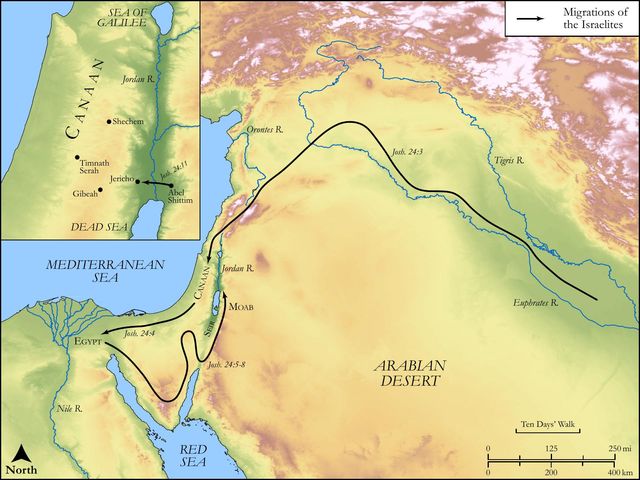
See on the biblical-era map
Study this verse
Public-domain commentary
Matthew Henry
From his Commentary on the Whole Bible. Henry comments on passages, not single verses — this entry covers Joshua 24:1–14. His three-level outline is real structure in the source text, so it is rendered as structure.
Joshua thought he had taken his last farewell of Israel in the solemn charge he gave them in the foregoing chapter, when he said, I go the way of all the earth; but God graciously continuing his life longer than expected, and renewing his strength, he was desirous to improve it for the good of Israel. He did not say, "I have taken my leave of them once, and let that serve;" but, having yet a longer space given him, he summons them together again, that he might try what more he could do to engage them for God. Note, We must never think our work for God done till our life is done; and, if he lengthen out our days beyond what we thought, we must conclude it is because he has some further service for us to do.
The assembly is the same with that in the foregoing chapter, the elders, heads, judges, and officers of Israel, Jos 24:1. But it is here made somewhat more solemn than it was there.
I.The place appointed for their meeting is Shechem, not only because that lay nearer to Joshua than Shiloh, and therefore more convenient now that he was infirm and unfit for travelling, but because it was the place where Abraham, the first trustee of God's covenant with this people, settled at his coming to Canaan, and where God appeared to him (Gen 12:6, Gen 12:7), and near which stood mounts Gerizim and Ebal, where the people had renewed their covenant with God at their first coming into Canaan, Jos 8:30. Of the promises God had made to their fathers, and of the promises they themselves had made to God, this place might serve to put them in mind.
II.They presented themselves not only before Joshua, but before God, in this assembly, that is, they came together in a solemn religious manner, as into the special presence of God, and with an eye to his speaking to them by Joshua; and it is probable the service began with prayer. It is the conjecture of interpreters that upon this great occasion Joshua ordered the ark of God to be brought by the priests to Shechem, which, they say, was about ten miles from Shiloh, and to be set down in the place of their meeting, which is therefore called (Jos 24:26) the sanctuary of the Lord, the presence of the ark making it so at that time; and this was done to grace the solemnity, and to strike an awe upon the people that attended. We have not now any such sensible tokens of the divine presence, but are to believe that where two or three are gathered together in Christ's name he is as really in the midst of them as God was where the ark was, and they are indeed presenting themselves before him.
III.Joshua spoke to them in God's name, and as from him, in the language of a prophet (Jos 24:2):
"Thus saith the Lord, Jehovah, the great God, and the God of Israel, your God in covenant, whom therefore you are bound to hear and give heed to." Note, The word of God is to be received by us as his, whoever is the messenger that brings it, whose greatness cannot add to it, nor his meanness diminish from it. His sermon consists of doctrine and application.
1.The doctrinal part is a history of the great things God had done for his people, and for their fathers before them. God by Joshua recounts the marvels of old: "I did so and so." They must know and consider, not only that such and such things were done, but that God did them. It is a series of wonders that is here recorded, and perhaps many more were mentioned by Joshua, which for brevity's sake are here omitted. See what God had wrought.
(1.)He brought Abraham out of Ur of the Chaldees, Jos 24:2, Jos 24:3. He and his ancestors had served other gods there, for it was the country in which, though celebrated for learning, idolatry, as some think, had its rise; there the world by wisdom knew not God. Abraham, who afterwards was the friend of God and the great favourite of heaven, was bred up in idolatry, and lived long in it, till God by his grace snatched him as a brand out of that burning. Let them remember that rock out of which they were hewn, and not relapse into that sin from which their fathers by a miracle of free grace were delivered. "I took him," says God, "else he had never come out of that sinful state." Hence Abraham's justification is made by the apostle an instance of God's justifying the ungodly, Rom 4:5.
(2.)He brought him to Canaan, and built up his family, led him through the land to Shechem, where they now were, multiplied his seed by Ishmael, who begat twelve princes, but at last gave him Isaac the promised son, and in him multiplied his seed. When Isaac had two sons, Jacob and Esau, God provided an inheritance for Esau elsewhere in Mount Seir, that the land of Canaan might be reserved entire for the seed of Jacob, and the posterity of Esau might not pretend to a share in it.
(3.)He delivered the seed of Jacob out of Egypt with a high hand (Jos 24:5, Jos 24:6), and rescued them out of the hands of Pharaoh and his host at the Red Sea, Jos 24:6, Jos 24:7. The same waters were the Israelites' guard and the Egyptians' grave, and this in answer to prayer; for, though we find in the story that they in that distress murmured against God (Exo 14:11, Exo 14:12), notice is here taken of their crying to God; he graciously accepted those that prayed to him, and overlooked the folly of those that quarrelled with him.
(4.)He protected them in the wilderness, where they are here said, not to wander, but to dwell for a long season, Jos 24:7. So wisely were all their motions directed, and so safely were they kept, that even there they had as certain a dwelling-place as if they had been in a walled city.
(5.)He gave them the land of the Amorites, on the other side Jordan (Jos 24:8), and there defeated the plot of Balak and Balaam against them, so that Balaam could not curse them as he desired, and therefore Balak durst not fight them as he designed, and as, because he designed it, he is here said to have done it. The turning of Balaam's tongue to bless Israel, when he intended to curse them, is often mentioned as an instance of the divine power put forth in Israel's favour as remarkable as any, because in it God proved (and does still, more than we are aware of) his dominion over the powers of darkness, and over the spirits of men.
(6.)He brought them safely and triumphantly into Canaan, delivered the Canaanites into their hand (Jos 24:11), sent hornets before them, when they were actually engaged in battle with the enemy, which with their stings tormented them and with their noise terrified them, so that they became a very easy prey to Israel. These dreadful swarms first appeared in their war with Sihon and Og, the two kings of the Amorites, and afterwards in their other battles, Jos 24:12. God had promised to do this for them, Exo 23:27, Exo 23:28. And here Joshua takes notice of the fulfilling of that promise. See Exo 23:27, Exo 23:28; Deu 7:20. These hornets, it should seem, annoyed the enemy more than the artillery of Israel, and therefore he adds, not with thy sword nor bow. It was purely the Lord's doing. Lastly, They were now in the peaceable possession of a good land, and lived comfortably upon the fruit of other people's labours, Jos 24:13.
2.The application of this history of God's mercies to them is by way of exhortation to fear and serve God, in gratitude for his favour, and that it might be continued to them, Jos 24:14. Now therefore, in consideration of all this, (1.) "Fear the Lord, the Lord and his goodness, Hos 3:5. Reverence a God of such infinite power, fear to offend him and to forfeit his goodness, keep up an awe of his majesty, a deference to his authority, a dread of his displeasure, and a continual regard to his all-seeing eye upon you." (2.) "Let your practice be consonant to this principle, and serve him both by the outward acts of religious worship and every instance of obedience in your whole conversation, and this in sincerity and truth, with a single eye and an upright heart, and inward impressions answerable to outward expressions." This is the truth in the inward part, which God requires, Psa 51:6. For what good will it do us to dissemble with a God that searches the heart? (3.) Put away the strange gods, both Chaldean and Egyptian idols, for those they were most in danger of revolting to. It should seem by this charge, which is repeated (Jos 24:23), that there were some among them that privately kept in their closets the images or pictures of these dunghill-deities, which came to their hands from their ancestors, as heir-looms of their families, though, it may be, they did not worship them; these Joshua earnestly urges them to throw away: "Deface them, destroy them, lest you be tempted to serve them." Jacob pressed his household to do this, and at this very place; for, when they gave him up the little images they had, he buried them under the oak which was by Shechem, Gen 35:2, Gen 35:4. Perhaps the oak mentioned here (Jos 24:26) was the same oak, or another in the same place, which might be well called the oak of reformation, as there were idolatrous oaks.
Continue studying Joshua 24:4 across the web’s major study libraries — every link below opens this exact verse, chapter, or book on the destination site.
Read & Compare
 BibleGatewayThis verse in more than 200 translations and 70 languages.
 Bible.comThe YouVersion reader — hundreds of translations, reading plans, and highlights.
 ESV.orgCrossway's official English Standard Version reader.
 NET BibleThe NET translation with 60,000+ translators' notes on every rendering decision.
 STEP BibleTyndale House's free study tool — original text, vocabulary, and scholarly resources.
 BibliaLogos Bible Software's free web reader.
 USCCBThe New American Bible (Revised Edition) with the U.S. bishops' study notes.
Commentaries
 BibleHub CommentariesDozens of classic commentaries on this verse, gathered on one page.
 StudyLightMore than 100 commentary sets — the largest collection on the web.
 BibleRefPlain-English commentary on what this verse means, verse by verse.
 Enduring WordDavid Guzik's free commentary on this chapter, widely used by Bible teachers.
 Bible Study ToolsVerse commentary alongside Greek and Hebrew study aids.
Original Language & Research
- BibleHub InterlinearThe verse word by word — original language, transliteration, and English.
- BibleHub LexiconEvery word's original-language definition and Strong's entry.
 Blue Letter BibleDeep-study tools — Strong's numbers, concordance, and word studies.
 SefariaThe Hebrew text with Rashi and centuries of Jewish commentary.
Sermons, Hymns & Audio


TrulyRandomVerse is not affiliated with these sites and doesn’t control their content. They’re linked because they’re genuinely useful.
Summary
Joshua 24:4, embedded within Joshua's pivotal farewell address at Shechem, succinctly captures God's unwavering sovereign and providential guidance over the foundational patriarchal lineage. It articulates the divine bestowal of distinct destinies upon Isaac's twin sons, Jacob and Esau: Esau's inheritance of Mount Seir, and Jacob's crucial descent into Egypt with his family, a divinely orchestrated journey essential for the burgeoning formation of the nation of Israel. This verse powerfully underscores God's active involvement in shaping history, demonstrating His meticulous faithfulness to His covenant promises as He orchestrates events to fulfill His grand redemptive plan.
Context
ShowHideLiterary Context
Joshua 24:4 is strategically positioned within Joshua's final, climactic covenant renewal address to the assembled tribes of Israel at Shechem, as meticulously recorded in Joshua 24. This profound discourse functions as a comprehensive historical review, recounting God's steadfast faithfulness from the initial call of Abraham (Joshua 24:2) through the miraculous Exodus, the challenging wilderness wanderings, and the triumphant conquest of Canaan. Specifically, this verse is part of the patriarchal history section (Joshua 24:2-4), establishing the indispensable foundation of Israel's unique heritage as a people divinely chosen and meticulously guided. It serves to ground Joshua's subsequent, potent challenge to the people to "choose this day whom you will serve" (Joshua 24:15), ensuring their present covenant reaffirmation is rooted in a deep, appreciative understanding of God's unwavering fidelity throughout their past.
Historical & Cultural Context
The solemn assembly at Shechem marks a critical juncture in Israel's nascent history, as they transition from the tumultuous period of conquest to the complex process of settling the Promised Land. Joshua, acutely aware of his impending death, gathers the tribal leaders and the entire populace to solemnly reaffirm their covenant relationship with Yahweh. The explicit mention of Isaac, Jacob, and Esau immediately evokes the foundational narratives enshrined within the Book of Genesis, narratives that were intimately familiar and deeply significant to the Israelite audience. The clear distinction drawn between Esau, the progenitor of Edom who settled in Mount Seir, and Jacob, the progenitor of Israel who journeyed into Egypt, profoundly highlights the unique and divinely ordained trajectory of God's chosen people. Mount Seir, a rugged, imposing mountainous region situated southeast of the Dead Sea, was historically and biblically recognized as the ancestral domain of Esau's descendants, the Edomites (Genesis 36:8). Jacob's purposeful descent into Egypt (Genesis 46:6-7) was not a random occurrence but a divinely orchestrated, crucial step that enabled the burgeoning family to proliferate into a numerous nation, setting the stage for the dramatic and miraculous Exodus.
Key Themes
ShowHideThis verse profoundly contributes to the articulation of several overarching theological and narrative themes. Firstly, it powerfully emphasizes Divine Sovereignty and Providence, with the emphatic and repeated declaration "And I gave" serving as a resounding testament to God's active, purposeful, and ultimate control over the destinies of both individuals and nations, meticulously orchestrating events to fulfill His overarching design. Secondly, it underscores Covenant Faithfulness, demonstrating God's unwavering commitment to the sacred promises He made to Abraham and Isaac, even as the lineage diverged into two distinct branches. While God provided for both brothers, His specific covenant line, which would ultimately lead to the formation of the nation of Israel, was meticulously preserved and continued through Jacob. Thirdly, the verse establishes the Distinction of Destinies for Jacob and Esau, vividly illustrating God's elective choice and the separate, divinely ordained paths He appointed for these two brothers and their respective descendants, culminating in the formation of two distinct nations. Finally, it functions as a critical Historical Foundation for Israel's Identity, serving as a potent reminder to the Israelites of their unique origins and the undeniable divine hand that meticulously guided their ancestors, thereby powerfully reinforcing their call to renewed covenant loyalty and obedience.
Exposition and Analysis
ShowHideKey Word Analysis
ShowHideThis ubiquitous Hebrew verb, meaning "to give," "to place," "to put," or "to grant," is profoundly significant in Joshua 24:4. Its repetition throughout this and preceding verses is not merely stylistic but an emphatic theological declaration of divine bestowal and purposeful action. God is unequivocally the active subject, the one who sovereignly granted or assigned these specific outcomes to Isaac's sons. This highlights God's initiative, His ultimate authority, and His meticulous, intimate involvement in guiding the course of history for His chosen people, underscoring His supreme control over their lineage and destiny.
This verb signifies "to inherit," "to take possession of," or "to dispossess." When applied to Esau and Mount Seir, it conveys that God divinely assigned and enabled Esau's descendants to take rightful ownership and permanently occupy that specific territory. This stands in stark contrast to Jacob's initial lack of immediate land possession; his inheritance was promised but not physically realized in a territory at that time, instead leading him into a period of sojourning and significant growth in Egypt before the ultimate fulfillment of the land promise to his descendants.
This verb literally means "to go down," or "to descend." In the context of Jacob and his children journeying into Egypt, it describes a literal physical movement from the elevated land of Canaan to the lower Nile region. However, it carries profound theological weight, signifying a descent into a foreign land, a place that would eventually become one of bondage, yet paradoxically, a place where God would miraculously multiply them into a great nation before their dramatic deliverance. This "going down" was not a random or unfortunate event but an integral part of God's larger, providential plan for the growth, preservation, and formation of the nation of Israel.
Verse Breakdown
ShowHide"And I gave unto Isaac Jacob and Esau:"
This opening clause immediately establishes God as the supreme actor, the "I" who sovereignly "gave." It underscores God's direct and active hand in the very lineage of Isaac, specifically in orchestrating the birth and distinct paths of his twin sons, Jacob and Esau. This echoes the prophetic word given to Rebekah before their birth, foretelling two nations from her womb and the elder serving the younger (Genesis 25:23). It profoundly emphasizes that even the seemingly natural processes of birth and family formation are under divine orchestration, meticulously setting the stage for their divergent destinies.
"and I gave unto Esau mount Seir, to possess it;"
Here, God's sovereign provision extends even to Esau. Despite not being the covenant heir through whom the nation of Israel would ultimately emerge, God nonetheless provided for Esau and his descendants. Mount Seir, a clearly defined geographical region, was divinely allotted to Esau's progeny, the Edomites, as their permanent and undisputed inheritance. This demonstrates God's comprehensive control over the distribution of lands and the destinies of all peoples, even those outside the direct covenant line of Israel. It also highlights the immediate fulfillment of a land promise for Esau, standing in contrast to Jacob's subsequent journey.
"but Jacob and his children went down into Egypt."
This concluding clause marks a pivotal and divinely ordained divergence in the narrative. Instead of receiving an immediate land inheritance like Esau, Jacob and his family "went down" into Egypt. This was not a punitive act or a random misfortune but a divinely guided migration (Genesis 46:3-4), absolutely essential for their preservation during a severe famine and for their miraculous growth into a numerous nation, as prophesied to Abraham generations earlier (Genesis 15:13-14). This "descent" was a necessary, purposeful step in God's long-term plan for Israel's formation and subsequent dramatic deliverance, ultimately leading to their rightful inheritance of the land of Canaan.
Literary Devices
ShowHideJoshua 24:4 masterfully employs several effective literary devices to convey its profound theological message. The most prominent is Repetition, specifically the recurring phrase "And I gave" (or "I gave" in the Hebrew original), which emphatically underscores God's active, initiating role and His ultimate sovereignty in determining the destinies of both Jacob and Esau. This repetition functions as a powerful anaphoric device, highlighting divine agency as the singular, driving force behind these pivotal historical events. Secondly, there is a clear Juxtaposition or Contrast drawn between the immediate and settled inheritance of land by Esau ("to possess it") and Jacob's subsequent, formative journey "into Egypt." This striking contrast serves to emphasize the distinct and divinely ordained paths for the two brothers, one leading to a geographically settled nation (Edom) and the other to a crucial period of sojourning, growth, and eventual nationhood (Israel). Finally, the verse itself functions as a powerful example of Conciseness and Summary, condensing a significant and complex portion of patriarchal history and highlighting its key turning points within a single, elegantly crafted sentence, thereby demonstrating the efficient and purposeful nature of God's overarching historical narrative.
Theological and Thematic Connections
ShowHideJoshua 24:4 stands as a foundational verse for comprehending the profound doctrines of God's sovereign election and His unwavering covenant faithfulness. It powerfully reiterates that the very existence, unique identity, and historical trajectory of Israel are not accidental or coincidental, but are the direct and deliberate result of God's active, purposeful intervention in history. The clear distinction between Jacob and Esau, chosen by God even before their birth, serves as a potent foreshadowing of the broader theological concept of God's elective grace, wherein His purposes are established not by human merit, effort, or foresight, but solely by His own divine will. This divine choice, while still providing for Esau, meticulously channels the sacred covenant promises exclusively through Jacob, thereby ensuring the precise lineage through which the promised Messiah would ultimately emerge. The divinely guided movement into Egypt, though seemingly a detour or a period of hardship, was intrinsically integral to God's grand plan to multiply Israel into a great and numerous nation, meticulously setting the stage for the dramatic and awe-inspiring display of His power in the Exodus and His ultimate, faithful fulfillment of the land promise.
Reflection and Application
ShowHideJoshua 24:4 offers both profound comfort and a challenging call to deeper faith for believers today. It serves as a powerful reminder that God is not a distant, disengaged observer, but an intimately involved, sovereign orchestrator of all history and every individual life. Just as He meticulously "gave" specific and distinct paths to Jacob and Esau, so too does He continue to work out His divine purposes in our own unique journeys. This profound understanding fosters a deep and abiding trust, assuring us that even when our circumstances appear uncertain, difficult, or even like a "descent" into an unfamiliar or challenging place—much like Jacob's journey into Egypt—they are often integral parts of God's larger, benevolent, and purposeful design for our spiritual growth, character formation, and for the ultimate advancement of His kingdom. It compels us to look beyond immediate appearances and to anchor our hope firmly in God's unfailing faithfulness, drawing immense confidence from His past actions throughout redemptive history and in our own personal lives. We are encouraged to embrace the unique path God has meticulously laid out for each of us, knowing with certainty that His hand guides us, and His promises endure, even when the way ahead is unconventional or demands a period of "descent" before a new season of ascent.
Questions for Reflection
ShowHideFAQ
ShowHideWhy is Esau mentioned in a passage primarily focused on Israel's history?
ShowHideEsau is mentioned to highlight God's comprehensive sovereign plan and the distinct paths He ordained for the twin brothers, Jacob and Esau. While the primary covenant line, through which Israel and ultimately the Messiah would come, was established through Jacob, God also provided for Esau and his descendants, the Edomites, giving them Mount Seir as their inheritance (Deuteronomy 2:5). This inclusion underscores that God's providence extends to all nations, even as He exercises a particular, elective grace towards Israel. It also serves to emphasize the unique nature of Israel's covenant relationship with God by contrast, showcasing His specific choice and purpose for Jacob's lineage.
What is the significance of Jacob and his children "going down into Egypt"?
ShowHideJacob's descent into Egypt was a crucial, divinely orchestrated step in God's plan for Israel's formation. It was not a random event but a purposeful migration to preserve the nascent family during a severe famine (Genesis 45:7-8) and to allow them to multiply into a great nation, as prophesied to Abraham generations earlier (Genesis 15:13-14). Though it led to eventual bondage, this period in Egypt was absolutely essential for their numerical growth and for setting the stage for God's dramatic demonstration of power in the Exodus, which would forge them into a distinct people under His covenant, prepared to inherit the Promised Land.
Does God's "giving" of destinies to Jacob and Esau negate human free will?
ShowHideThis verse, like many others throughout Scripture, presents God's sovereign activity without necessarily negating human responsibility or choice. The biblical narrative consistently portrays God working out His overarching purposes through and often in conjunction with human decisions, and sometimes even in spite of them. In the specific case of Jacob and Esau, God's "giving" refers primarily to His providential ordering of their lives and the distinct destinies of their descendants, particularly concerning the covenant line. While God's plan is ultimate and unchangeable, it frequently incorporates the choices and actions of individuals. The emphasis here is on God's initiative and ultimate control over the broader historical trajectory, ensuring His covenant promises are fulfilled, rather than on a deterministic denial of individual agency or moral responsibility.
Christ-Centered Fulfillment
ShowHideJoshua 24:4, with its profound emphasis on God's sovereign election, His meticulous covenant faithfulness, and the distinct paths ordained for Jacob and Esau, finds its ultimate fulfillment and deeper, richer meaning in the person and redemptive work of Jesus Christ. The divine "giving" of Jacob and Esau by God, establishing their unique destinies, powerfully foreshadows God's ultimate and most profound "giving" of His beloved Son, Jesus, for the salvation of the world (John 3:16). Just as God sovereignly chose Jacob's lineage to carry the sacred covenant promises and to be the channel for His redemptive plan, so too did He sovereignly choose to send His Son, Jesus, as the true heir and embodiment of all the promises made to Abraham (Galatians 3:16). The "descent" of Jacob into Egypt, a period of profound humbling, growth, and eventual oppression before the nation's miraculous deliverance, can be seen as a powerful type of Christ's own incarnation and profound humbling descent from heavenly glory to earth, and even into the depths of death on the cross, for the sake of His people (Philippians 2:6-8). Through His "descent" and subsequent resurrection and ascension, Christ establishes a new spiritual nation, the Church, composed of all who believe and are united to Him, regardless of their physical lineage or earthly origin (1 Peter 2:9-10). Thus, God's precise and purposeful guidance of the patriarchal family, as highlighted in Joshua 24:4, ultimately culminates in His grand, overarching plan of redemption through Christ, who is the true "seed" and the ultimate recipient of all covenant blessings, extending them freely and fully to all who are "in Christ" (Ephesians 1:3-6).