


Joshua 24:6
Bible text: King James Version (1769 Blayney text) · Public domain
Bible text: King James Version with Strong's numbers · Public domain
Bible text: Berean Standard Bible · Public domain
Bible text: American Standard Version (1901) · Public domain
Bible text: World English Bible, Messianic edition · Public domain
Bible text: Geneva Bible (1599) · Public domain
Bible text: Young's Literal Translation · Public domain
- וָאוֹצִיאva·'o·Tzi'and I brought outH3318Conj-w ¦ V-Hiphil-ConsecImperf-1csVerb Hiphil Consecutive Imperfect 1st Singular common genderוָandאוֹצִיאI brought out
- אֶת'et<obj.>H853DirObjMParticle Object Indicator
- אֲבוֹתֵיכֶם'a·vo·tei·Khemyour fathersH1N-fpc ¦ 2mpNoun Plural Feminine Constructאֲבוֹתֵיfathersכֶםyour
- מִמִּצְרַיִםmi·mitz·Ra·yimfrom EgyptH4714Prep-m ¦ N-properNoun Proper LocationמִfromמִּצְרַיִםEgypt
- וַתָּבֹאוּva·ta·Vo·'uand you cameH935Conj-w ¦ V-Qal-ConsecImperf-2mpVerb Qal Consecutive Imperfect 2nd Plural Masculineוַandתָּבֹאוּyou came
- הַיָּמָּהhai·Ya·mahthe sea towardsH3220Art ¦ N-ms ¦ SfxNoun Singular Masculine Absoluteהַtheיָּמָּseaהtowards
- וַיִּרְדְּפוּvai·yir·de·Fuand they pursuedH7291Conj-w ¦ V-Qal-ConsecImperf-3mpVerb Qal Consecutive Imperfect 3rd Plural Masculineוַandיִּרְדְּפוּthey pursued
- מִצְרַיִםmitz·Ra·yimEgyptH4713N-properNoun Proper Location
- אַחֲרֵי'a·cha·ReiafterH310Adj-mpcAdjective Numerical Plural Masculine Construct
- אֲבוֹתֵיכֶם'a·vo·tei·Khemyour fathersH1N-fpc ¦ 2mpNoun Plural Feminine Constructאֲבוֹתֵיfathersכֶםyour
- בְּרֶכֶבbe·Re·khevwith chariotryH7393Prep-b ¦ N-msNoun Singular Masculine Absoluteבְּwithרֶכֶבchariotry
- וּבְפָרָשִׁיםu·ve·fa·ra·Shimand with horsemenH6571Conj-w ¦ Prep-b ¦ N-mpNoun Plural Masculine Absoluteוּandבְwithפָרָשִׁיםhorsemen
- יַםyam[the] sea ofH3220N-mscNoun Singular Masculine Construct
- סוּףSufreed[s]H5488N-msNoun Title Singular Masculine Absolute
English is a literal word-by-word gloss of the Hebrew, not the KJV's wording. Why?
This is the original text the KJV's translators worked from — each Hebrew word with its own literal English meaning in this verse, prepared by scholars at Tyndale House, Cambridge. The KJV translates whole sentences, not word by word, so its wording differs: one Hebrew word can become several English words, and the KJV may choose “the LORD” where the gloss reads “Yahweh”. Both are faithful — they answer different questions. For the KJV's own rendering, switch to the KJV text.
Details
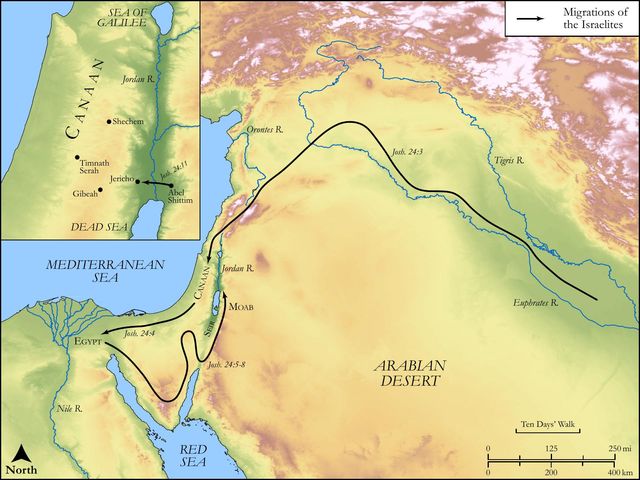
See on the biblical-era map
Study this verse
Public-domain commentary
Matthew Henry
From his Commentary on the Whole Bible. Henry comments on passages, not single verses — this entry covers Joshua 24:1–14. His three-level outline is real structure in the source text, so it is rendered as structure.
Joshua thought he had taken his last farewell of Israel in the solemn charge he gave them in the foregoing chapter, when he said, I go the way of all the earth; but God graciously continuing his life longer than expected, and renewing his strength, he was desirous to improve it for the good of Israel. He did not say, "I have taken my leave of them once, and let that serve;" but, having yet a longer space given him, he summons them together again, that he might try what more he could do to engage them for God. Note, We must never think our work for God done till our life is done; and, if he lengthen out our days beyond what we thought, we must conclude it is because he has some further service for us to do.
The assembly is the same with that in the foregoing chapter, the elders, heads, judges, and officers of Israel, Jos 24:1. But it is here made somewhat more solemn than it was there.
I.The place appointed for their meeting is Shechem, not only because that lay nearer to Joshua than Shiloh, and therefore more convenient now that he was infirm and unfit for travelling, but because it was the place where Abraham, the first trustee of God's covenant with this people, settled at his coming to Canaan, and where God appeared to him (Gen 12:6, Gen 12:7), and near which stood mounts Gerizim and Ebal, where the people had renewed their covenant with God at their first coming into Canaan, Jos 8:30. Of the promises God had made to their fathers, and of the promises they themselves had made to God, this place might serve to put them in mind.
II.They presented themselves not only before Joshua, but before God, in this assembly, that is, they came together in a solemn religious manner, as into the special presence of God, and with an eye to his speaking to them by Joshua; and it is probable the service began with prayer. It is the conjecture of interpreters that upon this great occasion Joshua ordered the ark of God to be brought by the priests to Shechem, which, they say, was about ten miles from Shiloh, and to be set down in the place of their meeting, which is therefore called (Jos 24:26) the sanctuary of the Lord, the presence of the ark making it so at that time; and this was done to grace the solemnity, and to strike an awe upon the people that attended. We have not now any such sensible tokens of the divine presence, but are to believe that where two or three are gathered together in Christ's name he is as really in the midst of them as God was where the ark was, and they are indeed presenting themselves before him.
III.Joshua spoke to them in God's name, and as from him, in the language of a prophet (Jos 24:2):
"Thus saith the Lord, Jehovah, the great God, and the God of Israel, your God in covenant, whom therefore you are bound to hear and give heed to." Note, The word of God is to be received by us as his, whoever is the messenger that brings it, whose greatness cannot add to it, nor his meanness diminish from it. His sermon consists of doctrine and application.
1.The doctrinal part is a history of the great things God had done for his people, and for their fathers before them. God by Joshua recounts the marvels of old: "I did so and so." They must know and consider, not only that such and such things were done, but that God did them. It is a series of wonders that is here recorded, and perhaps many more were mentioned by Joshua, which for brevity's sake are here omitted. See what God had wrought.
(1.)He brought Abraham out of Ur of the Chaldees, Jos 24:2, Jos 24:3. He and his ancestors had served other gods there, for it was the country in which, though celebrated for learning, idolatry, as some think, had its rise; there the world by wisdom knew not God. Abraham, who afterwards was the friend of God and the great favourite of heaven, was bred up in idolatry, and lived long in it, till God by his grace snatched him as a brand out of that burning. Let them remember that rock out of which they were hewn, and not relapse into that sin from which their fathers by a miracle of free grace were delivered. "I took him," says God, "else he had never come out of that sinful state." Hence Abraham's justification is made by the apostle an instance of God's justifying the ungodly, Rom 4:5.
(2.)He brought him to Canaan, and built up his family, led him through the land to Shechem, where they now were, multiplied his seed by Ishmael, who begat twelve princes, but at last gave him Isaac the promised son, and in him multiplied his seed. When Isaac had two sons, Jacob and Esau, God provided an inheritance for Esau elsewhere in Mount Seir, that the land of Canaan might be reserved entire for the seed of Jacob, and the posterity of Esau might not pretend to a share in it.
(3.)He delivered the seed of Jacob out of Egypt with a high hand (Jos 24:5, Jos 24:6), and rescued them out of the hands of Pharaoh and his host at the Red Sea, Jos 24:6, Jos 24:7. The same waters were the Israelites' guard and the Egyptians' grave, and this in answer to prayer; for, though we find in the story that they in that distress murmured against God (Exo 14:11, Exo 14:12), notice is here taken of their crying to God; he graciously accepted those that prayed to him, and overlooked the folly of those that quarrelled with him.
(4.)He protected them in the wilderness, where they are here said, not to wander, but to dwell for a long season, Jos 24:7. So wisely were all their motions directed, and so safely were they kept, that even there they had as certain a dwelling-place as if they had been in a walled city.
(5.)He gave them the land of the Amorites, on the other side Jordan (Jos 24:8), and there defeated the plot of Balak and Balaam against them, so that Balaam could not curse them as he desired, and therefore Balak durst not fight them as he designed, and as, because he designed it, he is here said to have done it. The turning of Balaam's tongue to bless Israel, when he intended to curse them, is often mentioned as an instance of the divine power put forth in Israel's favour as remarkable as any, because in it God proved (and does still, more than we are aware of) his dominion over the powers of darkness, and over the spirits of men.
(6.)He brought them safely and triumphantly into Canaan, delivered the Canaanites into their hand (Jos 24:11), sent hornets before them, when they were actually engaged in battle with the enemy, which with their stings tormented them and with their noise terrified them, so that they became a very easy prey to Israel. These dreadful swarms first appeared in their war with Sihon and Og, the two kings of the Amorites, and afterwards in their other battles, Jos 24:12. God had promised to do this for them, Exo 23:27, Exo 23:28. And here Joshua takes notice of the fulfilling of that promise. See Exo 23:27, Exo 23:28; Deu 7:20. These hornets, it should seem, annoyed the enemy more than the artillery of Israel, and therefore he adds, not with thy sword nor bow. It was purely the Lord's doing. Lastly, They were now in the peaceable possession of a good land, and lived comfortably upon the fruit of other people's labours, Jos 24:13.
2.The application of this history of God's mercies to them is by way of exhortation to fear and serve God, in gratitude for his favour, and that it might be continued to them, Jos 24:14. Now therefore, in consideration of all this, (1.) "Fear the Lord, the Lord and his goodness, Hos 3:5. Reverence a God of such infinite power, fear to offend him and to forfeit his goodness, keep up an awe of his majesty, a deference to his authority, a dread of his displeasure, and a continual regard to his all-seeing eye upon you." (2.) "Let your practice be consonant to this principle, and serve him both by the outward acts of religious worship and every instance of obedience in your whole conversation, and this in sincerity and truth, with a single eye and an upright heart, and inward impressions answerable to outward expressions." This is the truth in the inward part, which God requires, Psa 51:6. For what good will it do us to dissemble with a God that searches the heart? (3.) Put away the strange gods, both Chaldean and Egyptian idols, for those they were most in danger of revolting to. It should seem by this charge, which is repeated (Jos 24:23), that there were some among them that privately kept in their closets the images or pictures of these dunghill-deities, which came to their hands from their ancestors, as heir-looms of their families, though, it may be, they did not worship them; these Joshua earnestly urges them to throw away: "Deface them, destroy them, lest you be tempted to serve them." Jacob pressed his household to do this, and at this very place; for, when they gave him up the little images they had, he buried them under the oak which was by Shechem, Gen 35:2, Gen 35:4. Perhaps the oak mentioned here (Jos 24:26) was the same oak, or another in the same place, which might be well called the oak of reformation, as there were idolatrous oaks.
Continue studying Joshua 24:6 across the web’s major study libraries — every link below opens this exact verse, chapter, or book on the destination site.
Read & Compare
 BibleGatewayThis verse in more than 200 translations and 70 languages.
 Bible.comThe YouVersion reader — hundreds of translations, reading plans, and highlights.
 ESV.orgCrossway's official English Standard Version reader.
 NET BibleThe NET translation with 60,000+ translators' notes on every rendering decision.
 STEP BibleTyndale House's free study tool — original text, vocabulary, and scholarly resources.
 BibliaLogos Bible Software's free web reader.
 USCCBThe New American Bible (Revised Edition) with the U.S. bishops' study notes.
Commentaries
 BibleHub CommentariesDozens of classic commentaries on this verse, gathered on one page.
 StudyLightMore than 100 commentary sets — the largest collection on the web.
 BibleRefPlain-English commentary on what this verse means, verse by verse.
 Enduring WordDavid Guzik's free commentary on this chapter, widely used by Bible teachers.
 Bible Study ToolsVerse commentary alongside Greek and Hebrew study aids.
Original Language & Research
- BibleHub InterlinearThe verse word by word — original language, transliteration, and English.
- BibleHub LexiconEvery word's original-language definition and Strong's entry.
 Blue Letter BibleDeep-study tools — Strong's numbers, concordance, and word studies.
 SefariaThe Hebrew text with Rashi and centuries of Jewish commentary.
Sermons, Hymns & Audio


TrulyRandomVerse is not affiliated with these sites and doesn’t control their content. They’re linked because they’re genuinely useful.
Summary
Joshua 24:6 forms a crucial part of Joshua's farewell address at Shechem, serving as a profound historical anchor for the covenant renewal ceremony. This verse vividly recounts a pivotal moment in Israel's foundational narrative: God's sovereign act of bringing their ancestors out of Egyptian bondage, only for them to face the terrifying pursuit of Pharaoh's formidable army, complete with chariots and horsemen, to the seemingly insurmountable barrier of the Red Sea. This recollection underscores the Lord's unwavering faithfulness and mighty power, demonstrating that Israel's very existence and deliverance were entirely dependent on divine intervention, setting the stage for one of the most miraculous displays of God's redemptive might in the Old Testament.
Context
ShowHideLiterary Context
Joshua 24 serves as the climactic conclusion to the book of Joshua, marking the final public act of leadership before Joshua's death. The chapter opens with Joshua assembling "all the tribes of Israel to Shechem," a place of significant covenantal history (Genesis 12:6, Genesis 35:4, Deuteronomy 27). Here, Joshua delivers a sweeping historical prologue, beginning with Abraham's call (Joshua 24:2-3) and meticulously detailing God's redemptive acts through the Exodus, wilderness wanderings, and the conquest of Canaan. This comprehensive review, including the events of Exodus 1-15, is designed not merely as a history lesson but as a powerful theological argument. By recalling the Lord's consistent faithfulness, especially His miraculous deliverance at the Red Sea as highlighted in verse 6, Joshua aims to impress upon the new generation their profound indebtedness to God and to challenge them to make an unequivocal choice to serve Him alone, culminating in the famous exhortation found in Joshua 24:15.
Historical & Cultural Context
The events described in Joshua 24:6 are deeply embedded in the historical and geopolitical realities of Pharaoh's Egypt. Ancient Egypt was a dominant superpower, renowned for its highly organized and formidable military, particularly its chariot corps. Chariots represented the pinnacle of military technology, offering unmatched speed, maneuverability, and destructive power on the battlefield. For the newly liberated Israelite multitude, largely unarmed and unorganized, the sight of Pharaoh's "chariots and horsemen" relentlessly pursuing them would have evoked abject terror and a profound sense of inescapable doom. This pursuit was a desperate act by Pharaoh to reclaim his valuable slave labor and reassert his imperial authority, reflecting the typical response of a powerful empire to such a mass exodus. The "Red Sea" (Hebrew: Yam Suph, often translated "Sea of Reeds") served as an impassable natural barrier, effectively trapping the Israelites between the overwhelming Egyptian force and the vast body of water. This geographical and military predicament rendered their escape humanly impossible, meticulously setting the stage for a divine intervention that would defy all natural and military logic, thereby magnifying God's power and sovereignty.
Key Themes
ShowHideJoshua 24:6 powerfully contributes to several overarching themes that resonate throughout the book of Joshua and the broader biblical narrative. Firstly, it emphatically underscores God's Sovereign Deliverance, emphasizing that Israel's liberation from Egypt was not a result of their own strength, cunning, or military prowess, but solely through the Lord's direct initiative and omnipotent power. The phrase "I brought your fathers out of Egypt" attributes the entire Exodus event to Yahweh, setting the stage for the Red Sea miracle where God would demonstrate His ultimate authority over both nature and human empires, as vividly recounted in Exodus 14. Secondly, the verse highlights Divine Protection in Peril, showcasing God's unwavering commitment to safeguarding His people even when they are trapped in seemingly impossible circumstances and facing overwhelming threats. The detailed description of the pursuit by "chariots and horsemen" magnifies the direness of their situation, making God's subsequent deliverance even more profound and illustrating the truth that "the Lord will fight for you" (Exodus 14:14). Finally, Joshua's act of recounting this specific event reinforces the crucial theme of Remembrance of God's Faithfulness. By recalling God's past mighty acts, the new generation of Israelites is encouraged to trust Him for their present and future challenges, establishing a pattern of historical recollection as a cornerstone of their faith, identity, and ongoing covenant relationship with Yahweh.
Exposition and Analysis
ShowHideKey Word Analysis
ShowHideThis primitive root signifies "to go out," or causatively, "to bring out." In the context of Joshua 24:6, with God ("I") as the subject, it powerfully emphasizes divine agency and initiative. It underscores that the Exodus was not merely Israel's escape but God's active, sovereign act of leading His people forth from bondage, demonstrating His absolute power over Egypt and His unwavering commitment to His covenant promises. This word consistently attributes Israel's deliverance to Yahweh alone throughout the Exodus narrative.
This term refers to "Upper and Lower Egypt," encompassing the entire land and its people. Its inclusion here specifies the formidable empire from which Israel was delivered. The mention of "Egypt" evokes the historical reality of Israel's brutal enslavement and the immense power of their oppressors, thereby magnifying the miraculous nature of God's intervention in bringing them out.
This primitive root means "to run after," "to chase," or "to persecute," often with hostile intent. Its use in this verse vividly conveys the relentless, aggressive, and threatening nature of the Egyptian pursuit. It paints a picture of a desperate, high-stakes chase, where Pharaoh's army was determined to recapture or destroy the Israelites, thereby highlighting the imminent danger Israel faced and magnifying the subsequent divine intervention at the Red Sea.
While commonly translated "Red Sea," Yam Suph literally means "Sea of Reeds" or "Reed Sea," likely referring to a body of water characterized by reeds or papyrus. Its precise geographical location is debated, but its theological significance is paramount. It represents the ultimate impassable barrier for the Israelites and the dramatic stage for God's most profound display of power against Egypt. Here, God transformed an insurmountable obstacle into a path of salvation for His people and a watery grave for their oppressors, making it a foundational symbol of divine deliverance.
Verse Breakdown
ShowHide"And I brought your fathers out of Egypt:"
This opening clause immediately establishes the divine protagonist of the Exodus narrative. The first-person pronoun "I" refers to Yahweh, the covenant God of Israel, unequivocally asserting His direct, active, and sovereign role in their liberation. This emphasizes that the Exodus was not a human achievement but a miraculous act of divine redemption, fulfilling God's ancient promises to the patriarchs and demonstrating His faithfulness to His chosen people.
"and ye came unto the sea;"
This phrase describes the seemingly hopeless predicament of the Israelites. Having been led out of Egypt by God, they found themselves geographically trapped between the pursuing Egyptian army and an impassable body of water. This detail underscores their vulnerability, their lack of a viable escape route, and the human impossibility of their situation, meticulously setting the stage for a miraculous intervention that would defy all natural and military logic.
"and the Egyptians pursued after your fathers with chariots and horsemen unto the Red sea."
This final clause intensifies the peril and magnifies the threat. It specifies the formidable nature of the pursuing force—the elite "chariots and horsemen" of Pharaoh's army, the most advanced military technology of that day—and their relentless pursuit right up to the very barrier that seemed to seal Israel's doom. This vivid description serves to highlight the magnitude of the danger faced by Israel and, by extension, the extraordinary power and glory of God's subsequent deliverance at the Red Sea, demonstrating His absolute sovereignty over the greatest military force of that day.
Literary Devices
ShowHideJoshua 24:6 employs several potent literary devices to enhance its impact and convey its theological message. The overarching device is Recapitulation, as Joshua is systematically recounting a foundational, salvific event in Israel's history, bringing it to the forefront of the people's collective memory to reinforce their identity and covenant obligations. The use of the first-person divine pronoun "I" at the beginning of the verse ("And I brought") is a powerful instance of Divine Monologue or Divine Assertion, emphasizing God's direct agency and sovereign initiative in the Exodus. There is a strong element of Contrast at play: the overwhelming might of the Egyptian "chariots and horsemen" stands in stark opposition to the vulnerable, unarmed Israelites, thereby dramatically magnifying the power of God, who alone could deliver them from such an insurmountable threat. The specific mention of "chariots and horsemen" functions as a form of Merism or Synecdoche, representing the entirety of Pharaoh's elite military force, and also serves as Emphasis to underscore the direness of the threat. Finally, the narrative structure of the verse, moving from God's deliverance to Israel's entrapment and the enemy's pursuit, creates a sense of Dramatic Irony or Suspense, as the audience (both ancient and modern) knows the miraculous outcome that immediately follows this desperate situation in the larger Exodus narrative.
Theological and Thematic Connections
ShowHideJoshua 24:6 stands as a cornerstone in the theological understanding of Israel's identity and God's character. It encapsulates the profound truth that salvation, whether from physical bondage or spiritual peril, originates solely from God's initiative and omnipotent power. This verse, by recalling the Red Sea event, points to God's absolute sovereignty over all creation—human empires, natural elements, and the forces of chaos. It establishes a divine pattern: God often allows His people to reach the apparent end of their own resources, facing seemingly insurmountable obstacles, so that His glory can be fully displayed through His miraculous intervention. This historical act of redemption not only formed the basis for Israel's identity as God's chosen people but also served as the foundational experience that bound them to Him by a covenant of grace and faithfulness, a relationship continually renewed through remembrance of His mighty acts.
Reflection and Application
ShowHideJoshua 24:6, though deeply rooted in ancient history, offers profound and enduring truths for the contemporary believer. It serves as a powerful reminder that our God is an active, powerful deliverer, who intervenes on behalf of His people even in the most desperate and humanly impossible circumstances. Just as Israel found themselves trapped between an overwhelming enemy and an impassable sea, we too often encounter "Red Sea" moments in our lives—situations of seemingly insurmountable obstacles, whether they manifest as debilitating illnesses, overwhelming financial crises, profound relational brokenness, or intense spiritual attacks. This verse calls us to shift our gaze from the magnitude of our problems to the infinitude of God's power and His proven track record of faithfulness. By intentionally recalling His past mighty acts, both in the grand narrative of biblical history and in the intimate details of our personal testimonies, we cultivate a deep reservoir of trust that enables us to face present and future challenges with courage, hope, and unwavering confidence, knowing that the Lord who miraculously brought Israel out of Egypt is the same Lord who is actively at work in our lives today.
Questions for Reflection
ShowHideFAQ
ShowHideWhy does Joshua specifically mention the "chariots and horsemen" of the Egyptians?
ShowHideJoshua's specific mention of "chariots and horsemen" serves a crucial rhetorical and theological purpose: it emphasizes the overwhelming and seemingly insurmountable nature of the threat Israel faced. In that day, chariots were the most advanced and feared military technology, representing the pinnacle of speed, power, and an elite fighting force. By highlighting this formidable opposition, Joshua magnifies the desperation of Israel's situation and, by extension, the extraordinary power and glory of God's subsequent deliverance at the Red Sea. It underscores that Israel's salvation was not due to any human strength or strategic genius, but solely to God's miraculous intervention against a vastly superior force, as detailed in Exodus 14:7-9. This detail ensures that all glory for the deliverance is attributed to Yahweh alone.
What is the significance of the "Red Sea" (Yam Suph) in this verse?
ShowHideThe "Red Sea," or more accurately "Sea of Reeds" (Hebrew: Yam Suph), is profoundly significant as the geographical and theological locus of God's ultimate display of power against Egypt. It represented an impassable natural barrier, effectively trapping the Israelites and making their escape humanly impossible. Its mention in Joshua 24:6 sets the stage for the miraculous parting of the waters, allowing Israel to pass through on dry ground, and the subsequent engulfing of Pharaoh's army. This event, narrated in Exodus 14:21-31, became the quintessential act of redemption in Israel's history. It served as a foundational event that demonstrated God's absolute sovereignty over creation and His enemies, His unwavering commitment to His covenant people, and His ability to turn a hopeless situation into a glorious triumph.
Christ-Centered Fulfillment
ShowHideJoshua 24:6, with its vivid recollection of God's powerful deliverance at the Red Sea, finds its ultimate and most profound fulfillment in the person and redemptive work of Jesus Christ. The declaration, "And I brought your fathers out of Egypt," foreshadows Christ, the true and greater Deliverer, who liberates His people from the far more pervasive and insidious spiritual bondage of sin, death, and the dominion of Satan—a slavery infinitely more destructive than that imposed by Egypt. Just as ancient Israel was pursued by the overwhelming forces of Pharaoh's army to the edge of an impassable sea, humanity is pursued by the overwhelming forces of sin, death, and the devil, facing an ultimate barrier of divine judgment that no human effort or strength can ever overcome. Christ, however, is our ultimate Red Sea deliverance. His sacrificial death on the cross is the decisive act that parts the waters of God's righteous judgment and wrath, allowing all who believe to pass through from condemnation to new, eternal life. The glorious defeat of the Egyptian chariots and horsemen at the Red Sea powerfully prefigures Christ's triumphant victory over all principalities and powers, disarming them and leading them in triumph through the cross (Colossians 2:15). He is the true Lamb of God, whose shed blood provides the ultimate Passover deliverance from the angel of death and the power of sin (John 1:29). Furthermore, the crossing of the Red Sea is explicitly seen in the New Testament as a powerful type of baptism, symbolizing our identification with Christ's death, burial, and resurrection, leading us into a new covenant relationship with God and a new life in Him (1 Corinthians 10:1-2). Christ is the greater Joshua, who not only leads His people out of bondage but also brings them into the promised eternal rest, a spiritual inheritance far surpassing any earthly land (Hebrews 4:8-10).