


Genesis 35:4
- וַיִּתְּנוּvai·yi·te·Nuand they gaveH5414Conj-w ¦ V-Qal-ConsecImperf-3mpVerb Qal Consecutive Imperfect 3rd Plural Masculineוַandיִּתְּנוּthey gave
- אֶל'eltoH413PrepPreposition
- יַעֲקֹבya·'a·KoJacobH3290N-proper-mNoun Proper Masculine
- אֵת'et<obj.>H853DirObjMParticle Object Indicator
- כָּלkolallH3605N-mscNoun Singular Masculine Construct
- אֱלֹהֵי'e·lo·Hei[the] gods ofH430N-mpcNoun Plural Masculine Construct
- הַנֵּכָרha·ne·Khar<the> foreignnessH5236Art ¦ N-msNoun Singular Masculine Absoluteהַ<the>נֵּכָרforeignness
- אֲשֶׁר'a·SherwhichH834RelParticle Relative
- בְּיָדָםbe·ya·Dam[were] in their handH3027Prep-b ¦ N-csc ¦ 3mpNoun Singular common gender Constructבְּ[were] inיָדָhandםtheir
- וְאֶתve·'Etand <obj.>H853Conj-w ¦ DirObjMParticle Object Indicatorוְandאֶת<obj.>
- הַנְּזָמִיםha·ne·za·Mimthe ringsH5141Art ¦ N-mpNoun Plural Masculine Absoluteהַtheנְּזָמִיםrings
- אֲשֶׁר'a·SherwhichH834RelParticle Relative
- בְּאָזְנֵיהֶםbe·'a·ze·nei·Hem[were] in their earsH241Prep-b ¦ N-fdc ¦ 3mpNoun Dual Feminine Constructבְּ[were] inאָזְנֵיearsהֶםtheir
- וַיִּטְמֹןvai·yit·Monand he hidH2934Conj-w ¦ V-Qal-ConsecImperf-3msVerb Qal Consecutive Imperfect 3rd Singular Masculineוַandיִּטְמֹןhe hid
- אֹתָם'o·Tam<obj.> themH853DirObjM ¦ 3mpParticle Object Indicatorאֹתָ<obj.>םthem
- יַעֲקֹבya·'a·KoJacobH3290N-proper-mNoun Proper Masculine
- תַּחַתTa·chatunderH8478N-mscNoun Singular Masculine Construct
- הָאֵלָהha·'e·Lahthe oakH424Art ¦ N-fsNoun Singular Feminine Absoluteהָtheאֵלָהoak
- אֲשֶׁר'a·SherwhichH834RelParticle Relative
- עִם'im[was] nearH5973PrepPreposition
- שְׁכֶםshe·KhemShechemH7927N-properNoun Proper Location
English is a literal word-by-word gloss of the Hebrew, not the KJV's wording. Why?
This is the original text the KJV's translators worked from — each Hebrew word with its own literal English meaning in this verse, prepared by scholars at Tyndale House, Cambridge. The KJV translates whole sentences, not word by word, so its wording differs: one Hebrew word can become several English words, and the KJV may choose “the LORD” where the gloss reads “Yahweh”. Both are faithful — they answer different questions. For the KJV's own rendering, switch to the KJV text.
Details
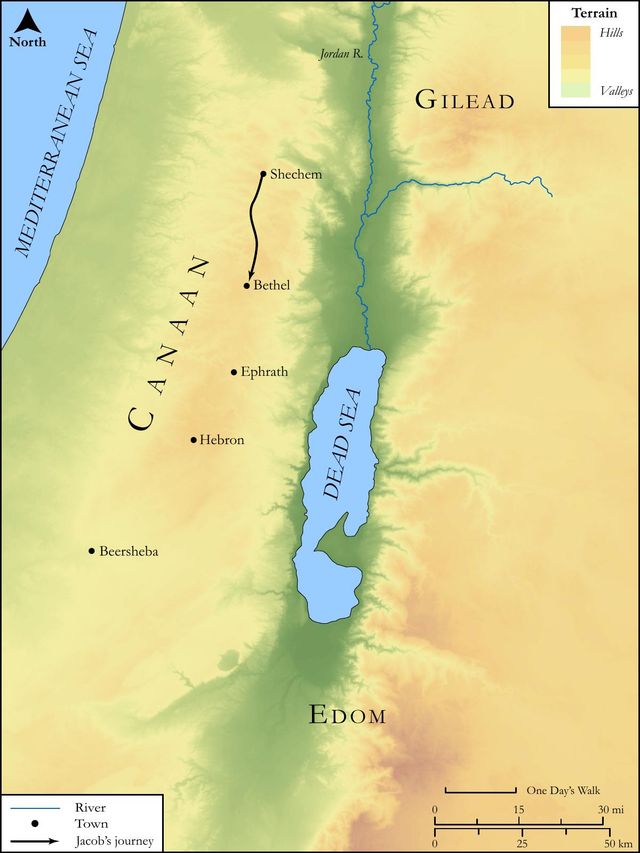
See on the biblical-era maps


Study this verse
Public-domain commentary
Matthew Henry
From his Commentary on the Whole Bible. Henry comments on passages, not single verses — this entry covers Genesis 35:1–5. His three-level outline is real structure in the source text, so it is rendered as structure.
Here, I. God reminds Jacob of his vow at Beth-el, and sends him thither to perform it, Gen 35:1. Jacob had said in the day of his distress, If I come again in peace, this stone shall be God's house, Gen 28:22. God had performed his part of the bargain, and had given Jacob more than bread to eat and raiment to put on - he had got an estate, and had become two bands; but, it should seem, he had forgotten his vow, or at least had too long deferred the performance of it. Seven or eight years it was now since he came to Canaan; he had purchased ground there, and had built an altar in remembrance of God's last appearance to him when he called him Israel (Gen 33:19, Gen 33:20); but still Beth-el is forgotten. Note, Time is apt to wear out the sense of mercies and the impressions made upon us by them; it should not be so, but so it is. God had exercised Jacob with a very sore affliction in his family (ch. 34), to see if this would bring his vow to his remembrance, and put him upon the performance of it, but it had not this effect; therefore God comes himself and puts him in mind of it: Arise, go to Beth-el. Note, 1. As many as God loves he will remind of neglected duties, one way or other, by conscience or by providences. 2. When we have vowed a vow to God, it is best not to defer the payment of it (Ecc 5:4), yet better late than never. God bade him go to Beth-el and dwell there, that is, not only go himself, but take his family with him, that they might join with him in his devotions. Note, In Beth-el, the house of God, we should desire to dwell, Psa 27:4. That should be our home, not our inn. God reminds him not expressly of his vow, but of the occasion of it: When thou fleddest from the face of Esau. Note, The remembrance of former afflictions should bring to mind the workings of our souls under them, Psa 66:13, Psa 66:14.
II.Jacob commands his household to prepare for this solemnity; not only for the journey and remove, but for the religious services that were to be performed, Gen 35:2, Gen 35:3. Note,
1.Before solemn ordinances, there must be solemn preparation. Wash you, make you clean, and then come, and let us reason together, Isa 1:16-18.
2.Masters of families should use their authority for the promoting of religion in their families. Not only we, but our houses also, should serve the Lord, Jos 24:15. Observe the commands he gives his household, like Abraham, Gen 18:19.
(1.)They must put away the strange gods. Strange gods in Jacob's family! Strange things indeed! Could such a family, that was taught the good knowledge of the Lord, admit them? Could such a master, to whom God had appeared twice, and oftener, connive at them? Doubtless this was his infirmity. Note, Those that are good themselves cannot always have those about them so good as they should be. In those families where there is a face of religion, and an altar to God, yet many times there is much amiss, and more strange gods than one would suspect. In Jacob's family, Rachel had her ִֶַ, which, it is to be feared, she secretly made some superstitious use of. The captives of Shechem brought their gods along with them, and perhaps Jacob's sons took some with the plunder. However they came by them, now they must put them away.
(2.)They must be clean, and change their garments; they must observe a due decorum, and make the best appearance they could. Simeon and Levi had their hands full of blood, it concerned them particularly to wash, and to put off their garments that were so stained. These were but ceremonies, signifying the purification and change of the heart. What are clean clothes, and new clothes, without a clean heart, and a new heart? Dr. Lightfoot, by their being clean, or washing themselves, understands Jacob's admission of the proselytes of Shechem and Syria into his religion by baptism, because circumcision had become odious.
3.They must go with him to Bethel, Gen 35:3. Note, Masters of families, when they go up to the house of God, should bring their families with them.
III.His family surrendered all they had that was idolatrous or superstitious, Gen 35:4.
Perhaps, if Jacob had called for them sooner, they would sooner have parted with them, being convicted by their own consciences of the vanity of them. Note, Sometimes attempts for reformation succeed better than one could have expected, and people are not so obstinate against them as we feared. Jacob's servants, and even the retainers of his family, gave him all the strange gods, and the ear-rings they wore, either as charms or to the honour of their gods; they parted with all. Note, Reformation is not sincere if it be not universal. We hope they parted with them cheerfully, and without reluctance, as Ephraim did, when he said, What have I to do any more with idols? (Hos 14:8), or that people that said to their idols, Get you hence, Isa 30:22. Jacob took care to bury their images, we may suppose in some place unknown to them, that they might not afterwards find them and return to them. Note, We must be wholly separated from our sins, as we are from those that are dead and buried out of our sight, cast them to the moles and the bats, Isa 2:20.
IV.He removes without molestation from Shechem to Bethel, Gen 35:5.
The terror of God was upon the cities. Though the Canaanites were much exasperated against the sons of Jacob for their barbarous usage of the Shechemites, yet they were so restrained by a divine power that they could not take this fair opportunity, which now offered itself, when they were upon their march, to avenge their neighbours' quarrel. Note, The way of duty is the way of safety. While there was sin in Jacob's house, he was afraid of his neighbours; but now that the strange gods were put away, and they were all going together to Bethel, his neighbours were afraid of him. When we are about God's work, we are under special protection. God is with us, while we are with him; and, if he be for us, who can be against us? See Exo 34:24, No man shall desire thy land, when thou goest up to appear before the Lord. God governs the world more by secret terrors on men's minds than we are aware of.
Continue studying Genesis 35:4 across the web’s major study libraries — every link below opens this exact verse, chapter, or book on the destination site.
Read & Compare
 BibleGatewayThis verse in more than 200 translations and 70 languages.
 Bible.comThe YouVersion reader — hundreds of translations, reading plans, and highlights.
 ESV.orgCrossway's official English Standard Version reader.
 NET BibleThe NET translation with 60,000+ translators' notes on every rendering decision.
 STEP BibleTyndale House's free study tool — original text, vocabulary, and scholarly resources.
 BibliaLogos Bible Software's free web reader.
 USCCBThe New American Bible (Revised Edition) with the U.S. bishops' study notes.
Commentaries
 BibleHub CommentariesDozens of classic commentaries on this verse, gathered on one page.
 StudyLightMore than 100 commentary sets — the largest collection on the web.
 BibleRefPlain-English commentary on what this verse means, verse by verse.
 Enduring WordDavid Guzik's free commentary on this chapter, widely used by Bible teachers.
 Bible Study ToolsVerse commentary alongside Greek and Hebrew study aids.
Original Language & Research
- BibleHub InterlinearThe verse word by word — original language, transliteration, and English.
- BibleHub LexiconEvery word's original-language definition and Strong's entry.
 Blue Letter BibleDeep-study tools — Strong's numbers, concordance, and word studies.
 SefariaThe Hebrew text with Rashi and centuries of Jewish commentary.
Sermons, Hymns & Audio


TrulyRandomVerse is not affiliated with these sites and doesn’t control their content. They’re linked because they’re genuinely useful.
Summary
Genesis 35:4 records a pivotal moment of spiritual purification for Jacob's household, demonstrating their collective submission to his leadership and a decisive corporate renunciation of pagan influences. As they prepared to journey to Bethel in obedience to God's command, Jacob's family surrendered all their "strange gods" and idolatrous earrings, which Jacob then buried, symbolizing a profound commitment to exclusive devotion to the true God and anticipation of renewed covenant fellowship.
Context
ShowHideLiterary Context
This verse is situated immediately after God's command to Jacob to return to Bethel, the site of his foundational encounter with the Lord and his vow in Genesis 28:10-22. The preceding chapter, Genesis 34, details the violent and treacherous actions of Simeon and Levi at Shechem, which brought great reproach upon Jacob's family and instilled fear of retaliation from the surrounding Canaanite inhabitants. God's directive in Genesis 35:1 to "Arise, go up to Bethel, and dwell there: and make there an altar unto God" serves as a divine intervention, calling Jacob away from the dangerous and defiled environment of Shechem and back to a place of covenant renewal. Jacob's subsequent command to his household in Genesis 35:2-3 to "put away the strange gods that are among you, and be clean, and change your garments" sets the stage for the obedient response recorded in Genesis 35:4, highlighting the spiritual prerequisite for approaching God in worship.
Historical & Cultural Context
The ancient Near East was a polytheistic environment, with various gods and goddesses worshipped by different peoples and localities. Canaanite religion, in particular, involved a pantheon of deities (like Baal, Asherah, Dagon) and associated cultic practices, often including the use of idols, amulets, and ritual objects. "Strange gods" (Hebrew: elohim nekar) refers to deities foreign to the worship of Yahweh, the God of Abraham, Isaac, and Jacob. Earrings, while sometimes merely ornamental, often held cultic significance in this period, serving as amulets or charms believed to offer protection, bring good fortune, or connect the wearer to specific deities. It is plausible that these items were acquired through trade, interaction with Canaanite neighbors, or even as spoils from the incident at Shechem. The presence of such items within Jacob's household indicates a degree of syncretism or at least exposure to and acceptance of foreign religious practices, which stood in stark contrast to the exclusive monotheism demanded by the covenant with Yahweh. Jacob's command and his family's response reflect a necessary purification from these pervasive cultural influences before they could properly worship God.
Key Themes
ShowHideGenesis 35:4 contributes significantly to several key themes within Genesis and the broader biblical narrative. Firstly, it underscores the theme of covenant faithfulness and purity. God's covenant with Abraham and his descendants demanded exclusive worship and separation from pagan practices, a principle reiterated throughout the Pentateuch. Secondly, it highlights the theme of divine command and human obedience. God's instruction to go to Bethel (Genesis 35:1) is met with Jacob's spiritual leadership and his family's compliance, demonstrating the importance of responding to God's directives with acts of purification. Thirdly, the verse emphasizes the rejection of idolatry. The surrender and burial of the "strange gods" and cultic earrings represent a decisive break with polytheism and a commitment to the worship of the one true God, a theme that will become central to Israel's identity and prophetic warnings (e.g., Joshua 24:14-15). Finally, it showcases Jacob's maturing leadership. After years of personal struggle and family strife, Jacob demonstrates a newfound spiritual resolve, taking decisive action to purify his household and guide them towards proper worship, marking a significant step in his transformation from "supplanter" to "Israel," one who strives with God.
Exposition and Analysis
ShowHideGenesis 35:4 details the practical steps taken by Jacob's household in response to his command for purification, highlighting their collective submission to his spiritual leadership and their commitment to the God of Abraham and Isaac.
Key Word Analysis
ShowHideFrom נָכַר; foreign, or (concretely) a foreigner, or (abstractly) heathendom; alien, strange ([phrase] -er). This word emphasizes the foreign, non-Israelite origin and nature of the gods, highlighting their incompatibility with the worship of Yahweh. They were not merely "different" but fundamentally "alien" to the covenant relationship.
Plural of אֱלוֹהַּ; gods in the ordinary sense; but specifically used (in the plural thus, especially with the article) of the supreme God; occasionally applied by way of deference to magistrates; and sometimes as a superlative; angels, [idiom] exceeding, God (gods) (-dess, -ly), [idiom] (very) great, judges, [idiom] mighty. Here, the plural form refers to the pagan deities or idols worshipped by other nations, contrasting them with the singular, supreme God of Jacob.
From an unused root of uncertain meaning; a nose-ring; earring, jewel. While nezem can refer to any jewel, in this context, especially alongside "strange gods" and given ancient Near Eastern practices, it strongly implies earrings worn as amulets or charms with cultic significance, not merely decorative items.
A primitive root; to hide (by covering over); hide, lay privily, in secret. This verb signifies a complete and deliberate concealment, suggesting a permanent removal and a definitive break with the idols. The act of burying them implies their utter rejection and consigning them to oblivion, preventing future use or veneration.
Verse Breakdown
ShowHide"And they gave unto Jacob all the strange gods which [were] in their hand"
This clause describes the immediate and collective response of Jacob's household to his command. The phrase "they gave" indicates a voluntary act of surrender, suggesting that the family members, including wives (like Rachel, who possessed teraphim in Genesis 31:19), children, and servants, complied with Jacob's directive. The "strange gods" were likely household idols or small cultic figures, and "in their hand" signifies their possession and control over these objects, making their surrender a tangible act of renunciation.
"and [all their] earrings which [were] in their ears"
This part of the verse specifies another category of items surrendered, highlighting their direct connection to personal adornment and, importantly, potential cultic significance. As noted in the Key Word Analysis, these earrings were likely more than mere jewelry; they were probably amulets or charms associated with pagan beliefs and practices. Their removal from the ears signifies a public and personal purification, a visible shedding of symbols of foreign worship.
"and Jacob hid them under the oak which [was] by Shechem"
This final clause describes Jacob's decisive action with the surrendered items. The verb "hid" (Hebrew: ṭâman) implies a thorough and permanent concealment, effectively burying them. The location, "under the oak which was by Shechem," is significant. Oaks often served as sacred sites in Canaanite religion, and burying the idols there might have been a deliberate act of desacralization, reclaiming the space from pagan associations, or simply a convenient and isolated place for their permanent disposal, ensuring they could not be retrieved or worshipped again. This act solidifies the family's break from idolatry.
Literary Devices
ShowHideThe passage employs several impactful literary devices. Symbolism is prominent, as the "strange gods" and "earrings" are not merely objects but powerful symbols of pagan worship and syncretism. Their surrender and burial symbolize a radical break with the past and a commitment to exclusive devotion to Yahweh. The act of burial itself is symbolic, representing the complete rejection and permanent disposal of idolatry, consigning it to oblivion. The "oak" under which they were buried also carries symbolic weight; while sometimes associated with pagan worship, in this context, it becomes a silent witness to the family's purification, a place where paganism is symbolically "buried" and left behind. The narrative also exhibits Narrative Progression, moving from God's command to Jacob's instruction, and then to the family's obedient action, culminating in Jacob's decisive disposal of the idols. This progression highlights the theme of spiritual cleansing as a necessary step before renewed covenant engagement.
Theological and Thematic Connections
ShowHideThe purification of Jacob's household in Genesis 35:4 serves as a foundational example of the biblical imperative for holiness and exclusive worship of God. It prefigures the consistent call throughout Israel's history for separation from idolatry and the corrupting influences of surrounding cultures. This act of renunciation underscores the truth that true worship requires internal purity and the removal of anything that competes for God's rightful place in the heart and home. It establishes a pattern for future generations, emphasizing that a relationship with the Holy God demands a radical break from all forms of spiritual impurity and divided loyalties. The burying of the idols signifies a definitive end to their power and presence, a theological statement that these "gods" are powerless and belong to the dust.
Reflection and Application
ShowHideThe account in Genesis 35:4 offers profound lessons for contemporary believers. Just as Jacob's family needed to rid themselves of tangible idols and cultic objects before drawing near to God, we too are called to examine our lives for "strange gods" – anything that competes for our ultimate loyalty, affection, or trust, diverting us from exclusive devotion to the Lord. These modern idols may not be physical statues, but can manifest as materialism, career ambition, social media validation, comfort, relationships, or even self-reliance. The act of "giving up" and "hiding" these idols under the "oak" implies a decisive and permanent break, not a temporary pause. This passage challenges us to engage in ongoing spiritual purification, identifying and actively removing anything that hinders our full surrender and worship of God. It reminds us that genuine worship flows from a heart made clean and wholly devoted to Him, urging us to prioritize spiritual purity over worldly attachments.
Questions for Reflection
ShowHideFAQ
ShowHideWhy were the earrings considered "strange" or idolatrous?
ShowHideWhile earrings could be purely ornamental, in the ancient Near East, they often held cultic or magical significance. They were frequently used as amulets or charms, believed to connect the wearer to specific deities, offer protection, or bring good fortune. Given their mention alongside "strange gods" and Jacob's command for purification, it's highly probable that these specific earrings were associated with pagan religious practices or superstitions, making them incompatible with the exclusive worship of Yahweh. Their removal was a symbolic act of renouncing foreign spiritual influences.
What is the significance of Jacob hiding the idols under an oak tree by Shechem?
ShowHideThe act of "hiding" them (Hebrew: ṭâman) implies a permanent burial, signifying a complete and irreversible disposal. This was not a temporary measure but a definitive break with idolatry. The location, "under the oak which was by Shechem," is also significant. Oak trees were often prominent landmarks and sometimes served as sacred sites for pagan worship in Canaanite culture. By burying the idols there, Jacob was not only disposing of them but potentially desacralizing a pagan site, or at least choosing a place that would ensure their permanent concealment and prevent their retrieval. It was a public and symbolic act of cleansing the land and his family from foreign religious elements before journeying to Bethel, the place of true worship.
Christ-Centered Fulfillment
ShowHideThe purification of Jacob's household in Genesis 35:4 serves as a profound Old Testament foreshadowing of the comprehensive spiritual cleansing and transformation offered through Jesus Christ. Just as Jacob's family had to put away their "strange gods" and cultic earrings to approach the Holy God at Bethel, so too does the New Covenant call believers to cast off the "old man" and its idolatrous practices to walk in newness of life in Christ. The physical act of burying the idols under the oak prefigures the spiritual reality of being "buried with Christ in baptism" (Romans 6:4), symbolizing a death to sin and a resurrection to new life. Through Christ, we are not merely commanded to put away external idols, but our very hearts are purified by faith (Acts 15:9), and we are freed from the dominion of sin and spiritual darkness (Colossians 1:13). The New Testament teaches that true worship is no longer tied to specific physical locations or rituals but is offered "in spirit and truth" (John 4:23-24) by those whose lives have been transformed by the indwelling Holy Spirit. This spiritual cleansing culminates in becoming a "new creation" in Christ (2 Corinthians 5:17), where old things have passed away and all things have become new, reflecting the ultimate and permanent removal of all that separates us from God.