


Genesis 35:3
Bible text: King James Version (1769 Blayney text) · Public domain
Bible text: King James Version with Strong's numbers · Public domain
Bible text: Berean Standard Bible · Public domain
Bible text: American Standard Version (1901) · Public domain
Bible text: World English Bible, Messianic edition · Public domain
Bible text: Geneva Bible (1599) · Public domain
Bible text: Young's Literal Translation · Public domain
- וְנָקוּמָהve·na·Ku·mahso let us ariseH6965Conj-w ¦ V-Qal-Imperf-1cpVerb Qal Imperfect 1st Plural common genderוְsoנָקוּמָהlet us arise
- וְנַעֲלֶהve·na·'a·Lehand we may go upH5927Conj-w ¦ V-Qal-ConjImperf-1cpVerb Qal Conjunction+Imperfect 1st Plural common genderוְandנַעֲלֶהwe may go up
- בֵּיתbeitBeth-H1008N-properNoun Proper Location
- אֵל'El-elH1008N-properNoun Proper Location
- וְאֶעֱשֶׂהve·'e·'e·sehso I may makeH6213Conj-w ¦ V-Qal-ConjImperf-1csVerb Qal Conjunction+Imperfect 1st Singular common genderוְsoאֶעֱשֶׂהI may make
- שָּׁםshamthereH8033AdvAdverb
- מִזְבֵּחַmiz·Be·achan altarH4196N-msNoun Singular Masculine Absolute
- לָאֵלla·'Elto the GodH410Prep-l ¦ N-msNoun Singular Masculine Absoluteלָto theאֵלGod
- הָעֹנֶהha·'o·Nehwho answeredH6030Art ¦ V-Qal-Prtcpl-msVerb Qal Participle Singular Masculine Absoluteהָwhoעֹנֶהanswered
- אֹתִי'o·Ti<obj.> meH853DirObjM ¦ 1csParticle Object Indicatorאֹתִ<obj.>יme
- בְּיוֹםbe·Yomon [the] day ofH3117Prep-b ¦ N-mscNoun Singular Masculine Constructבְּonיוֹם[the] day of
- צָרָתִיtza·ra·Timy distressH6869N-fsc ¦ 1csNoun Singular Feminine Constructצָרָתִdistressיmy
- וַיְהִיvay·Hiand he has beenH1961Conj-w ¦ V-Qal-ConsecImperf-3msVerb Qal Consecutive Imperfect 3rd Singular Masculineוַandיְהִיhe has been
- עִמָּדִי'i·ma·Diwith meH5978Prep ¦ 1csPrepositionעִמָּדִwithיme
- בַּדֶּרֶךְba·De·rekhon the journeyH1870Prep-b ¦ N-csNoun Singular common gender Absoluteבַּon theדֶּרֶךְjourney
- אֲשֶׁר'a·SherwhichH834RelParticle Relative
- הָלָכְתִּיha·La·khe·tiI have goneH1980V-Qal-Perf-1csVerb Qal Perfect 1st Singular common gender
English is a literal word-by-word gloss of the Hebrew, not the KJV's wording. Why?
This is the original text the KJV's translators worked from — each Hebrew word with its own literal English meaning in this verse, prepared by scholars at Tyndale House, Cambridge. The KJV translates whole sentences, not word by word, so its wording differs: one Hebrew word can become several English words, and the KJV may choose “the LORD” where the gloss reads “Yahweh”. Both are faithful — they answer different questions. For the KJV's own rendering, switch to the KJV text.
Details
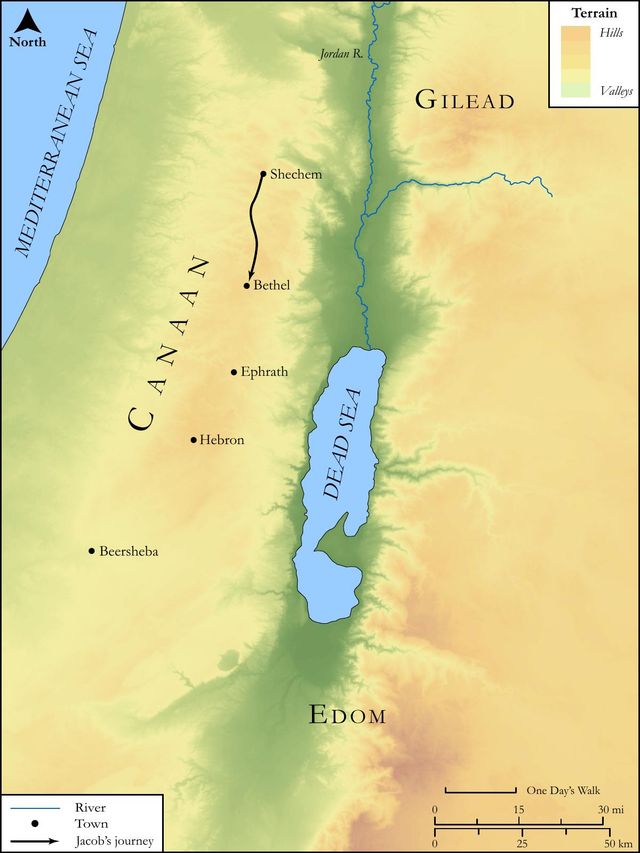
See on the biblical-era maps


Study this verse
Public-domain commentary
Matthew Henry
From his Commentary on the Whole Bible. Henry comments on passages, not single verses — this entry covers Genesis 35:1–5. His three-level outline is real structure in the source text, so it is rendered as structure.
Here, I. God reminds Jacob of his vow at Beth-el, and sends him thither to perform it, Gen 35:1. Jacob had said in the day of his distress, If I come again in peace, this stone shall be God's house, Gen 28:22. God had performed his part of the bargain, and had given Jacob more than bread to eat and raiment to put on - he had got an estate, and had become two bands; but, it should seem, he had forgotten his vow, or at least had too long deferred the performance of it. Seven or eight years it was now since he came to Canaan; he had purchased ground there, and had built an altar in remembrance of God's last appearance to him when he called him Israel (Gen 33:19, Gen 33:20); but still Beth-el is forgotten. Note, Time is apt to wear out the sense of mercies and the impressions made upon us by them; it should not be so, but so it is. God had exercised Jacob with a very sore affliction in his family (ch. 34), to see if this would bring his vow to his remembrance, and put him upon the performance of it, but it had not this effect; therefore God comes himself and puts him in mind of it: Arise, go to Beth-el. Note, 1. As many as God loves he will remind of neglected duties, one way or other, by conscience or by providences. 2. When we have vowed a vow to God, it is best not to defer the payment of it (Ecc 5:4), yet better late than never. God bade him go to Beth-el and dwell there, that is, not only go himself, but take his family with him, that they might join with him in his devotions. Note, In Beth-el, the house of God, we should desire to dwell, Psa 27:4. That should be our home, not our inn. God reminds him not expressly of his vow, but of the occasion of it: When thou fleddest from the face of Esau. Note, The remembrance of former afflictions should bring to mind the workings of our souls under them, Psa 66:13, Psa 66:14.
II.Jacob commands his household to prepare for this solemnity; not only for the journey and remove, but for the religious services that were to be performed, Gen 35:2, Gen 35:3. Note,
1.Before solemn ordinances, there must be solemn preparation. Wash you, make you clean, and then come, and let us reason together, Isa 1:16-18.
2.Masters of families should use their authority for the promoting of religion in their families. Not only we, but our houses also, should serve the Lord, Jos 24:15. Observe the commands he gives his household, like Abraham, Gen 18:19.
(1.)They must put away the strange gods. Strange gods in Jacob's family! Strange things indeed! Could such a family, that was taught the good knowledge of the Lord, admit them? Could such a master, to whom God had appeared twice, and oftener, connive at them? Doubtless this was his infirmity. Note, Those that are good themselves cannot always have those about them so good as they should be. In those families where there is a face of religion, and an altar to God, yet many times there is much amiss, and more strange gods than one would suspect. In Jacob's family, Rachel had her ִֶַ, which, it is to be feared, she secretly made some superstitious use of. The captives of Shechem brought their gods along with them, and perhaps Jacob's sons took some with the plunder. However they came by them, now they must put them away.
(2.)They must be clean, and change their garments; they must observe a due decorum, and make the best appearance they could. Simeon and Levi had their hands full of blood, it concerned them particularly to wash, and to put off their garments that were so stained. These were but ceremonies, signifying the purification and change of the heart. What are clean clothes, and new clothes, without a clean heart, and a new heart? Dr. Lightfoot, by their being clean, or washing themselves, understands Jacob's admission of the proselytes of Shechem and Syria into his religion by baptism, because circumcision had become odious.
3.They must go with him to Bethel, Gen 35:3. Note, Masters of families, when they go up to the house of God, should bring their families with them.
III.His family surrendered all they had that was idolatrous or superstitious, Gen 35:4.
Perhaps, if Jacob had called for them sooner, they would sooner have parted with them, being convicted by their own consciences of the vanity of them. Note, Sometimes attempts for reformation succeed better than one could have expected, and people are not so obstinate against them as we feared. Jacob's servants, and even the retainers of his family, gave him all the strange gods, and the ear-rings they wore, either as charms or to the honour of their gods; they parted with all. Note, Reformation is not sincere if it be not universal. We hope they parted with them cheerfully, and without reluctance, as Ephraim did, when he said, What have I to do any more with idols? (Hos 14:8), or that people that said to their idols, Get you hence, Isa 30:22. Jacob took care to bury their images, we may suppose in some place unknown to them, that they might not afterwards find them and return to them. Note, We must be wholly separated from our sins, as we are from those that are dead and buried out of our sight, cast them to the moles and the bats, Isa 2:20.
IV.He removes without molestation from Shechem to Bethel, Gen 35:5.
The terror of God was upon the cities. Though the Canaanites were much exasperated against the sons of Jacob for their barbarous usage of the Shechemites, yet they were so restrained by a divine power that they could not take this fair opportunity, which now offered itself, when they were upon their march, to avenge their neighbours' quarrel. Note, The way of duty is the way of safety. While there was sin in Jacob's house, he was afraid of his neighbours; but now that the strange gods were put away, and they were all going together to Bethel, his neighbours were afraid of him. When we are about God's work, we are under special protection. God is with us, while we are with him; and, if he be for us, who can be against us? See Exo 34:24, No man shall desire thy land, when thou goest up to appear before the Lord. God governs the world more by secret terrors on men's minds than we are aware of.
Continue studying Genesis 35:3 across the web’s major study libraries — every link below opens this exact verse, chapter, or book on the destination site.
Read & Compare
 BibleGatewayThis verse in more than 200 translations and 70 languages.
 Bible.comThe YouVersion reader — hundreds of translations, reading plans, and highlights.
 ESV.orgCrossway's official English Standard Version reader.
 NET BibleThe NET translation with 60,000+ translators' notes on every rendering decision.
 STEP BibleTyndale House's free study tool — original text, vocabulary, and scholarly resources.
 BibliaLogos Bible Software's free web reader.
 USCCBThe New American Bible (Revised Edition) with the U.S. bishops' study notes.
Commentaries
 BibleHub CommentariesDozens of classic commentaries on this verse, gathered on one page.
 StudyLightMore than 100 commentary sets — the largest collection on the web.
 BibleRefPlain-English commentary on what this verse means, verse by verse.
 Enduring WordDavid Guzik's free commentary on this chapter, widely used by Bible teachers.
 Bible Study ToolsVerse commentary alongside Greek and Hebrew study aids.
Original Language & Research
- BibleHub InterlinearThe verse word by word — original language, transliteration, and English.
- BibleHub LexiconEvery word's original-language definition and Strong's entry.
 Blue Letter BibleDeep-study tools — Strong's numbers, concordance, and word studies.
 SefariaThe Hebrew text with Rashi and centuries of Jewish commentary.
Sermons, Hymns & Audio


TrulyRandomVerse is not affiliated with these sites and doesn’t control their content. They’re linked because they’re genuinely useful.
Summary
Genesis 35:3 records Jacob's solemn directive to his household to journey to Bethel, the "House of God," a site of profound prior divine encounter. His stated purpose is to construct an altar there unto God, an act signifying the intentional fulfillment of a vow made in a time of deep vulnerability. This declaration serves as a powerful testament to God's unwavering faithfulness, acknowledging His responsive deliverance from distress and His constant, guiding presence throughout Jacob's arduous life journey.
Context
ShowHideLiterary Context
Jacob's command to "arise, and go up to Bethel" is not arbitrary but flows directly from God's explicit instruction in Genesis 35:1. This divine directive follows a tumultuous period in Jacob's life, marked by the violent retribution of Simeon and Levi against the Shechemites (Genesis 34) and the lingering threat of reprisal from surrounding peoples. Before embarking on this pilgrimage, Jacob wisely calls for a spiritual purification of his household, instructing them to "put away the strange gods that are among you, and be clean, and change your garments" (Genesis 35:2). This preparatory act underscores the sacred nature of the journey and the worship to follow, signaling a renewed commitment to the one true God. The journey to Bethel also represents the long-awaited fulfillment of a vow Jacob made decades earlier while fleeing from Esau, where he promised to return to this very place and build an altar if God would protect him and bring him back safely (Genesis 28:20-22).
Historical & Cultural Context
For the patriarchs, the construction of altars was a pivotal act of worship, signifying a place of sacrifice, covenant renewal, and communion with the divine. These altars often marked significant encounters with God, serving as tangible memorials of His presence and promises. Bethel, meaning "House of God," was already a consecrated site due to Jacob's initial dream and encounter with God there (Genesis 28:10-19). The act of "going up" to Bethel implies an ascent, both geographically (Bethel is elevated) and spiritually, reflecting a movement towards a sacred space for a consecrated purpose. Furthermore, the command to purify the household by putting away "strange gods" (Genesis 35:2) highlights the pervasive syncretism of the era, even within a patriarchal household, and emphasizes the importance of exclusive worship of Yahweh as a foundational covenant requirement.
Key Themes
ShowHideThis passage powerfully contributes to several overarching themes in Genesis and the broader biblical narrative. Central among these is the theme of covenant faithfulness, both God's unwavering commitment to His promises (as seen in His protection of Jacob) and the human responsibility to respond in obedience and honor vows made to Him. The journey to Bethel underscores the theme of divine presence and guidance, illustrating that God is not a distant deity but actively involved in the lives of His people, guiding them "in the way which [they] went." The act of building an altar and recalling God's deliverance from "distress" highlights remembrance and thanksgiving as essential components of authentic worship. Finally, the purification preceding the journey emphasizes spiritual renewal and holiness, signifying that true worship requires a consecrated heart and life, a theme that resonates throughout the Old Testament's sacrificial system and into the New Testament's call for sanctification.
Exposition and Analysis
ShowHideKey Word Analysis
ShowHideFrom the Hebrew words for "house" (bayith) and "God" (ʼêl), meaning "house of God." This name was given by Jacob himself in Genesis 28:19 after his profound dream. It signifies a place consecrated by divine encounter, where God's presence was uniquely manifested, making it a sacred destination for Jacob's act of worship and vow fulfillment.
This feminine noun literally means "tightness" or "narrowness," and figuratively conveys "trouble," "anguish," or "tribulation." It vividly describes the various severe predicaments Jacob had faced, from fleeing Esau's wrath to the complex and often hostile dealings with Laban, and most recently, the aftermath of his sons' violence in Shechem. Jacob's acknowledgment that God answered him "in the day of my distress" underscores God's active and timely intervention in his most desperate moments.
From a root meaning "to tread," this noun refers to a "road" or "path." Figuratively, it denotes a "course of life" or "mode of action." Coupled with the verb "went" (Hebrew, hâlak'), it emphasizes the entirety of Jacob's journey—both physical travels and life experiences. God's continuous presence "in the way which I went" speaks to His faithful companionship, guidance, and protection through every phase and challenge of Jacob's extensive and often perilous pilgrimage.
Verse Breakdown
ShowHide"And let us arise, and go up to Bethel"
This clause reveals Jacob's decisive leadership and his intention to initiate a sacred pilgrimage. The plural "us" indicates a communal act involving his entire household, underscoring the corporate nature of worship and covenant renewal in ancient Israelite life. "Go up" signifies both the literal ascent to Bethel's elevated location and a spiritual elevation towards God.
"and I will make there an altar unto God"
This is the core purpose of the journey. The construction of an altar was a foundational act of worship, signifying a dedicated space for sacrifice, prayer, and communion. For Jacob, it was the tangible fulfillment of the vow he made in Genesis 28:20-22, a public declaration of his gratitude and renewed commitment to the God of his fathers.
"who answered me in the day of my distress"
Here, Jacob articulates the primary motivation for his worship: God's faithful responsiveness. This phrase is a personal testimony, recalling specific instances of deep trouble (like fleeing Esau or dealing with Laban) where God intervened and provided deliverance. It highlights God's character as one who hears and responds to the cries of His people.
"and was with me in the way which I went"
This final clause emphasizes God's continuous, abiding presence and guidance throughout Jacob's entire journey. It's a profound acknowledgment that God's faithfulness extended beyond specific interventions to a constant, protective companionship, affirming His covenant promise to never leave or forsake His chosen ones, regardless of the path's difficulty.
Literary Devices
ShowHideThe verse employs several significant literary devices. Confession and Testimony are prominent, as Jacob openly declares God's past faithfulness and deliverance to his entire household. This serves not only as a personal act of worship but also as an instructional moment for his family, reinforcing their collective memory of God's work. The Symbolism of the altar is profound, representing a place of sacrifice, communion, and covenant renewal, a tangible marker of Jacob's renewed commitment to God. Furthermore, the phrase "in the day of my distress" and "in the way which I went" utilizes Metonymy, where "day" stands for the period of trouble and "way" for the entirety of his life's journey, emphasizing the comprehensive nature of God's care. The entire passage forms a pivotal point in Jacob's Narrative Arc, marking a spiritual turning point from past trials and compromises towards a renewed, obedient relationship with God, fulfilling long-standing vows.
Theological and Thematic Connections
ShowHideJacob's journey to Bethel and his declaration in Genesis 35:3 encapsulate profound theological truths that resonate throughout Scripture. His intentional act of fulfilling a vow underscores the sacredness of promises made to God, demonstrating that obedience and gratitude are integral responses to divine faithfulness. This passage highlights God's character as a covenant-keeping God who actively engages with His people, hearing their cries in distress and guiding them through every step of their lives. It establishes a pattern for believers to remember God's past interventions, cultivate a spirit of thanksgiving, and prioritize worship as a natural and necessary response to His unfailing presence and provision.
Reflection and Application
ShowHideJacob's actions in Genesis 35:3 offer timeless principles for contemporary believers. We are reminded of the solemnity and importance of keeping our commitments to God, especially those made in moments of vulnerability or desperation. Just as Jacob recounted God's faithfulness in his "day of distress," we are called to regularly reflect on and remember God's past deliverances in our own lives, allowing these memories to strengthen our faith and build our trust for future challenges. This act of remembrance fosters a deep sense of gratitude, leading us to prioritize worship and thanksgiving as central expressions of our relationship with God. Furthermore, Jacob's testimony that God "was with me in the way which I went" serves as a powerful assurance that God's presence is not limited to dramatic interventions but is a constant, abiding reality in our daily walk. Embracing this truth cultivates peace, resilience, and a profound reliance on Him, knowing that He guides and sustains us through every twist and turn of our earthly pilgrimage.
Questions for Reflection
ShowHideFAQ
ShowHideWhat is the significance of Jacob's return to Bethel?
ShowHideJacob's return to Bethel is profoundly significant as it represents the culmination and fulfillment of a solemn vow he made to God decades earlier while fleeing from Esau (Genesis 28:20-22). This act of obedience signifies a spiritual renewal for Jacob and his household, a re-establishment of his covenant relationship with God in the very place where he first encountered the Lord in a profound, life-altering dream. It underscores the biblical importance of honoring one's commitments to God and returning to foundational experiences of faith for spiritual reorientation and purification.
How does Jacob's experience of God's presence relate to believers today?
ShowHideJacob's testimony that God "was with me in the way which I went" resonates deeply with believers today because it illustrates the unchanging nature of God's promise to be present with His people. This divine companionship offers unwavering guidance, protection, and comfort through all of life's circumstances, whether in times of prosperity or "days of distress." For Christians, this promise finds its ultimate fulfillment in the person of Jesus Christ, who is Immanuel, meaning "God with us" (Matthew 1:23), and through the indwelling Holy Spirit, assuring believers of God's constant companionship and active involvement in their lives, just as He was with Jacob (Hebrews 13:5).
Christ-Centered Fulfillment
ShowHideJacob's experience in Genesis 35:3 serves as a powerful precursor to the person and work of Jesus Christ. Jacob's act of building an altar to God, who "answered me in the day of my distress," foreshadows Christ as the ultimate altar and perfect sacrifice through whom humanity's deepest distress—the bondage of sin and separation from God—is definitively answered and overcome (Hebrews 9:26). The God who "was with me in the way which I went" finds His perfect and complete embodiment in Jesus, Immanuel, "God with us" (Matthew 1:23). Christ is the true "House of God" (Bethel), the living Temple where God perfectly dwells among humanity, and through whom all access to the Father is granted (John 2:19-21). Through His atoning work, Christ fulfills all the promises of God's abiding presence, deliverance from distress, and the establishment of a new covenant, inviting all who believe into an eternal relationship with the God who is always "with us" (Matthew 28:20).