


Genesis 35:2
Bible text: King James Version (1769 Blayney text) · Public domain
Bible text: Berean Standard Bible · Public domain
Bible text: American Standard Version (1901) · Public domain
Bible text: World English Bible, Messianic edition · Public domain
Bible text: Geneva Bible (1599) · Public domain
Bible text: Young's Literal Translation · Public domain
- וַיֹּאמֶרvai·Yo·merand he saidH559Conj-w ¦ V-Qal-ConsecImperf-3msVerb Qal Consecutive Imperfect 3rd Singular Masculineוַandיֹּאמֶרhe said
- יַעֲקֹבya·'a·KoJacobH3290N-proper-mNoun Proper Masculine
- אֶל'eltoH413PrepPreposition
- בֵּיתוֹbei·Tohis householdH1004N-msc ¦ 3msNoun Singular Masculine Constructבֵּיתhouseholdוֹhis
- וְאֶלve·'Eland toH413Conj-w ¦ PrepPrepositionוְandאֶלto
- כָּלkolallH3605N-msNoun Singular Masculine Absolute
- אֲשֶׁר'a·SherwhoH834RelParticle Relative
- עִמּוֹi·Mo[were] with himH5973Prep ¦ 3msPreposition Definiteעִמּ[were] withוֹhim
- הָסִרוּha·Si·ruremoveH5493V-Hiphil-Imp-2mpVerb Hiphil Imperative 2nd Plural Masculine
- אֶת'et<obj.>H853DirObjMParticle Object Indicator
- אֱלֹהֵי'e·lo·Hei[the] gods ofH430N-mpcNoun Plural Masculine Construct
- הַנֵּכָרha·ne·Khar<the> foreignnessH5236Art ¦ N-msNoun Singular Masculine Absoluteהַ<the>נֵּכָרforeignness
- אֲשֶׁר'a·SherwhichH834RelParticle Relative
- בְּתֹכְכֶםbe·to·khe·Khemin midst of youH8432Prep-b ¦ N-msc ¦ 2mpNoun Singular Masculine Constructבְּinתֹכְmidst ofכֶםyou
- וְהִטַּהֲרוּve·hi·ta·ha·Ruand purify yourselvesH2891Conj-w ¦ V-Hithpael-Imp-2mpVerb Hithpael Imperative 2nd Plural Masculineוְandהִטַּהֲרוּpurify yourselves
- וְהַחֲלִיפוּve·ha·cha·Li·fuand changeH2498Conj-w ¦ V-Hiphil-Imp-2mpVerb Hiphil Imperative 2nd Plural Masculineוְandהַחֲלִיפוּchange
- שִׂמְלֹתֵיכֶםsim·lo·tei·Khemyour clothesH8071N-fpc ¦ 2mpNoun Plural Feminine Constructשִׂמְלֹתֵיclothesכֶםyour
English is a literal word-by-word gloss of the Hebrew, not the KJV's wording. Why?
This is the original text the KJV's translators worked from — each Hebrew word with its own literal English meaning in this verse, prepared by scholars at Tyndale House, Cambridge. The KJV translates whole sentences, not word by word, so its wording differs: one Hebrew word can become several English words, and the KJV may choose “the LORD” where the gloss reads “Yahweh”. Both are faithful — they answer different questions. For the KJV's own rendering, switch to the KJV text.
Details
See on the biblical-era maps


Study this verse
Public-domain commentary
Matthew Henry
From his Commentary on the Whole Bible. Henry comments on passages, not single verses — this entry covers Genesis 35:1–5. His three-level outline is real structure in the source text, so it is rendered as structure.
Here, I. God reminds Jacob of his vow at Beth-el, and sends him thither to perform it, Gen 35:1. Jacob had said in the day of his distress, If I come again in peace, this stone shall be God's house, Gen 28:22. God had performed his part of the bargain, and had given Jacob more than bread to eat and raiment to put on - he had got an estate, and had become two bands; but, it should seem, he had forgotten his vow, or at least had too long deferred the performance of it. Seven or eight years it was now since he came to Canaan; he had purchased ground there, and had built an altar in remembrance of God's last appearance to him when he called him Israel (Gen 33:19, Gen 33:20); but still Beth-el is forgotten. Note, Time is apt to wear out the sense of mercies and the impressions made upon us by them; it should not be so, but so it is. God had exercised Jacob with a very sore affliction in his family (ch. 34), to see if this would bring his vow to his remembrance, and put him upon the performance of it, but it had not this effect; therefore God comes himself and puts him in mind of it: Arise, go to Beth-el. Note, 1. As many as God loves he will remind of neglected duties, one way or other, by conscience or by providences. 2. When we have vowed a vow to God, it is best not to defer the payment of it (Ecc 5:4), yet better late than never. God bade him go to Beth-el and dwell there, that is, not only go himself, but take his family with him, that they might join with him in his devotions. Note, In Beth-el, the house of God, we should desire to dwell, Psa 27:4. That should be our home, not our inn. God reminds him not expressly of his vow, but of the occasion of it: When thou fleddest from the face of Esau. Note, The remembrance of former afflictions should bring to mind the workings of our souls under them, Psa 66:13, Psa 66:14.
II.Jacob commands his household to prepare for this solemnity; not only for the journey and remove, but for the religious services that were to be performed, Gen 35:2, Gen 35:3. Note,
1.Before solemn ordinances, there must be solemn preparation. Wash you, make you clean, and then come, and let us reason together, Isa 1:16-18.
2.Masters of families should use their authority for the promoting of religion in their families. Not only we, but our houses also, should serve the Lord, Jos 24:15. Observe the commands he gives his household, like Abraham, Gen 18:19.
(1.)They must put away the strange gods. Strange gods in Jacob's family! Strange things indeed! Could such a family, that was taught the good knowledge of the Lord, admit them? Could such a master, to whom God had appeared twice, and oftener, connive at them? Doubtless this was his infirmity. Note, Those that are good themselves cannot always have those about them so good as they should be. In those families where there is a face of religion, and an altar to God, yet many times there is much amiss, and more strange gods than one would suspect. In Jacob's family, Rachel had her ִֶַ, which, it is to be feared, she secretly made some superstitious use of. The captives of Shechem brought their gods along with them, and perhaps Jacob's sons took some with the plunder. However they came by them, now they must put them away.
(2.)They must be clean, and change their garments; they must observe a due decorum, and make the best appearance they could. Simeon and Levi had their hands full of blood, it concerned them particularly to wash, and to put off their garments that were so stained. These were but ceremonies, signifying the purification and change of the heart. What are clean clothes, and new clothes, without a clean heart, and a new heart? Dr. Lightfoot, by their being clean, or washing themselves, understands Jacob's admission of the proselytes of Shechem and Syria into his religion by baptism, because circumcision had become odious.
3.They must go with him to Bethel, Gen 35:3. Note, Masters of families, when they go up to the house of God, should bring their families with them.
III.His family surrendered all they had that was idolatrous or superstitious, Gen 35:4.
Perhaps, if Jacob had called for them sooner, they would sooner have parted with them, being convicted by their own consciences of the vanity of them. Note, Sometimes attempts for reformation succeed better than one could have expected, and people are not so obstinate against them as we feared. Jacob's servants, and even the retainers of his family, gave him all the strange gods, and the ear-rings they wore, either as charms or to the honour of their gods; they parted with all. Note, Reformation is not sincere if it be not universal. We hope they parted with them cheerfully, and without reluctance, as Ephraim did, when he said, What have I to do any more with idols? (Hos 14:8), or that people that said to their idols, Get you hence, Isa 30:22. Jacob took care to bury their images, we may suppose in some place unknown to them, that they might not afterwards find them and return to them. Note, We must be wholly separated from our sins, as we are from those that are dead and buried out of our sight, cast them to the moles and the bats, Isa 2:20.
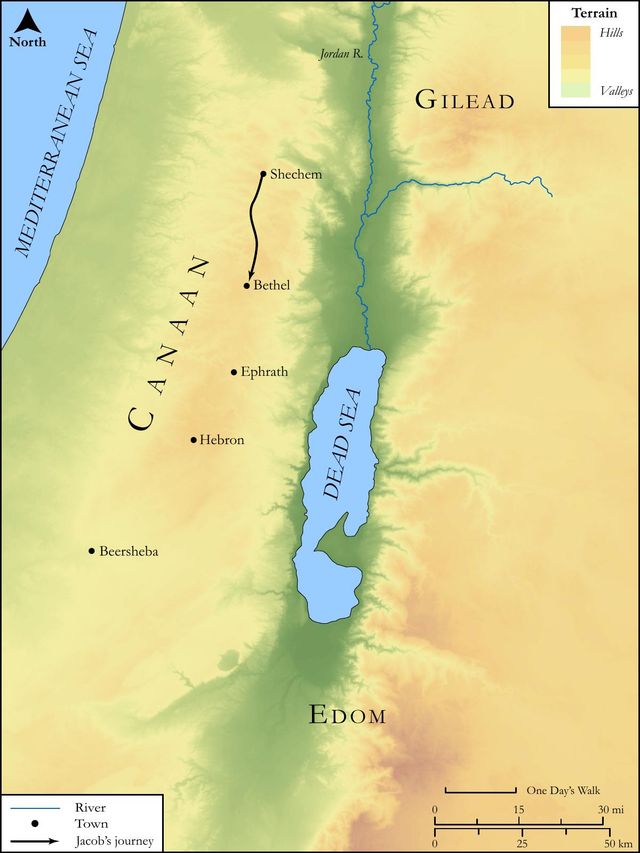
IV.He removes without molestation from Shechem to Bethel, Gen 35:5.
The terror of God was upon the cities. Though the Canaanites were much exasperated against the sons of Jacob for their barbarous usage of the Shechemites, yet they were so restrained by a divine power that they could not take this fair opportunity, which now offered itself, when they were upon their march, to avenge their neighbours' quarrel. Note, The way of duty is the way of safety. While there was sin in Jacob's house, he was afraid of his neighbours; but now that the strange gods were put away, and they were all going together to Bethel, his neighbours were afraid of him. When we are about God's work, we are under special protection. God is with us, while we are with him; and, if he be for us, who can be against us? See Exo 34:24, No man shall desire thy land, when thou goest up to appear before the Lord. God governs the world more by secret terrors on men's minds than we are aware of.
Historical interpretation
Historical reception
1 surviving comment on this verse from the historical church.
After he was called by God, Jacob ascends to Bethel, that is, to the house of God (this is how the name Bethel is interpreted), offers sacrifices to God and is declared chief and master of the holy rites. He teaches his successors and descendants how they must enter the house of God. He orders the foreign gods to be rejected like dung and filth and to change the garments. It is fitting for us to do likewise when we are called before God, or enter the divine temple, especially in the time of the holy baptism. We, as if we drive away the foreign gods and part from such error, must assert, “I refuse you, Satan, and all your pomp and all your worship.” We also must change completely our garment by stripping off “the old self that is corrupt through deceitful lusts” and by clothing ourselves with “the new self, which is being renewed in knowledge according to image of its Creator.” The women who were with Jacob took off their earrings. And in fact women by entering the house of God without wearing any carnal ornament and with loose hair remove from their head any accusation of pride. That is why, I believe, those women took off the precious stones they wore in their ears.
Continue studying Genesis 35:2 across the web’s major study libraries — every link below opens this exact verse, chapter, or book on the destination site.
Read & Compare
 BibleGatewayThis verse in more than 200 translations and 70 languages.
 Bible.comThe YouVersion reader — hundreds of translations, reading plans, and highlights.
 ESV.orgCrossway's official English Standard Version reader.
 NET BibleThe NET translation with 60,000+ translators' notes on every rendering decision.
 STEP BibleTyndale House's free study tool — original text, vocabulary, and scholarly resources.
 BibliaLogos Bible Software's free web reader.
 USCCBThe New American Bible (Revised Edition) with the U.S. bishops' study notes.
Commentaries
 BibleHub CommentariesDozens of classic commentaries on this verse, gathered on one page.
 StudyLightMore than 100 commentary sets — the largest collection on the web.
 BibleRefPlain-English commentary on what this verse means, verse by verse.
 Enduring WordDavid Guzik's free commentary on this chapter, widely used by Bible teachers.
 Bible Study ToolsVerse commentary alongside Greek and Hebrew study aids.
Original Language & Research
- BibleHub InterlinearThe verse word by word — original language, transliteration, and English.
- BibleHub LexiconEvery word's original-language definition and Strong's entry.
 Blue Letter BibleDeep-study tools — Strong's numbers, concordance, and word studies.
 SefariaThe Hebrew text with Rashi and centuries of Jewish commentary.
Sermons, Hymns & Audio


TrulyRandomVerse is not affiliated with these sites and doesn’t control their content. They’re linked because they’re genuinely useful.
Summary
Genesis 35:2 records Jacob's pivotal command to his entire household and all accompanying him, initiating a profound spiritual and ritual purification. This divine directive was a crucial preparatory step for their journey to Bethel, the sacred site where God had previously appeared to Jacob and where he was now divinely instructed to erect an altar, signifying a renewed covenant commitment and a decisive break from any lingering idolatrous practices within his camp.
Context
ShowHideLiterary Context
This verse immediately follows God's direct and urgent command to Jacob in Genesis 35:1 to journey to Bethel, build an altar, and dwell there. This divine instruction serves as the catalyst for Jacob's subsequent actions. The necessity for purification is underscored by the preceding narrative, particularly the violent and morally questionable events at Shechem in Genesis 34, which had brought Jacob's family into disrepute and danger. Jacob's command in Genesis 35:2 thus represents a turning point, a spiritual house-cleaning essential for approaching a holy God and re-establishing their covenant relationship at a place of profound spiritual significance. Bethel itself held deep personal meaning for Jacob, being the site of his foundational dream and God's reaffirmation of the Abrahamic covenant promises in Genesis 28:10-22.
Historical & Cultural Context
The peoples among whom Jacob's household had lived, from Laban's house to Shechem, worshipped many gods, and household idols (teraphim), such as those Rachel took from Laban, were common. Even within families who acknowledged Yahweh, syncretistic practices—mixing the worship of the true God with pagan customs—were a persistent temptation. The presence of "strange gods" within Jacob's household, likely including the teraphim Rachel had stolen from Laban (Genesis 31:19), illustrates this cultural reality. The commands to "be clean" and "change your garments" anticipate the cleansing of person and garments that Israel would later be commanded to observe before Sinai, and which received its full theological significance within the Mosaic Law. Changing garments often symbolized a transition to a sacred state, mourning, or a new beginning, while ritual washing was a prerequisite for approaching the divine or participating in sacred rites.
Key Themes
ShowHideGenesis 35:2 contributes significantly to several overarching themes in the book of Genesis and biblical theology. Foremost is the theme of Divine Sovereignty and Guidance, as Jacob's action is a direct response to God's command. It powerfully highlights the theme of Covenant Faithfulness and Renewal, as Jacob's family prepares to re-engage with God at the site of a foundational covenant promise. The explicit command to "put away the strange gods" introduces the critical theme of Exclusive Worship and the Rejection of Idolatry, a principle that becomes a cornerstone of Israelite faith. Furthermore, the instructions to "be clean, and change your garments" emphasize the theme of Holiness and Purity as Prerequisites for Divine Encounter, underscoring that approaching a holy God requires a corresponding state of ritual and spiritual consecration. These themes collectively prepare the reader for the unfolding narrative of Israel's unique relationship with Yahweh.
Exposition and Analysis
ShowHideKey Word Analysis
ShowHideThis term denotes more than just a physical dwelling; it encompasses the entire family unit, including servants, extended relatives, and all who lived under Jacob's authority. Its usage here emphasizes that Jacob's command for purification was comprehensive, extending to every individual within his sphere of influence, underscoring the communal responsibility for spiritual integrity.
This word means "foreign" or "alien." When applied to "gods" (H430, ʼĕlôhîym), it signifies deities that are not Yahweh, the covenant God of Israel. Their "strangeness" highlights their incompatibility with the true worship demanded by God, emphasizing that they are an intrusion and an affront to His exclusive claim on His people's devotion.
This primitive root signifies being "bright," and by implication, "pure." It refers to both physical purity (e.g., sound, unadulterated) and, crucially, Levitical (ceremonial) and moral purity. In this context, it implies a ritual washing to remove defilement, but also points to an underlying spiritual cleansing—a shedding of anything that would render one unfit to stand in God's presence.
This root means "to slide by," "pass on," or "change." When paired with "garments" (H8071, simlâh'), it implies a complete alteration of attire, not merely a superficial adjustment. This act was a powerful symbolic gesture, signifying a transition from an old state to a new, consecrated one, mirroring the internal transformation required for approaching God.
Verse Breakdown
ShowHide"Then Jacob said unto his household, and to all that [were] with him,"
This opening clause establishes the scope of Jacob's authority and the breadth of the command. It wasn't just his immediate family but everyone under his care, including servants and any other individuals who had joined his nomadic company. This universal reach highlights the communal nature of the impending spiritual encounter and the responsibility of the patriarch for the spiritual welfare of his entire camp.
"Put away the strange gods that [are] among you,"
This is the primary and most urgent directive. "Put away" (Hebrew: çûwr) implies a decisive removal, a conscious act of separation. The "strange gods" (Hebrew: ʼĕlôhîym nêkâr) refer to foreign deities or idols, indicating that despite their journey with Jacob, elements of polytheistic worship persisted within his extended family. This command underscores God's demand for exclusive worship and Jacob's recognition that idolatry was an impediment to true communion with Yahweh.
"and be clean,"
This second command calls for ritual and spiritual purification. The Hebrew word ṭâhêr denotes a state of ceremonial purity, typically achieved through washing. This act was not merely external but symbolized an internal readiness to shed defilement and present oneself as consecrated before a holy God. It signifies a moral and spiritual cleansing, preparing the heart for divine encounter.
"and change your garments:"
This final instruction reinforces the call for complete transformation. Changing garments (Hebrew: châlaph simlâh) was a common practice to mark a significant transition, such as entering a holy place, mourning, or taking a new status, as when Joseph shaved and changed his raiment before he came in unto Pharaoh. Here, it symbolizes a visible commitment to a new, consecrated state, leaving behind the old, defiled ways and embracing a renewed dedication to God.
Literary Devices
ShowHideThe passage employs several potent literary devices. The most prominent is Imperative Mood, as Jacob issues direct commands ("Put away," "be clean," "change"), conveying the urgency and non-negotiable nature of the purification. Symbolism is deeply embedded in the actions commanded: "strange gods" symbolize anything that displaces God in one's life; "being clean" symbolizes spiritual purity and preparedness; and "changing garments" symbolizes a complete transformation, a shedding of the old self and an embracing of a consecrated new identity. There is also an implicit Contrast between the defiled state of the household (due to the presence of idols and the events at Shechem) and the desired state of purity necessary for approaching the holy God at Bethel. These devices collectively underscore the gravity of the moment and the radical transformation required.
Theological and Thematic Connections
ShowHideJacob's command in Genesis 35:2 encapsulates fundamental theological principles that resonate throughout the biblical narrative. It powerfully asserts God's absolute holiness and His demand for exclusive worship, establishing that syncretism—the blending of devotion to Yahweh with pagan practices—is an affront to His nature. The necessity of purification, both ritual and spiritual, before approaching the divine is a foundational truth, demonstrating that a holy God cannot be casually encountered while clinging to defilement. This passage also highlights the ongoing need for covenant faithfulness and renewal, as believers are continually called to reaffirm their loyalty to God and separate themselves from anything that compromises their devotion.
Reflection and Application
ShowHideGenesis 35:2 offers timeless and profound lessons for believers today, emphasizing the enduring necessity of spiritual cleansing and singular devotion to God. We are called to engage in a continuous process of self-examination, identifying and decisively "putting away" any "strange gods" that may have infiltrated our lives. These modern idols are often not physical statues but anything that subtly or overtly takes precedence over God—be it wealth, career, relationships, self-image, comfort, or even spiritual pride. This involves a conscious commitment to repentance, seeking forgiveness for sin, and actively pursuing a life consecrated solely to God. Just as Jacob's household prepared for a physical encounter with God at Bethel, we are to prepare our hearts for God's presence in our daily lives, in corporate worship, and through His Word. This preparation entails consciously separating ourselves from worldly defilements, cultivating purity of heart, and striving to live in a manner worthy of His calling, reflecting His holiness in every aspect of our being.
Questions for Reflection
ShowHideFAQ
ShowHideWhat were these "strange gods" and why were they present in Jacob's household?
ShowHideThe "strange gods" (Hebrew: elohim nekar) were likely household idols or teraphim, small images or figurines used for various purposes in households like Laban's, including divination, protection, or as symbols of family inheritance rights. Their presence in Jacob's household, despite Jacob's personal faith in Yahweh, suggests a lingering syncretism within his extended family. This was not uncommon, as individuals often brought their former religious practices and objects into new contexts. A notable example is Rachel's theft of Laban's teraphim in Genesis 31:19, indicating that idolatry was a real and persistent challenge even within the patriarchal families. Jacob's command highlights the ongoing struggle to maintain monotheistic purity amidst pervasive polytheistic influences, underscoring the importance of decisive separation from all forms of idolatry.
Christ-Centered Fulfillment
ShowHideGenesis 35:2, with its imperative call for purification and separation from idols before encountering God, finds its profound and ultimate fulfillment in Jesus Christ. While Jacob's household underwent ritual cleansing and changed garments as an outward sign of an inward commitment, Christ offers a far more profound and lasting purification. He is the ultimate High Priest who, through His perfect sacrifice on the cross, provides the means for true spiritual cleansing, washing away the defilement of sin once and for all (Hebrews 9:14). Believers are not merely called to change their garments but to "put off the old man with his deeds" and "put on the new man, which is renewed in knowledge after the image of him that created him" (Colossians 3:9-10). This transformation is not achieved through external rituals but through an internal regeneration wrought by the Holy Spirit, making us clean and righteous in Christ. He is the true "Bethel," the "house of God," where God fully dwells among His people, and through Him, we are granted access to the Father, cleansed and consecrated not by human effort but by divine grace (Ephesians 2:18).