


Genesis 35:1
- וַיֹּאמֶרvai·Yo·merand he saidH559Conj-w ¦ V-Qal-ConsecImperf-3msVerb Qal Consecutive Imperfect 3rd Singular Masculineוַandיֹּאמֶרhe said
- אֱלֹהִים'E·lo·HimGodH430N-mpNoun Plural Masculine Absolute
- אֶל'eltoH413PrepPreposition
- יַעֲקֹבya·'a·KoJacobH3290N-proper-mNoun Proper Masculine
- קוּםkumariseH6965V-Qal-Imp-2msVerb Qal Imperative 2nd Singular Masculine
- עֲלֵה'a·Lehgo upH5927V-Qal-Imp-2msVerb Qal Imperative 2nd Singular Masculine
- בֵיתveitBeth-H1008N-properNoun Proper Location
- אֵל'el-elH1008N-properNoun Proper Location
- וְשֶׁבve·shevand dwellH3427Conj-w ¦ V-Qal-Imp-2msVerb Qal Imperative 2nd Singular Masculineוְandשֶׁבdwell
- שָׁםShamthereH8033AdvAdverb
- וַעֲשֵׂהva·'a·sehand makeH6213Conj-w ¦ V-Qal-Imp-2msVerb Qal Imperative 2nd Singular Masculineוַandעֲשֵׂהmake
- שָׁםshamthereH8033AdvAdverb
- מִזְבֵּחַmiz·Be·achan altarH4196N-msNoun Singular Masculine Absolute
- לָאֵלla·'Elto the GodH410Prep-l ¦ N-msNoun Singular Masculine Absoluteלָto theאֵלGod
- הַנִּרְאֶהha·nir·'Ehwho appearedH7200Art ¦ V-Niphal-Prtcpl-msVerb Niphal Participle Singular Masculine Absoluteהַwhoנִּרְאֶהappeared
- אֵלֶיךָ'e·Lei·khato youH413Prep ¦ 2msPreposition Definiteאֵלֶיtoךָyou
- בְּבָרְחֲךָbe·va·re·cha·Khawhen fleeing youH1272Prep-b ¦ V-Qal-Inf ¦ 2msVerb Qal Infinitive Constructבְּwhenבָרְחֲfleeingךָyou
- מִפְּנֵיmi·pe·Neifrom beforeH6440Prep-m ¦ N-mpcNoun Plural Masculine Constructמִfromפְּנֵיbefore
- עֵשָׂו'e·SavEsauH6215N-proper-mNoun Proper Masculine
- אָחִיךָ'a·Chi·khayour brotherH251N-msc ¦ 2msNoun Singular Masculine Constructאָחִיbrotherךָyour
English is a literal word-by-word gloss of the Hebrew, not the KJV's wording. Why?
This is the original text the KJV's translators worked from — each Hebrew word with its own literal English meaning in this verse, prepared by scholars at Tyndale House, Cambridge. The KJV translates whole sentences, not word by word, so its wording differs: one Hebrew word can become several English words, and the KJV may choose “the LORD” where the gloss reads “Yahweh”. Both are faithful — they answer different questions. For the KJV's own rendering, switch to the KJV text.
Details
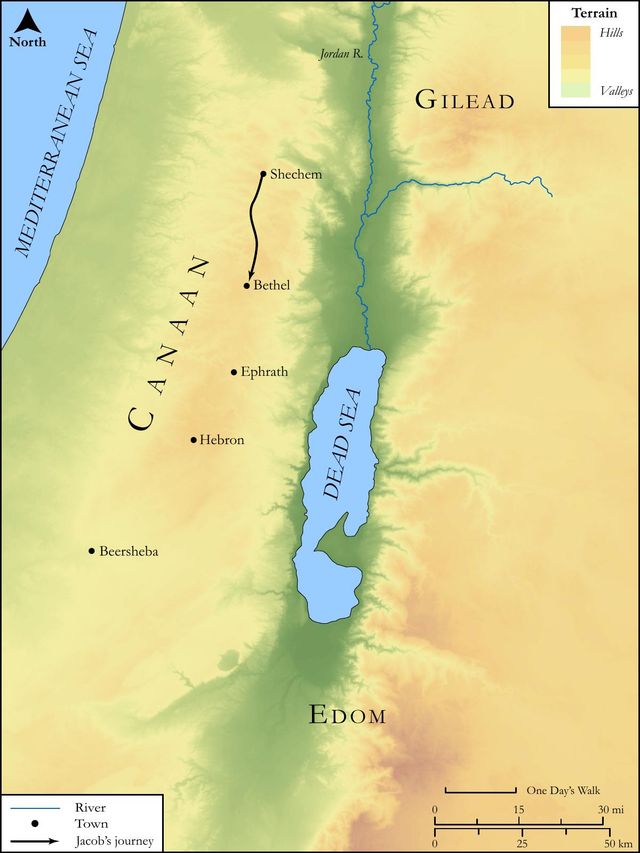
See on the biblical-era map


Study this verse
Public-domain commentary
Matthew Henry
From his Commentary on the Whole Bible. Henry comments on passages, not single verses — this entry covers Genesis 35:1–5. His three-level outline is real structure in the source text, so it is rendered as structure.
Here, I. God reminds Jacob of his vow at Beth-el, and sends him thither to perform it, Gen 35:1. Jacob had said in the day of his distress, If I come again in peace, this stone shall be God's house, Gen 28:22. God had performed his part of the bargain, and had given Jacob more than bread to eat and raiment to put on - he had got an estate, and had become two bands; but, it should seem, he had forgotten his vow, or at least had too long deferred the performance of it. Seven or eight years it was now since he came to Canaan; he had purchased ground there, and had built an altar in remembrance of God's last appearance to him when he called him Israel (Gen 33:19, Gen 33:20); but still Beth-el is forgotten. Note, Time is apt to wear out the sense of mercies and the impressions made upon us by them; it should not be so, but so it is. God had exercised Jacob with a very sore affliction in his family (ch. 34), to see if this would bring his vow to his remembrance, and put him upon the performance of it, but it had not this effect; therefore God comes himself and puts him in mind of it: Arise, go to Beth-el. Note, 1. As many as God loves he will remind of neglected duties, one way or other, by conscience or by providences. 2. When we have vowed a vow to God, it is best not to defer the payment of it (Ecc 5:4), yet better late than never. God bade him go to Beth-el and dwell there, that is, not only go himself, but take his family with him, that they might join with him in his devotions. Note, In Beth-el, the house of God, we should desire to dwell, Psa 27:4. That should be our home, not our inn. God reminds him not expressly of his vow, but of the occasion of it: When thou fleddest from the face of Esau. Note, The remembrance of former afflictions should bring to mind the workings of our souls under them, Psa 66:13, Psa 66:14.
II.Jacob commands his household to prepare for this solemnity; not only for the journey and remove, but for the religious services that were to be performed, Gen 35:2, Gen 35:3. Note,
1.Before solemn ordinances, there must be solemn preparation. Wash you, make you clean, and then come, and let us reason together, Isa 1:16-18.
2.Masters of families should use their authority for the promoting of religion in their families. Not only we, but our houses also, should serve the Lord, Jos 24:15. Observe the commands he gives his household, like Abraham, Gen 18:19.
(1.)They must put away the strange gods. Strange gods in Jacob's family! Strange things indeed! Could such a family, that was taught the good knowledge of the Lord, admit them? Could such a master, to whom God had appeared twice, and oftener, connive at them? Doubtless this was his infirmity. Note, Those that are good themselves cannot always have those about them so good as they should be. In those families where there is a face of religion, and an altar to God, yet many times there is much amiss, and more strange gods than one would suspect. In Jacob's family, Rachel had her ִֶַ, which, it is to be feared, she secretly made some superstitious use of. The captives of Shechem brought their gods along with them, and perhaps Jacob's sons took some with the plunder. However they came by them, now they must put them away.
(2.)They must be clean, and change their garments; they must observe a due decorum, and make the best appearance they could. Simeon and Levi had their hands full of blood, it concerned them particularly to wash, and to put off their garments that were so stained. These were but ceremonies, signifying the purification and change of the heart. What are clean clothes, and new clothes, without a clean heart, and a new heart? Dr. Lightfoot, by their being clean, or washing themselves, understands Jacob's admission of the proselytes of Shechem and Syria into his religion by baptism, because circumcision had become odious.
3.They must go with him to Bethel, Gen 35:3. Note, Masters of families, when they go up to the house of God, should bring their families with them.
III.His family surrendered all they had that was idolatrous or superstitious, Gen 35:4.
Perhaps, if Jacob had called for them sooner, they would sooner have parted with them, being convicted by their own consciences of the vanity of them. Note, Sometimes attempts for reformation succeed better than one could have expected, and people are not so obstinate against them as we feared. Jacob's servants, and even the retainers of his family, gave him all the strange gods, and the ear-rings they wore, either as charms or to the honour of their gods; they parted with all. Note, Reformation is not sincere if it be not universal. We hope they parted with them cheerfully, and without reluctance, as Ephraim did, when he said, What have I to do any more with idols? (Hos 14:8), or that people that said to their idols, Get you hence, Isa 30:22. Jacob took care to bury their images, we may suppose in some place unknown to them, that they might not afterwards find them and return to them. Note, We must be wholly separated from our sins, as we are from those that are dead and buried out of our sight, cast them to the moles and the bats, Isa 2:20.
IV.He removes without molestation from Shechem to Bethel, Gen 35:5.
The terror of God was upon the cities. Though the Canaanites were much exasperated against the sons of Jacob for their barbarous usage of the Shechemites, yet they were so restrained by a divine power that they could not take this fair opportunity, which now offered itself, when they were upon their march, to avenge their neighbours' quarrel. Note, The way of duty is the way of safety. While there was sin in Jacob's house, he was afraid of his neighbours; but now that the strange gods were put away, and they were all going together to Bethel, his neighbours were afraid of him. When we are about God's work, we are under special protection. God is with us, while we are with him; and, if he be for us, who can be against us? See Exo 34:24, No man shall desire thy land, when thou goest up to appear before the Lord. God governs the world more by secret terrors on men's minds than we are aware of.
Continue studying Genesis 35:1 across the web’s major study libraries — every link below opens this exact verse, chapter, or book on the destination site.
Read & Compare
 BibleGatewayThis verse in more than 200 translations and 70 languages.
 Bible.comThe YouVersion reader — hundreds of translations, reading plans, and highlights.
 ESV.orgCrossway's official English Standard Version reader.
 NET BibleThe NET translation with 60,000+ translators' notes on every rendering decision.
 STEP BibleTyndale House's free study tool — original text, vocabulary, and scholarly resources.
 BibliaLogos Bible Software's free web reader.
 USCCBThe New American Bible (Revised Edition) with the U.S. bishops' study notes.
Commentaries
 BibleHub CommentariesDozens of classic commentaries on this verse, gathered on one page.
 StudyLightMore than 100 commentary sets — the largest collection on the web.
 BibleRefPlain-English commentary on what this verse means, verse by verse.
 Enduring WordDavid Guzik's free commentary on this chapter, widely used by Bible teachers.
 Bible Study ToolsVerse commentary alongside Greek and Hebrew study aids.
Original Language & Research
- BibleHub InterlinearThe verse word by word — original language, transliteration, and English.
- BibleHub LexiconEvery word's original-language definition and Strong's entry.
 Blue Letter BibleDeep-study tools — Strong's numbers, concordance, and word studies.
 SefariaThe Hebrew text with Rashi and centuries of Jewish commentary.
Sermons, Hymns & Audio


TrulyRandomVerse is not affiliated with these sites and doesn’t control their content. They’re linked because they’re genuinely useful.
Summary
Genesis 35:1 records a pivotal divine command to Jacob, instructing him to depart from the defiled environment of Shechem and return to Bethel, the "House of God." This directive serves as a call to spiritual renewal and purification, urging Jacob to re-establish his covenant relationship with God by constructing an altar there as an act of worship and consecration. The command specifically grounds itself in God's prior manifestation to Jacob at Bethel during his flight from Esau, thereby underscoring God's enduring faithfulness and Jacob's need for obedient remembrance and renewed devotion.
Context
ShowHideLiterary Context
This verse marks a crucial turning point in Jacob's narrative within the book of Genesis. It immediately follows the deeply troubling events of Genesis 34, where Jacob's sons, Simeon and Levi, brutally retaliated against the men of Shechem for the rape of their sister Dinah, bringing great disrepute and danger upon Jacob's household. Prior to this, Genesis 33 details Jacob's tense but ultimately peaceful reconciliation with his brother Esau. The divine command in Genesis 35:1 thus serves as God's initiative to extricate Jacob and his family from a compromised and dangerous situation, directing them back to a place of covenant significance and spiritual purity, thereby re-centering the narrative on God's ongoing promises to Jacob.
Historical & Cultural Context
The command to "go up to Bethel" and "dwell there" carries significant weight. In ancient Near Eastern culture, altars were central to worship, serving as places for sacrifice, covenant renewal, and communion with the divine. The act of building an altar signified a public declaration of allegiance and devotion. Bethel itself, meaning "House of God," was not merely a geographical location but a sacred site where Jacob had a profound encounter with God decades earlier Genesis 28:10-22. His flight from Esau was a moment of vulnerability and spiritual awakening, and God's appearance there established a foundational covenant. Returning to Bethel, therefore, was a call to remember and re-engage with that initial covenant, moving away from the moral and spiritual defilement that had characterized the recent events in Shechem.
Key Themes
ShowHideGenesis 35:1 contributes significantly to several overarching themes in Genesis and the broader Pentateuch. It highlights the theme of Divine Initiative and Sovereignty, as God directly intervenes to guide Jacob. It reinforces Covenant Faithfulness, demonstrating God's unwavering commitment to His promises despite human failings, echoing the promises made to Abraham and Isaac. The command to leave Shechem and return to Bethel underscores the theme of Holiness and Separation, calling God's chosen people to distinguish themselves from the surrounding pagan cultures. Furthermore, the instruction to build an altar emphasizes the Importance of Worship and Remembrance as central to maintaining a right relationship with God, recalling Jacob's earlier vow in Genesis 28:20-22.
Exposition and Analysis
ShowHideKey Word Analysis
ShowHideFrom the Hebrew words for "house" and "God," literally meaning "house of God." This name is deeply significant, as it refers to the specific place where Jacob had his foundational dream of a ladder reaching to heaven and received God's covenant promises (Genesis 28:10-22). God's command to return here is a call to remember and renew that initial, transformative encounter, signifying a return to spiritual roots and a place consecrated by divine presence.
A primitive root meaning "to bolt, i.e., figuratively, to flee suddenly." This word precisely captures the urgency and fear that characterized Jacob's departure from Canaan decades earlier, when he was escaping the wrath of his brother Esau. God's reference to this past event serves as a powerful reminder of His faithful protection and provision during Jacob's most vulnerable time, providing a basis for trust and obedience in the present.
A primitive root meaning "to see, literally or figuratively," often implying a tangible manifestation or vision. In this context, it refers to God's visible or discernible manifestation to Jacob at Bethel. This emphasizes the personal, direct, and undeniable nature of God's interaction with Jacob, underscoring the reality of the divine encounter and the authenticity of the covenant promises made at that time.
Verse Breakdown
ShowHide"And God said unto Jacob, Arise, go up to Bethel, and dwell there:"
This opening clause establishes God's direct, sovereign initiative in Jacob's life. The command "Arise" (Hebrew: qum) conveys urgency and a call to immediate action, signaling a necessary departure from the compromised environment of Shechem. The destination, Bethel, is not arbitrary but a place of profound spiritual significance, the "House of God," where Jacob had previously encountered the Lord and made a vow. The instruction to "dwell there" implies a sustained re-establishment of his household in a place consecrated to God, signifying a deeper, more permanent commitment to a life centered on divine presence.
"and make there an altar unto God,"
This is a specific divine instruction for an act of worship and consecration. In the Old Testament, altars were central to Israelite worship, serving as places for sacrifice, dedication, and communion with God. This command signifies Jacob's public and private commitment to God, acknowledging His supremacy and providing a means for his household to engage in proper worship after the recent moral failings in Shechem. It represents a spiritual cleansing and a renewed focus on God as the center of their lives and faith.
"that appeared unto thee when thou fleddest from the face of Esau thy brother."
This concluding phrase serves as a powerful reminder of God's past faithfulness and a foundational reason for Jacob's present obedience. God explicitly recalls His initial, personal manifestation to Jacob at Bethel during a time of extreme vulnerability and fear, when Jacob was fleeing from his enraged brother Esau. This remembrance reinforces that the same faithful God who protected and promised to be with Jacob then is now calling him to a renewed phase of obedience, demonstrating God's consistent character and His enduring covenant promises.
Literary Devices
ShowHideThe verse employs several significant literary devices. Divine Command is central, as God's direct speech to Jacob initiates the action, highlighting His sovereignty and active involvement in the patriarch's life. The mention of "Bethel" functions as Symbolism, representing not just a geographical location but a sacred space of divine encounter, covenant, and spiritual renewal. It stands in stark contrast to Shechem, which symbolizes defilement and compromise. The command to "make there an altar" is also Symbolic, representing acts of worship, dedication, and purification. Finally, the explicit reference to God's past appearance "when thou fleddest from the face of Esau thy brother" serves as a form of Anamnesis or Remembrance, where God Himself recalls a pivotal moment in Jacob's personal history to underscore His unchanging faithfulness and to motivate Jacob's present obedience and trust.
Theological and Thematic Connections
ShowHideGenesis 35:1 profoundly illustrates God's active involvement in the lives of His covenant people, even when they have strayed or are in compromised situations. It underscores the principle that God often initiates the call to spiritual renewal, guiding His children back to places of foundational encounter and covenant commitment. The command to build an altar signifies the enduring importance of intentional worship, consecration, and the re-establishment of God's rightful place at the center of one's life and household. This verse serves as a powerful reminder that God's faithfulness is not contingent on human perfection but is rooted in His unchanging character and His covenant promises, providing a secure foundation for repentance and renewed obedience.
Reflection and Application
ShowHideGenesis 35:1 offers profound lessons for contemporary believers. Just as Jacob was called to return to Bethel, a place of foundational spiritual significance, we too are often called by God to return to our "first love" or the core truths of our faith, especially after periods of spiritual drift, complacency, or moral compromise. This divine directive reminds us that spiritual growth and restoration often require intentional separation from defiling influences and a deliberate return to consecrated living. The command to build an altar emphasizes the enduring importance of intentional worship and dedicating specific times and spaces for communion with God. It challenges us to consider what "altars" we need to build or rebuild in our lives—acts of devotion, sacrifice, and commitment that signify God's centrality. Furthermore, God's gentle reminder of His past faithfulness during Jacob's flight from Esau serves as a powerful encouragement: recalling God's consistent presence and provision in our past strengthens our faith and empowers us to obey His directives in the present, anchoring our souls in His unchanging character. Ultimately, this verse calls for active obedience, reminding us that faith is not passive but involves tangible steps in response to God's clear commands.
Questions for Reflection
ShowHideFAQ
ShowHideWhy did God command Jacob to return to Bethel specifically?
ShowHideGod commanded Jacob to return to Bethel specifically because it was a site of immense spiritual significance for him. Decades earlier, as Jacob fled from Esau, God appeared to him there in a profound dream, establishing a covenant and promising His presence and protection (Genesis 28:12-19). By commanding Jacob to return, God was calling him back to the place of his foundational encounter, to remember and renew his initial dedication and vows, and to purify his household from the defilement associated with the recent events in Shechem. It was a call to spiritual reset and covenant re-engagement.
What is the significance of building an altar in this context?
ShowHideThe command to build an altar was highly significant. In the ancient Near East, altars were central to worship and served as places for offering sacrifices, making covenants, and communing with God. For Jacob, building an altar at Bethel symbolized a renewed commitment to formal worship and consecration, both personally and for his entire household. It was a public declaration of his devotion to God, a means of spiritual cleansing after the moral failings in Shechem, and a re-establishment of God as the central focus of their lives, providing a tangible place for their devotion and thanksgiving.
Why does God remind Jacob of His past appearance "when thou fleddest from the face of Esau"?
ShowHideGod reminds Jacob of His past appearance during his flight from Esau to underscore His unwavering faithfulness and to provide a strong foundation for Jacob's present obedience and trust. This specific memory recalls a time of extreme vulnerability and fear for Jacob, during which God demonstrated His protective presence and made foundational promises (Genesis 28:15). By bringing this to Jacob's mind, God assures him that the same faithful God who was with him in his past distress is still with him now, providing comfort, demonstrating His consistency, and giving Jacob every reason to trust and obey the current divine command.
Christ-Centered Fulfillment
ShowHideThe divine command for Jacob to return to Bethel, the "House of God," and construct an altar there, finds its ultimate and profound fulfillment in Jesus Christ. Just as Bethel was the designated place of God's presence and encounter for Jacob, Christ Himself is the ultimate "House of God," the very dwelling place of God among humanity, through whom we gain direct access to the Father (John 1:14 and John 14:6). The altar Jacob was commanded to build, symbolizing sacrifice and consecration, powerfully foreshadows the singular, perfect sacrifice of Christ on the cross, which atones for sin once and for all and establishes a new and living way for continuous worship and communion with God (Hebrews 9:11-14 and Hebrews 10:10-14). God's faithfulness to Jacob, recalling His past appearance during a time of flight and vulnerability, is supremely realized in God's ultimate faithfulness to His people through Christ, who is "the same yesterday and today and forever" (Hebrews 13:8). The call for Jacob's spiritual renewal and separation from defilement is fully accomplished in the believer's union with Christ, who cleanses us from sin and empowers us to live a life consecrated to God through the indwelling Holy Spirit, making us living temples of God (1 Corinthians 6:19-20).