


Genesis 35:6
Bible text: King James Version (1769 Blayney text) · Public domain
Bible text: Berean Standard Bible · Public domain
Bible text: American Standard Version (1901) · Public domain
Bible text: World English Bible, Messianic edition · Public domain
Bible text: Geneva Bible (1599) · Public domain
Bible text: Young's Literal Translation · Public domain
- וַיָּבֹאvai·ya·Vo'and he cameH935Conj-w ¦ V-Qal-ConsecImperf-3msVerb Qal Consecutive Imperfect 3rd Singular Masculineוַandיָּבֹאhe came
- יַעֲקֹבya·'a·KoJacobH3290N-proper-mNoun Proper Masculine
- לוּזָהLu·zahLuz towardsH3870N-proper ¦ SfxNoun Proper LocationלוּזָLuzהtowards
- אֲשֶׁר'a·SherwhichH834RelParticle Relative
- בְּאֶרֶץbe·'E·retz[is] in [the] land ofH776Prep-b ¦ N-fscNoun Singular Feminine Constructבְּ[is] inאֶרֶץ[the] land of
- כְּנַעַןke·Na·'anCanaanH3667N-properNoun Proper Location
- הִואhi'thatH1931Pro-3fsPronoun Personal 3rd Singular Feminine
- בֵּיתbeit[is] Beth-H1008N-properNoun Proper Location
- אֵל'El-elH1008N-properNoun Proper Location
- הוּאhu'heH1931Pro-3msPronoun Personal 3rd Singular Masculine
- וְכָלve·kholand allH3605Conj-w ¦ N-mscNoun Singular Masculine Constructוְandכָלall
- הָעָםha·'Amthe peopleH5971Art ¦ N-msNoun Singular Masculine Absoluteהָtheעָםpeople
- אֲשֶׁר'a·SherwhichH834RelParticle Relative
- עִמּוֹi·Mo[was] with himH5973Prep ¦ 3msPreposition Definiteעִמּ[was] withוֹhim
English is a literal word-by-word gloss of the Hebrew, not the KJV's wording. Why?
This is the original text the KJV's translators worked from — each Hebrew word with its own literal English meaning in this verse, prepared by scholars at Tyndale House, Cambridge. The KJV translates whole sentences, not word by word, so its wording differs: one Hebrew word can become several English words, and the KJV may choose “the LORD” where the gloss reads “Yahweh”. Both are faithful — they answer different questions. For the KJV's own rendering, switch to the KJV text.
Details
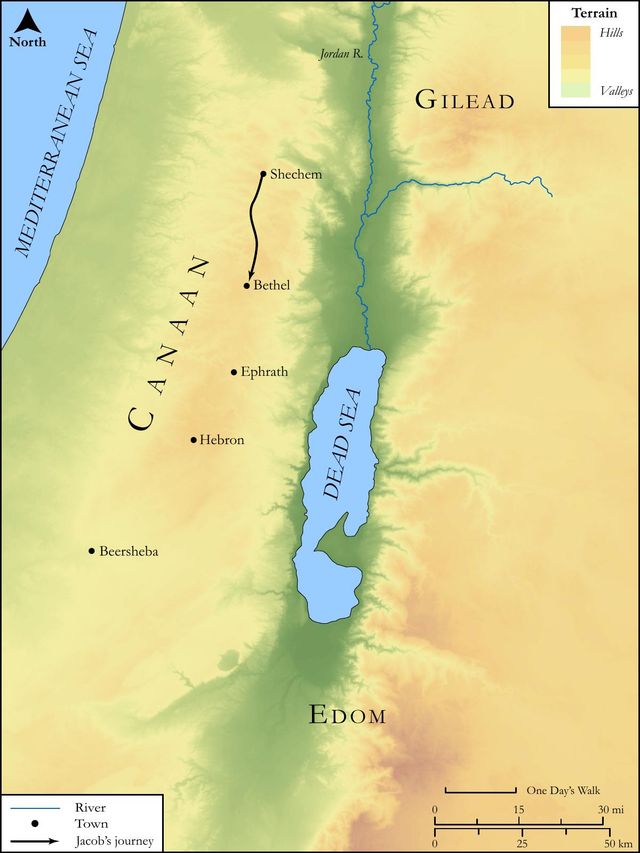
See on the biblical-era maps


Study this verse
Public-domain commentary
Matthew Henry
From his Commentary on the Whole Bible. Henry comments on passages, not single verses — this entry covers Genesis 35:6–15. His two-level outline is real structure in the source text, so it is rendered as structure.
Jacob and his retinue having safely arrived at Bethel, we are here told what passed there.
I.There he built an altar (Gen 35:7), and no doubt offered sacrifice upon it, perhaps the tenth of his cattle, according to his vow, I will give the tenth unto thee. With these sacrifices he joined praises for former mercies, particularly that which the sight of the place brought afresh to his remembrance; and he added prayers for the continuance of God's favour to him and his family. And he called the place (that is, the altar) El-beth-el, the God of Bethel. As, when he made a thankful acknowledgment of the honour God had lately done him in calling him Israel, he worshipped God by the name of El-elohe Israel; so, now that he was making a grateful recognition of God's former favour to him at Bethel, he worships God by the name of El-beth-el, the God of Bethel, because there God appeared to him. Note, The comfort which the saints have in holy ordinances is not so much from Bethel, the house of God, as from El-beth-el, the God of the house. The ordinances are but empty things if we do not meet with God in them.
II.There he buried Deborah, Rebekah's nurse, Gen 35:8.
We have reason to think that Jacob, after he came to Canaan, while his family dwelt near Shechem, went himself (it is likely, often) to visit his father Isaac at Hebron. Rebekah probably was dead, but her old nurse (of whom mention is made Gen 24:59) survived her, and Jacob took her to his family, to be a companion to his wives, her country-women, and an instructor to his children; while they were at Bethel, she died, and died lamented, so much lamented that the oak under which she was buried was called Allon-bachuth, the oak of weeping. Note,
1.Old servants in a family, that have in their time been faithful and useful, ought to be respected. Honour was done to this nurse, at her death, by Jacob's family, though she was not related to them, and though she was aged. Former services, in such a case, must be remembered.
2.We do not know where death may meet us; perhaps at Beth-el, the house of God. Therefore let us be always ready.
3.Family-afflictions may come even when family-reformation and religion are on foot. Therefore rejoice with trembling.
III.There God appeared to him (Gen 35:9), to own his altar, to answer to the name by which he had called him, The God of Bethel (Gen 35:7), and to comfort him under his affliction, Gen 35:8. Note, God will appear to those in a way of grace that attend on him in a way of duty. Here,
1.He confirmed the change of his name, Gen 35:10. It was done before by the angel that wrestled with him (Gen 32:28), and here it was ratified by the divine Majesty, or Shechinah, that appeared to him. There it was to encourage him against the fear of Esau, here against the fear of the Canaanites. Who can be too hard for Israel, a prince with God? It is below those who are thus dignified to droop and despond.
2.He renewed and ratified the covenant with him, by the name El-shaddai. I am God Almighty, God all-sufficient (Gen 35:11), able to make good the promise in due time, and to support thee and provide for thee in the mean time. Two things are promised him which we have met with often before: - (1.) That he should be the father of a great nation, great in honour and power - a company of nations shall be of thee (every tribe of Israel was a nation, and all the twelve a company of nations), great in honour and power - kings shall come out of thy loins. (2.) That he should be the master of a good land (Gen 35:12), described by the grantees, Abraham and Isaac, to whom it was promised, not by the occupants, the Canaanites in whose possession it now was. The land that was given to Abraham and Isaac is here entailed on Jacob and his seed. He shall not have children without an estate, which is often the case of the poor, nor an estate without children, which is often the grief of the rich; but both. These two promises had a spiritual signification, of which we may suppose Jacob himself had some notion, though not so clear and distinct as we now have; for, without doubt, Christ is the promised seed, and heaven is the promised land; the former is the foundation, and the latter the top-stone, of all God's favours.
3.He then went up from him, or from over him, in some visible display of glory, which had hovered over him while he talked with him, Gen 35:13. Note, The sweetest communions the saints have with God in this world are short and transient, and soon have an end. Our vision of God in heaven will be everlasting; there we shall be ever with the Lord; it is not so here.
IV.There Jacob erected a memorial of this, Gen 35:14.
1.He set up a pillar. When he was going to Padan-aram, he set up for a pillar that stone on which he had laid his head. This was agreeable enough to his low condition and his hasty flight; but now he took time to erect one more stately, more distinguishable and durable, probably placing that stone in it. In token of his intending it for a sacred memorial of his communion with God, he poured oil and the other ingredients of a drink-offering upon it. His vow was, This stone shall be God's house, that is, shall be set up for his honour, as houses to the praise of their builders; and here he performs it, transferring it to God by anointing it.
2.He confirmed the name he had formerly given to the place (Gen 35:15), Beth-el, the house of God. Yet this very place afterwards lost the honour of its name, and became Beth-aven, a house of iniquity; for here it was that Jeroboam set up one of his calves. It is impossible for the best man to entail upon a place so much as the profession and form of religion.
Historical interpretation
Historical reception
1 surviving comment on this verse from the historical church.
(Chapter 35, Verse 6.) And Jacob came to Luz in the land of Canaan, which is Bethel. Here it is clearly confirmed that Bethel is not Ulammaus, as stated above, but Luz, that is, the almond tree mentioned before.
Continue studying Genesis 35:6 across the web’s major study libraries — every link below opens this exact verse, chapter, or book on the destination site.
Read & Compare
 BibleGatewayThis verse in more than 200 translations and 70 languages.
 Bible.comThe YouVersion reader — hundreds of translations, reading plans, and highlights.
 ESV.orgCrossway's official English Standard Version reader.
 NET BibleThe NET translation with 60,000+ translators' notes on every rendering decision.
 STEP BibleTyndale House's free study tool — original text, vocabulary, and scholarly resources.
 BibliaLogos Bible Software's free web reader.
 USCCBThe New American Bible (Revised Edition) with the U.S. bishops' study notes.
Commentaries
 BibleHub CommentariesDozens of classic commentaries on this verse, gathered on one page.
 StudyLightMore than 100 commentary sets — the largest collection on the web.
 BibleRefPlain-English commentary on what this verse means, verse by verse.
 Enduring WordDavid Guzik's free commentary on this chapter, widely used by Bible teachers.
 Bible Study ToolsVerse commentary alongside Greek and Hebrew study aids.
Original Language & Research
- BibleHub InterlinearThe verse word by word — original language, transliteration, and English.
- BibleHub LexiconEvery word's original-language definition and Strong's entry.
 Blue Letter BibleDeep-study tools — Strong's numbers, concordance, and word studies.
 SefariaThe Hebrew text with Rashi and centuries of Jewish commentary.
Sermons, Hymns & Audio


TrulyRandomVerse is not affiliated with these sites and doesn’t control their content. They’re linked because they’re genuinely useful.
Summary
Genesis 35:6 marks the culmination of Jacob's journey of obedience as he arrives safely at Luz, the place he had previously consecrated as Bethel, in the land of Canaan. This arrival signifies a pivotal moment in his spiritual pilgrimage, fulfilling God's direct command to return to the site of his foundational encounter with the Almighty and serving as a powerful reaffirmation of divine promises and covenant.
Context
ShowHideLiterary Context
This verse is the climactic fulfillment of God's explicit command to Jacob in Genesis 35:1 to "Arise, go up to Bethel, and dwell there: and make there an altar unto God." It follows a period of significant spiritual and personal development for Jacob, including his reconciliation with Esau in Genesis 33, the traumatic events at Shechem in Genesis 34, and a crucial act of household purification in Genesis 35:2-4, where Jacob commanded his family to put away foreign gods and purify themselves. The safe arrival at Bethel, despite the dangers and challenges faced, underscores God's protective hand and Jacob's renewed commitment to monotheistic worship.
Historical & Cultural Context
Jacob's journey from Paddan Aram, his twenty-year sojourn with Laban, and his return to Canaan were fraught with peril, reflecting the realities of travel and tribal movements in the days of the patriarchs. The concept of a "house of God" (Bethel) was significant, as sacred sites often served as focal points for worship, covenant renewal, and divine communication. The act of returning to a specific location where God had previously appeared (a "theophany") was a common way to acknowledge and re-establish a relationship with the deity. Jacob's purification of his household, including the burying of foreign gods and earrings, was a culturally significant act of religious cleansing, preparing his family for a renewed encounter with Yahweh, the God of Israel.
Key Themes
ShowHideGenesis 35:6 powerfully encapsulates several overarching themes found throughout the book of Genesis and Jacob's narrative. It highlights Divine Faithfulness, as God fulfills His promise to bring Jacob back to the land (Genesis 28:15). It underscores Obedience and Covenant Renewal, as Jacob's journey to Bethel is a direct response to God's command, leading to a re-establishment of the covenant at a sacred site. The renaming of Luz to Bethel also emphasizes the theme of Sacred Space and Divine Presence, transforming a geographical location into a consecrated sanctuary where heaven and earth meet, echoing the significance of the ladder dream in Genesis 28:12.
Exposition and Analysis
ShowHideGenesis 35:6 succinctly records Jacob's obedient and safe arrival at a place of profound spiritual significance, highlighting both its geographical reality and its divinely ordained identity.
Key Word Analysis
ShowHideFrom the primitive root H935, meaning "to go or come (in a wide variety of applications)." In this context, it denotes Jacob's successful and purposeful arrival, emphasizing the completion of a divinely commanded journey. This is not a casual visit but a deliberate return to a sacred site.
Likely meaning "almond tree" or "nut tree." This was the original Canaanite name for the city. Its inclusion in the text alongside "Bethel" serves to identify the geographical location precisely, acknowledging its pre-existing identity before its spiritual transformation by Jacob.
A compound of "house" (bayit) and "God" (El), meaning "house of God." This is the name Jacob himself gave the place in Genesis 28:19 after his transformative dream and encounter with God. Its mention here reaffirms the spiritual significance of the location as a consecrated sanctuary and a place of divine revelation.
Verse Breakdown
ShowHide"So Jacob came to Luz"
This phrase marks the successful completion of Jacob's journey from Paddan Aram and his subsequent movements within Canaan. His arrival at "Luz" signifies reaching the specific geographical location God had commanded him to go to, emphasizing the direct obedience to the divine instruction in Genesis 35:1.
"which [is] in the land of Canaan"
This clarifies the broader geographical context, situating Luz within the promised land. It reminds the reader that Jacob is now firmly established in the territory promised to Abraham and his descendants, reinforcing the unfolding of God's covenant plan.
"that [is], Bethel"
This parenthetical explanation is crucial, identifying Luz with the spiritually significant name "Bethel," meaning "house of God." It highlights the transformation of a mere geographical location into a sacred space, a place where Jacob had a foundational encounter with God and made a vow. The dual naming acknowledges both the original identity and its profound spiritual renaming.
"he and all the people that [were] with him"
This detail underscores the communal nature of Jacob's obedience and the spiritual significance of this journey for his entire household. It implies that the preceding purification (putting away foreign gods) was a corporate act, preparing the whole family to enter this sacred space and participate in worship.
Literary Devices
ShowHideThe verse employs Identification and Apposition by clarifying that "Luz" is "that is, Bethel." This literary technique serves to bridge the gap between the original Canaanite name and the new, divinely-inspired Hebrew name, emphasizing the transformation of the place's identity from secular to sacred. The phrase "he and all the people that were with him" uses Synecdoche, where "all the people" represents his entire household, including family, servants, and possessions, highlighting the comprehensive nature of this obedient return and the corporate spiritual journey. The narrative also exhibits Fulfillment, as Jacob's arrival directly fulfills the divine command given in Genesis 35:1, underscoring God's faithfulness and Jacob's obedience.
Theological and Thematic Connections
ShowHideJacob's arrival at Bethel is more than a mere geographical relocation; it is a profound act of spiritual homecoming and covenant renewal. It demonstrates God's unwavering faithfulness in guiding and protecting Jacob throughout his tumultuous journey, fulfilling the promises made to him at this very spot years before. Bethel, as the "house of God," becomes a tangible symbol of divine presence and a consecrated space where the covenant between God and Jacob is reaffirmed, setting the stage for further blessings and the unfolding of Israel's history. This return to the place of initial encounter emphasizes the importance of remembering and revisiting foundational spiritual experiences as a source of strength and renewed commitment.
Reflection and Application
ShowHideGenesis 35:6 offers a profound invitation to reflect on the "Bethels" in our own lives—those sacred moments or places where God has profoundly met us, where we have made significant commitments, and where divine promises were first revealed. Just as Jacob was called to remember and revisit the site of God's initial promises, we are encouraged to regularly return to our spiritual foundations, recalling God's unwavering faithfulness in guiding and protecting us through our own life's journeys. This passage challenges us to live out our vows and commitments to God, prioritizing worship and consecrating our lives, homes, and communities as places where God is honored and His presence is welcomed. It reminds us that true spiritual progress often involves a disciplined return to the basics of faith, purifying ourselves from anything that hinders our relationship with God, and intentionally making our entire existence a "house of God" where His glory dwells.
Questions for Reflection
ShowHideFAQ
ShowHideWhy is the place called both Luz and Bethel in this verse?
ShowHideThe verse uses both names to provide clarity and emphasize the spiritual transformation of the location. "Luz" was the original, older Canaanite name for the city, likely known to the original audience. "Bethel" (meaning "house of God") was the new, spiritual name given by Jacob himself in Genesis 28:19 after his profound dream and encounter with God there. By stating "Luz, which is in the land of Canaan, that is, Bethel," the text acknowledges the historical and geographical identity while highlighting its divinely appointed significance as a sacred site where God had revealed Himself and established a covenant with Jacob.
Christ-Centered Fulfillment
ShowHideJacob's journey to Bethel, the "house of God," and the re-establishment of worship there, profoundly prefigures the ultimate "house of God" found in Jesus Christ. The very ladder Jacob saw at Bethel, connecting heaven and earth in Genesis 28:12, is directly referenced by Jesus in John 1:51, where He declares Himself to be the true ladder, the ultimate connection between the divine and humanity, through whom angels ascend and descend. Just as Jacob encountered God's presence and promises at Bethel, believers now encounter the fullness of God's presence and the fulfillment of all His promises in Christ, who is the true temple and dwelling place of God among humanity (John 2:19-21 and Colossians 2:9). Jacob's return to Bethel signifies a return to the place of divine encounter and covenant, mirroring the believer's journey of faith that culminates in intimate communion with God through Jesus, the cornerstone of God's spiritual house (Ephesians 2:19-22).