


Genesis 35:14
Bible text: King James Version (1769 Blayney text) · Public domain
Bible text: King James Version with Strong's numbers · Public domain
Bible text: Berean Standard Bible · Public domain
Bible text: American Standard Version (1901) · Public domain
Bible text: World English Bible, Messianic edition · Public domain
Bible text: Geneva Bible (1599) · Public domain
Bible text: Young's Literal Translation · Public domain
- וַיַּצֵּבvai·ya·Tzevand he set upH5324Conj-w ¦ V-Hiphil-ConsecImperf-3msVerb Hiphil Consecutive Imperfect 3rd Singular Masculineוַandיַּצֵּבhe set up
- יַעֲקֹבya·'a·KoJacobH3290N-proper-mNoun Proper Masculine
- מַצֵּבָהma·tze·Vaha pillarH4676N-fsNoun Singular Feminine Absolute
- בַּמָּקוֹםba·ma·Komat the placeH4725Prep-b ¦ N-msNoun Singular Masculine Absoluteבַּat theמָּקוֹםplace
- אֲשֶׁר'a·SherwhereH834RelParticle Relative
- דִּבֶּרdi·Berhe had spokenH1696V-Piel-Perf-3msVerb Piel Perfect 3rd Singular Masculine
- אִתּוֹ'i·Towith himH854Prep ¦ 3msPreposition Definiteאִתּwithוֹhim
- מַצֶּבֶתma·Tze·veta pillar ofH4678N-fscNoun Singular Feminine Construct
- אָבֶן'A·venstoneH68N-fsNoun Singular Feminine Absolute
- וַיַּסֵּךְvai·ya·Sekhand he poured outH5258Conj-w ¦ V-Hiphil-ConsecImperf-3msVerb Hiphil Consecutive Imperfect 3rd Singular Masculineוַandיַּסֵּךְhe poured out
- עָלֶיהָ'a·Lei·haon itH5921Prep ¦ 3fsPreposition Definiteעָלֶיonהָit
- נֶסֶךְNe·sekha drink offeringH5262N-msNoun Singular Masculine Absolute
- וַיִּצֹקvai·yi·Tzokand he pouredH3332Conj-w ¦ V-Qal-ConsecImperf-3msVerb Qal Consecutive Imperfect 3rd Singular Masculineוַandיִּצֹקhe poured
- עָלֶיהָ'a·Lei·haon itH5921Prep ¦ 3fsPreposition Definiteעָלֶיonהָit
- שָׁמֶןSha·menoilH8081N-msNoun Singular Masculine Absolute
English is a literal word-by-word gloss of the Hebrew, not the KJV's wording. Why?
This is the original text the KJV's translators worked from — each Hebrew word with its own literal English meaning in this verse, prepared by scholars at Tyndale House, Cambridge. The KJV translates whole sentences, not word by word, so its wording differs: one Hebrew word can become several English words, and the KJV may choose “the LORD” where the gloss reads “Yahweh”. Both are faithful — they answer different questions. For the KJV's own rendering, switch to the KJV text.
Details
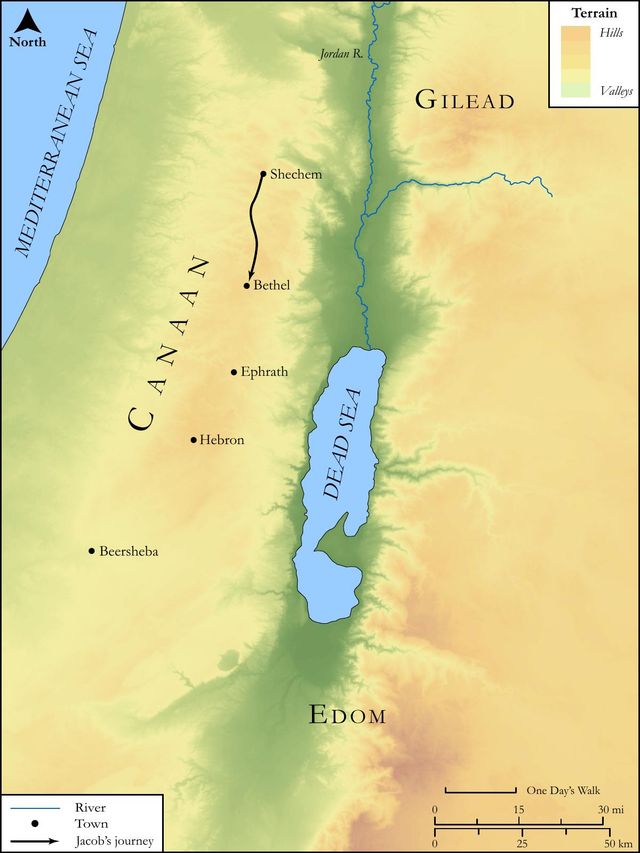
See on the biblical-era maps


Study this verse
Public-domain commentary
Matthew Henry
From his Commentary on the Whole Bible. Henry comments on passages, not single verses — this entry covers Genesis 35:6–15. His two-level outline is real structure in the source text, so it is rendered as structure.
Jacob and his retinue having safely arrived at Bethel, we are here told what passed there.
I.There he built an altar (Gen 35:7), and no doubt offered sacrifice upon it, perhaps the tenth of his cattle, according to his vow, I will give the tenth unto thee. With these sacrifices he joined praises for former mercies, particularly that which the sight of the place brought afresh to his remembrance; and he added prayers for the continuance of God's favour to him and his family. And he called the place (that is, the altar) El-beth-el, the God of Bethel. As, when he made a thankful acknowledgment of the honour God had lately done him in calling him Israel, he worshipped God by the name of El-elohe Israel; so, now that he was making a grateful recognition of God's former favour to him at Bethel, he worships God by the name of El-beth-el, the God of Bethel, because there God appeared to him. Note, The comfort which the saints have in holy ordinances is not so much from Bethel, the house of God, as from El-beth-el, the God of the house. The ordinances are but empty things if we do not meet with God in them.
II.There he buried Deborah, Rebekah's nurse, Gen 35:8.
We have reason to think that Jacob, after he came to Canaan, while his family dwelt near Shechem, went himself (it is likely, often) to visit his father Isaac at Hebron. Rebekah probably was dead, but her old nurse (of whom mention is made Gen 24:59) survived her, and Jacob took her to his family, to be a companion to his wives, her country-women, and an instructor to his children; while they were at Bethel, she died, and died lamented, so much lamented that the oak under which she was buried was called Allon-bachuth, the oak of weeping. Note,
1.Old servants in a family, that have in their time been faithful and useful, ought to be respected. Honour was done to this nurse, at her death, by Jacob's family, though she was not related to them, and though she was aged. Former services, in such a case, must be remembered.
2.We do not know where death may meet us; perhaps at Beth-el, the house of God. Therefore let us be always ready.
3.Family-afflictions may come even when family-reformation and religion are on foot. Therefore rejoice with trembling.
III.There God appeared to him (Gen 35:9), to own his altar, to answer to the name by which he had called him, The God of Bethel (Gen 35:7), and to comfort him under his affliction, Gen 35:8. Note, God will appear to those in a way of grace that attend on him in a way of duty. Here,
1.He confirmed the change of his name, Gen 35:10. It was done before by the angel that wrestled with him (Gen 32:28), and here it was ratified by the divine Majesty, or Shechinah, that appeared to him. There it was to encourage him against the fear of Esau, here against the fear of the Canaanites. Who can be too hard for Israel, a prince with God? It is below those who are thus dignified to droop and despond.
2.He renewed and ratified the covenant with him, by the name El-shaddai. I am God Almighty, God all-sufficient (Gen 35:11), able to make good the promise in due time, and to support thee and provide for thee in the mean time. Two things are promised him which we have met with often before: - (1.) That he should be the father of a great nation, great in honour and power - a company of nations shall be of thee (every tribe of Israel was a nation, and all the twelve a company of nations), great in honour and power - kings shall come out of thy loins. (2.) That he should be the master of a good land (Gen 35:12), described by the grantees, Abraham and Isaac, to whom it was promised, not by the occupants, the Canaanites in whose possession it now was. The land that was given to Abraham and Isaac is here entailed on Jacob and his seed. He shall not have children without an estate, which is often the case of the poor, nor an estate without children, which is often the grief of the rich; but both. These two promises had a spiritual signification, of which we may suppose Jacob himself had some notion, though not so clear and distinct as we now have; for, without doubt, Christ is the promised seed, and heaven is the promised land; the former is the foundation, and the latter the top-stone, of all God's favours.
3.He then went up from him, or from over him, in some visible display of glory, which had hovered over him while he talked with him, Gen 35:13. Note, The sweetest communions the saints have with God in this world are short and transient, and soon have an end. Our vision of God in heaven will be everlasting; there we shall be ever with the Lord; it is not so here.
IV.There Jacob erected a memorial of this, Gen 35:14.
1.He set up a pillar. When he was going to Padan-aram, he set up for a pillar that stone on which he had laid his head. This was agreeable enough to his low condition and his hasty flight; but now he took time to erect one more stately, more distinguishable and durable, probably placing that stone in it. In token of his intending it for a sacred memorial of his communion with God, he poured oil and the other ingredients of a drink-offering upon it. His vow was, This stone shall be God's house, that is, shall be set up for his honour, as houses to the praise of their builders; and here he performs it, transferring it to God by anointing it.
2.He confirmed the name he had formerly given to the place (Gen 35:15), Beth-el, the house of God. Yet this very place afterwards lost the honour of its name, and became Beth-aven, a house of iniquity; for here it was that Jeroboam set up one of his calves. It is impossible for the best man to entail upon a place so much as the profession and form of religion.
Historical interpretation
Historical reception
1 surviving comment on this verse from the historical church.
When we ascend to Bethel, that is, to the house of God, we will know the stone, I mean, the elected stone, which was made into a cornerstone, that is, Christ. We will see the one who is anointed by the Father in joy and exultation for all the creatures that live under the sky. As I said, the Son is anointed by God the Father: “Joy of us all, universal exultation” according to the words of the psalmist. And you see how this is prefigured in the words that were just said to us: “And Jacob set up a stone and poured oil upon it.” That action is a symbol of the mystery of Christ, through whom and with whom be glory to God the Father and the Holy Spirit, world without end. Amen.
Continue studying Genesis 35:14 across the web’s major study libraries — every link below opens this exact verse, chapter, or book on the destination site.
Read & Compare
 BibleGatewayThis verse in more than 200 translations and 70 languages.
 Bible.comThe YouVersion reader — hundreds of translations, reading plans, and highlights.
 ESV.orgCrossway's official English Standard Version reader.
 NET BibleThe NET translation with 60,000+ translators' notes on every rendering decision.
 STEP BibleTyndale House's free study tool — original text, vocabulary, and scholarly resources.
 BibliaLogos Bible Software's free web reader.
 USCCBThe New American Bible (Revised Edition) with the U.S. bishops' study notes.
Commentaries
 BibleHub CommentariesDozens of classic commentaries on this verse, gathered on one page.
 StudyLightMore than 100 commentary sets — the largest collection on the web.
 BibleRefPlain-English commentary on what this verse means, verse by verse.
 Enduring WordDavid Guzik's free commentary on this chapter, widely used by Bible teachers.
 Bible Study ToolsVerse commentary alongside Greek and Hebrew study aids.
Original Language & Research
- BibleHub InterlinearThe verse word by word — original language, transliteration, and English.
- BibleHub LexiconEvery word's original-language definition and Strong's entry.
 Blue Letter BibleDeep-study tools — Strong's numbers, concordance, and word studies.
 SefariaThe Hebrew text with Rashi and centuries of Jewish commentary.
Sermons, Hymns & Audio


TrulyRandomVerse is not affiliated with these sites and doesn’t control their content. They’re linked because they’re genuinely useful.
Summary
Genesis 35:14 records Jacob's profound act of worship and commemoration at Bethel, a sacred site where God had repeatedly manifested His presence. This verse details Jacob's erection of a stone pillar and his subsequent pouring of drink and oil offerings upon it, serving as a tangible response to God's renewed appearance and reaffirmation of the Abrahamic covenant. It marks the solemn consecration of the place and signifies Jacob's deepened commitment and gratitude to the Lord, transforming a physical location into an enduring memorial of divine faithfulness and human devotion.
Context
ShowHideLiterary Context
This verse is situated within a pivotal narrative in Jacob's life, following his return to Canaan from Paddan-Aram. God had specifically commanded Jacob to return to Bethel and build an altar there, prompting Jacob to purify his household of foreign gods Genesis 35:1-5. Just prior to this verse, God appeared to Jacob again at Bethel, reaffirming the covenant promises of land and numerous descendants, and formally bestowing upon him the new, significant name, Israel Genesis 35:9-13. Jacob's actions in verse 14 are a direct and immediate response to this profound divine visitation, serving as a personal act of worship and memorialization of the renewed covenant. This act also echoes his initial encounter and vow at this very location years earlier, as recorded in Genesis 28:18-22, creating a powerful sense of narrative continuity and covenant faithfulness across Jacob's life.
Historical & Cultural Context
The setting up of stone pillars (matzebah) as memorials was a common practice among the patriarchs, often used to mark significant events, covenants, or sacred sites, as when Jacob and Laban raised a pillar and a heap of witness. However, while some cultures used such pillars in idolatrous worship, Jacob's act is distinct, dedicated solely to Yahweh, the one true God. The pouring of drink offerings (nesekh) and oil (shemen) were also established forms of ancient worship. Drink offerings, typically wine, were libations poured out as acts of devotion, thanksgiving, or covenant ratification. Oil, particularly olive oil, was used extensively for anointing, consecration, and purification, signifying setting apart for sacred purposes or divine blessing. Jacob's actions here are deeply rooted in the cultural practices of his time but are uniquely transformed by their singular focus on the God of Abraham, Isaac, and Jacob, reflecting a personal and covenantal response rather than a generic pagan ritual.
Key Themes
ShowHideGenesis 35:14 contributes significantly to several overarching themes in the book of Genesis and the broader biblical narrative. It powerfully illustrates the theme of Divine Faithfulness and Covenant Renewal, as God consistently keeps His promises to Jacob despite Jacob's past failings, leading to a renewed commitment from Jacob. The act of setting up a pillar and making offerings underscores the theme of Worship and Consecration, demonstrating appropriate human response to divine revelation and the setting apart of places and objects for God's purposes. Furthermore, the emphasis on Bethel as a recurring site of divine encounter highlights the Theology of Sacred Place, where specific locations become hallowed through God's presence and serve as enduring memorials of His work. This verse also reinforces the theme of Jacob's Transformation into Israel, as his renewed worship follows his renaming, symbolizing a deeper spiritual maturity and dedication to his covenant God.
Exposition and Analysis
ShowHideFollowing God's powerful reaffirmation of His covenant and the bestowal of Jacob's new name, Israel, Jacob responds with immediate and tangible acts of worship, demonstrating his profound gratitude and renewed commitment. This verse encapsulates these significant actions.
Key Word Analysis
ShowHideMeaning "something stationed, i.e. a column or (memorial stone); by analogy, an idol." In this context, Jacob's pillar is a memorial stone, an upright monument erected to commemorate a significant event—God's renewed appearance and covenant reaffirmation. Unlike the "idol" connotation, Jacob's pillar is explicitly set up in worship of Yahweh, serving as a tangible marker of a sacred space and a profound divine encounter, echoing his earlier act in Genesis 28:18.
A primitive root meaning "to speak; rarely (in a destructive sense) to subdue; answer, appoint, bid, command, commune, declare, destroy, give, name, promise, pronounce, rehearse, say, speak, be spokesman, subdue, talk, teach, tell, think, use (entreaties), utter, [idiom] well, [idiom] work." Here, it specifically refers to God's act of speaking with Jacob, encompassing the divine commands, promises, and the renaming of Jacob to Israel as detailed in Genesis 35:9-13. It highlights the personal, communicative nature of God's relationship with Jacob, making the place of the pillar a site of intimate divine-human communion.
A primitive root meaning "to pour out, especially a libation, or to cast (metal); by analogy, to anoint a king; cover, melt, offer, (cause to) pour (out), set (up)." This word describes Jacob's action of pouring out both the drink offering and the oil. It signifies a deliberate act of offering and consecration, where a valuable substance is poured out as an act of devotion and dedication to God. This physical act represents a spiritual surrender and a setting apart of the pillar as sacred.
Verse Breakdown
ShowHide"And Jacob set up a pillar in the place where he talked with him, [even] a pillar of stone:"
This clause describes Jacob's primary physical response. The erection of the pillar (matstsêbâh) is not merely a marker but a memorial, a visible testament to the profound divine encounter that just transpired. The specification "a pillar of stone" emphasizes its permanence and solidity, signifying an enduring remembrance of God's faithfulness and the covenant renewed at this precise location. It is placed "where he talked with him," directly linking the physical monument to the verbal communication and covenant promises God had just made to Jacob.
"and he poured a drink offering thereon,"
This action signifies a libation (neçek), typically wine, poured out as an act of worship. It represents Jacob's profound gratitude, devotion, and perhaps a costly surrender to God. In patriarchal worship, such offerings often sealed covenants or expressed thanksgiving. For Jacob, it is a personal and heartfelt response to God's unwavering faithfulness and the reaffirmation of His promises, acknowledging God's worthiness through a tangible act of giving.
"and he poured oil thereon."
The pouring of oil (shemen) serves as an act of consecration. Oil in biblical tradition often symbolizes anointing, setting apart for sacred purposes, or the presence of the Holy Spirit. By anointing the pillar with oil, Jacob formally dedicates it as holy, a place imbued with divine significance due to God's manifestation there. This ritual act reinforces the sanctity of the location and the profound nature of the divine encounter, marking it as a special place of communion between God and humanity.
Literary Devices
ShowHideGenesis 35:14 is rich with Symbolism. The pillar itself symbolizes a permanent memorial, a tangible reminder of God's presence and promises, echoing Jacob's earlier act at Bethel in Genesis 28:18 and establishing a pattern of commemorating divine encounters. The drink offering symbolizes costly devotion, thanksgiving, and a pouring out of self in worship, while the oil symbolizes consecration, anointing, and the setting apart of something as holy for God. The passage also employs Repetition and Echo, specifically by recalling Jacob's earlier experience at Bethel, which reinforces the theme of God's enduring faithfulness and Jacob's consistent, though sometimes faltering, response. This repetition underscores the continuity of God's covenant relationship with Jacob across decades of his life. The entire scene functions as a Commemoration, establishing a sacred space and a ritual act that serves to remember and honor God's powerful intervention and covenant renewal.
Theological and Thematic Connections
ShowHideGenesis 35:14 powerfully illustrates the reciprocal nature of the covenant relationship between God and humanity. God's initiative in appearing to Jacob and reaffirming His promises elicits a profound and tangible response of worship and dedication from Jacob. This act underscores the importance of remembering and commemorating God's faithfulness in our lives, transforming ordinary places and moments into sacred memorials. It highlights that true worship involves not only verbal acknowledgment but also costly, tangible acts of devotion and consecration, setting apart our resources and ourselves for God's purposes. The pillar, drink offering, and oil collectively signify a deep reverence for God's presence and a renewed commitment to His covenant.
Reflection and Application
ShowHideJacob's actions in Genesis 35:14 provide a profound and enduring model for how we, as believers, might respond to God's presence and faithfulness in our own lives. Just as Jacob marked a significant place and time of divine encounter with a tangible memorial, we are called to acknowledge, remember, and respond to God's interventions and promises. This can involve creating personal "memorials" in our hearts and lives—whether through journaling moments of divine grace, establishing specific prayer practices, or engaging in acts of service that honor God's work within us. The ancient practices of pouring offerings, though culturally specific, point to the timeless principle of giving our best to God in worship and gratitude. It challenges us to consider what "costly" offerings we might pour out today—our time, talents, resources, or even our deepest desires—as acts of consecration and devotion in response to God's unfailing love and covenant promises. True worship is a personal, heartfelt, and tangible response to God's ongoing relationship with us, solidifying our commitment and deepening our gratitude.
Questions for Reflection
ShowHideFAQ
ShowHideWhy did Jacob set up a pillar instead of building an altar, as God commanded in Genesis 35:1?
ShowHideWhile God commanded Jacob to build an altar in Genesis 35:1, the pillar in Genesis 35:14 serves a distinct, though related, purpose. An altar (Hebrew: mizbeakh) was primarily for sacrifices, signifying atonement, communion, and worship through offerings. A pillar (matzebah), on the other hand, was typically a memorial stone, commemorating a significant event or marking a sacred place. Jacob had previously set up a pillar at Bethel in Genesis 28:18 after his initial dream. His action in Genesis 35:14 reaffirms that earlier dedication and specifically marks the precise spot of God's renewed appearance and covenant reaffirmation. The building of the altar for sacrifices would likely have followed or occurred concurrently, as implied by the broader context of God's command in Genesis 35:7. Both acts contribute to the sanctification of the place and Jacob's multifaceted worship and commemoration of God's faithfulness.
What is the significance of pouring both a drink offering and oil on the pillar?
ShowHideBoth the drink offering (nesekh) and the pouring of oil (shemen) are ancient acts of worship and consecration, each carrying distinct but complementary symbolic weight. The drink offering, often wine, was a libation poured out as an act of devotion, thanksgiving, and communion, signifying a costly and complete surrender to God. It expressed Jacob's profound gratitude for God's renewed promises and His unwavering faithfulness. The pouring of oil, on the other hand, symbolized anointing and setting apart something as holy or sacred for God's use. It marked the pillar as consecrated, imbued with divine significance due to God's manifest presence there. Oil in the Bible frequently signifies divine presence, anointing for sacred purposes, or the Holy Spirit. Together, these acts demonstrate Jacob's profound reverence, gratitude, and dedication, transforming a mere stone monument into a sacred memorial of God's enduring covenant and the hallowed ground where He chose to reveal Himself.
Christ-Centered Fulfillment
ShowHideJacob's act of setting up a pillar and consecrating it with offerings at Bethel serves as a rich foreshadowing of Christ and His redemptive work. Just as Bethel means "House of God" and was a place where God met humanity, Christ Himself is the ultimate "House of God," the true dwelling place of God among humanity, as affirmed in John 1:14. He is the living pillar of truth and the cornerstone of God's new temple, the Church Ephesians 2:20-22. The ladder Jacob saw at Bethel, connecting heaven and earth, finds its ultimate fulfillment in Jesus, who declares Himself to be the true access point between God and humanity John 1:51. Furthermore, the offerings Jacob poured out find their perfect antitype in Christ's own life and death. He is the ultimate "drink offering" poured out for the salvation of humanity, His blood sealing the new covenant Matthew 26:28. He is also the one anointed by the Holy Spirit without measure John 3:34, consecrating Himself as the perfect, once-for-all sacrifice Hebrews 10:10. Through His self-offering, we are also consecrated and brought into intimate, enduring communion with God, making us living stones in His spiritual house 1 Peter 2:5.