


Genesis 35:20
Bible text: King James Version (1769 Blayney text) · Public domain
Bible text: Berean Standard Bible · Public domain
Bible text: American Standard Version (1901) · Public domain
Bible text: World English Bible, Messianic edition · Public domain
Bible text: Geneva Bible (1599) · Public domain
Bible text: Young's Literal Translation · Public domain
- וַיַּצֵּבvai·ya·Tzevand he set upH5324Conj-w ¦ V-Hiphil-ConsecImperf-3msVerb Hiphil Consecutive Imperfect 3rd Singular Masculineוַandיַּצֵּבhe set up
- יַעֲקֹבya·'a·KoJacobH3290N-proper-mNoun Proper Masculine
- מַצֵּבָהma·tze·Vaha pillarH4676N-fsNoun Singular Feminine Absolute
- עַל'aloverH5921PrepPreposition
- קְבֻרָתָהּke·vu·ra·Tahher graveH6900N-fsc ¦ 3fsNoun Singular Feminine Constructקְבֻרָתָgraveהּher
- הִואhi'itH1931Pro-3fsPronoun Personal 3rd Singular Feminine
- מַצֶּבֶתma·Tze·vet[is] [the] pillar ofH4678N-fscNoun Singular Feminine Construct
- קְבֻרַתke·vu·rat[the] grave ofH6900N-fscNoun Singular Feminine Construct
- רָחֵלra·ChelRachelH7354N-proper-fNoun Proper Feminine
- עַד'aduntilH5704PrepPreposition
- הַיּוֹםhai·Yomthis dayH3117Art ¦ N-msNoun Singular Masculine Absoluteהַthisיּוֹםday
English is a literal word-by-word gloss of the Hebrew, not the KJV's wording. Why?
This is the original text the KJV's translators worked from — each Hebrew word with its own literal English meaning in this verse, prepared by scholars at Tyndale House, Cambridge. The KJV translates whole sentences, not word by word, so its wording differs: one Hebrew word can become several English words, and the KJV may choose “the LORD” where the gloss reads “Yahweh”. Both are faithful — they answer different questions. For the KJV's own rendering, switch to the KJV text.
Details
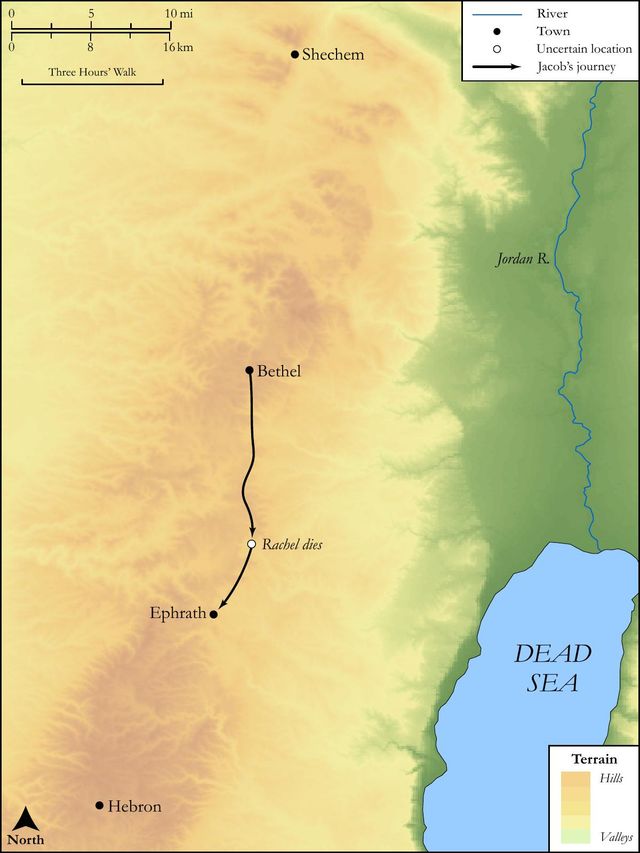
See on the biblical-era maps


Study this verse
Public-domain commentary
Matthew Henry
From his Commentary on the Whole Bible. Henry comments on passages, not single verses — this entry covers Genesis 35:16–20.
We have here the story of the death of Rachel, the beloved wife of Jacob. 1. She fell in travail by the way, not able to reach to Bethlehem, the next town, though they were near it; so suddenly does pain sometimes come upon a woman in travail, which she cannot escape, or put off. We may suppose Jacob had soon a tent up, convenient enough for her reception. 2. Her pains were violent. She had hard labour, harder than usual: this was the effect of sin, Gen 3:16. Note, Human life begins with sorrow, and the roses of its joy are surrounded with thorns. 3. The midwife encouraged her, Gen 35:17. No doubt she had her midwife with her, ready at hand, yet that would not secure her. Rachel had said, when she bore Joseph, God shall add another son, which now the midwife remembers, and tells her her words were made good. Yet this did not avail to keep up her spirits; unless God command away fear, no one else can. He only says as one having authority, Fear not. We are apt, in extreme perils, to comfort ourselves and our friends with the hopes of a temporal deliverance, in which we may be disappointed; we had better found our comforts on that which cannot fail us, the hope of eternal life. 4. Her travail was to the life of the child, but to her own death. Note, Though the pains and perils of childbearing were introduced by sin, yet they have sometimes been fatal to very holy women, who, though not saved in childbearing, are saved through it with an everlasting salvation. Rachel had passionately said, Give me children, or else I die; and now that she had children (for this was her second) she died. Her dying is here called the departing of her soul. Note, The death of the body is but the departure of the soul to the world of spirits. 5. Her dying lips called her new-born son Ben-oni, The son of my sorrow. And many a son, not born in such hard labour, yet proves the son of his parent's sorrow, and the heaviness of her that bore him. Children are enough the sorrow of their poor mothers in the breeding, bearing, and nursing of them; they should therefore, when they grow up, study to be their joy, and so, if possible, to make them some amends. But Jacob, because he would not renew the sorrowful remembrance of the mother's death every time he called his son by his name, changed his name, and called him Benjamin, The son of my right hand; that is, "very dear to me, set on my right hand for a blessing, the support of my age, like the staff in my right hand." 6. Jacob buried her near the place where she died. As she died in child-bed, it was convenient to bury her quickly; and therefore he did not bring her to the burying-place of his family. If the soul be at rest after death, it matters little where the body lies. In the place where the tree falls, there let it be. No mention is made of the mourning that was at her death, because that might easily be taken for granted. Jacob, no doubt, was a true mourner. Note, Great afflictions sometimes befal us immediately after great comforts. Lest Jacob should be lifted up with the visions of the Almighty with which he was honoured, this was sent as a thorn in the flesh to humble him. Those that enjoy the favours peculiar to the children of God must yet expect the troubles that are common to the children of men. Deborah, who, had she lived, would have been a comfort to Rachel in her extremity, died but a little before. Note, When death comes into a family, it often strikes double. God by it speaks once, yea, twice. The Jewish writers say, "The death of Deborah and Rachel was to expiate the murder of the Shechemites, occasioned by Dinah, a daughter of the family." 7. Jacob set up a pillar upon her grave, so that it was known, long after, to be Rachel's sepulchre (Sa1 10:2), and Providence so ordered it that this place afterwards fell in the lot of Benjamin. Jacob set up a pillar in remembrance of his joys (Gen 35:14), and here he sets up one in remembrance of his sorrows; for, as it may be of use to ourselves to keep both in mind, so it may be of use to others to transmit the memorials of both: the church, long afterwards, owned that what God said to Jacob at Bethel, both by his word and by his rod, he intended for their instruction (Hos 12:4), There he spoke with us.
Continue studying Genesis 35:20 across the web’s major study libraries — every link below opens this exact verse, chapter, or book on the destination site.
Read & Compare
 BibleGatewayThis verse in more than 200 translations and 70 languages.
 Bible.comThe YouVersion reader — hundreds of translations, reading plans, and highlights.
 ESV.orgCrossway's official English Standard Version reader.
 NET BibleThe NET translation with 60,000+ translators' notes on every rendering decision.
 STEP BibleTyndale House's free study tool — original text, vocabulary, and scholarly resources.
 BibliaLogos Bible Software's free web reader.
 USCCBThe New American Bible (Revised Edition) with the U.S. bishops' study notes.
Commentaries
 BibleHub CommentariesDozens of classic commentaries on this verse, gathered on one page.
 StudyLightMore than 100 commentary sets — the largest collection on the web.
 BibleRefPlain-English commentary on what this verse means, verse by verse.
 Enduring WordDavid Guzik's free commentary on this chapter, widely used by Bible teachers.
 Bible Study ToolsVerse commentary alongside Greek and Hebrew study aids.
Original Language & Research
- BibleHub InterlinearThe verse word by word — original language, transliteration, and English.
- BibleHub LexiconEvery word's original-language definition and Strong's entry.
 Blue Letter BibleDeep-study tools — Strong's numbers, concordance, and word studies.
 SefariaThe Hebrew text with Rashi and centuries of Jewish commentary.
Sermons, Hymns & Audio


TrulyRandomVerse is not affiliated with these sites and doesn’t control their content. They’re linked because they’re genuinely useful.
Summary
Genesis 35:20 poignantly records Jacob's establishment of a memorial pillar over the grave of his beloved wife, Rachel, near Ephrath (later identified with Bethlehem). This enduring monument, explicitly noted as remaining "unto this day," serves as a profound testament to Jacob's deep sorrow and unwavering love, marking a significant, sorrowful milestone in the patriarchal narrative while simultaneously affirming the historical authenticity and geographical rootedness of the account for its original audience.
Context
ShowHideLiterary Context
This verse concludes the deeply sorrowful narrative of Rachel's death, a pivotal and heartbreaking event for Jacob within the broader context of his return journey to Canaan. Immediately preceding this, Jacob had experienced a renewed encounter with God at Bethel, where the Abrahamic covenant promises of land and numerous descendants were reaffirmed (Genesis 35:9-12). The joy and divine affirmation of Bethel are abruptly contrasted with the profound personal tragedy of Rachel's death during childbirth near Ephrath (Genesis 35:16-19), highlighting the interwoven tapestry of divine blessing and human sorrow in the patriarchal life. Jacob's act of setting a pillar is his immediate, tender, and enduring response to this immense personal loss, marking a significant transition point in his family's history.
Historical & Cultural Context
The erection of memorial pillars, or matstsêbâh (מַצֵּבָה), was a common and deeply significant practice among the patriarchs, as Jacob's pillar at Bethel shows. These upright stones served various purposes: marking covenants, commemorating divine encounters, or, as here, designating burial sites and honoring the deceased. Such monuments were not merely practical markers but powerful symbols of remembrance, respect, and the enduring legacy of an individual. Rachel's burial "on the way to Ephrath (that is, Bethlehem)" (Genesis 35:19) places this event within a historically identifiable geographical location, suggesting a known landmark for the original audience. The act of setting a pillar was a deeply personal expression of grief, reflecting Jacob's profound emotional attachment to Rachel, whom he had loved more than Leah (Genesis 29:30).
Key Themes
ShowHideGenesis 35:20 contributes significantly to several key themes within the book of Genesis. First, it underscores the theme of grief and remembrance, portraying Jacob's profound human sorrow in the face of loss, a universal experience that even patriarchs endured. Second, it highlights the importance of historical markers and enduring legacy, as the pillar serves as a tangible link between the past and the present, validating the historical accuracy of the narrative for subsequent generations. Third, it subtly reinforces the theme of God's faithfulness amidst human sorrow; despite this personal tragedy, the divine covenant promises concerning Jacob's descendants continue to unfold, as Rachel's death leads to the birth of Benjamin, the twelfth son, completing the foundation of the twelve tribes of Israel. This sorrowful event is a crucial, albeit painful, step in the unfolding of God's redemptive plan for His chosen people, as seen throughout the patriarchal narratives.
Exposition and Analysis
ShowHideKey Word Analysis
ShowHideA primitive root meaning "to station, in various applications (literally or figuratively)." Here, it denotes the deliberate and purposeful act of erecting or establishing the pillar. It implies a firm and lasting placement, reflecting Jacob's intention for the memorial to endure. This is not a casual act but a foundational one, mirroring his earlier act of setting a pillar at Bethel to commemorate a divine encounter (Genesis 28:18).
A feminine (causatively) participle meaning "something stationed, i.e., a column or (memorial stone)." This term specifically refers to an upright stone monument, often used for commemorative or cultic purposes. In this context, it functions as a burial marker, a visible and enduring sign of Rachel's resting place and Jacob's remembrance. The repetition of "pillar" (also using H4678, matstsebeth, meaning "something stationary, a monumental stone") emphasizes its permanence.
Meaning "a day (as the warm hours), whether literal... or figurative (a space of time defined by an associated term), (often used adverb)." In the phrase "unto this day" (Hebrew: ʻad hayyōm hazzeh), 'day' functions adverbially to indicate continuity from the time of the event to the time of the narration. It serves as an authorial affirmation of the monument's continued existence and recognition, lending historical veracity to the account for the contemporary audience.
Verse Breakdown
ShowHide"And Jacob set a pillar upon her grave"
This clause describes Jacob's immediate and tender response to Rachel's death. The act of "setting a pillar" (Hebrew: wayyaṣṣēb maṣṣēbâ) was a deeply significant gesture, signifying a permanent memorial. It was not merely a practical marking of a burial site but a profound expression of grief, love, and honor for his beloved wife, Rachel, whom he had loved above all others. This action underscores the depth of his sorrow and the importance of Rachel within his life and the patriarchal family.
"that is the pillar of Rachel's grave unto this day"
This concluding clause serves as an authorial affirmation, emphasizing the enduring presence and recognition of the monument at the time the text was written. The phrase "unto this day" (Hebrew: ʻad hayyōm hazzeh) is a common literary device in the Old Testament, used to connect past events with the present reality of the audience. It reinforces the historical authenticity of the narrative, providing a tangible, verifiable link for the original readers to the patriarchal past and confirming Rachel's burial site as a known landmark.
Literary Devices
ShowHideThe verse effectively employs several literary devices to convey its meaning and impact. Symbolism is prominent, as the "pillar" itself is not merely a stone but a powerful symbol of remembrance, grief, and enduring love. It stands as a silent testament to Rachel's life and Jacob's sorrow. Repetition is also evident in the use of "pillar" and "grave," reinforcing the central elements of the verse and emphasizing the permanence of the memorial and the finality of death. Furthermore, the phrase "unto this day" functions as a form of Authorial Intrusion or Historical Verification, where the narrator directly addresses the audience, confirming the continued existence and recognition of the monument. This device lends credibility and historical depth to the narrative, bridging the gap between the ancient past and the contemporary reader.
Theological and Thematic Connections
ShowHideGenesis 35:20, while a somber record of human loss, is rich with theological implications. It powerfully illustrates the reality of profound grief even for those chosen by God, affirming that sorrow is an intrinsic part of the human experience. Jacob's act of setting a permanent memorial underscores the human need to honor the departed and to preserve their memory, reflecting a deep-seated value for life and legacy. The enduring nature of the pillar, noted "unto this day," points to the importance of historical continuity and the preservation of God's dealings with His people, reminding us that God's plan unfolds through real historical events and real people, with their joys and sorrows. Even amidst such personal tragedy, the broader narrative of Genesis 35 continues to affirm God's covenant faithfulness to Jacob, as the birth of Benjamin (though costly) completes the foundational twelve sons, moving God's redemptive plan forward.
Reflection and Application
ShowHideGenesis 35:20 offers timeless insights into the human experience of loss and the profound importance of remembrance. Jacob's act of setting a memorial acknowledges the deep reality and necessity of grief, reminding us that mourning is a natural and healthy human response to loss, even for figures of great faith. This verse validates our own experiences of sorrow, assuring us that it is permissible to grieve deeply for those we love. Whether through physical monuments, cherished traditions, or shared stories, memorials serve a vital role in helping us process loss, preserve history, and honor the legacies of those who have impacted our lives, acting as tangible links to the past and reminders of what was cherished. Furthermore, while this verse focuses on human sorrow, the broader context of Genesis 35 demonstrates God's continued presence and faithfulness to Jacob even amidst personal tragedy, offering profound comfort that God is intimately with us in our moments of deepest sorrow, just as He is in our joy.
Questions for Reflection
ShowHideFAQ
ShowHideWhy did Jacob set a pillar on Rachel's grave?
ShowHideJacob set a pillar on Rachel's grave as a lasting and deeply personal memorial to his beloved wife. This was a common and significant ancient custom to mark important burial sites and to express profound grief, honor, and remembrance. It was a tangible expression of his immense love and sorrow, ensuring that her resting place would be recognized and perpetually honored, reflecting the deep emotional bond they shared, as highlighted in Genesis 29:30.
What is the significance of the phrase "unto this day"?
ShowHideThe phrase "unto this day" (Hebrew: ʻad hayyōm hazzeh) is a common literary device in the Old Testament, used by the biblical narrator. It indicates that the monument, landmark, or event described was still recognizable and known to the audience at the time the text was written or compiled. Its significance lies in its function as a historical authenticator, serving to validate the accuracy and enduring reality of the narrative. By stating "unto this day," the text connects the ancient event to the contemporary experience of the readers, confirming that Rachel's grave and its pillar were a known and enduring landmark in the land of Israel, thus grounding the patriarchal history in verifiable geography.
Christ-Centered Fulfillment
ShowHideWhile Genesis 35:20 primarily details a poignant moment of human grief and the establishment of a physical memorial, it subtly points to the broader narrative of God's faithfulness amidst sorrow, which finds its ultimate and glorious fulfillment in Jesus Christ. Jacob's act of setting a lasting monument for Rachel, a beloved figure whose death was a profound loss, foreshadows the ultimate and eternal remembrance and victory over death achieved through Christ. The temporary stone pillar, a testament to earthly sorrow, is transcended by the living hope and eternal comfort found in Jesus, who is the resurrection and the life. Through His own death and resurrection, Christ conquered the sting of death, transforming human mourning into the promise of a future where sorrow and mourning will be no more (Revelation 21:4). Thus, Rachel's pillar, a symbol of a patriarch's grief, ultimately directs our gaze to the Lamb of God, who offers true and lasting solace for all who mourn, providing not merely a memorial, but eternal life and a blessed hope for reunion in His presence (1 Thessalonians 4:13-18).