


Genesis 35:21
Bible text: King James Version (1769 Blayney text) · Public domain
Bible text: Berean Standard Bible · Public domain
Bible text: American Standard Version (1901) · Public domain
Bible text: World English Bible, Messianic edition · Public domain
Bible text: Geneva Bible (1599) · Public domain
Bible text: Young's Literal Translation · Public domain
- וַיִּסַּעvai·yi·Sa'and he set outH5265Conj-w ¦ V-Qal-ConsecImperf-3msVerb Qal Consecutive Imperfect 3rd Singular Masculineוַandיִּסַּעhe set out
- יִשְׂרָאֵלYis·ra·'ElIsraelH3478N-proper-mNoun Proper Masculine
- וַיֵּטvai·Yetand he pitchedH5186Conj-w ¦ V-Qal-ConsecImperf-3msVerb Qal Consecutive Imperfect 3rd Singular Masculineוַandיֵּטhe pitched
- אָהֳלוֹ'o·ho·Lohis tentH168N-msc ¦ 3msNoun Singular Masculine Constructאָהֳלtentוֹhis
- מֵהָלְאָהme·Hal·'ahfrom beyondH1973Prep-m ¦ AdvAdverbמֵfromהָלְאָהbeyond
- לְמִגְדַּלle·mig·dal<to> MigdalH4029Prep-l ¦ N-properNoun Proper Locationלְ<to>מִגְדַּלMigdal
- עֵדֶר'E·derEderH4029N-properNoun Proper Location
English is a literal word-by-word gloss of the Hebrew, not the KJV's wording. Why?
This is the original text the KJV's translators worked from — each Hebrew word with its own literal English meaning in this verse, prepared by scholars at Tyndale House, Cambridge. The KJV translates whole sentences, not word by word, so its wording differs: one Hebrew word can become several English words, and the KJV may choose “the LORD” where the gloss reads “Yahweh”. Both are faithful — they answer different questions. For the KJV's own rendering, switch to the KJV text.
Details
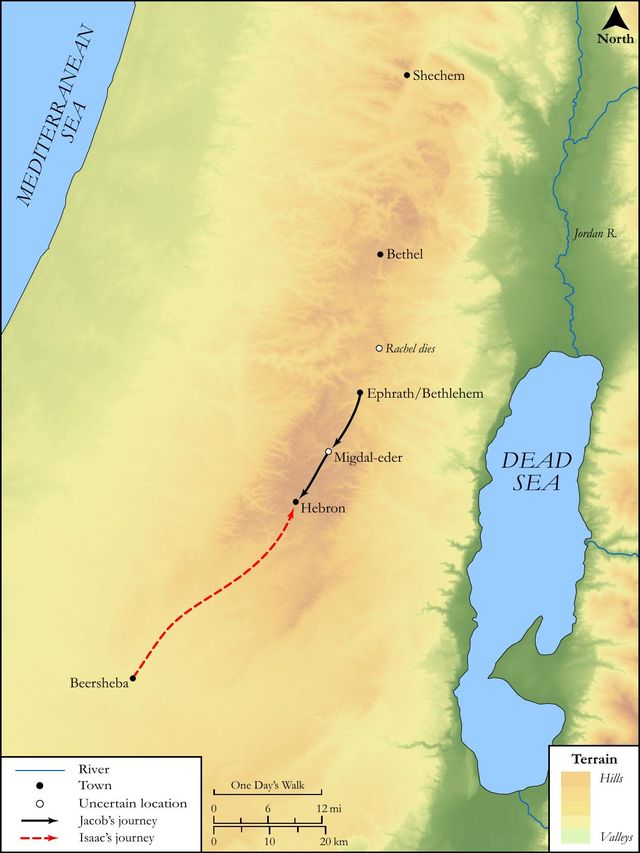
See on the biblical-era maps


Study this verse
Public-domain commentary
Matthew Henry
From his Commentary on the Whole Bible. Henry comments on passages, not single verses — this entry covers Genesis 35:21–29.
Here is, 1. Jacob's removal, Gen 35:21. He also, as his fathers, sojourned in the land of promise as in a strange country, and was not long in a place. Immediately after the story of Rachel's death he is here called Israel (Gen 35:21, Gen 35:22), and not often so afterwards: the Jews say, "The historian does him this honour here because he bore that affliction with such admirable patience and submission to Providence." Note, Those are Israel's indeed, princes with God, that support the government of their own passions. He that has this rule over his own spirit is better than the mighty. Israel, a prince with God, yet dwells in tents; the city is reserved for him in the other world. 2. The sin of Reuben. A piece of abominable wickedness it was that he was guilty of (Gen 35:22), that very sin which the apostle says (Co1 5:1) is not so much as named among the Gentiles, that one should have his father's wife. It is said to have been when Israel dwelt in that land; as if he were then absent from his family, which might be the unhappy occasion of these disorders. Though perhaps Bilhah was the greater criminal, and it is probable was abandoned by Jacob for it, yet Reuben's crime was so provoking that, for it, he lost his birthright and blessing, Gen 49:4. The first-born is not always the best, nor the most promising. This was Reuben's sin, but it was Jacob's affliction; and what a sore affliction it was is intimated in a little compass, and Israel heard it. No more is said - that is enough; he heard it with the utmost grief and shame, horror and displeasure. Reuben thought to conceal it, that his father should never hear of it; but those that promise themselves secresy in sin are generally disappointed; a bird of the air carries the voice. 3. A complete list of the sons of Jacob, now that Benjamin the youngest was born. This is the first time we have the names of these heads of the twelve tribes together; afterwards we find them very often spoken of and enumerated, even to the end of the Bible, Rev 7:4; Rev 21:12. 4. The visit which Jacob made to his father Isaac at Hebron. We may suppose he had visited him before since his return, for he sorely longed after his father's house; but never, till now, brought his family to settle with him, or near him, Gen 35:27. Probably he did this now upon the death of Rebekah, by which Isaac was left solitary, and not disposed to marry again. 5. The age and death of Isaac are here recorded, though it appears, by computation, that he died not till many years after Joseph was sold into Egypt, and much about the time that he was preferred there. Isaac, a mild quiet man, lived the longest of all the patriarches, for he was 180 years old; Abraham was but 175. Isaac lived about forty years after he had made his will, Gen 27:2. We shall not die an hour the sooner, but abundantly the better, for our timely setting our heart and house in order. Particular notice is taken of the amicable agreement of Esau and Jacob, in solemnizing their father's funeral (Gen 35:29), to show how wonderfully God had changed Esau's mind since he vowed his brother's murder immediately after his father's death, Gen 27:41. Note, God has many ways of preventing bad men from doing the mischief they intended; he can either tie their hands or turn their hearts.
Historical interpretation
Historical reception
1 surviving comment on this verse from the historical church.
(Verse 21.) And Israel advanced and pitched his tent beyond the tower of Eder. The Hebrews believe that this place is where the temple was later built, and the tower of Eder signifies the tower of the flock, that is, the congregation and assembly. This is also testified to by the prophet Micah, saying: And you, O cloudy tower of the flock, daughter of Zion (Micah 4:8), and so on. At that time, Jacob set up his tents across the place where the temple was later built. But if we follow the order of the way, there is a place near Bethlehem where the shepherds were, where even the King of the Angels sang at the birth of the Lord, or where Jacob fed his flock, giving the place its name, or what is more true, a certain prophecy was already then indicating the future mystery.
Continue studying Genesis 35:21 across the web’s major study libraries — every link below opens this exact verse, chapter, or book on the destination site.
Read & Compare
 BibleGatewayThis verse in more than 200 translations and 70 languages.
 Bible.comThe YouVersion reader — hundreds of translations, reading plans, and highlights.
 ESV.orgCrossway's official English Standard Version reader.
 NET BibleThe NET translation with 60,000+ translators' notes on every rendering decision.
 STEP BibleTyndale House's free study tool — original text, vocabulary, and scholarly resources.
 BibliaLogos Bible Software's free web reader.
 USCCBThe New American Bible (Revised Edition) with the U.S. bishops' study notes.
Commentaries
 BibleHub CommentariesDozens of classic commentaries on this verse, gathered on one page.
 StudyLightMore than 100 commentary sets — the largest collection on the web.
 BibleRefPlain-English commentary on what this verse means, verse by verse.
 Enduring WordDavid Guzik's free commentary on this chapter, widely used by Bible teachers.
 Bible Study ToolsVerse commentary alongside Greek and Hebrew study aids.
Original Language & Research
- BibleHub InterlinearThe verse word by word — original language, transliteration, and English.
- BibleHub LexiconEvery word's original-language definition and Strong's entry.
 Blue Letter BibleDeep-study tools — Strong's numbers, concordance, and word studies.
 SefariaThe Hebrew text with Rashi and centuries of Jewish commentary.
Sermons, Hymns & Audio


TrulyRandomVerse is not affiliated with these sites and doesn’t control their content. They’re linked because they’re genuinely useful.
Summary
Genesis 35:21 concisely records Israel's (Jacob's) continued journey after profound divine encounters and personal tragedy, noting his temporary encampment "beyond the tower of Edar." This seemingly minor geographical detail, situated near the future birthplace of the Messiah, carries significant prophetic weight regarding the future of God's covenant people and subtly foreshadows the coming of the Good Shepherd. The verse encapsulates the nomadic nature of the patriarchs' lives, their reliance on divine guidance, and the unfolding of God's redemptive plan amidst both blessing and sorrow.
Context
ShowHideLiterary Context
This verse is strategically placed within a pivotal chapter in Jacob's life, marking a transition point following a series of profound experiences. Immediately preceding this, Jacob has returned to Bethel, where God reaffirms the covenant promises made to Abraham and Isaac, explicitly renaming Jacob "Israel" and reiterating the promise of land and numerous descendants (Genesis 35:9-12). However, this divine encounter is quickly followed by deep personal sorrow: the death of his beloved wife, Rachel, during the birth of Benjamin near Ephrath, which is Bethlehem (Genesis 35:16-19). Thus, Israel's journey "beyond the tower of Edar" is not merely a geographical movement, but a continuation of his life's narrative, interwoven with divine faithfulness, human grief, and the ongoing fulfillment of God's purposes. The very next verse, Genesis 35:22, records Reuben's egregious transgression, indicating that even amidst God's blessings, the challenges and complexities of family life continued to unfold within the patriarchal household.
Historical & Cultural Context
The act of "journeying" and "spreading his tent" vividly portrays the nomadic lifestyle characteristic of the patriarchal period. Abraham, Isaac, and Jacob were not settled farmers or city-dwellers but semi-nomadic shepherds, constantly moving their flocks in search of pasture and water within the land of Canaan. Their tents (Hebrew: ʼôhel) were temporary dwellings, easily erected and dismantled, symbolizing their transient existence and their status as sojourners in a land promised to them but not yet fully possessed. This nomadic existence underscored their dependence on divine provision and guidance, as they had no permanent home. The mention of specific landmarks like "the tower of Edar" (Hebrew: Migdal-ʻÊder) serves as a geographical anchor, indicating the actual historical movements of these early progenitors of the Israelite nation within the land of Canaan, grounding the theological narrative in real-world geography.
Key Themes
ShowHideGenesis 35:21 contributes to several overarching themes within the book of Genesis and the broader biblical narrative. Firstly, it highlights Divine Guidance and Sovereignty, demonstrating God's continuous leading of His chosen patriarch, Israel, even through periods of profound personal loss. Secondly, the verse underscores the Patriarchal Journey and the Unfolding of the Covenant, as Israel's movements are part of God's larger plan to establish a nation through whom His promises will be fulfilled. The nomadic life itself becomes a metaphor for the journey of faith. Thirdly, the specific mention of "the tower of Edar" introduces the theme of Prophetic Geography and Foreshadowing. This seemingly minor detail becomes a significant geographical marker, subtly pointing forward to future messianic fulfillment, particularly in relation to the birthplace of the Messiah and His role as the Good Shepherd. This theme reinforces the interconnectedness of Old Testament narratives with New Testament realities, revealing God's intricate and long-term redemptive plan.
Exposition and Analysis
ShowHideKey Word Analysis
ShowHideFrom the root words meaning "he will rule as God," this is the symbolic name given to Jacob after his wrestling match with God (Genesis 32:28). Its use here emphasizes Jacob's transformed identity and his role as the progenitor of the nation that will bear this name, signifying God's sovereign choice and the future destiny of His people.
A primitive root meaning "to pull up, especially the tent-pins," indicating the act of breaking camp and setting out on a journey. This word highlights the transient, nomadic existence of the patriarchs, constantly on the move, symbolizing their pilgrimage through life and their dependence on God's direction for their next destination.
Refers to a portable dwelling, conspicuous from a distance. The "tent" is a quintessential symbol of the patriarchal lifestyle, representing their temporary habitation in the Promised Land. It signifies their status as sojourners and pilgrims, living by faith, without a permanent settled home, awaiting the fulfillment of God's promises.
Verse Breakdown
ShowHide"And Israel journeyed"
This phrase signifies the continuous movement of Jacob, now bearing his new, divinely bestowed name, "Israel." It underscores the ongoing nature of God's covenant plan, which unfolds through the physical movements and experiences of His chosen patriarch. Despite recent sorrow (Rachel's death), Israel continues to move forward, guided by God's overarching purpose.
"and spread his tent"
This action describes the typical nomadic practice of setting up a temporary dwelling. It emphasizes the transient nature of the patriarchs' lives in the Promised Land, living as aliens and strangers, awaiting the full inheritance promised by God. It also implies a pause in their journey, a moment of rest and encampment, albeit temporary.
"beyond the tower of Edar"
The specific mention of "the tower of Edar" (Hebrew: Migdal-ʻÊder, meaning "tower of the flock") is profoundly significant. This landmark was located near Ephrath, which is Bethlehem (Genesis 35:19), a place already marked by Rachel's recent death and the birth of Benjamin. Its deeper importance is revealed in prophetic literature, as Micah 4:8 explicitly references "the tower of the flock" in connection with the future ruler of Israel who would come forth from Bethlehem. This seemingly minor geographical detail thus serves as a profound foreshadowing of the Messiah's birthplace and His role as the Good Shepherd.
Literary Devices
ShowHideThe verse employs several literary devices that enrich its meaning. Symbolism is evident in the "tent" (Hebrew: ʼôhel), which symbolizes the temporary and nomadic existence of the patriarchs, highlighting their status as sojourners in the land of promise and their reliance on divine guidance rather than permanent settlement. The "tower of Edar" itself functions as a powerful Symbol of oversight and watchfulness, particularly in its literal meaning as a "tower of the flock," suggesting a place from which shepherds would watch over their sheep. This leads directly to Foreshadowing, as the specific mention of Migdal-ʻÊder near Bethlehem prophetically points to the future birthplace of the Messiah, who is the ultimate Shepherd of God's flock. The simple declarative statement of Israel's journey and encampment also contributes to the Narrative Progression, subtly moving the story forward while embedding profound theological and prophetic implications within a seemingly mundane geographical detail.
Theological and Thematic Connections
ShowHideGenesis 35:21, though brief, is rich with theological and thematic depth. It powerfully illustrates God's unwavering covenant faithfulness and His sovereign guidance over His chosen people, even amidst personal tragedy and the transient nature of their lives. The constant movement of Israel, the "spreading of his tent," embodies the pilgrimage of faith, where trust in God's leading is paramount. Most significantly, the precise geographical marker of "the tower of Edar" elevates the verse beyond a mere itinerary entry, imbuing it with profound prophetic significance. It serves as a subtle yet powerful pointer to the future, connecting the patriarchal narrative directly to the messianic hope, revealing God's long-term, meticulously planned redemptive work that culminates in Christ.
Reflection and Application
ShowHideGenesis 35:21, though seemingly a simple geographical notation, offers profound lessons for contemporary believers. Israel's journey, marked by both divine blessing and deep personal sorrow (Rachel's death), reminds us that life's pilgrimage, even for those walking closely with God, is often characterized by constant movement, change, and periods of grief and challenge. The act of "spreading his tent" symbolizes our own temporary dwelling on earth; we are pilgrims and sojourners, not yet in our permanent home. This calls us to cultivate an attitude of dependence on God's leading, trusting that He guides our steps even through difficult, uncertain seasons. Furthermore, the prophetic significance of the "tower of Edar" encourages us to recognize that seemingly insignificant places, moments, or details in our lives can hold profound meaning in God's larger narrative. God orchestrates all things, even the mundane, to fulfill His glorious purposes, reminding us that no part of our journey is outside of His sovereign plan. This perspective fosters a deeper appreciation for God's meticulous work and His faithfulness in every season of our lives.
Questions for Reflection
ShowHideFAQ
ShowHideWhy is the "tower of Edar" mentioned, and what is its significance?
ShowHideThe "tower of Edar" (Hebrew: Migdal-ʻÊder) translates to "tower of the flock." Its mention in Genesis 35:21 is significant not only as a geographical marker near Bethlehem (where Rachel died and Benjamin was born, as noted in Genesis 35:19) but primarily because of its profound prophetic association. In Micah 4:8, this very "tower of the flock" is linked to the future "dominion" and "kingdom" that will come to the "daughter of Jerusalem," a clear reference to the messianic ruler. This suggests that even seemingly minor geographical details in the Old Testament can carry profound meaning and foreshadow future events in God's redemptive plan, particularly concerning the birthplace and role of the Messiah as the Shepherd of His people.
Christ-Centered Fulfillment
ShowHideGenesis 35:21, particularly through the mention of "the tower of Edar," finds its ultimate and glorious fulfillment in Jesus Christ. The "tower of the flock" (Migdal-ʻÊder), situated near Bethlehem, prophetically points to the very birthplace of the Messiah, who is the Good Shepherd come to gather His flock. Just as Israel journeyed under divine guidance, enduring both blessing and sorrow, Christ's earthly life was a purposeful journey, from His humble birth in Bethlehem (a town also prophesied in Micah 5:2) to His ultimate sacrifice and resurrection, all leading to the redemption of humanity. The continuity of God's covenant promises, evident in Jacob's life and his descendants, culminates definitively in Christ, through whom all the promises of God are "Yes" and "Amen" for those who believe. He is the true "Israel" (God's Prince), the one who perfectly fulfills the nomadic pilgrimage of faith, establishing an eternal kingdom that transcends any temporary tent or earthly dwelling.