


Genesis 35:22
- וַיְהִיvay·Hiand it wasH1961Conj-w ¦ V-Qal-ConsecImperf-3msVerb Qal Consecutive Imperfect 3rd Singular Masculineוַandיְהִיit was
- בִּשְׁכֹּןbish·Konwhen dweltH7931Prep-b ¦ V-Qal-InfVerb Qal Infinitive Constructבִּwhenשְׁכֹּןdwelt
- יִשְׂרָאֵלYis·ra·'ElIsraelH3478N-proper-mNoun Proper Masculine
- בָּאָרֶץba·'A·retzin the landH776Prep-b ¦ N-fsNoun Singular Feminine Absoluteבָּin theאָרֶץland
- הַהִואha·Hiv'<the> thatH1931Art ¦ Pro-3fsPronoun Personal 3rd Singular Feminineהַ<the>הִואthat
- וַיֵּלֶךְvai·Ye·lekhand he wentH1980Conj-w ¦ V-Qal-ConsecImperf-3msVerb Qal Consecutive Imperfect 3rd Singular Masculineוַandיֵּלֶךְhe went
- רְאוּבֵןre·'u·VenReubenH7205N-proper-mNoun Proper Masculine
- וַיִּשְׁכַּבvai·yish·Kavand he lay withH7901Conj-w ¦ V-Qal-ConsecImperf-3msVerb Qal Consecutive Imperfect 3rd Singular Masculineוַandיִּשְׁכַּבhe lay with
- אֶת'et<obj.>H853DirObjMParticle Object Indicator
- בִּלְהָהbil·HahBilhahH1090N-proper-fNoun Proper Feminine
- פִּילֶגֶשׁpi·Le·gesh[the] concubine ofH6370N-fscNoun Singular Feminine Construct
- אָבִיו'a·Vivhis father ofH1N-msc ¦ 3msNoun Singular Masculine Constructאָבִיfather ofוhis
- וַיִּשְׁמַעvai·yish·Ma'and he heardH8085Conj-w ¦ V-Qal-ConsecImperf-3msVerb Qal Consecutive Imperfect 3rd Singular Masculineוַandיִּשְׁמַעhe heard
- יִשְׂרָאֵלYis·ra·'ElIsraelH3478N-proper-mNoun Proper Masculine
- וַיִּהְיוּvai·yih·Yuand they wereH1961Conj-w ¦ V-Qal-ConsecImperf-3mpVerb Qal Consecutive Imperfect 3rd Plural Masculineוַandיִּהְיוּthey were
- בְנֵיve·nei[the] sons ofH1121N-mpcNoun Plural Masculine Construct
- יַעֲקֹבya·'a·KoJacobH3290N-proper-mNoun Proper Masculine
- שְׁנֵיםshe·Neimtwo [plus]H8147Adj-cdAdjective Numerical Dual common gender Absolute
- עָשָׂר'a·SartenH6240Adj-csAdjective Numerical Singular common gender Absolute
English is a literal word-by-word gloss of the Hebrew, not the KJV's wording. Why?
This is the original text the KJV's translators worked from — each Hebrew word with its own literal English meaning in this verse, prepared by scholars at Tyndale House, Cambridge. The KJV translates whole sentences, not word by word, so its wording differs: one Hebrew word can become several English words, and the KJV may choose “the LORD” where the gloss reads “Yahweh”. Both are faithful — they answer different questions. For the KJV's own rendering, switch to the KJV text.
Details
See on the biblical-era map


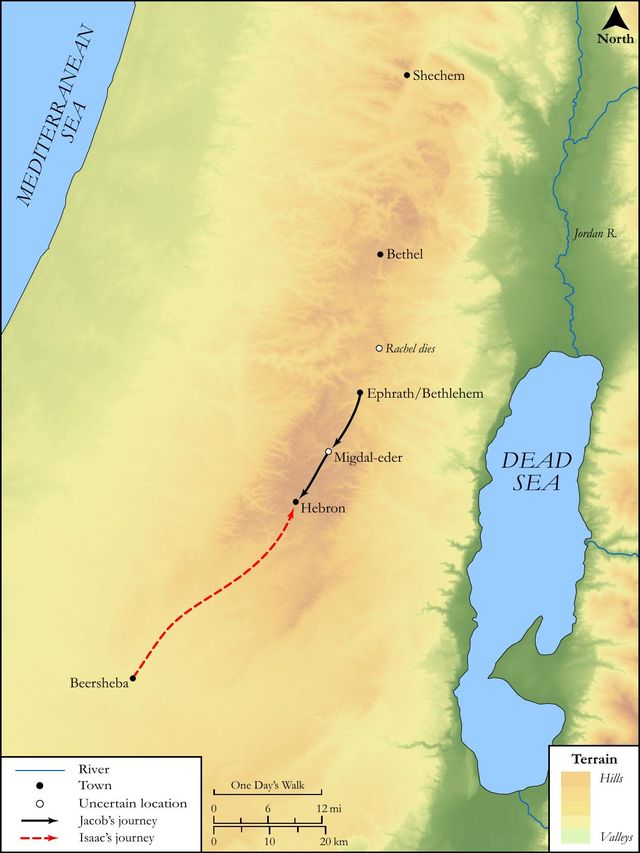
Study this verse
Public-domain commentary
Matthew Henry
From his Commentary on the Whole Bible. Henry comments on passages, not single verses — this entry covers Genesis 35:21–29.
Here is, 1. Jacob's removal, Gen 35:21. He also, as his fathers, sojourned in the land of promise as in a strange country, and was not long in a place. Immediately after the story of Rachel's death he is here called Israel (Gen 35:21, Gen 35:22), and not often so afterwards: the Jews say, "The historian does him this honour here because he bore that affliction with such admirable patience and submission to Providence." Note, Those are Israel's indeed, princes with God, that support the government of their own passions. He that has this rule over his own spirit is better than the mighty. Israel, a prince with God, yet dwells in tents; the city is reserved for him in the other world. 2. The sin of Reuben. A piece of abominable wickedness it was that he was guilty of (Gen 35:22), that very sin which the apostle says (Co1 5:1) is not so much as named among the Gentiles, that one should have his father's wife. It is said to have been when Israel dwelt in that land; as if he were then absent from his family, which might be the unhappy occasion of these disorders. Though perhaps Bilhah was the greater criminal, and it is probable was abandoned by Jacob for it, yet Reuben's crime was so provoking that, for it, he lost his birthright and blessing, Gen 49:4. The first-born is not always the best, nor the most promising. This was Reuben's sin, but it was Jacob's affliction; and what a sore affliction it was is intimated in a little compass, and Israel heard it. No more is said - that is enough; he heard it with the utmost grief and shame, horror and displeasure. Reuben thought to conceal it, that his father should never hear of it; but those that promise themselves secresy in sin are generally disappointed; a bird of the air carries the voice. 3. A complete list of the sons of Jacob, now that Benjamin the youngest was born. This is the first time we have the names of these heads of the twelve tribes together; afterwards we find them very often spoken of and enumerated, even to the end of the Bible, Rev 7:4; Rev 21:12. 4. The visit which Jacob made to his father Isaac at Hebron. We may suppose he had visited him before since his return, for he sorely longed after his father's house; but never, till now, brought his family to settle with him, or near him, Gen 35:27. Probably he did this now upon the death of Rebekah, by which Isaac was left solitary, and not disposed to marry again. 5. The age and death of Isaac are here recorded, though it appears, by computation, that he died not till many years after Joseph was sold into Egypt, and much about the time that he was preferred there. Isaac, a mild quiet man, lived the longest of all the patriarches, for he was 180 years old; Abraham was but 175. Isaac lived about forty years after he had made his will, Gen 27:2. We shall not die an hour the sooner, but abundantly the better, for our timely setting our heart and house in order. Particular notice is taken of the amicable agreement of Esau and Jacob, in solemnizing their father's funeral (Gen 35:29), to show how wonderfully God had changed Esau's mind since he vowed his brother's murder immediately after his father's death, Gen 27:41. Note, God has many ways of preventing bad men from doing the mischief they intended; he can either tie their hands or turn their hearts.
Continue studying Genesis 35:22 across the web’s major study libraries — every link below opens this exact verse, chapter, or book on the destination site.
Read & Compare
 BibleGatewayThis verse in more than 200 translations and 70 languages.
 Bible.comThe YouVersion reader — hundreds of translations, reading plans, and highlights.
 ESV.orgCrossway's official English Standard Version reader.
 NET BibleThe NET translation with 60,000+ translators' notes on every rendering decision.
 STEP BibleTyndale House's free study tool — original text, vocabulary, and scholarly resources.
 BibliaLogos Bible Software's free web reader.
 USCCBThe New American Bible (Revised Edition) with the U.S. bishops' study notes.
Commentaries
 BibleHub CommentariesDozens of classic commentaries on this verse, gathered on one page.
 StudyLightMore than 100 commentary sets — the largest collection on the web.
 BibleRefPlain-English commentary on what this verse means, verse by verse.
 Enduring WordDavid Guzik's free commentary on this chapter, widely used by Bible teachers.
 Bible Study ToolsVerse commentary alongside Greek and Hebrew study aids.
Original Language & Research
- BibleHub InterlinearThe verse word by word — original language, transliteration, and English.
- BibleHub LexiconEvery word's original-language definition and Strong's entry.
 Blue Letter BibleDeep-study tools — Strong's numbers, concordance, and word studies.
 SefariaThe Hebrew text with Rashi and centuries of Jewish commentary.
Sermons, Hymns & Audio


TrulyRandomVerse is not affiliated with these sites and doesn’t control their content. They’re linked because they’re genuinely useful.
Summary
Genesis 35:22 records a profound moral transgression by Reuben, Jacob's eldest son, who engaged in sexual relations with Bilhah, his father's concubine. This deeply disrespectful act occurred during a pivotal period when Israel's family was settling in the land of Canaan, revealing significant internal strife and moral decay within the patriarchal household, which would have lasting repercussions for Reuben's standing and the future dynamics of Jacob's lineage.
Context
ShowHideLiterary Context
This incident is strategically placed within a crucial section of Genesis that details Jacob's return to the Promised Land and the consolidation of his family. Immediately preceding this verse, Jacob has a transformative encounter with God at Bethel, where his name is reaffirmed as Israel, and God renews the covenant promises of land and numerous descendants (Genesis 35:9-15). Following this spiritual high point, the narrative quickly shifts to the birth of Benjamin and the tragic death of Rachel (Genesis 35:16-20), events that would have brought both joy and immense sorrow to Jacob's household. The account of Reuben's sin then follows directly, juxtaposing moments of divine blessing and family growth with a stark portrayal of human moral failure, highlighting the internal challenges faced by the nascent nation of Israel even as it was being formed. The verse also serves as a narrative bridge, concluding with the complete list of Jacob's twelve sons, setting the stage for the complex family dynamics that will unfold in subsequent chapters, particularly the story of Joseph.
Historical & Cultural Context
In the ancient Near East, a concubine (Hebrew: pilegesh) held a recognized, albeit subordinate, status within a patriarchal household, often serving as a secondary wife who could bear children for the patriarch, especially if the primary wife was barren, as seen with Rachel giving Bilhah to Jacob (Genesis 30:3-5). A concubine was considered the property of the patriarch, and any sexual relations with her by a son were viewed as a direct and egregious violation of the father's authority, honor, and property. Such an act was not merely a sexual transgression but a profound challenge to the patriarch's headship and an attempt to usurp his power or claim his inheritance. It was akin to a public declaration of rebellion, undermining the very foundation of family order and patriarchal succession. The silence of Jacob's immediate reaction in the text is culturally significant, implying the deep shame and gravity of the offense, which would be addressed later in a more formal and binding manner.
Key Themes
ShowHideGenesis 35:22 contributes to several overarching themes within the book of Genesis and the broader biblical narrative. Firstly, it powerfully illustrates the theme of human sin and its consequences, even within the divinely chosen lineage. Reuben's act is a stark reminder that moral failings persist despite God's covenant faithfulness. Secondly, it highlights the complex and often dysfunctional family dynamics within Jacob's household, foreshadowing future conflicts and demonstrating that God works through imperfect people. The subsequent loss of Reuben's birthright in Genesis 49:3-4 directly links to this transgression, underscoring the long-term repercussions of sin. Thirdly, the verse subtly reinforces the theme of divine sovereignty amidst human failure. Despite this grave moral lapse and the internal strife, the concluding statement, "Now the sons of Jacob were twelve," emphasizes that God's plan to form a nation through these twelve sons remains on track, demonstrating His ability to accomplish His purposes even through the weaknesses and sins of His chosen instruments. This narrative also touches on the theme of patriarchal authority and the severe implications of its violation.
Exposition and Analysis
ShowHideKey Word Analysis
ShowHideDerived from the imperative of "to see" and "son," meaning "see ye a son." This name was given by Leah, expressing her hope for Jacob's love (Genesis 29:32). The irony of Reuben's name is poignant in this verse; he was "seen" committing a grave sin, an act that would ultimately lead to his forfeiture of the birthright and preeminence, despite being the "firstborn" son. His actions here stand in stark contrast to the initial hope and significance of his name.
This term refers to a secondary wife or a paramour. In ancient Israelite society, a concubine was a legitimate, albeit subordinate, member of the household, often acquired to bear children or for companionship. Bilhah was Rachel's handmaid, given to Jacob to bear children on Rachel's behalf (Genesis 30:3-5). Reuben's act with Bilhah was not merely fornication but a profound violation of his father's marital rights and patriarchal authority, akin to incest and a challenge to Jacob's very headship and control over his household.
A primitive root meaning "to lie down" for various purposes, including rest, decease, or, as in this context, sexual connection. The use of this verb, combined with "went" (Hebrew, yâlak' H3212), forms a common biblical idiom for sexual intercourse. It is an unambiguous and direct description of Reuben's physical transgression, leaving no doubt about the nature of his sin.
Verse Breakdown
ShowHide"And it came to pass, when Israel dwelt in that land,"
This opening clause establishes the setting, indicating a period of relative stability and settlement for Jacob (now called Israel) and his family in the land of Canaan. This geographical and temporal anchor highlights that the subsequent transgression occurs not in transit, but within the established domestic sphere, making the violation even more egregious.
"that Reuben went and lay with Bilhah his father's concubine:"
This is the core of the verse, detailing Reuben's shocking moral failure. "Went and lay with" is a clear euphemism for sexual intercourse. The phrase "his father's concubine" underscores the gravity of the act, as it was a direct affront to Jacob's honor, property, and patriarchal authority, akin to violating a primary wife and challenging the father's very headship.
"and Israel heard [it]."
This terse statement reveals Jacob's immediate awareness of Reuben's transgression. The text's silence regarding Jacob's immediate reaction is highly significant, conveying the profound shock, pain, and perhaps silent rage of the patriarch. This lack of immediate verbal or punitive response from Jacob emphasizes the deep internalizing of the offense, the full consequences of which would only be revealed much later in Jacob's deathbed blessing in Genesis 49.
"Now the sons of Jacob were twelve:"
This concluding clause serves as a crucial narrative marker. Despite the moral failing and internal strife, the divine promise of a numerous offspring and the formation of a nation through Jacob's twelve sons remains intact. This statement confirms the complete number of progenitors for the future twelve tribes of Israel, highlighting God's overarching plan and faithfulness even amidst human imperfection and sin.
Literary Devices
ShowHideThe narrative of Genesis 35:22 employs several potent literary devices. Juxtaposition is prominent, as Reuben's egregious sin immediately follows a profound spiritual encounter between Jacob and God at Bethel, where the covenant promises were reaffirmed, and the family was ostensibly settling into the Promised Land. This stark contrast highlights the persistent reality of human sin even amidst divine blessing and the formation of God's chosen people. The device of Narrative Economy is powerfully used in the statement, "and Israel heard [it]." The text offers no immediate details of Jacob's reaction, leaving his silence to convey the immense weight, shock, and pain of the transgression. This silence is more impactful than any explicit outpouring of anger or sorrow, allowing the reader to grasp the profound dishonor and the deep wound inflicted upon the patriarch. Furthermore, the event serves as Foreshadowing, directly setting the stage for Reuben's later loss of his birthright and preeminence in Jacob's deathbed prophecy (Genesis 49:3-4), demonstrating that actions have lasting consequences within the biblical narrative.
Theological and Thematic Connections
ShowHideReuben's transgression in Genesis 35:22 serves as a stark reminder of the pervasive nature of sin and its profound consequences, even within the family chosen by God to bear the covenant promises. This act, a direct challenge to patriarchal authority and a violation of family purity, underscores that human moral failings can deeply impact one's standing, inheritance, and future. Yet, the concluding note that Jacob's sons were twelve simultaneously illustrates God's unwavering sovereignty; His divine plan to form a nation through this imperfect lineage remains steadfast, demonstrating His ability to work through flawed individuals to accomplish His perfect will.
Reflection and Application
ShowHideReuben's tragic moral failure in Genesis 35:22 offers a sobering reflection on the enduring human struggle with sin, even within the most sacred of contexts—a family chosen by God. This narrative reminds us that position or privilege (Reuben was the firstborn) does not exempt one from the consequences of moral compromise. It underscores the profound importance of sexual purity, respect for authority, and the sanctity of family relationships. Our actions, particularly those that violate trust and established order, carry far-reaching implications, not only for our personal standing but also for the integrity and well-being of our families and communities. We are called to learn from Reuben's mistake, recognizing the deceptive nature of sin and striving for integrity, self-control, and honor in all our relationships, trusting that God's grace can redeem even the most grievous failures, though consequences may remain.
Questions for Reflection
ShowHideFAQ
ShowHideWhy was Reuben's act with Bilhah considered so severe?
ShowHideReuben's act was considered a grave offense because Bilhah was his father Jacob's concubine, a secondary wife. In ancient Near Eastern culture, violating a patriarch's concubine was not merely a sexual transgression but a direct assault on his honor, authority, and property. It was often interpreted as an attempt to usurp his power, claim his inheritance, or publicly shame him, thereby undermining his headship and the established family order. Such an act was viewed as akin to incest and a profound act of rebellion against the father. The severity of the act is later underscored by Jacob's prophetic words in Genesis 49:3-4, where Reuben loses his birthright and preeminence.
Does this incident affect Reuben's position as the firstborn?
ShowHideYes, profoundly. While Jacob's immediate reaction is not detailed in Genesis 35:22, this transgression directly led to Reuben losing his birthright and preeminence among his brothers. Later, in Jacob's deathbed blessing in Genesis 49:3-4, Jacob explicitly references this act, declaring Reuben "unstable as water" and stating he would "not excel." This event solidified the shift of the birthright, which typically included a double portion of inheritance and leadership, away from Reuben. The leadership role eventually passed to Judah (Genesis 49:8-12), and the double portion of inheritance passed to Joseph's sons, Ephraim and Manasseh (Genesis 48:5-6).
Christ-Centered Fulfillment
ShowHideReuben's moral failure in Genesis 35:22 and his subsequent forfeiture of the birthright profoundly highlight the pervasive nature of sin and humanity's inherent inability to perfectly fulfill God's righteous standards. This incident, where the firstborn son proves unworthy of his position, foreshadows the ultimate need for a perfect Firstborn who would not fail. Jesus Christ, the true and eternal Firstborn of God (Colossians 1:15), perfectly fulfills the role of the righteous heir, not through human merit or birthright, but through His divine nature and perfect obedience to the Father (Philippians 2:8). Unlike Reuben, whose sin disqualified him, Christ's sinless life and atoning sacrifice on the cross establish a new covenant, granting believers an inheritance that cannot be forfeited by human weakness or sin (Hebrews 9:15). Through Him, the promises made to Abraham and Jacob find their ultimate fulfillment, demonstrating God's unwavering commitment to His people through a perfect Mediator who redeems and restores what human failure has marred.