


Genesis 35:23
Bible text: King James Version (1769 Blayney text) · Public domain
Bible text: Berean Standard Bible · Public domain
Bible text: American Standard Version (1901) · Public domain
Bible text: World English Bible, Messianic edition · Public domain
Bible text: Geneva Bible (1599) · Public domain
Bible text: Young's Literal Translation · Public domain
- בְּנֵיbe·Nei[the] sons ofH1121N-mpcNoun Plural Masculine Construct
- לֵאָהle·'AhLeahH3812N-proper-fNoun Proper Feminine
- בְּכוֹרbe·Khor[the] firstborn ofH1060N-mscNoun Singular Masculine Construct
- יַעֲקֹבya·'a·KoJacobH3290N-proper-mNoun Proper Masculine
- רְאוּבֵןre·'u·VenReubenH7205N-proper-mNoun Proper Masculine
- וְשִׁמְעוֹןve·shim·'Onand SimeonH8095Conj-w ¦ N-proper-mNoun Proper MasculineוְandשִׁמְעוֹןSimeon
- וְלֵוִיve·le·Viand LeviH3878Conj-w ¦ N-proper-mNoun Proper MasculineוְandלֵוִיLevi
- וִיהוּדָהvi·hu·Dahand JudahH3063Conj-w ¦ N-proper-mNoun Proper MasculineוִandיהוּדָהJudah
- וְיִשָּׂשכָרve·yi·so·sh·Kharand IssacharH3485Conj-w ¦ N-proper-mNoun Proper MasculineוְandיִשָּׂשכָרIssachar
- וּזְבוּלֻןu·ze·vu·Lunand ZebulunH2074Conj-w ¦ N-proper-mNoun Proper MasculineוּandזְבוּלֻןZebulun
English is a literal word-by-word gloss of the Hebrew, not the KJV's wording. Why?
This is the original text the KJV's translators worked from — each Hebrew word with its own literal English meaning in this verse, prepared by scholars at Tyndale House, Cambridge. The KJV translates whole sentences, not word by word, so its wording differs: one Hebrew word can become several English words, and the KJV may choose “the LORD” where the gloss reads “Yahweh”. Both are faithful — they answer different questions. For the KJV's own rendering, switch to the KJV text.
Details
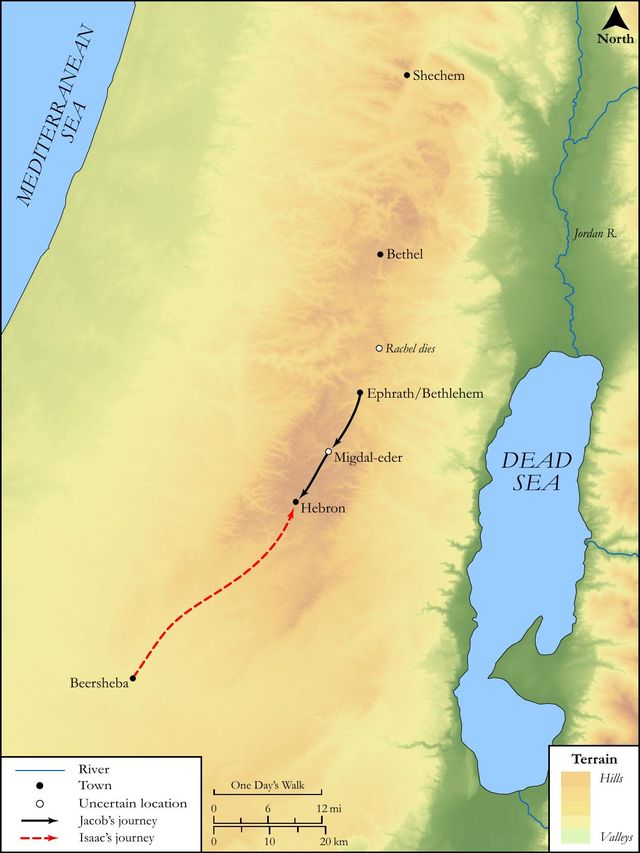
See on the biblical-era maps


Study this verse
Public-domain commentary
Matthew Henry
From his Commentary on the Whole Bible. Henry comments on passages, not single verses — this entry covers Genesis 35:21–29.
Here is, 1. Jacob's removal, Gen 35:21. He also, as his fathers, sojourned in the land of promise as in a strange country, and was not long in a place. Immediately after the story of Rachel's death he is here called Israel (Gen 35:21, Gen 35:22), and not often so afterwards: the Jews say, "The historian does him this honour here because he bore that affliction with such admirable patience and submission to Providence." Note, Those are Israel's indeed, princes with God, that support the government of their own passions. He that has this rule over his own spirit is better than the mighty. Israel, a prince with God, yet dwells in tents; the city is reserved for him in the other world. 2. The sin of Reuben. A piece of abominable wickedness it was that he was guilty of (Gen 35:22), that very sin which the apostle says (Co1 5:1) is not so much as named among the Gentiles, that one should have his father's wife. It is said to have been when Israel dwelt in that land; as if he were then absent from his family, which might be the unhappy occasion of these disorders. Though perhaps Bilhah was the greater criminal, and it is probable was abandoned by Jacob for it, yet Reuben's crime was so provoking that, for it, he lost his birthright and blessing, Gen 49:4. The first-born is not always the best, nor the most promising. This was Reuben's sin, but it was Jacob's affliction; and what a sore affliction it was is intimated in a little compass, and Israel heard it. No more is said - that is enough; he heard it with the utmost grief and shame, horror and displeasure. Reuben thought to conceal it, that his father should never hear of it; but those that promise themselves secresy in sin are generally disappointed; a bird of the air carries the voice. 3. A complete list of the sons of Jacob, now that Benjamin the youngest was born. This is the first time we have the names of these heads of the twelve tribes together; afterwards we find them very often spoken of and enumerated, even to the end of the Bible, Rev 7:4; Rev 21:12. 4. The visit which Jacob made to his father Isaac at Hebron. We may suppose he had visited him before since his return, for he sorely longed after his father's house; but never, till now, brought his family to settle with him, or near him, Gen 35:27. Probably he did this now upon the death of Rebekah, by which Isaac was left solitary, and not disposed to marry again. 5. The age and death of Isaac are here recorded, though it appears, by computation, that he died not till many years after Joseph was sold into Egypt, and much about the time that he was preferred there. Isaac, a mild quiet man, lived the longest of all the patriarches, for he was 180 years old; Abraham was but 175. Isaac lived about forty years after he had made his will, Gen 27:2. We shall not die an hour the sooner, but abundantly the better, for our timely setting our heart and house in order. Particular notice is taken of the amicable agreement of Esau and Jacob, in solemnizing their father's funeral (Gen 35:29), to show how wonderfully God had changed Esau's mind since he vowed his brother's murder immediately after his father's death, Gen 27:41. Note, God has many ways of preventing bad men from doing the mischief they intended; he can either tie their hands or turn their hearts.
Continue studying Genesis 35:23 across the web’s major study libraries — every link below opens this exact verse, chapter, or book on the destination site.
Read & Compare
 BibleGatewayThis verse in more than 200 translations and 70 languages.
 Bible.comThe YouVersion reader — hundreds of translations, reading plans, and highlights.
 ESV.orgCrossway's official English Standard Version reader.
 NET BibleThe NET translation with 60,000+ translators' notes on every rendering decision.
 STEP BibleTyndale House's free study tool — original text, vocabulary, and scholarly resources.
 BibliaLogos Bible Software's free web reader.
 USCCBThe New American Bible (Revised Edition) with the U.S. bishops' study notes.
Commentaries
 BibleHub CommentariesDozens of classic commentaries on this verse, gathered on one page.
 StudyLightMore than 100 commentary sets — the largest collection on the web.
 BibleRefPlain-English commentary on what this verse means, verse by verse.
 Enduring WordDavid Guzik's free commentary on this chapter, widely used by Bible teachers.
 Bible Study ToolsVerse commentary alongside Greek and Hebrew study aids.
Original Language & Research
- BibleHub InterlinearThe verse word by word — original language, transliteration, and English.
- BibleHub LexiconEvery word's original-language definition and Strong's entry.
 Blue Letter BibleDeep-study tools — Strong's numbers, concordance, and word studies.
 SefariaThe Hebrew text with Rashi and centuries of Jewish commentary.
Sermons, Hymns & Audio


TrulyRandomVerse is not affiliated with these sites and doesn’t control their content. They’re linked because they’re genuinely useful.
Summary
Genesis 35:23 meticulously enumerates the six sons born to Leah, Jacob's first wife: Reuben, Simeon, Levi, Judah, Issachar, and Zebulun. This verse initiates the comprehensive roster of Jacob's twelve sons, who would collectively become the progenitors of the twelve tribes of Israel, thereby establishing the crucial lineage through which God's covenant promises to Abraham and Isaac would be progressively fulfilled, ultimately culminating in the advent of the Messiah.
Context
ShowHideLiterary Context
Genesis 35 serves as a pivotal chapter in Jacob's life narrative, marking a significant transition from the tumultuous events surrounding the defilement of Dinah and the violent retribution by Simeon and Levi (Genesis 34). God's command for Jacob to return to Bethel, the sacred site of his foundational dream and covenant encounter (Genesis 28), initiates a period of spiritual renewal and consolidation. This chapter records the purification of Jacob's household, the somber death of Deborah (Rebekah's nurse), the poignant birth of Benjamin and the tragic death of Rachel, and culminates in the comprehensive listing of Jacob's twelve sons. Verse 23 specifically begins this enumeration by focusing on the six sons born to Leah, Jacob's primary wife, thereby establishing the initial and foundational segment of the future twelve tribes of Israel, whose full listing continues in Genesis 35:24-26.
Historical & Cultural Context
In the house of Jacob, lineage and tribal identity were paramount, serving as the bedrock of social, political, and religious structures. Genealogical records were not merely lists of names but vital documents affirming identity, inheritance rights, and covenant standing. The concept of a "firstborn" (H1060, bᵉkôwr) carried immense significance, typically entailing a double portion of inheritance and leadership responsibilities, though these could be forfeited. The practice of polygamy, while not God's ideal, was culturally permissible and often driven by the societal imperative for progeny, particularly male heirs, to ensure the continuation of the family line and the fulfillment of divine promises. The names given to children often held prophetic or personal significance, reflecting the parents' experiences, hopes, or theological understanding of God's work in their lives, as seen in Leah's naming of her sons in Genesis 29.
Key Themes
ShowHideGenesis 35:23 contributes significantly to several overarching themes within Genesis and the broader biblical narrative. Firstly, it underscores the theme of God's Faithfulness to His Covenant Promises, particularly the promise of numerous descendants to Abraham, Isaac, and Jacob (Genesis 12:2). Despite the complex and often dysfunctional family dynamics, God sovereignly orchestrates the growth of Jacob's family into the foundational unit of a nation. Secondly, the verse highlights the theme of Divine Providence Amidst Human Imperfection, demonstrating how God works through flawed individuals and challenging circumstances to achieve His redemptive purposes. The personal struggles of Leah and Rachel, and the strife within Jacob's household, do not derail God's plan for the covenant line. Finally, it emphasizes the theme of The Formation of Israel's Identity, as this list of sons directly foreshadows the establishment of the twelve tribes who would embody God's chosen people and through whom His law and redemptive plan would be revealed to the world.
Exposition and Analysis
ShowHideKey Word Analysis
ShowHideMeaning "a son (as a builder of the family name), in the widest sense (of literal and figurative relationship, including grandson, subject, nation, quality or condition, etc.)." In this context, bên specifically refers to the direct male offspring of Jacob, emphasizing their role as progenitors and foundational members of the emerging nation. The term underscores the generational continuity and the building of a family line, which is crucial for the fulfillment of the Abrahamic covenant.
Meaning "firstborn; hence, chief; eldest (son), firstborn(-ling)." This term, applied to Reuben, signifies his initial status as the eldest son of Jacob and Leah. In ancient Israelite culture, the firstborn held a position of preeminence, inheriting a double portion and leadership responsibilities. While Reuben is identified as the firstborn here, his later actions would lead to the forfeiture of these privileges, shifting the birthright and leadership to other sons, particularly Judah.
Meaning "habitation." Zebulun is the sixth and final son listed as born to Leah in this verse. His name, given by Leah, reflected her hope for Jacob to "dwell" with her, signifying her desire for a more stable and honored position within the family. The name "habitation" foreshadows the tribe of Zebulun's future allocation of territory within the promised land, providing a literal "dwelling place" for his descendants.
Verse Breakdown
ShowHide"The sons of Leah;"
This opening phrase immediately establishes the focus of the verse, specifying the mother of the children who are about to be listed. It highlights Leah's role as the primary wife and mother of a significant portion of Jacob's offspring, despite the emotional complexities of her relationship with Jacob. This is the first of four distinct groups of sons listed in this chapter, indicating a structured enumeration.
"Reuben, Jacob's firstborn, and Simeon, and Levi, and Judah, and Issachar, and Zebulun:"
This segment provides the specific names of Leah's six sons, in order of their birth. Each name carries a unique etymological and theological significance, reflecting Leah's personal experiences, hopes, and her understanding of God's involvement in her life. The inclusion of "Jacob's firstborn" for Reuben specifically identifies his status, which was culturally and theologically significant, even if later forfeited. This list forms the core foundation of the twelve tribes, with Judah's inclusion being particularly noteworthy for future messianic prophecy.
Literary Devices
ShowHideThe primary literary device at play in Genesis 35:23 is Enumeration or Cataloguing. This systematic listing of names serves a crucial narrative function, transitioning from individual family stories to the foundational establishment of a collective national identity. It is not merely a dry genealogical record but a deliberate act of Foundation-Laying, marking the fulfillment of God's promise to make Jacob a "multitude of nations" (Genesis 35:11). The order of the names also subtly employs Chronological Order, reflecting the sequence of their births, which was significant for establishing birthright and family hierarchy. Furthermore, the verse functions as a form of Summary Statement, consolidating the results of Jacob's earlier marriages and setting the stage for the subsequent listing of his other sons, thus completing the patriarchal lineage before the narrative shifts to the next generation.
Theological and Thematic Connections
ShowHideGenesis 35:23, though a simple list, is profoundly significant as it underscores God's unwavering faithfulness in bringing forth His covenant people. Despite the human frailties, rivalries, and complex relationships within Jacob's household, God sovereignly orchestrates the growth of his family, ensuring the continuation of the promised lineage. This verse is a tangible demonstration of God's power to work through imperfect circumstances and individuals to achieve His perfect redemptive plan, laying the very foundation for the nation of Israel, through whom the Messiah would ultimately come. It highlights that God's plan is not contingent on human perfection but on His divine will and power.
Reflection and Application
ShowHideGenesis 35:23, seemingly a mere genealogical entry, offers profound spiritual insights for contemporary believers. It serves as a powerful reminder that God's grand redemptive narrative unfolds through imperfect people and often messy, complicated situations. The lineage of Israel, and ultimately of Christ, is not a pristine, ideal family tree but one filled with human flaws, rivalries, and struggles. Yet, through it all, God faithfully worked to achieve His purposes. This should profoundly encourage us to trust in God's sovereignty even when our own lives, families, or circumstances seem far from ideal; He uses imperfect vessels to achieve His perfect will. Furthermore, the meticulous recording of each son's name underscores that every individual matters to God and has a unique, divinely appointed place within His overarching plan. Just as each son contributed uniquely to the formation of a nation, so too does every believer contribute to the body of Christ, reminding us of our shared spiritual heritage and identity in God's family, connected not by physical lineage but by faith in Christ.
Questions for Reflection
ShowHideFAQ
ShowHideWhy does Genesis 35:23 only list Leah's sons?
ShowHideGenesis 35:23 is not an exclusive list but rather the initial segment of a comprehensive enumeration of Jacob's twelve sons. The biblical narrative often structures genealogical records in distinct sections, typically beginning with the children of the primary wife. Subsequent verses, specifically Genesis 35:24-26, then complete the roster by listing the sons born to Rachel and the handmaids, Bilhah and Zilpah. This methodical presentation ensures that all twelve patriarchs, who would become the heads of the twelve tribes of Israel, are accounted for.
What is the significance of the names of Leah's sons?
ShowHideThe names of Leah's sons are deeply significant as they often serve as a window into her emotional state, her complex relationship with Jacob, and her theological reflections on God's intervention in her life. For instance, Reuben ("Behold, a son!") expressed her hope for Jacob's affection, Simeon ("Heard") signified her belief that God had heard her affliction, and Judah ("Praise") marked a profound moment of gratitude and worship toward the Lord. These names provide rich insight into Leah's personal journey, her struggles, and her perspective on God's providence, revealing how personal experiences were interwoven with the unfolding divine narrative of the covenant people.
Christ-Centered Fulfillment
ShowHideThe seemingly straightforward genealogical list in Genesis 35:23 carries profound Christ-centered fulfillment, particularly through the inclusion of Judah. From this son of Leah would descend the royal lineage of King David, and ultimately, Jesus Christ, the promised Messiah. The prophetic declaration in Genesis 49:10, stating that "the scepter shall not depart from Judah, nor a lawgiver from between his feet, until Shiloh comes," finds its ultimate and complete realization in Christ. He is the true King of Kings and Lord of Lords, the one who perfectly embodies the eternal reign foreshadowed by Judah's tribe. Thus, this verse, by meticulously establishing the foundational lineage of the tribes, points forward to the coming of the one true Son of God, Jesus Christ, through whom all the promises made to Abraham and Jacob would find their ultimate "Yes" and "Amen" (2 Corinthians 1:20). The entire history of Israel, beginning with these foundational sons, serves as a grand, divine preparation for the advent and redemptive work of Jesus Christ, the Lamb of God who takes away the sin of the world (John 1:29).