


Genesis 46:15
- אֵלֶּה'E·lehtheseH428PrtParticle Demonstrative
- בְּנֵיbe·Nei[were] [the] sons ofH1121N-mpcNoun Plural Masculine Construct
- לֵאָהle·'AhLeahH3812N-proper-fNoun Proper Feminine
- אֲשֶׁר'a·SherwhomH834RelParticle Relative
- יָלְדָהYal·dahshe had borneH3205V-Qal-Perf-3fsVerb Qal Perfect 3rd Singular Feminine
- לְיַעֲקֹבle·ya·'a·Koto JacobH3290Prep-l ¦ N-proper-mNoun Proper MasculineלְtoיַעֲקֹבJacob
- בְּפַדַּןbe·fa·Danin PaddanH6307Prep-b ¦ N-properNoun Proper LocationבְּinפַדַּןPaddan
- אֲרָם'a·RamAramH758N-properNoun Proper Location
- וְאֵתve·'Etand <obj.>H854Conj-w ¦ PrepPrepositionוְandאֵת<obj.>
- דִּינָהdi·NahDinahH1783N-proper-fNoun Proper Feminine
- בִתּוֹvi·Tohis daughterH1323N-fsc ¦ 3msNoun Singular Feminine Constructבִתּdaughterוֹhis
- כָּלkoleveryH3605N-mscNoun Singular Masculine Construct
- נֶפֶשׁNe·fesh<the> person ofH5315N-fscNoun Singular Feminine Construct
- בָּנָיוba·Navhis sonsH1121N-mpc ¦ 3msNoun Plural Masculine Constructבָּנָיsonsוhis
- וּבְנוֹתָיוu·ve·no·Tavand his daughtersH1323Conj-w ¦ N-fpc ¦ 3msNoun Plural Feminine Constructוּandבְנוֹתָיdaughtersוhis
- שְׁלֹשִׁיםshe·lo·Shim[was] thirtyH7970Adj-mpAdjective Numerical Plural Masculine Absolute
- וְשָׁלֹשׁve·sha·Loshand threeH7969Conj-w ¦ Adj-csAdjective Numerical Singular common gender Absoluteוְandשָׁלֹשׁthree
English is a literal word-by-word gloss of the Hebrew, not the KJV's wording. Why?
This is the original text the KJV's translators worked from — each Hebrew word with its own literal English meaning in this verse, prepared by scholars at Tyndale House, Cambridge. The KJV translates whole sentences, not word by word, so its wording differs: one Hebrew word can become several English words, and the KJV may choose “the LORD” where the gloss reads “Yahweh”. Both are faithful — they answer different questions. For the KJV's own rendering, switch to the KJV text.
Details
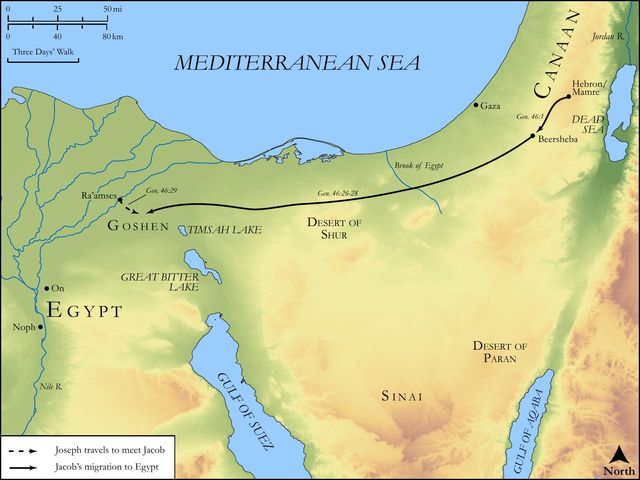
See on the biblical-era map


Study this verse
Public-domain commentary
Matthew Henry
From his Commentary on the Whole Bible. Henry comments on passages, not single verses — this entry covers Genesis 46:5–27.
Old Jacob is here flitting. Little did he think of ever leaving Canaan; he expected, no doubt, to die in his nest, and to leave his seed in actual possession of the promised land: but Providence orders it otherwise. Note, Those that think themselves well settled may yet be unsettled in a little time. Even old people, who think of no other removal than that to the grave (which Jacob had much upon his heart, Gen 37:35; Gen 42:38), sometimes live to see great changes in their family. It is good to be ready, not only for the grave, but for whatever may happen betwixt us and the grave. Observe, 1. How Jacob was conveyed; not in a chariot, though chariots were then used, but in a wagon, Gen 46:5. Jacob had the character of a plain man, who did not affect any thing stately or magnificent; his son rode in a chariot (Gen 41:43), but a wagon would serve him. 2. The removal of what he had with him. (1.) His effects (Gen 46:6), cattle and goods; these he took with him that he might not wholly be beholden to Pharaoh for a livelihood, and that it might not afterwards be said of them, "that they came beggars to Egypt." (2.) His family, all his seed, Gen 46:7. It is probable that they had continued to live together in common with their father; and therefore when he went they all went, which perhaps they were the more willing to do, because, though they had heard that the land of Canaan was promised them, yet, to this day, they had none of it in possession. We have here a particular account of the names of Jacob's family, his sons' sons, most of whom are afterwards mentioned as heads of houses in the several tribes. See Num 26:5, etc. Bishop Patrick observes that Issachar called his eldest son Tola, which signifies a worm, probably because when he was born he was a very little weak child, a worm, and no man, not likely to live; and yet there sprang from him a very numerous offspring, Ch1 7:2. Note, Living and dying do not go by probability. The whole number that went down into Egypt was sixty-six (Gen 46:26), to which add Joseph and his two sons, who were there before, and Jacob himself, the head of the family, and you have the number of seventy, Gen 46:27. The Septuagint makes them seventy-five, and Stephen follows them (Act 7:14), the reason of which we leave to the conjecture of the critics; but let us observe, [1.] Masters of families ought to take care of all under their charge, and to provide for those of their own house food convenient both for body and soul. When Jacob himself removed to a land of plenty, he would not leave any of his children behind him to starve in a barren land. [2.] Though the accomplishment of promises is always sure, yet it is often slow. It was now 215 years since God had promised Abraham to make of him a great nation (Gen 12:2); and yet that branch of his seed on which the promise was entailed had increased only to seventy, of which this particular account is kept, that the power of God in multiplying these seventy to so vast a multitude, even in Egypt, may appear the more illustrious. When God pleases, a little one shall become a thousand, Isa 60:22.
Continue studying Genesis 46:15 across the web’s major study libraries — every link below opens this exact verse, chapter, or book on the destination site.
Read & Compare
 BibleGatewayThis verse in more than 200 translations and 70 languages.
 Bible.comThe YouVersion reader — hundreds of translations, reading plans, and highlights.
 ESV.orgCrossway's official English Standard Version reader.
 NET BibleThe NET translation with 60,000+ translators' notes on every rendering decision.
 STEP BibleTyndale House's free study tool — original text, vocabulary, and scholarly resources.
 BibliaLogos Bible Software's free web reader.
 USCCBThe New American Bible (Revised Edition) with the U.S. bishops' study notes.
Commentaries
 BibleHub CommentariesDozens of classic commentaries on this verse, gathered on one page.
 StudyLightMore than 100 commentary sets — the largest collection on the web.
 BibleRefPlain-English commentary on what this verse means, verse by verse.
 Enduring WordDavid Guzik's free commentary on this chapter, widely used by Bible teachers.
 Bible Study ToolsVerse commentary alongside Greek and Hebrew study aids.
Original Language & Research
- BibleHub InterlinearThe verse word by word — original language, transliteration, and English.
- BibleHub LexiconEvery word's original-language definition and Strong's entry.
 Blue Letter BibleDeep-study tools — Strong's numbers, concordance, and word studies.
 SefariaThe Hebrew text with Rashi and centuries of Jewish commentary.
Sermons, Hymns & Audio


TrulyRandomVerse is not affiliated with these sites and doesn’t control their content. They’re linked because they’re genuinely useful.
Summary
Genesis 46:15 meticulously enumerates the thirty-three descendants of Leah—comprising her six sons and daughter Dinah—who were born to Jacob during his sojourn in Padanaram. This precise genealogical entry is an integral part of the broader account detailing Jacob's entire household migrating to Egypt, serving to underscore the initial, divinely orchestrated growth of the covenant family as a prelude to their development into a great nation, thereby fulfilling God's steadfast promises to Abraham, Isaac, and Jacob.
Context
ShowHideLiterary Context
This verse is situated within a comprehensive genealogical record found in Genesis 46:8-27, which meticulously lists all seventy (or seventy-five, depending on the textual tradition) members of Jacob's household who journeyed to Egypt. Specifically, Genesis 46:15 immediately follows the introductory statement to this grand enumeration (Genesis 46:8) and initiates the detailed breakdown of Jacob's children by each wife. It focuses exclusively on the lineage of Leah, Jacob's first wife, setting the stage for the subsequent lists of descendants from Zilpah, Rachel, and Bilhah. This meticulous accounting emphasizes the fulfillment of God's promise to multiply Jacob's "seed," a central theme throughout the patriarchal narratives.
Historical & Cultural Context
The setting of this verse, "Padanaram," refers to the region in Mesopotamia (also known as Paddan-Aram) where Jacob resided with Laban for twenty years (Genesis 29, Genesis 30, Genesis 31). It was during this period that most of Jacob's children, including all of Leah's, were born. Genealogies were critically important in the ancient Near East, serving not only as historical records but also as affirmations of identity, tribal affiliation, and inheritance rights. For the Israelites, these lists also served a theological purpose, demonstrating God's faithfulness in preserving and multiplying His chosen people, particularly in a time of severe famine that necessitated their migration to Egypt under Joseph's provision.
Key Themes
ShowHideGenesis 46:15 contributes significantly to several overarching themes in Genesis. Firstly, it highlights Divine Faithfulness and Covenant Fulfillment, as the growing number of descendants directly evidences God's promise to Abraham to make his offspring a great nation (Genesis 12:2). Secondly, the meticulous enumeration underscores God's Meticulous Providence, demonstrating His detailed oversight of His chosen people, ensuring that every individual is accounted for in His divine plan. Thirdly, it emphasizes the Foundation of the Nation Israel, with Leah's six sons becoming foundational tribes, laying the groundwork for Israel's identity and future. Finally, the verse reinforces the concept of the "Seed" of Promise, showing the initial blossoming of the promised lineage through whom salvation would ultimately come.
Exposition and Analysis
ShowHideGenesis 46:15 provides a focused account of Leah's descendants, emphasizing her foundational role as a matriarch in the burgeoning nation of Israel. The specification "which she bare unto Jacob in Padanaram" anchors these births to a specific period and location in Jacob's life, prior to his definitive return to Canaan. The explicit mention of "his daughter Dinah" highlights her inclusion in the family count, ensuring that the census encompasses all direct offspring, not solely the male heirs. The final tally of "all the souls of his sons and his daughters [were] thirty and three" precisely quantifies Leah's direct and indirect descendants who were part of the migration to Egypt.
Key Word Analysis
ShowHideDerived from a root meaning "to build," this term signifies a son or male offspring, often carrying the connotation of one who builds or continues the family name. In this context, it refers to Leah's six male children who would become patriarchs of significant tribes within Israel, thus "building" the future nation.
As the feminine form of bên, this word denotes a female offspring. Its inclusion here, specifically naming Dinah, underscores the comprehensive nature of the census, acknowledging all direct descendants, not just those who would carry the patriarchal lineage.
Properly meaning "a breathing creature" or "vitality," nephesh in this context refers to individual persons or living beings. It signifies each distinct member of the family being counted, emphasizing the individual lives that collectively formed the growing covenant community.
Verse Breakdown
ShowHide"These [be] the sons of Leah"
This clause introduces the specific segment of Jacob's family being enumerated, focusing on the descendants of his first wife, Leah, whose children formed a significant portion of the nascent Israelite nation.
"which she bare unto Jacob in Padanaram"
This phrase specifies the geographical and temporal context of their births, highlighting that these children were born during Jacob's twenty-year sojourn in Mesopotamia, away from the Promised Land. This detail underscores the fulfillment of God's promise to multiply Jacob even in a foreign land.
"with his daughter Dinah"
The explicit mention of Dinah, Jacob's only recorded daughter by Leah, ensures her inclusion in the count. This specific naming is notable, especially given her prominent and traumatic narrative in Genesis 34:1-31, reinforcing her continued place within the family of Israel and the comprehensive nature of the census.
"all the souls of his sons and his daughters [were] thirty and three"
This final clause provides the precise numerical total of Leah's direct and indirect descendants who accompanied Jacob to Egypt. The use of "souls" (Hebrew nephesh) denotes individual persons, emphasizing the meticulous record-keeping and the tangible growth of the covenant family. This count includes Leah's six sons, Dinah, and their respective children and grandchildren who were part of the migration.
Literary Devices
ShowHideThe primary literary device employed in Genesis 46:15 is Enumeration, a detailed listing of individuals, which is characteristic of biblical genealogies. This precise counting serves to validate the fulfillment of God's covenant promises regarding the multiplication of Abraham's seed. The specific mention of Dinah, despite the general categories of "sons and daughters," can be seen as a form of Emphasis through Inclusion, drawing particular attention to her presence and ensuring no direct descendant is overlooked. This meticulous record-keeping also functions as a form of Historical Documentation, providing a verifiable account of the foundational members of the emerging nation of Israel.
Theological and Thematic Connections
ShowHideThe meticulous enumeration of Jacob's descendants, particularly Leah's line in Genesis 46:15, serves as a profound testament to God's unwavering faithfulness and His active orchestration of redemptive history. This seemingly simple genealogical entry underscores the tangible fulfillment of God's covenant promises to Abraham, Isaac, and Jacob—promises that included the multiplication of their seed into a great nation. The growth of Jacob's family from a small, vulnerable unit into a burgeoning clan, even amidst trials and migrations, demonstrates God's consistent work in preserving and expanding His chosen people according to His divine plan. This detailed accounting highlights that every individual life is significant in God's grand design, contributing to the unfolding of His purposes.
Reflection and Application
ShowHideGenesis 46:15, while a concise genealogical entry, offers profound insights into God's character and His meticulous work in the world. It reveals a God who is precise, purposeful, and intimately involved in the details of His creation, even down to the individual members of a family lineage. The careful record-keeping of the biblical text underscores the immense value God places on every person, demonstrating that no life is insignificant in His grand redemptive narrative. For believers today, this verse serves as a powerful encouragement: just as God faithfully multiplied and preserved Jacob's family to fulfill His ancient promises, so too does He oversee every aspect of our lives and the growth of His kingdom. It calls us to trust in His detailed providence, knowing that He is actively at work, orchestrating events and drawing individuals into His divine plan, even from humble beginnings, to achieve His ultimate purposes. Our lives, like those counted in this ancient census, are known, valued, and purposed by God.
Questions for Reflection
ShowHideFAQ
ShowHideWhat does "souls" mean in this context?
ShowHideIn Genesis 46:15, the Hebrew word nephesh (נֶפֶשׁ), translated as "souls," refers simply to individual persons or living beings. It is not used in the modern theological sense of an immortal spirit separate from the body, but rather to denote each distinct, living member of the family being counted. This emphasizes that each life was a unique individual contributing to the growing patriarchal family that would eventually become the nation of Israel, a testament to God's careful accounting of His people.
Why is Dinah specifically mentioned if the count includes "sons and daughters"?
ShowHideDinah, Jacob's only recorded daughter by Leah, is specifically mentioned in Genesis 46:15 to ensure her explicit inclusion in the overall family count. While patriarchal genealogies often prioritize male heirs who carry on the family name, her specific mention highlights that the census includes all direct offspring who migrated to Egypt, regardless of gender or whether they would produce a tribal lineage. This is particularly significant given her prominent and traumatic story in Genesis 34:1-31, reinforcing her continued, integral place within the family of Israel despite past events.
Christ-Centered Fulfillment
ShowHideThe meticulous enumeration of Jacob's descendants in Genesis 46:15 and the subsequent verses serves as a foundational testament to the unfolding of God's grand redemptive plan, which finds its ultimate culmination in Jesus Christ. The growth of Jacob's family from a small, vulnerable group into a burgeoning nation demonstrates God's unwavering faithfulness in preserving and multiplying the "seed" through whom the Messiah would ultimately come. Every individual counted in this ancient census, including Leah's numerous descendants, forms an essential link in the genealogical chain that would eventually produce King David (Matthew 1:1-17) and, ultimately, Jesus Christ Himself—the promised Son of David and the true Seed of Abraham (Galatians 3:16). This detailed genealogical record, therefore, is far more than a mere historical list; it is a profound witness to God's precise, sovereign, and unwavering commitment to bringing forth the Savior of the world through a specific, chosen people, ensuring that the promise of redemption would be fulfilled in its appointed time through the person of Christ.