


Genesis 46:20
- וַיִּוָּלֵדvai·yi·va·Ledand it was bornH3205Conj-w ¦ V-Niphal-ConsecImperf-3msVerb Niphal Consecutive Imperfect 3rd Singular Masculineוַandיִּוָּלֵדit was born
- לְיוֹסֵףle·yo·Sefto JosephH3130Prep-l ¦ N-proper-mNoun Proper MasculineלְtoיוֹסֵףJoseph
- בְּאֶרֶץbe·'E·retzin [the] land ofH776Prep-b ¦ N-fscNoun Singular Feminine Constructבְּinאֶרֶץ[the] land of
- מִצְרַיִםmitz·ra·YimEgyptH4714N-properNoun Proper Location
- אֲשֶׁר'a·Sher[those] whomH834RelParticle Relative
- יָלְדָהYal·dahshe boreH3205V-Qal-Perf-3fsVerb Qal Perfect 3rd Singular Feminine
- לּוֹloto himPrep-l ¦ 3msSuffix Personal 3rd Singular Masculineלּtoוֹhim
- אָסְנַת'a·se·NatAsenathH621N-proper-fNoun Proper Feminine
- בַּתbat[the] daughter ofH1323N-fscNoun Singular Feminine Construct
- פּוֹטִיPo·tiPoti-H6319N-proper-mNoun Proper Masculine
- פֶרַעFe·ra'-pheraH6319N-proper-mNoun Proper Masculine
- כֹּהֵןko·Hen[the] priest ofH3548N-mscNoun Singular Masculine Construct
- אֹן'OnOnH204N-properNoun Proper Location
- אֶת'et<obj.>H853DirObjMParticle Object Indicator
- מְנַשֶּׁהme·na·ShehManassehH4519N-proper-mNoun Proper Masculine
- וְאֶתve·'Etand <obj.>H853Conj-w ¦ DirObjMParticle Object Indicatorוְandאֶת<obj.>
- אֶפְרָיִם'ef·Ra·yimEphraimH669N-proper-mNoun Proper Masculine
English is a literal word-by-word gloss of the Hebrew, not the KJV's wording. Why?
This is the original text the KJV's translators worked from — each Hebrew word with its own literal English meaning in this verse, prepared by scholars at Tyndale House, Cambridge. The KJV translates whole sentences, not word by word, so its wording differs: one Hebrew word can become several English words, and the KJV may choose “the LORD” where the gloss reads “Yahweh”. Both are faithful — they answer different questions. For the KJV's own rendering, switch to the KJV text.
Details
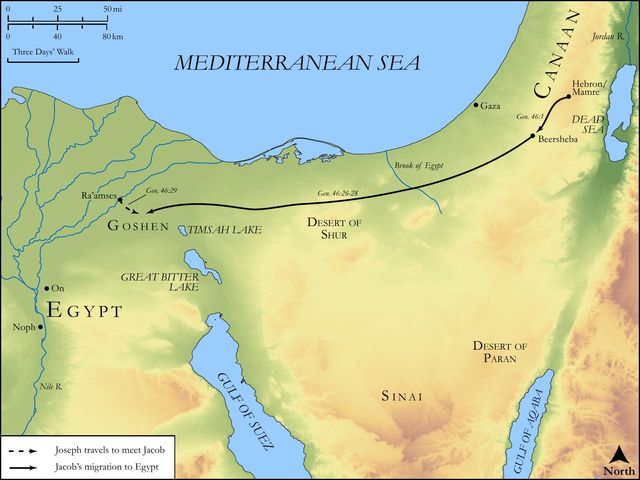
See on the biblical-era map


Study this verse
Public-domain commentary
Matthew Henry
From his Commentary on the Whole Bible. Henry comments on passages, not single verses — this entry covers Genesis 46:5–27.
Old Jacob is here flitting. Little did he think of ever leaving Canaan; he expected, no doubt, to die in his nest, and to leave his seed in actual possession of the promised land: but Providence orders it otherwise. Note, Those that think themselves well settled may yet be unsettled in a little time. Even old people, who think of no other removal than that to the grave (which Jacob had much upon his heart, Gen 37:35; Gen 42:38), sometimes live to see great changes in their family. It is good to be ready, not only for the grave, but for whatever may happen betwixt us and the grave. Observe, 1. How Jacob was conveyed; not in a chariot, though chariots were then used, but in a wagon, Gen 46:5. Jacob had the character of a plain man, who did not affect any thing stately or magnificent; his son rode in a chariot (Gen 41:43), but a wagon would serve him. 2. The removal of what he had with him. (1.) His effects (Gen 46:6), cattle and goods; these he took with him that he might not wholly be beholden to Pharaoh for a livelihood, and that it might not afterwards be said of them, "that they came beggars to Egypt." (2.) His family, all his seed, Gen 46:7. It is probable that they had continued to live together in common with their father; and therefore when he went they all went, which perhaps they were the more willing to do, because, though they had heard that the land of Canaan was promised them, yet, to this day, they had none of it in possession. We have here a particular account of the names of Jacob's family, his sons' sons, most of whom are afterwards mentioned as heads of houses in the several tribes. See Num 26:5, etc. Bishop Patrick observes that Issachar called his eldest son Tola, which signifies a worm, probably because when he was born he was a very little weak child, a worm, and no man, not likely to live; and yet there sprang from him a very numerous offspring, Ch1 7:2. Note, Living and dying do not go by probability. The whole number that went down into Egypt was sixty-six (Gen 46:26), to which add Joseph and his two sons, who were there before, and Jacob himself, the head of the family, and you have the number of seventy, Gen 46:27. The Septuagint makes them seventy-five, and Stephen follows them (Act 7:14), the reason of which we leave to the conjecture of the critics; but let us observe, [1.] Masters of families ought to take care of all under their charge, and to provide for those of their own house food convenient both for body and soul. When Jacob himself removed to a land of plenty, he would not leave any of his children behind him to starve in a barren land. [2.] Though the accomplishment of promises is always sure, yet it is often slow. It was now 215 years since God had promised Abraham to make of him a great nation (Gen 12:2); and yet that branch of his seed on which the promise was entailed had increased only to seventy, of which this particular account is kept, that the power of God in multiplying these seventy to so vast a multitude, even in Egypt, may appear the more illustrious. When God pleases, a little one shall become a thousand, Isa 60:22.
Continue studying Genesis 46:20 across the web’s major study libraries — every link below opens this exact verse, chapter, or book on the destination site.
Read & Compare
 BibleGatewayThis verse in more than 200 translations and 70 languages.
 Bible.comThe YouVersion reader — hundreds of translations, reading plans, and highlights.
 ESV.orgCrossway's official English Standard Version reader.
 NET BibleThe NET translation with 60,000+ translators' notes on every rendering decision.
 STEP BibleTyndale House's free study tool — original text, vocabulary, and scholarly resources.
 BibliaLogos Bible Software's free web reader.
 USCCBThe New American Bible (Revised Edition) with the U.S. bishops' study notes.
Commentaries
 BibleHub CommentariesDozens of classic commentaries on this verse, gathered on one page.
 StudyLightMore than 100 commentary sets — the largest collection on the web.
 BibleRefPlain-English commentary on what this verse means, verse by verse.
 Enduring WordDavid Guzik's free commentary on this chapter, widely used by Bible teachers.
 Bible Study ToolsVerse commentary alongside Greek and Hebrew study aids.
Original Language & Research
- BibleHub InterlinearThe verse word by word — original language, transliteration, and English.
- BibleHub LexiconEvery word's original-language definition and Strong's entry.
 Blue Letter BibleDeep-study tools — Strong's numbers, concordance, and word studies.
 SefariaThe Hebrew text with Rashi and centuries of Jewish commentary.
Sermons, Hymns & Audio


TrulyRandomVerse is not affiliated with these sites and doesn’t control their content. They’re linked because they’re genuinely useful.
Summary
Genesis 46:20 meticulously records the birth of Manasseh and Ephraim to Joseph and his Egyptian wife, Asenath, the daughter of Potipherah, priest of On. This seemingly brief genealogical entry is profoundly significant, underscoring Joseph's remarkable ascent to power and integration into the highest echelons of Egyptian society, while simultaneously affirming the continuation and expansion of God's covenant lineage, even as it takes root and flourishes in a foreign land, setting the stage for the burgeoning nation of Israel.
Context
ShowHideLiterary Context
Genesis 46:20 is embedded within a detailed genealogical list that enumerates the "souls of the house of Jacob, which came into Egypt" Genesis 46:26. This verse specifically serves as a parenthetical note within the broader enumeration of Jacob's descendants, clarifying that Joseph's family was already established in Egypt prior to the arrival of the rest of Jacob's household. It follows the listing of Jacob's sons and their children, highlighting Joseph's unique position as the one who had already found favor and established a family in the foreign land, thereby setting the stage for the entire family's survival and future growth. The preceding chapters, particularly Genesis 37, Genesis 38, Genesis 39, Genesis 40, Genesis 41, Genesis 42, Genesis 43, Genesis 44, Genesis 45, narrate Joseph's dramatic journey from slavery to becoming the vizier of Egypt, culminating in the reunion with his family and their invitation to settle in Goshen. This verse thus confirms the fruit of Joseph's elevated status and God's providential care in preserving the nascent nation.
Historical & Cultural Context
Ancient Egypt was a highly structured society with a sophisticated religious and political hierarchy. Joseph's marriage to Asenath, the daughter of Potipherah, a "priest of On," was not merely a personal union but a strategic alliance orchestrated by Pharaoh himself Genesis 41:45. On, also known as Heliopolis, was one of the most ancient and influential religious centers in Egypt, dedicated primarily to the worship of the sun god Ra. A "priest of On" would have held immense religious, social, and political power, often serving as a trusted advisor to the Pharaoh. This marriage firmly integrated Joseph into the highest echelons of Egyptian society, solidifying his authority and access to power, which was crucial for the survival and prosperity of his family during the famine. The naming of his sons, Manasseh ("causing to forget") and Ephraim ("fruitful"), also reflects Egyptian cultural practices of naming children to commemorate life events or express aspirations, while simultaneously revealing Joseph's personal spiritual journey and reliance on God Genesis 41:51-52.
Key Themes
ShowHideThis verse contributes significantly to several overarching themes in Genesis. Firstly, it powerfully illustrates Divine Providence, demonstrating God's sovereign hand in orchestrating Joseph's rise to power and the establishment of his family in Egypt, ensuring the survival and growth of the covenant people against all odds. Secondly, it highlights the theme of Covenant Continuity and Fulfillment, as the birth of Manasseh and Ephraim directly contributes to the increasing number of Jacob's descendants, a direct fulfillment of God's promise to Abraham that his offspring would be numerous and become a great nation, as seen in Genesis 12:2 and reiterated in Genesis 15:5. Thirdly, it touches upon the theme of Integration vs. Identity, as Joseph, despite his deep integration into Egyptian culture through marriage and position, maintains his distinct Israelite identity, and his sons, though born to an Egyptian mother, are later adopted by Jacob and receive a full tribal inheritance, affirming their place within the covenant family of Israel Genesis 48:5.
Exposition and Analysis
ShowHideKey Word Analysis
ShowHideFrom the root meaning "to add" or "he will add." This name, given by Rachel, prophetically points to God's future addition of another son (Benjamin) and, more broadly, to Joseph's role in adding to the family's prosperity and ensuring its survival. In this verse, it emphasizes the individual around whom the family's future in Egypt revolves, the one through whom God's providential plan for the covenant lineage is being fulfilled.
A primitive root meaning "to bear young" or "to beget." This word is crucial in genealogical contexts, emphasizing the continuity of lineage and the fulfillment of the divine command to "be fruitful and multiply." Its repetition (implied for "born" and explicit for "bare") highlights the act of procreation as central to the growth of the family, a direct counterpoint to the threat of famine and extinction that brought them to Egypt. It underscores the miraculous nature of life continuing and expanding even in a foreign land.
An active participle meaning "one officiating" or "a priest." This term denotes a person holding a position of religious authority and influence, often associated with a specific deity or cult. Potipherah's title as "priest of On" signifies his high social standing and connection to the powerful religious establishment of ancient Egypt, particularly the sun god Ra. This detail highlights the significant cultural and religious bridge Joseph's marriage created, placing the covenant family's patriarch at the very heart of Egyptian power and pagan worship, yet under God's sovereign control.
Verse Breakdown
ShowHide"And unto Joseph in the land of Egypt were born Manasseh and Ephraim"
This clause immediately establishes the setting for the births – "the land of Egypt," emphasizing Joseph's established life and high status there. The mention of Manasseh and Ephraim, Joseph's firstborn sons, highlights the continuation of his lineage and the burgeoning of the covenant family. Their names, given by Joseph himself, reflect his personal journey of overcoming past suffering ("Manasseh" meaning "causing to forget") and experiencing God's abundant blessing and fruitfulness ("Ephraim" meaning "fruitful") in a foreign land, as detailed in Genesis 41:51-52. These sons would later be adopted by Jacob, receiving a full tribal inheritance and effectively giving Joseph a double portion among his brothers, as recorded in Genesis 48:5.
"which Asenath the daughter of Potipherah priest of On bare unto him"
This identifies the mother of Joseph's sons as Asenath, an Egyptian woman, and crucially, her father, Potipherah, as a "priest of On." On, also known as Heliopolis, was a preeminent religious and intellectual center in ancient Egypt, primarily devoted to the worship of the sun god Ra. A "priest of On" held a position of immense religious, social, and political influence, often being part of the Pharaoh's inner circle. This detail underscores the strategic importance and high status of Joseph's marriage, which was arranged by Pharaoh himself Genesis 41:45. This union not only solidified Joseph's position at the pinnacle of Egyptian power but also demonstrates God's providential care in elevating Joseph and ensuring the survival and growth of the nascent Israelite nation through a seemingly unlikely, yet divinely orchestrated, union.
Literary Devices
ShowHideThe verse employs several literary devices to convey its profound message. Genealogy is the overarching framework, as this verse is a concise entry within a broader list, serving to meticulously track the covenant lineage and demonstrate God's faithfulness in multiplying Abraham's descendants. The Nominal Symbolism of Joseph's sons' names, Manasseh ("causing to forget") and Ephraim ("fruitful"), powerfully encapsulates Joseph's personal testimony of God's redemptive work in his life, transforming his pain into blessing. There is also a subtle Contrast or Divine Irony at play: the children destined to become two major tribes of Israel are born not in the promised land, nor to a woman of Abraham's direct lineage, but to an Egyptian woman, the daughter of a pagan priest. This highlights God's sovereign ability to work through unexpected and even seemingly contradictory circumstances to fulfill His purposes, demonstrating that His plans are not limited by human conventions or cultural boundaries.
Theological and Thematic Connections
ShowHideGenesis 46:20, while a simple genealogical entry, is rich with theological significance. It powerfully illustrates the theme of divine providence, showcasing God's active involvement in the minute details of human lives and historical events to fulfill His overarching redemptive plan. The birth of Manasseh and Ephraim in Egypt, to an Egyptian mother, yet their destiny to become two of the most prominent tribes of Israel, is a testament to God's sovereign hand. He works through diverse and often unexpected means, ensuring the growth, continuity, and preservation of His chosen people, even when they are immersed in a foreign culture. This verse affirms that God's covenant promises are unstoppable, unfolding precisely as He intends, regardless of the circumstances.
Reflection and Application
ShowHideGenesis 46:20 offers a profound lesson on the expansive nature of God's providence and His ability to work in and through all circumstances. Joseph's story, culminating in the birth of his sons in Egypt, reminds us that God's purposes are not confined by our present location, cultural context, or the apparent "unsuitability" of our surroundings. Like Joseph, who found himself integrated into a foreign and pagan culture, we are called to trust that God remains active in our lives, capable of bringing forth blessings, fruitfulness, and the fulfillment of His plans even in environments that seem far removed from our ideal or expected paths. This encourages us to maintain unwavering faith in God's overarching sovereignty, knowing that He can orchestrate diverse elements—including our unique backgrounds, relationships, and challenges—to achieve His perfect will for His people and His kingdom. It challenges us to see God's hand at work even in the mundane or seemingly secular aspects of our lives, recognizing that every detail can be part of His grand design.
Questions for Reflection
ShowHideFAQ
ShowHideWho were Manasseh and Ephraim, and why are they significant?
ShowHideManasseh and Ephraim were the two sons born to Joseph in Egypt. They are profoundly significant because, despite their Egyptian mother, their grandfather Jacob adopted them as his own sons, granting them the status of full heirs and establishing them as two distinct tribes within Israel, effectively giving Joseph a double portion in the tribal inheritance Genesis 48:5-6. This adoption elevated their status beyond mere grandchildren, making them foundational to the twelve tribes. Their names, meaning "causing to forget" (Manasseh) and "fruitful" (Ephraim), also reflect Joseph's personal testimony of God's faithfulness in his life, transforming his suffering into blessing and abundance, as detailed in Genesis 41:51-52.
What was the significance of Potipherah being a "priest of On"?
ShowHideOn, also known as Heliopolis, was one of the most ancient and important religious and intellectual centers in Egypt, primarily dedicated to the worship of the sun god Ra. A "priest of On" held a position of immense religious, social, and political power and influence within the Egyptian hierarchy, often serving as a key advisor to the Pharaoh. Joseph's marriage to Asenath, the daughter of such a prominent figure, signifies the depth of his integration and high standing within Egyptian society, further cementing his authority and Pharaoh's trust in him. This union, orchestrated by Pharaoh himself Genesis 41:45, highlights God's strategic placement of Joseph at the highest levels of power, ensuring the preservation and future prosperity of His covenant people amidst a severe famine.
Christ-Centered Fulfillment
ShowHideGenesis 46:20, by detailing the growth of Joseph's family in Egypt, subtly points towards Christ in profound ways. Joseph himself stands as a powerful type of Christ: sold by his brothers, he suffered unjustly and was imprisoned, yet was ultimately exalted to a position of unparalleled power to save his family and many nations from famine, providing sustenance and refuge. Similarly, Christ, rejected by His own people, endured suffering and death, only to be supremely exalted by God to bring salvation and eternal life to His people and the entire world Philippians 2:6-11. The birth of Manasseh and Ephraim signifies the burgeoning of the covenant family, a necessary and miraculous step in the unfolding of God's redemptive plan. This growing nation, preserved and multiplied in Egypt, would eventually be the very lineage from which the Messiah would come, fulfilling God's ancient promises to Abraham, Isaac, and Jacob, as meticulously traced in the genealogy of Jesus in Matthew 1:1-17. Furthermore, the inclusion of an Egyptian mother, Asenath, in the lineage of two major tribes of Israel powerfully foreshadows the inclusive nature of Christ's kingdom, where people from all nations and backgrounds are brought into the family of God through faith, breaking down the dividing wall between Jew and Gentile Ephesians 2:11-22. God's ability to work through seemingly unlikely circumstances and diverse individuals to achieve His ultimate redemptive purpose is a testament to the boundless scope of His grace in Christ Jesus.