


Genesis 48:4
Bible text: King James Version (1769 Blayney text) · Public domain
Bible text: King James Version with Strong's numbers · Public domain
Bible text: Berean Standard Bible · Public domain
Bible text: American Standard Version (1901) · Public domain
Bible text: World English Bible, Messianic edition · Public domain
Bible text: Geneva Bible (1599) · Public domain
Bible text: Young's Literal Translation · Public domain
- וַיֹּאמֶרvai·Yo·merand he saidH559Conj-w ¦ V-Qal-ConsecImperf-3msVerb Qal Consecutive Imperfect 3rd Singular Masculineוַandיֹּאמֶרhe said
- אֵלַי'e·Laito meH413Prep ¦ 1csPrepositionאֵלַtoיme
- הִנְנִיhi·Nihere IH2005Prt ¦ 1csParticle InterjectionהִנְhereנִיI
- מַפְרְךָmaf·re·Kha[am] about to make fruitful youH6509V-Hiphil-Prtcpl-ms ¦ 2msVerb Hiphil Participle Singular Masculine Constructמַפְרְ[am] about to make fruitfulךָyou
- וְהִרְבִּיתִךָve·hir·bi·Ti·khaand I will multiply youH7235Conj-w ¦ V-Hiphil-ConsecPerf-1cs ¦ 2msVerb Hiphil Consecutive Perfect 1st Singular common genderוְandהִרְבִּיתִI will multiplyךָyou
- וּנְתַתִּיךָu·ne·ta·Ti·khaand I will make youH5414Conj-w ¦ V-Qal-ConsecPerf-1cs ¦ 2msVerb Qal Consecutive Perfect 1st Singular common genderוּandנְתַתִּיI will makeךָyou
- לִקְהַלlik·Hal<into> a company ofH6951Prep-l ¦ N-mscNoun Singular Masculine Constructלִ<into>קְהַלa company of
- עַמִּים'a·MimpeoplesH5971N-mpNoun Plural Masculine Absolute
- וְנָתַתִּיve·Na·ta·Tiand I will giveH5414Conj-w ¦ V-Qal-ConsecPerf-1csVerb Qal Consecutive Perfect 1st Singular common genderוְandנָתַתִּיI will give
- אֶת'et<obj.>H853DirObjMParticle Object Indicator
- הָאָרֶץha·'A·retzthe landH776Art ¦ N-fsNoun Singular Feminine Absoluteהָtheאָרֶץland
- הַזֹּאתha·Zot<the> thisH2063Art ¦ PrtParticle Demonstrativeהַ<the>זֹּאתthis
- לְזַרְעֲךָle·zar·'a·Khato your offspringH2233Prep-l ¦ N-msc ¦ 2msNoun Singular Masculine Constructלְtoזַרְעֲoffspringךָyour
- אַחֲרֶיךָ'a·cha·Rei·khaafter youH310Adj-mpc ¦ 2msAdjective Numerical Plural Masculine Constructאַחֲרֶיafterךָyou
- אֲחֻזַּת'a·chu·Zata possession ofH272N-fscNoun Singular Feminine Construct
- עוֹלָםo·LamperpetuityH5769N-msNoun Singular Masculine Absolute
English is a literal word-by-word gloss of the Hebrew, not the KJV's wording. Why?
This is the original text the KJV's translators worked from — each Hebrew word with its own literal English meaning in this verse, prepared by scholars at Tyndale House, Cambridge. The KJV translates whole sentences, not word by word, so its wording differs: one Hebrew word can become several English words, and the KJV may choose “the LORD” where the gloss reads “Yahweh”. Both are faithful — they answer different questions. For the KJV's own rendering, switch to the KJV text.
Details
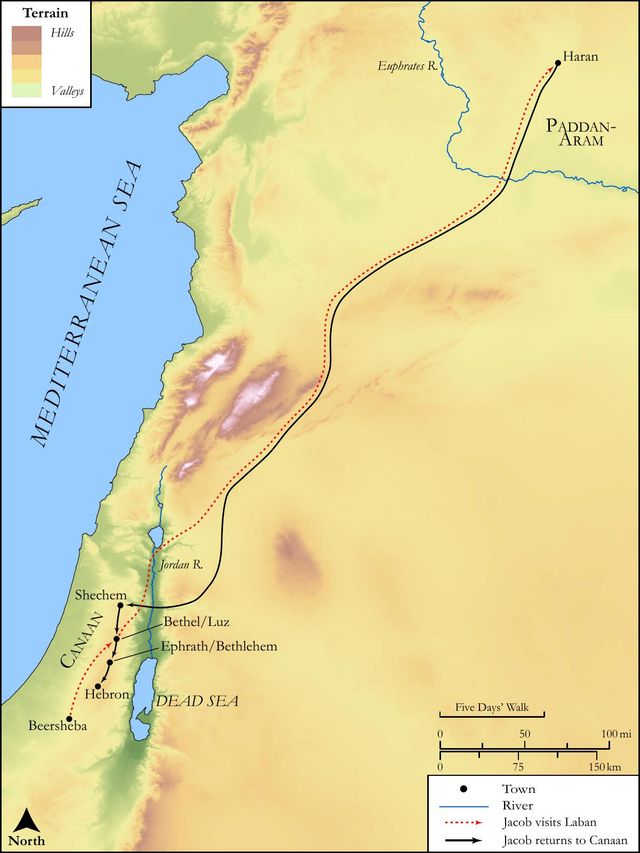
See on the biblical-era maps


Study this verse
Public-domain commentary
Matthew Henry
From his Commentary on the Whole Bible. Henry comments on passages, not single verses — this entry covers Genesis 48:1–7. His three-level outline is real structure in the source text, so it is rendered as structure.
Here, I. Joseph, upon notice of his father's illness, goes to see him; though a man of honour and business, yet he will not fail to show this due respect to his aged father, Gen 48:1. Visiting the sick, to whom we lie under obligations, or may have opportunity of doing good, either for body or soul, is our duty. The sick bed is a proper place both for giving comfort and counsel to others and receiving instruction ourselves. Joseph took his two sons with him, that they might receive their dying grandfather's blessing, and that what they might see in him, and hear from him, might make an abiding impression upon them. Note, 1. It is good to acquaint young people that are coming into the world with the aged servants of God that are going out of it, whose dying testimony to the goodness of God, and the pleasantness of wisdom's ways, may be a great encouragement to the rising generation. Manasseh and Ephraim (I dare say) would never forget what passed at this time. 2. Pious parents are desirous of a blessing, not only for themselves, but for their children. "O that they may live before God!" Joseph had been, above all his brethren, kind to his father, and therefore had reason to expect particular favour from him.
II.Jacob, upon notice of his son's visit, prepared himself as well as he could to entertain him, Gen 48:2.
He did what he could to rouse his spirits, and to stir up the gift that was in him; what little was lift of bodily strength he put forth to the utmost, and sat upon the bed. Note, It is very good for sick and aged people to be as lively and cheerful as they can, that they may not faint in the day of adversity. Strengthen thyself, as Jacob here, and God will strengthen thee; hearten thyself and help thyself, and God will help and hearten thee. Let the spirit sustain the infirmity.
III.In recompence to Joseph for all his attentions to him, he adopted his two sons. In this charter of adoption there is,
1.A particular recital of God's promise to him, to which this had reference: "God blessed me (Gen 48:3), and let that blessing be entailed upon them." God had promised him two things, a numerous issue, and Canaan for an inheritance (Gen 48:4); and Joseph's sons, pursuant hereunto, should each of them multiply into a tribe, and each of them have a distinct lot in Canaan, equal with Jacob's own sons. See how he blessed them by faith in that which God had said to him, Heb 11:21. Note, In all our prayers, both for ourselves and for our children, we ought to have a particular eye to, and remembrance of, God's promises to us.
2.An express reception of Joseph's sons into his family: "Thy sons are mine (Gen 48:5), not only my grandchildren, but as my own children." Though they were born in Egypt, and their father was then separated from his brethren, which might seem to have cut them off from the heritage of the Lord, yet Jacob takes them in, and owns them for visible church members. He explains this at Gen 48:16, Let my name be named upon them, and the name of my fathers; as if he had said, "Let them not succeed their father in his power and grandeur here in Egypt, but let them succeed me in the inheritance of the promise made to Abraham," which Jacob looked upon as much more valuable and honourable, and would have them to prize and covet accordingly. Thus the aged dying patriarch teaches these young persons, now that they were of age (being about twenty-one years old), not to look upon Egypt as their home, nor to incorporate themselves with the Egyptians, but to take their lot with the people of God, as Moses afterwards in the like temptation, Heb 11:24-26. And because it would be a piece of self-denial in them, who stood so fair for preferment in Egypt, to adhere to the despised Hebrews, to encourage them he constitutes each of them the head of a tribe. Note, Those are worthy of double honour who, through God's grace, break through the temptations of worldly wealth and preferment, to embrace religion in disgrace and poverty. Jacob will have Ephraim and Manasseh to believe that it is better to be low and in the church than high and out of it, to be called by the name of poor Jacob than to be called by the name of rich Joseph.
3.A proviso inserted concerning the children he might afterwards have; they should not be accounted heads of tribes, as Ephraim and Manasseh were, but should fall in with either the one or the other of their brethren, Gen 48:6. It does not appear that Joseph had any more children; however, it was Jacob's prudence to give this direction, for the preventing of contest and mismanagement. Note, In making settlements, it is good to take advice, and to provide for what may happen, while we cannot foresee what will happen. Our prudence must attend God's providence.
4.Mention is made of the death and burial of Rachel, Joseph's mother, and Jacob's best beloved wife (Gen 48:7), referring to that story, Gen 35:19. Note,
(1.)When we come to die ourselves, it is good to call to mind the death of our dear relations and friends, that have gone before us, to make death and the grave the more familiar to us. See Num 27:13. Those that were to us as our own souls are dead and buried; and shall we think it much to follow them in the same path?
(2.)The removal of dear relations from us is an affliction the remembrance of which cannot but abide with us a great while. Strong affections in the enjoyment cause long afflictions in the loss.
Continue studying Genesis 48:4 across the web’s major study libraries — every link below opens this exact verse, chapter, or book on the destination site.
Read & Compare
 BibleGatewayThis verse in more than 200 translations and 70 languages.
 Bible.comThe YouVersion reader — hundreds of translations, reading plans, and highlights.
 ESV.orgCrossway's official English Standard Version reader.
 NET BibleThe NET translation with 60,000+ translators' notes on every rendering decision.
 STEP BibleTyndale House's free study tool — original text, vocabulary, and scholarly resources.
 BibliaLogos Bible Software's free web reader.
 USCCBThe New American Bible (Revised Edition) with the U.S. bishops' study notes.
Commentaries
 BibleHub CommentariesDozens of classic commentaries on this verse, gathered on one page.
 StudyLightMore than 100 commentary sets — the largest collection on the web.
 BibleRefPlain-English commentary on what this verse means, verse by verse.
 Enduring WordDavid Guzik's free commentary on this chapter, widely used by Bible teachers.
 Bible Study ToolsVerse commentary alongside Greek and Hebrew study aids.
Original Language & Research
- BibleHub InterlinearThe verse word by word — original language, transliteration, and English.
- BibleHub LexiconEvery word's original-language definition and Strong's entry.
 Blue Letter BibleDeep-study tools — Strong's numbers, concordance, and word studies.
 SefariaThe Hebrew text with Rashi and centuries of Jewish commentary.
Sermons, Hymns & Audio


TrulyRandomVerse is not affiliated with these sites and doesn’t control their content. They’re linked because they’re genuinely useful.
Summary
Genesis 48:4 captures Jacob's solemn recounting of God's foundational covenant promise delivered to him at Luz (Bethel). This pivotal divine affirmation, made as Jacob prepares to bless Joseph's sons, underscores God's unwavering commitment to making Jacob exceedingly fruitful, multiplying his descendants into a vast assembly of nations, and granting the land of Canaan as an everlasting possession to his posterity. It serves as the theological bedrock for the subsequent transfer of patriarchal blessings, ensuring the continuity of God's redemptive plan across generations.
Context
ShowHideLiterary Context
Genesis 48 marks a crucial transition in the book of Genesis, bridging the narrative of Jacob's family settling in Egypt with the impending death of the patriarchs and the transfer of covenant promises. Jacob, now old and frail, summons Joseph and his two sons, Manasseh and Ephraim, to his bedside. Before bestowing a blessing that elevates Ephraim and Manasseh to the status of full tribes of Israel, Jacob deliberately recounts God's appearance to him at Luz (Bethel). This recollection, specifically found in Genesis 48:3-4, serves as the divine warrant and foundation for the blessings he is about to pronounce, emphasizing that his actions are not merely personal preferences but a continuation of God's established covenant. It links the present moment of blessing directly to the past divine encounters, ensuring the spiritual legacy is firmly rooted in God's promises.
Historical & Cultural Context
Jacob's family, comprising seventy souls, has been residing in Egypt for seventeen years under Joseph's provision. This period of peace and prosperity, however, is a temporary sojourn, not the permanent fulfillment of the land promise. The patriarchal household, as Isaac's blessing of Jacob shows, placed immense importance on the deathbed blessings of the patriarchs, which were seen as authoritative pronouncements carrying spiritual weight and prophetic significance for the future of the family and tribe. The act of adopting Ephraim and Manasseh into the direct lineage of Jacob, effectively giving Joseph a double portion, reflects the cultural practice of inheritance and the unique status of the firstborn (though Jacob later subverts this in his blessing). The mention of "Luz in the land of Canaan" (Genesis 48:3) serves as a powerful reminder that despite their current location in Egypt, the ultimate destiny and inheritance of Jacob's descendants remain tied to the Promised Land, a land that was foreign to them at this moment.
Key Themes
ShowHideGenesis 48:4 powerfully reinforces several overarching themes in Genesis. The continuity of the Abrahamic Covenant is paramount, as God's promises of numerous descendants and land, initially given to Abraham (Genesis 12:2-3), are reaffirmed to Isaac (Genesis 26:3-4), and now explicitly recounted by Jacob as having been given to him at Bethel (Genesis 28:13-15). This highlights God's unwavering faithfulness to His word across generations, even when circumstances (like famine and residence in Egypt) seem to contradict the promises. The theme of divine sovereignty is evident in God's active declaration, "I will make thee fruitful... and I will give this land," emphasizing that the fulfillment rests entirely on His power and purpose. Furthermore, the verse underscores the importance of generational blessing and spiritual heritage, as Jacob consciously transmits the knowledge of God's covenant to his grandsons, ensuring the legacy of faith continues.
Exposition and Analysis
ShowHideIn Genesis 48:4, Jacob directly quotes God's words spoken to him at Bethel, highlighting the specific elements of the covenant promise that are foundational to Israel's identity and future. The verse reiterates three core aspects of God's commitment to Jacob: personal fruitfulness, national multiplication, and the perpetual inheritance of the land.
Key Word Analysis
ShowHideA primitive root meaning "to bear fruit (literally or figuratively); bear, bring forth (fruit), (be, cause to be, make) fruitful, grow, increase." This term, consistently used in the patriarchal narratives, signifies God's intention to ensure the numerical growth of Jacob's lineage, enabling the formation of a vast nation as promised in the covenant. It speaks to both biological increase and the flourishing of the family into a significant entity.
Meaning "assemblage (usually concretely); assembly, company, congregation, multitude." When paired with "people" (H5971, ʻam), this refers to the formation of a great national assembly or congregation. It emphasizes not just raw numbers but the organized, distinct identity of the people of Israel as a collective unit, destined to become a significant nation among others.
Meaning "properly, concealed, i.e. the vanishing point; generally, time out of mind (past or future), i.e. (practically) eternity; frequentatively, adverbial (especially with prepositional prefix) always." When applied to "possession" (H272, ʼăchuzzâh), this term signifies a duration that is perpetual, enduring, and without end. It conveys the idea that the land grant is not temporary or conditional upon human performance, but a permanent, divinely guaranteed inheritance, secured by God's eternal faithfulness.
Verse Breakdown
ShowHide"And said unto me,"
This opening phrase immediately establishes the divine origin and authority of the words Jacob is about to recount. It emphasizes that these are not Jacob's own thoughts or desires, but a direct revelation from God Himself, spoken personally to Jacob. This lends immense weight and credibility to the subsequent promises.
"Behold, I will make thee fruitful, and multiply thee,"
This clause reiterates the foundational promise of numerical expansion. "Fruitful" (H6509, pârâh) and "multiply" (H7235, râbâh) are covenantal terms signifying God's active role in ensuring the rapid and abundant growth of Jacob's descendants. This promise was crucial, especially as Jacob's family was a relatively small group residing in a foreign land, yet God guaranteed their exponential increase.
"and I will make of thee a multitude of people;"
Building upon the previous clause, this phrase specifies the outcome of the numerical growth: the formation of a vast nation. The Hebrew "multitude of people" (H6951 qâhâl H5971 ʻam) points to a great assembly or congregation, indicating that Jacob's descendants would not merely be numerous individuals but would coalesce into a distinct, organized, and significant people group, fulfilling the promise of a "great nation."
"and will give this land to thy seed after thee"
This clause shifts focus from numerical increase to geographical inheritance. "This land" unequivocally refers to the land of Canaan, which God had previously promised to Abraham and Isaac. The phrase "thy seed after thee" (H2233 zeraʻ H310 ʼachar) emphasizes the generational aspect, ensuring that the inheritance would pass down through Jacob's direct descendants, securing their future in the Promised Land.
"[for] an everlasting possession."
This concluding phrase defines the nature and duration of the land grant. "Everlasting possession" (H5769 ʻôwlâm H272 ʼăchuzzâh) signifies a permanent, divinely secured, and enduring inheritance. It underscores that God's gift of the land is not temporary or revocable but a perpetual holding, guaranteed by His covenant faithfulness, providing ultimate assurance for the future of Jacob's descendants in Canaan.
Literary Devices
ShowHideGenesis 48:4 is rich in literary devices that enhance its theological impact. The most prominent is Repetition, as Jacob directly quotes God's words, echoing earlier covenant promises made to Abraham and Isaac. This repetition emphasizes the Continuity and Unwavering Nature of God's covenant across generations. The use of the divine "I will" ("I will make thee fruitful," "I will make of thee," "I will give") highlights God's Sovereignty and active role in fulfilling His promises, underscoring that these are divinely initiated and guaranteed, not dependent on human effort. The tripartite promise of fruitfulness, multiplication into a multitude, and the everlasting land possession creates a form of Parallelism and Emphasis, systematically laying out the comprehensive scope of God's commitment. Furthermore, the verse functions as Foreshadowing, looking forward to the eventual exodus from Egypt and the Israelite nation's entry into and possession of the Promised Land, even while Jacob's family is still in a foreign land.
Theological and Thematic Connections
ShowHideGenesis 48:4 stands as a powerful testament to the enduring nature of God's covenant promises and His unwavering faithfulness across generations. By having Jacob recount this specific promise from Bethel, the text underscores that the blessings about to be conferred upon Joseph's sons are not arbitrary but are deeply rooted in God's eternal word. This reiteration reinforces the continuity of the Abrahamic covenant, demonstrating that God's plan for His people, initiated with Abraham, is progressively unfolded and confirmed through Isaac and Jacob, providing a secure foundation for Israel's identity and future. It highlights God's sovereign power to bring about His purposes, even when circumstances seem to contradict the promises, instilling hope and assurance in the hearts of His people.
Reflection and Application
ShowHideGenesis 48:4 offers profound reassurance about the unchanging character of God and the reliability of His word. It reminds believers that God's promises are utterly dependable, extending through generations, and will ultimately be fulfilled, regardless of present challenges or delays. Just as Jacob's family was in Egypt yet held onto the promise of the land, we too are called to cultivate a deep, unwavering trust in God's faithfulness for our future, both individually and corporately. This verse encourages us to live with a long-term perspective, knowing that God's plans for His people are secure and His timing is perfect. Furthermore, Jacob's deliberate act of recounting God's promise to his grandsons highlights the vital importance of intentionally passing on our spiritual heritage, the stories of God's faithfulness, and the knowledge of His covenant promises to the next generation. This ensures that the legacy of faith continues to thrive, equipping future generations to trust in the same faithful God.
Questions for Reflection
ShowHideFAQ
ShowHideWhy does Jacob emphasize the "everlasting possession" of the land, especially since his family is in Egypt?
ShowHideJacob emphasizes the "everlasting possession" of the land to underscore the permanence and divine guarantee of this crucial covenant promise. At this point in the narrative, Jacob's family is indeed residing in Egypt, not Canaan. By recalling God's specific word that the land would be an "everlasting possession" (Genesis 48:4), Jacob reinforces that their current displacement is temporary and that God's covenant promise for their future inheritance of the Promised Land remains unwavering and eternally secured by God's own faithfulness. This emphasis serves to provide profound assurance and hope for Joseph and his sons, and by extension, all future generations of Israel, that God's long-term plan for them to inhabit Canaan is immutable, regardless of their immediate circumstances. It anchors their identity and future in God's unfailing word.
Christ-Centered Fulfillment
ShowHideWhile Genesis 48:4 speaks of a physical land and a numerous physical seed, its ultimate and most profound fulfillment points to Jesus Christ. Jesus is the true and ultimate "seed" of Abraham and Jacob, the one through whom all the promises of God find their definitive "Yes" and "Amen" (2 Corinthians 1:20). The promise of "fruitfulness" and "multitude of people" is spiritually fulfilled in the vast, multi-ethnic body of believers—the church—who are adopted into God's family through faith in Christ, thereby becoming spiritual descendants of Abraham and heirs according to the promise (Galatians 3:29). The "everlasting possession" of the land, while having a historical fulfillment for Israel, ultimately points to the eternal inheritance believers have in Christ: not merely a patch of earthly soil, but the new heavens and new earth, and eternal life in God's glorious presence (Revelation 21:1-7). The patriarchs themselves understood that their ultimate hope lay beyond a physical land, looking forward to a heavenly country (Hebrews 11:13-16). Christ is the ultimate Heir and the one who secures this everlasting spiritual possession for all who believe in Him, bringing about a fulfillment far grander than the original recipients could have fully imagined.