


Genesis 30:17
- וַיִּשְׁמַעvai·yish·Ma'and he listenedH8085Conj-w ¦ V-Qal-ConsecImperf-3msVerb Qal Consecutive Imperfect 3rd Singular Masculineוַandיִּשְׁמַעhe listened
- אֱלֹהִים'E·lo·HimGodH430N-mpNoun Plural Masculine Absolute
- אֶל'eltoH413PrepPreposition
- לֵאָהle·'AhLeahH3812N-proper-fNoun Proper Feminine
- וַתַּהַרva·Ta·harand she conceivedH2029Conj-w ¦ V-Qal-ConsecImperf-3fsVerb Qal Consecutive Imperfect 3rd Singular Feminineוַandתַּהַרshe conceived
- וַתֵּלֶדva·Te·ledand she boreH3205Conj-w ¦ V-Qal-ConsecImperf-3fsVerb Qal Consecutive Imperfect 3rd Singular Feminineוַandתֵּלֶדshe bore
- לְיַעֲקֹבle·ya·'a·Koto JacobH3290Prep-l ¦ N-proper-mNoun Proper MasculineלְtoיַעֲקֹבJacob
- בֵּןbena sonH1121N-msNoun Singular Masculine Absolute
- חֲמִישִׁיcha·mi·ShififthH2549Adj-msAdjective Numerical Position Singular Masculine Absolute
English is a literal word-by-word gloss of the Hebrew, not the KJV's wording. Why?
This is the original text the KJV's translators worked from — each Hebrew word with its own literal English meaning in this verse, prepared by scholars at Tyndale House, Cambridge. The KJV translates whole sentences, not word by word, so its wording differs: one Hebrew word can become several English words, and the KJV may choose “the LORD” where the gloss reads “Yahweh”. Both are faithful — they answer different questions. For the KJV's own rendering, switch to the KJV text.
Details
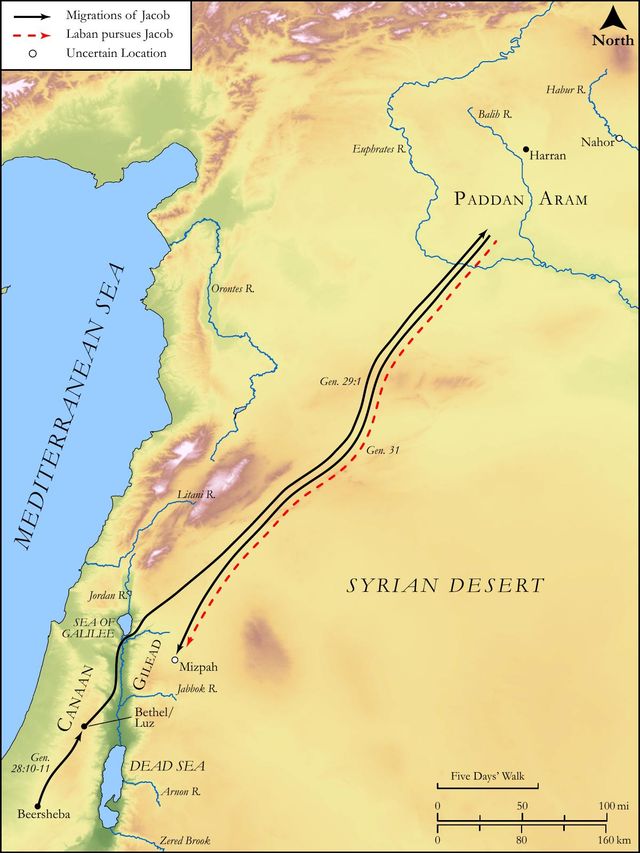
See on the biblical-era map


Study this verse
Public-domain commentary
Matthew Henry
From his Commentary on the Whole Bible. Henry comments on passages, not single verses — this entry covers Genesis 30:14–24.
Here is, I. Leah fruitful again, after she had, for some time, left off bearing. Jacob, it should seem, associated more with Rachel than with Leah. The law of Moses supposes it a common case that, if a man had two wives, one would be beloved and the other hated, Deu 21:15. But at length Rachel's strong passions betrayed her into a bargain with Leah that Jacob should return to her apartment. Reuben, a little lad, five or six years old, playing in the field, found mandrakes, dudaim. It is uncertain what they were, the critics are not agreed about them; we are sure they were some rarities, either fruits or flowers that were very pleasant to the smell, Sol 7:13. Note, The God of nature has provided, not only for our necessities, but for our delights; there are products of the earth in the exposed fields, as well as in the planted protected gardens, that are very valuable and useful. How plentifully is nature's house furnished and her table spread! Her precious fruits offer themselves to be gathered by the hands of little children. It is a laudable custom of the devout Jews, when they find pleasure, suppose in eating an apple, to lift their hearts, and say, "Blessed be he that made this fruit pleasant!" Or, in smelling a flower, "Blessed be he that made this flower sweet." Some think these mandrakes were jessamine flowers. Whatever they were, Rachel could not see them in Leah's hands, where the child had placed them, but she must covet them. She cannot bear the want of these pretty flowers, but will purchase them at any rate. Note, There may be great sin and folly in the inordinate desire of a small thing. Leah takes this advantage (as Jacob had of Esau's coveting his red pottage) to obtain that which was justly due to her, but to which Rachel would not otherwise have consented. Note, Strong passions often thwart one another, and those cannot but be continually uneasy that are hurried on by them. Leah is overjoyed that she shall have her husband's company again, that her family might yet further be built up, which is the blessing she desires and devoutly prays for, as is intimated, Gen 30:17, where it is said, God hearkened unto Leah. The learned bishop Patrick very well suggests here that the true reason of this contest between Jacob's wives for his company, and their giving him their maids to be his wives, was the earnest desire they had to fulfil the promise made to Abraham (and now lately renewed to Jacob), that his seed should be as the stars of heaven for multitude, and that in one seed of his, the Messiah, all the nations of the earth should be blessed. And he thinks it would have been below the dignity of this sacred history to take such particular notice of these things if there had not been some such great consideration in them. Leah was now blessed with two sons; the first she called Issachar (a hire), reckoning herself well repaid for her mandrakes, nay (which is a strange construction of the providence) rewarded for giving her maid to her husband. Note, We abuse God's mercy when we reckon that his favours countenance and patronize our follies. The other she called Zebulun (dwelling), owning God's bounty to her: God has endowed me with a good dowry, Gen 30:20. Jacob had not endowed her when he married her, nor had he wherewithal in possession; but she reckons a family of children not a bill of charges, but a good dowry, Psa 113:9. She promises herself more of her husband's company now that she had borne him six sons, and that, in love to his children at least, he would often visit her lodgings. Mention is made (Gen 30:21) of the birth of a daughter, Dinah, because of the following story concerning her, ch. 34. Perhaps Jacob had other daughters, though their names are not registered.
II.Rachel fruitful at last (Gen 30:22):
God remembered Rachel, whom he seemed to have forgotten, and hearkened to her whose prayers had been long denied; and then she bore a son. Note, As God justly denies the mercy we have been inordinately desirous of, so sometimes he graciously grants, at length, that which we have long waited for. He corrects our folly, and yet considers our frame, and does not contend for ever. Rachel called her son Joseph, which in Hebrew is akin to two words of a contrary signification, Asaph (abstulit), He has taken away my reproach, as if the greatest mercy she had in this son was that she had saved her credit; and Jasaph (addidit), The Lord shall add to me another son, which may be looked upon either as the language of her inordinate desire (she scarcely knows how to be thankful for one unless she may be sure of another), or of her faith - she takes this mercy as an earnest of further mercy. "Has God given me his grace? I may call it Joseph, and say, He shall add more grace! Has he given me his joy? I may call it Joseph, and say, He will give me more joy. Has he begun, and shall he not make an end?"
Historical interpretation
Historical reception
1 surviving comment on this verse from the historical church.
(Verse 17 and 18.) And God heard Leah, and she conceived and bore Jacob her fifth son, and she said, 'God has given me my wages because I gave my maid to my husband.' And she called his name Issachar. The Septuagint Interpreters have given the etymology of this name, it is wages. Not that, as many wrongly read with an added pronoun, it is to be understood as written, which is wages, but the whole name is interpreted, it is wages. For it is said that Sachar, the son of Ruben, bought the entrance which was owed to Rachel, for a price. It follows:
Continue studying Genesis 30:17 across the web’s major study libraries — every link below opens this exact verse, chapter, or book on the destination site.
Read & Compare
 BibleGatewayThis verse in more than 200 translations and 70 languages.
 Bible.comThe YouVersion reader — hundreds of translations, reading plans, and highlights.
 ESV.orgCrossway's official English Standard Version reader.
 NET BibleThe NET translation with 60,000+ translators' notes on every rendering decision.
 STEP BibleTyndale House's free study tool — original text, vocabulary, and scholarly resources.
 BibliaLogos Bible Software's free web reader.
 USCCBThe New American Bible (Revised Edition) with the U.S. bishops' study notes.
Commentaries
 BibleHub CommentariesDozens of classic commentaries on this verse, gathered on one page.
 StudyLightMore than 100 commentary sets — the largest collection on the web.
 BibleRefPlain-English commentary on what this verse means, verse by verse.
 Enduring WordDavid Guzik's free commentary on this chapter, widely used by Bible teachers.
 Bible Study ToolsVerse commentary alongside Greek and Hebrew study aids.
Original Language & Research
- BibleHub InterlinearThe verse word by word — original language, transliteration, and English.
- BibleHub LexiconEvery word's original-language definition and Strong's entry.
 Blue Letter BibleDeep-study tools — Strong's numbers, concordance, and word studies.
 SefariaThe Hebrew text with Rashi and centuries of Jewish commentary.
Sermons, Hymns & Audio


TrulyRandomVerse is not affiliated with these sites and doesn’t control their content. They’re linked because they’re genuinely useful.
Summary
Genesis 30:17 records a pivotal moment in the life of Leah, demonstrating God's direct and sovereign intervention amidst the complex and often contentious family dynamics of Jacob's household. Despite the recent human arrangement involving mandrakes and the ongoing rivalry with Rachel, God actively responded to Leah's desire for children, enabling her to conceive and bear Jacob's fifth son. This verse powerfully underscores God's ultimate control over life and fruitfulness, highlighting His faithfulness to His covenant plan even through imperfect human circumstances.
Context
ShowHideLiterary Context
Genesis 30:17 is situated within a highly charged narrative detailing the intense rivalry between Jacob's wives, Leah and Rachel, primarily driven by their desire to bear children for Jacob. The chapter opens with Rachel's barrenness and her desperate plea to Jacob, leading to the use of handmaids (Bilhah for Rachel, Zilpah for Leah) to bear children by proxy, a common practice in the ancient Near East designed to ensure lineage. Leah had previously borne four sons (Reuben, Simeon, Levi, Judah) but then ceased bearing. The immediate preceding verses Genesis 30:14-16 describe a peculiar incident where Reuben, Leah's eldest son, finds mandrakes (believed to be fertility aids). Rachel, still barren, bargains with Leah for these mandrakes, offering Leah a night with Jacob in exchange. It is directly after this human arrangement, which seemingly bypasses divine intervention, that Genesis 30:17 declares God's direct action in opening Leah's womb again.
Historical & Cultural Context
The cultural imperative for women to bear children, especially sons, was immense in ancient Israelite society. Barrenness was often seen as a curse or a sign of divine displeasure, leading to significant social and personal distress, as evidenced by Rachel's anguish in Genesis 30:1. Polygamy, while not God's ideal, was practiced in this patriarchal period, often exacerbating rivalries within households, as seen between Leah and Rachel. The use of mandrakes reflects ancient folk beliefs in their aphrodisiac or fertility-enhancing properties, highlighting human attempts to control or influence natural processes. However, the biblical narrative consistently emphasizes that ultimate control over conception and life rests with God, not with human remedies or cultural practices.
Key Themes
ShowHideThis verse contributes significantly to several overarching themes in Genesis. It reinforces the theme of Divine Sovereignty over Life and Fertility, demonstrating that God alone opens and closes the womb, regardless of human efforts or superstitions, a theme seen repeatedly with Sarah and Rebekah. It also highlights God's Responsiveness to Human Desire and Prayer, even when those desires are imperfectly expressed or intertwined with human rivalry and manipulation. Furthermore, it underscores God's Faithfulness to His Covenant, as the multiplication of Jacob's descendants is crucial for the fulfillment of the promises made to Abraham Genesis 12:2. Even amidst the dysfunctional family dynamics, God continues to work out His purposes, bringing forth the lineage through whom the covenant would be passed down.
Exposition and Analysis
ShowHideKey Word Analysis
ShowHideThis term, H430, refers to the supreme God, used here with the definite article, emphasizing the singular, ultimate divine authority. Its use here underscores that Leah's conception was not a natural occurrence or a result of the mandrakes, but a direct, intentional act of the sovereign Creator. It highlights divine agency as the sole cause.
H8085 signifies more than mere auditory perception; it implies attentive listening that leads to responsive action. When God "hearkened" to Leah, it means He not only heard her unspoken or spoken petitions and perceived her deep longing for more children, but He also acted decisively and favorably in response. This verb often carries connotations of obedience, but in this context, it signifies God's compassionate and active response to human need.
H2029 is a primitive root meaning "to be (or become) pregnant." Its direct connection to God's "hearkening" establishes a clear cause-and-effect: God's responsive action directly resulted in Leah's pregnancy. This word emphasizes the miraculous nature of the conception, attributing it solely to divine power rather than any human means or natural processes.
Verse Breakdown
ShowHide"And God hearkened unto Leah"
This initial clause is the theological lynchpin of the verse. It asserts divine agency as the primary cause of the subsequent events. "Hearkened" (Hebrew: shâmaʻ) implies not just listening, but listening with attention and a view to acting. It suggests that God was attentive to Leah's plight, her deep desire for more children, and her longing for validation within Jacob's household, even amidst the complex and flawed human machinations surrounding the mandrakes. This divine attentiveness underscores God's active involvement in the personal lives of His people.
"and she conceived"
This clause presents the direct, immediate consequence of God's "hearkening." Leah's conception is explicitly attributed to divine intervention, bypassing any natural or superstitious means (like the mandrakes). This highlights God's sovereignty over life and fertility, a recurring theme in Genesis. It is a testament to God's power to open the womb and grant fruitfulness according to His will and timing.
"and bare Jacob the fifth son"
This final clause states the outcome of the conception: Leah gave birth to Jacob's fifth son. This birth is significant for the ongoing expansion of Jacob's family, which forms the foundation of the twelve tribes of Israel. The emphasis on "the fifth son" (later named Issachar in Genesis 30:18) further demonstrates God's consistent work in building the covenant nation, even through the intertwined lives and imperfect choices of its patriarchs and matriarchs.
Literary Devices
ShowHideThe verse employs several significant literary devices. Divine Agency is paramount, as the opening phrase "And God hearkened" immediately establishes God as the primary actor, contrasting sharply with the human efforts and superstitions detailed in the preceding verses. This creates a powerful Juxtaposition between human striving (the mandrake exchange) and divine sovereignty, emphasizing that ultimate control over life and destiny rests with God alone. The concise, declarative nature of the statement also lends it an air of Authority and Finality, reinforcing the idea that God's will is decisive. Furthermore, the narrative functions as Foreshadowing, as God's consistent intervention in overcoming barrenness (seen also with Sarah and Rebekah) points forward to the miraculous nature of the lineage that would eventually lead to the Messiah, who would bring spiritual life to those who are spiritually barren.
Theological and Thematic Connections
ShowHideGenesis 30:17 profoundly illustrates God's active and intimate involvement in human affairs, even amidst the most complex and flawed family dynamics. It serves as a powerful reminder of His ultimate sovereignty over life, fertility, and the unfolding of His redemptive plan. Despite the human machinations, rivalries, and superstitious beliefs (like the mandrakes), God's will prevails. His "hearkening" to Leah demonstrates His compassionate attentiveness to the desires and struggles of His people, affirming that outcomes are not solely dependent on human effort or negotiation, but on His divine purpose. This passage reinforces the consistent biblical truth that God is the giver of life and the one who fulfills His promises, often working through imperfect vessels to achieve His perfect will.
Reflection and Application
ShowHideGenesis 30:17 offers profound encouragement for believers today, reminding us that God is intimately involved in the minute details of our lives, even when our circumstances are messy, competitive, or driven by human ambition. Leah's story, particularly the birth of her fifth son, serves as a powerful testament to God's grace and sovereignty. It teaches us that God genuinely hears our deepest desires and struggles, even when we feel overlooked, are navigating challenging relationships, or are caught in situations of our own making. His divine plan unfolds according to His perfect will, often in ways that transcend human logic, effort, or expectations. This verse encourages us to bring our petitions before God with trust, knowing that He is a God who hears and responds, bringing forth blessings and advancing His purposes even in the midst of human imperfection and rivalry. We are called to trust in His timing and His methods, recognizing that His hand is at work even when we cannot perceive it or when our own efforts seem to be in vain.
Questions for Reflection
ShowHideFAQ
ShowHideDid the mandrakes cause Leah's conception?
ShowHideNo, Genesis 30:17 explicitly states, "And God hearkened unto Leah, and she conceived." This direct attribution to God's action clearly indicates that Leah's conception was a result of divine intervention, not the mandrakes. The mandrake exchange in Genesis 30:14-16 reflects human superstition and an attempt to manipulate fertility, but the biblical text credits God alone with opening Leah's womb, thereby asserting His sovereignty over life.
Why did God "hearken" to Leah in this context, especially given the rivalry and the mandrake incident?
ShowHideGod's decision to "hearken" to Leah, meaning to hear and respond, demonstrates His sovereign compassion and faithfulness, even amidst the flawed circumstances of Jacob's household. While Leah's desire for more children was intertwined with rivalry and a longing for affirmation, it also stemmed from a deep, human desire for fruitfulness and a place within the covenant family. God, in His wisdom and according to His overarching plan to build the nation of Israel, chose to respond to her, continuing to expand the lineage through whom His covenant promises would be fulfilled. This highlights God's ability to work through imperfect human motivations and situations to achieve His divine purposes, demonstrating His grace and unwavering commitment to His plan.
Christ-Centered Fulfillment
ShowHideThe narrative of God opening barren wombs throughout Genesis, including Leah's in Genesis 30:17, consistently points towards the divine power to bring life where there is none, ultimately foreshadowing the miraculous birth of the Messiah. Just as God "hearkened" to Leah and granted her a son, fulfilling His promise to multiply Abraham's descendants and establish the physical lineage of Israel, so too does God "hearken" to humanity's deepest need for salvation, providing the ultimate "seed" through whom all nations would be blessed. The ongoing lineage, sustained by God's sovereign hand through figures like Leah, culminates in Jesus Christ, who is the true "seed" of Abraham Galatians 3:16 and the one who grants spiritual fruitfulness and new life to those who were spiritually barren John 3:3-5. Through Christ, the promise of a vast spiritual offspring is fulfilled, as He makes us new creations 2 Corinthians 5:17, bringing life out of spiritual death in a way far exceeding the physical births of Jacob's sons, and establishing a spiritual family that transcends all earthly rivalries and imperfections.