


1 Samuel 1:20
- וַיְהִיvay·Hiand it wasH1961Conj-w ¦ V-Qal-ConsecImperf-3msVerb Qal Consecutive Imperfect 3rd Singular Masculineוַandיְהִיit was
- לִתְקֻפוֹתlit·ku·Fotto [the] circuit ofH8622Prep-l ¦ N-fpcNoun Plural Feminine Constructלִtoתְקֻפוֹת[the] circuit of
- הַיָּמִיםhai·ya·Mimthe daysH3117Art ¦ N-mpNoun Plural Masculine Absoluteהַtheיָּמִיםdays
- וַתַּהַרva·Ta·harand she conceivedH2029Conj-w ¦ V-Qal-ConsecImperf-3fsVerb Qal Consecutive Imperfect 3rd Singular Feminineוַandתַּהַרshe conceived
- חַנָּהcha·NahHannahH2584N-proper-fNoun Proper Feminine
- וַתֵּלֶדva·Te·ledand she boreH3205Conj-w ¦ V-Qal-ConsecImperf-3fsVerb Qal Consecutive Imperfect 3rd Singular Feminineוַandתֵּלֶדshe bore
- בֵּןBena sonH1121N-msNoun Singular Masculine Absolute
- וַתִּקְרָאva·tik·Ra'and she calledH7121Conj-w ¦ V-Qal-ConsecImperf-3fsVerb Qal Consecutive Imperfect 3rd Singular Feminineוַandתִּקְרָאshe called
- אֶת'et<obj.>H853DirObjMParticle Object Indicator
- שְׁמוֹshe·Mohis nameH8034N-msc ¦ 3msNoun Singular Masculine Constructשְׁמnameוֹhis
- שְׁמוּאֵלshe·mu·'ElSamuelH8050N-proper-mNoun Proper Masculine
- כִּיkiforH3588PrtParticle Conditional
- מֵיְהוָהme·Yah·wehfrom YahwehH3068Prep-m ¦ N-properNoun Proper TitleמֵfromיְהוָהYahweh
- שְׁאִלְתִּיוshe·'il·TivI asked for himH7592V-Qal-Perf-1cs ¦ 3msVerb Qal Perfect 1st Singular common genderשְׁאִלְתִּיI asked forוhim
English is a literal word-by-word gloss of the Hebrew, not the KJV's wording. Why?
This is the original text the KJV's translators worked from — each Hebrew word with its own literal English meaning in this verse, prepared by scholars at Tyndale House, Cambridge. The KJV translates whole sentences, not word by word, so its wording differs: one Hebrew word can become several English words, and the KJV may choose “the LORD” where the gloss reads “Yahweh”. Both are faithful — they answer different questions. For the KJV's own rendering, switch to the KJV text.
Details
See on the biblical-era map
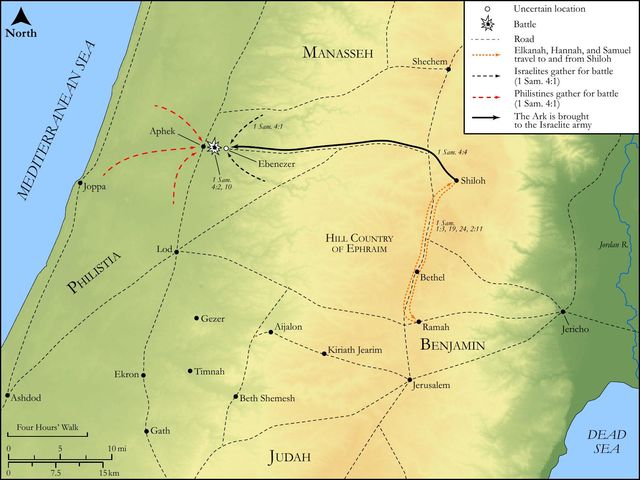
Study this verse
Public-domain commentary
Matthew Henry
From his Commentary on the Whole Bible. Henry comments on passages, not single verses — this entry covers 1 Samuel 1:19–28. His three-level outline is real structure in the source text, so it is rendered as structure.
Here is, I. The return of Elkanah and his family to their own habitation, when the days appointed for the feast were over, Sa1 1:19. Observe how they improved their time at the tabernacle. Every day they were there, even that which was fixed for their journey home, they worshipped God; and they rose up early to do it. It is good to begin the day with God. Let him that is the first have the first. They had a journey before them, and a family of children to take with them, and yet they would not stir till they had worshipped God together. Prayer and provender do not hinder a journey. They had spent several days now in religious worship, and yet they attended once more. We should not be weary of well-doing.
II.The birth and name of this desired son.
At length the Lord remembered Hannah, the very thing she desired (Sa1 1:11), and more she needed not desire, that was enough, for then she conceived and bore a son. Though God seem long to forget his people's burdens, troubles, cares, and prayers, yet he will at length make it to appear that they are not out of his mind. This son the mother called Samuel, Sa1 1:20. Some make the etymology of this name to be much the same with that of Ishmael - heard of God, because the mother's prayers were remarkably heard, and he was an answer to them. Others, because of the reason she gives for the name, make it to signify asked of God. It comes nearly to the same; she designed by it to perpetuate the remembrance of God's favour to her in answering her prayers. Thus she designed, upon every mention of his name, to take the comfort to herself and to give God the glory of that gracious condescension. Note, Mercies in answer to prayer are to be remembered with peculiar expressions of thankfulness, as Psa 116:1, Psa 116:2. How many seasonable deliverances and supplies may we call Samuels, asked of God; and whatever is so we are in a special manner engaged to devote to him. Hannah intended by this name to put her son in mind of the obligation he was under to be the Lord's, in consideration of this, that he was asked of God and was at the same time dedicated to him. A child of prayer is in a special manner bound to be a good child. Lemuel's mother reminds him that he was the son of her vows, Pro 31:2.
III.The close attendance Hannah gave to the nursing of him, not only because he was dear to her, but because he was devoted to God, and for him she nursed him herself, and did not hang him on another's breast. We ought to take care of our children, not only with an eye to the law of nature as they are ours, but with an eye to the covenant of grace as they are given up to God. See Eze 16:20, Eze 16:21. This sanctifies the nursing of them, when it is done as unto the Lord. Elkanah went up every year to worship at the tabernacle, and particularly to perform his vow, perhaps some vow he had made distinct from Hannah's if God would give him a son by her, Sa1 1:21. But Hannah, though she felt a warm regard for the courts of God's house, begged leave of her husband to stay at home; for the women were not under any obligation to go up to the three yearly feasts, as the men were. However Hannah had been accustomed to go, but now desired to be excused,
1.Because she would not be so long absent from her nursery. Can a woman forget her sucking child? We may suppose she kept constantly at home, for, if she had gone any where, she would have gone to Shiloh. Note, God will have mercy and not sacrifice. Those that are detained from public ordinances by the nursing and tending of little children may take comfort from this instance, and believe that, if they do that with an eye to God, he will graciously accept them therein, and though they tarry at home they shall divide the spoil.
2.Because she would not go up to Shiloh till her son was big enough, not only to be taken thither, but to be left there; for, if once she took him thither, she thought she could never find in her heart to bring him back again. Note, Those who are stedfastly resolved to pay their vows may yet see good cause to defer the payment of them. Every thing is beautiful in its season. No animal was accepted in sacrifice till it had been for some time under the dam, Lev 22:27. Fruit is best when it is ripe. Elkanah agrees to what she proposes (Sa1 1:23): Do what seemeth thee good. So far was he from delighting to cross her that he referred it entirely to her. Behold how good and pleasant a thing it is, when yoke-fellows thus draw even in the yoke, and accommodate themselves to one another, each thinking well of what the other does, especially in works of piety and charity. He adds a prayer: Only the Lord establish his word, that is, "God preserve the child through the perils of his infancy, that the solemn vow which God signified his acceptance of, by giving us the child, may be performed in its season, and so the whole matter may be accomplished." Note, Those that have in sincerity devoted their children to God may with comfort pray for them, that God will establish the word sealed to them at the same time that they were sealed for him.
IV.The solemn entering of this child into the service of the sanctuary.
We may take it for granted that he was presented to the Lord at forty days old, as all the first-born were (Luk 2:22, Luk 2:23): but this is not mentioned, because there was nothing in it singular; but now that he was weaned he was presented, not to be redeemed. Some think it was as soon as he was weaned from the breast, which, the Jews say, was not till he was three years old; it is said she gave him suck till she had weaned him, Sa1 1:23. Others think it was not till he was weaned from childish things, at eight or ten years old. But I see no inconvenience in admitting such an extraordinary child as this into the tabernacle at three years old, to be educated among the children of the priests. It is said (Sa1 1:24), The child was young, but, being intelligent above his years, he was no trouble. None can begin too soon to be religious. The child was a child, so the Hebrew reads it, in his learning-age. For whom shall he teach knowledge but those that are newly weaned from the milk and drawn from the breasts? Isa 28:9. Observe how she presented her child,
1.With a sacrifice; no less than three bullocks, with a meat-offering for each, Sa1 1:24. A bullock, perhaps, for each year of the child's life. Or one for a burnt-offering, another for a sin-offering, and the third of a peace-offering. So far was she from thinking that, by presenting her son to God, she made God her debtor, that she thought it requisite by these slain offerings to seek God's acceptance of her living sacrifice. All our covenants with God for ourselves and ours must be made by sacrifice, the great sacrifice.
2.With a grateful acknowledgement of God's goodness in answer to prayer. This she makes to Eli, because he had encouraged her to hope for an answer of peace (Sa1 1:26, Sa1 1:27): "For this child I prayed. Here it was obtained by prayer, and here it is resigned to the prayer-hearing God. You have forgotten me, my lord, but I who now appear so cheerful am the woman, the very same, that three years ago stood by thee here weeping and praying, and this was the child I prayed for." Answers of prayer may thus be humbly triumphed in, to the glory of God. Here is a living testimony for God. "I am his witness that he is gracious (see Psa 66:16-19); for this mercy, this comfort, I prayed, and the Lord has given me my petition." See Psa 34:2, Psa 34:4, Psa 34:6. Hannah does not remind Eli of it by adverting to the suspicion he had formerly expressed; she does not say, "I am the woman whom you passed that severe censure upon; what do you think of me now?" Good men ought not to be upbraided with their infirmities and oversights. They have themselves repented of them; let them hear no more of them.
3.With a full surrender of all her interest in this child unto the Lord (Sa1 1:28): I have lent him to the Lord as long as he liveth. And she repeats it, because she will never revoke it: He shall be (a deodand) lent or given to the Lord. Not that she designed to call for him back, as we do what we lend, but she uses this word Shaol, lent, because it is the same word that she had used before (Sa1 1:20, I asked him of the Lord), only in another conjugation. And (Sa1 1:27) the Lord gave me the petition which I asked (Shaalti, in Kal), therefore I have lent him (Hishilti, the same word in Hiphil), and so it gives another etymology of his name Samuel, not only asked of God, but lent to God. And observe,
(1.)Whatever we give to God, it is what we have first asked and received from him. All our gifts to him were first his gifts to us. Of thy own, Lord, have we given thee, Ch1 29:14, Ch1 29:16.
(2.)Whatever we give to God may upon this account be said to be lent to him, that though we may not recall it, as a thing lent, yet he will certainly repay it, with interest, to our unspeakable advantage, particularly what is given to his poor, Pro 19:17. When by baptism we dedicate our children to God, let us remember that they were his before by a sovereign right, and that they are ours still so much the more to our comfort. Hannah resigns him to the Lord, not for a certain term of years, as children are sent apprentices, but durante vita - as long as he liveth, he shall be lent unto the Lord, a Nazarite for life. Such must our covenant with God be, a marriage-covenant; as long as live we must be his, and never forsake him.
Lastly, The child Samuel did his part beyond what could have been expected from one of his years; for of him that seems to be spoken, He worshipped the Lord there, that is he said his prayers. He was no doubt extraordinarily forward (we have known children that have discovered some sense of religion very young), and his mother, designing him for the sanctuary, took particular care to train him up to that which was to be his work in the sanctuary. Note, Little children should learn betimes to worship God. Their parents should instruct them in his worship and bring them to it, put them upon engaging in it as well as they can, and God will graciously accept them and teach them to do better.
Historical interpretation
Fourteen Centuries of Reception
3 surviving comments on this verse. Each one is dated, so this reads as a timeline rather than a list.
Select a marker to jump to its quote. Markers stagger vertically where authors wrote within a few decades of each other.
Let the men among us emulate her, let the women among us imitate her: the woman is teacher of both sexes. Those who are sterile, let them not despair; those who are mothers, let them bring up in this fashion the children they have borne; and let everyone emulate this woman’s faith in giving birth and zeal following the birth. I mean, what could reveal sounder values than the way she meekly and nobly put up in such a manner with an intolerable calamity and did not desist until she had escaped the disaster and discovered a remarkable and baffling outcome of the problem, finding no helper or ally here below. In fact, she experienced the Lord’s lovingkindness—hence she made her approach on her own and achieved what she wanted. That is to say, the remedy for that depression depended not on human help but on divine grace.
And it happened after the cycle of days Anna conceived, etc. It happened after the illumination of much spiritual knowledge and the manifestation of virtues, through which the apostles shone upon the world, the Gentiles conceived through catechizing and gave birth to a people believing in God through baptizing, or rather the people believed in God through His people. For both must rightly be confessed, not only according to the reason of faith and truth but also as the very name of Samuel implies. For it is interpreted: God is there, or His name is God. God is there in the people who will be born, whom the Lord has chosen. His name is God, specifically whose, if not that of Him who, to signify that He would be constantly born in His own through grace, says: Whoever does the will of my Father who is in heaven is my brother, sister, and mother (Matthew VII). Nor should it seem strange to anyone that we have said that both the husband and son of the same Anna carry the type of Christ; because indeed the same Mediator of God and men is simultaneously the bridegroom and son of the holy Church which He governs: the bridegroom, always helping her to believe, hope, and love; the son, recently coming into the hearts of those believing, hoping, and loving through grace.
Samuel: This name imports, asked of God.
Continue studying 1 Samuel 1:20 across the web’s major study libraries — every link below opens this exact verse, chapter, or book on the destination site.
Read & Compare
 BibleGatewayThis verse in more than 200 translations and 70 languages.
 Bible.comThe YouVersion reader — hundreds of translations, reading plans, and highlights.
 ESV.orgCrossway's official English Standard Version reader.
 NET BibleThe NET translation with 60,000+ translators' notes on every rendering decision.
 STEP BibleTyndale House's free study tool — original text, vocabulary, and scholarly resources.
 BibliaLogos Bible Software's free web reader.
 USCCBThe New American Bible (Revised Edition) with the U.S. bishops' study notes.
Commentaries
 BibleHub CommentariesDozens of classic commentaries on this verse, gathered on one page.
 StudyLightMore than 100 commentary sets — the largest collection on the web.
 BibleRefPlain-English commentary on what this verse means, verse by verse.
 Enduring WordDavid Guzik's free commentary on this chapter, widely used by Bible teachers.
 Bible Study ToolsVerse commentary alongside Greek and Hebrew study aids.
Original Language & Research
- BibleHub InterlinearThe verse word by word — original language, transliteration, and English.
- BibleHub LexiconEvery word's original-language definition and Strong's entry.
 Blue Letter BibleDeep-study tools — Strong's numbers, concordance, and word studies.
 SefariaThe Hebrew text with Rashi and centuries of Jewish commentary.
Sermons, Hymns & Audio


TrulyRandomVerse is not affiliated with these sites and doesn’t control their content. They’re linked because they’re genuinely useful.
Summary
This pivotal verse in 1 Samuel chronicles the long-awaited and miraculous birth of Samuel, the son of Hannah and Elkanah. It marks the divine fulfillment of Hannah's fervent, tearful prayer for a child, culminating in her giving birth to a son whom she names Samuel, explicitly stating that his name signifies her having "asked him of the LORD." This event not only resolves Hannah's personal anguish over barrenness but also initiates the life of a key figure who would later serve as Israel's last judge and first prophet, bridging the era of the judges and the establishment of the monarchy and setting the stage for a new epoch in Israel's history.
Context
ShowHideLiterary Context
1 Samuel 1:20 stands as the climactic moment in the opening narrative of the book of Samuel, serving as the powerful resolution to Hannah's deep personal anguish and fervent supplication. The preceding verses meticulously detail Hannah's barrenness, her profound sorrow, the painful provocation from her rival Peninnah, and her husband Elkanah's loving but ultimately insufficient comfort. The narrative masterfully builds tension around Hannah's desperate prayer at the tabernacle in Shiloh, where she pours out her soul before the LORD and makes a solemn vow to dedicate any son born to her to God's service for life, as recorded in 1 Samuel 1:11. This verse, therefore, represents the direct, miraculous answer to that desperate plea, shifting the narrative from Hannah's personal suffering and supplication to the divine intervention of God and the birth of the child who will become central to Israel's future. It immediately precedes Hannah's joyous song of praise and the subsequent dedication of Samuel to the LORD, demonstrating the immediate fulfillment of her vow.
Historical & Cultural Context
The setting of 1 Samuel is the tumultuous period of the Judges, a time characterized by moral and spiritual decline in Israel, where "everyone did what was right in his own eyes," as famously stated in Judges 21:25. Within this societal framework, barrenness was not merely a personal sorrow but also a profound social stigma, often perceived as a sign of divine disfavor or judgment. A woman's primary role and source of honor were intrinsically tied to her ability to bear children, especially sons, to ensure the continuation of the family line, inheritance, and tribal strength. The practice of polygamy, as seen with Elkanah having two wives, Hannah and Peninnah, frequently led to intense domestic strife, particularly when one wife was fertile and the other was not. The annual pilgrimage to Shiloh, where the tabernacle was located, was a central religious observance, highlighting the importance of communal worship and seeking God's intervention in both personal and national affairs. The birth of Samuel, therefore, is not just a private family event but a significant divine intervention in a period of profound national spiritual need and leadership vacuum.
Key Themes
ShowHideThis verse powerfully encapsulates several foundational themes woven throughout the book of Samuel and indeed the broader biblical narrative. Foremost is the theme of Divine Faithfulness and Answered Prayer, demonstrating God's attentiveness to the cries of His people, particularly the lowly and suffering. Hannah's persistent and heartfelt prayer, culminating in this miraculous birth, underscores the efficacy of earnest supplication, echoing similar divine interventions for barren women like Sarah, as seen in Genesis 21:1-2, and Rachel, recorded in Genesis 30:22-24. Another crucial theme is The Significance of Names, as Hannah's naming of her son "Samuel" directly links his identity to the circumstances of his birth and God's intervention, serving as a perpetual reminder of God's grace and faithfulness. This practice of naming children to reflect divine action or personal experience is a common and vital motif throughout the Old Testament. Finally, Samuel's birth signifies the Fulfillment of Promise and Divine Initiative, as God actively intervenes to raise up a leader who will play a pivotal role in transitioning Israel from the chaotic period of the judges to the establishment of the monarchy, demonstrating God's sovereign hand in history and His commitment to His covenant people.
Exposition and Analysis
ShowHideKey Word Analysis
ShowHideThis name is central to the verse's meaning and Hannah's explicit explanation. While commonly understood to mean "heard of God" or "asked of God," it is a complex name. Hannah's explicit statement, "Because I have asked him of the LORD," directly links it to the Hebrew verb sha'al (H7592), meaning "to inquire" or "to request." This etymological play highlights the divine origin of Samuel, emphasizing that he was literally "asked for" and "given by" God in response to Hannah's earnest prayer. The name serves as a perpetual memorial of God's faithfulness and Hannah's vow, marking him as a child of divine petition.
This verb (H2029) signifies the divine act of opening Hannah's womb, a miraculous intervention after years of barrenness and despair. It underscores that Samuel's existence was not a natural occurrence but a direct result of God's remembrance and favor, fulfilling the promise implied by Eli's blessing in 1 Samuel 1:17. The conception itself is presented as a direct consequence of God's action, setting Samuel apart from birth as a divinely appointed child.
This verb (H7592) is crucial as it directly explains the naming of Samuel, forming the very foundation of his identity. Hannah's use of sha'al connects her act of naming to her earlier fervent prayer at Shiloh, where she "poured out her soul before the LORD," as described in 1 Samuel 1:15. It emphasizes the direct causal link between her persistent petition and God's gracious, sovereign response, powerfully highlighting the efficacy of prayer and God's attentiveness to the cries of His people.
Verse Breakdown
ShowHide"Wherefore it came to pass, when the time was come about after Hannah had conceived"
This opening phrase establishes the fulfillment of the divine promise and the natural progression of pregnancy. "When the time was come about" (H3117, H8622) refers to the completion of the full gestation period, emphasizing that the birth occurred in God's perfect timing and according to His preordained plan, following the miraculous conception. It highlights the culmination of a divinely orchestrated process.
"that she bare a son"
This simple, yet profound, statement (H3205, H1121) is the culmination of years of anguish, fervent prayer, and longing for Hannah. It signifies the direct and tangible answer to her petition, marking the end of her barrenness and the beginning of a new, joyous chapter for her family and for Israel. The birth of a son was particularly significant for continuing the family line, ensuring inheritance, and fulfilling societal and covenantal expectations.
"and called his name Samuel, [saying], Because I have asked him of the LORD"
This is the most profound and explanatory part of the verse. Hannah's act of naming her son Samuel (H7121, H8034, H8050) is a public declaration of God's faithfulness and her personal testimony. The explanation, "Because I have asked him (H7592) of the LORD (H3068)," directly links the child's identity to her prayer and God's divine response. It serves as a perpetual reminder of God's attentiveness, her solemn vow, and the miraculous nature of his birth, setting the stage for Samuel's dedication and future service to God. The name itself becomes a living testament to God's intervention and the power of prayer.
Literary Devices
ShowHideThe verse employs several significant literary devices that enrich its meaning and impact. Narrative Progression is powerfully evident, as the text moves from the long-awaited anticipation of conception to the concrete reality of birth, thereby resolving the central conflict of Hannah's barrenness that dominates the preceding verses. The strategic use of Direct Speech in Hannah's explanation for naming Samuel ("Because I have asked him of the LORD") provides immediate and intimate insight into her theological understanding, profound gratitude, and personal testimony, powerfully reinforcing the divine origin of the child. This also functions as a masterful example of Etymological Punning, where the name Samuel (H8050) is explicitly linked to the Hebrew verb sha'al (H7592, "to ask"), creating a memorable and deeply meaningful connection between the child's identity and the circumstances of his miraculous birth. Furthermore, the entire narrative surrounding Samuel's birth can be seen as a Type Scene of the miraculous birth of a significant figure, often to a barren woman, echoing similar accounts for Isaac, Jacob, and Samson, thereby elevating Samuel's importance and highlighting divine intervention as a recurring pattern in Israel's history.
Theological and Thematic Connections
ShowHideThe birth of Samuel, as recounted in this verse, serves as a powerful theological statement about God's sovereignty, faithfulness, and active involvement in human affairs. It underscores that God hears and responds to the earnest prayers of His people, even in seemingly impossible situations, demonstrating His ability to intervene supernaturally to fulfill His purposes. This event also highlights the theme of divine election and preparation, as Samuel's miraculous birth sets him apart from the very beginning as a chosen instrument for God's redemptive plan in Israel. His life will bridge the gap between the judges and the monarchy, initiating a new era of leadership under God's guidance. The narrative also subtly introduces the concept of God raising up leaders from unexpected places, often through miraculous means, to address the spiritual and political needs of His people, demonstrating His unceasing commitment to His covenant.
Reflection and Application
ShowHideThe story of Samuel's birth in 1 Samuel 1:20 offers profound and enduring lessons for believers today. Hannah's journey from deep sorrow and barrenness to joyous motherhood is a powerful testament to the transformative power of persistent, humble, and faith-filled prayer. It reminds us that God is intimately acquainted with our deepest longings and hears our cries, even when answers seem delayed or circumstances appear insurmountable. Her naming of Samuel, explicitly linking him to her "asking of the LORD," serves as a vital call to acknowledge God as the ultimate source of every good and perfect gift in our lives. This verse encourages us to cultivate a posture of grateful recognition, remembering that our blessings are not merely coincidental but are often direct answers to prayer and expressions of God's lavish grace. Furthermore, Hannah's subsequent dedication of Samuel back to the LORD, though not explicitly in this verse, is powerfully foreshadowed by her naming, modeling a spirit of stewardship and surrender, inviting us to consider how we might dedicate our own gifts, talents, and even our children back to the One who gave them, recognizing that true blessing lies in yielding to His divine purposes.
Questions for Reflection
ShowHideFAQ
ShowHideWhy was Hannah's barrenness such a significant issue?
ShowHideIn ancient Israelite society, barrenness was a profound source of personal sorrow, social stigma, and often perceived as a sign of divine disfavor or judgment. A woman's primary role and source of honor were intrinsically tied to her ability to bear children, especially sons, to ensure the continuation of the family line, inheritance, and tribal strength. To be barren meant not only personal anguish but also potential shame and vulnerability within the community. Hannah's deep distress, exacerbated by Peninnah's taunts, as described in 1 Samuel 1:6, reflects the immense pressure and suffering associated with this condition in her cultural context. Her barrenness also serves a crucial theological purpose in the narrative, highlighting that Samuel's birth was not a natural occurrence but a miraculous act of God, emphasizing His sovereign power and intervention in human affairs.
What is the significance of Hannah naming her son Samuel?
ShowHideHannah's naming of her son "Samuel" is deeply significant because it directly connects his identity to the circumstances of his miraculous birth and God's faithfulness. Her explanation, "Because I have asked him of the LORD," links the name to the Hebrew verb sha'al (שָׁאַל), meaning "to ask" or "to inquire." This act of naming serves as a perpetual reminder of her fervent prayer, God's gracious answer, and her solemn vow to dedicate him to the LORD's service, as recorded in 1 Samuel 1:11. In biblical culture, names often carried prophetic or descriptive meaning, and Samuel's name clearly testifies to God's attentiveness to Hannah's cries and His active involvement in raising up a pivotal leader for Israel during a critical period of spiritual decline and transition.
Christ-Centered Fulfillment
ShowHideThe miraculous birth of Samuel, a child "asked of the LORD," serves as a profound foreshadowing of God's greater redemptive plan culminating in Jesus Christ. Just as Samuel's birth was a divine intervention in a period of spiritual barrenness and national decline, signaling the dawn of a new era for Israel, so too was the birth of Jesus a supernatural act of God, bringing salvation to a world steeped in sin and spiritual darkness. Hannah's fervent prayer for a son, and God's gracious answer, echoes the ultimate "asking" and "giving" in the person of Christ. Jesus is the ultimate "gift from God," as declared in John 3:16, the one truly "sent by God" to accomplish His redemptive purposes, as affirmed in John 5:36. Samuel was dedicated to the LORD's service from birth, serving as a prophet, priest, and judge; similarly, Jesus, the perfect Prophet, Priest, and King, was consecrated by God from eternity to fulfill His Father's will, as seen in Hebrews 10:7. The narrative of Samuel's birth, therefore, points beyond itself to the greater story of God's provision of a deliverer, culminating in the Lamb of God who takes away the sin of the world, the one through whom all of God's promises find their "Yes" and "Amen," as powerfully stated in 2 Corinthians 1:20.