


1 Samuel 1:19
Bible text: King James Version (1769 Blayney text) · Public domain
Bible text: King James Version with Strong's numbers · Public domain
Bible text: Berean Standard Bible · Public domain
Bible text: American Standard Version (1901) · Public domain
Bible text: World English Bible, Messianic edition · Public domain
Bible text: Geneva Bible (1599) · Public domain
Bible text: Young's Literal Translation · Public domain
- וַיַּשְׁכִּמוּvai·yash·Ki·muand they rose earlyH7925Conj-w ¦ V-Hiphil-ConsecImperf-3mpVerb Hiphil Consecutive Imperfect 3rd Plural Masculineוַandיַּשְׁכִּמוּthey rose early
- בַבֹּקֶרva·Bo·kerin the morningH1242Prep-b ¦ N-msNoun Singular Masculine Absoluteבַin theבֹּקֶרmorning
- וַיִּשְׁתַּחֲווּvai·yish·ta·cha·Vuand they bowed downH7812Conj-w ¦ V-Hishtaphel-ConsecImperf-3mpVerb Hishtaphel Consecutive Imperfect 3rd Plural Masculineוַandיִּשְׁתַּחֲווּthey bowed down
- לִפְנֵיlif·Nei<to> beforeH6440Prep-l ¦ N-mpcNoun Plural Masculine Constructלִ<to>פְנֵיbefore
- יְהוָהYah·wehYahwehH3068N-properNoun Proper Title
- וַיָּשֻׁבוּvai·ya·Shu·vuand they returnedH7725Conj-w ¦ V-Qal-ConsecImperf-3mpVerb Qal Consecutive Imperfect 3rd Plural Masculineוַandיָּשֻׁבוּthey returned
- וַיָּבֹאוּvai·ya·Vo·'uand they wentH935Conj-w ¦ V-Qal-ConsecImperf-3mpVerb Qal Consecutive Imperfect 3rd Plural Masculineוַandיָּבֹאוּthey went
- אֶל'eltoH413PrepPreposition
- בֵּיתָםbei·Tamtheir houseH1004N-msc ¦ 3mpNoun Singular Masculine Constructבֵּיתָhouseםtheir
- הָרָמָתָהha·ra·Ma·tah<the> Ramah towardsH7414Art ¦ N-proper ¦ SfxNoun Proper Locationהָ<the>רָמָתָRamahהtowards
- וַיֵּדַעvai·Ye·da'and he knewH3045Conj-w ¦ V-Qal-ConsecImperf-3msVerb Qal Consecutive Imperfect 3rd Singular Masculineוַandיֵּדַעhe knew
- אֶלְקָנָה'el·ka·NahElkanahH511N-proper-mNoun Proper Masculine
- אֶת'et<obj.>H853DirObjMParticle Object Indicator
- חַנָּהcha·NahHannahH2584N-proper-fNoun Proper Feminine
- אִשְׁתּוֹ'ish·Tohis wifeH802N-fsc ¦ 3msNoun Singular Feminine Constructאִשְׁתּwifeוֹhis
- וַיִּזְכְּרֶהָvai·yiz·ke·Re·haand he remembered herH2142Conj-w ¦ V-Qal-ConsecImperf-3ms ¦ 3fsVerb Qal Consecutive Imperfect 3rd Singular Masculineוַandיִּזְכְּרֶhe rememberedהָher
- יְהוָהYah·wehYahwehH3068N-properNoun Proper Title
English is a literal word-by-word gloss of the Hebrew, not the KJV's wording. Why?
This is the original text the KJV's translators worked from — each Hebrew word with its own literal English meaning in this verse, prepared by scholars at Tyndale House, Cambridge. The KJV translates whole sentences, not word by word, so its wording differs: one Hebrew word can become several English words, and the KJV may choose “the LORD” where the gloss reads “Yahweh”. Both are faithful — they answer different questions. For the KJV's own rendering, switch to the KJV text.
Details
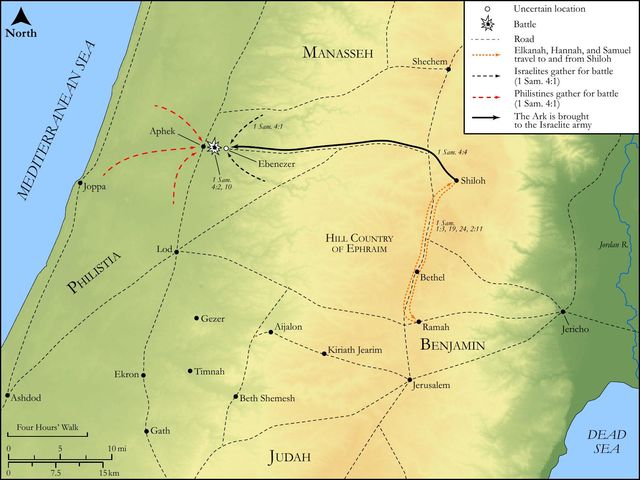
See on the biblical-era map
Study this verse
Public-domain commentary
Matthew Henry
From his Commentary on the Whole Bible. Henry comments on passages, not single verses — this entry covers 1 Samuel 1:19–28. His three-level outline is real structure in the source text, so it is rendered as structure.
Here is, I. The return of Elkanah and his family to their own habitation, when the days appointed for the feast were over, Sa1 1:19. Observe how they improved their time at the tabernacle. Every day they were there, even that which was fixed for their journey home, they worshipped God; and they rose up early to do it. It is good to begin the day with God. Let him that is the first have the first. They had a journey before them, and a family of children to take with them, and yet they would not stir till they had worshipped God together. Prayer and provender do not hinder a journey. They had spent several days now in religious worship, and yet they attended once more. We should not be weary of well-doing.
II.The birth and name of this desired son.
At length the Lord remembered Hannah, the very thing she desired (Sa1 1:11), and more she needed not desire, that was enough, for then she conceived and bore a son. Though God seem long to forget his people's burdens, troubles, cares, and prayers, yet he will at length make it to appear that they are not out of his mind. This son the mother called Samuel, Sa1 1:20. Some make the etymology of this name to be much the same with that of Ishmael - heard of God, because the mother's prayers were remarkably heard, and he was an answer to them. Others, because of the reason she gives for the name, make it to signify asked of God. It comes nearly to the same; she designed by it to perpetuate the remembrance of God's favour to her in answering her prayers. Thus she designed, upon every mention of his name, to take the comfort to herself and to give God the glory of that gracious condescension. Note, Mercies in answer to prayer are to be remembered with peculiar expressions of thankfulness, as Psa 116:1, Psa 116:2. How many seasonable deliverances and supplies may we call Samuels, asked of God; and whatever is so we are in a special manner engaged to devote to him. Hannah intended by this name to put her son in mind of the obligation he was under to be the Lord's, in consideration of this, that he was asked of God and was at the same time dedicated to him. A child of prayer is in a special manner bound to be a good child. Lemuel's mother reminds him that he was the son of her vows, Pro 31:2.
III.The close attendance Hannah gave to the nursing of him, not only because he was dear to her, but because he was devoted to God, and for him she nursed him herself, and did not hang him on another's breast. We ought to take care of our children, not only with an eye to the law of nature as they are ours, but with an eye to the covenant of grace as they are given up to God. See Eze 16:20, Eze 16:21. This sanctifies the nursing of them, when it is done as unto the Lord. Elkanah went up every year to worship at the tabernacle, and particularly to perform his vow, perhaps some vow he had made distinct from Hannah's if God would give him a son by her, Sa1 1:21. But Hannah, though she felt a warm regard for the courts of God's house, begged leave of her husband to stay at home; for the women were not under any obligation to go up to the three yearly feasts, as the men were. However Hannah had been accustomed to go, but now desired to be excused,
1.Because she would not be so long absent from her nursery. Can a woman forget her sucking child? We may suppose she kept constantly at home, for, if she had gone any where, she would have gone to Shiloh. Note, God will have mercy and not sacrifice. Those that are detained from public ordinances by the nursing and tending of little children may take comfort from this instance, and believe that, if they do that with an eye to God, he will graciously accept them therein, and though they tarry at home they shall divide the spoil.
2.Because she would not go up to Shiloh till her son was big enough, not only to be taken thither, but to be left there; for, if once she took him thither, she thought she could never find in her heart to bring him back again. Note, Those who are stedfastly resolved to pay their vows may yet see good cause to defer the payment of them. Every thing is beautiful in its season. No animal was accepted in sacrifice till it had been for some time under the dam, Lev 22:27. Fruit is best when it is ripe. Elkanah agrees to what she proposes (Sa1 1:23): Do what seemeth thee good. So far was he from delighting to cross her that he referred it entirely to her. Behold how good and pleasant a thing it is, when yoke-fellows thus draw even in the yoke, and accommodate themselves to one another, each thinking well of what the other does, especially in works of piety and charity. He adds a prayer: Only the Lord establish his word, that is, "God preserve the child through the perils of his infancy, that the solemn vow which God signified his acceptance of, by giving us the child, may be performed in its season, and so the whole matter may be accomplished." Note, Those that have in sincerity devoted their children to God may with comfort pray for them, that God will establish the word sealed to them at the same time that they were sealed for him.
IV.The solemn entering of this child into the service of the sanctuary.
We may take it for granted that he was presented to the Lord at forty days old, as all the first-born were (Luk 2:22, Luk 2:23): but this is not mentioned, because there was nothing in it singular; but now that he was weaned he was presented, not to be redeemed. Some think it was as soon as he was weaned from the breast, which, the Jews say, was not till he was three years old; it is said she gave him suck till she had weaned him, Sa1 1:23. Others think it was not till he was weaned from childish things, at eight or ten years old. But I see no inconvenience in admitting such an extraordinary child as this into the tabernacle at three years old, to be educated among the children of the priests. It is said (Sa1 1:24), The child was young, but, being intelligent above his years, he was no trouble. None can begin too soon to be religious. The child was a child, so the Hebrew reads it, in his learning-age. For whom shall he teach knowledge but those that are newly weaned from the milk and drawn from the breasts? Isa 28:9. Observe how she presented her child,
1.With a sacrifice; no less than three bullocks, with a meat-offering for each, Sa1 1:24. A bullock, perhaps, for each year of the child's life. Or one for a burnt-offering, another for a sin-offering, and the third of a peace-offering. So far was she from thinking that, by presenting her son to God, she made God her debtor, that she thought it requisite by these slain offerings to seek God's acceptance of her living sacrifice. All our covenants with God for ourselves and ours must be made by sacrifice, the great sacrifice.
2.With a grateful acknowledgement of God's goodness in answer to prayer. This she makes to Eli, because he had encouraged her to hope for an answer of peace (Sa1 1:26, Sa1 1:27): "For this child I prayed. Here it was obtained by prayer, and here it is resigned to the prayer-hearing God. You have forgotten me, my lord, but I who now appear so cheerful am the woman, the very same, that three years ago stood by thee here weeping and praying, and this was the child I prayed for." Answers of prayer may thus be humbly triumphed in, to the glory of God. Here is a living testimony for God. "I am his witness that he is gracious (see Psa 66:16-19); for this mercy, this comfort, I prayed, and the Lord has given me my petition." See Psa 34:2, Psa 34:4, Psa 34:6. Hannah does not remind Eli of it by adverting to the suspicion he had formerly expressed; she does not say, "I am the woman whom you passed that severe censure upon; what do you think of me now?" Good men ought not to be upbraided with their infirmities and oversights. They have themselves repented of them; let them hear no more of them.
3.With a full surrender of all her interest in this child unto the Lord (Sa1 1:28): I have lent him to the Lord as long as he liveth. And she repeats it, because she will never revoke it: He shall be (a deodand) lent or given to the Lord. Not that she designed to call for him back, as we do what we lend, but she uses this word Shaol, lent, because it is the same word that she had used before (Sa1 1:20, I asked him of the Lord), only in another conjugation. And (Sa1 1:27) the Lord gave me the petition which I asked (Shaalti, in Kal), therefore I have lent him (Hishilti, the same word in Hiphil), and so it gives another etymology of his name Samuel, not only asked of God, but lent to God. And observe,
(1.)Whatever we give to God, it is what we have first asked and received from him. All our gifts to him were first his gifts to us. Of thy own, Lord, have we given thee, Ch1 29:14, Ch1 29:16.
(2.)Whatever we give to God may upon this account be said to be lent to him, that though we may not recall it, as a thing lent, yet he will certainly repay it, with interest, to our unspeakable advantage, particularly what is given to his poor, Pro 19:17. When by baptism we dedicate our children to God, let us remember that they were his before by a sovereign right, and that they are ours still so much the more to our comfort. Hannah resigns him to the Lord, not for a certain term of years, as children are sent apprentices, but durante vita - as long as he liveth, he shall be lent unto the Lord, a Nazarite for life. Such must our covenant with God be, a marriage-covenant; as long as live we must be his, and never forsake him.
Lastly, The child Samuel did his part beyond what could have been expected from one of his years; for of him that seems to be spoken, He worshipped the Lord there, that is he said his prayers. He was no doubt extraordinarily forward (we have known children that have discovered some sense of religion very young), and his mother, designing him for the sanctuary, took particular care to train him up to that which was to be his work in the sanctuary. Note, Little children should learn betimes to worship God. Their parents should instruct them in his worship and bring them to it, put them upon engaging in it as well as they can, and God will graciously accept them and teach them to do better.
Historical interpretation
Historical reception
3 surviving comments on this verse. Each one is dated, so this reads as a timeline rather than a list.
Therefore, Elkanah knew his wife, etc. The Lord had mercy on enriching the Church of the nations through His grace, and having sent the seed of His word through preachers, He commanded all the ends of the earth to remember and turn to Him.
And they rose early in the morning, and worshiped, etc. The growth of the increasing Church is shown. At first, Anna rises alone to pray, and the hour at which she prayed is not expressed; now having received the blessing of the priest, she rises in the morning, not alone, but with her husband and her whole family, attending to prayer. At first, the Church sought the Lord with few, but when it had received from the faithful Jewish teachers the increase of faith, with the darkness of paganism already dispelled: From the ends of the earth, she says, I cry to you (Psalm 61); overflowing with such grace of heavenly gift, that the Lord himself, namely her husband, praying, has an advocate with the Father is not doubted to have.
And they returned, and came, etc. Ramatha is interpreted as height. Therefore, having completed prayer, to obtain what we ask for, so that after the grievous barrenness of an unfruitful mind, we may be able to bring forth the buds of virtues for consecration to God, not to be wasted outside on superfluous things, but let us strive to return to the exalted dwellings of our conscience with faith and truth. And let not our countenance be changed to different things anymore, but let it persist in the same ardor and devotion that it conceived in prayer, even after the tears of consumption.
Continue studying 1 Samuel 1:19 across the web’s major study libraries — every link below opens this exact verse, chapter, or book on the destination site.
Read & Compare
 BibleGatewayThis verse in more than 200 translations and 70 languages.
 Bible.comThe YouVersion reader — hundreds of translations, reading plans, and highlights.
 ESV.orgCrossway's official English Standard Version reader.
 NET BibleThe NET translation with 60,000+ translators' notes on every rendering decision.
 STEP BibleTyndale House's free study tool — original text, vocabulary, and scholarly resources.
 BibliaLogos Bible Software's free web reader.
 USCCBThe New American Bible (Revised Edition) with the U.S. bishops' study notes.
Commentaries
 BibleHub CommentariesDozens of classic commentaries on this verse, gathered on one page.
 StudyLightMore than 100 commentary sets — the largest collection on the web.
 BibleRefPlain-English commentary on what this verse means, verse by verse.
 Enduring WordDavid Guzik's free commentary on this chapter, widely used by Bible teachers.
 Bible Study ToolsVerse commentary alongside Greek and Hebrew study aids.
Original Language & Research
- BibleHub InterlinearThe verse word by word — original language, transliteration, and English.
- BibleHub LexiconEvery word's original-language definition and Strong's entry.
 Blue Letter BibleDeep-study tools — Strong's numbers, concordance, and word studies.
 SefariaThe Hebrew text with Rashi and centuries of Jewish commentary.
Sermons, Hymns & Audio


TrulyRandomVerse is not affiliated with these sites and doesn’t control their content. They’re linked because they’re genuinely useful.
Summary
1 Samuel 1:19 marks a pivotal moment in the narrative of Hannah, detailing the faithful actions of Elkanah and Hannah following their annual pilgrimage to Shiloh. This verse describes their diligent worship, their return to the routines of daily life in Ramah, and culminates in the profound declaration of divine intervention: "the LORD remembered her." It encapsulates themes of devout obedience, the integration of spiritual experience with domestic life, and God's sovereign, compassionate response to fervent prayer, setting the immediate stage for the miraculous conception and birth of Samuel.
Context
ShowHideLiterary Context
This verse immediately follows Hannah's deeply emotional and desperate prayer at the tabernacle in Shiloh, where she poured out her soul to the LORD and made a solemn vow to dedicate her future child to Him if her barrenness were overcome 1 Samuel 1:10-11. Eli, the high priest, had initially misunderstood her fervent prayer for drunkenness but later blessed her, saying, "Go in peace, and the God of Israel grant your petition that you have made to him" 1 Samuel 1:17. Verse 19 then describes the couple's actions immediately after this significant spiritual encounter, transitioning from the sacred space of worship back to their domestic life, where God's promised blessing would manifest. It serves as the bridge between Hannah's petition and the miraculous answer in the subsequent verse 1 Samuel 1:20.
Historical & Cultural Context
The setting is ancient Israel during the period of the judges, a time characterized by spiritual decline and moral decay, yet also marked by pockets of sincere faith. Annual pilgrimages to central worship sites like Shiloh, where the tabernacle and the Ark of the Covenant were located, were a vital part of Israelite religious life, fulfilling the Mosaic Law's requirements for presenting sacrifices and offerings Deuteronomy 16:16. Within this culture, barrenness was not merely a personal sorrow but often carried significant social stigma, as it was perceived as a divine curse or a sign of disfavor, leading to immense distress for women like Hannah. The act of "knowing" one's wife refers to marital intimacy, the natural means through which God often works to fulfill His extraordinary purposes, even when human efforts seem insufficient.
Key Themes
ShowHideThe verse powerfully illustrates several enduring themes. Firstly, it highlights Faithful Worship and Obedience, as Elkanah and Hannah consistently observed their religious duties, rising early to worship before the LORD. This commitment underscores their piety and sets the stage for divine favor, demonstrating that even amidst personal anguish, devotion to God remains paramount. Secondly, the phrase "the LORD remembered her" introduces the theme of God's Remembrance and Answered Prayer. In biblical terms, God "remembering" (Hebrew: zakhar) signifies an an active, purposeful engagement and intervention on behalf of someone, not merely a cognitive recall. This divine remembrance is the direct, compassionate response to Hannah's earnest petition, demonstrating God's faithfulness to His promises and His power to overcome what seems impossible, echoing similar divine interventions for barren women such as Sarah in Genesis 21:1 and Rachel in Genesis 30:22. Lastly, the verse subtly weaves together Marital Intimacy and Divine Providence, showing how God works through ordinary human means ("Elkanah knew Hannah his wife") to bring about His extraordinary purposes, making the subsequent conception of Samuel a clear act of God's sovereign hand.
Exposition and Analysis
ShowHideKey Word Analysis
ShowHideDerived from a root meaning "to break forth," this term refers to the dawn or early part of the day. Its inclusion here, alongside "early" (from H7925 shakam, to rise early), emphasizes the diligence and promptness of Elkanah and Hannah in fulfilling their religious duties. It signifies their commitment to God, making their worship not a casual act but a prioritized and intentional beginning to their day.
While this Hebrew verb has a broad semantic range, encompassing cognitive knowledge, experiential understanding, and even intimate relationship, its use in this context is a well-established biblical euphemism for sexual intercourse. It signifies the physical union between Elkanah and Hannah, highlighting the natural means through which God's supernatural intervention would manifest. This detail underscores the integration of human agency and divine sovereignty in the process of conception.
This term is a crucial theological concept in the Old Testament. When God "remembers," it is far more than a mere cognitive recall of a past event or person. Instead, zakhar implies an active, purposeful turning of divine attention towards someone, often involving a compassionate and decisive intervention on their behalf. It signifies God's faithfulness to His covenant promises, His compassionate response to the cries of His people, and His active involvement in human affairs to bring about His will. In Hannah's case, God's remembrance means He acted decisively to open her womb and grant her the child she had fervently prayed for.
Verse Breakdown
ShowHide"And they rose up in the morning early, and worshipped before the LORD"
This clause highlights the couple's continued piety and dedication. Rising "early" signifies diligence and eagerness in their religious duties, demonstrating their commitment to God even after the emotional intensity of Hannah's prayer. Their act of worship "before the LORD" at Shiloh, following Hannah's vow and Eli's blessing, underscores their trust in God's potential answer and marks the conclusion of their annual pilgrimage rituals before returning home.
"and returned, and came to their house to Ramah"
This describes their journey back to their home in Ramah, signifying a transition from the sacred space of the tabernacle to the ordinary sphere of their domestic life. It emphasizes the integration of their spiritual experiences with their daily existence, suggesting that God's work is not confined to the temple but extends into every aspect of life, including the mundane routines of home.
"and Elkanah knew Hannah his wife"
This is a common biblical idiom for marital relations, indicating the natural and intimate act within the marriage covenant. Its inclusion here is significant as it provides the human means through which God's miraculous intervention would take place, setting the stage for the physical conception. It highlights that God often works through ordinary human processes to achieve His extraordinary purposes.
"and the LORD remembered her"
This is the theological climax of the verse. It asserts that Hannah's subsequent conception was not a mere biological occurrence but a direct, sovereign act of God. "Remembered" signifies God's active, favorable intervention in response to Hannah's fervent prayer and vow, demonstrating His faithfulness, compassion, and power to overcome barrenness. It is the divine answer that makes the impossible possible, confirming His attentiveness to the cries of His people.
Literary Devices
ShowHideThe verse employs several significant literary devices. Juxtaposition is evident in the movement from corporate worship at Shiloh to the private intimacy of the marital bed in Ramah, demonstrating how God's work transcends both public and private spheres. The phrase "Elkanah knew Hannah his wife" is a clear Euphemism or Idiom for sexual intercourse, a common biblical device that maintains decorum while conveying a clear meaning. Most profoundly, the statement "the LORD remembered her" is an example of Anthropomorphism, attributing a human characteristic (remembering) to God, but in a way that conveys His active, purposeful, and compassionate intervention rather than a mere cognitive act. This divine "remembrance" functions as the Climax of the verse, providing the ultimate theological explanation for the subsequent events.
Theological and Thematic Connections
ShowHide1 Samuel 1:19 is a profound testament to God's attentiveness to the prayers of His people and His sovereign power to intervene in human circumstances. It underscores the biblical truth that God is not distant but intimately involved in the lives of His faithful, particularly those who seek Him diligently. Hannah's story, culminating in God's "remembrance," serves as a powerful paradigm for understanding divine providence: God often works through ordinary human means to accomplish extraordinary purposes, demonstrating His faithfulness to His promises and His compassion for the afflicted. This verse encapsulates the hope that even in seemingly impossible situations, fervent prayer, coupled with faithful worship, can move the heart of God to act decisively.
Reflection and Application
ShowHide1 Samuel 1:19 offers immense encouragement for believers today, reinforcing the truth that God hears and responds to the sincere and persistent prayers of His people. Hannah's journey from deep anguish to divine remembrance reminds us that even in seasons of profound personal sorrow, perceived barrenness (whether physical, spiritual, or circumstantial), or long-deferred hopes, God is attentive and actively involved. Our consistent worship and obedience, coupled with fervent prayer, position us to experience God's active "remembrance" and intervention in our lives. This verse teaches us to trust in God's perfect timing and His ability to bring life, purpose, and blessing out of what may seem like hopeless or barren situations, urging us to maintain faith and devotion even when the answer is not immediately apparent. It calls us to patience, perseverance in prayer, and unwavering trust in God's compassionate sovereignty.
Questions for Reflection
ShowHideFAQ
ShowHideWhat does it mean for "the LORD remembered her" in this context?
ShowHideIn biblical language, when God "remembers" someone, it signifies much more than a simple cognitive recall. It implies an active, purposeful, and often compassionate intervention on behalf of the person remembered. It means God is turning His attention to them with favor, acting decisively to fulfill a promise, respond to a plea, or bring about His will. In Hannah's case, it means God actively intervened to open her womb and enable her to conceive, directly answering her fervent prayer and fulfilling the blessing pronounced by Eli 1 Samuel 1:17. It underscores God's faithfulness and His sovereign power to overcome what is humanly impossible.
Christ-Centered Fulfillment
ShowHideWhile 1 Samuel 1:19 directly describes God's miraculous intervention in Hannah's life, it powerfully foreshadows the ultimate divine remembrance and intervention found in Jesus Christ. Hannah's barrenness and subsequent miraculous conception of Samuel, a prophet who would anoint kings and usher in a new era for Israel, points to a greater spiritual barrenness that afflicts humanity—our inability to produce spiritual life or righteousness on our own. Just as God "remembered" Hannah in her distress, He "remembered" His covenant promises to humanity by sending His Son, Jesus, to overcome the ultimate barrenness of sin and death. The "remembrance" of God culminates in the incarnation, where God actively entered human history to redeem His people. Through Christ, the seemingly impossible becomes possible: spiritual barrenness is overcome, and new life is granted to those who believe John 3:3-7. Jesus, the Lamb of God who takes away the sin of the world, is the ultimate answer to humanity's deepest cry, providing a spiritual lineage far greater than any physical one. His sacrifice and resurrection are the definitive acts of God's remembrance, securing for believers not just a child, but eternal life and adoption into God's family Galatians 4:4-7.