


Genesis 8:1
Bible text: King James Version (1769 Blayney text) · Public domain
Bible text: King James Version with Strong's numbers · Public domain
Bible text: Berean Standard Bible · Public domain
Bible text: American Standard Version (1901) · Public domain
Bible text: World English Bible, Messianic edition · Public domain
Bible text: Geneva Bible (1599) · Public domain
Bible text: Young's Literal Translation · Public domain
- וַיִּזְכֹּרvai·yiz·Korand he rememberedH2142Conj-w ¦ V-Qal-ConsecImperf-3msVerb Qal Consecutive Imperfect 3rd Singular Masculineוַandיִּזְכֹּרhe remembered
- אֱלֹהִים'E·lo·HimGodH430N-mpNoun Plural Masculine Absolute
- אֶת'et<obj.>H853DirObjMParticle Object Indicator
- נֹחַNo·achNoahH5146N-proper-mNoun Proper Masculine
- וְאֵתve·'Etand <obj.>H853Conj-w ¦ DirObjMParticle Object Indicatorוְandאֵת<obj.>
- כָּלkoleveryH3605N-mscNoun Singular Masculine Construct
- הַחַיָּהha·chai·Yah<the> animalH2416Art ¦ N-fsNoun Singular Feminine Absoluteהַ<the>חַיָּהanimal
- וְאֶתve·'Etand <obj.>H853Conj-w ¦ DirObjMParticle Object Indicatorוְandאֶת<obj.>
- כָּלkolallH3605N-mscNoun Singular Masculine Construct
- הַבְּהֵמָהha·be·he·Mahthe livestockH929Art ¦ N-fsNoun Singular Feminine Absoluteהַtheבְּהֵמָהlivestock
- אֲשֶׁר'a·SherwhichH834RelParticle Relative
- אִתּוֹ'i·To[were] with himH854Prep ¦ 3msPreposition Definiteאִתּ[were] withוֹhim
- בַּתֵּבָהba·te·Vahin the arkH8392Prep-b ¦ N-fsNoun Singular Feminine Absoluteבַּin theתֵּבָהark
- וַיַּעֲבֵרvai·ya·'a·Verand he made to passH5674Conj-w ¦ V-Hiphil-ConsecImperf-3msVerb Hiphil Consecutive Imperfect 3rd Singular Masculineוַandיַּעֲבֵרhe made to pass
- אֱלֹהִים'E·lo·HimGodH430N-mpNoun Plural Masculine Absolute
- רוּחַRu·acha windH7307N-fsNoun Singular Feminine Absolute
- עַל'aloverH5921PrepPreposition
- הָאָרֶץha·'A·retzthe earthH776Art ¦ N-fsNoun Singular Feminine Absoluteהָtheאָרֶץearth
- וַיָּשֹׁכּוּvai·ya·Sho·kuand they subsidedH7918Conj-w ¦ V-Qal-ConsecImperf-3mpVerb Qal Consecutive Imperfect 3rd Plural Masculineוַandיָּשֹׁכּוּthey subsided
- הַמָּיִםha·Ma·yimthe watersH4325Art ¦ N-mpNoun Plural Masculine Absoluteהַtheמָּיִםwaters
English is a literal word-by-word gloss of the Hebrew, not the KJV's wording. Why?
This is the original text the KJV's translators worked from — each Hebrew word with its own literal English meaning in this verse, prepared by scholars at Tyndale House, Cambridge. The KJV translates whole sentences, not word by word, so its wording differs: one Hebrew word can become several English words, and the KJV may choose “the LORD” where the gloss reads “Yahweh”. Both are faithful — they answer different questions. For the KJV's own rendering, switch to the KJV text.
Details
See on the biblical-era maps


Study this verse
Public-domain commentary
Matthew Henry
From his Commentary on the Whole Bible. Henry comments on passages, not single verses — this entry covers Genesis 8:1–3. His four-level outline is real structure in the source text, so it is rendered as structure.
Here is, I. An act of God's grace: God remembered Noah and every living thing. This is an expression after the manner of men; for not any of his creatures (Luk 12:6), much less any of his people, are forgotten of God, Isa 49:15, Isa 49:16. but, 1. The whole race of mankind, except Noah and his family, was now extinguished, and driven into the land of forgetfulness, to be remembered no more; so that God's remembering Noah was the return of his mercy to mankind, of whom he would not make a full end. It is a strange expression, Eze 5:13, When I have accomplished my fury in them, I will be comforted. The demands of divine justice had been answered by the ruin of those sinners; he had eased him of his adversaries (Isa 1:24), and now his spirit was quieted (Zac 6:8), and he remembered Noah and every living thing. he remembered mercy in wrath (Hab 3:2), remembered the days of old (Isa 63:11), remembered the holy seed, and then remembered Noah. 2. Noah himself, though one that had found grace in the eyes of the Lord, yet seemed to be forgotten in the ark, and perhaps began to think himself so; for we do not find that God had told him how long he should be confined and when he should be released. Very good men have sometimes been ready to conclude themselves forgotten of God, especially when their afflictions have been unusually grievous and long. Perhaps Noah, though a great believer, yet when he found the flood continuing so long after it might reasonably be presumed to have done its work, was tempted to fear lest he that shut him in would keep him in, and began to expostulate. How long wilt thou forget me? But at length God returned in mercy to him, and this is expressed by remembering him. Note, Those that remember God shall certainly be remembered by him, how desolate and disconsolate soever their condition may be. He will appoint them a set time and remember them, Job 14:13. 3. With Noah, God remembered every living thing; for, though his delight is especially in the sons of men, yet he rejoices in all his works, and hates nothing that he has made. He takes special care, not only of his people's persons, but of their possessions - of them and all that belongs to them. He considered the cattle of Nineveh, Jon 4:11.
II.An act of God's power over wind and water, both of which are at his beck, though neither of them is under man's control. Observe,
1.He commanded the wind, and said to that, Go, and it went, in order to the carrying off of the flood: God made a wind to pass over the earth. See here,
(1.)What was God's remembrance of Noah: it was his relieving him. Note, Those whom God remembers he remembers effectually, for good; he remembers us to save us, that we may remember him to serve him.
(2.)What a sovereign dominion God has over the winds. He has them in his fist (Pro 30:4) and brings them out of his treasuries, Psa 135:7. He sends them when, and whither, and for what purposes, he pleases. Even stormy winds fulfil his word, Psa 148:8. It should seem, while the waters increased, there was no wind; for that would have added to the toss of the ark; but now God sent a wind, when it would not be so troublesome. Probably, it was a north wind, for that drives away rain. However, it was a drying wind, such a wind as God sent to divide the Red Sea before Israel, Exo 14:21.
2.He remanded the waters, and said to them, Come, and they came.
(1.)He took away the cause. He sealed up the springs of those waters, the fountains of the great deep, and the windows of heaven. Note,
[1.]As God has a key to open, so he has a key to shut up again, and to stay the progress of judgments by stopping the causes of them: and the same hand that brings the desolation must bring the deliverance; to that hand therefore our eye must ever be. He that wounds is alone able to heal. See Job 12:14, Job 12:15.
[2.]When afflictions have done the work for which they are sent, whether killing work or curing work, they shall be removed. God's word shall not return void, Isa 55:10, Isa 55:11.
(2.)Then the effect ceased; not all at once, but by degrees: The waters abated (Gen 8:1), returned from off the earth continually, Heb. they were going and returning (v. 3), which denotes a gradual departure. The heat of the sun exhaled much, and perhaps the subterraneous caverns soaked in more. Note, As the earth was not drowned in a day, so it was not dried in a day. In the creation, it was but one day's work to clear the earth from the waters that covered it, and to make it dry land; nay, it was but half a day's work, Gen 1:9, Gen 1:10. But, the work of creation being finished, this work of providence was effected by the concurring influence of second causes, yet thus enforced by the almighty power of God. God usually works deliverance for his people gradually, that the day of small things may not be despised, nor the day of great things despaired of, Zac 4:10. See Pro 4:18.
Historical interpretation
Five Centuries of Reception
4 surviving comments on this verse. Each one is dated, so this reads as a timeline rather than a list.
Select a marker to jump to its quote. Markers stagger vertically where authors wrote within a few decades of each other.
Hippolytus, the expositor of the Targum, and my master, Jacobus Rohaviensis, have said: On the twenty-seventh day of the month Jiar, which is the second Hebrew month, the ark rose from the base of the holy mount; and already the waters bore it, and it was carried upon them round about towards the four cardinal points of the world. The ark accordingly held off from the holy mount towards the east, then returned towards the west, then turned to the south, and finally, bearing off eastwards, neared Mount Kardu on the first day of the tenth month. And that is the second month Kanun.
And Noah came out of the ark on the twenty-seventh day of the month Jiar, in the second year: for the ark continued sailing live whole months, and moved to and fro upon the waters, and in a period of fifty-one days neared the land. Nor thereafter did it float about any longer. But it only moved successively toward the four cardinal points of the earth, and again finally stood toward the east. We say, moreover, that that was a sign of the cross. And the ark was a symbol of the Christ who was expected. For that ark was the means of the salvation of Noah and his sons, and also of the cattle, the wild beasts, and the birds. And Christ, too, when He suffered on the cross, delivered us from accusations and sins, and washed us in His own blood most pure.
And just as the ark returned to the east, and neared Mount Kardu, so also Christ, when the work was accomplished and finished which He had proposed to Himself, returned to heaven to the bosom of His Father, and sat down upon the throne of His glory at the Father's right hand.
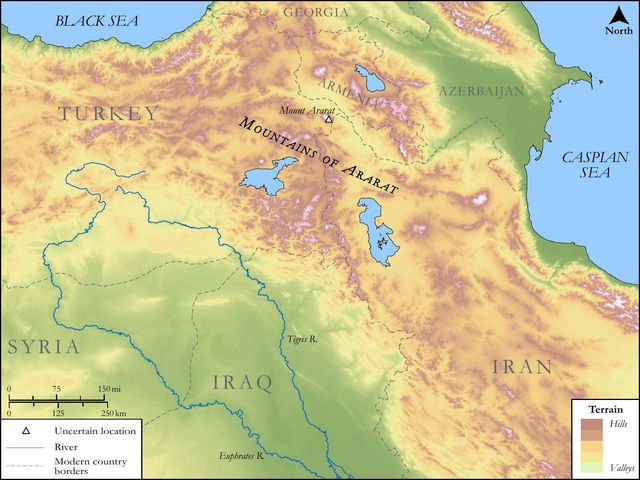
As to Mount Kardu, it is in the east, in the land of the sons of Raban, and the Orientals call it Mount Godash; the Arabians and Persians call it Ararat.
And there is a town of the name Kardu, and that hill is called after it, which is indeed very lofty and inaccessible, whose summit no one has ever been able to reach, on account of the violence of the winds and the storms which always prevail there. And if any one attempts to ascend it, there are demons that rush upon him, and cast him down headlong from the ridge of the mountain into the plain, so that he dies. No one, moreover, knows what there is on the top of the mountain, except that certain relics of the wood of the ark still lie there on the surface of the top of the mountain.
And the Lord brought a spirit upon the earth, and the water ceased (Genesis VIII, 1). I do not think this is said in such a way that we should understand the spirit as the name for wind. For the wind could not have dried up the flood. Otherwise, since the sea is stirred up daily by winds, it would certainly be emptied. For how could the sea, which had spread out over the whole earth in the flood, not be emptied by the force of the winds, if it had receded even to the pillars of Hercules, as they say, and the Great Sea was boiling up against the roofs of high mountains? Therefore, it is not doubtful that by the power of the invisible divine spirit, that flood was repressed, not by a gust of wind, but by celestial operation.
See how God did everything out of his esteem for the human being. As in the case of the destruction of human beings in the flood he destroyed also along with them the whole range of brute beasts, so in this case too, when he intends to show his characteristic love for the good man out of his regard for him, he extends his goodness to the animal kingdom as well, the wild beasts, the birds and the reptiles. “God was mindful of Noah,” the text says, “and of all the wild beasts, all the cattle and all the reptiles that were with him in the ark. God sent a wind upon the earth, and the water subsided.” Being mindful of Noah, the text says, and of those with him in the ark, he directed the flood of water to halt so that little by little he might show his characteristic love and now give the good man a breath of fresh air, free him from the turmoil of his thoughts and restore him to a state of tranquility by granting him the enjoyment of daylight and a breath of fresh air. “God sent a wind upon the earth, and the water subsided. The torrents of the depths and the sluice gates of heaven were shut off.”
But the Lord remembered Noah, and all the living creatures, and all the cattle that were with him in the ark, and caused a wind to pass over the earth, and the waters were diminished. This can be understood in the name of the Vivifying Spirit of God, of which it is said at the beginning: "And the Spirit of God was moving over the waters" (Genesis 1:2), regarding which there is no doubt that just as then, when the waters were gathered to one place, making the land dry, so also now, with the waters of the flood taken away, He once again revealed the face of the earth. This wind can also be called the Spirit, according to the following from the Psalmist: "He spoke and the stormy wind stood" (Psalm 107:25), by whose frequent blowing the waters are often caused to diminish or to be moved from their place; hence the passage from Exodus: "And when Moses stretched out his hand over the sea, the Lord caused it to go back by a strong east wind all night and made the sea dry land, and the waters were divided" (Exodus 14:21).
Continue studying Genesis 8:1 across the web’s major study libraries — every link below opens this exact verse, chapter, or book on the destination site.
Read & Compare
 BibleGatewayThis verse in more than 200 translations and 70 languages.
 Bible.comThe YouVersion reader — hundreds of translations, reading plans, and highlights.
 ESV.orgCrossway's official English Standard Version reader.
 NET BibleThe NET translation with 60,000+ translators' notes on every rendering decision.
 STEP BibleTyndale House's free study tool — original text, vocabulary, and scholarly resources.
 BibliaLogos Bible Software's free web reader.
 USCCBThe New American Bible (Revised Edition) with the U.S. bishops' study notes.
Commentaries
 BibleHub CommentariesDozens of classic commentaries on this verse, gathered on one page.
 StudyLightMore than 100 commentary sets — the largest collection on the web.
 BibleRefPlain-English commentary on what this verse means, verse by verse.
 Enduring WordDavid Guzik's free commentary on this chapter, widely used by Bible teachers.
 Bible Study ToolsVerse commentary alongside Greek and Hebrew study aids.
Original Language & Research
- BibleHub InterlinearThe verse word by word — original language, transliteration, and English.
- BibleHub LexiconEvery word's original-language definition and Strong's entry.
 Blue Letter BibleDeep-study tools — Strong's numbers, concordance, and word studies.
 SefariaThe Hebrew text with Rashi and centuries of Jewish commentary.
Sermons, Hymns & Audio


TrulyRandomVerse is not affiliated with these sites and doesn’t control their content. They’re linked because they’re genuinely useful.
Summary
Genesis 8:1 marks a profound turning point in the biblical flood narrative, shifting the divine focus from judgment and destruction to active remembrance and the commencement of restoration. After 150 days of overwhelming waters, this verse reveals God's purposeful and compassionate intervention on behalf of Noah, his family, and all the creatures preserved within the ark, initiating the process of the floodwaters' recession through the sending of a powerful wind, thereby signaling the dawn of hope and a new beginning for creation.
Context
ShowHideLiterary Context
This verse serves as the pivotal transition between the destructive phase of the global flood, meticulously detailed in Genesis 6 and Genesis 7, and the subsequent narrative of the earth's drying and the re-establishment of life. Prior to this, Genesis 7:24 concludes the account of the waters prevailing for 150 days, emphasizing the complete inundation and the perishing of all life outside the ark. Genesis 8:1 thus functions as a divine turning point, introducing God's active reversal of the flood's effects, setting the stage for Noah's eventual disembarkation and the subsequent covenant. It is the narrative hinge upon which the story moves from divine wrath to divine grace and renewal.
Historical & Cultural Context
Among the nations, flood narratives were common, often portraying capricious gods. However, the biblical account, particularly Genesis 8:1, stands in stark contrast by emphasizing the moral righteousness of God's judgment and His unwavering faithfulness. The concept of God "remembering" (Hebrew: zakhar) is crucial, as it implies not mere mental recall but an active, purposeful engagement and intervention, often in fulfillment of a covenant or promise. This understanding would have resonated deeply with ancient audiences, signifying God's steadfast character. Furthermore, the "wind" (Hebrew: ruach) in this context carries significant theological weight, often associated with divine power and life-giving force, as seen in Genesis 1:2 where the Spirit of God hovers over the primordial waters, or in Ezekiel 37:9 where wind brings life to dry bones, underscoring God's direct and sovereign control over creation.
Key Themes
ShowHideGenesis 8:1 powerfully contributes to several overarching themes in Genesis and biblical theology. Firstly, it highlights Divine Sovereignty, demonstrating God's absolute control over natural forces and His ability to orchestrate both judgment and restoration according to His perfect will. Secondly, the phrase "God remembered Noah" underscores God's Covenant Faithfulness, foreshadowing the formal covenant established in Genesis 9 and affirming His unwavering commitment to His chosen ones, even amidst widespread devastation. Thirdly, it introduces the theme of New Creation and Restoration, marking the beginning of the earth's renewal after its purification, echoing the original creation account in Genesis 1 and pointing forward to future acts of divine recreation. Finally, it emphasizes God's Comprehensive Care, extending His remembrance not only to Noah but also to "every living thing, and all the cattle," showcasing His concern for all of His creation, not solely humanity, a theme reiterated in passages like Psalm 36:6.
Exposition and Analysis
ShowHideGenesis 8:1 serves as the pivotal turning point in the flood narrative, transitioning from the cataclysmic judgment to the divine initiation of restoration. The verse declares, "And God remembered Noah, and every living thing, and all the cattle that [was] with him in the ark: and God made a wind to pass over the earth, and the waters asswaged;" This statement is rich in theological significance, revealing God's character and sovereign action.
Key Word Analysis
ShowHideThis plural form, used here with a singular verb, refers to the supreme God, emphasizing His majesty, power, and ultimate authority. The use of ʼĕlôhîym throughout the creation and flood narratives underscores that the actions described are not random occurrences but deliberate acts of the one, true, sovereign Creator and Judge. Here, it highlights that the remembrance and subsequent actions are solely divine in origin and execution.
Far more than a simple mental recall, zâkar in biblical context denotes active, purposeful attention that leads to decisive intervention. It implies God's compassionate engagement and His acting in accordance with His character, promises, or covenant. For Noah, this remembrance signifies God's unwavering faithfulness to His commitment to preserve him and all life in the ark, initiating the process of their deliverance and the earth's renewal. It is God's active turning toward His creation with a view to restoration.
This multifaceted word can mean "wind," "breath," or "spirit." In this context, it refers to a powerful, divinely directed current of air. The rûwach of God is not merely a natural phenomenon but an instrument of divine will, demonstrating God's direct control over the elements. Just as God's rûwach moved over the waters in creation (Genesis 1:2), here it moves over the floodwaters to bring about a new order, signaling the end of destruction and the beginning of new life.
This verb means "to subside," "to abate," or "to sink down." It suggests a gradual but definite decrease in the water level, a process that is divinely initiated and controlled. The use of shâkak indicates a controlled, divinely orchestrated recession of the waters, not a chaotic dispersal, setting the stage for the earth to become habitable once more. This marks the tangible beginning of hope and new life after the overwhelming destruction.
Verse Breakdown
ShowHide"And God remembered Noah, and every living thing, and all the cattle that [was] with him in the ark:"
This opening clause is foundational, revealing God's character and His active engagement. The divine "remembrance" is not a sudden recollection but a purposeful turning towards Noah and all the life he preserved. It signifies God's faithfulness to His prior commitment to save Noah and to sustain the animal kingdom. This comprehensive remembrance underscores God's deep care not only for humanity but for all His creation, even amidst the judgment of the world. It is a moment of divine grace breaking through the severity of judgment.
"and God made a wind to pass over the earth,"
This phrase highlights God's direct and sovereign intervention. The abatement of the flood was not a natural, spontaneous occurrence but a direct result of God's command and action. The "wind" (Hebrew: ruach) serves as a divine instrument, demonstrating God's complete control over the elements. This powerful current of air began the process of drying the earth, signaling the end of the destructive phase and the active commencement of the earth's renewal. It is a tangible sign of God's ongoing work in creation.
"and the waters asswaged;"
This final clause describes the immediate and tangible effect of God's intervention. The "asswaging" (subsiding) of the waters indicates a controlled and gradual decrease in their level, directly attributable to the wind God sent. This marks the physical turning point of the flood, as the earth slowly begins to re-emerge, becoming habitable once again. It is the visible manifestation of God's faithfulness and His commitment to restore life on the planet.
Literary Devices
ShowHideGenesis 8:1 employs several significant literary devices that enrich its theological impact. The most prominent is Anthropomorphism, seen in the phrase "God remembered Noah." While God does not forget in a human sense, this language attributes a human-like action (remembering) to God to convey His active, purposeful, and compassionate engagement. This is not a lapse of divine memory but a deliberate shift in divine focus and action, moving from judgment to salvation. Another device is Symbolism, where the "wind" (ruach) acts as a powerful symbol of divine agency and life-giving power. Just as the ruach of God hovered over the waters at creation, here it signals a new act of creation and restoration, bringing order out of chaos. The entire verse functions as a Turning Point or Narrative Pivot, dramatically shifting the tone and direction of the flood narrative from the destructive phase to the restorative phase, signaling hope and new beginnings. This pivotal structure emphasizes the divine initiative in salvation and renewal.
Theological and Thematic Connections
ShowHideGenesis 8:1 is a profound theological statement, revealing God's active faithfulness and sovereign control over creation. The "remembrance" of Noah signifies God's unwavering commitment to His covenant purposes, even in the midst of universal judgment. It underscores that God's actions are always deliberate and purposeful, moving from righteous wrath to redemptive grace. This verse establishes a crucial pattern: divine judgment is always followed by an act of divine remembrance and a pathway to new life for those who are faithful. It highlights that God's comprehensive care extends to all of creation, not just humanity, and that the process of salvation and restoration originates solely from His divine initiative and power.
Reflection and Application
ShowHideGenesis 8:1 offers profound comfort and assurance to believers navigating the "flood" seasons of their own lives. When circumstances feel overwhelming, chaotic, or destructive, this verse reminds us that God is never disengaged or forgetful. His "remembrance" of Noah signifies His active, compassionate, and perfectly timed intervention on behalf of His people. It encourages us to trust that even in the deepest trials, God is at work, orchestrating events to bring about relief, restoration, and new beginnings according to His divine plan. Just as the wind brought about the subsiding of the waters for Noah, God's Spirit is active in our lives, bringing order out of chaos and hope out of despair. This passage calls us to patient endurance, confident in the knowledge that God's faithfulness is unwavering, and His purposes for our good will ultimately prevail.
Questions for Reflection
ShowHideFAQ
ShowHideWhat does "God remembered Noah" truly imply?
ShowHideThe phrase "God remembered Noah" (Hebrew: zakhar) does not suggest that God had forgotten Noah. Instead, it signifies God's active, purposeful attention and intervention on Noah's behalf. It means God was now acting decisively to fulfill His commitment to preserve Noah and to begin the process of restoring the earth, demonstrating His faithfulness and compassion. This "remembrance" is a divine turning point, initiating the next phase of His redemptive plan.
Was the wind a natural phenomenon, or a miraculous intervention?
ShowHideWhile wind is a natural phenomenon, the text explicitly states "God made a wind to pass over the earth," indicating a direct, divine initiative. This was not a random meteorological event but a divinely orchestrated act, demonstrating God's sovereign control over creation to achieve His specific purpose of drying the earth and subsiding the waters. It highlights God's active involvement in the unfolding of His plan, a miraculous intervention that utilized natural means.
How long was Noah in the ark before the waters began to subside?
ShowHideAccording to Genesis 7:24, the waters prevailed upon the earth for 150 days. Genesis 8:1 describes the beginning of the waters assuaging after this period. The total time Noah spent in the ark from entry to exit was over a year, with the waters beginning to recede after the initial 150 days of their prevalence.
Christ-Centered Fulfillment
ShowHideGenesis 8:1 finds its ultimate Christ-centered fulfillment in the person and redemptive work of Jesus Christ. Just as God "remembered" Noah and initiated a new creation after the judgment of the flood, so too does God, in Christ, "remember" humanity and initiate a new covenant and a new creation that transcends the physical. The ark, a vessel of salvation through judgment, powerfully prefigures Christ, who is our ultimate ark, delivering us from the judgment of sin and death. As 1 Peter 3:20-21 alludes, Noah's salvation through water foreshadows the salvation found in baptism, which is a symbol of our union with Christ in His death and resurrection. The subsiding waters and the promise of a new beginning in Genesis point directly to the new heavens and new earth established through Christ's redemptive work, where sin and death are definitively overcome (Revelation 21:1-5). Christ is the one through whom God's faithfulness is perfectly demonstrated, bringing forth not just a physical restoration of the earth, but a spiritual regeneration for all who believe, ushering in an eternal new beginning and making all things new (2 Corinthians 5:17). He is the mediator of a better covenant, founded on better promises (Hebrews 8:6), ensuring God's remembrance of His people is eternally secured in Him.