


Genesis 21:1
Bible text: King James Version (1769 Blayney text) · Public domain
Bible text: Berean Standard Bible · Public domain
Bible text: American Standard Version (1901) · Public domain
Bible text: World English Bible, Messianic edition · Public domain
Bible text: Geneva Bible (1599) · Public domain
Bible text: Young's Literal Translation · Public domain
- וַיהוָהva·Yah·wehand YahwehH3068Conj-w ¦ N-properNoun Proper TitleוַandיהוָהYahweh
- פָּקַדpa·Kadhe visitedH6485V-Qal-Perf-3msVerb Qal Perfect 3rd Singular Masculine
- אֶת'et<obj.>H853DirObjMParticle Object Indicator
- שָׂרָהsa·RahSarahH8283N-proper-fNoun Proper Feminine
- כַּאֲשֶׁרka·'a·Sherjust asH834Prep-k ¦ RelParticle Relativeכַּjustאֲשֶׁרas
- אָמָר'a·Marhe had saidH559V-Qal-Perf-3msVerb Qal Perfect 3rd Singular Masculine
- וַיַּעַשׂvai·Ya·'asand he didH6213Conj-w ¦ V-Qal-ConsecImperf-3msVerb Qal Consecutive Imperfect 3rd Singular Masculineוַandיַּעַשׂhe did
- יְהוָהYah·wehYahwehH3068N-properNoun Proper Title
- לְשָׂרָהle·sa·Rahto SarahH8283Prep-l ¦ N-proper-fNoun Proper FeminineלְtoשָׂרָהSarah
- כַּאֲשֶׁרka·'a·Sherjust asH834Prep-k ¦ RelParticle Relativeכַּjustאֲשֶׁרas
- דִּבֵּרdi·Berhe had spokenH1696V-Piel-Perf-3msVerb Piel Perfect 3rd Singular Masculine
English is a literal word-by-word gloss of the Hebrew, not the KJV's wording. Why?
This is the original text the KJV's translators worked from — each Hebrew word with its own literal English meaning in this verse, prepared by scholars at Tyndale House, Cambridge. The KJV translates whole sentences, not word by word, so its wording differs: one Hebrew word can become several English words, and the KJV may choose “the LORD” where the gloss reads “Yahweh”. Both are faithful — they answer different questions. For the KJV's own rendering, switch to the KJV text.
Details
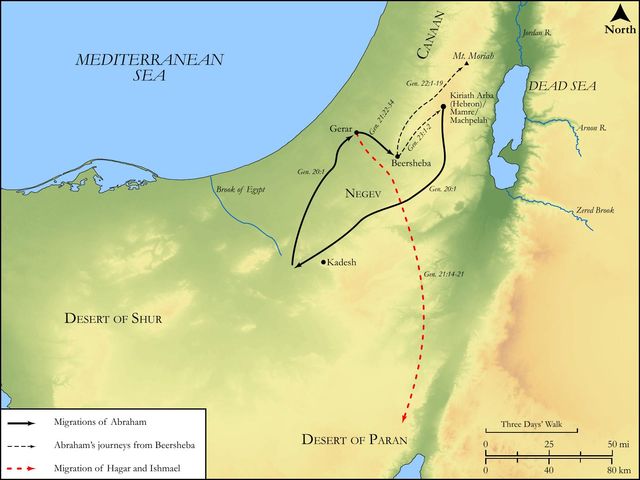
See on the biblical-era maps


Study this verse
Public-domain commentary
Matthew Henry
From his Commentary on the Whole Bible. Henry comments on passages, not single verses — this entry covers Genesis 21:1–8. His three-level outline is real structure in the source text, so it is rendered as structure.
Long-looked-for comes at last. The vision concerning the promised seed is for an appointed time, and now, at the end, it speaks, and does not lie; few under the Old Testament were brought into the world with such expectation as Isaac was, not for the sake of any great person eminence at which he was to arrive, but because he was to be, in this very thin, a type of Christ, that seed which the holy God had so long promised and holy men so long expected. In this account of the first days of Isaac we may observe,
I.The fulfilling of God's promise in the conception and birth of Isaac, Gen 21:1, Gen 21:2.
Note, God's providences look best and brightest when they are compared with his word, and when we observe how God, in them all, acts as he has said, as he has spoken.
1.Isaac was born according to the promise. The Lord visited Sarah in mercy, as he had said. Note, No word of God shall fall to the ground; for he is faithful that has promised, and God's faithfulness is the stay and support of his people's faith. He was born at the set time of which God had spoken, Gen 21:2. Note, God is always punctual to his time; though his promised mercies come not at the time we set, they will certainly come at the time he sets, and that is the best time.,
2.He was born by virtue of the promise: Sarah by faith received strength to conceive Heb 11:11. God therefore by promise gave that strength. It was not by the power of common providence, but by the power of a special promise, that Isaac was born. A sentence of death was, as it were, passed upon the second causes: Abraham was old, and Sarah old, and both as good as dead; and then the word of God took place. Note, True believers, by virtue of God's promises, are enabled to do that which is above the power of human nature, for by them they partake of a divine nature, Pe2 1:4.
II.Abraham's obedience to God's precept concerning Isaac.
1.He named him, as God commanded him, Gen 21:3. God directed him to a name for a memorial, Isaac, laughter; and Abraham, whose office it was, gave him that name, though he might have designed him some other name of a more pompous signification. Note, It is fit that the luxuriancy of human invention should always yield to the sovereignty and plainness of divine institution; yet there was good reason for the name, for,
(1.)When Abraham received the promise of him he laughed for joy, Gen 17:17. Note, When the sun of comfort has risen upon the soul it is good to remember how welcome the dawning of the day was, and with what exultation we embraced the promise.
(2.)When Sarah received the promise she laughed with distrust and diffidence. Note, When God gives us the mercies we began to despair of we ought to remember with sorrow and shame our sinful distrusts of God's power and promise, when we were in pursuit of them.
(3.)Isaac was himself, afterwards, laughed at by Ishmael (Gen 21:9), and perhaps his name bade him expect it. Note, God's favourites are often the world's laughing-stocks.
(4.)The promise which he was not only the son, but the heir of, was to be the joy of all the saints in all ages, and that which would fill their mouths with laughter.
2.He circumcised him, Gen 21:4. The covenant being established with him, the seal of the covenant was administered to him; and though a bloody ordinance, and he a darling, yet it must not be omitted, no, nor deferred beyond the eighth day. God had kept time in performing the promise, and therefore Abraham must keep time in obeying the precept.
III.The impressions which this mercy made upon Sarah.
1.It filled her with joy (Gen 21:6): "God has made me to laugh; he has given me both cause to rejoice and a heart to rejoice." Thus the mother of our Lord, Luk 1:46, Luk 1:47. Note,
(1.)God bestows mercies upon his people to encourage their joy in his work and service; and, whatever is the matter of our joy, God must be acknowledged as the author of it, unless it be the laughter of the fool.
(2.)When mercies have been long deferred they are the more welcome when they come.
(3.)It adds to the comfort of any mercy to have our friends rejoice with us in it: All that hear will laugh with me; for laughing is catching. See Luk 1:58. Others would rejoice in this instance of God's power and goodness, and be encouraged to trust in him. See Psa 119:74.
2.It filled her with wonder, Gen 21:7. Observe here,
(1.)What it was she thought so wonderful: That Sarah should give children suck, that she should, not only bear a child, but be so strong and hearty at the age as to give it suck. Note, Mothers, if they be able, ought to be nurses to their own children. Sarah was a person of quality, was aged; nursing might be thought prejudicial of herself, or to the child, or to both; she had choice of nurses, no doubt, in her own family: and yet she would do her duty in this matter; and her daughters the good wives are while they thus do well, Pe1 3:5, Pe1 3:6. See Lam 4:3.
(2.)How she expressed her wonder: "Who would have said it? The thing was so highly improbable, so near to impossible, that if any one but God had said it we could not have believed it." Note, God's favours to his covenant-people are such as surpass both their own and others' thoughts and expectations. Who could imagine that God should do so much for those that deserve so little, nay, for those that deserve so ill? See Eph 3:20; Sa2 7:18, Sa2 7:19. Who would have said that God should send his Son to die for us, his Spirit to sanctify us, his angels to attend us? Who would have said that such great sins should be pardoned, such mean services accepted, and such worthless worms taken into covenant and communion with the great and holy God?
IV.A short account of Isaac's infancy:
The child grew, Gen 21:8. Special notice is taken of this, though a thing of course, to intimate that the children of the promise are growing children. See Luk 1:80; Luk 2:40. Those that are born of God shall increase of God, Col 2:19. He grew so as not always to need milk, but was able to bear strong meat, and then he was weaned. See Heb 5:13, Heb 5:14. And then it was that Abraham made a great feast for his friends and neighbours, in thankfulness to God for his mercy to him. He made this feast, not on the day that Isaac was born, that would have been too great a disturbance to Sarah; nor on the day that he was circumcised, that would have been too great a diversion from the ordinance; but on the day that he was weaned, because God's blessing upon the nursing of children, and the preservation of them throughout the perils of the infant age, are signal instances of the care and tenderness of the divine providence, which ought to be acknowledged, to its praise. See Psa 22:9, Psa 22:10; Hos 11:1.
Continue studying Genesis 21:1 across the web’s major study libraries — every link below opens this exact verse, chapter, or book on the destination site.
Read & Compare
 BibleGatewayThis verse in more than 200 translations and 70 languages.
 Bible.comThe YouVersion reader — hundreds of translations, reading plans, and highlights.
 ESV.orgCrossway's official English Standard Version reader.
 NET BibleThe NET translation with 60,000+ translators' notes on every rendering decision.
 STEP BibleTyndale House's free study tool — original text, vocabulary, and scholarly resources.
 BibliaLogos Bible Software's free web reader.
 USCCBThe New American Bible (Revised Edition) with the U.S. bishops' study notes.
Commentaries
 BibleHub CommentariesDozens of classic commentaries on this verse, gathered on one page.
 StudyLightMore than 100 commentary sets — the largest collection on the web.
 BibleRefPlain-English commentary on what this verse means, verse by verse.
 Enduring WordDavid Guzik's free commentary on this chapter, widely used by Bible teachers.
 Bible Study ToolsVerse commentary alongside Greek and Hebrew study aids.
Original Language & Research
- BibleHub InterlinearThe verse word by word — original language, transliteration, and English.
- BibleHub LexiconEvery word's original-language definition and Strong's entry.
 Blue Letter BibleDeep-study tools — Strong's numbers, concordance, and word studies.
 SefariaThe Hebrew text with Rashi and centuries of Jewish commentary.
Sermons, Hymns & Audio


TrulyRandomVerse is not affiliated with these sites and doesn’t control their content. They’re linked because they’re genuinely useful.
Summary
Genesis 21:1 records the momentous fulfillment of God's long-standing promise to Abraham and Sarah, signaling the miraculous and divinely orchestrated birth of Isaac. This pivotal verse powerfully declares that the Lord actively intervened to bring about this event precisely as He had foretold, underscoring His unwavering faithfulness, sovereign power, and the absolute reliability of His spoken word, even in the face of human impossibility and prolonged waiting.
Context
ShowHideLiterary Context
Genesis 21:1 serves as the climactic culmination of a narrative arc stretching back many chapters, beginning with God's initial promise to Abraham in Genesis 12:1-3. Throughout subsequent chapters, the promise of a son and a multitude of descendants is reiterated and affirmed, notably in Genesis 15:1-6 where God makes a covenant with Abraham, and in Genesis 17:1-27 where the covenant is formalized through circumcision and the specific promise of a son through Sarah, to be named Isaac, is given. The immediate preceding chapters detail Abraham's and Sarah's advanced age, Sarah's initial disbelief and laughter upon hearing the promise in Genesis 18:9-15, and Abraham's sojourn in Gerar, where he again presents Sarah as his sister (Genesis 20:1-18). Genesis 21:1 thus marks the triumphant resolution of a long period of anticipation, doubt, and human attempts to fulfill God's promise (like Hagar and Ishmael in Genesis 16:1-16), unequivocally demonstrating God's sovereign control over His plan.
Historical & Cultural Context
In the households of the patriarchs, barrenness was considered a great shame and misfortune for a woman, often implying divine displeasure, as Rachel's cry for children shows. The ability to bear children, especially sons, was crucial for family lineage, inheritance, and social standing. Abraham and Sarah were living in a patriarchal society where the continuation of the family line was paramount. Their advanced age (Abraham was 100, Sarah 90, as noted in Genesis 17:17) made natural conception utterly impossible, highlighting the miraculous nature of Isaac's birth. The narrative takes place during the patriarchal period, where nomadic or semi-nomadic life was common, and divine communication often involved direct appearances or angelic messengers, as seen in the visitation of the Lord to Abraham in Genesis 18:1-8. This context underscores that Isaac's birth was not merely a biological event but a profound theological statement about God's power and faithfulness to His covenant promises, defying all human and natural limitations.
Key Themes
ShowHideThis verse powerfully contributes to several overarching themes in Genesis and the broader biblical narrative. Foremost among these is the theme of God's Covenant Faithfulness, demonstrating that God is utterly reliable and will always fulfill His promises, regardless of human doubt or impossibility, as seen in His repeated assurances to Abraham in Genesis 15:1-6 and Genesis 17:1-8. It also highlights Divine Sovereignty and Intervention, portraying God as actively involved in the lives of His people, orchestrating events to bring about His purposes, even when it means overriding natural processes. The miraculous nature of Isaac's birth underscores the theme of God's Power Over Impossibility, setting a precedent for God working through human weakness to display His strength, a truth echoed in the New Testament (e.g., Luke 1:37). Finally, it emphasizes the Efficacy of God's Word, showing that what God "says" and "speaks" is not merely a suggestion but a decree that will inevitably come to pass, a foundational truth for understanding the authority of Scripture.
Exposition and Analysis
ShowHideKey Word Analysis
ShowHideThis is the Tetragrammaton, the personal, covenantal name of God, often translated as "Jehovah" or "Yahweh." Its presence here emphasizes that it is not merely a generic deity but the specific, self-existent, and eternal God who is actively involved in fulfilling His promises. The use of this name highlights the personal and covenantal nature of God's interaction with Sarah, underscoring His commitment to His word.
This verb carries a rich semantic range beyond a simple social call. In this context, it signifies a purposeful and active remembrance, often with the intent to intervene, bless, or sometimes judge. Here, it denotes God's deliberate, benevolent, and effective intervention to fulfill His promise, "remembering" Sarah in a way that led to her miraculous conception. It implies a divine inspection or oversight that leads to a decisive act, confirming God's active involvement in the unfolding of His redemptive plan.
This primitive root means "to arrange," but is used figuratively of words, meaning "to speak," "declare," "command," or "promise." Its usage here, alongside "said" (H559, ʼâmar'), emphasizes the authority, certainty, and efficacy of God's verbal declarations. It highlights that God's word is not empty or idle but possesses inherent power to bring about what it declares, serving as the foundation for the fulfillment of His promises.
Verse Breakdown
ShowHide"And the LORD visited Sarah"
This opening clause immediately establishes the subject and the miraculous nature of the event. The "LORD" (Yᵉhôvâh), the covenant God, is the active agent. His "visitation" (pâqad) is not a casual encounter but a purposeful, decisive, and benevolent intervention. It signifies that God "remembered" Sarah and acted upon His long-standing promise, initiating the supernatural process that would lead to conception in her barren and aged womb. This was not a natural occurrence but a direct act of divine power.
"as he had said"
This phrase directly links the present action to God's prior verbal declarations. It refers back to the specific promises made to Abraham and Sarah regarding the birth of Isaac, particularly in Genesis 17:15-19 and Genesis 18:10-14. This emphasizes God's precision and adherence to His own word, confirming that the event unfolded exactly according to His divine blueprint.
"and the LORD did unto Sarah"
This clause reiterates God's active role, using the verb "did" (ʻâsâh), which means "to do or make" in its broadest sense. It confirms that the Lord not only "visited" but also "performed" or "accomplished" His will concerning Sarah. This highlights the practical, tangible outcome of His visitation—the actual conception and subsequent birth of Isaac. It underscores that God's promises are not just words but are backed by His power to bring them to fruition.
"as he had spoken"
This final phrase serves as a powerful reinforcement of the preceding "as he had said." The repetition emphasizes the absolute reliability and authority of God's spoken word (dâbar). It leaves no doubt that Isaac's birth was not a coincidence or a natural development, but the direct, precise, and certain fulfillment of God's prior declarations. This double affirmation underscores God's unwavering faithfulness and the inherent power of His divine decrees.
Literary Devices
ShowHideGenesis 21:1, though concise, employs several significant literary devices to amplify its profound theological message. The most prominent is Repetition and Parallelism. The phrases "as he had said" and "as he had spoken" are used in parallel constructions, creating a powerful rhetorical emphasis on the absolute certainty and reliability of God's word. This Anaphora ensures that the reader grasps the foundational truth: God's promises are immutable. The verse also functions as a Climax in the narrative, bringing to a head the long-standing tension and anticipation surrounding the promised heir. The simplicity of the language belies the immense significance of the event, allowing the divine action to stand out clearly. Furthermore, there is a subtle Irony at play when considering Sarah's earlier laughter of disbelief (Genesis 18:12), which is now transformed into the joy signified by Isaac's name ("he laughs").
Theological and Thematic Connections
ShowHideGenesis 21:1 is a foundational declaration of God's absolute faithfulness to His covenant promises, demonstrating that His word is not merely a suggestion but a decree that will inevitably come to pass. This verse profoundly illustrates God's sovereignty over all aspects of creation and human life, particularly His power to transcend natural limitations and bring about His will. The miraculous birth of Isaac, through a barren and elderly woman, serves as a powerful testament to God's ability to accomplish what is humanly impossible, reinforcing the truth that His power is not constrained by human weakness or biological realities. This event is a critical juncture in the unfolding of God's redemptive plan, establishing the lineage through which the Messiah would eventually come, thereby connecting the Abrahamic covenant directly to the ultimate fulfillment in Christ.
Reflection and Application
ShowHideGenesis 21:1 offers profound encouragement for believers today, reminding us that God is perpetually faithful to His word, even when circumstances seem to contradict divine promises or when prolonged delays test our patience. Sarah's long wait for Isaac's birth, and its eventual occurrence when she was "past age," teaches us perseverance and the importance of holding onto hope, knowing that God's timing is perfect. The "appointed time" (Genesis 18:14) will come when it is clear that the breakthrough is solely God's doing, leaving no room for human boasting. Furthermore, if God can enable a barren, elderly woman to conceive, He can certainly work in seemingly impossible situations in our own lives, strengthening our faith in His power to act beyond human capability. This verse calls us to trust in God's character and the efficacy of His promises, even when the path forward is unclear or seems humanly impossible.
Questions for Reflection
ShowHideFAQ
ShowHideWhat is the significance of the phrase "the LORD visited Sarah"?
ShowHideThe Hebrew word for "visited" (paqad) means more than a casual call. In this context, it signifies God's deliberate, purposeful, and benevolent intervention. It means He "remembered" Sarah with the intent to act on His promise, actively intervening in her life to bring about the miraculous conception and birth of Isaac. It highlights God's personal and sovereign involvement in fulfilling His word, demonstrating His active presence and power in human affairs, especially in bringing His promises to fruition.
Why is the repetition "as he had said, and... as he had spoken" emphasized?
ShowHideThis repetition serves as a powerful rhetorical device to underscore the absolute certainty, authority, and reliability of God's word (davar and ʼâmar). It is not merely a stylistic choice but a theological declaration, stressing that God's promises are not suggestions but divine decrees that will inevitably come to pass. It ensures that the reader understands that Isaac's birth was not a coincidence or a natural event, but the direct, precise, and unfailing fulfillment of God's prior declarations, reinforcing His unwavering faithfulness and the immutable nature of His promises, as seen in Isaiah 55:11.
Christ-Centered Fulfillment
ShowHideGenesis 21:1 finds its ultimate Christ-centered fulfillment in several profound ways, serving as a powerful foreshadowing of God's greater redemptive plan. The miraculous birth of Isaac, the promised son through whom Abraham's lineage would continue, directly anticipates the even more miraculous birth of Jesus Christ, the ultimate "seed" of Abraham (Galatians 3:16). Just as Isaac's birth defied natural limitations, so too did Christ's virgin birth demonstrate God's sovereign power to bring forth life in impossible circumstances, highlighting that "with God nothing will be impossible" (Luke 1:37). Furthermore, God's unwavering faithfulness in fulfilling His covenant promise to Abraham through Isaac ultimately culminates in the New Covenant established through Jesus' sacrificial death and resurrection (Hebrews 8:6). Christ is the true Isaac, the son of promise, through whom all the nations of the earth are blessed (Genesis 22:18; Acts 3:25). The reliability of God's word demonstrated in Genesis 21:1 serves as a foundational assurance for the greater promises of salvation, eternal life, and the coming of God's Kingdom, all secured and fulfilled in Jesus Christ (2 Corinthians 1:20).