


Genesis 21:2
- וַתַּהַרva·ta·Harand she conceivedH2029Conj-w ¦ V-Qal-ConsecImperf-3fsVerb Qal Consecutive Imperfect 3rd Singular Feminineוַandתַּהַרshe conceived
- וַתֵּלֶדva·Te·ledand she boreH3205Conj-w ¦ V-Qal-ConsecImperf-3fsVerb Qal Consecutive Imperfect 3rd Singular Feminineוַandתֵּלֶדshe bore
- שָׂרָהsa·RahSarahH8283N-proper-fNoun Proper Feminine
- לְאַבְרָהָםle·'av·ra·Hamto AbrahamH85Prep-l ¦ N-proper-mNoun Proper MasculineלְtoאַבְרָהָםAbraham
- בֵּןbena sonH1121N-msNoun Singular Masculine Absolute
- לִזְקֻנָיוliz·ku·Navof his old age<s>H2208Prep-l ¦ N-mpc ¦ 3msNoun Plural Masculine Constructלִofזְקֻנָיold age<s>וhis
- לַמּוֹעֵדla·mo·'Edto the appointed timeH4150Prep-l ¦ N-msNoun Singular Masculine Absoluteלַto theמּוֹעֵדappointed time
- אֲשֶׁר'a·SherwhichH834RelParticle Relative
- דִּבֶּרdi·Berhe had spokenH1696V-Piel-Perf-3msVerb Piel Perfect 3rd Singular Masculine
- אֹתוֹ'o·Towith <the> himH854Prep ¦ 3msPreposition Definiteאֹתwith <the>וֹhim
- אֱלֹהִים'E·lo·HimGodH430N-mpNoun Plural Masculine Absolute
English is a literal word-by-word gloss of the Hebrew, not the KJV's wording. Why?
This is the original text the KJV's translators worked from — each Hebrew word with its own literal English meaning in this verse, prepared by scholars at Tyndale House, Cambridge. The KJV translates whole sentences, not word by word, so its wording differs: one Hebrew word can become several English words, and the KJV may choose “the LORD” where the gloss reads “Yahweh”. Both are faithful — they answer different questions. For the KJV's own rendering, switch to the KJV text.
Details
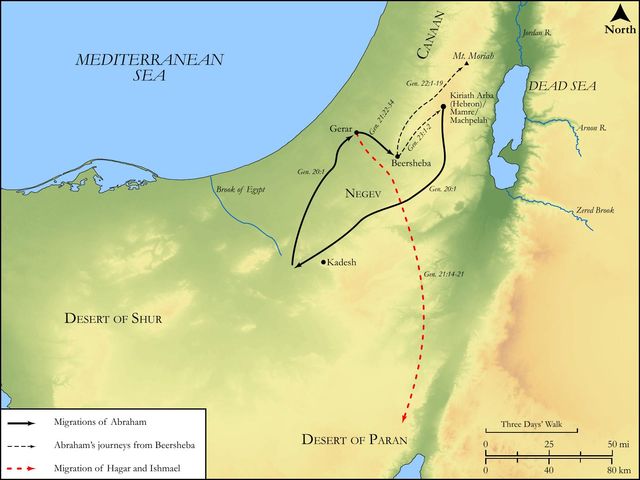
See on the biblical-era maps


Study this verse
Public-domain commentary
Matthew Henry
From his Commentary on the Whole Bible. Henry comments on passages, not single verses — this entry covers Genesis 21:1–8. His three-level outline is real structure in the source text, so it is rendered as structure.
Long-looked-for comes at last. The vision concerning the promised seed is for an appointed time, and now, at the end, it speaks, and does not lie; few under the Old Testament were brought into the world with such expectation as Isaac was, not for the sake of any great person eminence at which he was to arrive, but because he was to be, in this very thin, a type of Christ, that seed which the holy God had so long promised and holy men so long expected. In this account of the first days of Isaac we may observe,
I.The fulfilling of God's promise in the conception and birth of Isaac, Gen 21:1, Gen 21:2.
Note, God's providences look best and brightest when they are compared with his word, and when we observe how God, in them all, acts as he has said, as he has spoken.
1.Isaac was born according to the promise. The Lord visited Sarah in mercy, as he had said. Note, No word of God shall fall to the ground; for he is faithful that has promised, and God's faithfulness is the stay and support of his people's faith. He was born at the set time of which God had spoken, Gen 21:2. Note, God is always punctual to his time; though his promised mercies come not at the time we set, they will certainly come at the time he sets, and that is the best time.,
2.He was born by virtue of the promise: Sarah by faith received strength to conceive Heb 11:11. God therefore by promise gave that strength. It was not by the power of common providence, but by the power of a special promise, that Isaac was born. A sentence of death was, as it were, passed upon the second causes: Abraham was old, and Sarah old, and both as good as dead; and then the word of God took place. Note, True believers, by virtue of God's promises, are enabled to do that which is above the power of human nature, for by them they partake of a divine nature, Pe2 1:4.
II.Abraham's obedience to God's precept concerning Isaac.
1.He named him, as God commanded him, Gen 21:3. God directed him to a name for a memorial, Isaac, laughter; and Abraham, whose office it was, gave him that name, though he might have designed him some other name of a more pompous signification. Note, It is fit that the luxuriancy of human invention should always yield to the sovereignty and plainness of divine institution; yet there was good reason for the name, for,
(1.)When Abraham received the promise of him he laughed for joy, Gen 17:17. Note, When the sun of comfort has risen upon the soul it is good to remember how welcome the dawning of the day was, and with what exultation we embraced the promise.
(2.)When Sarah received the promise she laughed with distrust and diffidence. Note, When God gives us the mercies we began to despair of we ought to remember with sorrow and shame our sinful distrusts of God's power and promise, when we were in pursuit of them.
(3.)Isaac was himself, afterwards, laughed at by Ishmael (Gen 21:9), and perhaps his name bade him expect it. Note, God's favourites are often the world's laughing-stocks.
(4.)The promise which he was not only the son, but the heir of, was to be the joy of all the saints in all ages, and that which would fill their mouths with laughter.
2.He circumcised him, Gen 21:4. The covenant being established with him, the seal of the covenant was administered to him; and though a bloody ordinance, and he a darling, yet it must not be omitted, no, nor deferred beyond the eighth day. God had kept time in performing the promise, and therefore Abraham must keep time in obeying the precept.
III.The impressions which this mercy made upon Sarah.
1.It filled her with joy (Gen 21:6): "God has made me to laugh; he has given me both cause to rejoice and a heart to rejoice." Thus the mother of our Lord, Luk 1:46, Luk 1:47. Note,
(1.)God bestows mercies upon his people to encourage their joy in his work and service; and, whatever is the matter of our joy, God must be acknowledged as the author of it, unless it be the laughter of the fool.
(2.)When mercies have been long deferred they are the more welcome when they come.
(3.)It adds to the comfort of any mercy to have our friends rejoice with us in it: All that hear will laugh with me; for laughing is catching. See Luk 1:58. Others would rejoice in this instance of God's power and goodness, and be encouraged to trust in him. See Psa 119:74.
2.It filled her with wonder, Gen 21:7. Observe here,
(1.)What it was she thought so wonderful: That Sarah should give children suck, that she should, not only bear a child, but be so strong and hearty at the age as to give it suck. Note, Mothers, if they be able, ought to be nurses to their own children. Sarah was a person of quality, was aged; nursing might be thought prejudicial of herself, or to the child, or to both; she had choice of nurses, no doubt, in her own family: and yet she would do her duty in this matter; and her daughters the good wives are while they thus do well, Pe1 3:5, Pe1 3:6. See Lam 4:3.
(2.)How she expressed her wonder: "Who would have said it? The thing was so highly improbable, so near to impossible, that if any one but God had said it we could not have believed it." Note, God's favours to his covenant-people are such as surpass both their own and others' thoughts and expectations. Who could imagine that God should do so much for those that deserve so little, nay, for those that deserve so ill? See Eph 3:20; Sa2 7:18, Sa2 7:19. Who would have said that God should send his Son to die for us, his Spirit to sanctify us, his angels to attend us? Who would have said that such great sins should be pardoned, such mean services accepted, and such worthless worms taken into covenant and communion with the great and holy God?
IV.A short account of Isaac's infancy:
The child grew, Gen 21:8. Special notice is taken of this, though a thing of course, to intimate that the children of the promise are growing children. See Luk 1:80; Luk 2:40. Those that are born of God shall increase of God, Col 2:19. He grew so as not always to need milk, but was able to bear strong meat, and then he was weaned. See Heb 5:13, Heb 5:14. And then it was that Abraham made a great feast for his friends and neighbours, in thankfulness to God for his mercy to him. He made this feast, not on the day that Isaac was born, that would have been too great a disturbance to Sarah; nor on the day that he was circumcised, that would have been too great a diversion from the ordinance; but on the day that he was weaned, because God's blessing upon the nursing of children, and the preservation of them throughout the perils of the infant age, are signal instances of the care and tenderness of the divine providence, which ought to be acknowledged, to its praise. See Psa 22:9, Psa 22:10; Hos 11:1.
Historical interpretation
Three Centuries of Reception
2 surviving comments on this verse. Each one is dated, so this reads as a timeline rather than a list.
Select a marker to jump to its quote. Markers stagger vertically where authors wrote within a few decades of each other.
Do you wish to learn the symbolic meaning of Sarah’s sterility? The church was to bring forth the multitude of believers. In order, therefore, that you may not find incredible how one who was childless, fruitless and barren could have given birth, she who by nature was barren went ahead, paving the way for chosen sterility, and Sarah became a type of the church. For just as she gave birth in her old age when she was barren, so too the church, though barren, has given birth for these, the final times.
The Lord visited Sarah as He had promised, and fulfilled what He had spoken to her; she conceived and bore a son in her old age at the time God had predicted to her. God is said to visit Sarah as one who is sick and already despaired of all offspring, so that what nature seemed to deny, the presence of divine grace bestows: which word aptly suits all the children of the promise, who are saved not by their own free will but by the choice of grace, not by the effort of their own labor but by the Lord visiting their hearts and fulfilling the gift of grace which He promised.
Continue studying Genesis 21:2 across the web’s major study libraries — every link below opens this exact verse, chapter, or book on the destination site.
Read & Compare
 BibleGatewayThis verse in more than 200 translations and 70 languages.
 Bible.comThe YouVersion reader — hundreds of translations, reading plans, and highlights.
 ESV.orgCrossway's official English Standard Version reader.
 NET BibleThe NET translation with 60,000+ translators' notes on every rendering decision.
 STEP BibleTyndale House's free study tool — original text, vocabulary, and scholarly resources.
 BibliaLogos Bible Software's free web reader.
 USCCBThe New American Bible (Revised Edition) with the U.S. bishops' study notes.
Commentaries
 BibleHub CommentariesDozens of classic commentaries on this verse, gathered on one page.
 StudyLightMore than 100 commentary sets — the largest collection on the web.
 BibleRefPlain-English commentary on what this verse means, verse by verse.
 Enduring WordDavid Guzik's free commentary on this chapter, widely used by Bible teachers.
 Bible Study ToolsVerse commentary alongside Greek and Hebrew study aids.
Original Language & Research
- BibleHub InterlinearThe verse word by word — original language, transliteration, and English.
- BibleHub LexiconEvery word's original-language definition and Strong's entry.
 Blue Letter BibleDeep-study tools — Strong's numbers, concordance, and word studies.
 SefariaThe Hebrew text with Rashi and centuries of Jewish commentary.
Sermons, Hymns & Audio


TrulyRandomVerse is not affiliated with these sites and doesn’t control their content. They’re linked because they’re genuinely useful.
Summary
Genesis 21:2 records the miraculous birth of Isaac to Abraham and Sarah, fulfilling God's long-standing covenant promise precisely "at the set time." This pivotal moment underscores God's unwavering faithfulness, His sovereign power to transcend natural limitations, and the perfection of His divine timing, marking a foundational step in the unfolding of the Abrahamic covenant and the redemptive history of humanity.
Context
ShowHideLiterary Context
Genesis 21:2 marks the climactic fulfillment of a promise that has been central to the Abrahamic narrative since Genesis 12. Following decades of waiting, human attempts to "help" God's plan (e.g., Hagar and Ishmael in Genesis 16), and repeated divine assurances, this verse confirms the birth of the promised son, Isaac. It directly follows the brief announcement of Isaac's conception and birth in Genesis 21:1, serving as a theological explanation for the miraculous event. The subsequent verses detail Isaac's naming, circumcision, and Sarah's joy, solidifying his identity as the son of promise and the heir through whom God's covenant would continue.
Historical & Cultural Context
In the ancient Near East, progeny was of paramount importance, signifying divine favor, family legacy, and social standing. Barrenness was often perceived as a curse or a sign of divine displeasure, bringing immense sorrow and shame. Both Abraham and Sarah were well beyond childbearing age (Abraham 100, Sarah 90), making the prospect of a natural birth utterly impossible. This extreme physiological limitation serves to magnify the miraculous nature of Isaac's birth, emphasizing that it was solely a work of God, demonstrating His power over natural processes and His commitment to His covenant. The cultural expectation of a male heir also highlights the significance of "a son" in this context, not just any child, but the specific male heir through whom the promised "great nation" would descend.
Key Themes
ShowHideThis verse powerfully encapsulates several overarching themes within Genesis and the broader biblical narrative. Foremost is the theme of Divine Faithfulness, as God meticulously fulfills a promise made decades prior, despite human doubt and delay. It also highlights God's Sovereign Power, demonstrating His ability to operate outside and above natural laws to achieve His purposes, particularly in bringing life from barrenness. The concept of God's Perfect Timing is central, as the birth occurs "at the set time" (Hebrew: mo'ed), reinforcing that God's plans unfold according to His precise divine calendar, not human expectations. Finally, it is a crucial moment in the Fulfillment of the Abrahamic Covenant, establishing the lineage through which the promised blessings and, ultimately, the Messiah would come, as seen in the broader narrative of God's covenant with Abraham.
Exposition and Analysis
ShowHideGenesis 21:2 declares with profound simplicity the fulfillment of God's miraculous promise: "For Sarah conceived, and bare Abraham a son in his old age, at the set time of which God had spoken to him." This verse is a theological cornerstone, testifying to the sovereign power and meticulous faithfulness of God.
Key Word Analysis
ShowHideThis primitive root signifies "to be (or become) pregnant." Its use here emphasizes the biological reality of Sarah's pregnancy, despite her advanced age, underscoring the miraculous nature of the event. It is a direct act of divine intervention, enabling life where it was naturally impossible.
Derived from a root meaning "to build," this word signifies a son as a "builder of the family name." In this context, "a son" is not merely any child, but the specific male heir, Isaac, through whom Abraham's lineage and the covenant promises would be established and carried forward, ensuring the continuation of God's redemptive plan.
This term denotes "an appointment, i.e., a fixed time or season; specifically, a festival." Its usage here is crucial, indicating that Isaac's birth was not a random or delayed event, but occurred precisely at the divinely appointed moment. It highlights God's perfect precision, sovereignty, and unwavering commitment to His word, demonstrating that His plans unfold according to His pre-ordained calendar.
Verse Breakdown
ShowHide"For Sarah conceived, and bare Abraham a son"
This clause directly states the miraculous event. Sarah, long barren and now ninety years old, supernaturally became pregnant and gave birth. The natural impossibility of this act magnifies the divine agency involved, highlighting God's power to create life where human biology fails. It is the tangible manifestation of God's promise.
"in his old age"
This phrase emphasizes the extreme age of Abraham (100 years old) at the time of Isaac's birth. It serves as a powerful rhetorical device to underscore the human impossibility of the situation, thereby magnifying the miraculous nature of God's intervention. It ensures that no human credit can be taken for this birth; it is entirely a divine work.
"at the set time of which God had spoken to him"
This is the theological lynchpin of the verse. The "set time" (Hebrew: mo'ed) signifies a divinely appointed and precise moment. It confirms that Isaac's birth was not a random occurrence, nor was it delayed beyond God's predetermined schedule. Instead, it was the exact fulfillment of God's specific promise, previously articulated in Genesis 18:10. This highlights God's meticulous planning, His absolute sovereignty over time and circumstances, and His unwavering faithfulness to His spoken word.
Literary Devices
ShowHideThe verse employs several significant literary devices. Irony is powerfully present in the contrast between Sarah's advanced age and barrenness and the miraculous birth of a son, defying all natural expectations. This highlights the Divine Intervention as the sole cause of the event. The phrase "at the set time of which God had spoken to him" functions as a Fulfillment Narrative, explicitly connecting the present event to past divine promises, thereby emphasizing God's faithfulness and the certainty of His word. The repetition of the promise of a son and its eventual fulfillment also creates a sense of Anticipation and Resolution, bringing a long-standing narrative tension to its joyous conclusion.
Theological and Thematic Connections
ShowHideGenesis 21:2 is a profound testament to God's character and His method of operation in redemptive history. It underscores His unwavering faithfulness to His promises, demonstrating that His word is not merely a declaration but a divine commitment that will inevitably come to pass, regardless of human limitations or the passage of time. The miraculous nature of Isaac's birth showcases God's absolute sovereignty over creation and natural processes, affirming that nothing is impossible for Him. This event also establishes a crucial pattern of divine promise followed by certain fulfillment, building a foundation of trust for all future divine declarations and serving as a prototype for God's redemptive acts throughout history, culminating in Christ.
Reflection and Application
ShowHideGenesis 21:2 offers profound encouragement and a powerful lesson in faith for believers today. In a world that often demands instant gratification and tangible proof, this verse reminds us of God's impeccable timing and unwavering faithfulness. When we face seemingly impossible situations, prolonged seasons of waiting, or prayers that seem unanswered, Isaac's miraculous birth stands as a beacon of hope. It teaches us that God is not bound by our timelines, our limitations, or the natural order of things. His delays are not denials, but often preparations for a greater, more glorious manifestation of His power and purpose. We are called to cultivate a patient, persistent faith, trusting that what God has promised, He is utterly capable and faithful to bring to pass, even when it defies all human logic and expectation. Just as Abraham's faith was strengthened through the long wait, so too can ours be refined as we learn to rest in God's perfect plan and timing, knowing that He works all things for His glory and our good.
Questions for Reflection
ShowHideFAQ
ShowHideWhy is the timing of Isaac's birth emphasized as "at the set time"?
ShowHideThe emphasis on "at the set time" (Hebrew: mo'ed) is crucial because it highlights God's divine precision, sovereignty, and unwavering faithfulness. It underscores that Isaac's birth was not a random event or a delayed fulfillment, but the exact culmination of God's pre-ordained plan, demonstrating His perfect control over all circumstances and His commitment to His promises. This phrase assures us that God's timing is always perfect, even when it requires human patience and faith, and that His word will inevitably come to pass, as seen in Genesis 18:10.
Does Isaac's birth have significance beyond the Abrahamic covenant?
ShowHideYes, Isaac's miraculous birth holds profound significance beyond the immediate Abrahamic covenant. It serves as a powerful prototype for God's ability to bring life from barrenness and the impossible, a theme echoed in the births of other significant biblical figures like Samson, Samuel, and John the Baptist. More importantly, Isaac, as the son of promise, becomes a type of Christ, the ultimate Son of Promise. His supernatural birth from elderly parents foreshadows the unique, miraculous conception of Jesus by the Holy Spirit. Isaac's role as the heir through whom all nations would be blessed points directly to Jesus, the true "seed" of Abraham, through whom spiritual blessings and salvation are extended to all humanity, as explained in Galatians 3:16.
Christ-Centered Fulfillment
ShowHideThe miraculous birth of Isaac "at the set time" serves as a profound and multifaceted precursor to the ultimate "set time" in redemptive history: the advent of Jesus Christ. Just as Isaac was born to elderly, barren parents, demonstrating God's power to bring life from what was humanly impossible, so too was Christ conceived by the Holy Spirit in the virgin Mary, a supernatural birth transcending all natural limitations, as the angel Gabriel declared, "For nothing will be impossible with God" (Luke 1:34-37). Isaac, the son of promise through whom the covenant line continued and through whom a great nation would arise, prefigures Jesus, the Son of God, who is the very embodiment and fulfillment of all God's promises. Through Christ, the true "seed" of Abraham, God's promise to bless all nations is realized, bringing spiritual life and redemption to those who were spiritually barren and dead in sin (Galatians 3:16). Thus, Isaac's birth is not merely a historical event but a powerful testament to God's faithfulness and His sovereign plan, culminating in the perfect timing of Christ's arrival to redeem humanity and establish His eternal kingdom.