


1 Samuel 1:11
Bible text: King James Version (1769 Blayney text) · Public domain
Bible text: King James Version with Strong's numbers · Public domain
Bible text: Berean Standard Bible · Public domain
Bible text: American Standard Version (1901) · Public domain
Bible text: World English Bible, Messianic edition · Public domain
Bible text: Geneva Bible (1599) · Public domain
Bible text: Young's Literal Translation · Public domain
- וַתִּדֹּרva·ti·Dorand she vowedH5087Conj-w ¦ V-Qal-ConsecImperf-3fsVerb Qal Consecutive Imperfect 3rd Singular Feminineוַandתִּדֹּרshe vowed
- נֶדֶרNe·dera vowH5088N-msNoun Singular Masculine Absolute
- וַתֹּאמַרva·to·Marand she saidH559Conj-w ¦ V-Qal-ConsecImperf-3fsVerb Qal Consecutive Imperfect 3rd Singular Feminineוַandתֹּאמַרshe said
- יְהוָהYah·wehO YahwehH3068N-properNoun Proper Title
- צְבָאוֹתtze·va·'otof hostsH6635N-fpNoun Plural Feminine Absolute
- אִם'im<if>H518PrtParticle Conditional
- רָאֹהra·'Ohcertainly [if] <to see>H7200V-Qal-InfAbsVerb Qal Infinitive Absolute
- תִרְאֶהtir·'Ehyou will lookH7200V-Qal-Imperf-2msVerb Qal Imperfect 2nd Singular Masculine
- בָּעֳנִיbo·'o·Nion [the] affliction ofH6040Prep-b ¦ N-mscNoun Singular Masculine Constructבָּonעֳנִי[the] affliction of
- אֲמָתֶךָ'a·ma·Te·khayour maidservantH519N-fsc ¦ 2msNoun Singular Feminine Constructאֲמָתֶmaidservantךָyour
- וּזְכַרְתַּנִיu·ze·khar·Ta·niand you will remember meH2142Conj-w ¦ V-Qal-ConsecPerf-2ms ¦ 1csVerb Qal Consecutive Perfect 2nd Singular Masculineוּandזְכַרְתַּyou will rememberנִיme
- וְלֹאve·lo'and notH3808Conj-w ¦ NegParticle Negativeוְandלֹאnot
- תִשְׁכַּחtish·Kachyou will forgetH7911V-Qal-Imperf-2msVerb Qal Imperfect 2nd Singular Masculine
- אֶת'et<obj.>H853DirObjMParticle Object Indicator
- אֲמָתֶךָ'a·ma·Te·khayour maidservantH519N-fsc ¦ 2msNoun Singular Feminine Constructאֲמָתֶmaidservantךָyour
- וְנָתַתָּהve·na·ta·Tahand you will giveH5414Conj-w ¦ V-Qal-ConsecPerf-2msVerb Qal Consecutive Perfect 2nd Singular Masculineוְandנָתַתָּהyou will give
- לַאֲמָתְךָla·'a·ma·te·Khato your maidservant ofH519Prep-l ¦ N-fsc ¦ 2msNoun Singular Feminine Constructלַtoאֲמָתְmaidservant ofךָyour
- זֶרַעZe·ra'spring ofH2233N-mscNoun Singular Masculine Construct
- אֲנָשִׁים'a·na·ShimmenH582N-mpNoun Plural Masculine Absolute
- וּנְתַתִּיוu·ne·ta·Tivand I will give himH5414Conj-w ¦ V-Qal-ConsecPerf-1cs ¦ 3msVerb Qal Consecutive Perfect 1st Singular common genderוּandנְתַתִּיI will giveוhim
- לַיהוָהla·Yah·wehto YahwehH3068Prep-l ¦ N-properNoun Proper TitleלַtoיהוָהYahweh
- כָּלkolallH3605N-mscNoun Singular Masculine Construct
- יְמֵיye·Mei[the] days ofH3117N-mpcNoun Plural Masculine Construct
- חַיָּיוchai·Yavhis lifeH2416N-mpc ¦ 3msNoun Plural Masculine Constructחַיָּיlifeוhis
- וּמוֹרָהu·mo·Rahand a razorH4177Conj-w ¦ N-fsNoun Singular Feminine Absoluteוּandמוֹרָהa razor
- לֹאlo'notH3808NegParticle Negative
- יַעֲלֶהya·'a·Lehit will go upH5927V-Qal-Imperf-3msVerb Qal Imperfect 3rd Singular Masculine
- עַל'alonH5921PrepPreposition
- רֹאשׁוֹro·Shohis headH7218N-msc ¦ 3msNoun Singular Masculine Constructרֹאשׁheadוֹhis
English is a literal word-by-word gloss of the Hebrew, not the KJV's wording. Why?
This is the original text the KJV's translators worked from — each Hebrew word with its own literal English meaning in this verse, prepared by scholars at Tyndale House, Cambridge. The KJV translates whole sentences, not word by word, so its wording differs: one Hebrew word can become several English words, and the KJV may choose “the LORD” where the gloss reads “Yahweh”. Both are faithful — they answer different questions. For the KJV's own rendering, switch to the KJV text.
Details
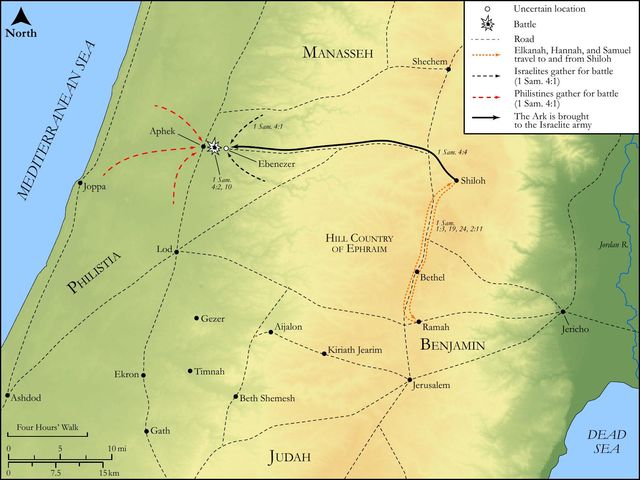
See on the biblical-era map
Study this verse
Public-domain commentary
Matthew Henry
From his Commentary on the Whole Bible. Henry comments on passages, not single verses — this entry covers 1 Samuel 1:9–18. His three-level outline is real structure in the source text, so it is rendered as structure.
Elkanah had gently reproved Hannah for her inordinate grief, and here we find the good effect of the reproof.
I.It brought her to her meat.
She ate and drank, Sa1 1:9. She did not harden herself in sorrow, nor grow sullen when she was reproved for it; but, when she perceived her husband uneasy that she did not come and eat with them, she cheered up her own spirits as well as she could, and came to table. it is as great a piece of self-denial to control our passions as it is to control our appetites.
II.It brought her to her prayers.
It put her upon considering, "Do I well to be angry? Do I well to fret? What good does it do me? Instead of binding the burden thus upon my shoulders, had I not better easy myself of it, and cast it upon the Lord by prayer?" Elkanah had said, Am not I better to thee than ten sons? which perhaps occasioned her to think within herself, "Whether he be so or no, God is, and therefore to him will I apply, and before him will I pour out my complaint, and try what relief that will give me." If ever she will make a more solemn address than ordinary to the throne of grace upon this errand, now is the time. They are at Shiloh, at the door of the tabernacle, where God had promised to meet his people, and which was the house of prayer. They had recently offered their peace-offerings, to obtain the favour of God and all good and in token of their communion with him; and, taking the comfort of their being accepted of him, they had feasted upon the sacrifice; and now it was proper to put up her prayer in virtue of that sacrifice, for the peace-offerings, for by it not only atonement is made for sin, but the audience and acceptance of our prayers and an answer of peace to them are obtained for us: to that sacrifice, in all our supplications, we must have an eye. Now concerning Hannah's prayer we may observe,
1.The warm and lively devotion there was in it, which appeared in several instances, for our direction in prayer.
(1.)She improved the present grief and trouble of her spirit for the exciting and quickening of her pious affections in prayer: Being in bitterness of soul, she prayed, Sa1 1:10. This good use we should make of our afflictions, they should make us the more lively in our addresses to God. Our blessed Saviour himself, being in an agony, prayed more earnestly, Luk 22:44.
(2.)She mingled tears with her prayers. It was not a dry prayer: she wept sore. Like a true Israelite, she wept and made supplication (Hos 12:4), with an eye to the tender mercy of our God, who knows the troubled soul. The prayer came from her heart, as the tears from her eyes.
(3.)She was very particular, and yet very modest, in her petition. She begged a child, a man-child, that it might be fit to serve in the tabernacle. God gives us leave, in prayer, not only to ask good things in general, but to mention that special good thing which we most need and desire. Yet she says not, as Rachel, Give me children, Gen 30:1. She will be very thankful for one.
(4.)She made a solemn vow, or promise, that if God would give her a son she would give him up to God, Sa1 1:11. He would be by birth a Levite, and so devoted to the service of God, but he should be by her vow a Nazarite, and his very childhood should be sacred. It is probable she had acquainted Elkanah with her purpose before, and had had his consent and approbation. Note, Parents have a right to dedicate their children to God, as living sacrifices and spiritual priests; and an obligation is thereby laid upon them to serve God faithfully all the days of their life. Note further, It is very proper, when we are in pursuit of any mercy, to bind our own souls with a bond, that, if God give it us, we will devote it to his honour and cheerfully use it in his service. Not that hereby we can pretend to merit the gift, but thus we are qualified for it and for the comfort of it. In hope of mercy, let us promise duty.
(5.)She spoke all this so softly that none could hear her. Her lips moved, but her voice was not heard, Sa1 1:13. Hereby she testified her belief of God's knowledge of the heart and its desires. Thoughts are words to him, nor is he one of those gods that must be cried aloud to, Kg1 18:27. It was likewise an instance of her humility and holy shamefacedness in her approach to God. She was none of those that made her voice to be heard on high, Isa 58:4. It was a secret prayer, and therefore, though made in a public place, yet was thus made secretly, and not, as the Pharisees prayed, to be seen of men. It is true prayer is not a thing we have reason to be ashamed of, but we must avoid all appearances of ostentation. Let what passes between God and our souls be kept to ourselves.
2.The hard censure she fell under for it. Eli was now high priest, and judge in Israel; he sat upon a seat in the temple, to oversee what was done there, Sa1 1:9. The tabernacle is here called the temple, because it was now fixed, and served all the purposes of a temple. There Eli sat to receive addresses and give direction, and somewhere (it is probable in a private corner) he espied Hannah at her prayers, and by her unusual manner fancied she was drunken, and spoke to her accordingly (Sa1 1:14): How long wilt thou be drunken? - the very imputation that Peter and the apostles fell under when the Holy Ghost gave them utterance, Act 2:13. Perhaps in this degenerate age it was no strange thing to see drunken women at the door of the tabernacle; for otherwise, one would think, the vile lust of Hophni and Phinehas could not have found so easy a prey there, Sa1 2:22. Eli took Hannah for one of these. It is one bad effect of the abounding of iniquity, and its becoming fashionable, that it often gives occasion to suspect the innocent. When a disease is epidemical every one is suspected to be tainted with it. Now,
(1.)This was Eli's fault; and a great fault it was to pass so severe a censure without better observation or information. If his own eyes had already become dim, he should have employed those about him to enquire. Drunkards are commonly noisy and turbulent, but this poor woman was silent and composed. His fault was the worse that he was the priest of the Lord, who should have had compassion on the ignorant, Heb 5:2. Note, It ill becomes us to be rash and hasty in our censures of others, and to be forward to believe people guilty of bad things, while either the matter of fact on which the censure is grounded is doubtful and unproved or is capable of a good construction. Charity commands us to hope the best concerning all, and forbids censoriousness. Paul had very good information when he did but partly believe (Co1 11:18), hoping it was not so. Especially we ought to be cautious how we censure the devotions of others, lest we call that hypocrisy, enthusiasm, or superstition, which is really the fruit of an honest zeal, and it is accepted of God.
(2.)It was Hannah's affliction; and a great affliction it was, added to all the rest, vinegar to the wounds of her spirit. She had been reproved by Elkanah because she would not eat and drink, and now to be reproached by Eli as if she had eaten and drunk too much was very hard. Note, It is no new thing for those that do well to be ill thought of, and we must not think it strange if at any time it be our lot.
3.Hannah's humble vindication of herself from this crime with which she was charged. She bore it admirably well. She did not retort the charge and upbraid him with the debauchery of his own sons, did not bid him look at home and restrain them, did not tell him how ill it became one in his place thus to abuse a poor sorrowful worshipper at the throne of grace. When we are at any time unjustly censured we have need to set a double watch before the door of our lips, that we do not recriminate, and return censure for censure. Hannah thought it enough to vindicate herself, and so must we, Sa1 1:15, Sa1 1:16.
(1.)In justice to herself, she expressly denies the charge, speaks to him with all possible respect, calls him, My lord, intimates how very desirous she was to stand right in his opinion and how loth to lie under his censure. "No, my lord, it is not as you suspect; I have drunk neither wine nor strong drink, not any at all" (though it was proper enough to be given to one of such a heavy heart, Pro 31:6), "much less to any excess; therefore count not thy handmaid for a daughter of Belial." Note, Drunkards are children of Belial (women-drunkards, particularly), children of the wicked one, children of disobedience, children that will not endure the yoke (else they would not be drunk), more especially when they are actually drunk. Those that cannot govern themselves will not bear that any one else should. Hannah owns that the crime would have been very great if she had indeed been guilty of it, and he might justly have shut her out of the courts of God's house; but the very manner of her speaking in her own defence was sufficient to demonstrate that she was not drunk.
(2.)In justice to him, she gives an account of her present behaviour, which had given occasion to his suspicion: "I am a woman of a sorrowful spirit, dejected and discomposed, and that is the reason I do not look as other people; the eyes are red, not with wine, but with weeping. And at this time I have not been talking to myself, as drunkards and fools do, but I have been pouring out my soul before the Lord, who hears and understands the language of the heart, and this out of the abundance of my complaint and grief." She had been more than ordinarily fervent in prayer to God, and this, she tells him, was the true reason of the transport and disorder she seemed to be in. Note, When we are unjustly censured we should endeavour, not only to clear ourselves, but to satisfy our brethren, by giving them a just and true account of that which they misapprehended.
4.The atonement Eli made for his rash unfriendly censure, by a kind and fatherly benediction, Sa1 1:17. He did not (as many are apt to do in such a case) take it for an affront to have his mistake rectified and to be convinced of his error, nor did it put him out of humour. But, on the contrary, he now encouraged Hannah's devotions as much as before he had discountenanced them; not only intimated that he was satisfied of her innocency by those words, Go in peace, but, being high priest, as one having authority he blessed her in the name of the Lord, and, though he knew not what the particular blessing was that she had been praying for, yet he puts his Amen to it, so good an opinion had he now conceived of her prudence and piety: The God of Israel grant thee thy petition, whatever it is, that thou hast asked of him. Note, By our meek and humble carriage towards those that reproach us because they do not know us, we may perhaps make them our friends, and turn their censures of us into prayers for us.
5.The great satisfaction of mind with which Hannah now went away, Sa1 1:18. She begged the continuance of Eli's good opinion of her and his good prayers for her, and then she went her way and did eat of what remained of the peace-offerings (none of which was to be left until the morning), and her countenance was no more sad, no more as it had been, giving marks of inward trouble and discomposure; but she looked pleasant and cheerful, and all was well. Why, what had happened? Whence came this sudden happy change? She had by prayer committed her case to God and left it with him, and now she was no more perplexed about it. She had prayed for herself, and Eli had prayed for her; and she believed that God would either give her the mercy she had prayed for or make up the want of it to her some other way. Note, Prayer is heart's-ease to a gracious soul; the seed of Jacob have often found it so, being confident that God will never say unto them, Seek you me in vain, see Phi 4:6, Phi 4:7. Prayer will smooth the countenance; it should do so.
Historical interpretation
Three Centuries of Reception
6 surviving comments on this verse. Each one is dated, so this reads as a timeline rather than a list.
Select a marker to jump to its quote. Markers stagger vertically where authors wrote within a few decades of each other.
Take note of the woman’s reverence: she did not say, “If you give me three, I shall give you two;” or “if two, I shall give you one.” Instead, “If you give me one, I shall dedicate the offspring wholly to you.” “He will not drink wine or strong drink.” She had not yet received the child and was already forming a prophet, talking about his upbringing and making a deal with God. What wonderful confidence on a woman’s part! Since she could not make a deposit on account of not having anything, she pays the price from what is coming to her. Just as many farmers who are living in extreme poverty but have no money to buy a calf or sheep, get them on credit from their masters by pledging to pay the price from the crops that are due, just so did she do, too—or rather much more: she did not take her son from God on credit but on condition of returning him wholly to him once again and reaping the fruit of his upbringing. She regarded it as sufficient reward, you see, to devote her labors to God’s priest.
What did she say? Instead of saying anything at first, she began with wailing and shed warm floods of tears. And just as, when rain storms fall, even the harder ground is moistened and softened and easily bestirs itself to produce crops, so too did this happen in the case of this woman: as though softened by the flood of tears and warmed with the pangs, the womb began to stir in that wonderful fertility.
“And she stood,” it says, “before the Lord”; and what are her words? “Adonai, Lord, Eloi Sabaoth!” and this is, being interpreted, “O Lord, the God of Hosts.” Her tears went before her speech. By these she hoped to prevail with God to bend to her request. Where tears are, there is always affliction also; where affliction is, there is great wisdom and attentiveness. She continues, “If you will indeed look on the affliction of your handmaid and will give to your handmaid a male child, then I will give him to the Lord all the days of his life.” She said not “for one year” or “for two” as we do; nor did she say, “If you will give me a child, I will give you money”; but, “I give back to you the very gift itself entirely, my firstborn, the son of my prayer.” Truly here was a daughter of Abraham. He gave when it was demanded of him. She offers even before it is demanded.
There were two women with the honored name of Anna: one married, who gave birth to holy Samuel; the other a widow, who recognized the Saint of saints when he was still an infant. The married one prayed with grief of soul and affliction of heart, because she had no sons. In answer to her prayer Samuel was given to her, and she offered him to God as she had vowed in her prayer to do. It is not easy to see how her prayer agrees with the Lord’s Prayer, except, perhaps, in those words, “Deliver us from evil,” because it seemed no slight evil to be married and to be deprived of the fruit of marriage, when the sole purpose of marriage is the begetting of children.
And Anna made a vow, etc. The Church vows, if the word would be entrusted to the nations, and the grace of faith would be granted, and a people strong in virtues would arise from them, that they would serve the Lord until the times of the Gentiles are fulfilled, and never in the example of the Jews, they would bend the knee to Baalim and Astarte, and the other idols of the nations. But if you understand the days allegorically as virtues, all the days of their life are given to the Lord; whatever honest life they live, whatever clear thing they bear in mind or body, they attribute not to themselves, but with the Apostle they proclaim: By the grace of God I am what I am (1 Cor. XV).
And a razor shall not come upon his head. And the reproof of sin shall not violate his conscience; but as far as it is possible for man, he endeavors to consecrate all his thoughts, words, and deeds, which gradually proceed as if from the brain of the heart, to Christ as a true Nazarite. Consequently, the hair of the apostles, because they are holy, cannot perish from their head (Luke XXI). However, the leprous, unclean person, and the woman captured by enemies, and others of that kind, are commanded to shave not only all the hair of their heads but also the hairs of their entire body, because they are vile and polluted; so that once the excess of mortal actions is cut off, whatever is found of living perfection in them may be more freely consecrated to the Creator. But we say these things, not because we believe that any saint has lived this life without the stain of sin, nor that what is said applies to anyone except Christ: And whatever he does shall prosper (Psalm I); but because we all ought to strive to serve the Lord in holiness and righteousness before him all our days (Luke I); according to him who said: I have sworn and determined to keep the judgments of your justice (Psalm CXVIII). Yet it is not in vain that it is preached elsewhere, saying: And do not enter into judgment with your servant, because no living person shall be justified in your presence (Psalm CXLII). Hence, more truly, these words of Anna can be understood as spoken by the Church about the Lord himself; whom she always desires to be generated in her and her members by the grace of new virtue. For he alone, because he lived without sin in the flesh, was given to the Lord all the days of his life, finding nothing in himself whatsoever that he would cut off by repenting.
Continue studying 1 Samuel 1:11 across the web’s major study libraries — every link below opens this exact verse, chapter, or book on the destination site.
Read & Compare
 BibleGatewayThis verse in more than 200 translations and 70 languages.
 Bible.comThe YouVersion reader — hundreds of translations, reading plans, and highlights.
 ESV.orgCrossway's official English Standard Version reader.
 NET BibleThe NET translation with 60,000+ translators' notes on every rendering decision.
 STEP BibleTyndale House's free study tool — original text, vocabulary, and scholarly resources.
 BibliaLogos Bible Software's free web reader.
 USCCBThe New American Bible (Revised Edition) with the U.S. bishops' study notes.
Commentaries
 BibleHub CommentariesDozens of classic commentaries on this verse, gathered on one page.
 StudyLightMore than 100 commentary sets — the largest collection on the web.
 BibleRefPlain-English commentary on what this verse means, verse by verse.
 Enduring WordDavid Guzik's free commentary on this chapter, widely used by Bible teachers.
 Bible Study ToolsVerse commentary alongside Greek and Hebrew study aids.
Original Language & Research
- BibleHub InterlinearThe verse word by word — original language, transliteration, and English.
- BibleHub LexiconEvery word's original-language definition and Strong's entry.
 Blue Letter BibleDeep-study tools — Strong's numbers, concordance, and word studies.
 SefariaThe Hebrew text with Rashi and centuries of Jewish commentary.
Sermons, Hymns & Audio


TrulyRandomVerse is not affiliated with these sites and doesn’t control their content. They’re linked because they’re genuinely useful.
Summary
1 Samuel 1:11 records Hannah's deeply personal and fervent vow to the LORD, an impassioned plea born from her profound anguish over barrenness. In this pivotal moment of desperate prayer, she pledges that if God mercifully grants her a son, she will dedicate him entirely and irrevocably to the LORD for the entirety of his life, specifically under the terms of a lifelong Nazarite vow. This radical commitment demonstrates an extraordinary depth of faith, sacrificial devotion, and an unwavering trust in God's sovereign power to intervene in seemingly impossible circumstances.
Context
ShowHideLiterary Context
This verse serves as the emotional and narrative apex of Hannah's profound suffering and earnest supplication, meticulously detailed in the preceding verses of 1 Samuel 1:1-10. It immediately follows her bitter weeping and deep distress at the Tabernacle in Shiloh, setting the stage for Eli the priest's initial misunderstanding of her intense, silent prayer. The solemn vow articulated here is the direct precursor to the miraculous birth of Samuel, his subsequent dedication to the LORD as promised, and his pivotal role in the unfolding narrative of 1 Samuel as a prophet, judge, and anointing figure for Israel's first kings. This vow is the turning point that shifts the narrative from Hannah's personal sorrow to God's redemptive action in Israel's history.
Historical & Cultural Context
The events of 1 Samuel unfold during the tumultuous era of the Judges, a period characterized by widespread spiritual decline, moral anarchy, and a pervasive lack of central leadership, famously summarized by the refrain, "everyone did what was right in his own eyes" (Judges 21:25). Within this society, barrenness was not merely a personal sorrow but a profound social stigma, often interpreted as a sign of divine disfavor or judgment. The annual pilgrimage to Shiloh, where the Tabernacle (God's designated dwelling place) was situated, represented a central and obligatory act of worship for Israelite families. The Nazarite vow, meticulously outlined in Numbers 6, was a well-established practice enabling individuals to consecrate themselves specially to God, involving specific abstentions and the distinctive growth of hair as a visible sign of their dedication.
Key Themes
ShowHideThis verse powerfully introduces and develops several profound theological and narrative themes. It highlights the theme of earnest, desperate prayer from the afflicted, demonstrating God's compassionate attentiveness to the cries of His people, particularly those in deep distress. It profoundly underscores the theme of divine remembrance and intervention, echoing similar narratives of barren women in the Old Testament, such as Sarah (Genesis 21:1-2) and Rachel (Genesis 30:22), where God actively intervenes to open the womb and fulfill His purposes. Furthermore, it establishes the profound theme of sacrificial dedication and the fulfillment of vows, setting the precedent for Samuel's lifelong service to the LORD and his crucial role in bringing spiritual renewal to Israel, thereby foreshadowing God's raising up of faithful leaders in times of spiritual barrenness and national need.
Exposition and Analysis
ShowHideKey Word Analysis
ShowHideDerived from the root nâdar (H5087), a "vow" is a solemn, binding promise or pledge made directly to God, often conditional upon divine action or as an expression of profound devotion and gratitude. In ancient Israel, such vows were considered extremely serious and legally binding, implying a deep spiritual commitment that demanded fulfillment. Hannah's "vow" here signifies a deeply intentional, weighty, and irrevocable promise to the Almighty.
This majestic and powerful divine title emphasizes God's supreme sovereignty and omnipotence as the commander of heavenly armies and all creation. Yᵉhôvâh signifies the self-existent, eternal God, while tsâbâʼ refers to a mass of persons, especially an organized army or host. Hannah's use of this appellation reflects her profound understanding of God's immense power and her desperate appeal to Him as the one truly capable of intervening in her seemingly impossible situation and granting her a child.
This primitive root means "to mark (so as to be recognized), i.e., to remember." By implication, it means to mention, be mindful, or bring to remembrance. In a theological context, when God "remembers," it signifies His active and decisive intervention on behalf of His covenant people, moving from passive awareness to redemptive action. Hannah's plea for God to "remember" her is a cry for Him to act powerfully and mercifully in her barrenness.
Derived from a root meaning "to shear," a "razor" specifically refers to the instrument used for cutting hair. Its mention here is crucial as it directly references the Nazarite vow, where one of the primary prohibitions was against cutting the hair, symbolizing a complete and visible consecration to God. Hannah's inclusion of this detail signifies her intention for her son to be a lifelong Nazarite, set apart for God's service from birth.
Verse Breakdown
ShowHide"And she vowed a vow, and said, O LORD of hosts"
This opening clause immediately establishes the solemnity, intentionality, and spiritual depth of Hannah's desperate prayer. Her direct address to "O LORD of hosts" signifies her profound recognition of God's supreme power, authority, and ability to command all creation, appealing to Him as the sovereign ruler who can intervene in her barrenness.
"if thou wilt indeed look on the affliction of thine handmaid, and remember me, and not forget thine handmaid"
Hannah's plea is deeply personal, emotionally charged, and persistent. "Look on the affliction" expresses her desperate longing for God's compassionate attention to her suffering. The plea to "remember me, and not forget" is a common biblical idiom that implies a desire for God's active, decisive, and redemptive intervention on her behalf, moving from passive awareness to tangible action. Her repeated self-identification as "thine handmaid" underscores her humility and complete dependence on divine grace.
"but wilt give unto thine handmaid a man child"
This is the specific, heartfelt request at the core of her prayer. The emphasis on a "man child" highlights the cultural importance of male heirs in ancient Israel for lineage and inheritance, and the particular nature of the Nazarite vow, which was often taken by or for males, signifying a desire for a son who could serve in a significant capacity.
"then I will give him unto the LORD all the days of his life"
This clause reveals the radical and sacrificial nature of Hannah's vow – a complete and lifelong dedication of the promised son to God's service. It demonstrates extraordinary faith and selflessness, promising to return to God the very thing she most desperately desires, a testament to her absolute trust in His goodness and sovereignty.
"and there shall no razor come upon his head"
This specific condition explicitly identifies the son as a lifelong Nazarite. This vow, detailed in Numbers 6:5, included abstaining from cutting one's hair, symbolizing a person consecrated to God under special, binding vows. This detail underscores the complete and unwavering dedication to God's service envisioned for the child from birth, marking him as set apart for divine purposes.
Literary Devices
ShowHideThe verse employs several powerful literary devices to convey Hannah's profound devotion and the gravity of her vow. The repetition of "thine handmaid" (three times) emphasizes Hannah's humility, her persistent plea, and reinforces her identity as a humble servant seeking divine favor. The phrase "vowed a vow" (a cognate accusative) intensifies the action, highlighting the solemn, binding, and deliberate nature of her promise to God, underscoring its weight and significance. The entire prayer functions as a heartfelt supplication, a direct and earnest appeal to God, demonstrating both her profound desperation and unwavering faith in His ability to respond. The specific mention of "no razor come upon his head" serves as a potent symbol of the Nazarite vow, immediately communicating the extent of her dedication and the unique, consecrated calling she envisions for her son. This detailed vow also acts as a powerful foreshadowing device, hinting at the extraordinary life and prophetic ministry of Samuel, who would indeed serve God faithfully all his days, becoming a pivotal figure in Israel's history.
Theological and Thematic Connections
ShowHideHannah's vow is a profound theological statement, illustrating the transformative power of desperate, faithful prayer and the principle of radical covenantal dedication. It reveals a God who truly "looks on the affliction" of His people, hears their cries, and "remembers" them with active, redemptive compassion. Her willingness to dedicate her longed-for son back to the LORD exemplifies a radical trust in divine sovereignty and a sacrificial response to God's anticipated grace. This act of giving back to God what is most precious establishes a pattern of divine-human partnership that would profoundly shape the future of Israel through Samuel's ministry, demonstrating that God often works through humble, consecrated individuals to fulfill His grand purposes, bringing life and renewal out of spiritual barrenness.
Reflection and Application
ShowHideHannah's vow in 1 Samuel 1:11 offers a timeless and powerful model for believers navigating deep personal anguish or seemingly insurmountable obstacles. Her prayer is not a casual request but a raw, honest outpouring of soul, demonstrating that true faith involves bringing our deepest pains and desires before God with humility, persistence, and complete transparency. It challenges us to consider the depth of our own trust in God's ability to intervene, even when circumstances seem utterly hopeless or beyond human capacity. Furthermore, Hannah's radical commitment to dedicate her future son to God's lifelong service serves as a powerful reminder of the principle of giving our "firstfruits" and our most cherished possessions—including our time, talents, and even our children—back to the Lord. It calls us to examine what we are willing to surrender to God's purposes, recognizing that true blessing often comes through sacrificial devotion and unwavering faithfulness to the commitments we make before Him. Her story encourages us to pray with abandon, to trust God with our deepest longings, and to live with a spirit of generous dedication.
Questions for Reflection
ShowHideFAQ
ShowHideWhat is the significance of Hannah addressing God as "LORD of hosts"?
ShowHideThe title "LORD of hosts" (Hebrew: Yᵉhôvâh tsâbâʼ) is profoundly significant. It portrays God as the supreme commander of heavenly armies and all creation, emphasizing His omnipotence, sovereignty, and limitless power. For Hannah, in her state of barrenness and deep distress, appealing to God by this majestic title was an acknowledgment that only a God of such immense power could intervene in her seemingly impossible situation and grant her a child. It reflects her profound trust in His ability to bring life out of barrenness and order out of chaos, as seen in other biblical accounts where God's power is displayed, such as in Isaiah 6:3.
What exactly was a Nazarite vow, and why did Hannah choose it for her son?
ShowHideA Nazarite vow was a special vow of consecration to God, meticulously detailed in Numbers 6:1-21. It involved three main prohibitions: abstaining from wine and all grape products, not cutting one's hair, and avoiding contact with dead bodies. It could be for a set period or, as in Samuel's case, for life. Hannah chose this for her son to signify his complete and lifelong dedication to God's service. It was an extraordinary act of devotion, demonstrating that if God granted her the child she longed for, he would not be for her own pleasure or status, but entirely for God's purposes, serving Him from birth. This commitment underscored her profound faith and the depth of her gratitude, ensuring Samuel would be set apart for God's divine will.
Christ-Centered Fulfillment
ShowHideHannah's desperate plea and sacrificial vow in 1 Samuel 1:11 profoundly foreshadow the ultimate Christ-centered fulfillment of God's redemptive plan. Her longing for a son, a "man child," echoes humanity's deep and universal need for a divine deliverer, a need ultimately and perfectly met in the person of Jesus Christ. Just as Hannah dedicated her son Samuel, who would become a pivotal prophet and judge in Israel, God Himself "gave" His only begotten Son, Jesus, as the ultimate sacrifice for humanity's salvation (as gloriously proclaimed in John 3:16). The Nazarite vow, with its emphasis on separation, purity, and lifelong dedication, points directly to Christ's perfect consecration to God's will and His sinless life, set apart for His divine mission. He was the true "Lamb of God" (John 1:29) who fulfilled all righteousness and offered Himself without blemish, a lifelong dedication to the Father's purposes. Hannah's barrenness, miraculously overcome by divine intervention, also serves as a spiritual metaphor for humanity's inherent inability to produce spiritual fruit or righteousness apart from God's grace—a spiritual barrenness overcome by the new birth and eternal life offered through faith in Christ (John 1:12-13). Ultimately, Hannah's story of a son given in response to desperate prayer and dedicated to God's service finds its fullest and most glorious realization in Jesus, the Son given by God for the world's salvation, consecrated entirely to His Father's will, and through whom all of God's promises find their resounding "Yes" and "Amen" (2 Corinthians 1:20).