


1 Samuel 1:12
Bible text: King James Version (1769 Blayney text) · Public domain
Bible text: Berean Standard Bible · Public domain
Bible text: American Standard Version (1901) · Public domain
Bible text: World English Bible, Messianic edition · Public domain
Bible text: Geneva Bible (1599) · Public domain
Bible text: Young's Literal Translation · Public domain
- וְהָיָהve·ha·Yahand it wasH1961Conj-w ¦ V-Qal-ConsecPerf-3msVerb Qal Consecutive Perfect 3rd Singular Masculineוְandהָיָהit was
- כִּיkithatH3588PrtParticle Conditional
- הִרְבְּתָהhir·be·Tahshe had increasedH7235V-Hiphil-Perf-3fsVerb Hiphil Perfect 3rd Singular Feminine
- לְהִתְפַּלֵּלle·hit·pa·Lelto prayH6419Prep-l ¦ V-Hithpael-InfVerb Hithpael Infinitive Constructלְtoהִתְפַּלֵּלpray
- לִפְנֵיlif·Nei<to> beforeH6440Prep-l ¦ N-mpcNoun Plural Masculine Constructלִ<to>פְנֵיbefore
- יְהוָהYah·wehYahwehH3068N-properNoun Proper Title
- וְעֵלִיve·'e·Liand EliH5941Conj-w ¦ N-proper-mNoun Proper MasculineוְandעֵלִיEli
- שֹׁמֵרsho·Mer[was] watchingH8104V-Qal-Prtcpl-msVerb Qal Participle Singular Masculine Absolute
- אֶת'et<obj.>H853DirObjMParticle Object Indicator
- פִּיהָPi·haher mouthH6310N-msc ¦ 3fsNoun Singular Masculine Constructפִּיmouthהָher
English is a literal word-by-word gloss of the Hebrew, not the KJV's wording. Why?
This is the original text the KJV's translators worked from — each Hebrew word with its own literal English meaning in this verse, prepared by scholars at Tyndale House, Cambridge. The KJV translates whole sentences, not word by word, so its wording differs: one Hebrew word can become several English words, and the KJV may choose “the LORD” where the gloss reads “Yahweh”. Both are faithful — they answer different questions. For the KJV's own rendering, switch to the KJV text.
Details
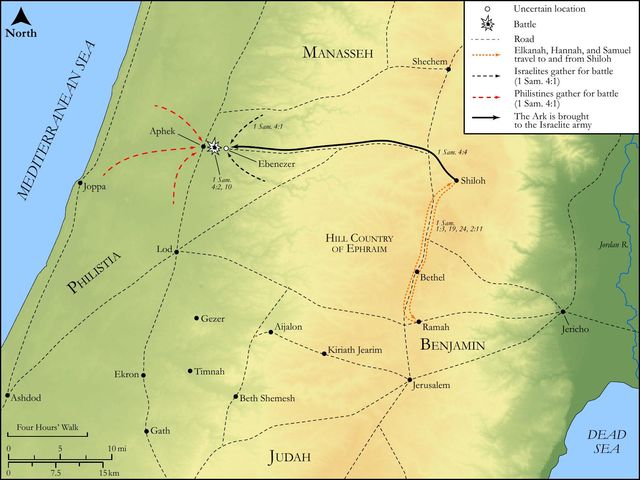
See on the biblical-era map
Study this verse
Public-domain commentary
Matthew Henry
From his Commentary on the Whole Bible. Henry comments on passages, not single verses — this entry covers 1 Samuel 1:9–18. His three-level outline is real structure in the source text, so it is rendered as structure.
Elkanah had gently reproved Hannah for her inordinate grief, and here we find the good effect of the reproof.
I.It brought her to her meat.
She ate and drank, Sa1 1:9. She did not harden herself in sorrow, nor grow sullen when she was reproved for it; but, when she perceived her husband uneasy that she did not come and eat with them, she cheered up her own spirits as well as she could, and came to table. it is as great a piece of self-denial to control our passions as it is to control our appetites.
II.It brought her to her prayers.
It put her upon considering, "Do I well to be angry? Do I well to fret? What good does it do me? Instead of binding the burden thus upon my shoulders, had I not better easy myself of it, and cast it upon the Lord by prayer?" Elkanah had said, Am not I better to thee than ten sons? which perhaps occasioned her to think within herself, "Whether he be so or no, God is, and therefore to him will I apply, and before him will I pour out my complaint, and try what relief that will give me." If ever she will make a more solemn address than ordinary to the throne of grace upon this errand, now is the time. They are at Shiloh, at the door of the tabernacle, where God had promised to meet his people, and which was the house of prayer. They had recently offered their peace-offerings, to obtain the favour of God and all good and in token of their communion with him; and, taking the comfort of their being accepted of him, they had feasted upon the sacrifice; and now it was proper to put up her prayer in virtue of that sacrifice, for the peace-offerings, for by it not only atonement is made for sin, but the audience and acceptance of our prayers and an answer of peace to them are obtained for us: to that sacrifice, in all our supplications, we must have an eye. Now concerning Hannah's prayer we may observe,
1.The warm and lively devotion there was in it, which appeared in several instances, for our direction in prayer.
(1.)She improved the present grief and trouble of her spirit for the exciting and quickening of her pious affections in prayer: Being in bitterness of soul, she prayed, Sa1 1:10. This good use we should make of our afflictions, they should make us the more lively in our addresses to God. Our blessed Saviour himself, being in an agony, prayed more earnestly, Luk 22:44.
(2.)She mingled tears with her prayers. It was not a dry prayer: she wept sore. Like a true Israelite, she wept and made supplication (Hos 12:4), with an eye to the tender mercy of our God, who knows the troubled soul. The prayer came from her heart, as the tears from her eyes.
(3.)She was very particular, and yet very modest, in her petition. She begged a child, a man-child, that it might be fit to serve in the tabernacle. God gives us leave, in prayer, not only to ask good things in general, but to mention that special good thing which we most need and desire. Yet she says not, as Rachel, Give me children, Gen 30:1. She will be very thankful for one.
(4.)She made a solemn vow, or promise, that if God would give her a son she would give him up to God, Sa1 1:11. He would be by birth a Levite, and so devoted to the service of God, but he should be by her vow a Nazarite, and his very childhood should be sacred. It is probable she had acquainted Elkanah with her purpose before, and had had his consent and approbation. Note, Parents have a right to dedicate their children to God, as living sacrifices and spiritual priests; and an obligation is thereby laid upon them to serve God faithfully all the days of their life. Note further, It is very proper, when we are in pursuit of any mercy, to bind our own souls with a bond, that, if God give it us, we will devote it to his honour and cheerfully use it in his service. Not that hereby we can pretend to merit the gift, but thus we are qualified for it and for the comfort of it. In hope of mercy, let us promise duty.
(5.)She spoke all this so softly that none could hear her. Her lips moved, but her voice was not heard, Sa1 1:13. Hereby she testified her belief of God's knowledge of the heart and its desires. Thoughts are words to him, nor is he one of those gods that must be cried aloud to, Kg1 18:27. It was likewise an instance of her humility and holy shamefacedness in her approach to God. She was none of those that made her voice to be heard on high, Isa 58:4. It was a secret prayer, and therefore, though made in a public place, yet was thus made secretly, and not, as the Pharisees prayed, to be seen of men. It is true prayer is not a thing we have reason to be ashamed of, but we must avoid all appearances of ostentation. Let what passes between God and our souls be kept to ourselves.
2.The hard censure she fell under for it. Eli was now high priest, and judge in Israel; he sat upon a seat in the temple, to oversee what was done there, Sa1 1:9. The tabernacle is here called the temple, because it was now fixed, and served all the purposes of a temple. There Eli sat to receive addresses and give direction, and somewhere (it is probable in a private corner) he espied Hannah at her prayers, and by her unusual manner fancied she was drunken, and spoke to her accordingly (Sa1 1:14): How long wilt thou be drunken? - the very imputation that Peter and the apostles fell under when the Holy Ghost gave them utterance, Act 2:13. Perhaps in this degenerate age it was no strange thing to see drunken women at the door of the tabernacle; for otherwise, one would think, the vile lust of Hophni and Phinehas could not have found so easy a prey there, Sa1 2:22. Eli took Hannah for one of these. It is one bad effect of the abounding of iniquity, and its becoming fashionable, that it often gives occasion to suspect the innocent. When a disease is epidemical every one is suspected to be tainted with it. Now,
(1.)This was Eli's fault; and a great fault it was to pass so severe a censure without better observation or information. If his own eyes had already become dim, he should have employed those about him to enquire. Drunkards are commonly noisy and turbulent, but this poor woman was silent and composed. His fault was the worse that he was the priest of the Lord, who should have had compassion on the ignorant, Heb 5:2. Note, It ill becomes us to be rash and hasty in our censures of others, and to be forward to believe people guilty of bad things, while either the matter of fact on which the censure is grounded is doubtful and unproved or is capable of a good construction. Charity commands us to hope the best concerning all, and forbids censoriousness. Paul had very good information when he did but partly believe (Co1 11:18), hoping it was not so. Especially we ought to be cautious how we censure the devotions of others, lest we call that hypocrisy, enthusiasm, or superstition, which is really the fruit of an honest zeal, and it is accepted of God.
(2.)It was Hannah's affliction; and a great affliction it was, added to all the rest, vinegar to the wounds of her spirit. She had been reproved by Elkanah because she would not eat and drink, and now to be reproached by Eli as if she had eaten and drunk too much was very hard. Note, It is no new thing for those that do well to be ill thought of, and we must not think it strange if at any time it be our lot.
3.Hannah's humble vindication of herself from this crime with which she was charged. She bore it admirably well. She did not retort the charge and upbraid him with the debauchery of his own sons, did not bid him look at home and restrain them, did not tell him how ill it became one in his place thus to abuse a poor sorrowful worshipper at the throne of grace. When we are at any time unjustly censured we have need to set a double watch before the door of our lips, that we do not recriminate, and return censure for censure. Hannah thought it enough to vindicate herself, and so must we, Sa1 1:15, Sa1 1:16.
(1.)In justice to herself, she expressly denies the charge, speaks to him with all possible respect, calls him, My lord, intimates how very desirous she was to stand right in his opinion and how loth to lie under his censure. "No, my lord, it is not as you suspect; I have drunk neither wine nor strong drink, not any at all" (though it was proper enough to be given to one of such a heavy heart, Pro 31:6), "much less to any excess; therefore count not thy handmaid for a daughter of Belial." Note, Drunkards are children of Belial (women-drunkards, particularly), children of the wicked one, children of disobedience, children that will not endure the yoke (else they would not be drunk), more especially when they are actually drunk. Those that cannot govern themselves will not bear that any one else should. Hannah owns that the crime would have been very great if she had indeed been guilty of it, and he might justly have shut her out of the courts of God's house; but the very manner of her speaking in her own defence was sufficient to demonstrate that she was not drunk.
(2.)In justice to him, she gives an account of her present behaviour, which had given occasion to his suspicion: "I am a woman of a sorrowful spirit, dejected and discomposed, and that is the reason I do not look as other people; the eyes are red, not with wine, but with weeping. And at this time I have not been talking to myself, as drunkards and fools do, but I have been pouring out my soul before the Lord, who hears and understands the language of the heart, and this out of the abundance of my complaint and grief." She had been more than ordinarily fervent in prayer to God, and this, she tells him, was the true reason of the transport and disorder she seemed to be in. Note, When we are unjustly censured we should endeavour, not only to clear ourselves, but to satisfy our brethren, by giving them a just and true account of that which they misapprehended.
4.The atonement Eli made for his rash unfriendly censure, by a kind and fatherly benediction, Sa1 1:17. He did not (as many are apt to do in such a case) take it for an affront to have his mistake rectified and to be convinced of his error, nor did it put him out of humour. But, on the contrary, he now encouraged Hannah's devotions as much as before he had discountenanced them; not only intimated that he was satisfied of her innocency by those words, Go in peace, but, being high priest, as one having authority he blessed her in the name of the Lord, and, though he knew not what the particular blessing was that she had been praying for, yet he puts his Amen to it, so good an opinion had he now conceived of her prudence and piety: The God of Israel grant thee thy petition, whatever it is, that thou hast asked of him. Note, By our meek and humble carriage towards those that reproach us because they do not know us, we may perhaps make them our friends, and turn their censures of us into prayers for us.
5.The great satisfaction of mind with which Hannah now went away, Sa1 1:18. She begged the continuance of Eli's good opinion of her and his good prayers for her, and then she went her way and did eat of what remained of the peace-offerings (none of which was to be left until the morning), and her countenance was no more sad, no more as it had been, giving marks of inward trouble and discomposure; but she looked pleasant and cheerful, and all was well. Why, what had happened? Whence came this sudden happy change? She had by prayer committed her case to God and left it with him, and now she was no more perplexed about it. She had prayed for herself, and Eli had prayed for her; and she believed that God would either give her the mercy she had prayed for or make up the want of it to her some other way. Note, Prayer is heart's-ease to a gracious soul; the seed of Jacob have often found it so, being confident that God will never say unto them, Seek you me in vain, see Phi 4:6, Phi 4:7. Prayer will smooth the countenance; it should do so.
Historical interpretation
Historical reception
1 surviving comment on this verse from the historical church.
It came to pass, therefore, when she was multiplying prayers, etc. It happened that, as the Church began to multiply across the world, new emblems of its devotion began to multiply, whose praise comes not from men but from God, so that the priests of the Jews should consider its external manifestations, to see whether it lived in a gentile or Jewish manner. But with Judaism gradually left behind, she rejoiced to follow the mysteries of faith rather, which purify the heart, and pleased invisible Christ with the wisdom of faith.
Continue studying 1 Samuel 1:12 across the web’s major study libraries — every link below opens this exact verse, chapter, or book on the destination site.
Read & Compare
 BibleGatewayThis verse in more than 200 translations and 70 languages.
 Bible.comThe YouVersion reader — hundreds of translations, reading plans, and highlights.
 ESV.orgCrossway's official English Standard Version reader.
 NET BibleThe NET translation with 60,000+ translators' notes on every rendering decision.
 STEP BibleTyndale House's free study tool — original text, vocabulary, and scholarly resources.
 BibliaLogos Bible Software's free web reader.
 USCCBThe New American Bible (Revised Edition) with the U.S. bishops' study notes.
Commentaries
 BibleHub CommentariesDozens of classic commentaries on this verse, gathered on one page.
 StudyLightMore than 100 commentary sets — the largest collection on the web.
 BibleRefPlain-English commentary on what this verse means, verse by verse.
 Enduring WordDavid Guzik's free commentary on this chapter, widely used by Bible teachers.
 Bible Study ToolsVerse commentary alongside Greek and Hebrew study aids.
Original Language & Research
- BibleHub InterlinearThe verse word by word — original language, transliteration, and English.
- BibleHub LexiconEvery word's original-language definition and Strong's entry.
 Blue Letter BibleDeep-study tools — Strong's numbers, concordance, and word studies.
 SefariaThe Hebrew text with Rashi and centuries of Jewish commentary.
Sermons, Hymns & Audio


TrulyRandomVerse is not affiliated with these sites and doesn’t control their content. They’re linked because they’re genuinely useful.
Summary
1 Samuel 1:12 presents a poignant scene at the Tabernacle in Shiloh, capturing Hannah's profound spiritual anguish and unwavering devotion. As she poured out her soul in fervent, silent prayer before the Lord, her intense supplication was observed by Eli, the high priest. This moment sets the stage for a critical interaction marked by initial misunderstanding, ultimately paving the way for divine intervention and the miraculous birth of Samuel, a pivotal figure in Israel's history.
Context
ShowHideLiterary Context
This verse is strategically placed within the opening narrative of 1 Samuel, immediately following the introduction of Elkanah's polygamous household and the annual pilgrimage to Shiloh. The preceding verses meticulously detail Hannah's deep sorrow and barrenness, exacerbated by Peninnah's constant provocation, which culminated in Hannah's inconsolable weeping and refusal to eat. Verse 12 serves as the dramatic pivot, directly leading into Eli's misinterpretation of Hannah's silent prayer as drunkenness, as detailed in 1 Samuel 1:13. This misjudgment, followed by Hannah's eloquent defense of her spiritual state, is crucial for the narrative's progression, highlighting the contrast between human perception and divine understanding, and setting the stage for Samuel's miraculous conception and dedication to the Lord. The entire chapter builds towards the fulfillment of Hannah's vow and the birth of the prophet who would anoint Israel's first kings.
Historical & Cultural Context
The events of 1 Samuel 1 unfold during the tumultuous period of the Judges, a time characterized by spiritual and moral decay, famously summarized by the refrain, "everyone did what was right in his own eyes" (Judges 21:25). Shiloh, situated in the tribal territory of Ephraim, served as the central sanctuary for Israel, housing the Tabernacle and the Ark of the Covenant, before the establishment of the monarchy and the construction of the Temple in Jerusalem. Childbearing, particularly for women, held immense social and religious significance in ancient Israelite society, viewed as a direct blessing from God and essential for continuing the family line and securing a legacy. Conversely, barrenness was often perceived as a profound personal tragedy, a social stigma, and even a sign of divine displeasure, leading to immense personal anguish, as vividly portrayed in Hannah's plight. The annual pilgrimage to Shiloh was a religious obligation, underscoring the importance of communal worship and individual vows made before the Lord at the designated sacred site.
Key Themes
ShowHide1 Samuel 1:12 profoundly contributes to several overarching themes that resonate throughout the book and beyond. It exemplifies the theme of Fervent, Persistent Prayer, showcasing Hannah's deep, unceasing supplication as a paradigm for approaching God in profound distress. Her prayer is not a mere ritual but a pouring out of her soul, echoing the earnest pleas found in the Psalms, such as Psalm 62:8. Another vital theme is Divine Observation vs. Human Misjudgment. While Hannah pours out her heart to the Lord, who sees and understands her deepest longings, Eli, the human observer, misinterprets her actions based on outward appearances. This stark contrast foreshadows the broader spiritual blindness within Eli's household and the nation, which is further explored in 1 Samuel 2. This verse also subtly introduces the theme of God's Sovereignty and Intervention, as Hannah's prayer is directed to Yᵉhôvâh (the LORD), who ultimately answers her according to His perfect timing and purpose, demonstrating His active involvement in the lives of His people, a truth often emphasized throughout the Old Testament, for example, in Isaiah 65:24.
Exposition and Analysis
ShowHideKey Word Analysis
ShowHideMeaning "to judge (officially or mentally); by extension, to intercede, pray; intreat, judge(-ment), (make) pray(-er, -ing), make supplication." The form used here (Hithpael) emphasizes the reflexive and intensive nature of the action, suggesting Hannah was deeply engaged in a personal, persistent act of supplication, almost pleading her case before God. It highlights the earnestness and internal struggle inherent in her prayer, a profound wrestling of the soul.
Meaning "to increase (in whatever respect); (bring in) abundance... [idiom] continue... (be, give, have, make, use) many (a time)... (make to) multiply..." While "continued" is a translation of the verb form, the root râbâh emphasizes the abundance or multiplication of her prayer. It underscores the prolonged, persistent, and unceasing nature of Hannah's supplication, indicating that she was not merely praying for a moment but was engaged in an extended period of intense communion with God.
Meaning "properly, to hedge about (as with thorns), i.e. guard; generally, to protect, attend to, etc.; beward, be circumspect, take heed (to self), keep(-er, self), mark, look narrowly, observe, preserve, regard, reserve, save (self), sure, (that lay) wait (for), watch(-man)." Eli's action of "marking" her mouth implies a careful, focused observation, a "taking heed" or "looking narrowly." This highlights his attempt to discern her state based on external cues, which ultimately leads to his misjudgment because he is observing the physical manifestation without understanding the spiritual depth.
Meaning "the mouth (as the means of blowing), whether literal or figurative (particularly speech); specifically edge, portion or side..." This refers to the physical opening of the mouth. The specific mention that Eli "marked her mouth" draws attention to the visible movement of her lips without any audible sound. This detail is crucial for understanding the silent nature of Hannah's fervent prayer, emphasizing that her communication with God transcended spoken words, a physical manifestation of an intense internal spiritual struggle.
Verse Breakdown
ShowHide"And it came to pass, as she continued praying before the LORD"
This opening clause establishes the setting and the primary action. Hannah's "continued praying" signifies a prolonged, earnest, and deeply personal engagement with God, reflecting the depth of her distress and her unwavering trust in divine intervention. The phrase "before the LORD" (Hebrew: pânîym H6440, Yᵉhôvâh H3068) emphasizes that her prayer was directed to the covenant God of Israel, in His sacred dwelling place at Shiloh, underscoring the solemnity and spiritual significance of her petition.
"that Eli marked her mouth"
This second clause shifts the narrative focus to Eli, the high priest (Hebrew: ʻÊlîy H5941), and his external observation of Hannah. Eli's "marking" (Hebrew: shâmar H8104) of her mouth indicates that he was carefully watching her, noticing the unusual sight of her lips moving without any audible sound. This observation, while accurate in its physical description, forms the basis for his immediate, yet erroneous, conclusion about her state, setting up the dramatic tension and the subsequent dialogue.
Literary Devices
ShowHideThe verse employs several significant literary devices. Contrast is powerfully evident between Hannah's internal, fervent, and silent prayer directed to God, who sees the heart, and Eli's external, superficial observation of her physical actions, leading to his misjudgment. This dramatic irony highlights the spiritual discernment gap: the high priest, meant to mediate spiritual matters, fails to correctly perceive a truly devout worshiper. There is also an element of Foreshadowing in Eli's misjudgment; this initial failure to correctly discern Hannah's spiritual state hints at his broader spiritual blindness and the impending judgment on his house for failing to discern God's will and restrain his wicked sons, as seen later in the book. The scene also uses Symbolism, with Hannah's silent, moving lips symbolizing a prayer so deep and personal that it transcends audible words, representing the inexpressible groans of the spirit that God alone fully comprehends.
Theological and Thematic Connections
ShowHide1 Samuel 1:12 profoundly illustrates the nature of true prayer and the challenges of spiritual discernment. Hannah's "continued praying" before the Lord exemplifies a deep, persistent, and heartfelt supplication that transcends mere words, reaching the very heart of God. It underscores the biblical truth that God sees beyond outward appearances into the depths of the human soul, understanding our unspoken burdens and desires. In contrast, Eli's "marking" of her mouth highlights the human tendency to misjudge based on superficial observation, a spiritual blindness that can lead to erroneous conclusions about others' devotion or struggles. This verse serves as a powerful reminder that genuine piety is often internal and unseen by human eyes, yet fully known and valued by God, who "weighs the spirit" (Proverbs 16:2).
Reflection and Application
ShowHideHannah's intense, silent prayer in 1 Samuel 1:12 offers profound lessons for contemporary believers, challenging us to move beyond superficial or ritualistic prayer to a place of genuine, heart-felt communion with God, even when our burdens are too deep for words. Her example reminds us that persistence in prayer, even in the face of prolonged suffering or unanswered petitions, is a testament to unwavering faith and trust in God's perfect timing and wisdom. We are called to pour out our souls before the Lord, confident that He hears and understands our deepest cries, even those unspoken. Furthermore, Eli's misjudgment serves as a crucial caution against quick, external assessments of others. We are called to cultivate a spirit of empathy, understanding, and humility, recognizing that we often do not know the full story of another's struggles or the depth of their spiritual journey. Instead of judging, we should seek to understand, offer compassion, and, if appropriate, extend grace and support, just as Eli eventually did after Hannah explained herself. This verse encourages a profound shift in perspective: from focusing on outward appearances to seeking inner truth, both in our own walk with God and in our interactions with others, fostering a community built on grace and discernment rather than hasty judgment.
Questions for Reflection
ShowHideFAQ
ShowHideWhy was Hannah praying silently, and what does this tell us about prayer?
ShowHideHannah was praying silently, moving her lips but making no sound, as clarified in the subsequent verse (1 Samuel 1:13). This was likely due to the overwhelming intensity of her emotional and spiritual distress; her anguish was too profound for audible words. Her silent prayer reveals that true communication with God is not dependent on eloquent speech or audible articulation, but on the sincere posture of the heart. It signifies a deep, personal, and often inexpressible communion with the divine, where the spirit groans beyond what words can convey. It teaches us that God hears the cries of our hearts, even when they are unspoken, emphasizing the intimacy and depth possible in our relationship with Him, and affirming that He understands our burdens even before we voice them.
Christ-Centered Fulfillment
ShowHideHannah's fervent, silent prayer in 1 Samuel 1:12 finds its ultimate fulfillment in the person and work of Jesus Christ. Her deep, inexpressible anguish and persistent supplication before the Lord foreshadow the perfect intercession of Christ, who, as our great High Priest, fully understands our weaknesses and intercedes for us with groanings too deep for words through the Holy Spirit (Romans 8:26 and Hebrews 4:15). While Eli misjudged Hannah based on outward appearance, Jesus, the true Son of God, perfectly discerns the heart and knows the true state of every soul, for He "knew what was in man" (John 2:25). He is the one who truly sees our hidden struggles and hears our unspoken prayers, not in a physical temple like Shiloh, but in the heavenly sanctuary, where He ever lives to make intercession for us (Hebrews 7:25). Hannah's desperate plea for a son, who would become a prophet and judge, points to Christ as the ultimate answer to humanity's deepest need—the one who brings true spiritual birth and delivers us from the barrenness of sin, establishing a new covenant of grace where all believers can approach God's throne with confidence, knowing they have a compassionate and understanding High Priest (Hebrews 4:16).