


1 Samuel 1:6
Bible text: King James Version (1769 Blayney text) · Public domain
Bible text: Berean Standard Bible · Public domain
Bible text: American Standard Version (1901) · Public domain
Bible text: World English Bible, Messianic edition · Public domain
Bible text: Geneva Bible (1599) · Public domain
Bible text: Young's Literal Translation · Public domain
- וְכִעֲסַתָּהve·khi·'a·Sa·tahand she provoked herH3707Conj-w ¦ V-Piel-ConsecPerf-3fs ¦ 3fsVerb Piel Consecutive Perfect 3rd Singular Feminineוְandכִעֲסַתָּshe provokedהher
- צָרָתָהּtza·ra·Tahher rivalH6869N-fsc ¦ 3fsNoun Singular Feminine Constructצָרָתָrivalהּher
- גַּםgamalsoH1571AdvAdverb
- כַּעַסKa·'asprovocationH3708N-msNoun Singular Masculine Absolute
- בַּעֲבוּרba·'a·Vurin orderH5668Prep-b ¦ N-mscNoun Singular Masculine Constructבַּinעֲבוּרorder
- הַרְּעִמָהּha·re·'i·Mahto disconcert herH7481V-Hiphil-Inf ¦ 3fsVerb Hiphil Infinitive Constructהַרְּעִמָto disconcertהּher
- כִּיkiforH3588PrtParticle Conditional
- סָגַרsa·Garhe had closedH5462V-Qal-Perf-3msVerb Qal Perfect 3rd Singular Masculine
- יְהוָהYah·wehYahwehH3068N-properNoun Proper Title
- בְּעַדbe·'AdbehindH1157Adj-cscAdjective Numerical Singular common gender Construct
- רַחְמָהּrach·Mahher wombH7358N-msc ¦ 3fsNoun Singular Masculine Constructרַחְמָwombהּher
English is a literal word-by-word gloss of the Hebrew, not the KJV's wording. Why?
This is the original text the KJV's translators worked from — each Hebrew word with its own literal English meaning in this verse, prepared by scholars at Tyndale House, Cambridge. The KJV translates whole sentences, not word by word, so its wording differs: one Hebrew word can become several English words, and the KJV may choose “the LORD” where the gloss reads “Yahweh”. Both are faithful — they answer different questions. For the KJV's own rendering, switch to the KJV text.
Details
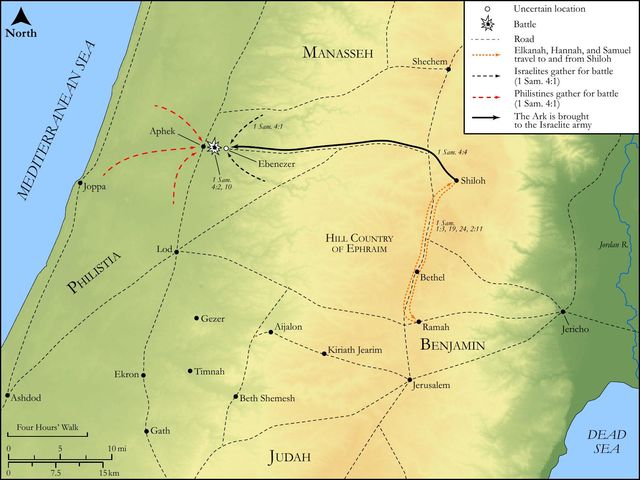
See on the biblical-era map
Study this verse
Public-domain commentary
Matthew Henry
From his Commentary on the Whole Bible. Henry comments on passages, not single verses — this entry covers 1 Samuel 1:1–8. His four-level outline is real structure in the source text, so it is rendered as structure.
We have here an account of the state of the family into which Samuel the prophet was born. His father's name was Elkanah, a Levite, and of the family of the Kohathites (the most honourable house of that tribe) as appears, Ch1 6:33, Ch1 6:34. His ancestor Zuph was an Ephrathite, that is, of Bethlehem-Judah, which was called Ephrathah, Ruth, Rut 1:2. There this family of the Levites was first seated, but one branch of it, in process of time, removed to Mount Ephraim, from which Elkanah descended. Micah's Levite came from Bethlehem to Mount Ephraim, Jdg 17:8. Perhaps notice is taken of their being originally Ephrathites to show their alliance to David. This Elkanah lived at Ramah, or Ramathaim, which signifies the double Ramah, the higher and lower town, the same with Arimathea of which Joseph was, here called Ramathaim-zophim. Zophim signifies watchmen; probably they had one of the schools of the prophets there, for prophets are called watchmen: the Chaldee paraphrase calls Elkanah a disciple of the prophets. But it seems to me that it was in Samuel that prophecy revived, before his time there being, for a great while, no open vision, Sa1 3:1. Nor is there any mention of a prophet of the Lord from Moses to Samuel, except Jdg 6:8. So that we have no reason to think that there was any nursery or college of prophets here till Samuel himself founded one, Jdg 19:19, Jdg 19:20. This is the account of Samuel's parentage, and the place of his nativity. Let us now take notice of the state of the family.
I.It was a devout family.
All the families of Israel should be so, but Levites' families in a particular manner. Ministers should be patterns of family religion. Elkanah went up at the solemn feasts to the tabernacle at Shiloh, to worship and to sacrifice to the Lord of hosts. I think this is the first time in scripture that God is called the Lord of hosts - Jehovah Sabaoth, a name by which he was afterwards very much called and known. Probably Samuel the prophet was the first that used this title of God, for the comfort of Israel, when in his time their hosts were few and feeble and those of their enemies many and mighty; then it would be a support to them to think that the God they served was Lord of hosts, of all the hosts both of heaven and earth; of them he has a sovereign command, and makes what use he pleases of them. Elkanah was a country Levite, and, for aught that appears, had not any place or office which required his attendance at the tabernacle, but he went up as a common Israelite, with his own sacrifices, to encourage his neighbours and set them a good example. When he sacrificed he worshipped, joining prayers and thanksgivings with his sacrifices. In this course of religion he was constant, for he went up yearly. And that which made it the more commendable in him was,
1.That there was a general decay and neglect of religion in the nations. Some among them worshipped other gods, and the generality were remiss in the service of the God of Israel, and yet Elkanah kept his integrity; whatever others did, his resolution was that he and his house should serve the Lord.
2.That Hophni and Phinehas, the sons of Eli, were the men that were now chiefly employed in the service of the house of God; and they were men that conducted themselves very ill in their place, as we shall find afterwards; yet Elkanah went up to sacrifice. God had then tied his people to one place and one altar, and forbidden them, under any pretence whatsoever, to worship elsewhere, and therefore, in pure obedience to that command, he attended at Shiloh. If the priests did not do their duty, he would do his. Thanks be to God, we, under the gospel, are not tied to any one place or family; but the pastors and teachers whom the exalted Redeemer has given to his church are those only whose ministration tends to the perfecting of the saints and the edifying of the body of Christ, Eph 4:11, Eph 4:12. None have dominion over our faith; but our obligation is to those that are the helpers of our holiness and joy, not to any that by their scandalous immoralities, like Hophni and Phinehas, make the sacrifices of the Lord to be abhorred, though still the validity and efficacy of the sacraments depend not on the purity of him that administers them.
II.Yet it was a divided family, and the divisions of it carried with them both guilt and grief.
Where there is piety, it is a pity but there should be unity. The joint-devotions of a family should put an end to divisions in it.
1.The original cause of this division was Elkanah's marrying two wives, which was a transgression of the original institution of marriage, to which our Saviour reduces it. Mat 19:5, Mat 19:8, From the beginning it was not so. It made mischief in Abraham's family, and Jacob's, and here in Elkanah's. How much better does the law of God provide for our comfort and ease in this world than we should, if we were left to ourselves! It is probable that Elkanah married Hannah first, and, because he had not children by her so soon as he hoped, he married Peninnah, who bore him children indeed, but was in other things a vexation to him. Thus are men often beaten with rods of their own making.
2.That which followed upon this error was that the two wives could not agree. They had different blessings: Peninnah, like Leah, was fruitful and had many children, which should have made her easy and thankful, though she was but a second wife, and was less beloved; Hannah, like Rachel, was childless indeed, but she was very dear to her husband, and he took all occasions to let both her and others know that she was so, and many a worthy portion he gave her (Sa1 1:5), and this should have made her easy and thankful. But they were of different tempers: Peninnah could not bear the blessing of fruitfulness, but she grew haughty and insolent; Hannah could not bear the affliction of barrenness, but she grew melancholy and discontented: and Elkanah had a difficult part to act between them.
(1.)Elkanah kept up his attendance at God's altar notwithstanding this unhappy difference in his family, and took his wives and children with him, that, if they could not agree in other things, they might agree to worship God together. If the devotions of a family prevail not to put an end to its divisions, yet let not the divisions put a stop to the devotions.
(2.)He did all he could to encourage Hannah, and to keep up her spirits under her affliction, Sa1 1:4, Sa1 1:5. At the feast he offered peace-offerings, to supplicate for peace in his family; and when he and his family were to eat their share of the sacrifice, in token of their communion with God and his altar, though he carved to Peninnah and her children competent portions, yet to Hannah he gave a worthy portion, the choicest piece that came to the table, the piece (whatever it was) that used to be given on such occasions to those that were most valued; this he did in token of his love to her, and to give all possible assurances of it. Observe,
[1.]Elkanah loved his wife never the less for her being barren. Christ loves his church, notwithstanding her infirmities, her barrenness; and so ought men to love their wives, Eph 5:25. To abate our just love to any relation for the sake of any infirmity which they cannot help, and which is not their sin but their affliction, is to make God's providence quarrel with his precept, and very unkindly to add affliction to the afflicted.
[2.]He studied to show his love so much the more because she was afflicted, insulted, and low-spirited. It is wisdom and duty to support the weakest, and to hold up those that are run down.
[3.]He showed his great love to her by the share he gave her of his peace-offerings. Thus we should testify our affection to our friends and relations, by abounding in prayer for them. The better we love them the more room let us give them in our prayers.
(3.)Peninnah was extremely peevish and provoking.
[1.]She upbraided Hannah with her affliction, despised her because she was barren, and gave her taunting language, as one whom Heaven did not favour.
[2.]She envied the interest she had in the love of Elkanah, and the more kind he was to her the more was she exasperated against her, which was all over base and barbarous.
[3.]She did this most when they went up to the house of the Lord, perhaps because then they were more together than at other times, or because then Elkanah showed his affection most to Hannah. But it was very sinful at such a time to show her malice, when pure hands were to be lifted up at God's altar without wrath and quarrelling. It was likewise very unkind at that time to vex Hannah, not only because then they were in company, and others would take notice of it, but then Hannah was to mind her devotions, and desired to be most calm and composed, and free from disturbance. The great adversary to our purity and peace is then most industrious to ruffle us when we should be most composed. When the sons of God come to present themselves before the Lord Satan will be sure to come among them, Job 1:6.
[4.]She continued to do this from year to year, not once or twice, but it was her constant practice; neither deference to her husband nor compassion to Hannah could break her of it.
[5.]That which she designed was to make her fret, perhaps in hopes to break her heart, that she might possess her husband's heart solely, or because she took a pleasure in her uneasiness, nor could Hannah gratify her more than by fretting. Note, It is an evidence of a base disposition to delight in grieving those that are melancholy and of a sorrowful spirit, and in putting those out of humour that are apt to fret and be uneasy. We ought to bear one another's burdens, not add to them.
(4.)Hannah (poor woman) could not hear the provocation: She wept, and did not eat, Sa1 1:7. It made her uneasy to herself and to all her relations. She did not eat of the feast; her trouble took away her appetite, made her unfit for any company, and a jar in the harmony of family-joy. It was of the feast upon the sacrifice that she did not eat, for they were not to eat of the holy things in their mourning, Deu 26:14; Lev 10:19. Yet it was her infirmity so far to give way to the sorrow of the world as to unfit herself for holy joy in God. Those that are of a fretful spirit, and are apt to lay provocations too much to heart, are enemies to themselves, and strip themselves very much of the comforts both of life and godliness. We find that God took notice of this ill effect of discontents and disagreements in the conjugal relation, that the parties aggrieved covered the altar of the Lord with tears, insomuch that he regarded not the offering, Mal 2:13.
(5.)Elkanah said what he could to her to comfort her. She did not upbraid him with his unkindness in marrying another wife as Sarah did, nor did she render to Peninnah railing for railing, but took the trouble wholly to herself, which made her an object of much compassion. Elkanah showed himself extremely grieved at her grief (Sa1 1:8): Hannah, why weepest thou?
[1.]He is much disquieted to see her thus overwhelmed with sorrow. Those that by marriage are made one flesh ought thus far to be of one spirit too, to share in each other's troubles, so that one cannot be easy while the other is uneasy.
[2.]He gives her a loving reproof for it: Why weepest thou? And why is thy heart grieved? As many as God loves he rebukes, and so should we. He puts her upon enquiring into the cause of her grief. Though she had just reason to be troubled, yet let her consider whether she had reason to be troubled to such a degree, especially so much as to be taken off by it from eating of the holy things. Note, Our sorrow upon any account is sinful and inordinate when it diverts us from our duty to God and embitters our comfort in him, when it makes us unthankful for the mercies we enjoy and distrustful of the goodness of God to us in further mercies, when it casts a damp upon our joy in Christ, and hinders us from doing the duty and taking the comfort of our particular relations.
[3.]He intimates that nothing should be wanting on his part to balance her grief: "Am not I better to thee than ten sons? Thou knowest thou hast my entire affection, and let that comfort thee." Note, We ought to take notice of our comforts, to keep us from grieving excessively for our crosses; for our crosses we deserve, but our comforts we have forfeited. If we would keep the balance even, we must look at that which is for us, as well as at that which is against us, else we are unjust to Providence and unkind to ourselves. God hath set the one over-against the other (Ecc 7:14) and so should we.
Historical interpretation
Two Centuries of Reception
2 surviving comments on this verse. Each one is dated, so this reads as a timeline rather than a list.
Select a marker to jump to its quote. Markers stagger vertically where authors wrote within a few decades of each other.
The word rival [aemulare] has a threefold meaning. First, it means to emulate [imitari], as in “Seek after the greater gifts.” We also read, “It is good that you always be emulated for the good.” Second, it is to envy [invidere], even one’s enemy, as was said through Samuel to Saul: “God has taken the kingdom from you and has given it to your rival [aemulo].” Peninnah, moreover, who played the role of the synagogue, was envied by Hannah because Hannah had not begotten a child in her barrenness. “Hannah’s rival [aemula] afflicted and agitated her severely.” The term rival here indicates enmity or envy. But “agitated” signifies “oppressed” [obprimebat], a metaphorical expression drawn from the act of choking on a piece of meat that one has suddenly regurgitated. Third, aemulare means “to anger,” as was demonstrated when the apostle said, “Shall we be angered [aemulamur] by the Lord? Are we stronger than he?” In other words, it means to provoke a temper.
Her rival also afflicted her, etc. The Synagogue afflicted the Gentiles, reproaching them for being neglected by God due to their immense crimes, and for neither being able to merit the discourse of God nor the oracles of the prophets, by which the offspring of souls acceptable to God might be brought forth; and therefore, the womb of their mind was deprived of the spiritual seed of heavenly virtues or of believing peoples.
Continue studying 1 Samuel 1:6 across the web’s major study libraries — every link below opens this exact verse, chapter, or book on the destination site.
Read & Compare
 BibleGatewayThis verse in more than 200 translations and 70 languages.
 Bible.comThe YouVersion reader — hundreds of translations, reading plans, and highlights.
 ESV.orgCrossway's official English Standard Version reader.
 NET BibleThe NET translation with 60,000+ translators' notes on every rendering decision.
 STEP BibleTyndale House's free study tool — original text, vocabulary, and scholarly resources.
 BibliaLogos Bible Software's free web reader.
 USCCBThe New American Bible (Revised Edition) with the U.S. bishops' study notes.
Commentaries
 BibleHub CommentariesDozens of classic commentaries on this verse, gathered on one page.
 StudyLightMore than 100 commentary sets — the largest collection on the web.
 BibleRefPlain-English commentary on what this verse means, verse by verse.
 Enduring WordDavid Guzik's free commentary on this chapter, widely used by Bible teachers.
 Bible Study ToolsVerse commentary alongside Greek and Hebrew study aids.
Original Language & Research
- BibleHub InterlinearThe verse word by word — original language, transliteration, and English.
- BibleHub LexiconEvery word's original-language definition and Strong's entry.
 Blue Letter BibleDeep-study tools — Strong's numbers, concordance, and word studies.
 SefariaThe Hebrew text with Rashi and centuries of Jewish commentary.
Sermons, Hymns & Audio


TrulyRandomVerse is not affiliated with these sites and doesn’t control their content. They’re linked because they’re genuinely useful.
Summary
First Samuel 1:6 profoundly illustrates the deep anguish of Hannah, one of Elkanah's two wives, who suffered from barrenness while her co-wife, Peninnah, bore children. This verse starkly portrays Peninnah's cruel and persistent provocation, designed to inflict emotional pain and anxiety upon Hannah. Crucially, it unveils the theological truth that Hannah's inability to conceive was not a random occurrence but a sovereign act of the LORD, setting the divine stage for a miraculous intervention and the birth of Samuel, a pivotal figure who would reshape Israel's history.
Context
ShowHideLiterary Context
This verse is strategically placed at the outset of the book of 1 Samuel, immediately following the introduction of Elkanah, a devout man, and his two wives, Hannah and Peninnah. The preceding verses establish Elkanah's annual pilgrimage to Shiloh to worship the LORD of Hosts and offer sacrifices, highlighting his piety and the family's adherence to religious custom. It also immediately reveals Elkanah's profound affection for Hannah, demonstrated by his giving her a double portion of the sacrifice, despite her barrenness. Verse 6 then introduces the central conflict and the wellspring of Hannah's profound anguish: Peninnah's relentless torment, explicitly linking Hannah's barrenness to a direct, sovereign act of God. This foundational conflict sets the entire narrative trajectory for Hannah's desperate and fervent prayer, God's eventual and miraculous answer, and the subsequent dedication of Samuel to the LORD, thereby establishing the prophetic and priestly lineage that would profoundly shape Israel's future leadership and spiritual direction.
Historical & Cultural Context
In ancient Israelite society, childbearing, particularly the birth of sons, was considered an immense and tangible blessing from God, a clear sign of divine favor, and absolutely essential for the continuation of the family lineage and tribal identity. Conversely, barrenness was often perceived as a profound curse, a source of deep personal shame, significant social stigma, and even a sign of divine displeasure. The practice of polygamy, though not explicitly commanded, was permitted within the cultural norms of the time and frequently led to intense domestic strife and rivalry, especially when one wife was fertile and the other was not. This dynamic is vividly illustrated in the biblical narratives of Rachel and Leah, as seen throughout Genesis 29-30. Peninnah's actions in 1 Samuel 1:6 reflect the harsh realities of such household dynamics, where a fertile wife might leverage her advantage to assert dominance, inflict emotional pain, or mock a barren co-wife. The annual pilgrimage to Shiloh, which served as the central place of worship and the location of the tabernacle before the construction of the Temple in Jerusalem, provided the public and sacred setting for this deeply personal family drama to unfold before the LORD.
Key Themes
ShowHideFirst Samuel 1:6 significantly contributes to several overarching themes that resonate throughout 1 Samuel and the broader Old Testament narrative. First, it powerfully underscores the pain of barrenness and the immense societal pressure associated with it, a poignant theme echoed in the stories of other matriarchs such as Sarah (Genesis 16:1) and Rachel (Genesis 29:31). Second, it highlights the destructive nature of human jealousy and malice, as Peninnah actively and intentionally seeks to "provoke" and "fret" Hannah, revealing the depths of human cruelty. Third, and most profoundly, it introduces the foundational theme of God's absolute sovereignty over life and death, blessing and barrenness. The explicit and unambiguous statement "because the LORD had shut up her womb" establishes that God is not merely a passive observer of human suffering but an active, deliberate agent, even in seemingly negative or painful circumstances. This divine intervention, which initially appears as a deprivation, sets the stage for a miraculous birth that will serve God's greater redemptive purposes, ultimately leading to the anointing of kings and the establishment of a new era for Israel, as vividly portrayed in the unfolding narrative of 1 Samuel.
Exposition and Analysis
ShowHideKey Word Analysis
ShowHideThis feminine noun, derived from a root meaning "tightness" or "distress," literally refers to "trouble" or "anguish." When applied to a person, as it is here, it denotes a "rival," specifically a female rival, or "one who causes distress." In this context, it unequivocally identifies Peninnah as Hannah's rival wife, who actively sought to cause her anguish and suffering. The term emphasizes not merely a competitive relationship but an intentional, malicious effort to inflict deep emotional pain and create a state of distress for Hannah.
This primitive verb signifies "to trouble," "to vex," "to irritate," "to anger," or "to grieve." It implies a deliberate, persistent, and often repeated action aimed at causing intense emotional turmoil and distress. Peninnah's provocation was not accidental or occasional but a calculated and continuous effort to make Hannah miserable, highlighting the depth of her cruelty and the sustained nature of her torment. The verb captures the active and aggressive nature of Peninnah's ill will.
This primitive root means "to tumble," "to be violently agitated," or "to crash" (as of thunder). Figuratively, it means "to irritate" or "to be in a rage." In this context, it describes the intense internal emotional state Hannah experienced as a direct result of Peninnah's taunts. It conveys a sense of deep anxiety, distress, inner turmoil, and perhaps even a trembling agitation, indicating a constant state of emotional unrest and disquietude.
Verse Breakdown
ShowHide"And her adversary also provoked her sore"
This opening clause immediately introduces Peninnah as Hannah's "adversary" or "rival," a term that instantly casts her in a negative and antagonistic light. The Hebrew term implies a source of profound distress and tightness. Peninnah's actions were not merely annoying or incidental but deeply painful and persistent, designed to inflict severe emotional suffering upon Hannah, likely through constant, cruel reminders of her barrenness and invidious comparisons with Peninnah's own children. The phrase "provoked her sore" underscores the intensity and effectiveness of this torment.
"for to make her fret"
This phrase explicitly reveals the malicious and calculated intent behind Peninnah's actions. Her deliberate goal was to cause Hannah deep emotional agitation, anxiety, and profound distress. The provocation was precisely calculated to keep Hannah in a perpetual state of inner turmoil, preventing her from finding any measure of peace or joy, even during sacred times like the annual pilgrimage to Shiloh, where one might expect solace.
"because the LORD had shut up her womb"
This crucial theological statement provides the ultimate and sovereign explanation for Hannah's barrenness and, by extension, the underlying context for Peninnah's cruelty. It unequivocally attributes Hannah's inability to conceive directly to the sovereign will of God. This is not presented as a random biological failing or a matter of chance, but as a deliberate divine act. This profound declaration sets the stage for God's later miraculous intervention and underscores His ultimate control over life, fertility, and the unfolding of His grand redemptive plan, demonstrating that even in seemingly negative circumstances, God is actively at work.
Literary Devices
ShowHideThe verse employs several significant literary devices that enrich its meaning and impact. Irony is powerfully present in the fact that while Elkanah, Hannah's loving husband, shows her special favor and gives her a double portion, it is God Himself who has "shut up her womb," creating the very condition that leads to her suffering and Peninnah's cruel advantage. This divine action, seemingly punitive, will ultimately lead to a greater, miraculous blessing. Conflict is central to the verse, immediately established through the designation of Peninnah as Hannah's "adversary" and her deliberate "provocation" of Hannah. This intense internal family strife serves as a microcosm, mirroring the broader spiritual conflicts and trials often present in the lives of God's people. The phrase "shut up her womb" functions as a poignant euphemism for barrenness, softening the directness of the condition, but it also operates as a powerful metonymy where God's specific action (shutting the womb) stands for the state of barrenness itself, profoundly emphasizing divine agency and control over human life. The entire verse functions as compelling foreshadowing, subtly hinting at the deeper divine purpose behind Hannah's suffering, which will ultimately lead to the miraculous birth of Samuel and his pivotal, transformative role in Israel's history.
Theological and Thematic Connections
ShowHideThe theological implications of 1 Samuel 1:6 are profoundly significant, particularly in its explicit assertion that Hannah's barrenness was a direct, sovereign act of the LORD. This concept powerfully highlights God's absolute sovereignty, extending even to the most intimate and often painful aspects of human life, such as fertility. It challenges a simplistic, often superficial view of suffering, suggesting that what appears to be a curse, a deprivation, or an inexplicable hardship can, in God's hands, be a deliberate and purposeful part of a larger, redemptive plan. This divine control over fertility is a recurring and potent motif throughout the Old Testament, frequently preceding the miraculous birth of a significant figure who will play a crucial role in salvation history. Hannah's suffering, therefore, is not meaningless or random but is intricately integrated into God's unfolding purpose for Israel, demonstrating that His ways are often mysterious and beyond immediate human comprehension, yet always purposeful and ultimately for His glory and the good of His people.
Reflection and Application
ShowHideThe poignant narrative of Hannah's suffering in 1 Samuel 1:6 resonates deeply with the universal human experience of adversity, emotional pain, and the often-mysterious nature of God's providence. We frequently encounter "adversaries" in our lives, whether they are individuals who intentionally cause us pain through their words or actions, or circumstances that feel like relentless, unceasing provocation. Hannah's story serves as a profound reminder that even when our pain is exacerbated by the malice of others, and even when God seems to have "shut up" a door or closed a path in our lives, His hand is ultimately sovereign and purposeful. This verse calls us to move beyond superficial or purely human explanations for suffering and to trust in God's deeper, often hidden, purposes, even when they are initially obscure, painful, and difficult to comprehend. It challenges us to consider how our trials, rather than being mere obstacles to be overcome, might in fact be divinely appointed catalysts for a greater work in our lives, shaping our character, deepening our faith, and preparing us for a unique calling. Our response to such "provocation" and "fretting" should, like Hannah's, ultimately lead us to a deeper, more profound reliance on God and fervent, persistent prayer, rather than succumbing to despair, bitterness, or retaliation.
Questions for Reflection
ShowHideFAQ
ShowHideWhy would the LORD "shut up" Hannah's womb and allow her to experience such distress?
ShowHideThe biblical narrative consistently portrays God as absolutely sovereign over all aspects of life, including human fertility and the timing of births. When the text explicitly states "the LORD had shut up her womb," it emphasizes that Hannah's barrenness was not a random biological event or an unfortunate accident but part of God's deliberate and purposeful plan. This divine action served several crucial purposes within the broader redemptive narrative: First, it drove Hannah to a place of desperate, fervent, and persistent prayer, revealing the profound depth of her desire for a child and her absolute dependence on God's miraculous intervention (1 Samuel 1:10-11). Second, it ensured that the child born, Samuel, would be unequivocally seen as a miraculous gift from God, a direct and undeniable answer to prayer, rather than a natural occurrence. This miraculous birth underscored Samuel's unique calling and prepared him for his pivotal role as prophet, judge, and king-maker in Israel's history. God often uses periods of waiting, suffering, and apparent deprivation to prepare individuals for a special purpose, to demonstrate His power and faithfulness in ways that would not be possible otherwise, and to highlight His glory, as seen in the lives of other barren matriarchs like Sarah and Rachel, whose children also played vital roles in salvation history.
Christ-Centered Fulfillment
ShowHideThe narrative of Hannah's barrenness and God's sovereign hand in 1 Samuel 1:6 finds profound Christ-centered fulfillment in the broader biblical story of God bringing life out of barrenness and hope out of despair. Just as God "shut up" Hannah's womb only to open it miraculously for the birth of Samuel, a deliverer, prophet, and judge for Israel, so too did God allow humanity to fall into a state of spiritual barrenness and death through sin. Yet, through this seemingly impossible spiritual barrenness, God brought forth ultimate, eternal life through Christ. The suffering of Hannah, relentlessly provoked by her adversary Peninnah, powerfully foreshadows the ultimate suffering of Christ, who was "provoked," reviled, and ultimately crucified by His adversaries, yet through His anguish and death, He brought forth a multitude of spiritual children for God's eternal family. The "shutting up" of Hannah's womb points to the seemingly impossible situation of fallen humanity, utterly unable to produce spiritual fruit or righteousness on its own. Yet, through the miraculous virgin birth of Jesus, God supernaturally opened the "womb" of salvation, bringing forth the Lamb of God who takes away the sin of the world. Hannah's eventual joy and her magnificent song of praise in 1 Samuel 2 echo the ultimate triumph of Christ over death, sin, and the barrenness of human fallenness, bringing forth a countless multitude of spiritual offspring for God's glory, as promised in passages like Isaiah 54:1 and gloriously fulfilled in the church, the spiritual children of God through faith in Christ Jesus (Galatians 3:26).