


1 Samuel 1:26
- וַתֹּאמֶרva·To·merand she saidH559Conj-w ¦ V-Qal-ConsecImperf-3fsVerb Qal Consecutive Imperfect 3rd Singular Feminineוַandתֹּאמֶרshe said
- בִּיbipardon meH994PrtParticle Interjection
- אֲדֹנִי'a·do·Nimy O lordH113N-msc ¦ 1csNoun Singular Masculine ConstructאֲדֹנִO lordיmy
- חֵיchei[by] [the] life ofH2416Adj-mscAdjective Singular Masculine Construct
- נַפְשְׁךָnaf·she·Khayour selfH5315N-fsc ¦ 2msNoun Singular Feminine Constructנַפְשְׁselfךָyour
- אֲדֹנִי'a·do·Nimy O lordH113N-msc ¦ 1csNoun Singular Masculine ConstructאֲדֹנִO lordיmy
- אֲנִי'a·NiIH589Pro-1csPronoun Personal 1st Singular common gender
- הָאִשָּׁהha·'i·Shah[am] the womanH802Art ¦ N-fsNoun Singular Feminine Absoluteהָ[am] theאִשָּׁהwoman
- הַנִּצֶּבֶתha·ni·Tze·vetwho stoodH5324Art ¦ V-Niphal-Prtcpl-fsVerb Niphal Participle Singular Feminine Absoluteהַwhoנִּצֶּבֶתstood
- עִמְּכָה'i·me·Khahwith youH5973Prep ¦ 2msPreposition Definiteעִמְּwithכָהyou
- בָּזֶהba·Zehin this [place]H2088Prep-b ¦ PrtParticle Demonstrativeבָּinזֶהthis [place]
- לְהִתְפַּלֵּלle·hit·pa·Lelto prayH6419Prep-l ¦ V-Hithpael-InfVerb Hithpael Infinitive Constructלְtoהִתְפַּלֵּלpray
- אֶל'eltoH413PrepPreposition
- יְהוָהYah·wehYahwehH3068N-properNoun Proper Title
English is a literal word-by-word gloss of the Hebrew, not the KJV's wording. Why?
This is the original text the KJV's translators worked from — each Hebrew word with its own literal English meaning in this verse, prepared by scholars at Tyndale House, Cambridge. The KJV translates whole sentences, not word by word, so its wording differs: one Hebrew word can become several English words, and the KJV may choose “the LORD” where the gloss reads “Yahweh”. Both are faithful — they answer different questions. For the KJV's own rendering, switch to the KJV text.
Details
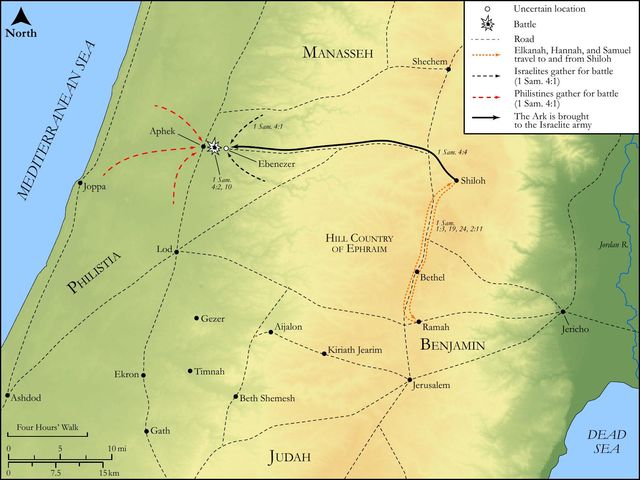
See on the biblical-era map
Study this verse
Public-domain commentary
Matthew Henry
From his Commentary on the Whole Bible. Henry comments on passages, not single verses — this entry covers 1 Samuel 1:19–28. His three-level outline is real structure in the source text, so it is rendered as structure.
Here is, I. The return of Elkanah and his family to their own habitation, when the days appointed for the feast were over, Sa1 1:19. Observe how they improved their time at the tabernacle. Every day they were there, even that which was fixed for their journey home, they worshipped God; and they rose up early to do it. It is good to begin the day with God. Let him that is the first have the first. They had a journey before them, and a family of children to take with them, and yet they would not stir till they had worshipped God together. Prayer and provender do not hinder a journey. They had spent several days now in religious worship, and yet they attended once more. We should not be weary of well-doing.
II.The birth and name of this desired son.
At length the Lord remembered Hannah, the very thing she desired (Sa1 1:11), and more she needed not desire, that was enough, for then she conceived and bore a son. Though God seem long to forget his people's burdens, troubles, cares, and prayers, yet he will at length make it to appear that they are not out of his mind. This son the mother called Samuel, Sa1 1:20. Some make the etymology of this name to be much the same with that of Ishmael - heard of God, because the mother's prayers were remarkably heard, and he was an answer to them. Others, because of the reason she gives for the name, make it to signify asked of God. It comes nearly to the same; she designed by it to perpetuate the remembrance of God's favour to her in answering her prayers. Thus she designed, upon every mention of his name, to take the comfort to herself and to give God the glory of that gracious condescension. Note, Mercies in answer to prayer are to be remembered with peculiar expressions of thankfulness, as Psa 116:1, Psa 116:2. How many seasonable deliverances and supplies may we call Samuels, asked of God; and whatever is so we are in a special manner engaged to devote to him. Hannah intended by this name to put her son in mind of the obligation he was under to be the Lord's, in consideration of this, that he was asked of God and was at the same time dedicated to him. A child of prayer is in a special manner bound to be a good child. Lemuel's mother reminds him that he was the son of her vows, Pro 31:2.
III.The close attendance Hannah gave to the nursing of him, not only because he was dear to her, but because he was devoted to God, and for him she nursed him herself, and did not hang him on another's breast. We ought to take care of our children, not only with an eye to the law of nature as they are ours, but with an eye to the covenant of grace as they are given up to God. See Eze 16:20, Eze 16:21. This sanctifies the nursing of them, when it is done as unto the Lord. Elkanah went up every year to worship at the tabernacle, and particularly to perform his vow, perhaps some vow he had made distinct from Hannah's if God would give him a son by her, Sa1 1:21. But Hannah, though she felt a warm regard for the courts of God's house, begged leave of her husband to stay at home; for the women were not under any obligation to go up to the three yearly feasts, as the men were. However Hannah had been accustomed to go, but now desired to be excused,
1.Because she would not be so long absent from her nursery. Can a woman forget her sucking child? We may suppose she kept constantly at home, for, if she had gone any where, she would have gone to Shiloh. Note, God will have mercy and not sacrifice. Those that are detained from public ordinances by the nursing and tending of little children may take comfort from this instance, and believe that, if they do that with an eye to God, he will graciously accept them therein, and though they tarry at home they shall divide the spoil.
2.Because she would not go up to Shiloh till her son was big enough, not only to be taken thither, but to be left there; for, if once she took him thither, she thought she could never find in her heart to bring him back again. Note, Those who are stedfastly resolved to pay their vows may yet see good cause to defer the payment of them. Every thing is beautiful in its season. No animal was accepted in sacrifice till it had been for some time under the dam, Lev 22:27. Fruit is best when it is ripe. Elkanah agrees to what she proposes (Sa1 1:23): Do what seemeth thee good. So far was he from delighting to cross her that he referred it entirely to her. Behold how good and pleasant a thing it is, when yoke-fellows thus draw even in the yoke, and accommodate themselves to one another, each thinking well of what the other does, especially in works of piety and charity. He adds a prayer: Only the Lord establish his word, that is, "God preserve the child through the perils of his infancy, that the solemn vow which God signified his acceptance of, by giving us the child, may be performed in its season, and so the whole matter may be accomplished." Note, Those that have in sincerity devoted their children to God may with comfort pray for them, that God will establish the word sealed to them at the same time that they were sealed for him.
IV.The solemn entering of this child into the service of the sanctuary.
We may take it for granted that he was presented to the Lord at forty days old, as all the first-born were (Luk 2:22, Luk 2:23): but this is not mentioned, because there was nothing in it singular; but now that he was weaned he was presented, not to be redeemed. Some think it was as soon as he was weaned from the breast, which, the Jews say, was not till he was three years old; it is said she gave him suck till she had weaned him, Sa1 1:23. Others think it was not till he was weaned from childish things, at eight or ten years old. But I see no inconvenience in admitting such an extraordinary child as this into the tabernacle at three years old, to be educated among the children of the priests. It is said (Sa1 1:24), The child was young, but, being intelligent above his years, he was no trouble. None can begin too soon to be religious. The child was a child, so the Hebrew reads it, in his learning-age. For whom shall he teach knowledge but those that are newly weaned from the milk and drawn from the breasts? Isa 28:9. Observe how she presented her child,
1.With a sacrifice; no less than three bullocks, with a meat-offering for each, Sa1 1:24. A bullock, perhaps, for each year of the child's life. Or one for a burnt-offering, another for a sin-offering, and the third of a peace-offering. So far was she from thinking that, by presenting her son to God, she made God her debtor, that she thought it requisite by these slain offerings to seek God's acceptance of her living sacrifice. All our covenants with God for ourselves and ours must be made by sacrifice, the great sacrifice.
2.With a grateful acknowledgement of God's goodness in answer to prayer. This she makes to Eli, because he had encouraged her to hope for an answer of peace (Sa1 1:26, Sa1 1:27): "For this child I prayed. Here it was obtained by prayer, and here it is resigned to the prayer-hearing God. You have forgotten me, my lord, but I who now appear so cheerful am the woman, the very same, that three years ago stood by thee here weeping and praying, and this was the child I prayed for." Answers of prayer may thus be humbly triumphed in, to the glory of God. Here is a living testimony for God. "I am his witness that he is gracious (see Psa 66:16-19); for this mercy, this comfort, I prayed, and the Lord has given me my petition." See Psa 34:2, Psa 34:4, Psa 34:6. Hannah does not remind Eli of it by adverting to the suspicion he had formerly expressed; she does not say, "I am the woman whom you passed that severe censure upon; what do you think of me now?" Good men ought not to be upbraided with their infirmities and oversights. They have themselves repented of them; let them hear no more of them.
3.With a full surrender of all her interest in this child unto the Lord (Sa1 1:28): I have lent him to the Lord as long as he liveth. And she repeats it, because she will never revoke it: He shall be (a deodand) lent or given to the Lord. Not that she designed to call for him back, as we do what we lend, but she uses this word Shaol, lent, because it is the same word that she had used before (Sa1 1:20, I asked him of the Lord), only in another conjugation. And (Sa1 1:27) the Lord gave me the petition which I asked (Shaalti, in Kal), therefore I have lent him (Hishilti, the same word in Hiphil), and so it gives another etymology of his name Samuel, not only asked of God, but lent to God. And observe,
(1.)Whatever we give to God, it is what we have first asked and received from him. All our gifts to him were first his gifts to us. Of thy own, Lord, have we given thee, Ch1 29:14, Ch1 29:16.
(2.)Whatever we give to God may upon this account be said to be lent to him, that though we may not recall it, as a thing lent, yet he will certainly repay it, with interest, to our unspeakable advantage, particularly what is given to his poor, Pro 19:17. When by baptism we dedicate our children to God, let us remember that they were his before by a sovereign right, and that they are ours still so much the more to our comfort. Hannah resigns him to the Lord, not for a certain term of years, as children are sent apprentices, but durante vita - as long as he liveth, he shall be lent unto the Lord, a Nazarite for life. Such must our covenant with God be, a marriage-covenant; as long as live we must be his, and never forsake him.
Lastly, The child Samuel did his part beyond what could have been expected from one of his years; for of him that seems to be spoken, He worshipped the Lord there, that is he said his prayers. He was no doubt extraordinarily forward (we have known children that have discovered some sense of religion very young), and his mother, designing him for the sanctuary, took particular care to train him up to that which was to be his work in the sanctuary. Note, Little children should learn betimes to worship God. Their parents should instruct them in his worship and bring them to it, put them upon engaging in it as well as they can, and God will graciously accept them and teach them to do better.
Continue studying 1 Samuel 1:26 across the web’s major study libraries — every link below opens this exact verse, chapter, or book on the destination site.
Read & Compare
 BibleGatewayThis verse in more than 200 translations and 70 languages.
 Bible.comThe YouVersion reader — hundreds of translations, reading plans, and highlights.
 ESV.orgCrossway's official English Standard Version reader.
 NET BibleThe NET translation with 60,000+ translators' notes on every rendering decision.
 STEP BibleTyndale House's free study tool — original text, vocabulary, and scholarly resources.
 BibliaLogos Bible Software's free web reader.
 USCCBThe New American Bible (Revised Edition) with the U.S. bishops' study notes.
Commentaries
 BibleHub CommentariesDozens of classic commentaries on this verse, gathered on one page.
 StudyLightMore than 100 commentary sets — the largest collection on the web.
 BibleRefPlain-English commentary on what this verse means, verse by verse.
 Enduring WordDavid Guzik's free commentary on this chapter, widely used by Bible teachers.
 Bible Study ToolsVerse commentary alongside Greek and Hebrew study aids.
Original Language & Research
- BibleHub InterlinearThe verse word by word — original language, transliteration, and English.
- BibleHub LexiconEvery word's original-language definition and Strong's entry.
 Blue Letter BibleDeep-study tools — Strong's numbers, concordance, and word studies.
 SefariaThe Hebrew text with Rashi and centuries of Jewish commentary.
Sermons, Hymns & Audio


TrulyRandomVerse is not affiliated with these sites and doesn’t control their content. They’re linked because they’re genuinely useful.
Summary
In 1 Samuel 1:26, Hannah, having journeyed to Shiloh with her young son Samuel, approaches Eli the high priest. With profound reverence and a solemn oath, she identifies herself as the very woman who, years prior, stood before him in deep distress, fervently praying to the LORD for a child. This pivotal moment marks the miraculous fulfillment of her desperate vow, powerfully underscoring God's unwavering faithfulness in answering prayer and Hannah's exemplary commitment to her promise, as she now presents her miracle child for dedication to the Lord's lifelong service.
Context
ShowHideLiterary Context
This verse is situated at a crucial juncture in the narrative of 1 Samuel chapter 1. It immediately follows the account of Samuel's weaning and Hannah's journey with her husband Elkanah and their son to Shiloh, the central place of worship, to fulfill the vow she made to the LORD. Her identification to Eli directly recalls their previous encounter detailed in 1 Samuel 1:9-18, where Eli initially mistook her fervent, silent prayer for drunkenness. The verse sets the stage for Samuel's dedication to the Lord's service, a commitment affirmed in 1 Samuel 1:28, and precedes Hannah's magnificent prayer of thanksgiving in 1 Samuel 2:1-10, which beautifully articulates the theological implications of her experience.
Historical & Cultural Context
Ancient Israelite society placed immense value on children, especially sons, viewing barrenness as a significant social and personal affliction, sometimes even perceived as divine disfavor, as poignantly illustrated by Hannah's distress (compare Genesis 30:1). Shiloh served as the primary religious sanctuary for Israel before the establishment of the monarchy and the construction of the Temple in Jerusalem, housing the Tabernacle and the Ark of the Covenant. This made it the central pilgrimage site for worship, sacrifice, and the making of vows. The practice of making vows to God, often involving a specific dedication or sacrifice in exchange for a blessing, was a common and serious commitment (e.g., Numbers 30:2). Hannah's vow, though not explicitly a Nazirite vow, shares similarities in its lifelong dedication of her son to the Lord's service, underscoring the gravity with which such commitments were undertaken in the ancient Near East. Eli, as the high priest, held significant religious and judicial authority, making Hannah's formal address and identification crucial.
Key Themes
ShowHide1 Samuel 1:26 powerfully encapsulates several core themes of the chapter and the broader book of 1 Samuel. Divine Faithfulness is paramount, as Hannah's presence with Samuel is living proof that God hears and answers the desperate cries of His people, transforming sorrow into joy (compare Psalm 113:9). This theme stands in stark contrast to the spiritual decline and unfaithfulness of Eli's sons, Hophni and Phinehas, later in the book (see 1 Samuel 2:12-17). The Fulfillment of Vows is another central theme, demonstrating Hannah's integrity and unwavering commitment to her promise to the Lord, setting a moral standard for obedience and trustworthiness that contrasts with the laxity of others. Furthermore, the theme of Remembrance and Recognition is evident, as Hannah's statement serves to bridge her past anguish with her present joy, ensuring Eli understands the miraculous nature of Samuel's birth as a direct answer to her fervent prayer (recall 1 Samuel 1:13).
Exposition and Analysis
ShowHideKey Word Analysis
ShowHideThis word (H113), translated "my lord," signifies a sovereign, controller, or master, whether human or divine. Hannah's repeated use of this term when addressing Eli reflects deep respect and deference to his authority as the high priest, acknowledging his sacred office and position within the sanctuary. It sets a tone of humility and reverence for her crucial declaration.
Translated "soul" in the phrase "thy soul liveth," nephesh (H5315) broadly refers to a breathing creature, vitality, or life itself. In this context, "as thy soul liveth" is a solemn oath, invoking the very life and being of Eli. It emphasizes the absolute truthfulness and gravity of Hannah's statement, akin to swearing on one's life, and serves to command Eli's full attention to the profound reality she is about to reveal.
This primitive root (H6419), translated "praying," means to judge, but by extension, to intercede or pray. In the Hebrew text, the verb is in the hitpa'el stem (mitpallellet), which intensifies the action, indicating an earnest, persistent, and deeply personal act of prayer. This highlights the profound spiritual anguish and fervent petition that characterized Hannah's earlier encounter with Eli, distinguishing her genuine communion with God from Eli's initial misjudgment.
Verse Breakdown
ShowHide"And she said, Oh my lord"
Hannah initiates the conversation with a respectful and deferential address to Eli, acknowledging his position as the high priest. This opening sets a tone of humility and reverence, appropriate for someone approaching a spiritual authority figure in the sacred space of the sanctuary.
"[as] thy soul liveth, my lord"
This powerful oath serves as a solemn affirmation of truth and gravity. By invoking Eli's very life, Hannah underscores the absolute veracity of her subsequent statement, ensuring he recognizes the profound significance of her return. It is a rhetorical device designed to capture Eli's full attention and impress upon him the miraculous nature of what she is about to reveal.
"I [am] the woman that stood by thee here"
This is Hannah's direct and unequivocal self-identification, serving as the core of her statement. She specifically refers to their previous encounter at this very location, the sanctuary at Shiloh, bringing back to Eli's memory the specific circumstances of her earlier visit. This statement is crucial for bridging the past and present, reminding Eli of her former state of barrenness and distress.
"praying unto the LORD"
This final clause specifies the nature of her previous presence and activity. It clarifies that her earlier, misunderstood behavior was not intoxication but profound, desperate, and sincere prayer to Yahweh (H3068). This detail serves to vindicate her past actions and establish the divine context for the miraculous answer she has received, directly linking Samuel's birth to her fervent petition to God.
Literary Devices
ShowHideThe verse employs several effective literary devices to convey its profound message. A prominent Recognition Scene unfolds as Hannah reveals her identity to Eli, recalling a previous, significant encounter. This trope allows for a dramatic re-evaluation of past events in light of present realities, highlighting God's intervention. There is a powerful implicit Contrast between Hannah's previous state of deep sorrow and barrenness (implied by her fervent "praying unto the LORD" for a child) and her current state of joy and fulfillment, evidenced by the presence of Samuel. The repetition of "my lord" functions as a subtle form of Anaphora or Emphasis, reinforcing Hannah's respect for Eli while simultaneously drawing his attention to the gravity and solemnity of her words. The entire exchange serves as a Fulfillment Narrative, demonstrating the resolution of a prior conflict (Hannah's barrenness and Eli's misunderstanding) and the faithfulness of God in answering prayer, which foreshadows the larger theme of God's faithfulness to His covenant promises throughout the book of Samuel.
Theological and Thematic Connections
ShowHideThis verse powerfully illustrates the dynamic interplay between human faithfulness and divine sovereignty. Hannah's unwavering commitment to her vow, even years later, underscores the biblical imperative to honor one's promises to God, reflecting a deep reverence for His holiness and authority. Simultaneously, the very possibility of fulfilling such a vow rests entirely on God's prior faithfulness in hearing and answering her desperate prayer. It is a profound testament to the Lord's attentiveness to the cries of the afflicted and His transformative power to turn barrenness into fruitfulness, and sorrow into joy. This exchange between Hannah and Eli serves as a foundational moment, demonstrating that God is intimately involved in the lives of His people, responding to their earnest petitions and enabling them to live out their commitments with integrity.
Reflection and Application
ShowHideHannah's determined return to Shiloh, years after her fervent prayer, to fulfill her solemn vow, offers profound and enduring lessons for contemporary believers. Her actions challenge us to consider the integrity of our own commitments, particularly those made to God in moments of desperation, earnest petition, or profound gratitude. Do we remember God's faithfulness in our past and honor the promises we made in response to His grace, even when circumstances change or time passes? This verse also serves as a powerful reminder of God's attentiveness to prayer. Hannah's story encourages persistent, heartfelt prayer, even when answers seem delayed or circumstances appear bleak. It calls us to reflect on the transformative power of God's intervention, turning our deepest sorrows into testimonies of His goodness and enabling us to participate in His redemptive plan. Ultimately, Hannah's example inspires a life of profound gratitude and faithful obedience, recognizing that every blessing is an opportunity to honor the Giver and live out our dedication to Him.
Questions for Reflection
ShowHideFAQ
ShowHideWhy did Hannah need to identify herself to Eli? Did he not remember her?
ShowHideWhile Eli was the high priest and likely encountered many people at the sanctuary, it's highly plausible he didn't immediately recall Hannah. Her previous visit, described in 1 Samuel 1:9-18, involved her praying silently and deeply distressed, leading Eli to initially mistake her for being drunk. This suggests she was not engaging in a typical, memorable public interaction. Furthermore, a significant amount of time had passed since that encounter—enough for Samuel to be born and weaned, which typically took 2-3 years or more in ancient Israel. By identifying herself specifically as "the woman that stood by thee here, praying unto the LORD," Hannah ensures Eli fully connects her present joy and the miraculous child with her past anguish and fervent petition, underscoring the divine answer to her prayer and magnifying God's faithfulness.
What is the significance of the phrase "as thy soul liveth"?
ShowHideThe phrase "as thy soul liveth, my lord" (Hebrew: חַי נַפְשְׁךָ, chai nafsh'kha) is a common and very strong oath or affirmation in the Old Testament. It signifies a solemn declaration, akin to "as surely as you live" or "I swear by your life." Hannah uses this to emphasize the absolute truthfulness and gravity of her statement, ensuring Eli recognizes the woman before him and the miracle that has transpired. It lends an air of profound sincerity and seriousness to her words, underscoring that what she is about to reveal is not a casual remark but a divinely orchestrated fulfillment of a promise made in deep distress.
Christ-Centered Fulfillment
ShowHideHannah's story, culminating in the dedication of Samuel as depicted in 1 Samuel 1:26, profoundly foreshadows the coming of Christ and the redemptive nature of God's plan. Samuel, born miraculously to a barren woman, dedicated to the Lord from birth, and growing to become a pivotal prophet, priest, and judge, serves as a significant type of Christ. Just as Samuel was a "gift from God" in response to fervent prayer, Jesus is the ultimate, divine gift of God to humanity, born through a miraculous conception (compare Luke 1:37). Hannah's vow and the lifelong dedication of her son to the Lord's service—a life set apart for God's purposes—powerfully points to Jesus, who perfectly fulfilled the will of the Father, living a life of complete obedience and ultimate self-sacrifice (see John 6:38 and Hebrews 10:7). Moreover, Hannah's transformation from barrenness to fruitfulness, and her subsequent prophetic song of praise in 1 Samuel 2:1-10, beautifully echo the spiritual transformation and new life that believers experience through Christ, who takes away the sin of the world and makes all things new (2 Corinthians 5:17). Ultimately, God's faithfulness to Hannah's prayer is a microcosm of His greater faithfulness to His covenant promises, all of which find their ultimate "Yes" and "Amen" in Jesus Christ, the faithful and true witness (2 Corinthians 1:20 and Revelation 3:14).